Analysis of the Energy-Performance Tradeoff
for Delayed Mobile Offloading
Huaming Wu
Institute for Computer Science Freie Universität Berlin, Germany[email protected]
Katinka Wolter
Institute for Computer Science Freie Universität Berlin, Germany[email protected]
ABSTRACT
Mobile cloud offloading that migrates heavy computation from mobile devices to powerful cloud servers through com-munication networks can alleviate the hardware limitations of mobile devices for higher performance and energy saving. Different applications usually give different relative impor-tance to the factors of response time and energy consump-tion. In this paper, we investigate two types of delayed off-loading policies, the partial model where jobs can leave from the slow phase of the offloading process and then executed locally on the mobile device, and the full offloading model, where jobs can abandon the WiFi Queue and then offloaded via the Cellular Queue. In both models we minimise the Energy-Response time Weighted Product (ERWP) metric. We find that jobs abandon the queue very often especially when the availability ratio (AR) of the WiFi network is rel-atively small. We can optimally choose the reneging dead-line to achieve different energy-performance tradeoff by op-timizing the ERWP metric. The amount of delay a job can tolerate closely depends on the application type and the po-tential energy saving for the mobile device. In general one can say that for delay-sensitive applications, the partial off-loading model is preferred when having a suitable reneging rate, while for delay-tolerant applications, the full offloading model shows very good results and outperforms the other offloading models when setting the deadline a large value.
CCS Concepts
•Networks → Cloud computing; Mobile networks; •Mathematics of computing→Mathematical analysis;
Keywords
Energy-performance tradeoff; queueing model; offloading poli-cies; heterogeneous networks; mobile cloud computing
1.
INTRODUCTION
Besides light-weight Internet applications, there is still an increasing demand from mobile users for computation-heavy and energy-hungry applications that are being de-ployed to mobile devices. Running complex applications on such devices is however challenging due to the strict con-straints on their resources, e.g., the limited computational capacity, battery lifetime and network connectivity. Mobile cloud computing aims at combining the strength of cloud computing and the convenience of mobile terminals. Off-loading computation-intensive tasks from mobile devices to a capable cloud server via wireless networks is an effective way to alleviate a tussle between resource-constrained mo-bile devices and resource-hungry momo-bile applications, and thus boosts the device’s performance.
Potential benefits obtained from offloading include response time shortening and energy saving. However, different appli-cations usually have relative energy and performance impor-tance. For delay-tolerant applications (e.g., iCloud, Drop-box, RSS feeds and participatory sensing), response time is less critical and optimising energy usage is more rele-vant. Some information is not time-critical and its submis-sion to the server may be delayed until the device enters an energy-efficient network [1]. For delay-sensitive applications (e.g., speed chess game, face recognition, video conferencing and vehicular communications), fast response time is of pri-mary concern while energy consumption is less important. The offloading scheme in which cloud services are available with short network latencies (e.g., WiFi networks) can serve
in a better way by providing high responsiveness. Thus,
there exists a fundamental tradeoff between mean energy consumption and mean response time in expecting applica-tions [2]. Since performance can be defined as the inverse of the mean response time [3], the energy-performance trade-off has been studied in [4, 5] by deciding whether or not and by means of which communication interface to offload a whole application. Instead, an application can consist of several components (or jobs), and offloading decisions should be made for each. Seamless offloading operation by switch-ing between several transmission technologies has been pro-posed in [6]. In addition, they examined the tradeoff be-tween energy consumption for WiFi search and transmis-sion rate when the WiFi network was intermittently avail-able. Energy-efficient delayed network selection has been suggested in [2] to optimise the tradeoff between energy us-age and delay in data transmission by intentionally deferring data transmission until the device meets an energy-efficient network. Researchers have further suggested the use of
“de-VALUETOOLS 2015, December 14-16, Berlin, Germany Copyright © 2016 ICST
layed offloading”: if no WiFi connection is available, (some) traffic can be delayed up to a given deadline, or until WiFi becomes available [7].
Mobile devices usually have multiple radio interfaces for data transfer, such as 3G/4G and WiFi with different avail-abilities, delays and energy costs. Thus, there are several ways to offload tasks to the cloud, e.g., via a costly cellular connection or via intermittently available WiFi [8, 9]. By delaying offloading until WiFi becomes available, there are opportunities to reduce the transmission time while in the meantime bringing extra waiting time. The reduced trans-mission time is directly translated into battery power saving for the mobile device [7]. However, the delayed offloading is still a matter of debate, since it is not know what extent users would be willing to delay a transmission [10]. In this paper, we try to give an overall guidance of how to balance the time and energy saving for different types of scenarios like delay-tolerant and delay-sensitive applications.We develop a theoretical framework to capture the energy-performance tradeoff by using queueing models with impatient jobs and service interruptions. The models can be used to predict the average performance and energy consumption of mobile offloading under a given network environment deployment condition. The main contributions are as follows:
• Proposing two types of queueing models for delayed
mobile cloud offloading systems: the partial offloading model and the full offloading model. A non-delayed offloading model [10] is also introduced here as a com-parison.
• Developing an analytical framework for analyzing
queue-ing models with renegqueue-ing and service interruptions. We obtain closed-form formulas for key performance metrics in the delayed offloading system such as Energy-Response time Weighted Product (ERWP), which com-bines the advantages of other previously studied met-rics.
• Trying to answer the following questions: (i) Given
a deadline, what are the expected response time and expected energy consumption as a function of net-work parameters and the job arrival rate? (ii) How should the deadlines be optimally chosen in order to achieve different energy-delay tradeoffs for specific
ap-plications? (iii) Among different offloading models,
how to choose the optimal one that achieves the most performance gains based on the ERWP metric.
The remainder of this paper is as follows. In Section 2, we introduce the delayed offloading system and the queueing model as well as the considered metric. In Section 3, we analyse the partial offloading model based on the ERWP metric. The full offloading model is proposed and analysed in Section 4. Section 5 evaluates metrics and models using numerical examples. The paper is concluded in Section 6.
2.
SYSTEM OVERVIEW
In delayed offloading, each data transfer is associated with a deadline, and the data transfer is resumed whenever get-ting in the coverage of WiFi until the transfer is completed [7]. If the transfer does not finish within its deadline, the task will either be executed locally or the cellular networks will finally complete the transfer.
We consider a queueing system for the delayed offloading. The mobile device, the cloud and the wireless networks are represented as queueing nodes to capture the resource con-tention and delay on the system. The mobile device executes an application with offloadable jobs that can be processed either locally on the processor of the mobile device, or re-motely in a cloud infrastructure through offloading. The mobile device, the cellular and WiFi connections are
mod-elled asM/M/1-FCFS queues, and the remote cloud is
mod-eled as anM/M/∞queue, i.e., as a delay center. We
de-note 1/µm and 1/µr the expected execution time of jobs
on the mobile device and the cloud, respectively. The ex-pected rates to transfer data to the cloud over the cellular
network and WiFi are µc and µw, respectively. The total
cost, in terms of energy or response time for processing all the offloadable jobs, is composed of the remote cost (sending some jobs to the cloud and waiting for the cloud to complete them), and the local cost (processing the remaining jobs lo-cally on the mobile device). Our objective is to minimise the mean energy consumption and the mean response time. The delayed offloading systems involve queueing with reneg-ing and service interruptions. In queuereneg-ing, renegreneg-ing means that a job will leave the queue and join another queue after the deadline expires. Service interruption literally means un-willing discontinuity of service in the queue, and this models connection and disconnection periods of a mobile device to WiFi networks in the system [11].
2.1
The WiFi Model
To facilitate the analysis of the mobile offloading systems, we assume that a cellular network is available to mobile users all the time while the availability of a WiFi network depends on the location. Mobile users move in and out of a WiFi cov-erage area. We model this time variation of the WiFi con-nection state by the ON-OFF alternating renewal process
TON(i),TOFF(i)
, i≥1, as shown in Fig. 1. The ON periods
represent the presence of the WiFi connectivity, while the OFF periods denote the interruption of the WiFi connectiv-ity. During the latter periods data is either not transmitted (the interface is idle) or it is transmitted only through the
cellular network. The duration of each ON period TON(i), is
assumed to be an exponentially distributed random variable and independent of the duration of other ON or OFF
peri-ods [10]. Further, the WiFi availability ratio (AR) can be
defined asAR= E[TON]
E[TON]+E[TOFF].
ON
OFF
WiFi Idle/ Cellular
T
ONT
OFFFigure 1: The WiFi network availability model [12]
2.2
Delayed Offloading Models
Accordingly, we build two types of delayed offloading mod-els based on the WiFi network availability model as follows:
available, all the offloadable jobs are sent over the WiFi network; otherwise, they are sent over the cellular in-terface as the cellular network is always available. We set a reneging deadline in the cellular network, if the deadline expires before the job switched over to some WiFi AP, then it is executed locally on the mobile de-vice rather than remotely on the cloud [7]. By doing this, we have partial jobs offloaded to the cloud and the remaining ones processed locally.
• Full Offloading Model: when there is a WiFi con-nection available, all the offloadable jobs are sent over the WiFi network; otherwise, they can be delayed up to a given deadline, or until WiFi becomes available [12]. If the deadline expires before the job can be transmit-ted over some WiFi AP, then it is offloaded through the cellular network. In this way, we have all the off-loadable jobs offloaded to the cloud via the cellular or WiFi network.
2.3
The ERWP Metric
The general cost metric includes energy consumption re-lated costs in addition to the usual performance metrics such as the response time [13]. The response time is the time between the arrival of a job until it completes service and departs. The energy consumption is the energy spent on the mobile device in that period.
We use queueing theory to model the offloading systems according to a new metric named Energy-Response time Weighted Product (ERWP), which is defined as:
ERWP=E[E]ω·E[T]1−ω, (1)
whereE[T] andE[E] are the mean response time and mean
energy consumption, respectively. ω (ranging between 0
and 1) is a weighting parameter that represents the rela-tive significance of energy consumption and response time
for the mobile device. Largeω favors energy consumption
while smallωfavors response time. Specifically, to focus on
performance, ωshould be less than 0.5; to focus on power
consumption,ωshould be greater than 0.5. In some special
cases performance can be traded for power consumption and
vice versa, therefore we can use theωparameter to express
such special cases preferences for different applications. We obtain tight optimality results by deriving explicit expressions in mobile cloud offloading systems to capture energy-performance tradeoffs.
3.
PARTIAL OFFLOADING MODEL
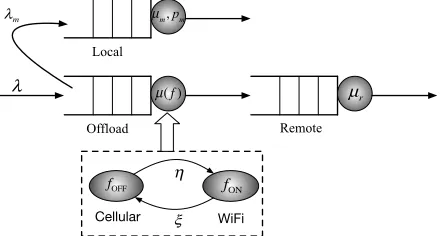
Figure 2 depicts a delayed offloading model based on the
WiFi network availability model [1]. We consider anM/M/1
modulated queue in a two-phase (fast and slow) Markovian random environment, with impatient jobs. The jobs are off-loaded either via a cellular connection or a WiFi network to the cloud. The single-server queuing system that oscillates
between two feasible phases is denoted by fON and fOFF.
The persistence of the system at any phase is governed by a
random mechanism: if the system functions at phasefONit
tends ‘to jump’ to the other phase with Poisson intensityξ
and if the system functions at phasefOFF it tends ‘to jump’
to the other phase with Poisson intensityη[14].
We assume that offloading jobs arrive at the system
ac-cording to a Poisson process with rateλ, and the modulating
µ(f)
WiFi Cellular
Remote
η
ξ
Offload
fOFF fON
Local
µr
λm µm,pm
λ
Figure 2: Partial offloading model with cellular and WiFi networks
processf∈ {fON, fOFF}determines the service rates:
µ(f) =
µc, iff=fOFF
µw, iff=fON . (2)
The average job size isE[X], the transmission speed of the
fast phase (WiFi network) is sw with service rate µw =
sw/E[X], and its operating power ispw when serving jobs
and zero whenever idle. Similarly, the corresponding speed
for the slow phase (cellular network) isscwith service rate
µc=sc/E[X] (µc≤µw), and its operating power ispc.
When in the slow phase, jobs become impatient. A
reneg-ing deadline Td, is associated with each job in this phase.
That is, each job, upon arrival, activates an individual ‘im-patience timer’, exponentially distributed with an reneging
rateR. If the system does not change its environment from
the slow phase to the fast phase before the deadline expires,
the job will be removed from theOffload Queue and is
as-sumed to be executed locally on the mobile device rather than offloaded to the cloud [15]. Thus, Fig. 2 demonstrates
that the delayed offloading model consists of an Offload
Queue (with two alternating phases of cellular and WiFi),
aLocal Queue denoting the local processing on the mobile
device and a Remote Queue representing the remote
pro-cessing on the cloud server.
TheOffload Queuealternates its service by means of
mu-tual resets according to the availability of WiFi, which is governed by an interrupted Poisson Process (IPP) with ex-ponentially distributed ON-OFF periods. We model the in-termittent availability of WiFi hotspots as a FCFS queue with occasional server break-down [8], either in ON-state where the WiFi network is processing the existing jobs, or in the OFF-state during which the job is serving by the cellular network (the cellular connectivity is assumed to be always available). However, when the job stays in cellular network
for too long time, it abandons theOffload Queueand is then
processed locally on the mobile device. We assume that the sojourn time in a hotspot and the time to move from one hotspot to another are exponentially distributed with
pa-rametersξ(failure rate), andη(recovery rate), respectively.
If the job in theOffload Queueis completely transmitted
be-fore the assigned deadline has expired, we say that the job is successfully offloaded. If offloading fails, the job leaves
theOffload Queue and join theLocal Queueon the mobile
device for immediate local processing. We call such an event a reneging event [11].
Since there is no waiting time before entering service, the
M/M/∞queue of the Cloud is occasionally referred to as a
distri-bution of the delay being that of the service time.
3.1
Queueing Analysis
We use queueing analysis to derive formulas for the
av-erage number of jobs for anM/M/1 queue operating in a
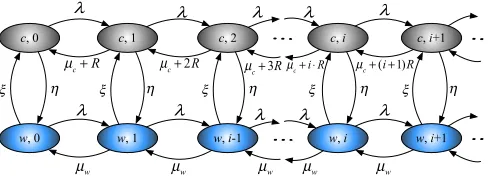
2-phase network environment. Given the previously stated assumptions, the partial offloading model can be modeled with a 2D Markov chain, as shown in Fig. 3.
w, 0 w, 1 w, i-1 w, i w, i+1 c, 0 c, 1 c, 2 c, i c, i+1
ξ η ξ η ξ η ξ η ξ η
µw
λ λ λ λ λ
λ λ λ λ λ
µw µw µw µw
µc+R µc+2R µc+3Rµc+i⋅R µc+(i+1)R
Figure 3: The 2D Markov chain for the partial off-loading model with cellular and WiFi networks
The states with cellular network are denoted with{c, i},
and the states with WiFi connectivity are denoted with
{w, i}. icorresponds to the number of jobs in the system
(queuing and in service). During the WiFi phase, the system
empties at rateµw and during the cellular phase, the
sys-tem empties at rateµc+i·Rsince any of theiqueued jobs
can abandon theOffload Queue [12]. Writing the balance
equations for the cellular and WiFi phases gives:
(λ+η)πc,0 = (µc+R)πc,1+ξπw,0 (3a)
(λ+η+µc+iR)πc,i = λπc,i−1+ µc+ (i+ 1)R
πc,i+1
+ξπw,i (3b)
(λ+ξ)πw,0 = µwπw,1+ηπc,0 (3c)
(λ+ξ+µw)πw,i = λπw,i−1+µwπw,i+1+ηπc,i(3d)
The steady-state probability of finding the offloading system in some region with WiFi unavailability (with only cellular
access) isπc= E[TOFF]
E[TON]+E[TOFF] =
ξ
η+ξ. Similarly, the
steady-state probability for the periods with WiFi availability is
πw= E[TON]
E[TON]+E[TOFF] =
η
η+ξ, which equals to the availability
ratio AR. The probability generating functions for both
cellular and WiFi states are defined as:
Gc(z) =
∞
X
i=0
πc,izi and Gw(z) =
∞
X
i=0
πw,izi, |z| ≤1. (4)
After some calculation and algebraic manipulations, we ob-tain:
Gw(z)β(z) =ηzGc(z)−µw(1−z)πw,0,
where β(z) = (λz−µw)(1−z) +ξz. The rootsz1, z2 of
the quadratic polynomial β(z) = −λ(z −z1)(z−z2) are
z1,2=
λ+µw+ξ∓√(λ+µw+ξ)2−4λµw
2λ [15].
3.1.1
General Case
Assume the reneging rate R 6= 0, we have the partial
offloading model as depicted in Fig. 2. According to [15], we obtain:
πc,0 =
RSξκ2(1)
µc(ξ+η)(SV −T U)
, (5)
πw,0 = −
RT κ2(1)
µw(ξ+η)(SV −T U)
, (6)
where we define S = Rz1
0
κ1(x)
β(x)dx, T =
Rz1
0
κ1(x)
x dx, U =
R1
z1
κ2(x)
β(x)dx and V =
R1
z1
κ2(x)
x dx. Accordingly, κ1(z) and
κ2(z) are represented as follows:
κ1(z) =e−
λz
RzµcR(z1−z)
ηz1 (z2−1)
R(z2−z1 )(z2−z)− ηz2 (z1−1)
R(z2−z1 ), z≤z1,
κ2(z) =e−
λz
RzµcR(z−z1)
ηz1 (z2−1)
R(z2−z1 )(z2−z)−
ηz2 (z1−1) R(z2−z1 ), z≥z1.
By the definitions ofκ1(z),κ2(z) andβ(z), it follows that
T, U, V >0 andS <0. Therefore, πc,0 andπw,0 are
posi-tive. One can show formally that the system is ergodic. In-tuitively, we indicate that the system is always stable since,
with any set of parametersλ≥0,µc≥0,µw >0, ξ >0,
η >0 andR >0, the abandonment process, whose overall
rate increases with the number of jobs, prevents explosion
[15]. Alternatively, the system is stable if and only if πc,0
andπw,0 are positive, which always holds for the above set
of parameters.
Letµbe defined as: µ=πc·µc+πw·µw. According to
[15], we obtain:
E[Nc] =
λ−µ+µcπc,0+µwπw,0
R , (7)
E[Nw] =
η(λ−µ) +R(λ−µw)πw
ξR +
ηµcπc,0+µw(η+R)πw,0
ξR . (8)
From Fig. 3, the expected number of jobs served per unit
of time in the slow and fast phases are µc(πc−πc,0) and
µw(πw−πw,0), respectively [16]. Therefore, the rate of
aban-donment due to impatience in the slow phase, λaband, is
given by:
λaband = λ−µc(πc−πc,0)−µw(πw−πw,0)
= λ−µ+µcπc,0+µwπw,0
= R·E[Nc], (9)
where the abandonment rate is proportional to the reneging rate and the mean number of jobs in the cellular phase.
The rateλm that jobs are executed locally on the mobile
device must be equal to the abandonment rate, i.e.,λm =
λaband. The probability that an arbitrary job arriving to the
Offload Queue will leave and join the Local Queue, i.e., it
will be executed locally and will never be offloaded again, is defined as:
Pr{abandon}=λaband
λ =
λ−µ+µcπc,0+µwπw,0
λ , (10)
where Pr denotes the probability operation.
3.1.2
Extreme Case
Assume the reneging rateR → 0, the partial offloading
model as shown in Fig. 2 reduces to a non-delayed offloading model (or on-the-spot offloading [7]), which is depicted in
Fig. 4. Since the reneging rate is zero, there will be noLocal
Queue in this model. We use this model as a reference case
for comparison purpose with the delayed offloading models.
After solving the balanced equations when settingR= 0,
we have [17]:
µ(f)
WiFi Cellular
Remote
η
ξ Offload
fOFF fON
µr λ
Figure 4: Non-delayed offloading model with cellular and WiFi networks
whereg(z) =λ2z3−λ(η+ξ+λ+µ
c+µw)z2+ (ηµw+ξµc+
µcµw+λ(µc+µw))z−µcµw, and it is proven thatg(z) has
only one rootz0 in the interval (0,1).
After some algebraic manipulations, we obtain:
πc,0 =
ξ(µ−λ)z0
µc(1−z0)(µw−λz0)
, (11)
πw,0 =
η(µ−λ)z0
µw(1−z0)(µc−λz0)
. (12)
Once the values ofπc,0 andπw,0 have been established,
ac-cording to Eq. (4), the probability generating functions can be calculated as:
Gc(z) =
ξ(µ−λ)z+πc,0µc(1−z)(λz−µw)
g(z) , (13)
Gw(z) =
η(µ−λ)z+πw,0µw(1−z)(λz−µw)
g(z) .(14)
By usingE[Nc] =P
∞
i=0iπc,i=dGc(z)/dz|z=1andE[Nw] =
P∞
i=0iπw,i=dGw(z)/dz|z=1, we get the average number of
jobs in the system [17]:
E[N] = E[Nc] +E[Nw]
= λ
µ−λ+
µc(µw−λ)πc,0+µw(µc−λ)πw,0
(ξ+η)(µ−λ) −
(µc−λ)(µw−λ)
(ξ+η)(µ−λ) . (15)
3.2
Metric-Based Analysis
The total cost for offloading a job is composed of the cost for sending the job to the cloud and idly waiting for the
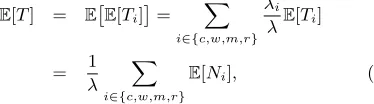
cloud to complete the job. By Little’s Law,E[N] =λE[T],
the mean response time can be calculated as:
E[T] = EE[Ti]
= X
i∈{c,w,m,r}
λi
λE[Ti]
= 1
λ
X
i∈{c,w,m,r}
E[Ni], (16)
wherei∈ {c, w, m, r}represents the cellular phase, the WiFi
phase, the mobile device and the remote cloud, respectively.
E[Nc] andE[Nw] are the average number of jobs in the
cel-lular network and WiFi network as obtained in Eqs. (7) and (8), respectively.
For the local processing, since the arrival rate to theLocal
Queueequals to the abandonment rate of theOffload Queue,
we haveλm=R·E[Nc]. The work load, i.e., the fraction of
time when the server is busy, is denoted as: ρm=λm/µm.
For an ordinaryM/M/1-FCFS queue, the average number
of jobs on the mobile device isE[Nm] =ρm/(1−ρm).
Since there is no waiting time before entering into remote
service in the cloud, for an M/M/∞ queue, the average
number of jobs in the Remote Queue is E[Nr] = λr/µr,
whereλr=λ−λmis the arrival rate to theRemote Queue.
A key assumption in our work is that each service operates
at a constant powerpi, i∈ {c, w, m}
whenever it is busy, i.e., the mobile device consumes energy only when there are
jobs in the system. SinceE[P] =λE[E] is the mean power
consumption, we can calculate the mean energy consump-tion for the partial offloading model as:
E[E] =EE[Ei]
= X
i∈{c,w,m}
λi
λE[Ei] =
1 λ
X
i∈{c,w,m}
E[Pi].(17)
Since some jobs are remotely executed on the cloud server rather than on the mobile device, we do not need to include
such energy consumption. Fori∈ {c, w, m}, the
correspond-ing average power consumption can be calculated as:
E[Pi] =pi·Pr{Ni>0}=pi·ρi. (18)
Since the utilization of the queue is the probability that
the server is busy, we have Pr{Ni >0}=ρi [18], i.e., the
energy cost is only incurred during the fraction of the time the server is busy.
The energy consumed due to local execution depends on the processing speed of the mobile device. Since the service on mobile device is always available, we have:
E[Pm] =pm·Pr{Nm>0}=pm·ρm. (19)
The mean energy consumed due to offloading via cellular or WiFi network depends on the transmission power and speed. We have:
E[Pc] = pc·Pr{Nc>0}=pc·ρc, (20)
E[Pw] = pw·Pr{Nw>0}=pw·ρw, (21)
whereρcandρware the utilizations of the cellular and WiFi
networks, which are equal to the probability that the corre-sponding network is busy. According to Fig. 3, they can be
separately calculated as: ρc=πc−πc,0andρw=πw−πw,0.
Further, by substituting Eqs. (16) and (17) into Eq. (1), we can formulate the explicit expressions and the optimiza-tion problem of the ERWP metric for the offloading assign-ment as:
R∗= arg min
R
ERWP, (22)
we seek the reneging rateR∗such thatERWPis minimised.
4.
FULL OFFLOADING MODEL
Figure 5 depicts another delayed offloading model based on the WiFi network availability model. All jobs arriving to the system are by default sent to the WiFi interface for offloading. When a job is offloaded to the cloud via a WiFi network, there is queueing due to the transmission speed of the WiFi link. We model the intermittent availability of hotspots as a FCFS queue with occasional server break-down. The server availability is governed by an IPP with exponentially distributed ON-OFF periods. Specifically, the server is either in ON-state processing the existing jobs, or in OFF-state during which no job receives service. We assume the jobs will abandon the queue during periods without WiFi connectivity.
WiFi Cellular
Remote
ON OFF η
ξ Transmitting Unconnected
µc,pc
µw,pw
µr
λ
λ
cFigure 5: Full offloading model with cellular and WiFi networks
queued or while at the head of the queue, but waiting for WiFi). A job can be served only via WiFi before its deadline. As the queueing system is continuous, it handles transmis-sion at the bit level so that assigning a deadline to a job is equivalent to assigning the same deadline to each bit of
the job [7]. When in the OFF-state, jobs become
impa-tient. That is, each job, upon arrival, activates an individ-ual timer, exponentially distributed with an reneging rate
R. If the network does not change its environment from the
OFF-state to the ON-state before the deadline expires, the
job abandons theWiFi Queue, and instead, to be offloaded
via a cellular network [12]. If the job in theWiFi Queue is
completely transmitted through WiFi networks before the assigned deadline has expired, we say that the job is
success-fully offloaded. If offloading fails, the job leaves theWiFi
Queueand join theCellular Queuein the mobile device for
immediate transmission through cellular networks. We call such an event a reneging event.
When the job is offloaded to the cloud via a cellular net-work, there is queueing due to the transmission speed of the cellular link. Costs arise in terms of transmission de-lays (queueing and actual transmission time) and transmis-sion energy consumption. Service is always available since
the cellular connection is always on. Similarly, theRemote
Queue is a pure delay station at which jobs spend an
ex-ponentially distributed amount of time with mean equal to
1/µr time units.
4.1
Queueing Analysis
TheWiFi Queuerefers to offloading jobs from the mobile
device to the cloud via a WLAN network, which is modeled
as anM/M/1-FCFS queue with intermittently available
ser-vice. When a server recovers, it continues to serve the job whose service has been interrupted, i.e., the work already completed is not lost (cf. data transfers with resume) [8].
ON, 0 ON, 1 ON, 2 ON, i ON, i+1
OFF, 0 OFF, 1 OFF, 2 OFF, i OFF, i+1
ξ η ξ η ξ η ξ η ξ η
2R 3R
R
λ λ
λ λ λ λ
λ λ λ
λ
µw µw µw µw µw
(i+1)R i⋅R
Figure 6: The 2D Markov chain for the WiFi queue
We assume that the service fails from time to time and
resumes its operation after a random time. The Markov
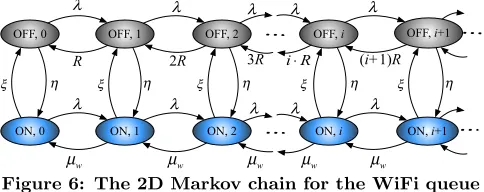
chain for the WiFi Queue is depicted in Fig. 6, which is
equivalent to assuming thatµc= 0,πON=πw andπOFF =
πcin Fig. 3. The states with WiFi connectivity are denoted
with{ON, i}, and the states with WiFi unconnectivity are
denoted with{OFF, i}. icorresponds to the number of jobs
in the system (queuing and in service). During the ON-state,
the system empties at rate µw and during the OFF-state,
the system empties at rate i·R since any of theiqueued
jobs can abandon theWiFi Queue[12]. Writing the balance
equations for this chain gives:
(λ+η)πOFF,0=ξπON,0+RπOFF,1 (23a)
(λ+η+iR)πOFF,i=λπOFF,i−1+ (i+ 1)RπOFF,i+1
+ξπON,i (23b)
(λ+ξ)πON,0=ηπOFF,0+µwπON,1 (23c)
(λ+ξ+µw)πON,i=λπON,i−1+µwπON,i+1+ηπOFF,i(23d)
After substitutingµc= 0 intoκ1(z) andκ2(z), yields:
κ1(z) =e
−λz
R(z1−z) η R
z1 (z2−1)
z2−z1 (z2−z)− η R
z2 (z1−1)
z2−z1 , z≤z1,
κ2(z) =e−
λz R(z−z1)
η R
z1 (z2−1)
z2−z1 (z2−z)− η R
z2 (z1−1)
z2−z1 , z≥z1.
According to [12], we obtain:
πOFF,0 = −
Sξκ2(1)
(ξ+η)U κ1(0)
, (24)
πON,0 =
Rκ2(1)
µw(ξ+η)U
. (25)
We further have µ = πc·µc+πw·µw = πONµw. After
substituting the above values in Eqs. (7) and (8), we derive
the mean number of jobs inWiFi Queue as:
E[NOFF] =
λ−µw(πON−πON,0)
R ,
E[NON] =
ηλ−µw(η+R)(πON−πON,0) +λRπON
ξR .
Therefore, the average number of jobs in the WiFi Queue
can be calculated as:
E[Nw] =E[NOFF] +E[NON]. (26)
As shown in Fig. 6, the expected number of jobs served
per unit of time in the WiFi Queue is µw(πON−πON,0).
Therefore, the rate of abandonment due to impatience in
the OFF periods,λaband, is given by:
λaband=λ−µw(πON−πON,0) =R·E[NOFF]. (27)
where the abandonment rate is proportional to the reneging rate and the mean number of jobs in the OFF-state.
The rate of jobs sent back to the cellular networkλcmust
be equal to the abandonment rate, i.e., λc =λaband. The
probability that an arbitrary job arriving to theWiFi Queue
will abandon, i.e., it will be offloaded over aCellular Queue,
is defined as:
Pr{renege}= λaband
λ =
λ−µw(πON−πON,0)
λ . (28)
4.2
Metric-Based Analysis
By Little’s Law, E[N] =λE[T], the mean response time
can be calculated as:
E[T] = EE[Ti]
= X
i∈{c,w,r}
λi
λE[Ti]
= 1
λ
X
i∈{c,w,r}
where E[Nw] is the average number of jobs in the WiFi
Queueas obtained in Eq. (26).
TheCelluar Queue refers to offloading jobs from the
mo-bile device to the cloud via a cellular network, which is
mod-eled as anM/M/1-FCFS queue. Since the arrival rate to the
Celluar Queueequals to the abandonment rate of theWiFi
Queue, i.e.,λc=R·E[NOFF]. The average number of jobs
in this queue is given by:
E[Nc] =
ρc
1−ρc
, (30)
whereρc=λc/µcis the probability that theCellular Queue
is busy.
Since all the jobs are offloaded to the remote server in the
cloud, for anM/M/∞queue, the average number of jobs in
the cloud server can be calculated as: E[Nr] =λ/µr.
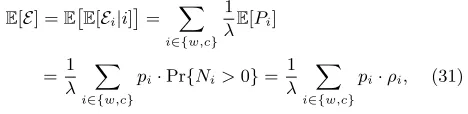
The mean energy consumption can be calculated as:
E[E] =EE[Ei|i]
= X
i∈{w,c} 1
λE[Pi]
= 1
λ
X
i∈{w,c}
pi·Pr{Ni>0}=
1 λ
X
i∈{w,c}
pi·ρi, (31)
where ρw is the fraction of time that WiFi is available to
process jobs, and it can be calculated as:ρw=πON−πON,0,
as the recovery rateη→ ∞, the availability of WiFiπON=
AR= ξ+ηη tends to be 1.
Further, by substituting Eqs. (29) and (31) into Eq. (1), we can formulate the optimization of the ERWP metric for the offloading assignment as:
R∗= arg min
R
ERWP, (32)
we also seek to find the reneging rateR∗such thatERWP
is minimised.
5.
PERFORMANCE EVALUATION
We consider here a simple scenario where the transmission rate of the cellular network is smaller than that of WiFi,
i.e.,sc< swand the power consumption when transmitting
jobs via the cellular link is larger than the WiFi link, i.e.,
pc> pw. Using measurements from real traces collected by
[7], the average data rates of the cellular and WiFi networks
are set as sc = 200 Kbps andsw = 2 Mbps, respectively.
The average duration of WiFi availability period is 52 min
(ξ= 1/52 min−1), while the average duration with only
cel-lular network coverage is 25.4 min (η= 1/25.4 min−1). The
availability ratio is thus 67%. The mean job size is assumed to be 10 MB. According to the power models developed by
[19], we set the power coefficientspc= 2.5 W,pw= 0.7 W
andpm= 2 W, respectively. Besides, suppose that the total
job arrival rate is λ = 0.5 packet/min, the mobile service
rateµm= 0.2 and the cloud service rateµr= 1.
An availability ratio of 11% has been reported in [20]. In
Fig. 7 as the availability ratio (AR) of the WiFi network
in-creases, the percentage of jobs abandon theOffload Queue
(for the partial offloading model, refer to Fig. 7(a)) or the
WiFi Queue(for the full offloading model, refer to Fig. 7(b))
declines rapidly. However, the full offloading model has
much higher reneging probability than the partial one under
the same deadlineTd. That’s because the partial offloading
model can use the cellular network to transmit data, and
thus the number of jobs waiting in the Offload Queue is
reduced. On the other hand, as the reneging deadline in-creases from 60 min to 120 min, jobs have more chance to be offloaded via the WiFi network, and therefore the reneg-ing probability decreases at the lower level of arrival rates. However, at high arrival rates, the reneging probability stays the same under different deadline.
The partial offloading model in Fig. 8(a) has the lowest av-erage response time, since it takes full use of the slow phase of the cellular network during the WiFi is in the unavailable
period. For the lower deadlines (Td<40 min), the mean
re-sponse time decreases as the deadline arises, since jobs with higher deadlines has more chance to transmit with the fast WiFi network, leading to smaller response time. However, the mean response time increases for higher deadlines, since jobs with lower deadlines leave the queue earlier, leading to smaller queueing delays. From Fig. 8(b), when the reneging deadline is small, the non-delayed offloading model achieves the lowest mean energy consumption among the three mod-els, but as the deadline increases, the full offloading model is much more preferred. This is due to the fact that the WiFi network is much more fast and energy-efficient than the cellular network. The reduced serving time can cause less energy consumption on the mobile device.
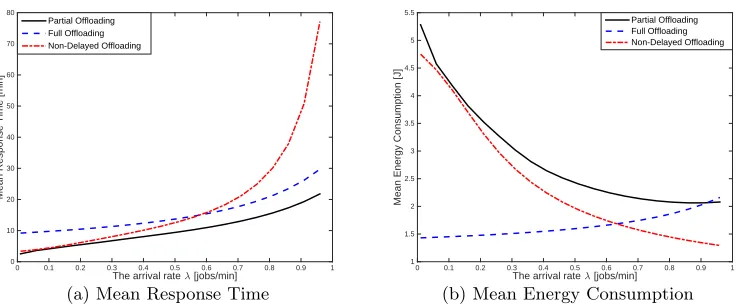
We fix the reneging deadline as 120 min. In Fig. 9(a), the mean response time arises with the increase of job
ar-rival rate λ due to the queueing effects. The partial
off-loading model performs much better than the other two models since it fully uses the unavailable periods of WiFi by offloading jobs with a cellular network, which in turn brings huge energy consumption as shown in Fig. 9(b). The full offloading model is much more energy-efficient than the
non-dealyed offloading model at lowλ, while at highλ, the
non-delayed offloading model saves much more energy. This
can be drawn from Fig. 7(b) that asλincreases, more jobs
are abandoned from theWiFi Queueand are then offloaded
via costly cellular network, which result in more energy con-sumption.
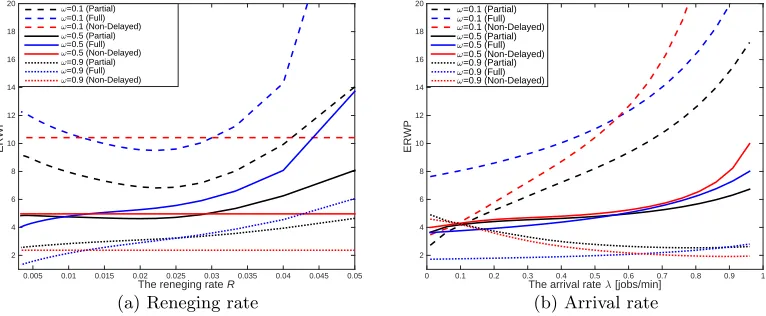
We use the ERWP metric to compare different offloading
models. It can be observed from Fig. 10(a) that when ω
is small, the partial offloading model can achieve the
small-est ERWP value by optimally choosing the reneging rateR,
which indicates that when considering response time more important (for delay-sensitive applications), it is better to use the partial offloading model. Otherwise, when consider-ing energy consumption more important than response time (for delay-tolerance applications), the full offloading model is much more preferred, which translates the reduced trans-mission time from the fast WiFi network into battery power saving for the mobile device. As shown in Fig. 10(b), when
the weighting parameterωis small, as the arrival rate of the
offloadable jobsλincreases, all the three offloading models
perform worse. However, the non-delayed offloading model is more sensitive to the arrival job rates. The partial off-loading model can always achieve the smallest ERWP value, which that when considering response time more important, it is better to use the partial offloading model. Otherwise, when considering energy consumption more important than response time, the full offloading model is much more
pre-ferred at lower λ. While at higher rate, the non-delayed
offloading model is preferred.
6.
CONCLUSIONS
The arrival rate 6 [jobs/min]
0 0.5 1 1.5 2 2.5
Probability of Reneging
Pr
%
0 10 20 30 40 50 60 70 80
90 AR=11%, T
d=1h
AR=11%, Td=2h
AR=30%, Td=1h
AR=30%, Td=2h
AR=50%, Td=1h
AR=50%, Td=2h
AR=67%, Td=1h
AR=67%, Td=2h
AR=89%, Td=1h
AR=89%, Td=2h
(a) Partial offloading model
The arrival rate 6 [jobs/min]
0 0.5 1 1.5 2 2.5
Probability of Reneging
Pr
%
0 10 20 30 40 50 60 70 80 90
100 AR=11%, T
d=1h
AR=11%, Td=2h
AR=30%, Td=1h
AR=30%, Td=2h
AR=50%, Td=1h
AR=50%, Td=2h
AR=67%, Td=1h
AR=67%, Td=2h
AR=89%, Td=1h
AR=89%, Td=2h
(b) Full offloading model
Figure 7: The reneging probabilities for the delayed offloading models
The deadline [min]
0 50 100 150 200 250 300
Mean Response Time [min]
5 10 15 20 25 30 35 40
Partial Offloading Full Offloading Non-Delayed Offloading
(a) Mean Response Time
The deadline [min]
0 50 100 150 200 250 300
Mean Energy Consumption [J]
1 1.5 2 2.5 3 3.5 4 4.5 5
Partial Offloading Full Offloading Non-Delayed Offloading
(b) Mean Energy Consumption
Figure 8: Comparison of the offloading models under different deadlines
The arrival rate 6 [jobs/min]
0 0.1 0.2 0.3 0.4 0.5 0.6 0.7 0.8 0.9 1
Mean Response Time [min]
0 10 20 30 40 50 60 70 80
Partial Offloading Full Offloading Non-Delayed Offloading
(a) Mean Response Time
The arrival rate 6 [jobs/min]
0 0.1 0.2 0.3 0.4 0.5 0.6 0.7 0.8 0.9 1
Mean Energy Consumption [J]
1 1.5 2 2.5 3 3.5 4 4.5 5 5.5
Partial Offloading Full Offloading Non-Delayed Offloading
(b) Mean Energy Consumption
Figure 9: Comparison of the offloading models under different arrival rates
for delayed mobile cloud offloading to leverage the comple-mentary strength of WiFi and cellular networks by choosing
heterogeneous wireless interfaces for offloading. We have
carried out optimality analysis of the energy-performance tradeoff for mobile cloud offloading systems based on the ERWP metric, which captures both energy and performance metrics and also intermittently available access links.
When the availability ratio (AR) of the WiFi network is
relatively small, the percentage of jobs abandon the queue is also very high. We can optimally choose the reneging dead-line to achieve different energy-performance tradeoff by op-timizing the ERWP metric. We find that for delay-sensitive
applications, the partial offloading model is preferred when setting a middle deadline, while for delay-tolerant applica-tions, the full model shows very good results and outper-forms the other offloading models when setting the deadline a large value. In general one can say that the partial off-loading policy is faster, while the full policy uses less energy.
7.
REFERENCES
[1] H. Wu, Y. Sun, and K. Wolter, “Analysis of the energy-response time tradeoff for delayed mobile cloud
offloading,”ACM SIGMETRICS Performance
The reneging rate R
0.005 0.01 0.015 0.02 0.025 0.03 0.035 0.04 0.045 0.05
ERWP
2 4 6 8 10 12 14 16 18 20
!=0.1 (Partial) !=0.1 (Full) !=0.1 (Non-Delayed) !=0.5 (Partial) !=0.5 (Full) !=0.5 (Non-Delayed) !=0.9 (Partial) !=0.9 (Full) !=0.9 (Non-Delayed)
(a) Reneging rate
The arrival rate 6 [jobs/min]
0 0.1 0.2 0.3 0.4 0.5 0.6 0.7 0.8 0.9 1
ERWP
2 4 6 8 10 12 14 16 18 20
!=0.1 (Partial) !=0.1 (Full) !=0.1 (Non-Delayed) !=0.5 (Partial) !=0.5 (Full) !=0.5 (Non-Delayed) !=0.9 (Partial) !=0.9 (Full) !=0.9 (Non-Delayed)
(b) Arrival rate
Figure 10: Comparison of ERWP for the offloading models under different reneging rates and arrival rates
[2] M.-R. Ra, J. Paek, A. B. Sharma, R. Govindan, M. H. Krieger, and M. J. Neely, “Energy-delay tradeoffs in
smartphone applications,” inProceedings of the 8th
international conference on Mobile systems,
applications, and services, pp. 255–270, ACM, 2010.
[3] A. Gandhi, V. Gupta, M. Harchol-Balter, and M. A. Kozuch, “Optimality analysis of energy-performance
trade-off for server farm management,”Performance
Evaluation, vol. 67, no. 11, pp. 1155–1171, 2010.
[4] H. Wu, Q. Wang, and K. Wolter, “Tradeoff between performance improvement and energy saving in mobile
cloud offloading systems,” inCommunications
Workshops (ICC), 2013 IEEE International
Conference on, pp. 728–732, IEEE, 2013.
[5] H. Wu and K. Wolter, “Dynamic transmission scheduling and link selection in mobile cloud
computing,” inAnalytical and Stochastic Modeling
Techniques and Applications, pp. 61–79, Springer,
2014.
[6] A. Rahmati and L. Zhong, “Context-for-wireless: context-sensitive energy-efficient wireless data
transfer,” inProceedings of the 5th international
conference on Mobile systems, applications and
services, pp. 165–178, ACM, 2007.
[7] K. Lee, J. Lee, Y. Yi, I. Rhee, and S. Chong, “Mobile data offloading: How much can wifi deliver?,”
Networking, IEEE/ACM Transactions on, vol. 21,
no. 2, pp. 536–550, 2013.
[8] E. Hyyti¨a, T. Spyropoulos, and J. Ott, “Offload (only)
the right jobs: Robust offloading using the markov
decision processes,” inWorld of Wireless, Mobile and
Multimedia Networks (WoWMoM), 2015 IEEE 16th
International Symposium on a, pp. 1–9, IEEE, 2015.
[9] H. Wu, W. Knottenbelt, and K. Wolter, “Analysis of the energy-response time tradeoff for mobile cloud
offloading using combined metrics,” inTeletraffic
Congress (ITC 27), 2015 27th International,
pp. 134–142, IEEE, 2015.
[10] F. Mehmeti and T. Spyropoulos, “Performance analysis of “on-the-spot” mobile data offloading,” in Global Communications Conference (GLOBECOM),
2013 IEEE, pp. 1577–1583, IEEE, 2013.
[11] Y. Kim, K. Lee, and N. B. Shroff, “An analytical framework to characterize the efficiency and delay in a
mobile data offloading system,” inProceedings of the
15th ACM international symposium on Mobile ad hoc
networking and computing, pp. 267–276, ACM, 2014.
[12] F. Mehmeti and T. Spyropoulos, “Is it worth to be patient? analysis and optimization of delayed mobile
data offloading,” inINFOCOM, 2014 Proceedings
IEEE, pp. 2364–2372, IEEE, 2014.
[13] H. Wu and K. Wolter, “Tradeoff analysis for mobile cloud offloading based on an additive
energy-performance metric,” inPerformance
Evaluation Methodologies and Tools (VALUETOOLS),
2014 8th International Conference on, pp. 90–97,
ICST, 2014.
[14] S. Balsamo, G.-L. dei Rossi, and A. Marin, “Queueing networks and conditional product-forms,” in
Proceedings of the 7th International Conference on
Performance Evaluation Methodologies and Tools,
pp. 204–213, ICST, 2013.
[15] N. Perel and U. Yechiali, “Queues with slow servers
and impatient customers,”European Journal of
Operational Research, vol. 201, no. 1, pp. 247–258,
2010.
[16] U. Yechiali, “Queues with system disasters and
impatient customers when system is down,”Queueing
Systems, vol. 56, no. 3-4, pp. 195–202, 2007.
[17] U. Yechiali and P. Naor, “Queuing problems with
heterogeneous arrivals and service,”Operations
Research, vol. 19, no. 3, pp. 722–734, 1971.
[18] A. Wierman, L. L. Andrew, and A. Tang, “Power-aware speed scaling in processor sharing
systems,” inINFOCOM 2009, IEEE, pp. 2007–2015,
IEEE, 2009.
[19] N. Balasubramanian, A. Balasubramanian, and A. Venkataramani, “Energy consumption in mobile phones: a measurement study and implications for
network applications,” inProceedings of the 9th ACM
SIGCOMM conference on Internet measurement
conference, pp. 280–293, ACM, 2009.
[20] A. Balasubramanian, R. Mahajan, and
A. Venkataramani, “Augmenting mobile 3G using
WiFi,” inProceedings of the 8th international
conference on Mobile systems, applications, and
![Figure 1: The WiFi network availability model [12]](https://thumb-us.123doks.com/thumbv2/123dok_us/8418295.1693194/2.612.319.555.550.604/figure-the-wifi-network-availability-model.webp)