Licensed under Creative Common Page 636
http://ijecm.co.uk/
ISSN 2348 0386
THE MODERATING EFFECT OF DISTRIBUTIVE PERCEIVED
ORGANIZATIONAL JUSTICE ON THE RELATIONSHIP
BETWEEN FLEXIBILITY I-DEALS AND INNOVATIVE WORK
BEHAVIOR AMONG TIED LIFE INSURANCE AGENTS IN KENYA
Andrew Kimutai Kimwolo
Lecturer, Department of Management Science,
School of Business and Economics, Moi University, Eldoret, Kenya [email protected]
Joyce Kimosop
Senior Lecturer, Department of Management Science, School of Business & Economics, Moi University, Eldoret, Kenya
Abstract
The main purpose of the study was to determine moderating effect of perceived organizational
justice on the relationship between flexibility I-deals and innovative work behaviour (IWB)
among tied life insurance sales agents in Kenya. The study was guided by idiosyncratic deals
and equity theories. It followed quantitative paradigm and employed explanatory design. The
study sampled 498 tied life insurance agents using structured and unstructured questionnaires
by the researcher with one research assistant. Cronbach Alpha was used to test reliability of the
data collection instrument, while factor analysis was used to validate the instrument.
Hierarchical moderated multiple regression were used to test the hypotheses. The study
findings showed a positive relationship between flexibility I-deals and IWB (β= 0.168, ρ< .05)
and IWB. The moderating variable indicated that there was a significant effect of both flexibility
I-deals (β= 0.150, ρ= 0.04) and interactions with POJ, hence presence of moderating effects on
the same variables on IWB. The findings therefore confirmed the significant moderating effects
of perceived organizational justice on the relationship between flexibility l-deals and innovative
work behaviour. The finding that flexibility I-deals had a higher effect on innovative work
Licensed under Creative Common Page 637
as it extends both idiosyncratic, social exchange and equity theories. Further research should
focus on the moderating effect of perceived organizational justice on the relationship other types
of I-deals and innovative work behaviour.
Keywords: Flexibility I-deals, perceived organizational justice, innovative work behaviour,
distributive perceived organizational justice, Life insurance, fairness perceptions
INTRODUCTION
Innovative work behavior is paramount due to the need for organizations to be competitive in their operations in a dynamic business world. IWB is defined as individual intentional creation, introduction and application of new and useful ideas, processes, products or procedures within a work role, group or organization meant to benefit role performance, for the group, or the organization (Farr & Ford, 1990). IWB has its roots in role innovation, defined as the initiation of major changes such as task objectives, processes, materials, scheduling and interpersonal relationships into a pre-existing role (West & Farr, 1990).
Once ideas have been explored, they may be made better by generating them through researching on new working ways and approaches or models of making them workable within the job. Moreover, when the ideas have been generated the employee may explain to the co-workers on their uses and how advantageous they are over the normal ways of doing work within the organization. Finally, the innovative employee may want to introduce the new ideas, processes, products and processes within the work role in the so as to improve its overall effectiveness. IWB has been associated to work engagement and leads to a reduction in work-life conflicts and private conflicts among employees within the organization (Howell et al., 2004). Of importance to this study is that IWB is also related to high performance work system in organizations (HPWS) - a system that incorporates autonomy in job design through I-deals as a form of motivation for high performance in organizations. Evidence for the efficacy of these i-deals in enhancing performance is found in a study by Spieglare et al., (2014) which found out a positive relationship between flexibility in tasks, work schedules and financial incentives on IWB. The current study wishes to examine the effect of perceived organizational justice on the relationship between flexibility I-deals and IWB among tied life insurance agents in Kenya.
Licensed under Creative Common Page 638 between the managers and their employees. A number of studies have in the past investigated the relationship between justice perceptions and IWB and came with diverse findings. One study in point is by Janssen (2000) on the relationship between job demands and IWB. While moderating the relationship with perceived effort-reward fairness, he found out that there was a positive relationship when employees perceived effort–reward fairness rather than when there was under-reward fairness. This implies that the extent to which employees actually perform more innovatively in response to higher job demands is contingent upon fairness perceptions of the ratio between the efforts spent and the reward received in line with equity theory.
In a similar study, on individual innovativeness and leader member exchange (LMX) and the role of organizational justice in organizations Wojtczuk & Turek (2013) indicated that separate dimensions of organizational justice are mutually dependent and hence explained IWB in different ways. Similarly, Almansour (2012) in a study on the relationship between organizational justice components (i.e. distributive, procedural & interactional) and IWB; found out that interactional justice alone had a significant relationship with IWB.
Since there are few known studies on the relationship between I-deals and IWB, except for the study by Spieglare et al., (2014), the current study utilized much theoretical literature from I-deals and other employee outcomes. Hence, according to Spieglare et al., (2014) the relationship between I-deals and IWB is explained by the High Performance Work Systems (HPWS) which emphasize job security, flexibility in working, financial reward and job design that are deemed to foster IWB among employees in organizations. This study thus extends I-deals-IWB research by examining the relationship between them and I-deals-IWB using flexibility with its interaction with perceived organizational justice in predicting innovative work behaviour in the context of tied life insurance agents in Kenya. The motivation to this study arises from the scanty studies that have investigated the role of perceived organizational justice on the relationship between flexibility I-deals and IWB.
Licensed under Creative Common Page 639 underwriting as well as through the enhancement of policy holder services which call for innovativeness, particularly through individual agents. The distribution of life insurance product in Kenya therefore needs creative and innovative working as done in Europe and USA. This innovative work behaviour may be achieved through I-deals that are granted fairly to employees in the insurance firms. Therefore this study examined the role of perceived organizational justice on the relationship between flexibility I-deals and innovative work behavior among life insurance agents in Kenyan firms.
Fairness perceptions on the ratio between effort spent and reward received at work and how the reward is shared among co-workers affect the way employees perform more innovatively in response to higher job demands (Janssen, 2000) in an organization. Therefore perceptions of unfairness among tied agents of life insurance organizations in Kenya, as regards procedures and distribution of I-deals, and the nature of interactions between subordinates and managers, may probably have made these life insurance agents (employees) to be demotivated in their work hence inhibit the display of IWB in the life insurance organizations in Kenya hence limiting their effectiveness.
One gap in the literature reviewed emanated from the lack of any empirical research to date on the effect of I-deals on innovative work behaviour in the context of life insurance companies in Kenya and other developing countries. Therefore the present research attempts to fill the gap identified by testing the moderating role of perceived distributive organizational justice on the relationship between flexibility idiosyncratic deals and innovative work behaviour among tied life insurance agents in Kenya. The findings from this research are therefore of new value to the literature related to idiosyncratic deals, organization justice and innovative work behaviour. Hence, the hypotheses that guided the study are;
Ho1 Flexibility idiosyncratic deals have no significant effect on innovative work behavior
among tied life insurance agents in Kenya.
Ho2 Perceived organizational justice has no significant effect on the relationship between
flexibility I-deals and innovative work behavior among tied life insurance agents in Kenya.
THEORETICAL BACKGROUND
Licensed under Creative Common Page 640 and granting. Employees with political skills, emotional intelligence and initiative are likely to be granted with I-deals than those who do not display such characteristics (Liao et al., 2014). The model identifies styles, personalities, and behaviors of leaders as some of the antecedents of I-deals. The intermediate processes that mitigate the relationships include leader member exchange, justice perceptions, perceived organizational support, perceived job characteristics, self efficacy, trust in the organization, organization-based self esteem and unit climate (Liao et al., 2014). The model explains some of the outcome of I-deals as comprising of job satisfaction, organizational commitment, turnover intention, work-family conflict, psychological contract fulfillment, work motivations, work engagement, in-role performance, OCB, voice behavior and creativity (Liao et al., 2014). According to Liao et al., (2014) constructs relevant to group-level I-deals research include I-I-deals differentiation, group median I-I-deals, and we-I-deals which vary with respect to individual members bargaining for similar numbers of I-deals while other groups and some members may bargain for many more I-deals than others.
Figure 1. The Multi-Level Model of Idiosyncratic Deals (Liao et al., 2014)
Gr
oup Le
ve
l
Individual Le
ve
l
Antecedents Intermediate Process
Multilevel Model of I-Deals
Culture and social norms Economic strategic factors- Organizational climate
Accommodative Development Supportive Group characteristics
Group size Group tenure Leader characteristics
Leader personality Leader behavior Leader styles
We i-deals (timing, Group median i-deals Ideals differentiation Ratio of i-deals to standard practice
Group cohesion Group collaboration group
Group justice climate
Group effectiveness Group performance Group OCB Group creativity
Culture as individual values Job constraints Job alternatives Job level Leader characteristics Leader personality Leader behavior Leader styles Employee characteristics Proactive personality Social skills Initiative
Emotional intelligence Demographics
Individual i-deals (timing,
I-deals social comparison
Trust in the organization POS
LMX
Organizational based self esteem self efficacy Justice perception Perceived job characteristics Job autonym Job control
Employee attitude and perception
Job satisfaction Organizational
commitment Turnover intention Work-family conflict Psychological contract
fulfillment Work motivation Working engagement
Employee behavior Role performance
OCB
Licensed under Creative Common Page 641 LITERATURE REVIEW
Flexibility I-Deals and IWB
Flexibility I-deals comprise considerations of personal needs in work schedules, accommodation of off-the-job demands when assigning duties, an allowance to attend non-work related duties outside the normal leaves and holidays. I-deals that involve flexible work schedules allow employees to participate more readily in social activities at work. Furthermore, studies have shown that those with higher communion striving abilities may enjoy more supportive social networks, making it easier for them to receive I-deals from supervisors and the approval by colleagues for those special arrangements (Rosen et al., 2013). These I-deals also involve completion of work not finished from the outside of the offices, doing work from outside the office (e.g. from home) and customized working times as well as stop times of work. They have been linked to reduced work–family conflict (Hornung et al., 2010). Those that specifically grant employees flexible work hours also allow them to arrange their priorities more easily and juggle their career demands (Rosen et al., 2013). In addition, individuals with higher achievement striving hope to receive I-deals because these special treatments signal that these individuals are competent workers with a high potential to excel in their professions.
Licensed under Creative Common Page 642 Innovative Work Behaviour, Flexibility I-deals and Distributive Perceived Organizational
Justice
Flexibility I-deals present intrinsic motivation that is likely to make an employee create time to reciprocate through new ideas, processes, procedures and products. The basis of these I-deals in enhancing such motivation among employees is through flexibility features that come with those I-deals which include approval by employers/ agents for consideration of personal needs, accommodation for off-the-job demands, additional time to attend non-work related duties outside the formal leaves, completion of portion of work outside the office and allowing employees to do work from somewhere other than the main offices. Such I-deals motivate employees to reciprocate innovative work behaviour in different ways. For instance, consideration of personal needs when negotiating work schedules and accommodation of off-the-job demands is likely to reduce work-family conflicts (Hornung et al., 2008) hence allowing time for innovativeness.
Moreover, approval of arrangements that allows an employee complete work outside the office as well as that allow work to be done somewhere else other than the main office are likely to give an employee a considerable opportunity to be independent and to initiate ideas that help solve problems independent of their supervisor and co-workers. It may also give an opportunity for mingling with industry experts that enables them get accustomed to new ways of tackling common problems in an easier way. Employees eventually spread the new ideas to the co-workers and hence implementation of the new ideas is made possible through such flexibility arrangements.
The current study also holds that I-deals approved in an organization need to be granted in a way that is perceived by employees to be just so as to bring significant effects on innovative work behaviour. I-deals that are granted in an environment with perceived organizational justice are likely to be motivate employees, resulting to a social exchange relationship that invoke the display of employee outcomes like IWB. Perceived organizational justice refers to the perception of justice in the procedures, distribution and interaction between employees and employers or their agents involved with employee outcomes in comparison with the inputs that they offer (Colquit, 2001).
Licensed under Creative Common Page 643 perceived then the likelihood of the display of employee outcomes like innovative work behaviour will be minimal or insignificant. In fact in the contrary, such unfairness may elicit harmful effects to the organization or the responsible individual through reduced citizenship behaviours and others that are little but beneficial to the organization, like IWB (Folger & Scarlicki, 1997; Adams, 1965).
METHODOLOGY
The study followed positivism philosophical approach and it used explanatory design. A survey was used to collect data at one point in time from all the relevant people hence a cross-sectional survey approach was adopted to collect the data from 498 life insurance agents. Stratified sampling was used to identify the sample sizes for each insurance company branch that was proportionate to the total agents per branch. Data was collected from primary through structured and unstructured questionnaires. They were administered on employees and their managers/ supervisors who evaluated them.
Data Measurements
Innovative work behavior (IWB) was measured using a nine item scale that was developed and validated by Jeroen & Hartog (2010). The scale measures IWB using its four dimensions of idea exploration, idea generation, idea championing and idea implementation. The items were based on a seven point scale ranging from 1(never) to 7(always).
Flexibility I-deals were measured by adopting some of Rosen et al’s., (2013) 16 items. A seven point likert scale was used with scores ranging from 1(strongly disagree) to 7 (strongly agree) for each item. Distributive perceived organizational justice was measured using a 3-items scale which was adopted from the 20-scale of the overall perceived organizational justice scale developed by Neihoff & Moorman (1993). The Response options ranged from (1) “strongly disagree” to (7) “strongly agree”.
Reliability
Licensed under Creative Common Page 644 Table 1: Reliability Statistics for the Variables.
Reliability Statistics
Variable Cronbach's Alpha N of Items
F-IDEALS 0.722 5
DPOJ 0.885 3
IWB 0.883 9
Legend: F-IDEALS: Financial Idiosyncratic Deals, DPOJ: Distributive Perceived Organizational Justice,
IWB: Innovative Work Behaviour.
Validity
Exploratory factor analysis was used to establish the construct validity of the research instrument. The requirements for factor analysis were adhered to as concerning KMO of above 0.5 and a Bartlets’s test that is significant. Factor analysis provided the dimensions of the instrument as suggested by Zikmund et al., (2013).
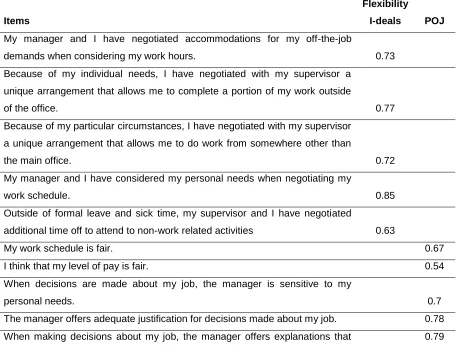
Table 2: Factor Analysis for Flexibility I-deals and Perceived Organizational Justice
Items
Flexibility
I-deals POJ
My manager and I have negotiated accommodations for my off-the-job
demands when considering my work hours. 0.73
Because of my individual needs, I have negotiated with my supervisor a unique arrangement that allows me to complete a portion of my work outside
of the office. 0.77
Because of my particular circumstances, I have negotiated with my supervisor a unique arrangement that allows me to do work from somewhere other than
the main office. 0.72
My manager and I have considered my personal needs when negotiating my
work schedule. 0.85
Outside of formal leave and sick time, my supervisor and I have negotiated
additional time off to attend to non-work related activities 0.63
My work schedule is fair. 0.67
I think that my level of pay is fair. 0.54
When decisions are made about my job, the manager is sensitive to my
personal needs. 0.7
Licensed under Creative Common Page 645 make sense to me.
Total Variance Explained: Rotation Sums of Squared Loadings
Initial Eigen values 2.4 3.14
% of Variance 37.6 18.4
Cumulative % 65.7 59.2
KMO and Bartlett's Test
Kaiser-Meyer-Olkin Measure of Sampling Adequacy. 0.74 0.68 Bartlett's Test of Sphericity, Approx. Chi-Square 421 4408.3
Sig. 0 0
Cronbach's Alpha 0.72 0.86
Cronbach's Alpha Based on Standardized Items 0.71 0.86
Extraction Method: Principal Component Analysis. Rotation Method: Varimax with Kaiser Normalization.
Analytical Model
This involved the use of moderated regression models to analyse the moderating effect of perceived organizational justice on the relationship between flexibility I-deals and innovative work behaviour among tied life insurance sales agents in Kenya. The hierarchical method was chosen because it would show how the prediction of the independent variables, the moderator, and interactions of the independent variables and the moderator improved the prediction (Leech et al., 2011). At each stage of interaction the R2 calculated showed the incremental change in variance accounted for in Y with the addition of a new predictor variable. Moderation was confirmed with the interaction term being significant and was supported when the addition of the interaction term provided a significant increment in variance (R2) associated with the flexibility I-deals on the innovative work behaviour beyond the variance accounted for by the main effects (Cohen et al., 2003). The moderated regression equation thus was:
𝑦 = 𝛽0+ 𝐶 + 𝜀1... (1)
𝑦 = 𝛽0+ 𝐶 + 𝛽1𝑥1+ 𝜀2... (2)
𝑦 = 𝛽0+ 𝐶 + 𝛽1𝑥1+ 𝛽2𝑥1∗ 𝑤 + 𝜀4... (3)
Where:
y= Innovative Work Behaviour c= Control Variables
β0= Constant
x1= Flexibility I-deals
Licensed under Creative Common Page 646
β1- β2= Coefficient of Regression e1….e4= Error Terms
FINDINGS
Descriptive Analysis of the Study Constructs
The results for the aggregated items for each of the independent, the moderator and the dependent variables showed that perceived organizational justice had the highest mean of 6.178, standard deviation of 0.688, skewness of -0.844 and kurtosis of -0.34. This implied that the life insurance organizations demonstrated more of fairness in work flexibility. Flexibility Ideals had a mean of 5.471, a standard deviation of 0.880, skewness of 0.146 and kurtosis of -0.079. Finally, IWB had a mean of 5.226, standard deviation of 0.944, skewness of -0.42 and kurtosis of -1.286. Further, to test the normality distribution the study examined the skewness and kurtosis values. Skewness is used to measure the symmetry of a distribution while kurtosis is used to measure the peakness or flatness of a distribution (Tabachnick and Fidell, 2007). Based on the results showed above, the values of Skewness and kurtosis revealed that the data was normally distributed where the values were well below the threshold of +/- 2. The findings in table 3 provide descriptive statistics for all the study variables.
Table 3: Aggregate Mean Descriptive Analysis of the Study Constructs
Variables Minimum Maximum Mean
Std.
Deviation Skewness Kurtosis
FIDEAL 3.60 7.0 5.471 0.880 -0.146 -0.791
IWB 3.78 6.6 5.226 0.944 -0.420 -1.286
DPOJ 4.65 7.0 6.178 0.688 -0.844 -0.340
Legend: F-IDEALS-Financial Idiosyncratic Deals, DPOJ- Distributive Perceived Organizational Justice,
IWB-Innovative Work Behaviour.
Testing of the hypothesis
Licensed under Creative Common Page 647 Hypothesis HO2 presumed that there was no significant moderating effect of perceived
organizational justice on the relationship between flexibility I-deals and innovative work behavior among tied life insurance agents in Kenya.
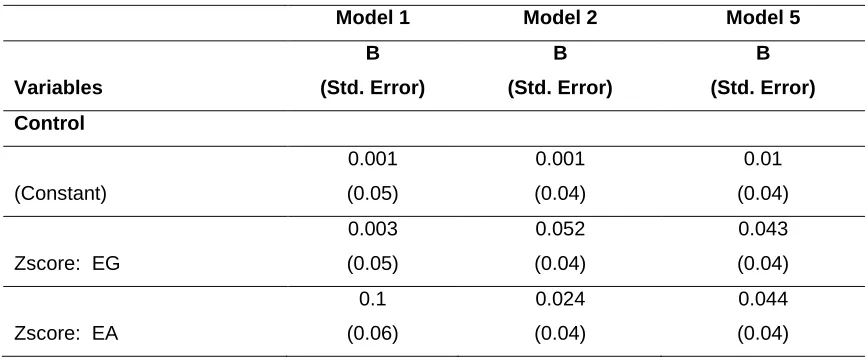
As can be read from table 4 below, the regression coefficient suggests that the interaction between flexibility I-deals and perceived organizational justice exerts a positive and significant moderating effect of perceived distributive organizational justice on the relationship between flexibility I-deals and innovative work behavior (β =0.122, ρ< 0.05). With the low p-value associated with the t-p-value, the hypothesis is not supported. Hence, there is a significant moderating effect of perceived distributive organizational justice on the relationship between flexibility I-deals and innovative work behavior.
The results suggest that whenever there is perceived distributive organizational justice employees tend to negotiate more for off-the-job demand and work arrangements that make it possible for them to complete a portion of their work outside work. The job autonomy in turn enhances their innovative work behavior in the sense that they will find new ways of doing things in an innovative manner.
The hierarchical multiple regression results also revealed an increase in R-square with the addition of the interaction variable. For instance the controls contributed to an R-square change of 3%. With the addition of the direct variable (flexibility) I-deals, the R-square increased to 48%. However, with the addition of the interaction of perceived distributive organizational justice and flexibility I-deals, the R-square increased to 50% (R-square change of 1%). This implied that there was a moderating effect of perceived organizational justice on the relationship between both flexibility I-deals on innovative work behaviour.
Table 4: Moderating Effects of Perceived Distributive Organizational Justice on the Relationship between Flexibility Idiosyncratic Deals and Innovative Work Behavior
Model 1 Model 2 Model 5
Variables
B
(Std. Error)
B
(Std. Error)
B
(Std. Error)
Control
(Constant)
0.001 (0.05)
0.001 (0.04)
0.01 (0.04)
Zscore: EG
0.003 (0.05)
0.052 (0.04)
0.043 (0.04)
Zscore: EA
0.1 (0.06)
0.024 (0.04)
Licensed under Creative Common Page 648 Zscore: EDL
0.022 (0.05)
-0.015 (0.04)
-0.027 (0.04)
Zscore: ELS
0.1 (0.06)
0.06 (0.04)
0.045 (0.04)
Predictors
Z (FIDEAL)
0.178 (0.050)*
0.066 (0.06)
Z(DPOJ)
0.083 (0.04)*
Interactions
Z(Fideal_Poj)
0.122 (0.043)*
R .164a .690b .706e
R Square 0.03 0.48 0.5
Adjusted R Square 0.02 0.47 0.48
Std. Error of
the Estimate 0.99 0.73 0.72
R Square Change 0.03 0.45 0.01
F 2.64 42.7 33.7
F Change 2.64 80.5 8.17
Sig. .034b
Sig. F Change 0.03 0 0
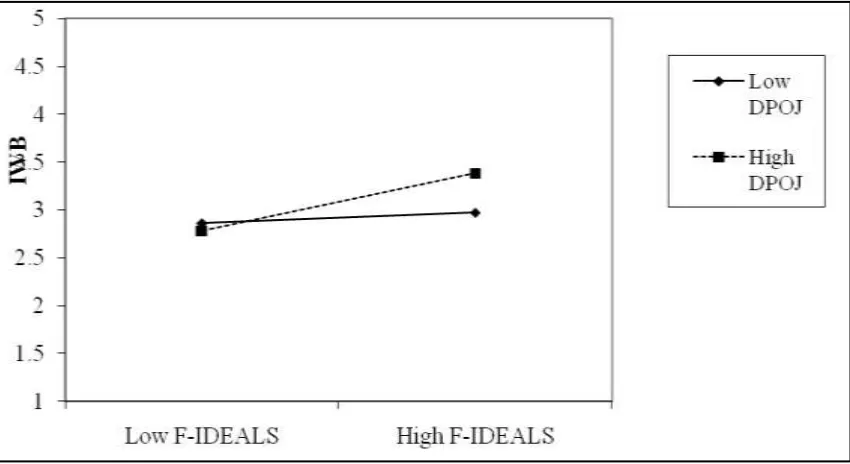
The moderation effects of perceived organizational justice on the relationship between flexibility I-deals and innovative work behavior was determined using the graphical method. The analysis revealed that the effect of flexibility I-deals on innovative work behavior had stronger significance on IWB at higher levels of perceived organizational justice than at the lower levels of the same.
It further indicates that at low levels of flexibility I-deals, the high perceived organizational justice had a bigger moderating effect on the relationship than with the low level of perceived organizational justice. The slopes in the figure thus indicate that, at high levels of perceived organizational justice, flexibility I-deals were associated with stronger and significant innovative work behavior as compared to when there was low perceived organizational justice as shown in figure 2 below.
Licensed under Creative Common Page 649 Figure 2: Moderation of Distributive Perceived Organizational Justice on the Relationship
between Flexibility I-deals and Innovative Work Behavior
The explanation is drawn from Rousseau (2005) view that flexibility I-deals are granted by employers or their agents to trusted and lower performing employees. This is likely to evoke feelings of fairness or unfairness among the co-workers due to the fact that those benefitting from them are perceived by co-workers not to deserve them because they are not special. Hence perceived organizational justice in their granting has a significant effect on how the employee reciprocates. With low perceived organizational justice the effect of these I-deals on innovative work behavior is low while the opposite is true with high perceived organizational justice.
CONCLUSIONS AND RECOMMENDATIONS
Licensed under Creative Common Page 650 reciprocates depending on their perception of distributive fairness in their granting. With low perceive distributive organizational justice the effect of these I-deals on innovative work behavior than with high perception of organizational justice perceptions.
The significant moderating effect of perceived organizational justice on the relationships flexibility and innovative work behaviour presents a contribution on I-deals-outcomes literature since many other studies have investigated the direct relationship between I-deals and employee outcomes and a few have studied the intermediate processes of the relationships. This study therefore has extended literature by incorporating perceived distributive organizational justice as one of the intermediate process in literature on the relationship between I-deals and innovative work behaviour literature.
The current study findings are consistent with equity theory associated with Adams (1965). According to this theory people compare the ratios of their own perceived work outcomes (e.g. pay and recognition) to their own perceived work inputs (i.e. contributions) to the corresponding ratios of comparison of others (e.g. co-workers). If the ratio is unequal, the party whose ratio is higher is theorized to be inequitably overpaid while the one whose amount is low is said to be inequitably underpaid (Greenberg, 1990).
Life insurance companies’ management and other related employers should also view flexibility I-deals as crucial for employees’ social exchange relationships. This is consistent with the findings of Vidyarthi et al’s., (2014) study at a large information technology company in India which concluded that flexible work arrangements were important ingredients in encouraging employees’ attitudes and behaviour (e.g. innovative work behaviour). Although past study
findings on the relationship between this type of i-deal and employee outcomes seems controversial (Vidyarthi et al., 2014), the current study has support on their relationships with employee outcomes (e.g. innovative work behaviour). Therefore, given the complexity of the current employment environment, the need to motivate employees and to benefit from such motivated employees through reciprocation from them, life insurance companies’ management
as well as other employers in related industries should consider approving such I-deals negotiated by their employees in a fair manner.
Licensed under Creative Common Page 651 managers evaluated their employees innovative work behaviours. Hence, some managers could have been biased in their evaluation. Therefore future research should attempt to reduce this bias by also incorporating aggregation of evaluation of employees from both the managers and self-evaluation from them too.
REFERENCES
Adams, J. S. (1965). Inequity in social exchange. In L. Berkowitz (Ed.), Advances in experimental social psychology (Vol. 2, pp. 267–299). New York: Academic Press.
Almansour, Y. M. (2012). The relationship between leadership styles and motivation of managers conceptual framework. Journal of Arts, Science and Commerce, 3(1), 161-166.
Al-Zu’bi, H. A. (2010). A study of relationship between organizational justice and job satisfaction. International Journal of Business and Management, 5(12), 102.
Bakhshi, A., Kumar, K., & Rani, E. (2009). Organizational justice perceptions as predictor of job satisfaction and organization commitment. International journal of Business and Management, 4(9), 145. Cohen, J., Cohen, P., West, S. G.., & Aiken, L.S. (2003). Applied Multiple Regression/ Correlation Analysis for the Behavioural Sciences (3rd ed.)Mahwah, NJ: Lawrence Erlbaum Associates.
Farr, J. and Ford,C.(1990) Individual Innovation In West, M. and Farr, J. (eds.), Managing Innovation. Sage.
Fatt, C. Kwai, Knin, E. Wong and Heng, T. Ngee. (2010). The Impact of Organizational Justice on Employees’Job Satisfaction: The Malaysian Companies Perspectives. American Journal of Economics and Business Administration, 2, (1), 56-63, London.
Greenberg, J. (1990). Organizational justice: Yesterday, today, and tomorrow. Journal of management, 16(2), 399-432.
Hodgkinson, P., & Ford K.(2016). Reflecting on the past and looking to the future, Wiley Online, 37, S3-S8.DOI: 10.1002/job.208.
Hornung,S., Rousseau,D.M. and Glaser,J. (2008), “Creating flexible work arrangements through idiosyncratic deals”,Journal of Applied Psychology,Vol.93,pp.655-64.
Hornung, S., Rousseau, D. M., Glaser, J., Angerer, P., & Weigl, M. (2010). Beyond top‐down and bottom‐up work redesign: Customizing job content through idiosyncratic deals. Journal of Organizational Behavior, 31(2‐3), 187-215.
Howell, J.M., Shea, C.M. and Higgins, C.A. (2004) Champions of Product Innovations: Defining, Developing, and Validating a Measure of Champion Behavior. Journal of Business Venturing, 20,641–61.
Insurance Regulatory Authority (2016).Insurance Industry Report.First Quarter Report. January- March. Janssen, O. (2000). Job demands, perceptions of effort-reward fairness, and innovative work behavior. Journal of Occupational and organizational psychology, 73, 287-302.
Jeroen, J.& Hartog, D.(2010). Measuring innovative work behavior, Blackwell, 19, 1 l Psychology, 73, 287-302.
Kangetta C. & Kirai M. (2017). Effects of Mergers and Acquisitions on Employee Morale in the Kenyan Insurance Sector. The Strategic Journal of Business and Change Management. Vol.4, Iss.1 (4), pp. 101-114.
Leech, N. L., Barret, K. C., & Morgan, G.A. (2011). SPSS for intermediate statistics: Use and interpretation (4th ed.). New York, NY: Psychology Press.
Licensed under Creative Common Page 652 Najafi, S., Noruzy, A., Azar, H. K., Nazari-Shirkouhi, S., & Dalvand, M. R. (2011). Investigating the relationship between organizational justice, psychological empowerment, job satisfaction, organizational commitment and organizational citizenship behavior: An empirical model. African Journal of Business Management, Vol. 5(13), pp. 5241-5248.
Odemba, J. (2013). Factors Affecting the uptake of Life Insurance in Kenya. MBA Thesis, University of Nairobi.
Ponnu, C. H., & Chuah, C. C. (2010). Organizational commitment, organizational justice and employee turnover in Malaysia. African Journal of Business Management, 4(13), 2676.
Prajya R.Vidyarthi, Anjali Chaudhry, Smriti Anand, Robert C.Liden. (2014). Flexibility-deals: how much is ideal?.Journal of Managerial Psychology29:3,246-265.
Rosen, C. C., Slater, D. J., Chang, C-H., & Johnson, R. E. (2013). Let’s make a deal:development and validation of the ex post i-deals scale. Journal of Management, 39(3), 709-742.doi:10.1177/0149206310394865.
Rousseau, D.M.(2005).I-deals: Idiosyncratic Deals Employees Bargain for Themselves, M.E.Sharpe, NewYork,NY.
Scott, G.S. & Bruce. A. B. (1994).Determinants of Innovative Behavior: A Path Model of Individual Innovation in the Workplace. Academy of Management. Vol. 37.No. 3. 583- 607.
Spieglare, D. S.(2014). The Employment Relationship and Innovative Work Behaviour. PhD dissertation. University of Amsterdam.
Tabachnick, B. G., & Fidell, L. S. (2007). Experimental designs using ANOVA. Thomson/Brooks/Cole. Vidyarthi, P. R., Anand, S., & Liden, R. C. (2014). Do emotionally perceptive leaders
motivate higher employee performance? The moderating role of task interdependence and power distance. Leadership Quarterly, 25, 232-244. doi:10.1016/j.leaqua.2013.08.003
West, M. A., & Farr, J. L. (1990). innovation and creativity at work: Psychological and Organizational Strategies. Chichester: Wiley.
Wojtczuk, T. & Turek D. (2013). Innovativeness in Organizations: The Role of Leader Member Exchange & Organizational Justice: The case of Poland. International Journal of Synergy & Research. Vol.2, 1,2013,pp. 41-55.