1149
Using Mind Map In Teaching Mathematics: An
Experimental Study
Nguyen Phu Loc, Mai Tan Loc
Abstract : A mind map is a diagram in which information is arranged visually and sequentially. Therefore, the use of mind maps in teaching has been used by many educators around the world; they showed that it much supports the teaching process of teachers and students' learning process. Also, with the mind map approach in teaching mathematics, we conducted experimental teaching in teaching the topics of straight line and circle equations - Geometry 10 in high school mathematics program in Vietnam. By using mind maps in reviewing knowledge, in teaching new knowledge and in systematizing knowledge for two experimental classes, we found that the learning results of students in the two experimental classes were actually higher than those of the two control classes. From our experience gained through experimental teaching, we believe that teaching mathematics with the help of mind maps will be a teaching method that contributes to improving the effectiveness of mathematics education in schools.
Index Terms :Mind map, mathematics education, teaching geometry, teaching with a mind map. Geometry teaching —————————— ——————————
1.
INTRODUCTION
The mind map is a diagram of information presented with a central idea in the middle and connected ideas arranged around it (Oxford Dictionary). In other words, a mind map is an organizational tool that supports thinking; it can be described as a graphic technique with the right combination of words, images, lines, colours, compatibility with the structure, activity and function of the brain to unlock your potential and infinite brains. In particular, this is an open diagram, does not require scale and harsh details such as geographic maps, can draw more or less branches, each draw a different form, using colours, images, different phrases; the same topic but each person can express it in the form of a mind map in a specific way, so the mind map maximizes each person's creative capacity. In order to carry out the steps of constructing a mind map, we must first understand the content of knowledge, proceed to identify the core content, divide into main ideas and identify sub-ideas of each main idea. This can be done by mapping knowledge summary or branching in a "chicken leg" style to facilitate the construction of the corresponding mind map.
To build a mind map, we need to perform the following steps:
Step 1: Write the name of the topic (central idea) in the middle. Step 2: From the central topic, draw the main branches that link the topics. On each main branch writing a word, the phrase reflects an essential content of the topic.
Step 3: From each main branch, draw additional branches (sub-branch 1) to clarify that main branch.
Step 4, 5 Continue drawing branches level 2, 3 etc.
The theory of mind maps has been developed by Tony Buzan since the 1960s and has been used by research educators to teach in many different subjects over the years. Many studies have confirmed the dynamic effects of the mind map in teaching new knowledge, in problem-solving, in systematizing
knowledge, in reviewing knowledge. According to Buzan & Buzan (2015), as a visual and graphical integrative thinking approach, mind mapping is an appropriate technique for exercising different brain functions, including memory, creativity, and learning (cited from Polat, O., Yvuz, A., E., Tunc, A., B, O. (2017).; mind maps help individuals to recall knowledge and to show the relations between different thoughts and concepts (Buzan & Buzan, 1995). Barra, Wilujeng & Kuswanto (2019) conducted a study to assess the impacts of the inductive learning model-assisted mind map MindManager in enhancing critical thinking skills among students in learning physics on the topic optical eye. The study adopted quasi-experimental research with a pre-test and post-test design. A total of 33 students with a good academic background in science and mathematics took part in the study. The study used essay questions as test instruments to gather data that was analyzed using the paired sample t-test. The results showed that there is a difference in the critical thinking skills of students before and after using Mindmap Mindjet Mindmanager. Mahasneh (2017) carried out a study to investigate the impacts of electronic mind mapping on students' attitudes and performance. The study used a quasi-experimental research model with pre-test and post-test control groups. In total, 65 students took part in the study with 31 students being in the experimental group while on the other hand, 34 in the control group. The experimental group was trained on how to use electronic mind mapping while the control group were provided with traditional classroom teachings. An achievement test and a mind mapping attitude test were used to determine the difference between the two groups. However, the primary limitation of this study is that the sample size selected may have been too small to come up with generalizable results. Lee, Ong &Messom (2011) also carried out a study that aimed at introducing a new concept time book into mind mapping. The study used the concept of time evolution in creating e-books for school curriculums. The study used a sample of 20 grade 7 pupils, 20 university students, three math teachers and ten university lecturers. The results of the study reveal that the mind-mapping tool has the potential of enhancing teaching and learning processes. However, the sample size selected was also rather small to produce results that could be generalized. Gargouri & Naatus (2017) argue that mind map used to provide clarity of reasoning based on supporting evidence to achieve meaningful conclusions that improve decision-making skills. The study was quasi-experimental, a total of 14 students ————————————————
Nguyen Phu Loc, Assoc.Prof. Dr. in Math Education, School of Education, Can Tho, University, Vietnam
E-mail: [email protected]
participated, and it lasted for a semester. The assessment criteria that was initially determined by the Novakian concept maps, this was, however, further refined by Davies (2011). The results of the research indicated that integrating mind maps into assessments has the potential of tapping into the thought process of students which, in turn, improves their understanding and cognitive development. Other than the small sample size, the other limitation of the study was the lack of longitudinal data that would have helped in the overtime comparison between the variables of the study. The first theme that stood out based on the literature reviewed is on cognitive and critical thinking skills. The study by Lee, Ong & Messom (2011) reveals that incorporating mind maps with the time evolution learning technique improves the cognitive decision-making skills of students. Additionally, the findings of Gargouri & Naatus (2017) indicate that combining inductive learning with MindJet MindManager is more effective in improving the cognitive and critical thinking skills of learners. This is also in line with the findings of Santiago (2011), who found out that Mindmap Mindmanager trains students to think systematically and structurally. About target perception, Faste & Lin (2012) conducted a study that aimed at evaluating various limitations of mind mapping software applications with a more significant objective of guiding future application developers. The research carried out ethnographic research on several individuals who were frequent users of the software. The results of the study revealed that digital mind mapping increases efficiency in problem-solving. Safar et al. (2012) carried out a study to investigate the perceptions and willingness of undergraduate students in using mind mapping software to learn. The study adopts a quantitative research design where questionnaires were used at data collecting tools. A sample of 72 students took part in the study. The findings revealed that the majority of the students had positive perceptions about mind mapping techniques. They were also willing to apply the methods to improve their problem-solving techniques. The main limitation of the study is that it only covers the use of the software in an academic scenario and excludes other areas of its application. Although electronic mind mapping improves the cognitive performance of students, the tool has some inherent setbacks. The results of the study by Faste & Lin (2012) reveal that the use of mind maps has the potential of improving the speed and efficiency of the working memory of individuals. However, it was found that switching between the mouse and the keyboard can disrupt the workflow of an individual. This is because to achieve efficiency, the speed of data entry is required to match the thought process. In the same light, the use of mind maps often comes with new levels of control that may limit the though process of individuals. Furthermore, the mind map techniques that were examined did not have the multi-user options that would allow users to merge maps or to leverage other people’s maps. Also, the willingness and attitudes of students towards adopting mind mapping techniques is an area if research curiosity. A study by Safar et al. (2012) revealed that a majority of students have overall positive attitudes towards integrating mind mapping techniques, especially in solving complex computational and logical problems.
1.1 Research problem
Math is the core subject in high school. However, it is a highly abstract subject. Math concepts and theorems are inextricably
related. To understand, memorize and solve math problems, or be able to apply math in practice requires students to know how to link mathematical knowledge together. From the research works of different authors in the world, as mentioned above, shows that using mind maps in teaching has many positive results. The question of using mind maps in teaching mathematics in Vietnam is useful or not? This is an issue that we need to study
1.2 Research Focus
The focus of our research was to apply mind map to teaching the topics on the equation of a straight line and a circle in a plane – Geometry 10 in Vietnamese curriculum of Mathematics and evaluate the results of this teaching.
2
RESEARCH
METHODOLOGY
2.1 General Background
Mind mapping may be used by the teacher or the students for planning the lesson, summarizing the lesson or recall to the lesson that the students have learnt (Chin Sok Funa, Norhayati Maskata, 2010). Brinkmann (2003) suggested that mind mapping could be used in mathematics education in the following ways:
- To organize information, - To support memory,
- To use for repetition and summary,
- To summarise the ideas of several students,
- To meaningfully connect new information with given knowledge,
- To introduce new knowledge,
- To let the cognitive structure of students become visible, and
- To foster creativity
In the study, we used mind map in teaching with the purposes as follows: Use the mind map to review the old knowledge
Because the time to check the old lesson is only about 5 - 7 minutes, teachers' requirements are usually not too difficult, do not require much analysis, comparison etc. to answer questions. Teachers often ask students to recreate part of a lesson by asking students to come upon the board to answer the questions and to grade based on the level of the students' reading. This method accidentally allows many students to fall into the state of "rote learning", recite without understanding the lesson. Therefore, there should be a change in the test and assessment of students' awareness; the requirement is not only to test the "memory section" but also to pay attention to the "understanding part". This approach avoids rote learning and assesses students accurately while improving the quality of learning. Using the mind map helps the teacher check both the "memory" and the "understanding" of the students for the old lesson. Teachers may proceed with the old test by doing the following:
Method 1: Use the "fill in the blank" exercises to review knowledge, or connect known information together.
Method 2: The teacher presents a keyword that represents the topic of the previous knowledge that students have learned, needs to test, and asks them to draw a mind map through a suggested question. On the basis of that keyword combined with the directional question of the teacher, students will remember and formulate the mind map as required.
1151 mapping out their thinking according to their understanding.
For the old test, the teacher had one or two children stick on the products prepared at home.
Figure 1 is an exercise for reviewing old knowledge before teaching a new knowledge of the equation of a straight line. (see an illustration – Figure 1 in (Appendix)
Use the mind map in teaching new lessons
Using the mind map is a suggestion for presenting new ideas. Instead of making bullet points on the board, teachers use the mind map to take part or the entire lesson visually. The teacher creates a keyword to elicit knowledge of the new lesson and asks students to draw a mind map by asking questions, eliciting them from the vocabulary, and figuring out the words related to that keyword and completing good mind map. Through the mind map, students will grasp the lesson knowledge quickly. For teaching new lessons, in order to use the mind map effectively, teachers must prepare the exercises carefully at home. From the content of the lesson, the teacher summarizes it into a mind map. When going to class, the teacher will use that mind map to guide students to explore each content of the lesson. Each content corresponds to a sub-branch of the map. By using the mind map in teaching, step by step, the teacher will help students gradually discover the entire lesson knowledge gradually. Teachers help students re-enact the vast knowledge revolving around the heart of the lesson, the small ideas in each big idea so that until the end of the lesson, the general knowledge of the lesson is presented in a visual way. Create, lively on the diagram. In addition to providing students with comprehensive knowledge, the thinking map also helps students to multi-dimensionally recognize all aspects of the problem, thereby making new ideas, discovering new things, finding connections. Forcing ideas in the lesson to find the logical circuit of the lesson. After finishing, students can look at the diagram to reproduce and re-present the entire lesson knowledge. At the same time, students can also confirm the entire amount of knowledge of the lesson, identify the main ideas, side ideas and plan active learning. Can be summarized by the following activities: Activity 1: Teacher introduces the topic name or a picture, drawing of the main topic to the centre of the mind map Activity 2: In the course of developing the lesson, the system of mind maps gradually improves
Activity 3: Concluding part of a lesson, a lesson, the teacher uses the same mind map that was established during the promotion process to consolidate knowledge.
(see an illustration – Figure 2 in (Appendix)) Use mind map to make a summary of knowledge
After each section, each chapter, teachers need to review, review, and systematize knowledge for students before they do homework, periodic tests, semester tests and year-end tests. With the strength of mind maps, knowledge can be codified in the form of diagrams, and the lines describe the logical circuit of knowledge or causal or equivalent relationships, plus the colour of the links, the colour of knowledge units, which will help students see the "overall picture" of a portion of the knowledge they have learned (see an illustration – Figure 3 in (Appendix)
Use the mind map to guide students in self-study Self-study is not only meaningful in the time of studying at school, but also has great significance in the life of every human being. Practising self-study at home with a mind map will help students get in the habit of learning scientifically. Designing and using a mind map in learning helps students actively learn
and mobilize all students to participate in constructing lessons excitedly. With a unique product "knowledge and painting" is the daily creative joy of students and also the joy of teachers and students 'parents when witnessing the fruits of their students' labour. This method of learning also develops the individual competence of each student not only intellectually (what to draw and write on the mind map), systematize knowledge (mobilize previous learning to select ideas) to record), painting ability (presentation form, combining drawings, writing, colours), the application of knowledge learned from books to life. Figure 4 presents some types of task about the equation of a circle which students self-study to discover how to solve them.
(see an illustration – Figure 4 in Appendix)
2.2 Experimental model and sample
The model used for experimental teaching
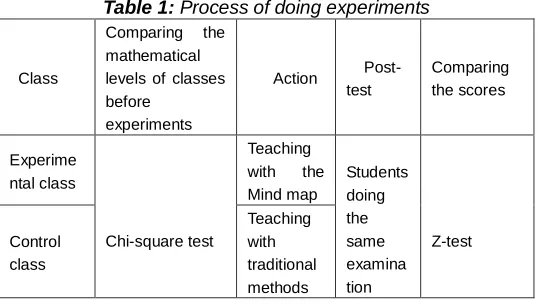
Table 1 showed the model which we carried out pedagogical experiments.
Table 1: Process of doing experiments
Class
Comparing the mathematical levels of classes before
experiments
Action Post-test Comparing the scores Experime ntal class Chi-square test Teaching with the Mind map Students doing the same examina tion Z-test Control class Teaching with traditional methods Samples for experimental teaching
Two experimental classes and two control classes at two different high schools:
- High School for pedagogical practice - Can Tho University, Can Tho City, and
- Truong Dinh High School – Go Cong Town, Tien Giang Province
Table 2 and Table 3 show the ability of students of experimental classes and control classes in the first semester of the 2018-2019 year before experimental teaching.
- 10A1 (experimental class) and 10A2 (control class) of Pedagogical Practice High School - Can Tho University, Ninh Kieu District, Can Tho City. 60% of students of each class who are good at mathematics and mathematics level of two classes are equivalent (see Table 2)
Table 2: Comparing the mathematics level of Class 10A1 & 10A2 of Pedagogical Practice High School - Can Tho University
Class N
Good Moderate Poor
n (%) N (%) n (%) 10A1
(Experime
ntal class) 10A2 (Control
class)
36 22 61.1% 11 30.6% 3 8.3%
Chi-square test
H1: The mathematics level of two class is not equivalent
H0: The mathematics level of two class is equivalent
The chi-square statistic is 2.7513. The p-value is .252678. The result is not significant at p < .05. Therefore, H0 is not accepted.
- 10/1 (experimental class) and 10/2 (control class) of Truong Dinh High School, Go Cong City, Tien Giang province. Under 50% of students of each class who are good at mathematics and mathematics level of two classes are equivalent (see Table 3)
Table 3: Comparing the mathematics level of Class 10/1 & 10/2 of Truong Dinh – Tien Gang Province
Class N
Good Moderate Poor
n (%) n (%) n (%)
10/1 (Experimental
class)
35 12 34.3% 13 37.1% 10 28.6%
10/2 (Control
class)
34 15 44.1% 10 29.4% 9 26.5%
Chi-square test
H1: The mathematics level of two class is not equivalent
H0: The mathematics level of two class is equivalent
The chi-square statistic is 0.7629. The p-value is .252678. The result is not significant at p < .05. Therefore, H0 is not accepted.
3
THE
RESULTS
OF
EXPERIMENTAL
TEACHING
AND
DISCUSSIONS
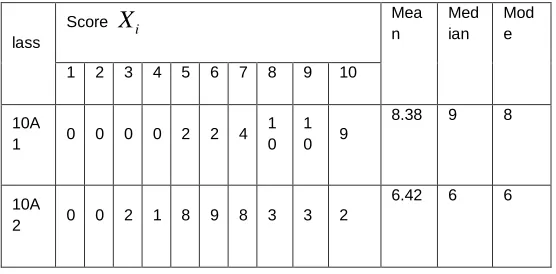
Table 4: The scored results of doing an examination of Class 10A1 and Class 10A2
lass
Score
X
i Mean
Med ian
Mod e 1 2 3 4 5 6 7 8 9 10
10A
1 0 0 0 0 2 2 4 1 0
1 0 9
8.38 9 8
10A
2 0 0 2 1 8 9 8 3 3 2
6.42 6 6
H1: The scoring average of Class 10A1 is higher than the one of Class
10A2
H0: The scoring average of Class 10A1 is not higher than the one of
Class 10A2
The Z-Score is 4.51832. The p-value is < .00001. The result is significant at p < .05. Therefore, H0 is not accepted.
Table 5: The scored results of doing an examination of Class 10/1 and Class 10/2
Clas s
Score
X
i Mean
Media n
Mod e 1 2 3 4 5 6 7 8 9 10
10/1 0 0 0 0 2 3 7 9 7 7 8 8 8 10/2 0 0 3 3 9 9 6 2 1 1 5.8 6 5 H1: The scoring average of Class 10/1 is higher than the one of Class
10/2
H0: The scoring average of Class 10/1 is not higher than the one of
Class 10/2
The Z-Score is 5.06. The p-value is < .00001. The result is significant at p < .05. Therefore, H0 is not accepted.
Table 4 and Table 5 show that the score averages of two experimental classes are the ones of two control classes. The results of experiments indicate the effectiveness of applications of the mind map in teaching mathematics. It is explained as follows:
- About the quality of acquiring knowledge and thinking capacity
Students were more proactive and active in the class time; mind maps created excitement and promoted creative and thinking skills for students during class; the knowledge is codified in a comprehensive, detailed but concise manner with mind maps that helped students easily observe, remember genuinely and take longer. They had opportunities to work effectively in groups and debated to understand and deepen the knowledge chain fully.
- About the ability to apply knowledge
Students’ the ability to apply knowledge into doing exercises was improved. They could easily review old knowledge quickly, generously and thoroughly with just a mind map Thanks to the completeness, detail but concise of the mind map, students had better orientation in memorizing knowledge and have a reasonable learning method with high efficiency, avoiding the case of learning too much theoretical knowledge but did not know how deep chain and does not apply when solving problems.
4
CONCLUSION
1153 only take notes; students have opportunities to promote
creativity and autonomy in learning. A mind map helps students connect knowledge logically, easily memorize and apply later. In short, the proficient and competent use of the mind map in teaching will bring significant results in the student's learning method and the teacher's teaching method. Students will learn ways to learn, increase initiative, creativity and develop thinking. Teachers will save time, increase flexibility in lessons, and most importantly, help students gain knowledge through a "diagram" that shows the intricate links of knowledge. Using the mind map in combination with active teaching methods, it will be highly feasible, contributing to innovating teaching methods.
REFERENCES
[1] Barra, W. N., Wilujeng, I., &Kuswanto, H. (2019, June). The Effect of Inductive Learning Model Assisted Mindmap Mindjet Mindmanager towards Critical Thinking Skills of Students. In Journal of Physics: Conference Series (Vol. 1233, No. 1, p. 012046). IOP Publishing.
[2] Brinkmann, A. (2003). Graphical Knowledge Display-Mind Mapping and Concept Mapping as Efficient Tools in Mathematics Education. Mathematics Education Review, No 16, April, 35-48.
[3] Buzan, T. and Buzan, B. (1995). The Mind Map Book. London: BBC Books.
[4] Davies, M. (2011). Concept mapping, mind mapping and argument mapping: what are the differences and do they matter?. Higher education, 62(3), 279-301.
[5] Faste, H., & Lin, H. (2012, May). The untapped promise of digital mind maps. In Proceedings of the SIGCHI conference on human factors in computing systems (pp. 1017-1026). ACM.
[6] Chin Sok Funa, Norhayati Maskata (2010). Teacher-Centered Mind Mapping vs Student-Teacher-Centered Mind Mapping in the Teaching of Accounting at Pre-U Level – An Action Research. Procedia Social and Behavioral Sciences 7(C) (2010) 240–246
[7] Gargouri, C., &Naatus, M. K. (2017). An Experiment in Mind-Mapping and Argument-Mapping: Tools for Assessing Outcomes in the Business Curriculum. e-Journal of Business Education and Scholarship of Teaching, 11(2), 39-78.
[8] Lee, H. J., Ong, T., &Messom, C. H. (2011, October). A timeline-based authoring tool for e-Textbook: Bringing the "mind-mapped learning model". In 2011 Frontiers in Education Conference (FIE) (pp. S1E-1). IEEE.
[9] Mahasneh, A. M. (2017). The effect of using electronic Mind Mapping on Achievement and Attitudes in an introduction to educational Psychology Course. StanisławJuszczyk. 295.
[10]Oxford Advanced Learner's Dictionary,
https://www.oxfordlearnersdictionaries.com/definition/englis h/a_1?q=a
[11] Polat, O., Yvuz, A.,E., Tunc, A., B,O.(2017). The effect of using mind maps on the development of maths and science skills. Cypriot Journal of Educational Sciences, 12(5), 32-45
[12] Safar, A. H., Alqudsi-Ghabra, T. M., &Qabazard, N. M. (2012). Use of concept mapping and visual learning
software in education at Kuwait University. Education, 132(4), 834-862.
[13] Santiago, H. C. (2011). Visual Mapping to Enhance Learning and Critical Thinking Skills. Optometric Education, 36(3).
[13]Sielis, G. A., Tzanavari, A., & Papadopoulos, G. A. (2009, July). Enhancing the creativity process by adding context-awareness in creativity support tools. In International Conference on Universal Access in Human-Computer Interaction (pp. 424-433). Springer, Berlin, Heidelberg.