Reliability of Resource Allocation in Mobile
Ad Hoc Grid with Tasks Replication
Sri Chusri Haryanti and Riri Fitri Sari
Department of Electrical Engineering, Faculty of Engineering, University of Indonesia, Depok, 16424 Indonesia Email: [email protected], [email protected]
Abstract— In the interest of achieving higher reliability, mobile ad hoc grid should apply a fault tolerance in resource allocation scheme. Resource allocation plays a critical role in mobile ad hoc grids due to the dynamic nature of nodes connection. Allocating appropriate resources for the tasks can avoid uncompleted tasks and ensure service reliability. We propose two approaches for avoiding tasks failure due to nodes mobility. They are selecting resource nodes, which have corresponding mobility with resource management system, and implementing task replication strategy. Task replication is expected to increase service reliability. In this paper, we study the reliability of the resource allocation scheme which considers mobile ad hoc grids with centralized architecture with the presence of dependent tasks. Eventually, numerical examples are given to illustrate resulting equations. The result shows that assigning tasks replication provides superior reliability in mobile ad hoc grid, and tasks replication could also minimize the required service time of completing the tasks.
Index Terms— resource allocation, mobile ad hoc grid, reliability, tasks replication, dependent tasks
I. INTRODUCTION
Rapid advancement in mobile computing has emerged to support grid accessibility [1]. Wireless and mobile nodes can access, join, and involve in a so called mobile ad hoc grid. Mobile nodes are able to request and receive a sharing of resources in a Grid computing system dynamically. Mobile ad hoc grid provides self-governed interaction between nodes [2].
In recent years, mobile ad hoc grid is a challenging research topic. The development of mobile ad hoc grid has shifted the objective of using grid. Initially, the grid is used for solving many scientific applications, and in the future it might be used for solving problems of everyday life [3].
The main characteristic of mobile ad hoc grid is its highly dynamic changing network topology due to nodes mobility, nodes switching on and off, and so on [1, 4]. In this environment, failures are likely to occur due to resource allocation fault. It is highly possible that a resource could not return its completed tasks. After a period, the resource node might fail to access the resource management system.
Resource allocation plays a crucial role in determining the performance of the overall grid system. Thus, it is highly critical to provide a resource allocation scheme
that is suitable for the environment, and that ensures the completion of the tasks.
We propose two approaches to obtain a reliable resource allocation service. First, for avoiding tasks failure due to nodes mobility, only specific resource nodes will be allocated in completing the tasks. They are resource nodes, which have corresponding mobility with resource management system (RMS). The second is implementing task replication strategy which is expected to increase service reliability.
In an infrastructure grid, task replication is primarily used as a fault tolerance technique in case of a system outage [5]. It is assumed that the success probability of completing the task will increase when it is done by multiple resources. Task replication is a proficient technique in case of a task running on an unreliable execution environment. The goal of the replication is to ensure that at least one replica is always able to complete the computation in case the others fail [6].
In this study, we also investigate the reliability of the proposed resource allocation scheme. The mobile ad hoc grid is considered having centralized architecture. A task graph example is used to examine the reliability with the presence of dependent tasks.
The paper is structured as follows. Section 2 discusses the related works. Section 3 describes problem statement and objective. Section 4 presents the proposed scheme. Reliability analysis is presented in Section 5. In Section 6, illustrative examples are presented and discussed while Section 7 gives the conclusions to the paper.
II. RELATED WORKS
There are proposed schemes of resource allocation, which address mobile ad hoc grids [7-12]. Some of them have addressed the issues such as node mobility, energy management, and task failure. To select the most suitable node for task execution, Gomes et al. in [10] proposed a scheme which utilizes a delayed reply mechanism. It also provides load balancing and scalability. Node mobility has been addressed in [9] by profiling regular movements of a user over the time. To deal with the precedence dependencies, Shilve et al. in [11] have proposed a scheme based on a static allocation of resources in ad hoc grids; however, due to static allocation, this scheme is not adaptive to network changes and application behavior.
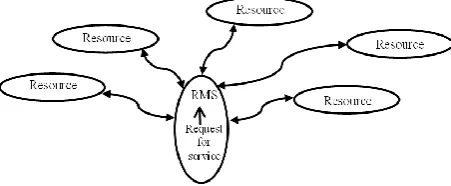
Figure 1. Mobile ad hoc grid with a star architecture grid that considers fault tolerant mechanism. Hummel
and Jelleschitz [9] recommend both proactive and reactive fault tolerance mechanism to address task failure. It is stated that, in a proactive mechanism, only stable resource nodes are selected for tasks execution. Reactive fault tolerance mechanisms aim at recovering the distributed queues and resubmitting active tasks. However, this paper [9] did not describe the method for determining a stable resource node. In [12], Litke et al. suggest to use tasks replication. They also estimate the minimum number of replicas to guarantee a specific fault tolerance level for the grid environment. However, due to the characteristic and limitation of the communication link in mobile ad hoc grid, the number of task replica should be limited.
Our literature review reveals that there is still very few proposed resource allocation algorithm for mobile ad hoc grid that considers fault tolerant mechanisms to reduce the impact of failure. This paper presents two approaches for avoiding a task failure due to node mobility. First, selecting only nodes, which have corresponding mobility as resource nodes. This will ensure only nodes with long-term connectivity will do the tasks. The second is task replication strategy, which is expected to increase service reliability.
Dabrowski noted that there are studies and efforts in developing reliability methods for grid environments [13]. Some investigations on the reliability of infrastructure and management services that are in charge of critical functions for grid systems to operate, such as resource allocation and scheduling in traditional grid have been conducted [14-17]. Nevertheless, there is still minor attention to the reliability of a mobile ad hoc grid [12, 18].
Jang [18] analyzes a mobile resource reliability-based job scheduling model in order to overcome the unreliability of wireless mobile devices and to guarantee stable and reliable job processing. The mobile resource reliability of each resource is calculated and predicted by using connectivity and availability metrics. Litke et al. [12] use tasks replication to guarantee a fault tolerance level for the Grid environment.
The main contribution of this paper is not only proposing a resource allocation scheme that is exhaustive fault tolerant but also performing a reliability study of mobile ad hoc grid.
III. PROBLEM CONTEXT AND OBJECTIVES
In a mobile ad hoc grid, if a node does not have enough resource to execute an application or the performance of an application is not good enough, it will submit the application to resource allocation service through application submission service. Once application is submitted, resource allocation service activates resource discovery service which in turn broadcasts a discovery message to nodes within a wireless range. The nodes willing to share computing resources will reply. They will be noted as the potential resources.
In this paper, the mobile ad hoc grid is considered to have a centralized architecture. It means that there is a
single node which is responsible as an RMS. Although the centralized architecture suffers from the scalability and probability of a single point of failure, it gratifies an effective resource allocation decisions due to network-wide view [7].
It is critical to implement effective fault tolerant technique in resource allocation, due to the vulnerability of a mobile ad hoc grid environment. To prevent and reduce the potential errors that may occur due to node mobility, it is necessary to consider the relative mobility in selecting resource nodes. Unpredictable node mobility across the coverage area in mobile ad hoc grid may lead to a task failure. Node mobility across the coverage area will affect not only the task execution on a node but also the dependent tasks execution on the other nodes. Therefore, mobility of a single node can have a large effect on an application performance.
Implementation of a fault tolerant mechanism will also increase service reliability in a mobile ad hoc grid. An effective fault resilience is mandatory, due to the unreliable execution environment of such a grid.
In this paper, we present a comprehensive solution for fault resilient mechanisms in a mobile ad hoc grid. We propose two supportive methods. First, a resource selection that considers nodes mobility. The second is task replication. Furthermore, the reliability of mobile ad hoc grid is analyzed. The analysis is based on the hierarchical model such as presented by Dai et al. [15]. In the hierarchical modeling, the reliability analysis considers the probability of different kinds of failures at each layer.
IV. RESOURCE ALLOCATION SCHEME
In grid computing systems, the resource management system (RMS) controls sharing resources among nodes [19]. The resource allocation service in a star topology is depicted in Fig. 1. The RMS is at the center and is directly connected to the resources through a communication channel.
Figure 2. Markov chain for matchmaking reliability
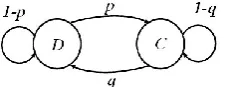
Figure 3. Connectivity states of nodes and their transition probability such as processing power, memory, and remaining
battery power are enclosed. These attributes will be used to select resource nodes that will execute the tasks. When the tasks execution has finished, the results will be gathered by the requesting node which submit the application.
We use a procedure to obtain a stable cluster of resource nodes among all nodes that are willing to share resources. Stable means having the ability to communicate with the node that requests help to complete the tasks. The task will only be submitted to the nodes which belong to this cluster. This is conducted to ensure that most of the tasks will be properly resolved.
Subsequently, to consolidate the fault tolerant mechanism, tasks replication is also applied. It is assumed that each resource can process only a single task at a time. The same task can be replicated and assigned to several resources for parallel execution. It is assumed that different tasks replication number is assigned, which depends on the condition of the number of available resource nodes. If the same task is processed by several resources, it is completed when first output is returned to the RMS. All the tasks are completed when their results are returned to the RMS from the resources. Some tasks require outputs from previous tasks for their execution. The order of tasks’ execution is determined by the precedence constraints.
V. RESOURCE ALLOCATION RELIABILITY ANALYSIS Dai et al. originally introduce a hierarchical model for the grid service reliability analysis and evaluation in [15]. They map the physical and logical architecture of the grid service system. The model considers various types of failures in the grid computing environment, such as blocking failures, time-out failures, matchmaking failures, network failures, program failures, and resource failures. Using the hierarchical model makes the evaluation and calculation tractable by identifying the independence among layers. Later, Zhang presents an analysis of grid service reliability subject to failures similar to Dai’s approach [17].
In association with the resource allocation in a mobile ad hoc grid, we present a reliability analysis using the hierarchical model approach. In this respect, the reliability analysis is comprised of reliability of matchmaking process, reliability of network and reliability of task execution. The reliability analysis will be described in the following sub section.
A. Reliability of Matchmaking Process
The management layer can be considered as the global resource allocation layer [15]. It has the function of detecting new resources, monitoring the resources, removing failed resources, and matching the resource requests of a service to the registered resources. If the resource requests are fit to the available resources, the network layer will handle the next process.
Matchmaking failure means that the requests fail to match with the correct resources [15]. During the matchmaking process, certain requests may be
mismatched to the wrong resource, which causes matchmaking failure. The assumptions for matchmaking failures are:
The failure rate of matchmaking process is λ(k), which is a function to k number of faults.
When a matchmaking failure happens, the program will notify the RMS and then they will try to remove the faults.
Removing the fault may result in other new faults. The occurrence of a new generating fault follows a Poisson distribution. The rate of new faults is constant, v.
To model this process, according to those assumptions, it fits a continuous time Markov chain (CTMC) [15]. The model is depicted in Fig.2. It is an infinite number of states of a birth-death Markov process. State k represents k matchmaking faults.
Matchmaking time for a request can be regarded smaller enough than the whole life of the resource allocation service. Accordingly, the failure rate can be considered as constant, as in [15], which can be estimated as
𝜆 = 𝑛𝑓
𝑛𝑡𝜏 (1)
Where nf is the number of mismatched requests, nt is the
total number of requests, and is the expected time for completing each request. The probability that all requests are correctly fitted to their required resources if the given H requests can be yielded by
𝑅𝑚𝑎𝑡𝑐 ℎ= exp −𝜆 ∙ 𝐻 ∙ 𝜏 = exp −𝑛𝑓
𝑛𝑡𝐻 = exp 𝜆𝑚𝐻 (2)
B. Reliability of Network
If the matchmaking process has worked well, the programs can connect to the resources through the network. However, during the period of connection, network failures may occur. Since the communication of the nodes occur through a mobile ad hoc network, the network reliability follows the reliability of mobile ad hoc network accordingly. Consequently, the discussions of a link in a mobile ad hoc network need to be associated with node’s mobility.
Fig. 3 shows the connectivity and transition probability between two nodes in an ad-hoc network. The state D denotes that two nodes are disconnected, and the state C indicates that they are connected with a bidirectional wireless channel. p refers to the probability of the transition from D to C, and q is the probability of the transition from C to D.
If α and β are transition rates of DC and CD, respectively, a continuous-time Markov chain will yield to (3) as the probability of the connection of the two nodes will break in time t [20].
lim𝑡→∞𝑝𝐷 𝑡 =𝛼+𝛽𝛽 (3)
Thus, the reliability of the network
Rn(t) = pD(t) (4)
Where the values of α and β depend on the mobility model of the nodes [20].
C. Reliability of Task Execution
In the the reliability of
tasks execution depends not only on the reliability of each task, but also on the reliability of the execution dependencies on them [16]. In the tasks execution phase, tasks will be processed in different resources. Each resource can only process one task when it is available. However, in case of implementing tasks replication, the same task may be assigned to several resources. If the same task is done by several resources, it is considered completed when first output has arrived back to the RMS. To facilitate the discussion, it is assumed that RMS is fully reliable. The time of task processing by the RMS is also assumed to be insignificant as it is considered very small compared to the tasks processing and network connection time. As it is assumed that the grid service has the star topology, the discussion of task execution reliability will follow [16].
In this work, a job is composed of m tasks with cj
complexity and the amount of the total data that will be interchanged between RMS and a resource is aj (1 ≤ j ≤
m). The matrix H, m x m, describes the precedence dependency of task execution. If the task i needs an output data from the task k, then hki =1, otherwise, hki =0.
For k < i, hki =1 means that the task i can be executed
only if the task k has been completed.
The task execution time is defined as the time from the beginning of the input data transmission from the RMS to a resource, to the end of output data transmission from the resource to the RMS [16].
The random time of task i executed by resource j (tij)
has two possible values. If the task has been completed successfully, then
tij = 𝑡 ij = 𝑥𝑐𝑖
𝑗+
𝑎𝑖
𝑠𝑗 (5)
and otherwise tij = ∞.
The probability of a successful task execution when the failure rate of the resource (μj) is constant is:
pj(𝑡 ij) = 𝑒−𝜇𝑗×𝑡 𝑖𝑗 (6)
with Pr(tij=𝑡 ij) = pj(𝑡 ij) dan Pr(tij=∞) = 1 - pj(𝑡 ij).
It is assumed that, for every task i, RMS allocates a set of resources ωi (ωi∩ωj = Ø). RMS will sent the data of
the task i to ωi after the previous task k ϵ øi is
successfully completed. Thus, it can be determined that the random time of the start of task i execution, Ti is
Ti = 𝑚𝑎𝑥𝑘∈𝜙𝑖(𝑇 𝑘) (7)
where 𝑇 𝑘 is the random completion time for task k. øi= Ø
means that the execution of the task i does not depend on the data produced from other task and it can be started without delay : Ti = 0. If øi ≠ Ø, so the value becomes
varied 𝑇 il (1 ≤ 𝑙 ≤ Li)
With the start of execution Ti and execution time tij of
task i by resource j, the random execution of task i by resource j is
𝑡 ij = Ti+ tij (8)
To obtain the distribution of 𝑡 ij, the probability of any realization of 𝑡 ij =𝑇 il+𝑡 ij has to be considered. According to [16], it is equal to the product of three occurrences:
1. Task i execution starts at 𝑇 il: qil = Pr(Ti = 𝑇 il)
2. Resource j has not failed before the task i execution starts : pj( 𝑇 il)
3. Resource j has not failed during task i execution: pj(𝑡 ij)
Consequently, the distribution of 𝑡 ij, with the task i execution at 𝑇 il (Ti = 𝑇 il) is :
Pr(𝑡 ij=𝑇 il+𝑡 ij) = pj(𝑇 il)pj(𝑡 ij) = pj(𝑇 il+𝑡 ij) = 𝑒−𝜆𝑗(𝑇 𝑖𝑗+𝑡 𝑖𝑗)
Pr(𝑡 ij=∞) = 1 - pj(𝑇 il+𝑡 ij) = 1 - 𝑒−𝜆𝑗(𝑇 𝑖𝑗+𝑡 𝑖𝑗) (9)
The random execution time of task i, 𝑇 𝑖 is equal to the
fastest time that one of resource from the ωi set can finish
the task,
𝑇 i = 𝑚𝑖𝑛𝑗 ∈𝜔𝑖(𝑡 𝑖𝑗) (10)
In case that the last task is the task m, the start time of task m is Tm. Knowing the distribution of Tm, in the form
of qml = Pr(Tm =𝑇 ml ) for 1 ≤ 𝑙 ≤ Lm, the reliability of
the service performance can be evaluated.
In estimating the service reliability and the performance, one can use different measures depending on the application [16]. In the application where the execution time of each task is critical, the task execution reliability Rt(T*) is defined as the probability of the
correct output in time less than T*.
Rt(T*) = 𝐿𝑙=1𝑚 𝑞𝑚𝑙⋅ 1(𝑇 𝑚𝑙 < 𝑇∗) (11)
In applications where the number of executed tasks over a fixed time is important, the service reliability can be defined as the probability that the correct output is produced without respect to the service time.
W = 𝐿𝑙=1𝑚 𝑇 𝑚𝑙𝑞𝑚𝑙/𝑅𝑡(∞) (12)
is effective for evaluating the reliability of the multi state system [21].
u function, which represents the probability mass function (pmf) of a discrete random variable Y, is a polinomial function :
u(z) = 𝐾𝑘=1𝛼𝑘𝑧𝑦𝑘 (13)
Y variable has K possible values and αk is the probability
that the Y value is equal yk.
To obtain u function that represent a pmf of a function with two independent random variables φ(Yi, Yj) :
U(z) = 𝑢𝑖(𝑧)⨂
𝜑 𝑢𝑗(𝑧) = 𝛼𝑖𝑘𝑧 𝑦𝑖𝑘 𝐾𝑖
𝑘=1 ⨂𝜑 𝛼𝑗ℎ𝑧𝑦𝑗 ℎ
𝐾𝑗 ℎ=1
= 𝛼𝑖𝑘𝛼𝑗ℎ𝑧𝜑(𝑦𝑖𝑘,𝑦𝑗 ℎ) 𝐾𝑗
ℎ=1 𝐾𝑖
𝑘=1 (14)
The function U(z) describes all possible combination from all variables by means of connecting the probability of each combination to the value of the function φ(Yi, Yj).
In the case of the grid system, u function uij(z) defines the
pmf of execution time of service i that is executed in the resource j.
uij(z) = pj(𝑡 ij) 𝑧𝑡 𝑖𝑗 + (1 - pj(𝑡 ij)) 𝑧∞ (15)
Where 𝑡 ij and pj(𝑡 ij) are determined by (5) and (6).
Pmf of random start time Ti for task i can be described
as the u function Ui(z) :
Ui(z) = 𝑙=1𝐿𝑖 𝑞𝑖𝑙𝑧𝑇 𝑖𝑙 (16)
Where qil = Pr(Ti = 𝑇 il).
For each realization of 𝑇 il, the conditional distribution of the completion time 𝑡 ij of the task i which is executed by the resource j if 𝑇 il= Ti can be represented by u
function is :
𝑢 ij(z, 𝑇 il) = pj(𝑇 il + 𝑡 ij) 𝑧𝑇 𝑖𝑙+𝑡 𝑖𝑗 + (1 - pj(𝑇 il + 𝑡 ij)) 𝑧∞ (17)
The total completion time from the task i which is executed by the resource j and d is equal to the minimum time of completion time for those resource as in (7). To get u function that represent the pmf of that time, if Ti =
𝑇 il, it has to use a composition operator with φ(Yj, Yd) = min(Yj, Yd)
𝑢 i(z, 𝑇 il) = 𝑢 𝑖𝑗(𝑧, 𝑇 𝑖𝑙) ⨂
𝑚𝑖𝑛 𝑢 𝑖𝑑(𝑧, 𝑇 𝑖𝑙)
= [pj(𝑇 il + 𝑡 ij) 𝑧𝑇 𝑖𝑙+𝑡 𝑖𝑗 + (1 - pj(𝑇 il + 𝑡 ij)) 𝑧∞]
⨂
𝑚𝑖𝑛 [pd(𝑇 il + 𝑡 id) 𝑧
𝑇 𝑖𝑙+𝑡 𝑖𝑑 + (1 – p
d(𝑇 il + 𝑡 id)) 𝑧∞]
= pj(𝑇 il + 𝑡 ij) pd(𝑇 il + 𝑡 id) 𝑧𝑇 𝑖𝑙+𝑚𝑖𝑛 (𝑇 𝑖𝑗+𝑡 𝑖𝑑)
+ pd(𝑇 il + 𝑡 id) (1 - pj(𝑇 il + 𝑡 ij)) 𝑧𝑇 𝑖𝑙+𝑡 𝑖𝑑
+ pj(𝑇 il + 𝑡 ij)(1 - pd(𝑇 il + 𝑡 id)) 𝑧𝑇 𝑖𝑙+𝑡 𝑖𝑗
+ (1 - pj(𝑇 il + 𝑡 ij)) (1 – pd(𝑇 il + 𝑡 id)) 𝑧∞ (18)
u function of𝑢 𝑖(z, 𝑇 il) from (15) represents the
conditional pmf from the completion time of 𝑇 𝑖 for the
task i that is executed by all resources in ωi= j1, ...ji ,
where :
𝑢 i(z, 𝑇 il) = 𝑢 ij1(z, 𝑇 il)⨂
𝑚𝑖𝑛𝑢 ij2(z, 𝑇 il)𝑚𝑖𝑛⨂. . ⨂𝑚𝑖𝑛𝑢 il(z, 𝑇 il) (19)
𝑢 i(z, 𝑇 il) can be obtain recursively :
𝑢 i(z, 𝑇 il) = 𝑢 𝑖𝑗1(z, 𝑇 il)
𝑢 i(z, 𝑇 il) = 𝑢 i (z, 𝑇 il) ⨂
𝑚𝑖𝑛 𝑢 ie(z, 𝑇 il) for e = j2, ... ji (20)
With the realization of the probability that exclusively mutual from the start time Ti, qil = Pr(Ti = 𝑇 il) and u
function of 𝑢 i(z, 𝑇 il) which represent the conditional
distribution of the completion task i, now u function that represent non conditional pmf of the completion time 𝑇 𝑖
can be represented as :
𝑈 i(z) = 𝑙=1𝐿𝑖 𝑞𝑖𝑙𝑈 𝑖(𝑧, 𝑇 𝑖𝑙) (21)
With u function 𝑈 𝑘(𝑧), which represents pmf of the
completion time 𝑇 𝑘for random task k ϵ øi = {k1, ..., ki},
we can get the u function Ui(z) that represents the pmf of
start time Ti from task i as correspond to (7) as :
Ui(z) = 𝑈 k1(z)⨂
𝑚𝑎𝑥𝑈 k2(z)𝑚𝑎𝑥⨂ … ⨂ 𝑈 𝑚𝑎𝑥𝑘𝑙 𝑧 𝑞𝑖𝑙𝑧 𝑇 𝑖𝑙
𝐿𝑖
𝑙=1 (22)
Ui(z) can be obtained recursively as
Ui(z) = z0,
Ui(z) = Ui(z) ⨂
𝑚𝑎𝑥 𝑈 e(z) for e = k1, ..., ki (23)
It can be seen that if øi = Ø, then Ui(z) = z0.
The final result of the u function Um(z) represents the
pmf of random completion time task Tm in the form of :
Um(z) = 𝐿𝑙=1𝑚 𝑞𝑚𝑙𝑧𝑇 𝑚𝑙 (24)
C. Grid Service Reliability
Following the analysis above, with the assumption that the condition of the three levels of the hierarchical modeling is independent, the resource allocation service reliability can be calculated by :
Rservice = Rmatch . Rn . Rt (25)
Where Rmatch, Rn, and Rt are determined by (2), (4) and
(11) respectively.
VI. ILLUSTRATIVE EXAMPLES
This example illustrates the analysis of the reliability, the performance of a resource allocation grid service that has been discussed above.
A. Computing the Reliability of Matchmaking Process Suppose that the RMS records the number of mismatched requests nf = 10 out of the total number of
requests that have been completed (nt = 1000). This
means λm = 10/1000 = 0.001, we can get the probability
for the matchmaking failure that is not occurring for the fifteen request by (2):
𝑅𝑚𝑎𝑡𝑐 ℎ= exp −
𝑛𝑓
Figure 4. Task execution precedence constraints for the analytical example
B. Computing the Reliability of Network
It has been explained in the previous sections that the tasks will only be done by a cluster of resource nodes which have corresponding mobility with resource management system. Accordingly, the mobility model of the resource nodes can be assumed following the Random Point Group Mobility (RPGM). In [20], we obtain the parameter α =0.00074 and β = 0.00164which is satisfied the RPGM. Consequently, the reliability of the communication channel is:
𝑅𝑚𝑎𝑡𝑐 ℎ = 𝛽 𝛼 + 𝛽=
0.00164
0.00074 + 0.00164= 0.6874
C. Computing the Reliability of Task Execution
It is assumed that there are only 15 resources which satisfy the condition and are included in the cluster of resource nodes. The entire service job consists of eight tasks with precedence constraints presented in Fig. 4. Task 9 corresponds to the final task processing by the RMS. The first scenario (Case A) of the task assignment and the parameter used can be seen in Table I. The values of the time of task i executed in resource j are in the range of 10 – 20 seconds referred to [18]. The assumption of the failure rate of resource j is referred to [16].
Only tasks number 2, 4, and 7 are executed by a single resource; 4, 7, and 12, respectively. The rest of the tasks are executed by 2 or 3 resources in parallel. It is assumed
that the RMS is in node 13 and it is fully reliable (μ = 0). The failure rate of the other resources is assumed 0.0001. Referring to Fig 4., the tasks 1, 2, 3 and 4 get the input data directly from the RMS. Task 5 needs input data from task 1, task 6 needs input data from tasks 2 and 3. Task 7 needs input data from tasks 5 and 6 and task 8 needs input data from tasks 4 and 6. The task is completed when the RMS gets the outputs of both tasks 8 and 7. It can be stated that ø1 = ø2 = ø3 = ø4 = Ø. In consequence,
the realization of the start time of tasks 1, 2, 3 and 4 is 0, and therefore U1(z)=U2(z)=U3(z)=U4(z)=z0. We can
obtain the u-functions representing the pmf of completion times 𝑡 11, 𝑡 12, 𝑡 13, 𝑡 24, 𝑡 35, 𝑡 36, and 𝑡 47.
Task execution time distributions for the individual resources, define the u-functions uij(z), according to Table
I, and (15):
𝑢 11 (z,0) = e-0.0005x20z20 + (1- e-0.0005x20)z∞
= 0.99 z20 + 0.01 z∞ In a similar method, we obtain
𝑢 12(z,0) = 0.9882 z17 + 0.0118 z∞
𝑢 13(z,0) = 0.9984 z16 + 0.0016 z∞
𝑢 35(z,0) = 0.9974 z13 + 0.0026 z∞
𝑢 36(z,0) = 0.994 z10 + 0.006 z∞
For task 1 which is executed by resources 1, 2 and 3, the u-function representing the pmf of the completion time is :
𝑈 1(z) = 𝑢 1(z,0) = 𝑢 11(𝑧, 0) ⨂
𝑚𝑖𝑛 𝑢 12(𝑧, 0) ⨂𝑚𝑖𝑛 𝑢 13(𝑧, 0)
= (0.99 z20 + 0.01 z∞)⨂
𝑚𝑖𝑛(0.9882 z
17 + 0.0118 z∞)
𝑚𝑖𝑛⨂(0.9984 z
16 + 0.0016 z∞)
= 0.9984 z16 + 0.0016 z17
For task 3 executed by both resources 5 and 6, the u-function representing the pmf of the completion time is :
𝑈 3(z) = 𝑢 3(z,0) = 𝑢 35(𝑧, 0) ⨂
𝑚𝑖𝑛 𝑢 36(𝑧, 0)
= (0.9974 z13 + 0.0026 z∞) ⨂
𝑚𝑖𝑛(0.994 z
10 + 0.006 z∞)
= 0.994 z10 + 0.006 z13
Task 2 and task 4, each is executed by one resource. The pmf of the completion time of task 2 and task 4 :
𝑈 2(z) = 𝑢 2(z,0) =𝑢 24 (z,0) = 0.9881 z12 + 0.0119 z∞
𝑈 4(z) = 𝑢 4(z,0) = 𝑢 47(z,0) = 0.992 z20 + 0.008 z∞
The execution of task 5 begins after the completion of task 1. Therefore,
𝑈5(z) = 𝑈 1(z) = 0.9984 z16 + 0.0016 z17
The u-functions representing the conditional pmf of the completion times for the task 5 executed by resource number 8, 9 and 10 are obtained as follows.
𝑢 58 (z,16) = e-0.0003x(16+14)z(16+14) + (1- e-0.0003x(16+14))z∞
= 0.991 z30 + 0.009 z∞ TABLE I.
No. of resource j
Failure rate of resource j
Time of task i executed in
resource j
No of task that will be executed (i)
1 0.0005 20 1
2 0.0007 17 1
3 0.0001 16 1
4 0.0010 12 2
5 0.0002 13 3
6 0.0006 10 3
7 0.0004 20 4
8 0.0003 14 5
9 0.0008 10 5
10 0.0010 15 5
11 0.0007 18 6
12 0.0002 10 6
13 0.0000 12 7
14 0.0004 14 8
15 0.0003 17 8
TABLE II.
𝑢 58 (z,17) = 0.9907 z31 + 0.0093 z∞
𝑢 59 (z,16) = 0.9794 z26 + 0.0206 z∞
𝑢 59 (z,17) = 0.9786 z27 + 0.0214 z∞
𝑢 510 (z,16) = 0.9695 z31 + 0.0305 z∞
𝑢 510 (z,17) = 0.9685 z32 + 0.0315 z∞
The conditional pmf of task 5 completion time for each realization time are
𝑢 5(z,16) = 𝑢 58(𝑧, 16) ⨂
𝑚𝑖𝑛 𝑢 59(𝑧, 16) ⨂𝑚𝑖𝑛 𝑢 510(𝑧, 16)
= 0.9794 z26 + 0.0204 z30 + 0.0002 z31
𝑢 5(z,17) = 𝑢 58(𝑧, 17) ⨂
𝑚𝑖𝑛 𝑢 59(𝑧, 17) ⨂𝑚𝑖𝑛 𝑢 510(𝑧, 17)
= 0.9786 z27 + 0.0212 z31 + 0.0002 z32
According to (21), we can obtain the u-function represented the unconditional pmf of the task 5 completion time is
𝑈 5(z) = 0.9984 𝑢 5(z,16) + 0.0016 𝑢 5(z,17)
= 0.9984(0.9794 z26 + 0.0204 z30 + 0.0002 z31) + 0.0016(0.9786 z27 + 0.0212 z31 + 0.0002 z32)
= 0.9778 z26 + 0.0016 z27 + 0.0204 z30 + 0.0002 z31
Next, the task 6 needs the input data from task 2 and 3. Therefore, the u-function representing the pmf ot the task 6 is obtained as
𝑈6(z) = 𝑈 2(z) ⨂ 𝑚𝑎𝑥𝑈 3(z)
= (0.9881 z12 + 0.0119 z∞) ⨂
𝑚𝑎𝑥 (0.994 z
10 + 0.006 z13)
= 0.9822 z12 + 0.0059 z13 + 0.0119 z∞
The u-functions representing the conditional pmf of the completion times for the task 6 executed by individual resources are obtained as follows.
𝑢 611 (z,12) = e-0.0007x(12+18)z(12+18) + (1- e-0.0007x(12+18))z∞
= 0.9792 z30 + 0.0208 z∞
𝑢 611 (z,13) = 0.9785 z31 + 0.0215 z∞
𝑢 611 (z,∞) = z∞
𝑢 612 (z,12) = 0.9956 z22 + 0.0044 z∞
𝑢 612 (z,13) = 0.9954 z23 + 0.0046 z∞
𝑢 612 (z,∞) = z∞
The u-functions representing the conditional pmf of the completion times for the task 6 for each realization time are
𝑢 6(z,12) = 𝑢 611(𝑧, 12) ⨂
𝑚𝑖𝑛 𝑢 612(𝑧, 12)
= 0.9956 z22 + 0.0043 z30 + 0.0001 z∞
𝑢 6(z,13) = 𝑢 611(𝑧, 13) ⨂
𝑚𝑖𝑛 𝑢 612(𝑧, 13)
= 0.9954 z23 + 0.0045 z31 + 0.0001 z∞ 𝑢 6(z,∞) = z∞
According to (21), the u-function represented by the unconditional pmf of the completion time of task 6 is
𝑈 6(z) = 0.98822𝑢 6(z,12) + 0.0059 𝑢 6(z,13)
+ 0.0119 𝑢 6(z,∞)
𝑈 6(z) = 0.9779 z22 + 0.0059 z23 + 0.0042 z30 + 0.012 z∞
The entire task is completed when tasks 7 and 8 return their outputs to the RMS, which corresponds to the beginning of task 9. After performing the calculation for task 7 and task 8 using the same method, we can obtain the u-function representing the pmf of the entire service time which is
𝑈9(z) = 𝑈 7(z) ⨂ 𝑚𝑎𝑥𝑈 8(z)
= 0.9049 z40 + 0.0015 z41 + 0.0227 z42 +
0.0150 z43 + 0.0233 z44 + 0.0002 z45 +
0.0004 z47 + 0.0316 z∞
From the obtained pmf, we can calculate the service reliability using (11),
Rt(T*) = 0.9049 for 40 ˂ T* ≤ 41
Rt(T*) = 0.9064 for 41 ˂ T* ≤ 42
Rt(T*) = 0.9291 for 42 ˂ T* ≤ 43
Rt(T*) = 0.9441 for 43 ˂ T* ≤ 44
Rt(T*) = 0.9674 for 44 ˂ T* ≤ 45
Rt(T*) = 0.9676 for 45 ˂ T* ≤ 47
Rt(∞) = 0.9996
According to (25), with Rmatch = 0.985 and Rn = 0.6874 as
calculated in the subsection A and B in the section IV, we can obtain the reliability of the service of the Case A as Rt(T*) = 0.6127 for 40 ˂ T* ≤ 41
Rt(T*) = 0.6137 for 41 ˂ T* ≤ 42
Rt(T*) = 0.6290 for 42 ˂ T* ≤ 43
Rt(T*) = 0.6550 for 43 ˂ T* ≤ 44
Rt(T*) = 0.6552 for 44 ˂ T* ≤ 45
Rt(T*) = 0.6554 for 45 ˂ T* ≤ 47
Rservice (∞) = 0.6768
We also evaluate the effect of removing some of resources from the grid. The summary of different cases is presented in Table II. In Case B, resource number 3 and 10 are removed. In Case C, more resources are removed, i.e resource number 3, 10, 12 and 15. In Case D, there are also four resources removed from the list as in Case C, but not all of the removed resources are the same. Case E is the resource allocation service without task replication. In Case F, we apply the same number of replica for each task, i.e. two, where the set of resources for each task is shown in Table II.
TABLE II.
Case Condition
A The same as in Table I B Removing resource number 3 & 10 C Removing resource number 3, 10, 12 & 15 D Removing resource number 6, 10, 12 & 15
E No task replication, using resource number 1,4,5,7,10,11,13 & 15
F
The comparison of reliability for each case is presented in Table III. It is shown that the minimum of required service time for Case F is the minimum among all the cases. The less of resources will extend the minimum of required service time (Tmin). It denotes that the
implementation of task replication in resource allocation of mobile ad hoc grid could decrease the required service time and increase the reliability.
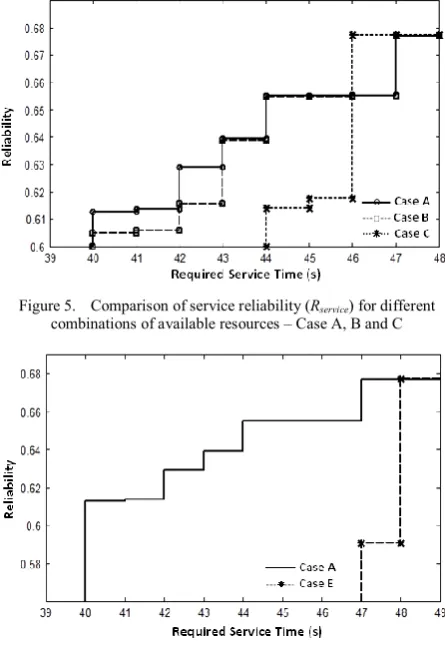
The comparison of reliability of Case A, B and C is presented in Fig. 5. It is shown that if more resources participate in completing the tasks, the reliability will increase. Although Tmin of Case A and Case B is the
same, Case A is more reliable than Case B. It can be inferred that all the value of R(Ti) in Case A is higher
than in Case B. Case C uses less resources than Case B. Although the value of R(Tmin) of Case C is higher than
Case B, but the reliability for the same Ti values in Case
B is always higher than Case C.
Fig. 6 presents the reliability of full replication condition (Case A) compared to no replication condition (Case E). It is shown that the reliability of Case A is better than Case E. The required service time of Case A is also smaller than Case E. It can be concluded that the task replication will increase the reliability and decrease the required service time of resource allocation in mobile ad hoc grid.
The same number of resources that finish the tasks but with different condition of replication number in the graph will result in different reliability as shown in Fig. 7. Case C and D use the same number of resources but with different replication tasks. It is shown that Case C has less Tmin and superior reliability compared to Case D.
This indicates that for a job that include dependent task, the scenario of replication number of each task will greatly affect the reliability of the whole job.
Fig. 8 presents the comparison of service reliability of Case A, E, and F. It is interesting to note that the reliability of Case F (the same number of replication for all tasks) is better than Case A (different number of replication for each task). This result provides further support for the hypothesis that performing the same replication number for all the tasks will give higher reliability and shorter required service time of resource allocation in mobile ad hoc grid. However, further studies should be done to investigate the optimum number of task replication that satisfy mobile ad hoc grid environment.
Figure 8. Comparison of service reliability (Rservice) for Case A, E, and F
Figure 7. Service reliability (Rservice) for case with task replication (Case A) compared with no task replication (Case E)
Figure 6. Service reliability (Rservice) for case with task replication (Case A) compared with no task replication (Case E) Figure 5. Comparison of service reliability (Rservice) for different
combinations of available resources – Case A, B and C TABLE III.
Case Tmin R(Tmin) Tmax R(∞)
A 40 0.6127 44 0.6768
B 40 0.6049 44 0.6770
C 44 0.6139 46 0.6773
D 44 0.6135 45 0.6771
E 47 0.5907 48 0.6771
VII. CONCLUSION
A fault-tolerant resource allocation is highly needed in the severe environment of mobile ad hoc grid. In this work, we propose two approaches in resource allocation of mobile ad hoc grid for avoiding tasks failure due to nodes mobility. The first is selecting resource nodes, which have corresponding mobility with resource management system, is expected to ensure that the tasks will be properly completed. The second is implementing task replication, which is expected to increase the service reliability.
In this paper, we also analyze the reliability of the resource allocation with tasks replication in mobile ad hoc grid using the hierarchical model. By means of the model, the reliability of mobile ad hoc network could be taken into account. The result of an analytical example shows that assigning tasks replication provides superior reliability in mobile ad hoc grid. Tasks replication could also minimize the required service time for completing all the tasks. However, it turns out that a certain combination of task replica number will give different reliability. In the future, we will study the optimization of task replica for a certain failure probability in mobile ad hoc grid.
REFERENCES
[1] H. Kurdi, M. Li, and H. Al-Raweshidy, “A Classification of Emerging and Traditional Grid Systems,” IEEE Distributed Systems Online, vol. 9, no. 3, March 2008. [2] T. Abdullah, "Mechanisms for self-organizing ad hoc
grids," Doctoral dissertation, TU Delft, Netherlands, 2010. [3] S.C. Shah, "Energy Efficient and Robust Allocation of Interdependent Tasks on Mobile Ad hoc Computational Grids," PhD dissertation theses, Korea University, February 2012.
[4] Z. Li, L. Sun, E.C.Ifeachor, “Challenges of mobile ad-hoc grids and their applications in e-healthcare,” Proceedings of Second International Conference on Computational Intelligence in Medicine and Healthcare, 2005.
[5] R. Garg and A. K. Singh, “Fault Tolerance In Grid Computing: State of the Art and Open Issues,”
International Journal of Computer Science & Engineering Survey (IJCSES), vol.2, no.1, pp. 88-97, Feb 2011. [6] P. Latchoumy and P. S. A. Khader, "Survey on Fault
Tolerance in Grid Computing," International Journal of Computer Science & Engineering Survey (IJCSES), vol.2, no.4, November 2011.
[7] S.C Shah, S.H. Chauhdary, A.K. Bashir, M.S.Park, “A Centralized Location-Based Job Scheduling Algorithm for Inter-dependent Jobs in Mobile Ad Hoc Computational Grids,” Journal of Applied Sciences, vol.10, no. 3, pp.174-181, 2010.
[8] S.C Shah, M.S.Park, "An Energy-Efficient Resource Allocation Scheme for Mobile Ad Hoc Computational Grid," Journal of Grid Computing, vol. 9, no. 3, pp. 303-323, 2011.
[9] K.A. Hummel, G. Jelleschitz, "A Robust Decentralized Job Scheduling Approach for Mobile Peers in Ad-hoc Grids,"
CCGrid, Seventh IEEE International Symposium on Cluster Computing and the Grid (CCGrid '07), pp. 461-470, 2007
[10] A.T.A. Gomes, A. Ziviani, L.D.S. Lima, M. Endler, “Performance Evaluation of A Discovery and Scheduling Protocol for Multihop Ad Hoc Mobile Grids,” Journal of
the Brazilian Computer Society, vol.15, no.4, pp. 15-29, 2009.
[11] S. Shivle, H.J. Siegle, A.A. Maciejewski, P. Sugavanam and T. Banka et al., “Static Allocation of Resources to Communicating Subtask in a Heterogeneous Ad hoc Grid Environment,” Journal Parallel Distributed Computing, Elsevier, vol.66, no.4, pp. 600-611, 2006
[12] A. Litke, D. Skoutas, K. Tserpes, & T. Varvarigou, “Efficient task replication and management for adaptive fault tolerance in mobile grid environments,” Future Generation Computer Systems, vol.23, no.2, pp. 163-178, 2007
[13] C. Dabrowski, "Reliability in grid computing systems,"
Concurrency and Computation: Practice and Experience,
vol. 21, no.8, pp. 927-959, 2009
[14] G. Levitin, Y.-S. Dai, and H. Ben-Haim, “Reliability and Performance of Star Topology Grid Service With Precedence Constraints on Subtask Execution,” IEEE Transactions on Reliability, vol. 55, no. 3, pp. 507–515, Sep. 2006.
[15] Y.S. Dai, Y. Pan, X. Zou, "A Hierarchical Modeling and Analysis for Grid Service Reliability," Computers, IEEE Transactions on, vol.56, no.5, pp.681-691, May 2007. [16] Y.S. Dai and J. Dongarra, "Reliability and Performance
Models for Grid Computing," Grid and Cloud Computing: Concepts, Methodologies, Tools and Applications, pp. 119-151, 2012.
[17] J. Zhang, “An approach to analyze grid service reliability subject to failures,” Computer Science & Education, 2009. ICCSE'09. 4th International Conference on. IEEE, pp. 343–347, July 2009.
[18] S.H. Jang, J.S. Lee, “Mobile Resource Reliability-based Job Scheduling for Mobile Grid,” Korean Society for Internet Information (KSII) Transactions On Internet And Information Systems vol.5, no.1, pp. 83-104, 2011. [19] B. Wang; G. Chen; H. Luo; W. Zheng, "A Taxonomy and
Survey of Resource Management in Grid," Semantics Knowledge and Grid (SKG), 2010 Sixth International Conference on , pp.309,312, 1-3 Nov. 2010
[20] S. K. Hwang and D. S. Kim, “Markov model of link connectivity in mobile ad hoc networks,”
Telecommunication Systems, vol. 34, no. 1–2, pp. 51–58, Dec. 2006.
[21] G. Levitin, “A Universal Generating Function in the Analysis of Multi-state Systems”, in Krishna B. Misra (ed.), Handbook of Performability Engineering, Springer, pp. 449-450, 2008.
Sri Chusri Haryanti received her B.Sc. and Master degrees in Electrical Engineering from Universitas Indonesia. She is a lecturer at Universitas YARSI, Jakarta, and currently she is a PhD candidate at Electrical Engineering Department of Universitas Indonesia. Her research interest includes mobile computing and mobile ad hoc grid.