502
Screening Of Novel Antibiotic From Streptomyces
Griseus To Control Pyogenic Infection Causing
Multidrug Resistant Staphylococcus Aureus
Saravana kumari. P, Balachandar. S, Dhanabalan. R
Abstract: Recent studies by epidemiology surveys on acquiring the potential of drug resistance among Staphylococcus aureus delineated that drug resistance is tremendously increasing due to the high rate of mutation in virulence genes of pathogens. Apart from the emergence of Methicillin resistant Staphylococcus aureus (MRSA), Vancomycin resistant cases also increased 170% within last one decade, indicating a need for continued surveillance and to search and develop prospective agent to treat drug resistant pathogens. Present study aimed to screen for novel antibiotic from Streptomyces sp., isolated from undisturbed areas. Alkaline to acidic range of soil samples from different part of Western Ghats regions in and around Coimbatore district of Tamil Nadu were collected and upon processing thirty different Streptomyces species with unique morphological features were identified. Antibiotic production against pathogenic, multidrug resistant Staphylococcus aureus (AR, CR, ChR, CdS, ER, GR, MR, OR, VR) isolated from suppurative wound swab used in the study along with a reference strain S. aureus MTCC740 (AR, CS, ChR, CdR, ER, GS, MR, OR, VS). By the primary screening for antibiotic production from thirty Streptomyces sp., maximum zone of inhibition of 27mm showing organism belonging to Streptomyces griseus, was identified and confirmed by 16S rDNA sequencing. Antibiotic was partially purified from the S. griseus and minimal bacteriocidal concentration (MBC) of antibiotic against test pathogens S. aureus MTCC740 and clinical pathogen recorded as 128µg/ml and 256µg/ml respectively. Minimal inhibitory concentration (MIC) for S. aureus MTCC740 was confirmed as 8µg/ml and against the clinical isolate as 32µg/ml. Recorded MIC and MBC concentrations of novel antibiotics required to control the pathogens were comparatively lower than the antibiotics used in treatment at present. Thereby the study recommends the potential use of novel antibiotic purified from new strain of Streptomyces griseus as drug, after complete purification, characterization and toxicity assay as drug to treat emerging pan drug resistant clinical pathogens of S. aureus.
Index Terms: Multidrug resistance, Staphylococcus aureus, Streptomyces griseus, Antibiogram, MIC and MBC. ————————————————————
1
I
NTRODUCTIONDevelopment of multidrug resistance among the pathogenic bacteria poses a major threat in the treatment of microbial infections. From a long history, it has been recognized that microbial infections especially bacterial infections in human causes high morbidity and mortality rate. Improper use of antibiotics for treatment of primary infections or secondary infections becomes difficult to treat such infections and have become very complicated. In certain cases, administration of drug caused serious side effects and is ineffective against mutant strains of bacteria which increased the rate of death in human and animals. Death rate in Europe due to development of antibiotic resistance was estimated as 33, 000 in 2018 that was estimated as 2.6 times higher than previous year [1], 23, 000 cases in US during 2013, and in India, the Center for Disease Dynamics, Economics policy in 2015 reported that infections due to drug resistant bacterial infections resulted in 13% increase in mortality in hospitals. Further research studies on development of multidrug resistant organisms suggested that more than 2 million people are estimated dies to due to infections caused by antibiotic resistant bacterial pathogens all over the world. Normal flora of 50% to 60% of individuals is intermittently or permanently colonized with
Staphylococcus aureus, due to the reason relatively high potential to cause pyogenic infections in human was recorded worldwide which results in increasing public health problem [2], [3] especially in diabetic persons. Bacterial pathogen invades the host system, establishes by biofilm formation which protects pathogen from host immune system and external defense mechanisms. The production of staphylococcal bacterial toxins and virulence factors including α-hemolysins, penton valentine leukocidin, phenol soluble modulins, arginine catabolic mobile element and an imbalanced expression of regulatory gene agr results in skin lesions formation, host cell lysis and enhances pathogenesis. Invariable prescription and use of antistaphylococcal antibiotics to treat such infections made three fold increase in infection rates of S. aureus associated abscesses and cellulitis formation was recognized worldwide from primary care settings [4], [5]. Drug resistance to first line of drugs to treat pyogenic infections caused by Staphylococcus aureus are wide spread and developed resistance to methicillin and such pathogens are called as methicillin resistant Staphylococcus aureus (MRSA), which are estimated to cause 64% of infections in hospitals. Apart from that morbidity rate is comparatively more than death rate in infections caused by non-resistant form of S. aureus. In a study conducted by the Indian Network for Surveillance of Antimicrobial Resistance at 15 tertiary care centers on S.aureus isolates, found 41% prevalence rate of MRSA, and also recorded a high rate of resistance to ciprofloxacin, gentamicin, cotrimoxazole, erythromycin, and clindamycin by the isolates [6]. Similar pathological conditions observed both in methicillin sensitive and resistant cases. In severe cases of pyogenic infections further pathological conditions complicated with lung and pleural infection. Rate of recovery is comparatively low; in temperate climatic conditions results in complicated conditions such as infections associated with HIV infections. In patients with chronic disorders like diabetic leads to persistent infection and act as another reason for emergence of multidrug
————————————————
Saravana kumari. P is currently working as Associate Professor in the Department of Microbiology, Rathnavel Subramaniam College of Arts and Science, Coimbatore, India, PH-91-94423 86269. E-mail: [email protected]
S. Balachandar is currently working as Associate Professor in the Department of Microbiology, Rathnavel Subramaniam College of Arts and Science, Coimbatore, India. E-mail: [email protected] R. Dhanabalan is currently working as Associate Professor and Head in
503 resistant pathogen [7]. Pyogenic infections are primary cause
of death in tertiary care hospitals among patients of below 5 years, immunocompromised individuals and in elderly people. Where the pan drug resistant pathogens like Staphylococcus aureus, Pseudomonas aeruginosa, Streptococcus sp., Proteus sp., etc., cause multitudes of infectious pattern and ultimately results in death. Streptomyces species are known for their ability to produce most of the antibiotics (80%) as secondary metabolites. Streptomyces sp., are highly resistant to external stress, so commonly recommended to search for newer antibiotics as well as commercial scale production of antibiotic. Moreover these organisms acquire the characteristic of novel antibiotic production through artificial or natural genetic selection method [8]. Antibiotics purified from these organisms specifically act on pathogens by interfering with DNA replication and synthesis of RNA / cell wall / protein. Still many number of antibiotic need to be explored from these organisms. According to the environmental conditions and microbial competitions in natural environment, the Streptomyces sp., undergoes adaptive evolution to produce new antibiotics, which satisfies the need for the development of new antibiotics against emerging multidrug resistant pathogens. Production of new antibiotic by the Streptomyces sp., was poorly understood, but many antibiotic are known to produce by Streptomyces sp., about 383 antibiotics are produced by Micromonospora sp., 286 compound produced by Streptomyces hygroscopicus, 290 compounds by S. lavendulae and 278 by Nocardia sp., [9]. Existing antibiotics were proven to have antitumour, antiviral and antioxidant activity apart from their antimicrobial activity. According to the pattern of evolution of drug resistant pathogens, antibiotic producing organisms also evolves tremendously and produce new antibiotics. So, continuous isolation and evaluation of new antibiotic producing strains from the environment yields chemically advanced antibiotics to restrict the growth of emerging pathogens such as pyogenic infection causing, pan drug resistant Staphylococcus aureus.
2
M
ATERIALS ANDM
ETHODS2.1 Isolation of Streptomyces sp., from soil samples In order to isolate new antibiotic producing Streptomyces sp., undisturbed 13 different soil samples from Western Ghats regions in Coimbatore district of Tamil Nadu, located between 76o45'E, 11o0'N extending Anamalais 10o-12o5'E,11o7'N and Doddabetta 11° 33′ 0″ N, 76° 37′ 30″ E were located. About 100g of subsurface soil samples were collected aseptically and stored at -4°C till processing of the samples. The collected soil samples were dried at 60oC for 1 hr in order to accelerate the growth of actinomycetes spores and to control the growth of unwanted microorganisms. Under aseptic conditions, soil samples were serially diluted and plated on nutrient agar (NA) and yeast extract malt extract (YEME) medium with ampicillin (10μg/ml) and cycloheximide (60μg/ml). After incubation, morphologically unique colonies were subcultured and used for further study [10].
2.2. Identification of actinomycetes
The isolated organisms were subcultured and incubated at 37oC for 72hrs on International Streptomyces project (ISP-2) agar and used to study the cultural characteristics of the organisms. Selected pure culture of organism was further identified by cover-slip method, biochemical tests [11] and
amplification of purified 16S rDNA using specific primers (Sm6F 5′-GGTGGCGAAGGCGGA-3′, Sm5Rb 5′-GAACTGAGACCGGCTTTTTGA-3′) [12] in RT-PCR, 16S rRNA sequencing and by BLASTN program.
2.3 Selection of pathogenic organisms
Pathogenic, pyogenic infection causing Gram positive organism, Staphylococcus aureus isolated from clinical specimen and standard bacterial pathogen Staphylococcus aureus MTCC740 was procured and used as reference strain. Fifty suppurative, pus swabs from ulcerative wounds of diabetic persons were selectively collected from Microbiology department of Bioline Laboratory, Coimbatore and subcultured directly on Mannitol salt agar (MSA) for selective isolation and identification of pathogen. Selected pathogens were subcultured on mannitol salt agar and confirmed by biochemical tests [13].
2.4 Determination of antibiogram pattern of pathogens The pathogenic organism selected were subcultured in nutrient broth and incubated at 37oC for overnight. The turbidity of the media was adjusted and equalized to 0.5 Mc Farland standard of Barium chloride solution (0.5ml 0f 0.048 mol/l BaCl2 in 99.5 ml of 0.18 mol/l of H2SO4), indicated the
presence of 1 X 10⁸ cells/ml of the broth. Muller Hinton agar plates were prepared and swabbed aseptically with test pathogens. Aseptically a set of antibiotic discs at standard active concentration were placed on the swabbed plate viz; Ampicillin (10 µg) (A), Cephalothin (30 µg) (C), Clindamycin (2 µg) (Cd), Chloramphenicol (30 µg) (Ch), Erythromycin (15 µg) (E), Gentamicin (10 µg) (G), Oxacillin (1µg) (Ox), Vancomycin (30 µg) (V), and Methicillin (50 µg) (M) carefully. The plates were incubated at 30oC for 24hrs and antibiotic activity assayed on the presence of zone of clearance around the discs measured in millimeters [14].
2.5 Primary screening for antibiotic production by isolated Streptomyces sp.
The culture filtrate (40 µl) collected from isolated Streptomyces sp., were evaluated against the broth cultures of test pathogens standardized to 0.5 Mc Farland standards for the qualitative determination of antibiotic production by well diffusion assay. Exactly 40 µl of culture filtrate of each isolate was poured into 6 mm wells made on culture plates swabbed with selected drug resistant pathogen and standard organism and results were subjected to standard statistical tests [15].
2.6 Partial purification of antibiotics
A single Streptomyces sp., showing >27mm of zone of inhibition was selected and subcultured separately in ISP-2 broth for 7 days at 30oC. The culture broth was centrifuged at 10,000 rpm for 5 minutes to achieve the sedimentation of vegetative cells. The cell free supernatant was collected and mixed with equal volume of ethyl acetate (1:1 (v/v)) and continuously mixed in rotatory shaker at 150 rpm. The organic phase was collected separately and evaporated to dryness [16].
2.7 Determination of MIC and MBC of antibiotic
504 except the first test tube having 4ml of broth. Exactly 1024 µg
of partially purified antibiotic was introduced into the first test tube and vortexed, then 2 ml of diluted suspension was transferred to next test tube aseptically, similarly dilutions were carried out till 11th test tube where the concentration of antibiotic was 1 µg. A test tube without antimicrobial agent act as negative control and a test tube having 2 ml broth with 25µg of Amphotericin B were used as the positive control. In each test tube 10 µl of inoculum of pathogens prepared according to CLSI standard, inoculated aseptically and incubated at 37oC for 24 hrs. After incubation turbidity of each tube was determined at 585nm and presence/absence of growth determined by streaking on nutrient agar plate for confirmation [17]. The tests were performed in triplicates and the recorded results were analysed using standard statistical tool for interpretation.
3
R
ESULTS ANDD
ISCUSSION3.1 Cultural characteristics
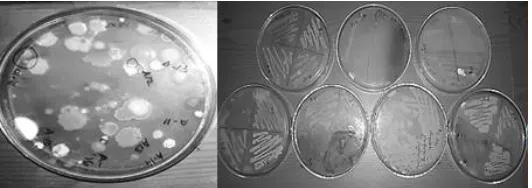
Thirty different Streptomyces species with unique morphological features were identified from collected 13 different soil samples. The selected colonies showed difference in colony colour, size, elevation, margin, odour, diffusible pigment production at the back side of the colony and dryness (table 1). The organism Streptomyces sp., commonly generates from a single spore to form horizontal and deep vertical hyphae, when hyphal segmentation occurs, the death of the deeper layers of the mycelia and sporulation take place. Interestingly, some of the spores formed germinate, giving rise to a new cycle of mycelial growth, cell death, and sporulation. This process is repeated several times, and typical, morphologically heterogeneous Streptomyces colonies grow. The same process was observed all species with minor differences mainly in the developmental time and spore colour. Studies on colony morphology of the isolates revealed that high degree of correlation between 500 species of Streptomyces sp., isolates and their ability to produce pigment which enables the spores to survive better in highly stressed environment [18]. In present study diverse group of Streptomyces sp., were recognized from the soil and more abundant distribution was recorded in lime soil and red soil (Fig. 1; Table. 1).
Fig. 1. Isolated Streptomyces sp.
TABLE 1. CHARACTERISTICS OF SOIL SAMPLE AND ISOLATED BACTERIAL POPULATION
Soil sample showed varying degree of moisture content and pH and compared for the distribution of heterotrophic eubacteria and Streptomyces species. Distribution of
eubacteria was abundant and their ranged between 32 X 10
6
and 74 X 10
8
CFU/g of soil sample. But proportionate to the larger size of the Streptomyces sp., comparatively lower
number; too few to count (TFTC) to 49 X 10
6
propagules/g of soil was recorded and their distribution was abundant in alkaline, dry and lime soil sample. Variation in soil pH depends on the entry of various additives into the soil, for example application of fertilizers decreases the soil pH which eliminates the rhizosphere flora of the soil environment in turn affects the
soil health. At lower pH growth of all bacteria including
505 3. 2 Isolation of pyogenic Staphylococcus aureus
Staphylococcus aureus is the normal flora of the skin, so the chances of getting it presence positive is high in samples from wound infection, certainly in case of ulcerative, suppurative lesions of diabetic persons. So that, out of 50 processed samples 24 (48%) samples showed positive and among them organism showing multidrug resistance was selected for the further study. A cross sectional survey on positive bacterial infected cases on diabetic foot ulcer cases made by Nelson, et al., in 2018 [22] reported that most prevalent pathogen in tissues of wound sample was Staphylococcus aureus of 43.8% out of 87% of clinically infected cases and were commonly diagnosed from the tissues of ulcerative wounds rather than pus sample. Complicated, pathological condition exhibited by the spread of infection from wound surface spreading towards soft tissue and eventually to bone [23]. Oligonucleotide microarray technique used for genetic level identification of pathogen on ulcerative lesion sample also concluded the presence of same phenotypic strains on the wound surface and deep infected tissue [24].
3. 3 Primary screening of Streptomyces sp., for antibiotic production
Among the isolated 30 strains of Streptomyces sp., S-7, S-15, S-20 and S-26 restricted the growth of pathogens to the maximum extent which was confirmed by the presence of above 20mm of zone of inhibition around the wells poured with culture filtrate from the isolates. Culture filtrate purified from certain isolates referred as 2, 4, 5, 11, 12, 14, S-16, S-17, S-18, S-20 to S–24, S-28 and S-29 showed insignificant (< 3 mm) inhibitory zone (Graph 1). The maximum zone of inhibition was exhibited by S-15 which restricted standard and clinical isolates of Gram positive pathogens S. aureus to 27+2mm. The result substantiates that Streptomyces sp., are well known for antibiotic production. Apart from production of known antibiotics from the isolates, present study aimed to explore the synthesis of new broad spectrum antibiotics by Streptomyces sp., which is quite essential to control multidrug resistant pathogens. While searching for newer antibiotics by Nooshin et al., in 2015 [25] recognized emergence of streptomycetes to produce antibiotics against a series of multidrug resistant Gram positive and Gram negative organisms by Streptomyces flavogriseus ACT2. Similar activity of antibacterial and antifungal activity of several Streptomyces sp., isolated from different niches such as leaf surface by Streptomyces sp., J12 was explored [26].
3. 4 Identification of Streptomyces sp.
Even though 30 organisms were isolated, maximum antibiotic producing organism S-15 alone chosen from the primary screening and subjected for further identification studies. Microscopic observation of isolate S-15 showed established hyphae with lengthy chains of spores arranged in with spiral or hook like ends, the morphology was similar to the genus streptomycetes [27]. The isolate utilized the sugars such as fructose, xylose, mannose, rhamnose, except mannitol and hydrolyzed casein [28]. DNA from the isolate was purified and 16S rDNA was amplified using specific primer in RT-PCR and sequencing was performed. The sequence was compared with all databases in NCBI by BLASTN 2.9.0+ and 98.78% of similarity was obtained with already existing organism of Streptomyces griseus strain KACC 20084 with 0.0 E-value and accession number of NR 042791.1d [29], [30] (Table 2). So, the isolated organism was identified and confirmed as Streptomyces griseus.
3. 5 Antibiogram patterns of selected pathogens
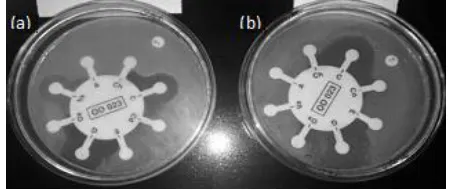
Two different Strains of Staphylococcus aureus causing pyogenic infections were selected for the study and their sensitivity pattern to various commonly used antibiotics were assayed and results were interpreted according to the CLSI guidelines. Antibiogram of S. aureus MTCC740 was AR, CS, ChR, CdR, ER, GS, MR, OR, VS, and the clinical pathogens of S. aureus was AR, CR, ChR, CdS, ER, GR, MR, OR, VR (Fig. 2). Standard pathogens selected for the study was multidrug resistant pathogen; compared to it the clinical isolates showed high degree of resistant to antibiotics such as Cephalothin and Vancomycin resistant and sensitive to Clindamycin. So, the test pathogen S. aureus used in the study was recognized as Methicillin and Vancomycin resistant pathogen and considered to be the major threat to the society. Gram positive organisms, S. aureus pose potential threat to the society and cause health care associated threat to community associated infections by acquiring high level of resistance gene clusters [31] coding for antibiotic synthesis [32]. According to the WHOs report on 27th February 2017 states that antibiotic resistance is growing-up and there is an urgent need to develop new antibiotic to treat pyogenic infection causing pathogens S. aureus which is categorized as critical and high risk group of pathogen. By following the suitable purification procedure, a pure, white, crystalline precipitate measuring approximately 2 mg/ml of culture filtrate was obtained from the isolated Streptomyces griseus [33], [34]. The precipitate was lyophilized and stored.
506
TABLE 2. CHARACTERISTICS OF SOIL SAMPLE AND ISOLATED BACTERIAL POPULATION
3. 6 Determination of MIC and MBC
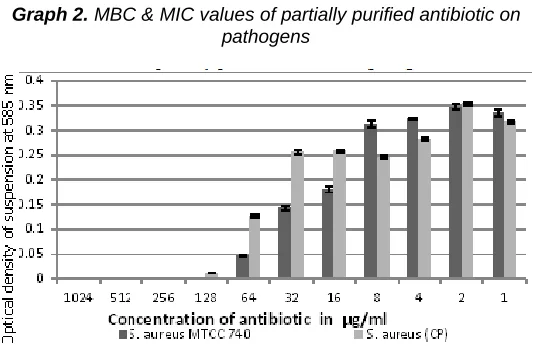
The minimum inhibitory concentrations (MIC) defined as the lowest concentration of antibiotic required to inhibit the growth of bacteria and minimum bactericidal concentration (MBC) is concentration required to metabolically inactivating the test pathogens. In order to determine MIC and MBC of antibiotic from the isolate was taken at concentrations of 1024 µg/ml to 1 µg/ml against pathogens assessed in terms of turbidity by presence/absence of growth in culture broth (Fig. 3). The following graph 2 shows MIC and MBC value of test clinical pathogen S. aureus and S. aureus MTCC740.
Fig. 3. Determination of MIC & MBC value of purified antibiotic from Streptomyces sp.
Graph 2. MBC & MIC values of partially purified antibiotic on pathogens
Minimum bactericidal concentration represented by zero turbidity by having blank as un-inoculated control. MBC of partially purified antibiotic for standard strain MTCC740 and clinical pathogen of S. aureus revealed clearly from the graph as 128µg/ml and 256µg/ml respectively. MIC for standard strain was 8µg/ml for S. aureus MTCC 740 and 32µg/ml for clinical isolate, S. aureus. As the clinical pathogen showed resistance to most of the existing antibiotic including methicillin and vancomycin exhibited comparatively increased resistance than the standard strain towards the purified antibiotic too. In another study using HPLC-purified antibiotic fraction from Bacillus subtilis URID 12.1 showed significant antimicrobial activity against multidrug-resistant strains of Staphylococcus aureus , and the MICs ranged from 0.5 to 16 μg/ml for methicillin and vancomycin-resistant Staphylococcus aureus (MVRSA) and methicillin-resistant Staphylococcus epidermidis (MRSE) strains [35]. These results validate the existence and continuous production of novel antibiotic to control emerging drug resistant pathogens. Newer antimicrobials, such as linezolid, remains as the last drug of choice to treat in patients with multi drug resistant S. aureus infections. In several cases of studies associated with S. aureus infections in immunocompromised individuals, common drug used to treat against MRSA infection are clindamycin, trimethoprim-sulfamethoxazole, ciprofloxacin, vancomycin, rifampicin and fusidic acid. But the organism often develops resistance even to intravenous injection of vancomycin, and cause persistent S. aureus bacteremia in patients, along with rifampin and ciprofloxacin resistance. At a last trial to save, oral linezolid combined with rifampicin and ciprofloxacin administrated; which also failed to treat the patient thereby MRSA is becoming a threat in treatment process [36]. Under clinical conditions, 25μg/ml to 500μg/ml of antibiotic generally recommended dosage to control the growth of MRSA. But in the present study the partially purified drug from Streptomyces griseus completely inhibited the highly resistant pan drug resistant clinical pathogen and reference strain MTCC 740 of S. aureus controlled at 128μg/ml concentration, so the novel antibiotic after complete purification, characterization and toxicity assay can be recommended as an efficient drug of choice to treat pan drug resistant S. aureus.
4
C
ONCLUSION507 antibiotics. Exploring the possibilities of such antibiotics can
help in accelerate the process of treatment of MDR infections in immunocompromised individuals or diabetic patients or infections in elderly persons.
F
UNDINGAuthors express their gratitude to the Dr. K. Senthil Ganesh, Managing trustee and Dr. T. Sivakumar, Principal of Rathnavel Subramaniam College of Arts and Science for funding and contingency grant which has been utilized for sample collection and procurement of reference strain.
C
ONFLICT OF INTEREST STATEMENTThe authors declare that the research was conducted without any conflict of interest.
A
CKNOWLEDGMENTAuthors sincerely acknowledge Dr. Krishnan Subbiah, Senior Scientific Officer, Rathnavel Subramaniam College of Arts and Science for scientific support.
E
THICS STATEMENTThroughout the study none of the samples were directly collected from human or animal samples.
R
EFERENCES[1] Chris Dall. European study: 33,000 deaths a years from resistant infection. In: Center for Infectious Disease Research Policy. November issue, 2018.
[2] Wertheim H.F., Melles D.C., Vos M.C., van Leeuwen W., van Belkum A., Verbrugh H.A., and Nouwen J.L. The role of nasal carriage in Staphylococcus aureus infections. Lancet Infect Dis. 5:751–762, 2005.
[3] Gorwitz R.J., Kruszon-Moran D., McAllister S.K., McQuillan G., McDougal L.K., Fosheim G.E., Jensen B.J., Killgore G., Tenover F.C., and Kuehnert M.J. Changes in the prevalence of nasal colonization with Staphylococcus aureus in the United States, 2001-2004. J Infect Dis. 197:1226–1234, 2008.
[4] Hayward A, Knott F, Petersen I, Livermore DM, Duckworth G, Islam A, and Johnson AM. Increasing hospitalizations and general practice prescriptions for community-onset staphylococcal disease, England. Emerg Infect Dis. 14:720–726, 2008.
[5] Saxena S , Thompson P , Birger R , Bottle A , Spyridis N , Wong I , Johnson A. P., Gilbert R , and Sharland M. Improving Children's Antibiotic Prescribing Group. Increasing skin infections and Staphylococcus aureus complications in children, England, 1997-2006. Emerg Infect Dis. 16:530–533, 2010.
[6] Indian Network for Surveillance of Antimicrobial Resistance (INSAR) group. Methicillin resistant Staphylococcus aureus (MRSA) in India: prevalence & susceptibility pattern. Indian J Med Res. 137(2):363–9. Feb 2013.
[7] Steven Y. C. Tong, Joshua S. Davis, Emily Eichenberger, Thomas L. Holland, and Vance G. Fowler Jr. Staphylococcus aureus Infections: Epidemiology, Pathophysiology, Clinical Manifestations, and Management. American Society for Microbiology Journals. 28(3): 603—661, 2015.
[8] Houssam M Atta. Biochemical studies on antibiotic production from Streptomyces sp.: Taxonomy, fermentation, isolation and biological properties. Journal of Saudi Chemical Society. 19(1):12-22, 2015.
[9] Dhananjeyan V., Selvan and Dhanapal. K. Isolation, Characterization, Screening and antibiotic sensitivity of actinomyces from locally collected soil samples. Journal of Biological Sciences, 10(6): 514-519, 2010.
[10]Passari, A. K., Mishra, V. K., Saikia, R., Gupta, V. K., and Singh, B. P. Isolation, abundance and phylogenetic affiliation of endophytic actinomycetes associated with medicinal plants and screening for their in vitro antimicrobial biosynthetic potential. Frontiers in microbiology, 6, 273, 2015.
[11]Korn-Wendisch, F., and Kutzner, H.J. The Family Streptomycetaceae. The Prokaryotes. In A Handbook on the Biology of Bacteria: Ecophysiology, Isolation, Identification, Applications. Chapter 41. Springer-Verlag. Berlin, New York, pp 965–968, 1991.
[12]Paolo Monciardini, Margherita Sosio, Linda Cavaletti, Claudia Chiocchini, and Stefano Donadio. New PCR primers for the selective amplification of 16S rDNA from different groups of actinomycetes, FEMS Microbiology Ecology, 42(3): 419–429, 2002. https://doi.org/10.1111/j.1574-6941.2002.tb01031.x [13]Uma devi S. Methicillin resistant Staphylococcus aureus
in pus samples. International Journal of Medical Science and Clinical invention, 4(12): 3374 – 3376, 2017..
[14]Hemamalini, V., Kavitha, V., and Ramachandran, S. In vitro antibiogram pattern of Staphylococcus aureus isolated from wound infection and molecular analysis of mecA gene and restriction sites in methicillin resistant Staphylococcus aureus. Journal of advanced pharmaceutical technology & research, 6(4), 170–175, 2015. doi:10.4103/2231-4040.165019.
[15]Bizuye, A., Moges, F., and Andualem, B. Isolation and screening of antibiotic producing actinomycetes from soils in Gondar town, North West Ethiopia. Asian Pacific Journal of Tropical Disease, 3(5):375–381, 2013. doi:10.1016/S2222-1808(13)60087-0.
[16]Raghava Rao, K. V., Mani, P., Satyanarayana, B., and Raghava Rao, T. Purification and structural elucidation of three bioactive compounds isolated from Streptomyces coelicoflavus BC 01 and their biological activity. Biotech, 7(1): 24, 2017. doi:10.1007/s13205-016-0581-9.
[17]Ginovyan, M., Petrosyan, M., and Trchounian, A. Antimicrobial activity of some plant materials used in Armenian traditional medicine. BMC complementary and alternative medicine, 17(1):50, 2017. doi:10.1186/s12906-017-1573.
[18]Euzeby, J.P. Genus streptomyces. List of Prokaryotic names with Standing in Nomenclature. 2008.
[19] Rousk, J., Brookes, P. C., and Bååth, E. Investigating the mechanisms for the opposing pH relationships of fungal and bacterial growth in soil. Soil Biol. Biochem. 42: 926–934, 2010. doi: 10.1016/j.soilbio.2010.02.009. [20] Ostash, B., Gren, T., Hrubskyy, Y., Tistechok, S.,
508 [21] Cruz-Morales, P., Ramos-Aboites, H. E.,
Licona-Cassani, C., Selem-Mójica, N., Mejía-Ponce, P. M., Souza-Saldívar, V., et al. Actinobacteria phylogenomics, selective isolation from an iron oligotrophic environment and siderophore functional characterization, unveil new desferrioxamine traits. FEMS Microbiol. Ecol. 93: 2017. fix086. doi: 10.1093/femsec/fix086
[22]Nelson A, Wright-Hughes A, Backhouse MR, et al. CODIFI (Concordance in Diabetic Foot Ulcer Infection): a cross-sectional study of wound swab versus tissue sampling in infected diabetic foot ulcers in England. BMJ Open; 8:2018. e019437. doi:10.1136/bmjopen-2017-019437
[23]Lavery L. A., Armstrong D. G., Wunderlich R. P., Mohler M.J., Wendel C. S., and Lipsky B. A. Risk factors for foot infections in individuals with diabetes. Diabetes Care, 29:1288–1293, 2006
[24]Albert Sotto, Jean-Louis Richard, Nathalie Jourdan, Christophe Combescure, Nicole Bouziges, and Jean-Philippe Lavigne. Miniaturized Oligonucleotide Arrays. Diabetes Care, 30(8): 2051-2056, 2007. DOI: 10.2337/dc07-0461
[25]Noorshin Khandan Desfully and Janardhana Gottravalli Ramanayaka. Isolation, identification and evaluation of antimicrobial activity of Streptomyces flavogriseusstrain ACTK2 from soil samples of Kodagu, Karnataka state (India). Jundishapur J. Microbiol. 8(2): e15107, 2015. [26]Salha H. M. Al Zahrani. Studies on the antimicrobial
activity of Streptomyces sp., isolated from Jazan. JKAU Sci, 19:127–138, 2007.
[27]Anderson, A.S. and E.M.H. Wellington. The taxonomy of streptomyces and related genera. Int. J. Syst. Evol. Microbiol., 51:797-814, 2001.
[28]Aouar, L. Lerat, S. Ouffroukh, A. Boulahrouf, A. and Beaulieu, C. Taxonomic identification of rhizospheric actinobacteria isolated from Algerian semi-arid soil exhibiting antagonistic activities against plant fungal pathogens. Canadian Journal of Plant Pathology, 34(2): 165-176, 2012.
[29]Zheng Zhang, Scott Schwartz, Lukas Wagner, and Webb Miller.A greedy algorithm for aligning DNA sequences. J Comput Biol. 7(1-2):203-14, 2000.
[30]Aleksandr Morgulis, George Coulouris, Yan Raytselis, Thomas L. Madden, Richa Agarwala, and Alejandro A. Schäffer. Database Indexing for Production MegaBLAST Searches, Bioinformatics. 24:1757-1764, 2008.
[31]Leelakrishnan S and Palaniswamy C. Exploring the ability of Streptomyces antibiotics to combat Methicillin-resistant Staphylococcus aureus using in silico studies. Adv App Sci Res, 3:3502, 2012.
[32]Allen H K, Donati J, Wang H, Cloud Hansen Davies, and Handelson. Call of wild: antibiotic resistance genes in natural environment. Nat Rev. microbial. 8: 251- 259, 2010.
[33]Zitouni A., Boudjella H., Lamari L., Badji B., Mathieu F., Lebrihi A., et al. Nocardiopsis and Saccharothrix genera in Saharan soils of Algeria: isolation, biological activities and partial characterization of antibiotics. Res Microbiol, 156:984-993, 2005.
[34]Ripa FA, Nikkon F, Rahman BM and Khondkar P. In vitro antibacterial activity of bioactive metabolite and crude extract from a new Streptomyces sp.
Streptomyces rajshahiensis. Int J PharmTech Res. 2(1): 644-648, 2010.
[35] Chalasani A. G, Dhanarajan G, Nema S, Sen R and Roy U. () An Antimicrobial Metabolite from Bacillus sp.:
Significant Activity Against Pathogenic Bacteria
Including Multidrug-Resistant Clinical Strains. Front. Microbiol.,6:1335, 2015. doi: 10.3389/fmicb.2015.01335 [36]Gao W, Chua K, Davies J. K, Newton H. J., Seemann T,
Harrison P. F., et al. Two Novel Point Mutations in Clinical Staphylococcus aureus Reduce Linezolid Susceptibility and Switch on the Stringent Response to Promote Persistent Infection. PLoS Pathog, 6(6):
e1000944, 2010.