3900 IJSTR©2019
www.ijstr.org
Design Of Mathematics Module For Mental
Retardation Students In Mathematical
Problem-Solving
Susiana, Suparman
Abstract: This study aims to develop a mathematical learning module design based on Indonesian Realistic Mathematics Learning which aims to improve the mathematical problem-solving abilities of mentally retarded students. This study uses the analysis design development implementation evaluation (ADDIE) model. The phase of this model includes analysis and design. The analysis phase carried out in this study included the analysis of teaching materials, student characteristics, and curriculum. The design phase carried out in this study includes the preparation of the module framework and designing the initial form of the module. The research subjects were Yogyakarta special school, mental retardation students. The object of this research is teaching materials, student characteristics, and curriculum. The study produced a needs analysis module mathematics learning Indonesian Realistic Mathematics Education based on the following problem-solving skills improve teaching materials, the characteristics of the students, and the curriculum. The module design consists of covers, identity pages, introductory words, table of contents, concept maps, learning activities, evaluation. The design used in the manufacture of modules using Microsoft Publisher 2013.. The results of the feasibility media module test results are in a very good category, with a score of 14.
Keywords: learning modules mathematics, problem solving, mental retardation
————————————————————
1 INTRODUCTION
Problem-solving skills are at the heart of mathematics learning [1]. Troubleshooting includes part of efforts to respond to a condition when the clarity of the answers has not appeared [2]. Solving in mathematics is an activity to seek resolution of mathematical problems, using mathematical knowledge in an integrative provisions [3]. The general objective of mathematics learning problem solving skills [4]. Therefore, it is deemed important for the students problem-solving ability, because it can help solve contextual problems both in lessons and in daily. Students can not break away from mathematical problems, solving mathematical problems can occur if students think, so they can find solutions to problems encountered [5]. Mathematical problem solving ability is a crucial component in solving learning problems [6]. Effective implementation of mathematical problem solving in everyday life, not just do the math arithmetic operation, but related to the student's ability to use mathematical concepts in solving the problems of everyday life [7]. Therefore, providing contextual issues in the classroom will be invaluable in applications for students in their daily lives. Learning approach that is familiar with the real world including realistic mathematics education, membelajarkan through contextual issues, students are given the opportunity, guided solving to demonstrate its ability in solving mathematical problems [8] and [9]. Then, [10], [11], [12], [13] and [14] states that the use of realistic mathematics learning significantly improves students' mathematical problem solving
ability, compared with conventional methods or lectures. In addition, [15], [16] and [17] states that the teaching and learning of mathematics education is realistic Indonsia can improve students' ability in solving mathematical problems, from understanding the problems, devise strategies, perform calculations, and to re-examine the estimates obtained, which teramu of the test results of mathematical problem solving. Realistic mathematics education is learning math using a contextual approach, achieving the objectives of mathematics [18]. Conventional learning can be replaced with realistic mathematics education learning Indonesia, with which is expected to improve students' skills in mathematical problem solving. The development of mathematics teaching material should fit the purpose of learning mathematics in the curriculum, and the students' characteristics [19] and [20]. Teaching and learning of mathematics by realistic mathematics education approach Indonesia effectively requires learning resources to support learning, such as math module based Indonesian Realistic Mathematics Education. The module is one of the materials that are intended help students learn. The researcher is interested in designing a learning module of Indonesian realistic mathematics education on multiplication material, with the aim of helping the process of learning mathematics that affects the ability of students to solve mathematical problems.
2 RESEARCH METHODS
This study is research with this type of development. The products developed are math-based learning module Indonesian Realistic Mathematics Education (PMRI), to improve students' mathematical problem solving mental retardation. Research using ADDIE models. Phase of this model include analysis, design, development, implementation, and evaluation [21], [22], [23], [24] and [25]. This study is limited in two phases which analysis and design. Phase analysis conducted in this study includes analysis of teaching materials, the characteristics of the students, and the curriculum. Basis for the development of mathematics learning module is based on the analysis. The design phase is done in ————————————————
Susiana is currently pursuing master’s degree program in mathematics education at University Ahmad Dahlan, Indonesia Suparman is an associate professor in mathematics education at
3901 IJSTR©2019
the study include the preparation of the module framework and designing the initial shape of the module. The third phase of development. The stages used in this study are shown in Figure 1 of the module design flow.
Fig. 1. Module Design Flow
Figure 1 shows a process of the steps carried out in making the module. The first is conducting analysis, design, development, implementation, and evaluation. The analysis of teaching materials in this study refers to the use of teaching materials used in schools. The purpose of analyzing teaching materials in order to facilitate mentally retarded students, to help in understanding, and to help mentally retarded students in solving mathematical problems related to calculating operations related to multiplication. Characteristics analysis of students in this study were mentally retarded students. Curriculum analysis in this study is a curriculum used in learning for mentally retarded students. The design phase carried out in this study includes the preparation of a module framework which includes the selection of media to be used, the format selection in designing modules, and can be continued by designing and designing the initial form of the module. This study uses data collection instruments in the form of questionnaire and test guidelines in order to obtain the data required in the preparation of the module. Questionnaire in this study will be given to subject matter experts to assess the feasibility of the module. Tests in this study of mathematical problem solving ability test.
3 D
ISCUSSIONThe study was conducted by designing mathematical learning modules based Indonesian Realistic Mathematics Education improve students' mathematical problem solving abilities retarded. Competence to be achieved is shown in table 1.
Fig. 2. Design Module
TABLE1
BASIC COMPETENCE
No. Competencies
3.3 Recognize the concept of multiplication of two natural numbers that result up to 20 using concrete objects 4.3 Calculating the result of multiplying the result of two natural
numbers up to 20
Table 1 provides information that two basic competencies will be used in module development. Furthermore, analysis of the students do. Based on observations on learning activities conducted on SMPLB eighth grade students and teacher interviews by student characteristics analysis results obtained are poor problem-solving ability, visible from the students who are still hesitant to answer questions given by the teacher. Problem solving ability of students still need to be improved. In the module there are a number of things you want to achieve with the use of modules, while competency achievement in this module is shown in the table 2 index of achievement of competencies.
TABLE2
COMPETENCY ACHIEVEMENT INDEX
No. Learning Objects
1. Determine the sum of two numbers up to 20
2. Determine the outcome of repeated subtraction of two numbers up to 20
3. Determine the outcome operations of addition and subtraction of two numbers a maximum number of 100
If a graphic is to appear in print as black and white, it should be saved and submitted as a black and white file (grayscale or bitmap.). Table 2 index of achievement of competency, shows that there are three achievements to be done in the module. The first is to determine the sum of the two maximum numbers 20. Determine the results of repeated reductions of two maximum numbers 20. Determine the result of the addition operation and subtract two numbers from a maximum number of 100.
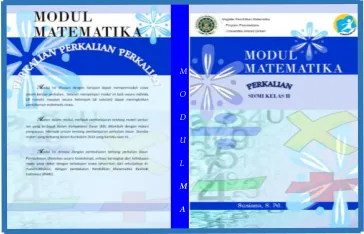
The design of the second phase, which aims to design modules developed. Stages in the design include the selection of media, format selection, preliminary design. Based on the task analysis, analysis of the concept, and the facilities available in schools, the media selected is the module. The following outlook of the initial design Realistic Mathematics Education guided learning modules based on Figure 2. The module cover includes the title, author's identity, student's identity, curriculum used, and supporting images. The module cover is presented in Figure 2, dominating blue, because it relates to the color of the cloud, which anyone can see including mentally retarded students. Flowers with six petals, related to multiplication material that will use flower petals as contextual material. Accompanied by numbers and symbols of multiplication, addition, and subtraction. The module cover can be seen in Figure 2.
M
O
D
U
L
M
A
T
E
M
A
3902 IJSTR©2019
www.ijstr.org
Figure 2 presents the module cover design that will be used in this study. The design of the module cover is made with bright colors, numerical drawings, counting operations and flower drawings that aim to attract students' interest in learning mathematics. The color selection is dominated by blue, because from the results of interviews with students that students like the color blue. Based on the results of student interviews, the module uses blue. The identity page, contains the title, author's name, supervisor's name, validator, module size, and media used in compiling the module. The cover page can be seen in Figure 3.
Fig. 3. Identity page
The identity page in figure 3, contains a description of the identity of a mathematical module, which aims to make it easier to recognize the identity of the module.
The introduction serves to provide the reader with the content or description contained in the module. The introduction can be seen in Figure 4.
Fig. 4. Foreword
The foreword in figure 4, contains a presentation that includes a thank you to God and people who helped write and apologize, but the opening also consisted of a general description of the subject and completed with descriptions that encouraged others to read the module. The table of contents contains a description of the layout of the parts in the module.
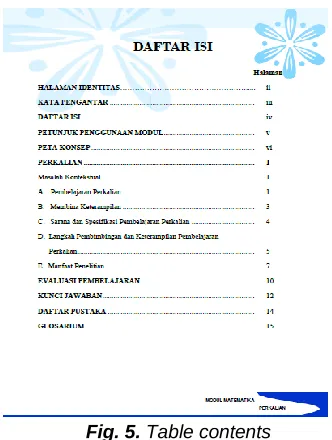
The table of contents is arranged in the order on the page in the module. The table of contents can be seen in Figure 5.
Fig. 5. Table contents
The table of contents in figure 4 serves to make it easier to find material that you want to learn to learn
Contains images of concept maps of multiplication material in mathematics learning modules. The concept map of the mathematics learning module can be seen in figure 6.
Fig. 6. Concept maps
3903
Fig. 7. Learning Activities
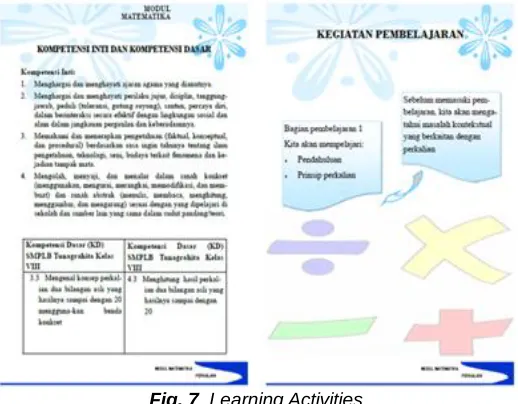
Mathematical Learning Activities the subject of multiplication. Learning with a realistic Indonesian mathematical approach, arranged in such a way so that the material studied is in contrast to the daily lives of students, and is formed mathematically. Learning will be facilitated by the material in the module. Facilitate students in learning, provide an overview of what students will learn. The material in the module is presented as shown in Figure 8.
Fig. 8. Material Description
Learning will be facilitated by the material in the module. Facilitate students in learning, provide an overview of what students will learn. The material in the module is presented as shown in Figure 8. The evaluation section of learning activities contains multiplication questions that have been learned. Evaluation of learning activities in the mathematics learning module can be seen in Figure 9.
Fig. 9. Evaluation
Evaluation in the form of ability test questions to measure students' understanding of multiplication material that has been learned. The problem is in the form of mathematical problem-solving questions about multiplicationThe formation of the development of instructional media in sequence and series include clarity of work instructions, the suitability of the format as a module, the suitability of the module with the concept or definition of the desired, color harmony, writing and drawing on the module, the suitability of color drawings and writings in practice problems, suitability appearance image and writing the material in the sequence and series. The initial design is referred to in this paper is the design of all activities carried out before the test is done. The results of the initial draft of this module is the draft I, presented in table 3.
TABLE3
ADVICE FROM THE EXPERT MODULE DESIGN
Comment Suggestion
Concept maps should be designed in accordance with the purpose of achievement of KD
Preferably map concept is designed in accordance with the KD to be achieved
3904 IJSTR©2019
www.ijstr.org
TABLE4
CALCULATION OF ELIGIBILITY QUESTIONNAIRE RESULTS MATERI
Evaluator Position Score
Criteria for Quantitative Data
Dr. Andriyani, M. Si
Ani Agus Riani, S. Pd., M.Pd.
Lecturer at the University of Ahmad Dahlan
Teacher at the International School
14
14
Very good and decent
Very good and decent
Based on table 4, it can be seen that the subject matter expert assessment score was 14. These results indicate that the developed learning media in terms of the material in the excellent category and decent. So we can conclude that instructional media design developed in terms of media modules included in the excellent category.
4
C
ONCLUSIONMaterial math module based on realistic mathematics education model Indonesia is the multiplication of two natural numbers. The design used in the manufacture of modules using Microsoft Publisher 2013. The feasibility media module test results are categorized as very good, with the acquisition of a score of 14.
A
CKNOWLEDGMENTThank you to the head of the National Trustees SLB, who gave permission to the researchers to carry out research at school, the teacher who has been pleased to share time during the research. Thanks to those who have helped in this study.
REFERENCES
[1] Sarbiyono, S. (2016). Implementation Approach Toward Realistic Mathematics Mathematical Problem Solving Ability Students. JRPM (Education Review Journal of Mathematics), 1 (2), 163-173.
[2] Siswono, Tatag YE (2018). Mathematics Learning-Based Filing and Troubleshooting Focus on Critical Thinking and Creative Thinking. Bandung: PT Young Rosdakarya
[3] Tarin, DE (2012). Mathematical Problem Solving Ability Analysis based measures Polya on Material Systems of Linear Equations Two Variables for eighth grade students of SMP Negeri 9 Surakarta in terms of reasoning abilities of students (Doctoral dissertation, UNS (the March University)
[4] Fatmawati, H., & Triyanto, T. (2014). Analysis of Critical Thinking Students in Mathematical Problem Solving Based on Topic Polya Quadratic Equations (research in Class X SMK Muhammadiyah 1 Sragen Year Lessons
[5] Masfingatin, T. (2013). Thinking Process School Students First In Math Problem Solving Judging from the Adversity Quotient. JIPM (Scientific Journal of Mathematics Education), 2 (1).
[6] Charisma, JY, & Sugiman, S. (2017). Mathematics Instructional Materials Development Oriented Problem Based on Mathematical Problem Solving
Ability and Achievement in Mathematics. Journal of Mathematics and Science Education, 5 (2), 142-151. [7] Setyaningrum, W., Primary, LD, & Ali, MB (2018).
Game-Based Learning in Problem Solving Method: The Effects on Students' Achievement. Emerging International Journal on Mathematics Education, 2 (2), 157-164.
[8] Krismiati, A. (2013). Application of Learning with Realistic Mathematics Education (PMR) In Flocking To Improve Mathematical Problem Solving Ability Students in class X SMA. Infinity Journal, 2 (2), 123-135.
[9] Soedjadi, R. (2014). Basics core Indonesian Realistic Mathematics Education. Journal of Mathematics Education, 1 (2).
[10]Misdalina, M., Zulkardi, Z., & Purwoko, P. (2013). Integral Material Development for High School (SMA) Approach Using Realistic Mathematics Education Indonesia (PMRI) in Palembang. Journal of Mathematics Education, 3 (1)
[11]Wahidin, W., and Sugiman, S. (2014). Influence PMRI approach to achievement motivation, problem solving skills, and learning achievement. Pythagoras: Journal of Mathematics Education, 9 (1), 99-109.
[12]Hand, IGA, Sadra, IW, and Ardana, IM (2014). Effect of 5e-Based Learning Cycle Model Problem Solving Ability of Mathematical Problem Solving Students Seen From Beginning Knowledge. Journal of Education and Learning Mathematics Indonesia, 3 (1).
[13]Anisa, WN (2015). The increase in mathematical problem-solving skills through realistic mathematics education learning for learners Junior High School in Garut. JP3M (Journal of Education Research and Teaching of Mathematics), 1 (1), 73-82.
[14]Sarbiyono, S. (2016). Implementation Approach toward Realistic Mathematics Mathematical Problem Solving Ability Students. JRPM (Education Review Journal of Mathematics), 1 (2), 163-173.
[15]Muchlis, EE (2012). The influence of Indonesian realistic mathematics education approach (PMRI) on the development of problem-solving ability of students grade II SD Kartika 1:10 Padang. Exacta, 10 (2), 136-139.
[16]Wahyuni, R. (2016). Improving Ability Mathematical Problem Solving Students with Indonesian Realistic Mathematics Education. Mosharafa: Journal of Mathematics Education, 5 (2), 85-9
[17]Pebriana, PH (2017). Improved Learning Outcomes Mathematical Approach By Applying Indonesian Realistic Mathematics Education (PMRI) Students of Class V SDN 003 Bangkinang. Scholar Journal: Journal of Mathematics Education, 1 (1), 68-79. [18]Melyanti, R., Rohana, R., & Syahbana, A. (2018). The
influence of Indonesian Realistic Mathematics Education Approach to Mathematical Problem Solving Ability based Adversity Quotient. AdMathEdu: Mathematics Education, Mathematics, and Applied Mathematics Journal, 8 (1), 23-34.
3905
[20]Charisma, JY, & Asman, A. (2018). Mathematics Instructional Materials Development Oriented Problem Based on Mathematical Problem Solving Ability and Achievement in Mathematics. Indonesian Journal of Mathematics Education, 1 (1), 34-46. [21]Cheung, L. (2016). Using the ADDIE models of
instructional design to teach chest radiograph interpretation. Journal of Biomedical Education, 2016. [22]Davis, A. L. (2013). Using instructional design principles to develop effective information literacy instruction: The ADDIE model. College & Research Libraries News, 74(4), 205-207.
[23]Jones, B. A. (2014). ADDIE Model (Instructional Design).