1
Effect of dietary nitrate supplementation on conduit artery blood flow, muscle
1oxygenation, and metabolic rate during handgrip exercise
2Jesse C. Craig1, Ryan M. Broxterman1,2, Joshua R. Smith1, Jason D. Allen3, and Thomas J. 3
Barstow.1 4
5
1
Department of Kinesiology, Kansas State University, Manhattan, KS, USA 6
2
Department of Anatomy and Physiology, Kansas State University, Manhattan, KS, USA 7
3
Department of Medicine, Duke University Medical Center, Durham, NC, USA and Department 8
of Kinesiology, University of Virginia, Charlottesville, VA, USA 9
10
Running title: Dietary nitrate and small muscle mass exercise 11
12
Corresponding author:
13
Jesse C. Craig 14
Department of Kinesiology 15
Kansas State University 16
Manhattan, KS, 66506 17
Tel: 785-532-4476 18
Fax: 785-532-6486 19
E-mail: [email protected] 20
2
Abstract
22
Dietary nitrate supplementation has positive effects on mitochondrial and muscle contractile 23
efficiency during large muscle mass exercise in humans, and on skeletal muscle blood flow (Q̇) 24
in rats. However, concurrent measurement of these effects has not been performed in humans. 25
Therefore, we assessed the influence of nitrate supplementation on Q̇ and muscle oxygenation 26
characteristics during moderate (40%peak) and severe (85%peak) intensity handgrip exercise in 27
a randomized, double-blind, crossover-design. Nine healthy men (age: 25±2 yrs) completed four 28
constant-power exercise tests (two per intensity) randomly assigned to condition (nitrate-rich 29
(Nitrate) or nitrate-poor (Placebo) beetroot supplementation) and intensity (40%peak or 30
85%peak). Resting mean arterial pressure was lower after Nitrate compared to Placebo (84±4 vs 31
89±4 mmHg; p<0.01). All subjects were able to sustain 10 min of exercise at 40%peak in both 32
conditions. Nitrate had no effect on exercise tolerance during 85%peak (Nitrate: 358±29, 33
Placebo: 341±34 s; p=0.3). Brachial artery Q̇ was not different after Nitrate at rest or any time 34
during exercise. Deoxygenated-[hemoglobin+myoglobin] was not different for 40%peak 35
(p>0.05), but was elevated throughout 85%peak (p<0.05) after Nitrate. The metabolic cost (V̇O2) 36
was not different at end exercise, however, the V̇O2 primary amplitude at the onset of exercise 37
was elevated after Nitrate for the 85%peak work rate (96±20 vs 72±12 ml/min; p<0.05) and had 38
a faster response. These findings suggest that an acute dose of Nitrate reduces resting blood 39
pressure and speeds V̇O2 kinetics in young adults, but does not augment Q̇ or reduce steady-state 40
V̇O2 during small muscle mass handgrip exercise. 41
3
New and Noteworthy
43
We show that acute dietary nitrate supplementation via beetroot juice increases the 44
amplitude and speed of local muscle V̇O2 on-kinetics parameters during severe- but not 45
moderate-intensity handgrip exercise. These changes were found in the absence of an increased 46
blood flow response, suggesting the increased V̇O2 was attained via improvements in fractional 47
O2 extraction and/or spatial distribution of blood flow within the exercising muscle. 48
49
Introduction
50Dietary nitrate supplementation is well documented to have positive effects during large 51
muscle mass exercise in humans (4, 33, 38, 48, 50). These effects include lowering oxygen 52
consumption (V̇O2) (4, 32, 38, 42), speeding V̇O2 kinetics (3, 6, 31, 32) and reducing the ATP 53
cost of work (2, 26) during submaximal exercise, which may translate to the enhanced exercise 54
tolerance found during severe intensity exercise (6, 31, 37, 50). The precise mechanism(s) for 55
these effects still remains uncertain, but they are facilitated through the reduction of the dietary 56
nitrate to nitrite by commensal bacteria in the mouth (40). Once absorbed into the circulatory 57
system, nitriteis readily converted to nitric oxide (NO) in hypoxic (16, 47) and acidic (41) 58
environments, which are expected to be present at the exercising muscle. 59
Nitric oxide is a potent vasodilator (20, 22, 45); as such it had been proposed that nitrate 60
supplementation may augment blood flow (Q̇) to active muscle. This was first experimentally 61
investigated in rats during submaximal treadmill running (23, 24). These authors found that 62
nitrate supplementation resulted in an increased Q̇ to the hindlimb, particularly to muscles 63
composed of greater percentages of type II fibers. These findings demonstrate that nitratemay 64
4
proportion to one another across a range of exercise intensities (1, 43). Recently the effect of 66
nitrateon Q̇ was investigated in human subjects (5, 12, 34), but no change in brachial artery 67
blood flow (Q̇BA) was found in healthy, young men and women during light-to-moderate 68
intensity handgrip exercise. These previous studies might not have recruited type II fibers in the 69
younger subjects due to lower intensity exercise, potentially missing the preferential effects of 70
dietary nitrate on higher order fiber types (for review see (30)). It should be noted, two of the 71
aforementioned studies did find improvements in compromised populations (i.e., older adults in 72
hypoxia (12) and ‘noncompensators’ (5)). 73
Importantly, these previous studies in humans using nitrate(12, 34), provided no measure 74
of V̇O2or fractional O2 extraction (which can be estimated noninvasively via deoxygenated-75
[hemoglobin + myoglobin] (deoxy-[Hb + Mb]) and used to estimate V̇O2) (7, 18, 19, 35). 76
Moreover, the measurements were made after fixed durations of moderate intensity submaximal 77
exercise and during the steady state, leaving the effects of nitrateon local muscle V̇O2 during the 78
exercise onset transient unknown. Since faster V̇O2 kinetics are associated with a reduction in the 79
O2 deficit (and thus accumulation of fatigue inducing metabolites), these findings carry important 80
implications for patient populations, such as chronic heart failure (CHF), as accumulating 81
evidence suggests nitrate supplementation may be effective for enhancing quality of life through 82
improvements in exercise and/or daily activity tolerance (21, 25, 51). 83
Therefore, the purpose of this investigation was to resolve whether acute supplementation 84
of nitrate preferentially provided positive effects in small muscle mass exercise during severe 85
intensity exercise, where type II fibers would be recruited and greater hypoxic and acidic muscle 86
environment exists. Specifically, we tested the hypotheses that with nitrate supplementation 87
5
intensity exercise; 2) V̇O2 would be elevated during severe intensity exercise and display faster 89
kinetics; and 3) tolerance of exercise (Tlim) would be increased during severe intensity exercise. 90
91
Materials and Methods
92Ten healthy, recreationally active men volunteered for the investigation (mean ± SD: age: 93
25 ± 2 yrs; height: 178 ± 4 cm; body mass: 80 ± 10 kg; BMI: 25 ± 3 kg/m2). All experimental 94
procedures in the present study were approved by the Institutional Review Board at Kansas State 95
University and conformed to the standards set forth by the Declaration of Helsinki. Prior to 96
participation in the study, all subjects were informed of the protocol, any possible health risks, as 97
well as the probable benefits of the study. All subjects provided written informed consent to 98
participate and completed a medical health history questionnaire to ensure absence of any known 99
cardiovascular or metabolic diseases which would preclude them from the study. 100
101
Experimental Protocol
102
All testing sessions were performed on a custom-built, two-handed handgrip ergometer 103
previously described by our laboratory (7, 8). Briefly, the subjects were seated in an upright 104
position at arm’s length from the ergometer with the hands pronated at heart level and directly in 105
front of their torso. All sessions were performed utilizing a 50% duty-cycle (1.5 s contraction, 106
1.5 s relaxation) and fixed 4 cm linear displacement that was maintained via audio cues. All 107
subjects were familiarized with the exercise, audio cues, and duty-cycle prior to the first testing 108
session. During the first visit, subjects performed an incremental test for the determination of 109
peak power (Ppeak) starting at 1 Watt (W) and increasing at a rate of 0.5 W·min-1. The test was 110
6
subject was unable to maintain the correct tempo or complete full contractions. Ppeak was 112
recorded as the highest power obtained in which the subjects completed at least 30 s of the stage. 113
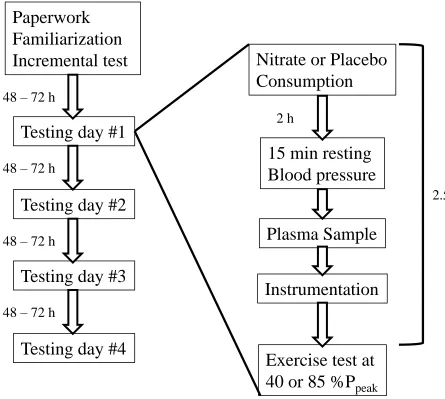
The four subsequent visits were randomly assigned to 40 or 85 %Ppeak (two tests per 114
intensity) and supplemental condition (see Supplementation below; Figure 1). The four constant 115
power tests were performed for 10 min or until exhaustion for 40 and 85 %Ppeak, respectively. 116
The coefficient of variation for tolerance of exercise (Tlim) at 85 %Ppeak intensity in our 117
laboratory is ~7% (8). All testing sessions were separated by 48 - 72 h and subjects were asked 118
to abstain from vigorous activity, food, and caffeine prior to testing for 12, 3, and 2 h, 119
respectively. Upon arrival to the laboratory, the subjects sat quietly for 15 min, after which 120
resting blood pressure measurements and subsequent plasma samples were obtained (See Figure 121
1). All exercise tests were performed at approximately the same time of day (± 1.5 h for each 122
subject) between 1000 and 1500 hours. 123
124
Supplementation
125
The exercise testing sessions were randomly assigned to nitrate or placebo beetroot 126
supplementation conditions (one of each per intensity; i.e., nitrate + 40 %Ppeak and placebo + 40 127
%Ppeak), creating a randomized, double-blind, crossover study design. In each condition, the 128
subjects consumed beetroot concentrate (2 x 70 ml providing ~13 mmol nitrate) or nitrate-129
depleted beetroot concentrate placebo (2 x 70 ml providing ~0.006 mmol nitrate; both Beet It 130
Sport, James White Drinks, Ipswich, UK). Subjects consumed the shots on their own outside of 131
the laboratory ~2.5 h before testing began to allow for maximal expression of plasma nitrite 132
concentrations ([nitrite]) (49, 50) (See Figure 1). This dose of nitrate was chosen because it was 133
7
subjects were asked to abstain from using mouthwash (29) and toothpaste or chewing gum that 135
contained triclosan, as these products serve to reduce the oral bacteria needed to facilitate the 136
conversion of nitrate to nitrite. Each exercise testing session was separated from the others by at 137
least 48 h to allow plasma [nitrite] adequate time to return to pre-supplementation concentrations 138
(50). Subjects were asked to maintain their normal diet with the exception of limiting foods high 139
in nitrate, such as spinach and arugula (39). No subjects reported taking any multivitamins or 140
anti-oxidant supplements. All subjects self-reported compliance with the supplemental protocol. 141
No subjects reported gastrointestinal discomfort; however, when subjects reported typical 142
symptoms (i.e., beeturia or red stools) they were assured this was a typical side effect of the 143
nitrate supplementation. 144
145
Measurements
146
Venous blood samples (5-6 ml) were separated into 1.5 ml Eppendorf tubes containing 5 147
μl heparin (concentration 1000U/ml) and centrifuged at 3250 rpm at 4 °C for 5 min within 1 min 148
of withdrawal. Plasma samples were then pipetted into separate Eppendorf tubes, flash frozen in 149
liquid nitrogen, and stored at -80 °C until later analysis. 150
The measurements of plasma nitrate and nitrite were performed within 30 min of thawing 151
via chemiluminescence with a NO analyzer (NOA 280i, Sievers Instruments, Boulder, CO, 152
USA). In order to obtain plasma nitrite levels and to avoid potential reduction of nitrate, 153
potassium iodide in acetic acid was used as a reductant. This reductant has the ability to reduce 154
nitrite to NO but is incapable of reducing higher oxides of nitrogen (i.e., nitrate), thus increasing 155
the specificity for nitrite. Plasma nitrate concentrations were obtained using the same apparatus 156
8
This stronger reductant reduces the sum of all nitrogen oxides with an oxidation state of +2 or 158
higher, which is predominately nitrate (μM), but also includes both nitrite (nM) and nitrosothiols 159
(nM). 160
Resting blood pressure was measured in the left arm using an automated patient monitor 161
(S/5 Light Monitor type F-LM1-03, Datex-Ohmeda General Electric, Finland) which makes use 162
of the oscillometric technique. To increase accuracy, this machine utilizes a 3-lead ECG to 163
monitor heart rate. This measurement was taken in triplicate and a mean value was obtained. 164
Exercising blood pressure was taken from the left ankle using the same patient monitor while the 165
subject was seated at the handgrip ergometer. During the measurement, subjects were asked to 166
remain still and allow their leg to relax. A correction factor (pressure = measured pressure – 167
(distance between the heart and ankle in meters x 76 mm Hg) was used to adjust for the 168
increased hydrostatic pressure present between the ankle and heart (27). Pilot work performed in 169
our lab validated the correction factor with measurements taken from the ankle and arm at heart 170
level. This pilot work also revealed that the increase in blood pressure during 85 %Ppeak handgrip 171
exercise exceeded the capabilities of the equipment to accurately measure ankle pressure so 172
pressure was only obtained for the 40 %Ppeak intensity. 173
The raw blood velocity profiles were measured in the right brachial artery using Doppler 174
ultrasound (Vivid 3, GE Medical Systems, Milwaukee, WI, USA) operating in pulse wave mode 175
at a Doppler frequency of 4.0 MHz with a phased linear array transducer probe operating at an 176
imaging frequency of 6.7 MHz, and were stored for post-hoc analysis. For all testing sessions the 177
Doppler gate was set to the full width of the brachial artery to ensure complete insonation and all 178
Doppler velocity measurements were corrected for the angle of insonation, which was adjusted 179
9
bifurcation of the brachial artery. Brachial artery diameters were measured in the transverse axis 181
using two-dimensional sonography. 182
Muscle and microvascular oxygenation status were measured noninvasively using a 183
frequency-domain multi-distance near infrared spectroscopy (NIRS) system (OxiplexTS, ISS, 184
Champaign, IL, USA) positioned over the belly of the left flexor digitorum superficialis (FDS). 185
Details of this technique have been described previously (7, 11). Briefly, this device consists of 186
one detector fiber bundle and eight light-emitting diodes (LED) operating at wavelengths of 690 187
and 830 nm (four LEDs per wavelength). The LED-detector fiber bundle separation distances are 188
2.0, 2.5, 3.0, and 3.5 cm. This NIRS device measures and incorporates the reduced scattering 189
coefficient (μs′), measured dynamically, to provide absolute concentrations (μM) for deoxy-[Hb 190
+ Mb] and total-[Hb + Mb]. The NIRS probe was calibrated prior to each test according to the 191
manufacturer’s specifications. The belly of the FDS of the left arm was identified using palpation 192
and EMG. The NIRS probe was secured along the belly of the FDS and was wrapped with an 193
elastic bandage to prevent shifting of the probe. The placement of the NIRS probe was marked 194
with permanent ink for reproducible positioning throughout the study. The NIRS data were 195
collected at 50 Hz and stored for post-hoc analysis. 196
The V̇O2 (ml O2·min-1) of the FDS was calculated for each minute of exercise using the 197
technique described previously (7), which integrates deoxy-[Hb + Mb] and Q̇BA. It was assumed 198
that the deoxy-[Hb + Mb] signal reflects exclusively deoxy-[Hb] [we acknowledge that the 199
signal contains deoxy-[Mb] as well (17)] and that the entire signal arises only from the muscle 200
(i.e., not from any interposing adipose or skin tissue). With these assumptions the deoxy-[Hb] 201
may be converted into an estimated V̇O2. The deoxy-[Hb] values are in units of μmole heme/l 202
10
μmole heme/l blood using the conversion 1.36% capillary blood volume/muscle volume [derived 204
from 400 cap/mm2, 28.3 μm2 CSA, and a coefficient of 1.2 correcting for tortuosity and 205
branching of the capillaries (44)]. These units can then be converted into mole O2/l blood 206
assuming 1mole O2/mole heme and further to l O2/l blood using the conversion 22.4 l O2/mole 207
O2. V̇O2 values in l O2/min may then be obtained by multiplying this value by the measured Q̇BA 208
values. This calculation was performed with the understanding that Q̇BA likely overestimates Q̇ 209
through the capillaries under the NIRS probe. However, because the same calculation (and 210
subsequent assumptions) was used across subjects and the primary comparison was within 211
subjects, the error associated with this assumption was minimized. Further, these assumptions 212
were held constant across both supplemental conditions. 213
214
Data analysis
215
Mean blood velocity (V̇mean; cm·s-1) was defined as the time-averaged mean velocity over 216
each 3 s contraction cycle. Q̇BA (ml·min-1) was calculated using the product of V̇mean and vessel 217
cross-sectional area (CSA = πr2). CSA (cm2) was calculated each minute of exercise using 218
brachial artery diameters measured at the beginning of each minute. The Q̇BA data were analyzed 219
using three consecutive contraction cycles (i.e., 9 s) for rest and at the end of each minute of 220
exercise. The NIRS data were first multiplied by 4 to convert the values from hemoglobin 221
equivalents back to total heme units (15) and were subsequently analyzed using 1 s mean values 222
that were converted to 30 s mean bins for resting values and 9 s time-binned mean values at the 223
end of each minute of exercise and at exhaustion. Systolic blood pressure (SBP) and diastolic 224
11
exercise and were then used to calculate MAP. Vascular conductance (VC) (ml·min-1·(100 226
mmHg)-1) was calculated using the quotient of Q̇BA/MAP, multiplied by 100. 227
Kinetics analyses were conducted for the V̇O2 data using 6 s time-binned mean values 228
over the initial 120 s of exercise and 9 s time-binned mean values at 180 and 240 s with a mono-229
exponential model: 230
y(t) = y(b) + A(1 – e –(t – TD)/τ) 231
where y(t) is the V̇O2 at any point in time, y(b) is the baseline before the onset of exercise, A is 232
the primary amplitude of the response, TD is the time delay proceeding the increase in, and τ is 233
the time constant. The rate constant (RC) was calculated as A divided by τ (giving ml/min/s) to 234
give an indication of the acceleration of the response. 235
236
Statistical analysis
237
All curve fitting and statistical analyses were performed using a commercially available 238
software package (SigmaPlot 12.5, Systat Software, San Jose, CA, USA). Differences in resting 239
values and Tlim were analyzed using Student’s paired t-tests. Differences within condition (i.e.,
240
40% nitrate and 85% nitrate) for resting plasma [NOx] and MAP were compared and if no 241
differences were found, these values were averaged to represent the mean resting value for that 242
condition. Exercising values (i.e., Q̇BA, deoxy-[Hb + Mb], total-[Hb + Mb], and V̇O2) were 243
analyzed using two-way ANOVAs with repeated measures (supplement x time) using Tukey’s 244
post hoc tests when main effects were detected. V̇O2 kinetics parameters were analyzed using 245
two-way ANOVA with repeated measures (supplement x work rate) using Tukey’s post hoc tests 246
when main effects were detected. Differences were considered significant when p < 0.05. Data 247
12 249
Results
250Ten subjects completed the protocol. One subject was determined to be an outlier based 251
on their 85 %Ppeak Tlim change score (-285 s) being more than 3 SD outside the group mean 252
change score (15 ± 84 s). This subject was removed from all data analyses. 253
254
Plasma [nitrate] & [nitrite] and resting blood pressure
255
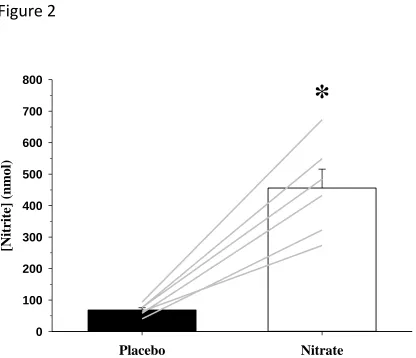
Plasma [nitrate] and [nitrite] was measured in six participants (see Limitations section 256
below for explanation). Plasma [nitrate] was elevated 26-fold over placebo after acute nitrate 257
supplementation (784 ± 32 vs 29 ± 2 μM, p < 0.001). All subjects demonstrated elevated plasma 258
[nitrite] after acute nitrate supplementation (456 ± 60 vs 68 ± 7 nM, p < 0.001, Fig. 2) resulting 259
in a 5.7-fold increase over placebo. Resting blood pressure values are presented in Table 1. 260
Acute nitrate supplementation was associated with a lowering of SBP, DBP, and MAP by 7%, 261
4%, and 6%, respectively (all p < 0.05) compared to placebo. 262
263
40 %Ppeak exercise 264
The mean power for 40 %Ppeak was 2.2 ± 0.1 W. All subjects were able to sustain 10 min 265
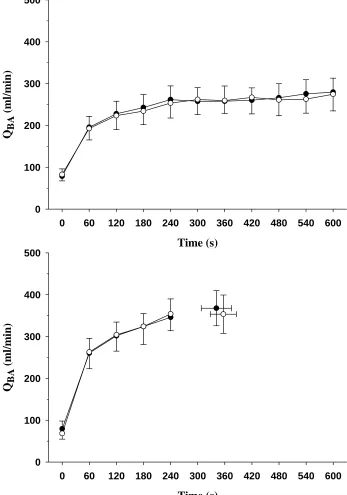
of exercise at 40 %Ppeak in both conditions. Q̇BA increased rapidly from exercise onset in both 266
conditions before approaching a steady-state of approximately 260 ml·min-1 by 240 s. Q̇BA was 267
not different after nitrate supplementation at rest or at any time during exercise compared to 268
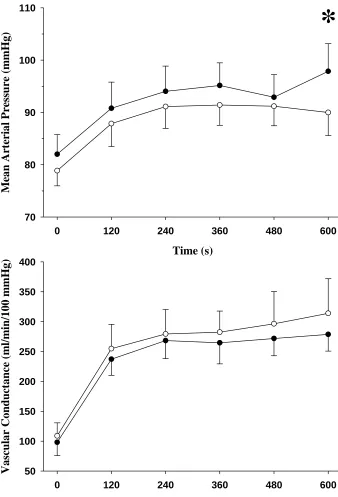
placebo (Fig. 3). MAP was measured during exercise in eight of nine subjects. There was no 269
main effect of nitrate on MAP during exercise compared to placebo (p = 0.11, Fig. 4), although 270
13
and 98 ± 5 mmHg (p = 0.02) for nitrate and placebo, respectively. There was no effect of nitrate 272
on VC (p = 0.14, Fig. 4); both groups increased to end exercise values of 314 ± 58 and 279 ± 28 273
ml/min/100 mmHg (p = 0.08) for nitrate and placebo, respectively. 274
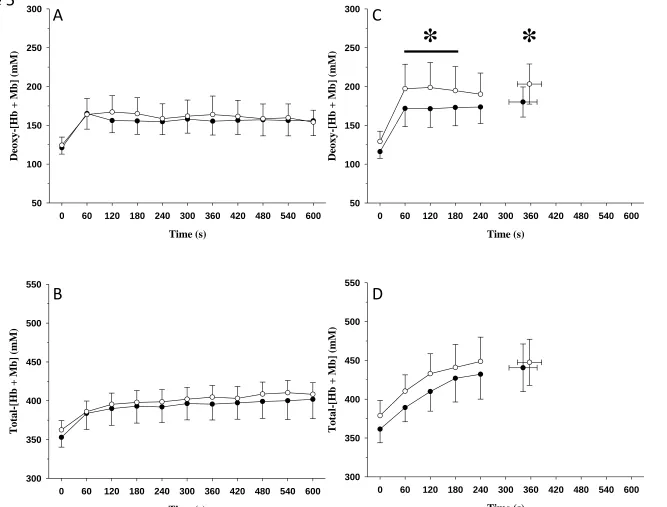
Deoxy-[Hb + Mb] increased following exercise onset in both conditions, with no 275
differences between conditions. End exercise deoxy-[Hb + Mb] was not different between nitrate 276
and placebo (154 ± 15 vs 156 ± 19 μM, p = 0.83, Fig. 5). Total-[Hb + Mb] was not different after 277
nitrate supplementation at any min during exercise or at the end of exercise compared to placebo 278
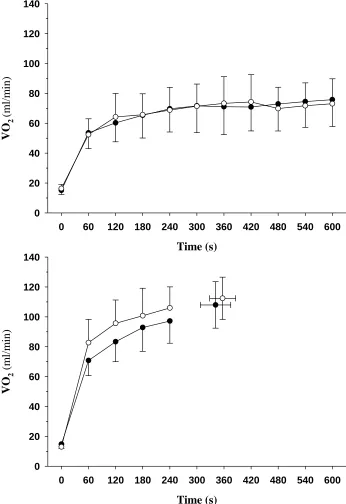
(408 ± 15 vs 402 ± 25 μM, p = 0.76, Fig. 5). V̇O2 was not different at any min during exercise or 279
at the end of exercise (73.1 ± 16.7 vs 75.8 ± 18.0 ml/min, p = 0.68, Fig. 6). The results of the 280
V̇O2 kinetics analysis are presented in Table 2 (n = 7). 281
282
85 %Ppeak exercise 283
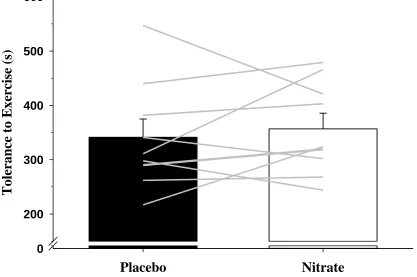
The mean power for 85 %Ppeak was 4.7 ± 0.2 W. Nitrate had no effect on Tlim compared 284
to placebo (358 ± 29 vs 341 ± 34 s, p = 0.3, Fig. 7). Q̇BA was not different at rest or any time 285
during exercise after nitrate supplementation. Q̇BA increased at exercise onset and attained end 286
exercise values of 368 ± 42 and 353 ± 46 ml/min (p = 0.56, Fig. 3), for nitrate and placebo, 287
respectively. 288
Deoxy-[Hb + Mb] was not different at rest and increased at exercise onset in both 289
conditions, with nitrate elevated over placebo for time points preceding end exercise (60 – 180 s, 290
p < 0.05), but not 240 s (p = 0.08). At Tlim, nitrate and placebo were different (203 ± 26 vs 180 ± 291
19 μM, p = 0.03, Fig. 5). Total-[Hb + Mb] was not different after nitrate supplementation, both 292
conditions showed a progressive increase toward the end exercise values (447 ± 30 vs 440 ± 31 293
14
and placebo, respectively. There was no difference for end exercise V̇O2 after nitrate 295
supplementation (112 ± 12 vs 107 ± 14 ml/min, p = 0.62, Fig. 6). The results of the V̇O2 kinetics 296
analysis are presented in Table 2 (n = 7). Both supplemental conditions had significantly higher 297
primary amplitudes during 85% Ppeak compared to 40% Ppeak (p < 0.05). Nitrate supplementation 298
also increased the primary amplitude within 85% Ppeak (p = 0.02) and reduced the time constant 299
(τ; p = 0.04) compared to placebo. 300
301
Discussion
302The present study investigated the effects of acute nitrate supplementation on conduit 303
artery Q̇ concurrently with local muscle microvascular oxygenation characteristics during 304
moderate and severe intensity handgrip exercise. The acute dosage utilized (~13 mmol nitrate), 305
elevated plasma [nitrite] more than 5-fold higher than that seen with placebo and was associated 306
with reductions in blood pressure at rest of 4-8%. Contrary to our first hypothesis, nitrate had no 307
effect on Q̇BAat rest or any time point during moderate or severe intensity handgrip exercise 308
compared to placebo. The primary novel finding of the present study, in agreement with our 309
second hypothesis, was that the V̇O2 primary amplitude was elevated and the kinetics were faster 310
after nitrate during severe intensity handgrip exercise consequent to an increased O2 extraction 311
(deoxy-[Hb + Mb]) . Additionally, nitrate had no effect on Tlimwhen exercise was performed in 312
the severe intensity domain. 313
314
Effect on control of blood flow
315
Ferguson and colleagues (23, 24) discovered that nitrate supplementation increased bulk 316
15
and IIx fibers (23, 24). To date, the previous studies (5, 12, 34) and the present investigation that 318
directly measured Q̇ in young healthy humans during small muscle mass (handgrip) exercise, 319
have been unable to replicate the findings of Ferguson et al. (23, 24) or Cosby et al. (14). The 320
work of Kim and colleagues (34) had young healthy subjects perform rhythmic exercise under 321
both nitrate and placebo conditions; however the work done was performed at fairly low work 322
rates. The greatest Q̇BA achieved in the work of Kim et al. (34) was approximately 200 ml/min 323
for both supplementations, which was lower than the Q̇BA measured in the present investigation 324
at 40 %Ppeak (~260 ml/min). If dietary nitrate does in fact have preferential effects in high order 325
fiber types, it is likely that Kim et al. (34) and the lower work rate in the present study did not 326
recruit said fibers. 327
The other two studies (5, 12) and the present investigation performed higher intensity 328
exercise that increased the likelihood of recruiting higher order fibers. However, in agreement 329
with the lower intensity data, nitrate supplementation had no effect on the steady state Q̇BA in 330
healthy young subjects. The present investigation advanced these previous studies by measuring 331
the dynamic response during the onset of exercise. While there was no difference in the speed of 332
the Q̇BA adjustment to exercise, there was evidence of improved O2 delivery within the 333
exercising muscle (see Effect on tissue oxygenation and V̇O2 below). Casey and colleagues (12)
334
attempted to maximize the stimulus for nitrite conversion to NO (and thus maximize the 335
potential augmentation of Q̇BA) by putting their subjects in hypoxia, but there was still no 336
difference between nitrate and placebo. The study by Bentley and colleagues (5) used a 337
hydrostatic challenge to alter O2 delivery and found no differences in the absolute Q̇BA following 338
nitrate supplementation. These authors did find there was less attenuation of Q̇BA induced by the 339
16
compensatory vasodilation (5). The supine exercise model used in these aforementioned studies 341
(5, 12, 34) differed from the present investigation in that our subjects were seated upright with 342
the arms at heart level. It has been shown that the seated posture increases muscle sympathetic 343
activity and reduced central venous pressure compared to the supine posture (9). Since the 344
present findings are largely in agreement with these previous studies (5, 12, 34) and handgrip 345
exercise is not limited by cardiac output, these postural differences were likely inconsequential. 346
Nevertheless, a recent study found that acute nitrate supplementation increased peak 347
cardiac output and V̇O2 in CHF patients with preserved ejection fraction during a supine peak 348
incremental exercise test (51). This study was not designed to resolve the spatial distribution of 349
the ~10% increase in cardiac output. If nitrate does favorably affect VC and Q̇ to type II fibers, 350
as suggested by Ferguson and colleagues (24), the increased reliance on type II fibers with CHF, 351
and other diseases (28, 46) supports the notion that nitrate supplementation may be more 352
effective in these populations with O2 delivery challenges. The discovery that nitrate can increase 353
Q̇BA in older adults in hypoxia (12) further bolsters this hypothesis. 354
355
Effect on tissue oxygenation and V̇O2 356
Larsen and colleagues (38) were the first to show that a dietary nitrate salt supplement 357
could reduce the V̇O2 associated with a given work rate. Subsequent studies utilizing beetroot 358
supplementation have yielded mixed results across a variety of exercise modalities, with some 359
showing ~3-5% reductions in V̇O2 (2, 4, 37, 42, 48, 50), and others no change (6, 13, 31, 32) 360
after supplementation. NIRS-derived variables measured concurrently with V̇O2 paralleled the 361
17
Given the above, attempting to interpret the present findings in the context of whole body 363
exercise is difficult. In the present investigation, deoxy-[Hb + Mb] was elevated after nitrate 364
supplementation throughout severe-, but not moderate-, intensity exercise. Moreover, total-[Hb + 365
Mb] was not impacted by nitrate supplementation during both exercise intensities. Changes in 366
total-[Hb + Mb] from rest to exercise are thought to reflect the change in microvascular 367
hematocrit (17). To the best of our knowledge, the current study is the first to observe an 368
increased primary amplitude, exercising level, and Tlim value for deoxy-[Hb + Mb] after nitrate 369
supplementation. It should be noted that Breese et al. (6) reported a higher value on beet root 370
juice across the transition from moderate to severe exercise due to faster kinetics, but no 371
differences in the amplitude or Tlim were observed(6). Increased deoxy-[Hb + Mb] relative to 372
unchanged total-[Hb + Mb] (and Q̇BA), suggests an increased fractional O2 extraction. The 50% 373
duty-cycle used in the present investigation has been shown to mechanically constrain Q̇BA and 374
V̇O2 during severe intensity handgrip exercise (7), such that the present changes should be 375
viewed as positive and suggest improvements in the microvascular distribution of O2 rather than 376
a decrease in efficiency. Nitrate may facilitate the delivery of O2 to regions that were otherwise 377
under perfused in this exercise model. This improved O2 extraction was manifest in the kinetic 378
response (see discussion below); however, there was no difference in V̇O2 at the end of exercise 379
after nitrate supplementation in the present investigation. This implies that the efficiency of the 380
work was neither positively nor negatively impacted and the improvements in fractional O2 381
extraction were likely obscured by the mechanical limitations of the exercise. Future work could 382
usefully attempt to elucidate if there is a ‘threshold’ type effect of the duty cycle used for the 383
exercise (i.e., employing 20, 30, 40% duty cycles in the severe intensity domain). 384
18
Effect on V̇O2 kinetics parameters and tolerance to exercise 386
No differences in the end exercise amplitude of local muscle V̇O2 were found in the 387
present study, but kinetics analyses revealed that the initial amplitude of V̇O2 was increased 388
during exercise at 85% Ppeak after nitrate supplementation. Nitrate supplementation resulted in a 389
faster τ and a substantially greater rate constant (amplitude/τ; ~73% increase). These findings are 390
in agreement with the speeding of pulmonary V̇O2 kinetics shown during whole body exercise in 391
instances of compromised O2 delivery and/or recruitment of higher order Type II muscle fibers 392
(3, 6, 31, 32) and the equivalent microvascular PO2 response in rats (23). The present 393
investigation is the first to show significant differences in kinetics parameters after an acute 394
dosage of nitrate, where other studies used chronic supplementation to see effects (3, 6, 31). 395
However, these improvements in V̇O2 amplitude and speed of adjustment did not lead to 396
improved Tlim in the present investigation. Previous work has found that speeding V̇O2 kinetics 397
during whole body exercise does not always result in improvements to Tlim (10, 36), indicating 398
that the relationship between these two variables is not a simple relationship. Indeed, interactions 399
between V̇O2 kinetics and other physiological parameters are likely requisite to see 400
improvements in exercise tolerance. Had there been a summation of the improved kinetics across 401
multiple transitions (such as that seen during daily activity), a greater sparing of the O2 deficit 402
could result in an accumulated improvement. 403
404
Limitations
405
We acknowledge that the method used to estimate V̇O2 herein utilizes several 406
assumptions (7) and likely overestimated the V̇O2. We contend that these assumptions, held 407
19
size was small and as such could have resulted in the present investigation not being sufficiently 409
powered to detect differences in some variables (e.g., exercising MAP and VC). Finally, we did 410
not measure plasma [nitrite] in all nine subjects (access to the NOA was precluded during later 411
data collection); however, the three subjects without this measurement exhibited similar 412
differences in blood pressure to the six with plasma [nitrite] measurements. It should be noted 413
that no pre-dose blood pressure measurements were made in the present investigation. However, 414
each subject served as their own control and thus had two separate days of blood pressure 415
measurements for each condition (i.e., nitrate and placebo), increasing our confidence that nitrate 416
influenced blood pressure herein. 417
418
Conclusions
419
The present study reaffirmed previous findings that an acute dose of nitrate is associated 420
with lower SBP, DBP, and MAP in healthy, young men. The acute dose was also an effective 421
method to increase and speed the local muscle V̇O2 on-kinetics parameters during severe 422
intensity handgrip exercise, primarily through an increased fractional O2 extraction rather than 423
increased blood flow. However, the ergogenic effects associated with nitrate supplementation 424
(i.e., improved tolerance to exercise) during large muscle mass exercise were not seen when the 425
exercise was performed in small muscle mass handgrip exercise. These findings warrant future 426
studies investigating the effects of nitrate supplementation during the dynamic adjustment at the 427
onset of exercise in populations at risk of O2 delivery impairment and reduced NO 428
bioavailability. 429
430
Grants
20
This work was supported by National Aeronautics and Space Administration (NASA) 432
Grant NNX10AK60G awarded to T. J. Barstow, by NASA Experimental Program to Stimulate 433
Competitive Research Grant NNX11AM05A supporting R. M. Broxterman, and by the Kansas 434
State University College of Veterinary Medicine Dr. Albert Borroughs Memorial Award granted 435
to R. M. Broxterman. 436
437
Disclosures
438
No conflicts of interest, financial or otherwise, are declared by the author(s). 439
21
References
441 442
1. Andersen P, and Saltin B. Maximal perfusion of skeletal muscle in man. J Physiol 366: 443
233-249, 1985. 444
2. Bailey SJ, Fulford J, Vanhatalo A, Winyard PG, Blackwell JR, DiMenna FJ,
445
Wilkerson DP, Benjamin N, and Jones AM. Dietary nitrate supplementation enhances muscle 446
contractile efficiency during knee-extensor exercise in humans. J Appl Physiol (1985) 109: 135-447
148, 2010. 448
3. Bailey SJ, Varnham RL, Dimenna FJ, Breese BC, Wylie LJ, and Jones AM. 449
Inorganic nitrate supplementation improves muscle oxygenation, O2 uptake kinetics and exercise 450
tolerance at high but not low pedal rates. Journal of applied physiology 118: 1396-1405, 2015. 451
4. Bailey SJ, Winyard P, Vanhatalo A, Blackwell JR, Dimenna FJ, Wilkerson DP,
452
Tarr J, Benjamin N, and Jones AM. Dietary nitrate supplementation reduces the O2 cost of 453
low-intensity exercise and enhances tolerance to high-intensity exercise in humans. J Appl 454
Physiol (1985) 107: 1144-1155, 2009. 455
5. Bentley RF, Walsh JJ, Drouin PJ, Velickovic A, Kitner SJ, Fenuta AM, and
456
Tschakovsky ME. Dietary nitrate restores compensatory vasodilation and exercise capacity in 457
response to a compromise in oxygen delivery in the noncompensator phenotype. J Appl Physiol 458
(1985) 123: 594-605, 2017. 459
6. Breese BC, McNarry MA, Marwood S, Blackwell JR, Bailey SJ, and Jones AM. 460
Beetroot juice supplementation speeds O2 uptake kinetics and improves exercise tolerance 461
during severe-intensity exercise initiated from an elevated metabolic rate. Am J Physiol Regul 462
Integr Comp Physiol 305: R1441-1450, 2013. 463
7. Broxterman RM, Ade CJ, Wilcox SL, Schlup SJ, Craig JC, and Barstow TJ. 464
Influence of duty cycle on the power-duration relationship: observations and potential 465
mechanisms. Respir Physiol Neurobiol 192: 102-111, 2014. 466
8. Broxterman RM, Craig JC, Smith JR, Wilcox SL, Jia C, Warren S, and Barstow
467
TJ. Influence of blood flow occlusion on the development of peripheral and central fatigue 468
during small muscle mass handgrip exercise. J Physiol 593: 4043-4054, 2015. 469
9. Burke D, Sundlof G, and Wallin G. Postural effects on muscle nerve sympathetic 470
activity in man. J Physiol 272: 399-414, 1977. 471
10. Carter H, Grice Y, Dekerle J, Brickley G, Hammond AJ, and Pringle JS. Effect of 472
prior exercise above and below critical power on exercise to exhaustion. Medicine and science in 473
sports and exercise 37: 775-781, 2005. 474
11. Casavola C, Paunescu LA, Fantini S, Franceschini MA, Lugara PM, and Gratton E. 475
Application of near-infrared tissue oxymetry to the diagnosis of peripheral vascular disease. Clin 476
Hemorheol Microcirc 21: 389-393, 1999. 477
12. Casey DP, Treichler DP, Ganger CTt, Schneider AC, and Ueda K. Acute dietary 478
nitrate supplementation enhances compensatory vasodilation during hypoxic exercise in older 479
adults. J Appl Physiol (1985) 118: 178-186, 2015. 480
13. Christensen PM, Nyberg M, and Bangsbo J. Influence of nitrate supplementation on 481
VO2 kinetics and endurance in elite cyclists. Scan J Med Sci Sports 23: e21-e31, 2013. 482
14. Cosby K, Partovi KS, Crawford JH, Patel RP, Reiter CD, Martyr S, Yang BK,
483
Waclawiw MA, Zalos G, Xu X, Huang KT, Shields H, Kim-Shapiro DB, Schechter AN,
484
Cannon RO, 3rd, and Gladwin MT. Nitrite reduction to nitric oxide by deoxyhemoglobin 485
22
15. Craig JC, Broxterman RM, Wilcox SL, Chen C, and Barstow TJ. Effect of adipose 487
tissue thickness, muscle site, and sex on near-infrared spectroscopy derived total-[hemoglobin + 488
myoglobin]. J Appl Physiol (1985) 123: 1571-1578, 2017. 489
16. Crawford JH, Isbell TS, Huang Z, Shiva S, Chacko BK, Schechter AN,
Darley-490
Usmar VM, Kerby JD, Lang JD, Jr., Kraus D, Ho C, Gladwin MT, and Patel RP. Hypoxia, 491
red blood cells, and nitrite regulate NO-dependent hypoxic vasodilation. Blood 107: 566-574, 492
2006. 493
17. Davis ML, and Barstow TJ. Estimated contribution of hemoglobin and myoglobin to 494
near infrared spectroscopy. Respir Physiol Neurobiol 186: 180-187, 2013. 495
18. De Blasi RA, Cope M, Elwell C, Safoue F, and Ferrari M. Noninvasive measurement 496
of human forearm oxygen consumption by near infrared spectroscopy. Eur J Appl Physiol Occup 497
Physiol 67: 20-25, 1993. 498
19. DeLorey DS, Kowalchuk JM, and Paterson DH. Relationship between pulmonary O2 499
uptake kinetics and muscle deoxygenation during moderate-intensity exercise. J Appl Physiol 500
(1985) 95: 113-120, 2003. 501
20. Dyke CK, Proctor DN, Dietz NM, and Joyner MJ. Role of nitric oxide in exercise 502
hyperaemia during prolonged rhythmic handgripping in humans. J Physiol 488 ( Pt 1): 259-265, 503
1995. 504
21. Eggebeen J, Kim-Shapiro DB, Haykowsky M, Morgan TM, Basu S, Brubaker P,
505
Rejeski J, and Kitzman DW. One Week of Daily Dosing With Beetroot Juice Improves 506
Submaximal Endurance and Blood Pressure in Older Patients With Heart Failure and Preserved 507
Ejection Fraction. JACC Heart Fail 4: 428-437, 2016. 508
22. Endo T, Imaizumi T, Tagawa T, Shiramoto M, Ando S, and Takeshita A. Role of 509
nitric oxide in exercise-induced vasodilation of the forearm. Circulation 90: 2886-2890, 1994. 510
23. Ferguson SK, Hirai DM, Copp SW, Holdsworth CT, Allen JD, Jones AM, Musch
511
TI, and Poole DC. Dose dependent effects of nitrate supplementation on cardiovascular control 512
and microvascular oxygenation dynamics in healthy rats. Nitric Oxide 39: 51-58, 2014. 513
24. Ferguson SK, Hirai DM, Copp SW, Holdsworth CT, Allen JD, Jones AM, Musch
514
TI, and Poole DC. Impact of dietary nitrate supplementation via beetroot juice on exercising 515
muscle vascular control in rats. J Physiol 591: 547-557, 2013. 516
25. Ferguson SK, Holdsworth CT, Colburn TD, Wright JL, Craig JC, Fees A, Jones
517
AM, Allen JD, Musch TI, and Poole DC. Dietary nitrate supplementation: impact on skeletal 518
muscle vascular control in exercising rats with chronic heart failure. J Appl Physiol (1985) 121: 519
661-669, 2016. 520
26. Fulford J, Winyard PG, Vanhatalo A, Bailey SJ, Blackwell JR, and Jones AM. 521
Influence of dietary nitrate supplementation on human skeletal muscle metabolism and force 522
production during maximum voluntary contractions. Pflugers Arch 465: 517-528, 2013. 523
27. Gornik HL, Garcia B, Wolski K, Jones DC, Macdonald KA, and Fronek A. 524
Validation of a method for determination of the ankle-brachial index in the seated position. J 525
Vasc Surg 48: 1204-1210, 2008. 526
28. Gosker HR, van Mameren H, van Dijk PJ, Engelen MP, van der Vusse GJ, Wouters
527
EF, and Schols AM. Skeletal muscle fibre-type shifting and metabolic profile in patients with 528
chronic obstructive pulmonary disease. Eur Respir J 19: 617-625, 2002. 529
29. Govoni M, Jansson EA, Weitzberg E, and Lundberg JO. The increase in plasma 530
nitrite after a dietary nitrate load is markedly attenuated by an antibacterial mouthwash. Nitric 531
23
30. Jones AM, Ferguson SK, Bailey SJ, Vanhatalo A, and Poole DC. Fiber Type-Specific 533
Effects of Dietary Nitrate. Exerc Sport Sci Rev 44: 53-60, 2016. 534
31. Kelly J, Fulford J, Vanhatalo A, Blackwell JR, French O, Bailey SJ, Gilchrist M,
535
Winyard PG, and Jones AM. Effects of short-term dietary nitrate supplementation on blood 536
pressure, O2 uptake kinetics, and muscle and cognitive function in older adults. Am J Physiol 537
Regul Integr Comp Physiol 304: R73-83, 2013. 538
32. Kelly J, Vanhatalo A, Bailey SJ, Wylie LJ, Tucker C, List S, Winyard PG, and
539
Jones AM. Dietary nitrate supplementation: effects on plasma nitrite and pulmonary O2 uptake 540
dynamics during exercise in hypoxia and normoxia. Am J Physiol Regul Integr Comp Physiol 541
307: R920-930, 2014. 542
33. Kenjale AA, Ham KL, Stabler T, Robbins JL, Johnson JL, Vanbruggen M, Privette
543
G, Yim E, Kraus WE, and Allen JD. Dietary nitrate supplementation enhances exercise 544
performance in peripheral arterial disease. J Appl Physiol (1985) 110: 1582-1591, 2011. 545
34. Kim JK, Moore DJ, Maurer DG, Kim-Shapiro DB, Basu S, Flanagan MP,
Skulas-546
Ray AC, Kris-Etherton P, and Proctor DN. Acute dietary nitrate supplementation does not 547
augment submaximal forearm exercise hyperemia in healthy young men. Appl Physiol Nutr 548
Metab 40: 122-128, 2015. 549
35. Koga S, Kano Y, Barstow TJ, Ferreira LF, Ohmae E, Sudo M, and Poole DC. 550
Kinetics of muscle deoxygenation and microvascular PO(2) during contractions in rat: 551
comparison of optical spectroscopy and phosphorescence-quenching techniques. J Appl Physiol 552
(1985) 112: 26-32, 2012. 553
36. Koppo K, and Bouckaert J. The decrease in VO(2) slow component induced by prior 554
exercise does not affect the time to exhaustion. Int J Sports Med 23: 262-267, 2002. 555
37. Lansley KE, Winyard PG, Fulford J, Vanhatalo A, Bailey SJ, Blackwell JR,
556
DiMenna FJ, Gilchrist M, Benjamin N, and Jones AM. Dietary nitrate supplementation 557
reduces the O2 cost of walking and running: a placebo-controlled study. J Appl Physiol (1985) 558
110: 591-600, 2011. 559
38. Larsen FJ, Weitzberg E, Lundberg JO, and Ekblom B. Effects of dietary nitrate on 560
oxygen cost during exercise. Acta Physiol (Oxf) 191: 59-66, 2007. 561
39. Lidder S, and Webb AJ. Vascular effects of dietary nitrate (as found in green leafy 562
vegetables and beetroot) via the nitrate-nitrite-nitric oxide pathway. Br J Clin Pharmacol 75: 563
677-696, 2012. 564
40. Lundberg JO, Weitzberg E, and Gladwin MT. The nitrate-nitrite-nitric oxide pathway 565
in physiology and therapeutics. Nat Rev Drug Discov 7: 156-167, 2008. 566
41. Modin A, Bjorne H, Herulf M, Alving K, Weitzberg E, and Lundberg JO. Nitrite-567
derived nitric oxide: a possible mediator of 'acidic-metabolic' vasodilation. Acta Physiol Scand 568
171: 9-16, 2001. 569
42. Porcelli S, Ramaglia M, Bellistri G, Pavei G, Pugliese L, Montorsi M, Rasica L, and
570
Marzorati M. Aerobic Fitness Affects the Exercise Performance Responses to Nitrate 571
Supplementation. Medicine and science in sports and exercise 47: 1643-1651, 2015. 572
43. Richardson RS, Poole DC, Knight DR, Kurdak SS, Hogan MC, Grassi B, Johnson
573
EC, Kendrick KF, Erickson BK, and Wagner PD. High muscle blood flow in man: is 574
maximal O2 extraction compromised? J Appl Physiol (1985) 75: 1911-1916, 1993. 575
44. Richardson RS, Poole DC, Knight DR, Wagner PD, Hogan MC, and
Mathieu-576
Costello O. Red blood cell transit time in man: Theoretical effects of capillary density. In: 577
24
45. Shoemaker JK, Halliwill JR, Hughson RL, and Joyner MJ. Contributions of 579
acetylcholine and nitric oxide to forearm blood flow at exercise onset and recovery. Am J Physiol 580
273: H2388-2395, 1997. 581
46. Sullivan MJ, Green HJ, and Cobb FR. Skeletal muscle biochemistry and histology in 582
ambulatory patients with long-term heart failure. Circulation 81: 518-527, 1990. 583
47. Totzeck M, Hendgen-Cotta UB, Luedike P, Berenbrink M, Klare JP, Steinhoff HJ,
584
Semmler D, Shiva S, Williams D, Kipar A, Gladwin MT, Schrader J, Kelm M, Cossins AR,
585
and Rassaf T. Nitrite regulates hypoxic vasodilation via myoglobin-dependent nitric oxide 586
generation. Circulation 126: 325-334, 2012. 587
48. Vanhatalo A, Bailey SJ, Blackwell JR, DiMenna FJ, Pavey TG, Wilkerson DP,
588
Benjamin N, Winyard PG, and Jones AM. Acute and chronic effects of dietary nitrate 589
supplementation on blood pressure and the physiological responses to moderate-intensity and 590
incremental exercise. Am J Physiol Regul Integr Comp Physiol 299: R1121-1131, 2010. 591
49. Webb AJ, Patel N, Loukogeorgakis S, Okorie M, Aboud Z, Misra S, Rashid R, Miall
592
P, Deanfield J, Benjamin N, MacAllister R, Hobbs AJ, and Ahluwalia A. Acute blood 593
pressure lowering, vasoprotective, and antiplatelet properties of dietary nitrate via bioconversion 594
to nitrite. Hypertension 51: 784-790, 2008. 595
50. Wylie LJ, Kelly J, Bailey SJ, Blackwell JR, Skiba PF, Winyard PG, Jeukendrup
596
AE, Vanhatalo A, and Jones AM. Beetroot juice and exercise: pharmacodynamic and dose-597
response relationships. J Appl Physiol (1985) 115: 325-336, 2013. 598
51. Zamani P, Rawat D, Shiva-Kumar P, Geraci S, Bhuva R, Konda P, Doulias PT,
599
Ischiropoulos H, Townsend RR, Margulies KB, Cappola TP, Poole DC, and Chirinos JA. 600
Effect of inorganic nitrate on exercise capacity in heart failure with preserved ejection fraction. 601
Circulation 131: 371-380; discussion 380, 2015. 602
25
Table 1. Resting Blood Pressure After Acute Dietary Nitrate Supplementation
Placebo Nitrate
SBP (mmHg) 130 ± 4 121 ± 4 †
DBP (mmHg) 69 ± 4 66 ± 5 *
MAP (mmHg) 89 ± 4 84 ± 4 *
SBP, DBP, and MAP denote systolic blood pressure, diastolic blood pressure, and mean arterial pressure,
respectively. Values are expressed as means ± SE. † significantly different from placebo (p < 0.01), * significantly different from placebo (p < 0.05)
605 606
Table 2. V̇O2 Kinetics Parameters for the Onset of Handgrip Exercise
40% Ppeak Placebo Nitrate
Baseline (ml/min) 17 ± 3 16 ± 4
Amplitude (ml/min) 52 ± 13 64 ± 8
τ (s) 38 ± 5 34 ± 9
TD (s) 1 ± 1 3 ± 1
RC (ml/min/s) 1.6 ± 0.4 1.9 ± 0.6
85% Ppeak
Baseline (ml/min) 15 ± 4 17 ± 2
Amplitude (ml/min) 72 ± 16 † 99 ± 22 *†
τ (s) 37 ± 8 25 ± 3 *
TD (s) 4 ± 2 6 ± 2
RC (ml/min/s) 2.2 ± 0.4 3.8 ± 0.6 * τ, TD, and RC denote time constant, time delay, and rate constant, respectively. Values are expressed as means ± SE. * significantly different from placebo within work rate, † significantly different from 40% Ppeak within supplement (both p < 0.05).
26
Figure Legends
608
Figure 1. Schematic representation of experimental protocol
609
Left: overall protocol showing the timing of the five laboratory visits in relation to one another. 610
Right: expansion of an individual testing day (in this case, Testing day #1; each subsequent 611
testing session followed the same timeline). Each testing session was assigned randomly to the 612
supplemental condition (i.e., nitrate or placebo) and exercise intensity (i.e., 40 or 85 %Ppeak). All 613
exercise tests began approximately 2.5 h after supplement consumption. 614
615
Figure 2. Resting nitrite concentrations
616
Plasma nitrite concentration ([nitrite]) for individual subjects (gray lines) and group means (both, 617
n = 6; see text for discussion of reduced subject number). Plasma nitrate concentrations were 618
similar to [nitrite], these data are presented in text only. Error bars represent SE. * significantly 619
different from placebo (p < 0.001). 620
621
Figure 3. Brachial artery blood flow during exercise
622
A: Mean brachial artery blood flow (Q̇BA) at the end of each minute of 40 %Ppeak exercise. B: 623
Mean Q̇BA at the end of each minute of 85 %Ppeak exercise and the limit of exercise tolerance 624
(Tlim). In both graphs, filled circles represent placebo and open circles represent nitrate 625
supplementation (both, n = 9). Error bars represent SE. 626
627
Figure 4. Mean blood pressure and vascular conductance responses to 40 %Ppeak exercise 628
A: Mean arterial pressure (MAP) taken every 120 s during exercise. B: Vascular conductance 629
(VC) calculated as the product of brachial artery blood flow and MAP every 120 s during 630
exercise. In both graphs, filled circles represent placebo and open circles represent nitrate 631
supplementation (both, n = 8). Error bars represent SE. 632
633
Figure 5. NIRS-derived muscle and microvascular oxygenation responses during exercise
634
Left: 40 %Ppeak exerciseA: Mean deoxygenated-[hemoglobin + myoglobin] (deoxy-[Hb + 635
Mb]) at the end of each minute of exercise. B: Mean total-[hemoglobin + myoglobin] (total-[Hb 636
+ Mb]) at the end of each minute of exercise (both, n = 9). Right: 85 %Ppeak exerciseC: Mean 637
deoxy-[Hb + Mb] at the end of each minute of exercise and at the limit of exercise tolerance 638
(Tlim). D: Mean total-[Hb + Mb] at the end of each minute of exercise and at Tlim. In all graphs, 639
filled circles represent placebo and open circles represent nitrate supplementation (both, n = 9). 640
Error bars represent SE. * significantly different from placebo (p < 0.05). 641
642
Figure 6. Estimated V̇O2 during exercise 643
A: Mean estimated V̇O2 at the end of each minute of 40 %Ppeak exercise. B: Mean estimated V̇O2 644
27
both graphs, filled circles represent placebo and open circles represent nitrate supplementation 646
(both, n = 9). Error bars represent SE. 647
648
Figure 7. Effect of supplementation on tolerance to exercise
649
Individual (solid gray lines) and mean (n = 9) tolerance to exercise (Tlim) responses under both 650
supplementations during 85 %Ppeak exercise. Error bars represent SE. 651
Paperwork
Familiarization
Incremental test
Testing day #1
Testing day #2
Testing day #3
Testing day #4
48 – 72 h
48 – 72 h
48 – 72 h
48 – 72 h
Nitrate or Placebo
Consumption
15 min resting
Blood pressure
Plasma Sample
Instrumentation
Exercise test at
40 or 85 %P
peak2 h
2.5 h
Placebo
Nitrate
[Ni
tr
ite
] (nm
ol
)
0 100 200 300 400 500 600 700 800
*
Figure 2
Figure 3
Time (s)
0 60 120 180 240 300 360 420 480 540 600
QBA
(m
l/
m
in)
0 100 200 300 400
500 Time (s)
0 60 120 180 240 300 360 420 480 540 600
QBA
(m
l/
m
in)
Figure 4
Time (s)
0 120 240 360 480 600
M
ean Ar
te
ri
al
P
re
ss
ur
e (m
m
H
g)
70 80 90 100 110
Time (s)
0 120 240 360 480 600
V
asc
ul
ar
Conduc
tanc
e (m
l/
m
in/
100 m
m
H
g)
50 100 150 200 250 300 350 400
Time (s)
0 60 120 180 240 300 360 420 480 540 600
De oxy -[ H b + M b] (m M ) 50 100 150 200 250 300 Time (s)
0 60 120 180 240 300 360 420 480 540 600
T otal-[H b + M b] (m M ) 300 350 400 450 500 550 Time (s)
0 60 120 180 240 300 360 420 480 540 600
De oxy -[ H b + M b] (m M ) 50 100 150 200 250 300 Time (s)
0 60 120 180 240 300 360 420 480 540 600
Figure 6
Time (s)
0 60 120 180 240 300 360 420 480 540 600
VO
2
(m
l/
m
in)
0 20 40 60 80 100 120 140
Time (s)
0 60 120 180 240 300 360 420 480 540 600
VO
2
(m
l/
m
in)