3752
Impact E-Modul Ethnoconstructivism: Attitude &
Motivation
Syahrial, Asrial, Lia Gusti Melinda, M. Rizky Fajar, Nurdatul Jannah, Tari Okta Puspitasari, Yolanda Eka Putri
Abstract: The purpose of this study is to look at the impact of ethnoconstructivism e-modules on students' attitude and motivation. This study uses a quantitative quasi-experimental design pretest and posttest non-equivalent control group design. Where the total number of samples from this study were 70 elementary school students taken by purposive sampling technique. The experimental group (n = 35) was taught with ethnoconstructivism e-modules, while the control group (n = 35) was taught using traditional modules. Data were then analyzed with the help of the SPSS 21 application to look for descriptive statistics and inferential statistics. On the results of motivation and attitude for control classes using conventional, there are significant differences with the experimental class using ethnoconstructivism based e-modules, which are in the superior experimental class because they use ethnoconstructivism based e-modules with a test score of 19.542 on motivation and 20.342 on learning styles.
Index Terms: Students; E-Modul; Ethnoconstructivism; Attitude; Motivation; Thematic; Elementary School
—————————— ——————————
1
INTRODUCTION
Education is the most important thing for every human being to be able to think more advanced. Education has become a fundamental necessity to enhance and develop the potential of human resources. Education is not just the media to pass the culture to the next generation, but also the pattern of the national Lifetime Investment which is a long-term investment that we must prepare in order. For us to have a better life in the Future [1]. Education is also one of the major milestones for the development and progress of a country, it is in accordance with the opinion [2-3]. On the grounds that education is one of the strategic steps to form a qualified young generation and able to face and solve problems in the diverse community life at the regional level. Education can be used as a tool for social and investment change, in the national development. Therefore, education is very important and always have to be improved in accordance with the development of the era, so that the education system, especially in Indonesia, not outdated and better. According to [4], the education system in Indonesia has always evolved, which aims to improve the quality of education. The purpose of education is the intellectual life of the Nation [5]. But in reality, the current system or method used by Indonesian educators is still using old methods and still passive in the implementation of learning even though the times and technology are progressing. Constructivist Learning is the learning that students experience through students ' experiences and through the people around them.
According to Richardson [6] it states that constructivism as the position that "individuals have their understanding, based on the interactions of what they already know and believe, and the phenomena or ideas with which they touch. Learning that uses constructivism this approach requires that a teacher be able to create learning in such a way that students can actively engage with the subject matter through the social interactions established in the class [7]. Therefore teachers are expected to improve the quality of their teaching. and become more professional in creating effective learning but not boring by leveraging increasingly sophisticated technological advances. Learning by utilizing technology in the 21st century is highly recommended in the learning process. This is in line with the opinion [8] which says that "one of the excellent aspects of media is able to improve student learning outcomes is a combination of media elements such as text, images, and animation, and multimedia presentations can accommodate all This element ". The use of well-used technology will create an active, innovative, creative, effective and enjoyable learning process. "PAIKEM's learning model describes the entire learning process that takes place in fun by engaging students to participate actively during the learning process" [9]. In learning, attitudes are also an aspect worth reckoned with. In the learning process, especially in the physics lesson, the attitude of the participants is important to be rejected [10]. The process attitude is very important [11-12]. Because, students who have this view will have different attitudes, with students who have a positive view during the learning process [13]. One of them is motivation. According to Higgins & Kruglanski, [14] in general, motivation means something that encourages to do or act. Motivation can be interpreted as a power (energy) person who has a degree of persistence and enthusiasm in carrying out activities, both from within the individual (intrinsic motivation) [14]. For example, students have a willingness to learn physics, able and concentrate while learning the physics of [14]. And from outside individuals (extrinsic motivation), love getting rewarded and getting good grades [14]. Students who have a negative attitude toward the defense have less motivation for class involvement, and also students who have a positive attitude toward learning will have the motivation to class involvement [15]. Therefore, it takes good attitude and motivation in learning, one of which can use technology, using technology in learning, teachers have important role, one of which is teacher must have Skills in the use of information and communication technology. According to [16], the teacher's computer experience shows that students in _____________________________________
• Syahrial is Associate Professor in Faculty of Teaching and Education in Universitas Jambi, Jambi , Indonesia 36361 E-mail; [email protected]
• Asrial is a Professor in Faculty of Teaching and Education on
Universitas Jambi, Jambi, Indonesia, 36361. E-mailL
• Lia Gusti Melinda, is a Students in Faculty of Teaching and Education, Universita Jambi, Jambi Indonesia, 36361
• M. Rizky Fajar, is a Stuents in Faculty of Teaching and Education, Universita Jambi, Jambi Indonesia, 36361
• Nurdatul Jannah, is a student in Faculty of Teaching and Education, Universitas Jambi, Jambi, Indonesia, 36361.
• Tari Okta Puspitasari, is a Students in Faculty of Teaching and Education, Universita Jambi, Jambi Indonesia, 36361
3753 the classroom have teachers who are less experienced in using
computers at higher levels, so that students in classes with teachers who have periods of computer experience The lower can have more opportunities to share the learning experience and work with students. Thus learning by using the media teaching materials e-module ethnoconstructivism based 3D Professional PageFlips can be used to make the supporting students more active in learning. This e-module teaching material Ethnoconstructivism is one of the unprinted teaching materials. There are also interactive multimedia teaching materials such as CAI, interactive Multimedia compact disk (CD) learning, and web-based teaching materials [17]. In line with the opinion Suryatiningsih [18] electronic modules can display text, images, animations, and video via computer and the existence of e-modules can improve the understanding of concepts and outcomes of student learning. So with the appearance of images, animations, and videos, students are interested in participating in the learning process. The results of students learning using electronic books are higher than printed books [19-20]. Therefore, research aims to find out if there is an influence between the motivation and thematic attitudes of students in the lesson as using the E-module ethnoconstructivism?
2
METHODOLOGY
Research design used by researchers is a type of quantitative research with quasi-experimental design using pretests and posttest non-equivalent control group design. It was done to investigate the causal hypothesis on causes that can be manipulated by comparing one or more of the experimental groups treated with one untreated comparative group [21]. The design of this research is applied because it is in accordance with research objectives, where the goal is to find out if there is a difference between student thematic attitudes as well as student motivation in learning after using e-module ethnoconstructivism with traditional module. The study uses descriptive statistics in the mean, Min and Max forms and uses inferential statistics. The inferential statistics used are independent sample-t tests. This research is located in elementary school with a total of 42 students, in Jambi province. In experimental classes, there are 21 students and in the control class, there are 21 students. In experimental classes use the E-module ethnoconstructivism, as well as the control class using the traditional print teaching materials in the lesson. Sample collection techniques using the purposive sampling method. Purposive sampling is a sampling technique based on the criteria of researchers [22]. The criteria applied are Grade 5 students of elementary school. In this study included the dissemination of questionnaires to students to see their initial values. Then it gives action only to the experimental class using the E-module ethnoconstructivism, while for the control class provided the traditional teaching module. Afterwards, see the results of the students ' thematic attitudes as well as the student motivation after using e-modules. The instrument used is a questionnaire. [23], Questionnaire is a list of questions given to others who are willing to answer (respondents) according to the user's request. In this study, the study uses questionnaires and semi-open interview instruments, in this study using a Likert scale of 5 (five) for a positive statement strongly disagree to have a score of 1, disagree has a score of 2, Neutral has a Score 3, agree to have 4 scores and strongly agree 5. For a negative statement strongly disagree has a score of 5, disagree has a
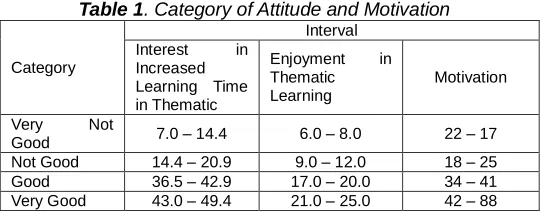
score of 4, Neutral has a score of 3, agreed to have a score of 2, and strongly agree has a score of 1). Below is a category of questionnaire attitude and motivation in learning, among others, very good, good, sufficient, not good, and not very good, as in table 1 below:
Table 1. Category of Attitude and Motivation
Category
Interval Interest in
Increased Learning Time in Thematic
Enjoyment in Thematic Learning
Motivation
Very Not
Good 7.0 – 14.4 6.0 – 8.0 22 – 17
Not Good 14.4 – 20.9 9.0 – 12.0 18 – 25 Good 36.5 – 42.9 17.0 – 20.0 34 – 41 Very Good 43.0 – 49.4 21.0 – 25.0 42 – 88 All data obtained from the thematic attitude questionnaire as well as the motivation of the students in the control class and experiment classes are gathered and then calculated and assisted with the SPSS 21 application. Descriptive statistics are given to calculate the frequency, percentage, average, Min, and Max sample [21] in the control group and experiment. In this study, quantitative data was analyzed using parametric statistics from independent sample-t tests. The test-t independent samples were conducted to test the influence of Ethnoconstructivism e-modules against thematic attitudes as well as ethnoconstructivism e-modules against student motivation. This study uses SPSS 21 at significance levels 0.025. And followed by interviews that are used to strengthen the results of quantitative data. Followed by interviews intended to strengthen the results of quantitative data. The steps in the interview can be seen as follows: (1) to calculate frequencies such as ideas, themes, pieces of data and words. (2) Pay attention to patterns and themes. (3) Try to make good data, using intuition to reach conclusion. (4) is a group set items into categories, types, behavior, and classification? (5) makes a metaphor that uses figurative language and connotative rather than literal and denotative language, animates data, thereby reducing data, making patterns, aligning data, linking data with theory. (6) Separate variables to decipher, differentiate and ' unpack ' ideas, ie move from drive to integration and obfuscate data. (7) surrendered specifically into the general, carrying a large number of variables under a small number of (frequently) unobserved hypothetical variables. (8) identifies and records relationships between variables. (9) finds an intervening variable: looks for another variable that seems to ' block ' calculations for what is expected to be a strong relationship between variables. (10) Building logical chain of evidence: Noting causality and making conclusions. (11) Creating Conceptual/Theoretical coherence: moving from metaphor to construct to Tories to explain phenomena [23].
3 RESULTS
Attitude is a feeling of like or unremarkable or motivated to something object [24]. Therefore, the attitude must be owned by each student especially in thematic subjects. Novelty in the study views from the indicators of interest in increasing learning time, and pleasure in thematic learning, as well as
student motivation in the use of e-modules
3754
Table 2. Gaps in thematic attitude scores and student
motivation in Pretest between experiment class and control class
Indicator Groups Category Mean Min Max N % Interest in
Increased Learning Time in Thematic
Experiment Not
Good 16.4 10 26 35 42.8 Control Not
Good 14.1 8 24 35 38.1 Enjoyment
in Thematic Learning
Experiment Not
Good 14.2 8 23 35 47.6 Control Not
Good 12.5 7 21 35 42.8 Motivation
Experiment Good 47.5 25 66 35 57.1 Control Not
Good 33.1 19 62 35 52.4 Based on the average rating and category shown in Table 2, the student Pre-tests scores the experiment group slightly higher in the motivational indicator of 57.1% (M = 47.5) and the lowest Interest in Increased Learning Time in Thematic 42.8% (M = 16.4). The student control group is slightly higher in terms of learning motivation which is 52.4% (M = 33.1) and the lowest Interest increased learning time in thematic 38.1% (M = 14.1). It shows that before treatment, all students have the same thematic attitude and motivation to learn.
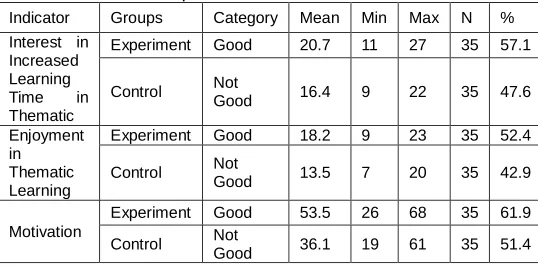
Table 3. Gaps in attitude score on cultural values Posttest
between experiment class and control class
Indicator Groups Category Mean Min Max N % Interest in
Increased Learning Time in Thematic
Experiment Good 20.7 11 27 35 57.1
Control Not
Good 16.4 9 22 35 47.6 Enjoyment
in Thematic Learning
Experiment Good 18.2 9 23 35 52.4 Control Not
Good 13.5 7 20 35 42.9
Motivation
Experiment Good 53.5 26 68 35 61.9 Control Not
Good 36.1 19 61 35 51.4 According to the average rating and category presented in table 4, it shows that students of the experiment group are more dominant in all indicators compared to the control group students. It confirms that the implementation of the E-module ethnoconstructivism has a significant impact on the motivation and thematic attitudes of the students. In addition, experimental group students gained the highest average rating on learning motivation of 61.9% (M = 53.5) and the lowest enjoyment in Thematic Learning 52.4% (M = 13.5). The student control group is slightly higher in terms of learning motivation which is 51.4% (M = 36.1) and the lowest Interest increased learning time in thematic 42.9% (M = 13.5).
Table 4. Independent Sample T-test for attitudes to
thematic against e-module ethnoconstructivism
T Df Mean Std.Deviati
on
95% confidence
interval Lowe
r
Upp er Studen
t
19.54
2 70
4.090
6 .24321
18.23 4
.612 0
attitud e in e-modul es
19.54 2
129.0 67
3.203
3 .30015
17.98 5
.861 5
From Table 4 It can be seen that the value is obtained (t count) with the value of T table. The T-table value can be found in table T with a significance value of 0.025 (2-sided test) with degrees of Freedom (DF) 42. In This study, the results for T table are 1.97658. While for the value of T count can be seen in table 4. (column T) which is 19542. The hypothesis testing criteria is that there is a rejection value of H0 [26]. So, it can be concluded that there is a significant difference in The thematic attitude of students using traditional modules with Exprimentary classes using the E-module ethnconstructivism. It can be seen from table 4 that the average value of student interest is 4.0906, which means it can improve the attitude of students in thematic learning.
Table 6. Independent Sample T-test for motivation to
thematic against e-module ethnoconstructivism
T Df Mean Std.Deviatio n
95% confidence
interval Lower Uppe
r Student
motivatio n in e-modules
20.34
2 70
4.190
6 .24321
18.33
4 .5120 19.64
2
129.06 7
3.403
3 .30015
17.48
5 .6615 From table 6 it can be seen that the value is obtained (t count) with the value of t table. The t-table value can be found in table t with a significance value of 0.025 (2-sided test) with degrees of freedom (df) 42. In this study, the results for t table are 1.97658. While for the value of t count can be seen in table 6. (column t) which is 20.342. The hypothesis testing criteria is that there is a rejection value of H0 [26]. So, it can be concluded that there is a significant difference in Motivation for students using traditional modules with exprimentary classes that use Ethnconstructivism e-modules. It can be seen from table 6 that the average value of student interest is 4.2906, which means it can improve the motivation of students in learning.
4 DISCUSSION
From the results of questionnaire data processing on indicators of interest increasing learning time in thematic After using e-module ethnoconstructivism on (experiment) categorized good with 57.1% and those who did not (controls) categorized Not good with 47.6%. The attitude is shown with students often asking teachers about thematic learning when night is not only in the hours of thematic learning, it is because the student has an interest in Learn a good thematic. It can also be seen from the results of interviews that have been done.
―What do you respond to if hours of thematic lessons are in a school in multiple?‖
―I am glad, because if the lesson hours I will be more understanding of the learning given by the teacher in the classroom‖
3755 interesting things on the net in the thematic‖
Based on the results of interviews that are seen students ' positive attitude towards thematic learning by wanting to multiply the learning time. If the lesson hours are added then students will better understand the concepts and formulas given by the teacher in the classroom. In addition, the interest of increasing the time of thematic learning is not only obtained from reading the literature at home only, but also obtained by students through watching videos on YouTube and looking for interesting things on the internet about thematic. [26-27] said the student's positive attitude toward learning is mirrored from the student's wishes, adding and spending time learning to find things related to the lesson. Addition in thematic learning time is not a bad thing, because with the addition of learning time can provide good insight for students related information in the environment about learning, with a lot of reading literature About thematic and looking for additional information on thematic learning. The addition of time for individuals can provide new experiences, improve skills, and provide opportunities for individuals to gain new insight [28-29]. From The results of questionnaire data processing on indicators of enjoyment in thematic learning After using e-module ethnoconstructivism on (experiment) categorized good with 52.4% and those who did not (controls) categorized Not good with 42.9%. The attitude is shown with students happy when following the learning in the classroom because the students have the pleasure of learning a good thematic. It can also be seen from the results of interviews that have been done.
"Do you enjoy learning thematic? What proof"
"Yeah I enjoy learning thematic. The proof I actively asked and worked on the writing when asked the same teacher "
"If you are given a teacher's duty when you work on it?" "Night Time"
"Do you work alone or cheating with friends?" "Work on Your Own"
A fairly good attitude in the fun indicators in thematic learning is the students are active in class and willing to do their own tasks. Learning pleasure depends on the learning process, students are happy in learning will have a positive impact on the teacher. Students say that teachers while learning are very friendly and understand the deeper concepts. It is very important for students to have an experienced concept understanding and make the learning situation happy [30]. This positive attitude makes learning the fun of students can improve learning outcomes. [31-32]"Good physics learning results are influenced by the enjoyment of student science and pleasure given the predictive effect in science learning". In addition, students who have positive emotions related to pleasure will be successful in learning [33-34]. Based on the data obtained from the implementation of the E-module ethnoconstructivism, it can be seen that the use of e-modules is effective in enhancing the thematic attitude and motivation of Ssiwa. It is based on e-module which is part of e-Learning, where the use of e-Learning in learning makes the learning process can be done continuously. In addition E-Learning is a solution in offering various possibilities for social networking so that in this way teachers can store a variety of student interaction records in collaborative learning [35]. If students have a good attitude in learning, they will have an impact on the learning motivaries of students. Where learning is a characteristic of cognitive, affective and psychomotor, as an
indicator that acts relatively stable for interconnected learning and attitude has factors that can affect social and internal conditions themselves [36-37]. Attitudes help us achieve the desired goal and avoid unwanted results. We will tend to show a positive attitude towards a particular attitude object if it is considered profitable, otherwise we will show a negative attitude towards a particular object if it is considered to be a loss [38-39]. Through learning to use the products of information technology and communication of various multimedia services can be easily transferred, such as High-Resolution audio, video, graphics so that the thought process can lead to thought. Added also the advantage of using e-Learning is that students can interact not only in two directions but can be multi-purpose. Where to improve attitudes and be motivated through e-modules, where the use of e-modules uses media such as computers/laptops, events that keep students interested and motivated [40]. Mobile learning is most effective when its three aspects (learner, device and social) are all fulfilled in the learning process [41-42]. Develop a personal mobile learning system to support guided learning activities for high school students. They found that the student's attitude and motivation for learning was significantly improved [43-46].
5
CONCLUSION
It can be seen that the E-module ethnoconstructivism has an influence on the thematic attitude as well as the motivation of students in learning. In the results of the students' thematic attitudes on the control class using traditional teaching materials there is a significant difference with the experimental classes using Ethnoconstructivism e-modules that are in the superior experimental class because they use E-Model Ethnoconstructivism with a test score of 19,542 on the students' thematic attitudes, as well as the 20,342 on student motivation learning. According to the results, it is recommended that students need to be given opportunities in developing live experiences and thoughts in lesson activities. Teachers must utilize electronic modules to develop their students' attitudes and motivation.
6
ACKNOWLEDGMENT
Thanks to all the parties who have been involved in this article, I would like to thank you very much
7
REFERENCES
[1]. Nafiati, D. A. (2018). Motivation, Creativity, and Self-Confidence as Forming Factors of Economic Learning Autonomy. Dinamika Pendidikan, 12(2), 182–195. https://doi.org/10.15294/dp.v12i2.13566
[2]. Bakhtiar, D. (2016). Teaching materials based on local wisdom integrated STM (science, Technology, and society) on Physics subjects. 1, 730-742.
[3]. Kurniawan, D. A., Asrial., Syahrial., Salsabila, W. S., Kurniawati, E. F., Anandari, Q. S., Perdana. R., Lumbantoruan, A., Nasih, N., Samosir, S. C., Dewi, U. P. Etnoscience Investigation in Pimary Schools: Impact on Science Learning. Universal Journal of Educational Research. 7(12), 2789-2795. 2019.
3756 and Research in Education (IJERE), 4(1), 38.
https://doi.org/10.11591/ijere.v4i1.4490
[5]. Sukasni, A., & Efendy, H. (2017). The Problematic of Education System in Indonesia and Reform Agenda. International Journal of Education, 9(3), 183. https://doi.org/10.5296/ije.v9i3.11705
[6]. Richardson, V. (Ed.) (1997). Constructivit teacher education: Building a world of new understandings. London: Falmer
[7]. Wardoyo Sigit Mangun. (2015). Pembelajaran Konstruktivisme.ALFABETA:Bandung
[8]. Wijaya, M. (2007). Pemanfaatan Teknologi Informasi dan Komunikasi dalam Pembelajaran. Jurnal Pendidikan Penabur, 6(8), 50–59.
[9]. Siregar, P. S., Wardani, L., & Hatika, R. G. (2017). Penerapan Pendekatan Pembelajaran Aktif Inovatif Pembelajaran Matematika Kelas Iv Sd Negeri 010 Rambah. Jurnal Pemikiran Dan Pengembangan SD, 5(2), 743–749.
[10].Astalini, Kurniawan, D. A., Darmaji, Sholihah, L. R., Perdana, R. (2019).Characteristics Of Students‘ Attitude To Physics In Muaro Jambi High School. Humanities & Social Science Reviews (HSSR), 7(2), 91-99
[11].Astalini., Kurniawan, D. A., Perdana, R., Kurniasari, D. (2019). Identification of Student Attitudes toward Physics Learning at Batanghari District High School. The Educational Review, 2(9), 475-484.
[12].Astalini., Kurniawan, D. A., Sulistiyo, U., Perdana, R., Susbiyanto, S. (2019). E-Assessment Motivation in Physics Subjects for Senior High School. International Journal of Online and Biomedical Engineering (iJOE). 15(9), 4-15.
[13].Astalini., Darmaji., Kurniawan, W., Khairul, A., & Kurniawan, D. A. (2019) Effectivenes of Using E-module and E-Assessment. International Journal of Interactive Mobile (IJIM), 13(9), 21-39.
[14].Higgins, E. T., 7 Kruglanski, A. W. (2000). Motivational Science: Social and Personality Perspective. Psychology Press.
[15].Maison., Astalini., Kurniawan, D. A., Perdana, R., Anggraini, L. (2019). The Phenomenon of Physicology Senior High School Education: Relationship of Students‘ Attitudes towards Physics, Learning Style, Motivation. Universal Journal of Educational Research. 7(10), 2199-2207.
[16].Darmawan I Gusti Ngurah, (2007). Keterampilan berpikir kritis siswa di sekolah TIK Thailand, 8 (2), 125-132.
[17].Colak, E. (2017). ―Teachers' Experiences in a
Professional Learning Community on The
Constructivist Lesson Planning: A Case Study Among Primary School Teachers‖. Education and Science. 42(190). 189-209. DOI: 10.15390/EB.2017.6911 [18].Suryatiningsih. (2017). Pengaruh penggunaan e-modul
interaktif terhadap hasil belajar mahasiswa pada materi kesehatan dan keselamatan kerja. Jurnal Ilmiah Pendidikan Teknik Elektro.
[19].Asrial., Syahrial., Kurniawan, D. A., Perdana, R.,
Nugroho, P. Supporting Technologi 4.0:
Ethnoconstructivist Multimedia for Elementary Schools. International Journal of Online and Biomedical Engineering (iJOE). 15(9), 4-15. 2019
[20]. Suyatno. (2019). Strategy of Values Education in the Indonesian Education System. 12(1), 607–624.
[21]. Creswell, John W. 2012. Educational Research: Planning, Conducting, And Evaluating Quantitative And Qualitative Research. New York: Pearson
[22]. Kerlinger, F. N. (2014). Foundations of behavioral research. Yogyakarta: Gadjah Mada
[23]. Cohen, L., Manion, L., & Morrison, K. (2005). Research Methods In Education : Routledge.
[24]. Astalini., Kurniawan, D. A., Perdana, R., Kurniawan, W. (2019). Identification Attitudes of Learners on Physics Subjects. Journal of Educational Science and Technology (EST), 5(1) , 39-48.
[25]. Cramer, D. (2003). Advanced quantitative data analysis. McGraw-Hill Education (UK).
[26]. Hartinah, S., & Setiawan, T. (2013). Sikap Guru Taman Kanak-Kanak Terhadap Pembelajaran Matematika.
Jurnal Ilmu Pendidikan, 51.
http://dx.doi.org/10.17977/jip.v19i1.3754
[27]. Kurniawan, D.A., Astalini., Anggraini, L. (2019). Evaluasi Sikap Siswa Smp Terhadap Ipa Di Kabupaten Muaro Jambi. JURNAL ILMIAH DIDAKTIKA: Media Ilmiah Pendidikan dan Pengajaran, 19(1), 124-139. [28]. Edginton, C. R., & Chen, P. (2008). Leisure as
Transformation. Champaign, IL: Sagamore
Publishing.ISBN: 9781571677341
[29]. Astalini, A., Kurniawan, D. A., & Putri, A. D. (2018). Identifikasi Sikap Implikasi Sosial dari IPA, Ketertarikan Menambah Waktu Belajar IPA, dan Ketertarikan Berkarir Dibidang IPA Siswa SMP Se-Kabupaten Muaro Jambi. Jurnal Tarbiyah: Jurnal Ilmiah Kependidikan. 7(2), 93-108.
[30]. Rawatee Maharaj-Sharma, A. S. (2017). Using Ict In Secondary School Science Teaching – What Students And Teachers In Trinidad And Tobago Say. European Journal of Education Studies , 197-211.
[31]. Ainley, M. A. (2011). A Cultural Perspective on the Structure of Student Interest in Science. International Journal of Science Education, 51-71.
[32]. Astalini, A., Maison, M., Ikhlas, M., & Kurniawan, D. A. (2018). The Development Of Students Attitude Instrument Towards Mathematics Physics Class. Edusains, 10(1). 46-52.
[33]. Astalini, A., Darmaji, D., Pathoni, H., Kurniawan, W., Jufrida., Kurniawan, D. A., & Perdana, R. (2019). Motivation and Attitude of Students on Physics Subject in the Middle School in Indonesia. International Education Studies, 12(9), 15-26.
[34]. Astalini, A., Kurniawan, D. A., & Sumaryanti. (2018). Sikap Siswa Terhadap Pelajaran Fisika Di Sman Kabupaten Batanghari. Jurnal Ilmu Pendidikan Fisika, 3(2), 59-64
[35]. Colak, E. (2017). Teachers' Experiences in a
Professional Learning Community on The
Constructivist Lesson Planning: A Case Study Among Primary School Teachers. Education and Science. 42(190)
[36]. Craker, D. E. (2006). Attitudes Toward Science Of Students Enrolled In Introductory Level Science Courses At UW-La Crosse. UW-L Journal Of Undergraduate Research IX, 9, 1-6.
3757 science in secondary school in Indonesia. Beder
Scientific Journal of Education Sciences (BJES), 20(1), 30-45.
[38].Larkin-Hein, T., & Budny, DD. (2001). Research on learning style: Applications in the physics and engineering classrooms. IEEE Transactions on Education, 44 (3), 276-281.
[39].Astalini., Kurniawan, D. A., Kurniawan, N., Anggraini, L. (2019). Evaluation of Student‘s Attitude Toward Science in Indonesia. Open Journa of Educational Research (OJER), 3(1), 1-12.
[40].Martínez-Caro, E., Cegarra-Navarro, J. G., & Cepeda-Carrión, G. (2015). An application of the performance-evaluation model for e-learning quality in higher education. Total Quality Management & Business Excellence, 26(5-6), 632-647.
[41].Li, K.C., Lee, L.Y-K., Wong, S-L., Yau, I.S-Y. and Wong, B.T-M. (2019) ‗The effects of mobile learning for nursing students: an integrative evaluation of learning process, learning motivation, and study performance‘, Int. J. Mobile Learning and Organisation, 13(1), 51–67. [42].Asrial., Syahrial., Kurniawan, D. A., Subandiyo, M., Amalina, N. (2019). Exploring obstacles in language learning among prospective primary school teacher. International Journal of Evaluation and Research in Education (IJERE), 8(2), 249-254.
[43].Wongwatkit, G., Panjaburee, P. and Srisawasdi, N. (2017). ‗A proposal to develop a guided-inquiry mobile learning with a mastery learning mechanism for improving students‘ learning performance and attitudes in Physics‘, Int J. Mobile Learning and Organisation, 11(1), 63–86.
[44].Zheng, L., Li, X., Tian, L. and Cui, P. (2018). ‗The effectiveness of integrating mobile devices with inquiry-based learning on students‘ learning achievements: a meta-analysis‘, Int. J. Mobile Learning and Organisation, 12(1), pp.77–95.
[45].Asrial, Syahrial, Kurniawan, D. A, Chan, F., Nugroho, P., Pratama, R. A., Septiasari, R. (2019). Identification: The Effect Of Mathematical Competence On Pedagogic Competency Of Prospective Teacher. Humanities & Social Science Reviews (HSSR). 7(4), 85-92