247
An Energy Efficient Unequal Cluster Based
Routing Protocol For WSN With Non-Uniform
Node Distribution
Dhanoop K Dhanpal, Ajit Joseph, Asha PanickerAbstract: Clustering is an efficient method for increasing the lifetime of wireless sensor network systems. The current clustering algorithms generate clusters of almost equal size. This will cause ―hot spot‖ problem in multi-hop sensor networks. In this paper an energy efficient varying sized clustering algorithm (EEVSCA) and routing protocol are introduced for non-uniform node distributed wireless sensor network system. EEVSCA helps for the construction of clusters of varying size, at the same time unequal cluster based routing algorithm forces each cluster head to choose node with higher energy as their next hop. The unequal size of clusters can balance the energy consumption among clusters. Theoretical analysis and simulation results show that EECSVA balance energy consumption well among the cluster heads and increase the network lifetime effectively.
Index Terms: Clustering, Energy Efficient, hot spot, multi-hop sensor networks, network lifetime, unequal cluster, wireless sensor network
————————————————————
1
I
NTRODUCTIONT Energy efficiency is one of important key factor in designing a wireless sensor network system. Large energy consumption will affect the lifetime of the sensor networks. Due to limited energy provision care must be taken while designing the topology. Clustering is an important method for increase the scalability and lifetime of wireless sensor network system. The sensor network is divided into clusters. Each cluster consists of cluster head and member nodes. In the first step the sensor nodes sense the physical parameter under consideration and collected data are sent to the cluster head. During second phase the cluster head forwards the data to the base station in a single hop or multi-hop manner. In the case of multi-hop communication an efficient routing protocol is required for attain the energy balance. Two types of energy consumptions are associated with a CH, inter cluster and intra cluster energy consumption. The energy reduction during receiving and aggregating the data from the cluster members is known as intra cluster energy consumption. While forwarding the aggregated data to the base station also reduce some amount of energy associated with the C.H, it is termed as inter cluster energy consumption.
To make a balance between the energy among nodes, most clustering algorithm uses cluster head rotation mechanism. In most cases the cluster head rotation is based on energy of the cluster head or a time basis. In time based cluster head rotation mechanism, the role of cluster head changes after particular time duration. In the case of energy based CH rotation mechanism, the role of CH changes when the residual energy of cluster head is less than a threshold value. In both cases the size of clusters are almost equal due to equal radio range. In equal clustering algorithms an energy imbalance among cluster head is generated. Consider the case of single hop communication, the CH which located far away from base station have to transmit information to a long distance and it will die very early compared to CH located near to base station. While considering the case of multi-hop communication the cluster head located near to base station has a high level of traffic compared to those located far away from base station. This will cause the premature dying of CHs located near to the base station. This phenomenon is known as ―energy hole‖ or ―hot spot‖. To solve the above problem unequal clustering algorithms are proposed. In this paper, an energy efficient varying sized clustering algorithm (EEVSCA) and an unequal cluster based routing protocol are introduced. In the network the sensor nodes are randomly distributed in the field, EEVSCA construct clusters of varying size in order to balance the energy consumption among the cluster heads. At the same time the unequal cluster based routing algorithm makes the whole system in an efficient manner. The remaining part of this paper is organized as follows. Section 2 covers the related works in this area. Section 3 and 4 exhibits the Network model, Energy model respectively. Section 5 describes Energy Efficient Varying Sized Clustering Algorithm in detail and also explains the inter cluster multi-hop routing algorithm for unequally distributed clusters. Section 6 analyzes some important properties of the proposed algorithm. Section 7 shows the EEVSCA simulation results and analysis of results obtained. Finally section 8 concludes this paper.
2 Related Works
LEACH: It is a clustering based routing protocol that utilizes random rotation of cluster heads with a probability. Base station receives and aggregates information from member nodes and sends the aggregated data to the base station, which is located outside the sensor field in a single hop _________________________
Dhanoop K Dhanpal is currently pursuing masters of technology program in communication engineering at Mangalam College of Engineering, Kottayam, Kerala, India, PH-+918086998435.
E-mail: [email protected]
Ajit Joseph is currently working as associate professor in Electronic and Communication Engineering Department at Mangalam College of Engineering, Kottayam, Kerala, India, PH-+919495108681.
E-mail: [email protected]
Prof. Asha Panicker is currently working as HOD, professor in Electronic and Communication Engineering Department at Mangalam College of Engineering, Kottayam, Kerala, India,
248 communication. In order to balance the energy dissipation, the
role of cluster head is periodically rotated among the nodes. While considering the performance of LEACH in heterogeneous environment, is not very good, because the election of the cluster head is not based on the residual energy. EADEEG: It is a distributed clustering algorithm. The selection of cluster head is based on the ratio between the average residual energy of residual node and residual energy of node its self EADEEG provides a very well cluster head distribution and increases the network lifetime. EADEEG cause ―isolate point‖ problem. EADC: A cluster based routing protocol for wireless sensor networks with non-uniform node distribution. EADC consists of Energy aware distributed clustering algorithm EADC and cluster based routing algorithm. The black hole problem is affected by this EADC protocol, due to the equal size. EEUC: Energy Efficient Unequal Clustering uses a probabilistic method to elect the tentative cluster head. Tentative cluster head nodes participate in the CH competition. This protocol considers the residual energy of node for CH election. The unequal clustering algorithms, to solve the hotspot problem is proposed in the paper [8],[9]. In these papers the network field is divided into cirques. The clusters located in the same cirques have equal size, but clusters in the different cirques have different size. The node with higher energy takes the role of cluster head and manages the cluster operation.
3
N
ETWORKM
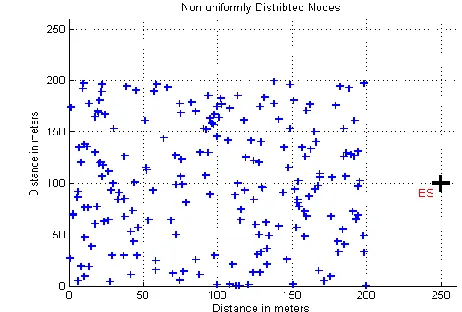
ODELTo simplify the system model, considering few reasonable assumptions. Let us consider a sensor network contain N number of sensor nodes, distributed randomly in an MxM square field.
1) There is a base station (data sink) fixed far away from the sensing field. All the sensor nodes and base station are stationary after deployment.
2) The sensor nodes are heterogeneous in nature and they have same capability.
3) The sensor nodes are location unaware.
4) Nodes are capable of power control to vary the power of transmission. The power control depends on the distance to base station
5) The base station is located outside the sensor field. The location of base station is known by all the sensor nodes and it has sufficient energy resource.
6) Each node is indicated by the identity (id).
4
E
NERGYM
ODELEnergy model is adapted from the EADC protocol [1]. We are considering the free space and multipath fading channel models. The channel model selection depends on the distance between the transmitter and receiver. The energy consumed for transmission of ‗l‘ bit data packet over distance d is given by
2
0 4
0
,
,
Elec fsTx
Elec mp
lE
l
d d
d
E
lE
l
d d
d
(1)In the above equation d is the transmission distance; the packet length is denoted by l. Eelec, εfs and εmp are parameters
of the transmission and reception circuitry. While receiving an l-bit data, the radio expends energy
Rx Elec
E
lE
(2)
Here assume that the sensed data is highly correlated, thus the cluster head can aggregate the data gathered from its member nodes into a single packet having fixed length
2 0
fs
mp
d
(3)
5
U
NEQUAL CLUSTER BASED ROUTING PROTOCOLThe proposed protocol consists of an energy efficient varying sized clustering algorithm and unequal cluster based routing algorithm. The detailed description of the EEVSCA and routing algorithm are in the following two subsections. The descriptions of control message used in the process are shown in the table 1.
TABLE 1
DESCRIPTION OF CONTROL MESSAGES
Message Description
Head_Msg
Join_Msg
Schedule_Msg
Route_Msg
Tuple(selfid)
Tuple(selfid, headid)
Tuple(scheduleorder)
Tuple(selfid, selfenergy, disttoBS)
5.1 EEVSCA details
This phase is similar to the setup phase in LEACH. The whole process is divided into two, Cluster head election phase and cluster formation phase In the network deployment stage the base station broadcasts a signal with particular energy level. Each node can calculate its approximate distance to BS based on the strength of the received signal.
5.1.1 EEVSCA details
This stage takes place in two steps having duration T1 and T2
respectively. In T1 of time after beginning this stage, each node
calculates its waiting time, twi, based on its residual energy. For
each node the following equation to calculate its waiting time twi for broadcasting Head_Msg
249
2 max
1
iwi r
E
t
T V
E
(4)where Ei is the residual energy of node i and Emax is the
maximum initial energy of the nodes in the network. Vr in the
above equation is a random real value, which is uniformly distributed in the interval [0.9,1]. The weight value Vr reduces
the probability that two nodes simultaneously send Head_Msg. After T1 expires, the election of cluster head begins, which
depends on the value of twi. During the time interval of duration
T2, for any node si, if it does not receives any Head_Msg when
time twi expires, node si broadcasts Head_Msg within radio
range Rci. The Head_Msg of si indicates that it will be a cluster
head. Otherwise if node si receives a Head_Msg from another
node sk before timer twi expires, si records the identity of node
k and with the help of received Head_Msg power level, si
calculate the distance to node sk. Then node si becomes a
non-cluster head node. Each node in the sensor field need to calculate their competition radius Rc, for the generation of
variable sized clusters.
max
max
max min
1
ici
d
d
R
R
d
d
(5)In the above formula dmax and dmin are maximum and minimum
distance from the base station to the nodes in the sensor field. di is the distance from base station to sensor node si, α is
random value belongs to [0,1], Rmax is the maximum value of
allowable competition radius. By analyzing the above formula, we can see that the competition radius of node si depends on
the value of di. The value is directly proportional to di, i.e.
larger di is, the larger Rci is and vice versa.
While considering the case of heterogeneous network, the initial energy of nodes are heterogeneous in nature. Consider the case that energy consumption of each node is same, then the node with low initial energy will die prematurely, it will reduce the overall network lifetime. This will leads to think about how to take full advantage of node with higher energy?
The answer is, the node with higher energy should take more work load. This leads to modification in the formula for Rci.
max
max
max min max
1
i ici
d
d
E
R
R
d
d
E
(6)β is an another real random value in the interval [0,1]. By analyzing the above formula, consider that the competition radius of si depends on the value of Ei and di. The node with
larger Ei and di have large completion radius Rci. Cluster head
located nearer to the B.S could save energy for data forwarding. On the other words, to avoid the premature death of cluster head with lower residual energy, control smaller clusters. This will increase the system lifetime.
5.1.2 Cluster formation phase
The duration of this phase is T3. During this phase each
non-cluster head nodes compare the value of distance to CH, from where the Head_Msg is received. Then select the CH which is located near to the non-cluster head node. The cluster head sends the Join_Msg to member node, which contains the id and residual energy of this node. Based on the received Join_Msg each cluster head generates a node schedule list, including the Schedule_Msg for its cluster members. The Schedule_Msg gives the idea about when the sensor node can send data to the cluster head.
5.2 Unequal cluster based routing algorithm
The duration of the phase is T4. During this phase a routing
tree is constructed on the cluster heads. Here introduce a threshold distance DIST_TH. If the distance between the cluster head si to base station d(si,BS) is less than the
threshold distance DIST_TH, then direct communication between the node si and base station takes place, i.e. single
hop communication between CH and BS. These type of cluster heads known as child cluster heads. Otherwise node si
selects the next hop from its neighbor cluster heads, based on their relay value. At the beginning each cluster had broadcasts a Route_Msg with in the radio radius Rri, which contain the id,
residual energy and distance to the base station. We can select the radio radius Rri=2Rci. If d(si,BS) less than DIST_TH
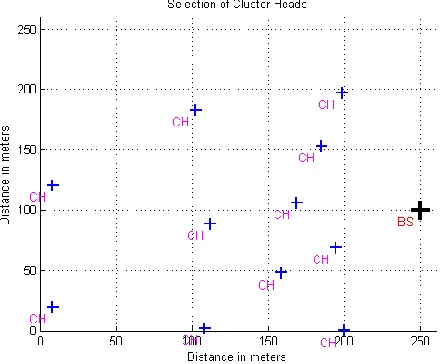
then base station is the next hop. Otherwise the next hop Fig. 2. Cluster head selection
250 selection is based on the relay value of the neighbor nodes.
Cluster head si elects the neighbor cluster head which having
higher residual energy and no farther away from BS as its next hop cluster head. Here gives the formula for compute relay(si,sj), i.e. when cluster head si chooses sj as its next hop.
max
( ,
i j)
E
jrelay s s
E
(7)
In the above equation Ej is the residual energy of cluster head
sj and Emax is the maximum initial energy of nodes in the
system. α is a real random value located in the interval [0,1].
5.3 Data transmission phase
The data transmission phase is divided into two stages; they are intra cluster communication and inter cluster communication.
5.3.1 Intra cluster communication
In this phase communication within a cluster takes place. The sensor node collects the local data from the environment and transmits the data to the cluster head.
5.3.2 Inter cluster communication
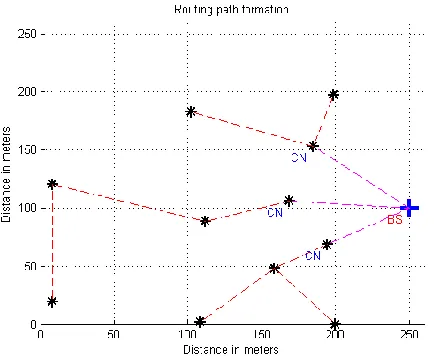
The cluster head receives and aggregate the data received from their cluster members and forward the aggregated data to the next hop node. The forwarding of data takes place with the help of routing tree which is constructed on the basis of unequal cluster based routing algorithm.
6
P
ROTOCOLA
NALYSISAnalyzing EEVSCA we can summarize the characteristics of EEVSCA as follows,
1) The equation for waiting time twi ensure that, the
waiting time of each node is less than T2. There for
any expected cluster head can broad cast the Head_Msg and become a cluster head before T2
expires, which results all the nodes are covered by the elected cluster heads. Different nodes have different waiting time, so there is at most one cluster head in each Rc ratio coverage range.
2) For the construction of unequal clusters, nodes use
unequal competition range. This leads to balanced energy consumption among the nodes.
3) It elects cluster heads based on the ratio between residual energy of the nodes and maximum initial energy. Nodes which have relatively higher energy are selected as cluster head. This leads no prolonging the network lifetime.
4) There is no isolate point in EEVSCA.
5) The competition radius Rci takes the value of d(si ,BS)
and residual energy is si for its calculation. Varying
sized clusters generated by using Rci will be more
effective in increasing the network lifetime.
Unequal cluster based routing algorithm analysis
The value of DIST_TH determines the number of cluster heads which are communicate directly to the base station. If the DIST_TH is less than BS to network field, then there is no child cluster head and the network cannot communicate with BS. On the other hand, if DIST_TH is very much larger than the distance from the base station to network field, then the number of child cluster heads will increase and which leads to wastage of energy. Then care must be given while choosing DIST-TH. The clusters which are located away from the BS requires higher energy for intra cluster communication but the energy required for inter cluster communication is very less. The number of cluster heads generated increases as we move towards the base station. This will leads to an energy balance between the cluster heads. The premature dying of cluster head near to the base station is eliminated by increasing the number of CH near to the base station and reduces the inter cluster energy consumption.
7
S
IMULATIONSThe simulation was performed in MATLAB. Each experiment is done in different scenarios and the two scenarios are selected to be mentioned as follows.
Scenario 1: 200 nodes are randomly deployed over a 200mX200m field and initial energy of each node in the network is 2.5J.
Scenario 2: 200 nodes are randomly deployed over a 200m X 200m field and initial energy of the nodes in the network is uniformly distributed over the interval [1,3]J
The parameters of simulations are displayed in table 2
TABLE 2
PARAMETERS OF SIMULATIONS
Parameter Value
Sensor field BS location Number of nodes Initial energy of nodes Data packet size Eelec
εfs
εmp
Esen
Ecom
200 m×200 m (250,100) 100 1–3 J 500 bytes 50 nJ/bit 10 pJ/(bit m2) 0.0013 pJ/(bit m4) 0 J/bit
5 nJ/(bit signal) Fig. 4. unequal cluster based routing path between cluster
251
7.1 Cluster head distribution
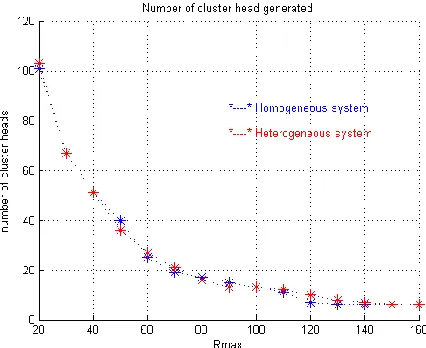
Run EEVSCA in the above mentioned scenarios respectively. The fig (5) shows that the graph generated for each scenarios are coincide roughly. This indicates that the no of cluster head generated in each scenario are equal. This concludes that the initial energy does not depend on the initial residual energy of the nodes. A balance in the energy consumption is provided by EEVSCA.
Fig (6) shows the relation between the number of clusters and distance from base station. We can see that while we are moving towards the base station the number of cluster head increases. On other words more no of cluster heads are located nearer to the base station and it decreases as we move away from the base station. This shows the distribution of cluster head in the network.
7.2 Network life time
There is no clear definition for network life time can be calculated using the following ways.
FND-First Node Dies: The time between the deployment of the network and death of the first node.
PNA- Percentage Node Alive: The time till certain percentage of node alive
LND: Last Node Dies: The time when all the nodes in the
network are dead
Here define the network lifetime as PNA, i.e. the time when 90% of nodes alive. From the fig (5) we can see that when Rmax increases the total number of cluster head decreases and
rate of decrease gradually slows down. This indicates that network life time increases gradually as the value of Rmax
increases. To find out the network lifetime of EEVSCA, run EADC and EEVSCA. The fig (7) shows the comparison of network lifetime. The result shows that EEVSCA can prolong lifetime.
8
C
ONCLUSIONIn this paper, propose an energy efficient varying sized clustering algorithm and unequal cluster based routing protocol. EEVSCA elects cluster heads based on the ratio between residual energy of the node and maximum initial energy. The unequal competition radius is used for the construction of varying sized clusters and is calculated using the distance to the base station and residual energy of the node. The cluster located near to base station have smaller size to reserve some energy for inter cluster data forwarding, also the number of cluster heads decreases as move away from the base station. The combined effects can balance the energy consumption among the cluster heads and increase the network lifetime. Each cluster head chooses a cluster head with higher residual energy as its next hop, i.e. further energy balance is provided with the help of unequal cluster based routing protocol.
References
[1] Jiguo Yu, Yingying Qi, Guanghui Wang, Xin Gu, “A Cluster-Based Routing Protocol for Wireless Sensor Networks with Nonuniform Node Distribution”. Int. J. Electron. Commun. (AEÜ) 66 (2012) 54– 61
[2] Jiguo YU, Yingying QI, Guanghui WANG, “An Energy-Driven Unequal Clustering Protocol for Heterogeneous Wireless Sensor Networks”. J Control Theory Appl 2011 9 (1) 133–139
[3] B. Baranidharan, S. Srividhya and B. Santhi, ―Energy Efficient Hierarchical Unequal Clustering in Wireless Sensor Networks‖. Indian Journal of Science and Technology, Vol 7(3), 301–305, March 2014
Fig. 5. Number of cluster heads generated vs Rmax
Fig. 6. CH distribution according to d(si,BS)
252 [4] Chengfa Li, Mao Ye, Guihai Chen, Jie Wu, ―An
Energy-Efficient Unequal Clustering Mechanism for Wireless Sensor Networks‖.
[5] Jiguo Yu, Yingying Qi, Gang Wang, Qiang Guo, and Xin Gu, ―An Energy-Aware Distributed Unequal Clustering Protocol for Wireless Sensor Networks‖ International Journal of Distributed Sensor Networks Volume 2011, Article ID 202145
[6] W. R. Heinzelman, A. Chandrakasan, H. Balakrishnan, ―Energy Efficient Communication Protocol for Wireless Micro-sensor Networks‖ [C]//Proceedings of the 33rd Annual Hawaii International Conference on System Sciences.
[7] Maui, HI, 2000: 1 – 10. M. Liu, J. Cao, G. Chen, et al. “EADEEG: An Energy-Aware Data Gathering Protocol for Wireless Sensor Networks‖ [J]. Journal of Software, 2007, 18(5): 1092 – 1109.
[8] S. Soro,W. R. Heinzelman. ―Prolonging The Lifetime of Wireless Sensor Networks via Unequal Clustering‖[C] //Proceedings of the 19th IEEE International Parallel and Distributed Processing Symposium. Los Alamitos: IEEE Computer Society, 2005: 236 – 243.