Extreme quadrupole deformation and clusterization
J. Darai1,a, J. Cseh2, G. Adamian3, and N. Antonenko31 Department of Experimental Physics, University of Debrecen, Debrecen, Pf. 105, Hungary-4010 2 Institute of Nuclear Research, Hungarian Academy of Sciences, Debrecen, Pf. 51, Hungary-4001 3 Bogoliubov Laboratory, Joint Institute for Nuclear Research, 141980 Dubna, Russia
Abstract. We discuss a simple symmetry-adapted method for the determination of the shape isomers, and for the study of their possible fragmentation. In other words the connection between the quadrupole (collective) and dipole (cluster) degrees of freedom is considered in terms of an easily applicable, yet microscopic method. The energetics is taken into account by the double-folding method. Special attention is focused on those cases in which the theoretical predictions have a direct comparison with experimental observation.
1 Introduction
The behavior of the finite nuclear matter under extreme conditions raises many exciting questions. One of them concerns the case of the large quadrupole deformation. Su-perdeformed (SD) states have been observed in several nu-clei, while the appearance of hyperdeformation (HD) is a hot topic for a discussion. Especially interesting is their existence in theN = Z nuclei, in which the role of pair-ing, quarterpair-ing, isospin, can be studied. The experimental observation of the SD states in these nuclei started approx-imately a decade.
The investigation of clusterization of a specific nuclear state is important from two aspects. First it contributes to our understanding of the nuclear structure. Second it gives valuable information on the nuclear reactions, which can populate the state in question. In particular, a binary clus-ter configuration with the clusclus-ters in their ground intrinsic state is uniquely related to a reaction channel, like target and projectile in their ground state. Actually, one of the possible definition of a binary cluster configuration is pro-vided by this kind of reaction channel. (Since it is directly related to its observation, probably this is the best way to define a cluster configuration.)
In this contribution we present a simple method, that we have applied recently for the determination of the shape isomers of some light nuclei, and for investigating their possible binary clusterizations as well. In both steps sym-metry-considerations played an essential role.
The next section describes briefly the methodology, whi-le in Sec. 3 we present some results. We focus on those cases in which the theoretical predictions or results can be compared with the experimental observation.
2 Methods
2.1 Preliminaries
The basic connection between the quadrupole shape and clusterization was found in the fifties, via the bridge of
a e-mail:[email protected]
the shell model. This relation is based on theS U(3) sym-metry. Elliot has shown [1], how the quadrupole deforma-tion and collective rotadeforma-tion can be derived from the spher-ical shell model: the states belonging to a collective band are determined by their specificS U(3) symmetry. Wilder-muth and Kanellopoulos [2] established the relation be-tween the shell and cluster models. They have shown that the Hamiltonians of the two models can be rewritten into each other exactly in the harmonic oscillator approxima-tion. This relation results in a close connection between the corresponding eigenvectors, too: the wave function of one model is a linear combination of those of the other, which belong to the same energy. Later on this relation was in-terpreted by Bayman and Bohr [3] in terms of theS U(3) symmetry. As a consequence, the cluster bands can be con-sidered from the shell model viewpoint, like a set of states having specialS U(3) symmetry, just like the collective ro-tational bands.
The 1958S U(3) connection was based on the symme-try of the spherical shell model. In light of the fact that today very largely deformed states are known experimen-tally, it is an important question, what happens to this sym-metry with increasing deformation. The superdeformed sta-tes e.g. represent a situation which is close to the axially symmetric spheroid with ratios of main axis of 2:1:1, the hyperdeformed states correspond to 3:1:1.
In [4] it was shown that the symmetry algebra of the anisotropic harmonic oscillator isS U(3), when its frequen-cies are commensurate, i.e. expressed as ratios of integer numbers. As a special case it includes the spherical oscilla-tor, as well as the superdeformed or hyperdeformed shapes. More details, concerning the axially symmetric case with 2:1, 3:1, and 3:2 ratios are discussed in [5], and for the tri-axially deformed oscillator in [6]. (For previous works on this problem we refer to the citations in these papers.)
The connection between the anisotropic harmonic os-cillator and clusterization have been discussed in [7–9].
2.2 Shape isomers
In what follows we pay attention to the problem of more realistic interactions. In these considerations the Nilsson DOI: 10.1051/
C
Owned by the authors, published by EDP Sciences, 2012 epjconf 20123/ 816001
This is an Open Access article distributed under the terms of the Creative Commons Attribution License 2 0 , which . permits unrestricted use, distributi and reproduction in any medium, provided the original work is properly cited.
model plays an important role, which gives single nucleon orbitals for more realistic interactions, including spin-orbit, as well asl2terms. Soon after the experimental discovery of the superdeformed states, Sugawara-Tanabeet al. have realized that theL−S coupling recovers for the superde-formed shape, first in a simple model [10], then in more realistic calculations [11]. In particular they found that the L−S coupled spherical wave function components became more that 85% of the total. The reason for this is the domi-nant role of the quadrupole interaction due to the large de-formation. This phenomenon provides an explanation for the appearance of the parity doublet levels.
We investigate the survival (or appearance) of theS U(3) symmetry systematically as a function of the quadrupole deformation (including triaxial deformation). We do so in terms of the Nilsson-model combined with the concept of the quasi-dynamical (or effective)U(3) symmetry [12]. It is a generalization of the concept of the realU(3) symme-try, known to be approximately valid in light nuclei [1]. The quasi-dynamical symmetry is more general in the fol-lowing sense. The Hamiltonian breaks the symmetry in such a way that theU(3) quantum numbers are not valid for its eigenvectors either (contrary to the case of the real U(3) dynamical symmetry). In other words neither the op-erator is symmetric (i.e. it is not a U(3) scalar), nor its eigenvectors are (i.e. they do not transform according to a single irreducible representation) [13]. Yet, the symmetry is present is some sense.
An asymptotic Nilsson-state serves as an intrinsic state for the quasi-dynamicalS U(3) representation. Thus the ef-fective quantum numbers are determined by the Nilsson-states in the regime of large deformation [14]. When the deformation is not large enough, then we can expand the Nilsson-states in the asymptotic basis, and calculate the ef-fective quantum numbers based on this expansion [15].
TheS U(3) quantum numbers uniquely determine the quadrupole shape of the nucleus [16], thus we obtain the shape isomers from them. In particular, a self-consistency calculation is performed with respect to the quadrupole shape of nucleus, which is an alternative of the more usual energy-minimum calculations. It is based on the applica-tion of the quasi-dynamicalU(3) quantum numbers [17], and in those cases when a detailed comparison can be made with the traditional energy-minimum calculations, the re-sults are very similar [17–19].
2.3 Clusterization
Once the shape isomers have been found, the next question is how they are related to cluster configurations. In simple cases theS U(3) connection could provide the answer [20]. It was working very simple (e.g. in the ground-state region) due to two facts that: i) theS U(3) symmetry was approx-imately valid, and ii) the connection between the cluster and shell model states was simple, i.e. expanding the clus-ter basis state in clus-terms of shell model basis only a very few (sometimes a single) basis states gave contribution [21, 22]. The symmetry-breaking interaction, however, mixes theS U(3) states. Furthermore, the shell-model expansion of a cluster state is usually very complicated, too; i.e. many shell-model basis states give contribution [21, 22].
What happens with the shape isomers? As seen above, theS U(3) symmetry recovers, even for the
symmetry-brea-king interactions like spin-orbit. It is not necessarily a real S U(3), more often it is a quasi-dynamicalS U(3), but for light nuclei many times the two coincide with each other. What can we expect from a selection rule, based on the quasi-dynamicalS U(3) symmetry? First it has a definite geometrical content in spite of the abstract algebraic for-mulation. It shows how much the quadrupole shapes of the shell-model state and the cluster configuration are con-sistent with each other [18]. This consistency is obtained from a cluster picture, in which the Pauli-principle is taken into account at an approximate level. Namely, single shell-model configurations can be associated to the internal struc-ture of the clusters [14], and for these configurations the exclusion principle is valid. Of course, when the quasi-dynamical symmetry reduces to a real one, the selection rule gives an exact result (to the extent theU(3) symmetry is valid). Thus we can say that the Pauli-principle is incor-porated only in an approximate, but well-defined way, and its validity can be checked by making a comparison with the results of the fully microscopic description, where they are available.
The selection rule is only a necessary condition for the appearance of the allowed clusterization, but not a suffi -cient one. Another simple prescription is provided by Har-vey [23] which is also based on the use of the harmonic oscillator basis, therefore, it is easily applicable, too. This is also a necessary condition. The content of the two re-quirement is not the same, in some sense, they are comple-mentary to each other. Their relation is discussed more in detail in [19]. Therefore, one should apply both prescrip-tion in a combined way, and that is how we used them in the cases presented later on. When a cluster configuration is forbidden, we characterize its forbiddenness in a quanti-tative way [24].
In short this part can be summarized, by saying that condition i), i.e. the validity of theU(3) symmetry is sat-isfied (in an approximate way). It also turns out that con-dition ii), i.e. the simple relation between the cluster and shell model basis is also valid many times, in spite of the fact that the shape isomers are usually highly excited states. It is a consequence of the fact that the highly deformed states are realized only in a very limited number of shell-configurations.
The energetic preference represents a complementary viewpoint for the selection of clusterization. We incorpo-rate it in two different ways: i) by applying simple binding-energy arguments [25], and ii) by performing double-fol-ding calculations, accordouble-fol-ding to the dinuclear system model [26, 27]. In this model the charge (mass) asymmetryηZ = (Z1−Z2)/(Z1+Z2) (η=(A1−A2)/(A1+A2)), whereZ1(A1) andZ2(A2) are the charge (mass) numbers of the heavy and light nuclei of the dinuclear system, is the relevant collec-tive variable describing the partition of nucleons among the nuclei forming the dinuclear system. The wave function inηZis thought to be a superposition of the mononucleus configuration with|ηZ| =1 and different cluster-type con-figurations. The relative contribution of each cluster com-ponent to the total wave function is ruled by the potential U(ηZ) at|ηZ|<1 [27, 28]:
of the nucleus-nucleus potentialV. HereRt is the touch-ing distance between the clusters, which depends on their relative orientation. The negative quantitiesB1andB2are the binding energies of the clusters andB is the binding energy of the parent nucleus. The experimental ground-state masses and quadrupole deformation parameters [29, 30] are used in the present calculations. Since the values of U are given with respect to B,U(|ηZ| = 1) = 0. The double-folding method of the calculation ofV as well as the parameters used are presented in [28, 31]. The mutual orientation of nuclei in the dinuclear system corresponds approximately to the result of the microscopic considera-tion.
3 Results
3.128Si
There has been much discussion recently on the superde-formed state in28Si, both from the theoretical and from the experimental sides. An AMD study by Taniguchiet al. [32] delineates an SD band in28Si with a moment of inertia of≈6~2/MeV. Its structure is dominated by24Mg+αand 12C+16O clustering. Another recent calculation in terms of the macroscopic-microscopic model [33] also predicts an SD band with strong12C+16O clustering.
From the experimental side, there are a set of states in 28Si identified in the12C(20Ne,α)28Si reaction which have been attributed to the superdeformed band by Kubonoet al. [34]. This sequence has no, however, the smooth char-acteristics expected for such a band.
Jenkinset al. have reviewed the available experimental data, and extended them with newγ-transitions [35]. As a result, they propose a new candidate for the SD band. In particular the 6+state was identified by Brenneisenet al. [36] at 12.86 MeV, which is populated in (α, γ) reaction, but not in (p, γ). In a recent Gammasphere measurement the12C(20Ne,α)28Si reaction was studied [35]. Double and tripleγ-coincidence were measured, and nearly all states below 10 MeV have been located, as well as essentially all knownγ-decaying high-spin (J >4) states. This work confirms the location and the decay branching of the can-didate state by Brennenstein et al. As a result, the new SD candidate band has states with 2+, 4+, and 6+ spin-parities. Theirγ-decay is strongly retarded to the oblate ground state band, and enhanced to the prolate band.
Inspired by this exciting situation with open questions on the SD state, we have carried out an independent theo-retical analysis of highly-deformed structures in28Si [37]. In particular we performed a Nilsson-calculation, combined with quasi-dynamical U(3) considerations, and determined the allowed binary clusterizations of the shape isomers. As a result we have obtained 8 shape isomers from the ground state up to the alpha-chain states. The low-energy section, containing the ground (GS), prolate (Pr) and superdeformed-prolate (SD) states is shown in Table 1.
Five (from our eight) shape isomers were seen previ-ously in energy-calculations of the Nilsson model [38]. Even better agreement is recognized with Brink-model re-sults [39–41]. These studies gave also eight shape isomers, and seven of them are in a one-to-one correspondence with our results.
Table 1. Shape isomers in the 28Si nucleus from the Nilsson
model+quasi-dynamicalS U(3) calculation. ‘e’ stands for eff ec-tiveU(3) quantum numbers, ‘h’ indicates the states correspond-ing to simple harmonic oscillator configurations. (p) and (o) mean prolate and oblate, respectively. The triaxiality,γ, is given in de-grees. The penultimate column indicates the axis ratio, while the final column presents the moment of inertia (in units of~2/MeV).
St Mod ~ω U(3) β2 γ a:b:c J
e(p) -1 [13,13,9] 0.17 60 1.2:1.2:1 3.4 GS e(o) 0 [16,15,5] 0.44 55 1.6:1.5:1 4.8 3.5 3.3 h 0 [16,16,4] 0.50 60 1.7:1.7:1 3.4 Pr e 0 [19,9,8] 0.44 5 1.5:1:1 4.4 4.3 2.8 h 0 [20,8,8] 0.50 0 1.5:1:1 4.5 SD e 4 [27,8,5] 0.81 7 2.2:1.1:1 5.8 5.5 2.3 h 4 [28,8,4] 0.88 9 2.3:1.2:1 6.1 5.7 2.2
We have studied systematically the allowed binary clus-ter configurations of the shape isomers. In doing so the clusters were considered to have deformations, like the gro-und states of the corresponding nuclei, and no constraint was applied for their relative orientation. The alpha-like clusterizations proved to be energetically favored.
The GS allows those clusterizations for which the lighter cluster is either4He and8Be, while the Pr and SD states allow several cluster configurations (both the effective and the harmonic oscillator states can be clusterized). For the SD state, which was the focus of our work, we found that the4He+24Mg, and the12C+16O cluster configurations are the most probable, taking account of both the selection rules and energetic preference. This finding is in line with the recent AMD [32] and macroscopic-microscopic calcu-lations [33], as well as with the new experimental results [35]. Its predicted moment-of-inertia is near-identical to that of the AMD calculation, and showed by the experi-ment, thus it gives support to the new candidate for the SD state [35].
3.236Ar
The SD band of the36Ar nucleus was reported in [42]. Fol-lowing the experimental observation a considerable theo-retical effort has been concentrated on this band. In [43] e.g. the possible binary clusterizations of this state was studied systematically. Similar studies have been done also for the ground, and the hyperdeformed bands. The latter one had been predicted from alpha-cluster model calcula-tions [44]. One of the interesting conclusions of this work [43] was that the HD state of the36Ar nucleus could be populated in the24Mg+12C and20Ne+16O reactions.
Fig. 1. Excited states in 36Ar, observed as resonances in the 12C+24Mg (open circles) and16O+20Ne (full circles) reactions.
The SD band observed in36Ar and the ground-state band are also
included. The shapes are from Nilsson-calculations.
phase-shift study, as well as Regge-pole and energy-depen-dent resonance calculations. The existence of five reso-nances have been proved, which have angular momenta 2, 4, 6, 7, 8. These states together with the resonances from the20Ne+16O reactions seem to establish a rotational band [45], as shown in the upper part of figure 1. Its moment of inertia is in a very good agreement with that of the HD shape predicted from alpha-cluster model [44]. The simi-larity of the (predicted and observed) moments of inertia, and the fact that the resonances were seen in exactly those reactions, which define the preferred cluster-configurations of the HD shape suggest that the recently observed band in figure 1 is a good candidate for the hyperdeformed shape isomer of the36Ar nucleus. For comparison also the ground and superdeformed bands are indicated in figure 1. The energetical preferences of cluster-configurations have been discussed in detail in [46].
Since a candidate for the HD state showed up, the ex-citing question arises if such a shape can be seen in shell-model calculation as well. In [17] we have carried out Nils-son-model+quasi-dynamicalS U(3) calculation in order to find the answer. This calculation gives a HD state which has exactly the same symmetry as that from the alpha-cluster model. The moment of inertia from these model agrees well with the one indicated by the experiment.
It was an interesting finding that different states can be built up from the same two clusters, like e.g.12C+24Mg, as illustrated in figure 2. The difference in these cases is the relative orientation of the two deformed clusters. This result is a consequence of the fact that the Pauli-principle was taken into account, and no simplifying assumptions were made on the shapes and relative orientations of the clusters.
The combination of these findings seems to suggest that the largely deformed band in figure 1 is a good can-didate for the hyperdeformed state, thus36Ar may be a nu-cleus to have experimental evidence for the existence of ground, superdeformed, as well as hyperdeformed bands.
The question of the ternary clusterization for these shape isomers have been addressed in [47]. In particular, those possible ternary cluster-configurations have been
determin-Fig. 2. The shape isomers of the36Ar nucleus from
Nilsson-model calculations, and their amalgamation from two clusters. The central part shows the shell-model results for the ground (at the bottom), superdeformed, triaxial, and hyperdeformed (at the top) states. The left column corresponds to the 24Mg+12C
clusterization. The right side illustrates the32S+4He,20Ne+16O, 28Si(prolate)+8Be, 28Si(prolate)+8Be, 20Ne+16O configurations
(from the bottom), respectively. At the upper most line also the alpha-clusterization of the HD state is shown from the work [44], where the contour corresponds to the HD state of the Nilsson-model.
ed, which contain at least one double-magic clusters. They are preferred from the energetic viewpoint.
3.340Ca
The situation of the shape isomers of the40Ca nucleus is somewhat similar to that of the36Ar. In particular the SD band has been observed experimentally [48], and due to this fact several theoretical studies have been carried out. In [49] we have investigated the possible binary clusteri-zations in the ground, superdeformed and a hypothetical hyperdeformed band. The latter one was obtained from simple harmonic oscillator shell model configurations with quadrupole deformation, which is considered to be appro-priate for the HD state. TheU(3) selection rule has been applied, and the energetic calculations were carried out.
Both for the SD and for the HD states the28Si+12C clusterization turned out to be an important one. For the SD shape this finding is consistent with the conclusion of the fully microscopic AMD calculations [50]. Work is in progress [51] in order to complete this analysis with the systematic determination of the shape isomers from Nilsson-model+qusidynamicalU(3)-symmetry calculations. A comparison with the results of an experimental work on the elastic scattering of28Si+12C is also being done.
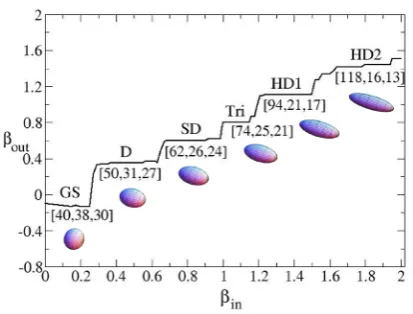
3.456Ni
Fig. 3.Quadrupole deformation of the 56Ni nucleus from the
Nilsson-model with the effective U(3) quantum numbers and schematic illustrations of the shape at the plateaus.
deformations fulfill the self-consistency argument between the input and output deformation-parameters to some ap-proximation.)
As seen from the figure, the triaxial ground-state (for which the experimental deformation isβ2 =0.173) is fol-lowed by a prolate-like deformed state of 0~ωexcitation. The next region of stability corresponds to the superde-formed shape. This state represents 4 nucleon excitation, being very much in line with [52, 53]. Then appears an even more deformed state with triaxial shape, and two pro-nounced hyperdeformed shapes close to each other.
It is remarkable that a superdeformed, a triaxial and a hyperdeformed state appear both in the alpha-cluster-model calculation [53], and in our (Nilsson-alpha-cluster-model-based) quasi-dynamical symmetry consideration. The superdefor-med states seem to correspond to each other exactly, both of them being a 4~ωexcitation. Then we observe a largely deformed triaxial state with 12~ω, which is not completely identical, but similar to that of the alpha-cluster model (with 16~ω). This latter state is considered to be a candidate for the28Si+28Si molecular resonances, in which the two oblate28Si are thought to have an equator-to-equator posi-tion. The alpha-cluster-model gives also a hyperdeformed state, and our calculation have two candidates for that. Based on their possible cluster-structure the lower-lying one seems to be very similar to that of the work [53].
We have found that the ground state of 56Ni prefers asymmetric cluster configurations, from among the alpha-like clusterization only4He+52Fe is allowed. The deformed, superdeformed and largely deformed triaxial states match with several clusterizations. Structure considerations sug-gest that the correlated28Si+28Si and40Ca+16O resonances correspond to the superdeformed state of56Ni, but not to the hyperdeformed one. In the latter case the 40Ca+16O configuration has a strong structural forbiddenness [28]. The24Mg+32S cluster configuration on the other hand, which is determined by the entrance channel of the ternary fission experiment [54] matches both with the SD and HD states, and with the largely deformed triaxial state in between.
The triaxial state is of special interest, because it is thought to be related to the molecular resonances of two ground-state-like (oblate)28Si clusters in their equator-to-equator configuration. This configuration is allowed in the
triaxial state from all cited studies. If the equator-to-equator configuration is not exactly parallel, then other alpha-like binary clusterizations, like e.g.24Mg+32S, are also possi-ble.
The hyperdeformed state both from the alpha-cluster and from our Nilsson-calculation prefers a binary configu-ration of prolate28Si clusters with a pole-to-pole configu-ration. The state from our quasi-dynamical considerations allows 24Mg+32S as well (again close to the position in which the longest major axes of both nuclei are parallel with the molecular axis). The HD state from alpha-cluster studies does not contain this configuration.
The energetic preference of the cluster configurations were obtained from binding-energy arguments [25], and from calculations based on the Dinuclear System Model [26]. The latter ones were performed both for the pole-to-pole configurations and for the ones derived from the microscopic considerations. The 4He+core configuration turned out to be the most preferred one, followed by the 8Be+core one. Then a group of the12C,28Si, and16O clus-ters come, with close-lying values, but in different order from different calculations. The24Mg and20Ne turned out to be the least-preferred alpha-like clusters.
More detailed investigations on this nucleus is presented in [28]. In this work the results of the energetic calculation with three different methods are compared: in addition to the binding energy, and double folding, mentioned above, there the extended liquid drop model [55] was also applied.
3.5 OtherN=Znuclei
A comparison of the possible (predicted) alpha-like binary cluster configurations in the SD and HD states of these nu-clei, as well as of the the60Zn nucleus is presented in [56]. That work includes also further discussion on the candidate reactions to populate these shape isomers.
4 Summary
In this paper we have considered the elongated shape iso-mers of someN =Znuclei and their possible binary clus-terizations. Both in finding the stable shapes and in deter-mining their relations to cluster configurations symmetry considerations were applied extensively. It could be done due to the facts that i) theU(3) symmetry turned out to re-cover for these states even for realistic (Nilsson-type) inter-actions, and ii) the number of shell-model configurations which build up the cluster state reduce considerably.
We have determined the shape isomers from the quasi-dynamicalU(3) symmetry, obtained from Nilsson-calculati-ons.
can be illustrated in simple geometrical terms, in spite of its abstract algebraic content: it measures, how similar the quadrupole deformations are in the cluster configuration and in the shell-model (or collective model) state.
The clusters were considered to have a deformation, like the corresponding free nuclei (spherical, prolate, oblate or triaxial), and no constraints were applied for their rela-tive orientation.
The methods we applied here seem to be applicable in heavier nuclei, too. Symmetry considerations can be help-ful in studying both the shape isomers of nuclei, and their clusterizations. As for this latter problem is concerned we think that the preferred cluster configurations are those ones which are favored by the energetics, and which are Pauli-allowed. From the viewpoint of the application to heavier systems we consider it as a promising sign, that the results of the present method [49] are very similar to the ones from ab initio calculations for the case of the40Ca nucleus [50], where the fully microscopic treatment was also applied.
Acknowledgment
This work was supported by the OTKA (Grant No K72357), T ´AMOP (4.2.1./B-09/1/KONV-2010-0007/IK/IT), and MTA-JINR collaboration (project no 2009/001).
References
1. J.P. Elliot, Proc. Roy. Soc. A245, 128 (1958)
2. K. Wildermuth and Th. Kanellopoulos, Nucl. Phys.7, 150 (1958)
3. B.F. Bayman and A. Bohr Nucl. Phys. 9, 596 (1958/59)
4. G. Rosensteel and J.P. Draayer, J. Phys. A22, 1323 (1989)
5. K. Sugawara-Tanabe and A. Arima, Nucl. Phys. A 619, 88 (1997)
6. K. Sugawara-Tanabe, K. Tanabe, A. Arima, and B. Gruber, Phys. Rev. C80, 044307 (2009)
7. W.D.M. Rae, Int. J. Mod. Phys.3, 1343 (1988) 8. W. Nazarewitch and J. Dobaczewski, Phys. Rev. Lett.
68, 154 (1992)
9. J. Cseh and W. Scheid, J. Phys. G: Nucl. Part. Phys. 18, 1419 (1992)
10. K. Sugawara-Tanabe and A. Arima, Phys. Lett. B317, 1 (1993)
11. K. Sugawara-Tanabe, A. Arima, and N. Yoshida, Phys. Rev. C51, 1809 (1995)
12. P. Rochford and D. J. Rowe, Phys. Lett. B 210, 5 (1988);
D. J. Rowe, P. Rochford, and J. Repka, J. Math. Phys. 29, 572 (1988)
13. J. Cseh, in: Proceedings of IV Intl. Symposium on Quantum Theory and Symmetries (Varna, Bulgaria) (Sofia, Heron Press) (2006) p. 918.
14. M. Jarrio, J. L. Wood, and D. J. Rowe, Nucl. Phys. A 528, 409 (1991)
15. P. O. Hess, A. Algora, M. Hunyadi, and J. Cseh, Eur. Phys. J. A15, 449 (2002)
16. D. J. Rowe, Rep. Prog. Phys.48, 1419 (1985)
17. J. Cseh, J. Darai, W. Sciani, Y. Otani, A. Lepine-Szily, E.A. Benjamim, L.C. Chamon, and R. Lichtenthaler, Phys. Rev. C80, 034320 (2009)
18. J. Cseh, J. Darai, A. Algora, H. Yepez-Martinez, and P. O. Hess, Rev. Mex. Fis. S.54(3), 0030 (2008) 19. J. Cseh and J. Darai, AIP Conf. Proc. 1098: Fusion08
225(2008), and references therein.
20. J. Cseh and J. Darai, Acta Univ. Debrecen., Ser. Phys. Chim.XL, 23 (2006)
21. K.T. Hecht, Phys. Rev. C16, 2401 (1977) 22. Y. Suzuki, Nucl. Phys. A448, 395 (1986)
23. M. Harvey, in: Proceedings of 2nd Intl. Conference on Clustering Phenomena in Nuclei, (College Park); USDERA report ORO-4856-26, p. 549 (1975) 24. A. Algora and J. Cseh, J. Phys. G: Nucl. Part. Phys.
22, L39 (1996)
25. B. Buck, A. C. Merchant, and S. M. Perez, Few-Body Systems29, 53 (2000)
26. V.V. Volkov, Phys. Rep.44, 93 (1978);Deep inelastic nuclear reactions(Energoizdat, Moscow, 1982) 27. T. M. Shneidman,et al., Phys. Lett. B526, 322 (2002) 28. J. Darai, J. Cseh, N.V. Antonenko, G. Royer, A. Al-gora, P.O. Hess, R.V. Jolos, and W. Scheid, Phys. Rev. C84, 024302 (2011)
29. G. Audi, A. H. Wapstra, and C. Thibault, Nucl. Phys. A729, 337 (2003)
30. S. Raman, C. W. Nester, and P. Tikkanen, At. Data Nucl. Data Tables78, 1 (2001)
31. G.G. Adamian, N.V. Antonenko, S.P. Ivanova, R.V. Jolos, and O. I. Melnikova, Int. J. Mod. Phys. E5, 191 (1996)
32. Y. Taniguchi, Y. Kanada-En’yo, and M. Kimura, Phys. Rev. C80, 044316 (2009)
33. T. Ichikawa, Y. Kanada-En’yo, and P. Moller, Phys. Rev. C83, 054319 (2011)
34. S. Kubono,et al., Nucl. Phys. A457, 461 (1986) 35. D.G. Jenkins,et al.submitted to Phys. Rev. C. 36. J. Brenneisen,et al., Z. Phys. A352, 149 (1995); ibid.
p.279; ibid. p.403.
37. J. Darai, J. Cseh, and D.G. Jenkins, submitted to Phys. Rev. C.
38. G. Leander and S.E. Larsson, Nucl. Phys. A339, 93 (1975)
39. A.C. Merchant and W.D.M. Rae, Nucl. Phys. A549, 431 (1992)
40. J. Zhang and W.D.M. Rae, Nucl. Phys. A 564, 252 (1993)
41. J. Zhang, W.D.M. Rae, and A.C. Merchant, Nucl. Phys. A575, 61 (1994)
42. C.E. Svensson,et al., Phys. Rev. Lett.85, 2693 (2000) 43. J. Cseh, A. Algora, J. Darai, and P.O. Hess, Phys. Rev.
C70, 034311 (2004)
44. W.D.M. Rae and A.C. Merchant, Phys. Lett. B279, 207 (1992)
45. W. Sciani, Y. Otani, A. Lepine-Szily, E.A. Benjamim, L.C. Chamon, R. Lichtenthaler, J. Darai, and J. Cseh, Phys. Rev. C80, 034319 (2009)
46. J. Cseh, J. Darai, N.V. Antonenko, G.G. Adamian, A. Algora, P.O. Hess, and A. Lepine-Szily, J. Phys. Conf. Ser.239, 012006 (2010)
48. E. Ideguchi,et al., Phys. Rev. Lett.87, 222501 (2001); S. Torilov,et al., Eur. Phys. J. A19, 307 (2004) 49. J. Cseh, J. Darai, N.V. Antonenko, A. Algora, P.O.
Hess, R.V. Jolos, and W. Scheid, Rev. Mex. Fis. S.52 (4), 11 (2006)
50. Y. Kanada-Enyo, M. Kimura, and H. Horiuchi, AIP Conf. Proc.644, 188 (2003)
51. J. Darai, A. Lepine-Szilyet al., in preparation. 52. D. Rudolph,et al., Phys. Rev. Lett.82, 3763 (1999) 53. J. Zhang, A. C. Merchant, and W. D. M. Rae, Phys.
Rev. C49, 562 (1994)
54. W. von Oertzen,et al., Eur. Phys. J. A36, 279 (2008) 55. G. Royer and B. Remaud, Nucl. Phys. A 444, 477
(1985)