© 2017 IJSRST | Volume 3 | Issue 8 | Print ISSN: 2395-6011 | Online ISSN: 2395-602X Themed Section: Science and Technology
Management Information System Employee Bonus Reward with TOPSIS
Method as Decision Support
Wahyuddin Albra1, Mohd. Heikal1, Muammar Khaddafi2, A Apridar3, D Damanhur4, I Ichsan3
1
Department of Management, Universitas Malikussaleh, Aceh, Indonesia
2
Department of Accounting, Universitas Malikussaleh, Aceh, Indonesia
3
Department of Economics, Universitas Malikussaleh, Aceh, Indonesia
4
Department of Islamic Economics, Universitas Malikussaleh, Aceh, Indonesia
ABSTRACT
A piece of information on reality will be more efficient and effective with the application of computerization because everything is required quickly and accurate. Decision support system or known as Decision Support System is another form of term management Information System. Decision support system to determine the bonus is one form of decision support system used to help provide decisions to the leadership according to specific criteria, The most common problem is a large number of employees can complicate the giving of the right bonus.This research aims at designing and making the system to determine employees who are eligible to receive a gift by using the Technique Order Preference By Similarity To Ideal Solution (TOPSIS) method, the expected results of the leadership can get recommendations of employees who are eligible for bonuses based on specific criteria.
Keywords : Decision Support System, TOPSIS Method, MIS, Bonus Reward
I.
INTRODUCTION
Decision-making [1] [2] [3] is always associated with the uncertainty of the outcome of the decision taken. Reduce the uncertainty factor, the decision requires valid information about the conditions that have been and may occur and then process the data into several alternatives problem-solving as a balance to take a decision [1] [4] [5]. Therefore, developed a decision support system that can process the information into an alternative problem solving [1] [5].
Decision Support System (DSS) is an information system that provides information, modeling, and data manipulation [6] [7]. Another opinion of DSS is similar to traditional management information system because both of them depend on a database as data source. Some DSS objectives include helping managers make decisions on semi-structured issues, increasing the effectiveness of decisions taken by managers rather than improving efficiency, computing speed, increasing productivity and improving quality [1] [6].
The method of TOPSIS (Technique for Order Performance by Similarity to Ideal Solution) is a multi-criteria decision-making methods by applying a weighting value to each criterion. This method uses the principle that the chosen alternative should have the shortest distance from the positive ideal solution and the farthest distance from the perfect negative solution, the choice will be sorted by the value of that alternative has the shortest distance to the positive ideal solution is the best alternative [8] [9] [10]
II.
THEORY
Decision Support System
Decision support system is an interactive information support system that provides information and modeling [1] [6] [11]. The system is used to assist decision making in semi-structured situations and unstructured situations, where no one knows precisely how decisions should be made.
[5] [12]. Such decision support systems are called application decision support systems. Application of decision support system used in decision making in a problem. The application of decision support system using CBIS (computer-based information system) is flexible, interactive and can be adapted and developed in support of a solution to the problem of unstructured specification management [13].
Decision-making involving multiple criteria is called multiple criteria decision making [1]. Multiple criteria decision making is part of a relatively complex making problem that requires one or more decision-makers, with some diverse criteria to be considered, and each rule has a specific weighting value, with the aim of obtaining an optimal solution to source problems [1] [11].
Technique for Order Preference by Similarity to Ideal Solution (TOPSIS)
TOPSIS is one of the multiple criteria decision-making methods that first introduced by Yoon and Hwang [10] [14] [8]. TOPSIS using the principle that the alternatives selected must have the shortest distance from the positive ideal solution and the farthest from the negative ideal solution from a geometrical point by using the Euclidean distance to determine the relative proximity of an alternative to the optimal solution [10] [15] [14]. The positive ideal resolution is defined as the sum of all the best value that can be achieved for each attribute, while the negative ideal solution consists of all the worst value obtained for each quality. TOPSIS into account both the distance of the positive ideal solution and the distance to the negative ideal solution by taking the relative proximity to the positive ideal solution. Based on the comparison of the relative distance, the alternative priority order could achieve. This method is widely used to complete the decision making. TOPSIS method due to the concept is simple, easy to understand, efficient computation, and can measure the relative performance of the alternatives decision [10] [15] [16] [14] [8].
The steps in calculating the TOPSIS method [9]: 1. TOPSIS starts with building a decision matrix.
The decision matrix m X refers to the alternatives that will be evaluated based on the criteria. The decision matrix X could be seen in Figure 2 below
2. Make a decision matrix is normalized.
The equation used to transform each element xij, are as follows:
3. Make a decision matrix is normalized weighted. With the weight w j = (w1, w2, w3,..., Wn), where w j is the weight of the criteria for all j and j 1 wj 1, The normalization of weight matrix V, is
v ij = w j * rij
4. Determining the ideal solution matrix of positive and negative ideal solution, The ideal solution is
denoted positive A whereas the negative ideal
solution denoted A ,Here is the equation of Aand
A:
a.
b.
5. Calculating separation
a. Sis an alternative distance from the positive ideal solution is defined as:
, Where i = 1, 2, 3,. , , , m
b. Sis an alternative distance from the negative ideal solution, defined as:
6. Calculating the relative proximity to the positive ideal solution,
The relative proximity of any alternative to the positive ideal solution can be computed using the following equation:
7. The alternative rank.
Alternative C sorted from most significant value to the smallest amount. Alternative with the most significant
benefit of C the best solution
III. RESULT AND DISCUSSION
Alternative calculation process is performed using Technique Order Preference By Similarity To Ideal Solution (TOPSIS) method, and this method can be used to solve the problem of Fuzzy Multiple Attribute Decision Making (FMADM), to determine the best alternative needed some criteria and weight as follows: a. Determining each of each criterion can be seen in
table 1
Table 1. Criteria
Criteria C1 Absent C2 Behavior C3 Achievement C4 Teamwork
b. Next, take the decision of giving Weight Preferences for each criterion as W seen in table 2:
Table 2. Weight Value
Criteria Range (%) Weight
C1 30 0,3
C2 25 0,25
C3 20 0,2
C4 15 0,15
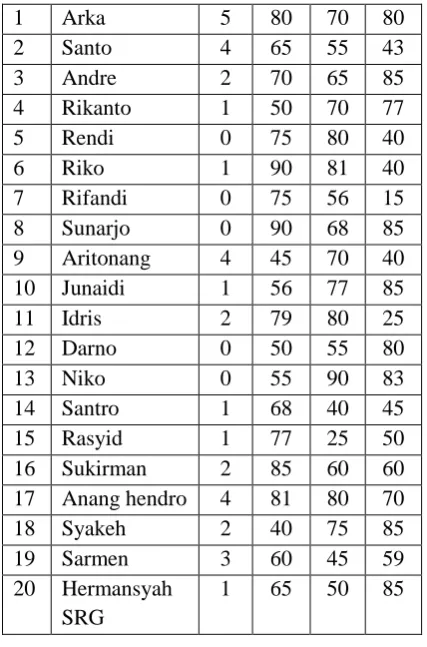
c. The value data of each employee can be seen in table 3:
Table 3. Value for Each Alternative
No Alternative
Criteria
C1 C2 C3 C4
1 Arka 5 80 70 80 2 Santo 4 65 55 43 3 Andre 2 70 65 85 4 Rikanto 1 50 70 77 5 Rendi 0 75 80 40 6 Riko 1 90 81 40 7 Rifandi 0 75 56 15 8 Sunarjo 0 90 68 85 9 Aritonang 4 45 70 40 10 Junaidi 1 56 77 85 11 Idris 2 79 80 25 12 Darno 0 50 55 80 13 Niko 0 55 90 83 14 Santro 1 68 40 45 15 Rasyid 1 77 25 50 16 Sukirman 2 85 60 60 17 Anang hendro 4 81 80 70 18 Syakeh 2 40 75 85 19 Sarmen 3 60 45 59 20 Hermansyah
SRG
1 65 50 85
d. The rating of each employee based on alternative data above can be matched on each criterion, which is seen in table 4:
Table 4. Rating Match
No Alternative
Criteria
C1 C2 C3 C4
1 Arka 4 3 3 5
2 Santo 4 3 2 2
3 Andre 4 2 4 5
4 Rikanto 3 4 4 4
5 Rendi 4 4 3 2
6 Riko 4 3 1 2
7 Rifandi 4 3 2 1
8 Sunarjo 5 2 5 4
9 Aritonang 5 2 2 4
10 Junaidi 4 3 4 1
11 Idris 4 2 4 5
12 Darno 3 2 4 1
13 Niko 2 5 3 5
14 Santro 2 3 2 1
15 Rasyid 4 5 4 1
16 Sukirman 5 4 4 1 17 Anang hendro 4 2 4 4
19 Sarmen 3 3 2 1 20 Hermansyah SRG 3 4 4 4
e. Form each alternative ranking
176 17 295 2 3 2 3 2 4 2 4 2 5 2 4 2 2 2 2 2 3 2 4 2 4 2 5 2 5 2 4 2 4 2 4 2 3 2 4 2 4 2 4 1 , == == + + + + + + + + + + + + + + + + + + + = X 731 , 14 217 4 3 4 2 4 5 3 5 2 2 3 2 2 3 3 4 4 2 3 3 2 2 2 2 2 2 2 2 2 2 2 2 2 2 2 2 2 2 2 2 2 X 033 , 15 226 4 2 3 4 4 4 2 3 4 4 4 2 5 2 1 3 4 4 2 3 2 2 2 2 2 2 2 2 2 2 2 2 2 2 2 2 2 2 2 2 3 X 967 , 14 224 4 1 5 4 1 1 1 5 1 5 1 4 4 1 2 2 4 5 2 5 2 2 2 2 2 2 2 2 2 2 2 2 2 2 2 2 2 2 2 2 4 X
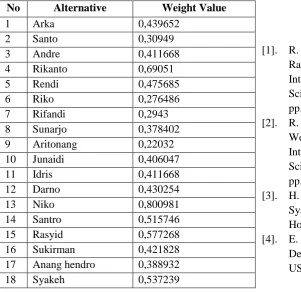
Using equations 1 through 7 and calculated by the formula, the following results are obtained:
Table 5. List of Rankings
No Alternative Weight Value
1 Arka 0,439652
2 Santo 0,30949 3 Andre 0,411668 4 Rikanto 0,69051 5 Rendi 0,475685
6 Riko 0,276486
7 Rifandi 0,2943 8 Sunarjo 0,378402 9 Aritonang 0,22032 10 Junaidi 0,406047 11 Idris 0,411668 12 Darno 0,430254 13 Niko 0,800981 14 Santro 0,515746 15 Rasyid 0,577268 16 Sukirman 0,421828 17 Anang hendro 0,388932 18 Syakeh 0,537239
19 Sarmen 0,419955 20 Hermansyah SRG 0,69051
Table 6. Recommended Employee Bonus
No Alternative Weight Value
1 Niko 0,800981 2 Rikanto 0,69051 3 Hermansyah SRG 0,69051 4 Rasyid 0,577268 5 Syakeh 0,537239
IV.
CONCLUSIONBased on the results of the research, the implementation of Technique Order Preference method By Similarity to Ideal Solution for the decision support process of disciplinary bonus recipients who have been designed, Ir can write the following conclusions:
1.
The process of determining the criteria of employee bonus recipients used are absent, behavior, achievement, teamwork2.
Application of Technique Order Preference method By Similarity To Ideal Solution is quite easy to use as a way to determine employees who receive bonuses because the steps are quite simple settlementV.
REFERENCES[1]. R. Rahim, "Study of the Simple Multi-Attribute Rating Technique For Decision Support," International Journal of Scientific Research in Science and Technology (IJSRST), vol. 2, no. 6, pp. 491-494, 2016.
[2]. R. Rahim, "Study Approach of Simple Additive Weighting For Decision Support System," International Journal of Scientific Research in Science and Technology (IJSRST), vol. 3, no. 3, pp. 541-544, 2017.
[3]. H. Nurdiyanto and R. Rahim, "Decision Support System for Electrical Power Selection to Household Users," INA-Rxiv, pp. 1-5, 2017. [4]. E. Turban, J. E. Aronson and T.-P. Liang,
[5]. R. Rahim and S. Syamsuddin, "Study Approach Technique for Order of Preference by Similarity to Ideal Solution (TOPSIS)," International Journal of Recent Trends in Engineering & Research, vol. 3, no. 3, pp. 268-285, 2017.
[6]. J. Jasri, D. Siregar and R. Rahim, "Decision Support System Best Employee Assessments with Technique for Order of Preference by Similarity to Ideal Solution," INTERNATIONAL JOURNAL OF RECENT TRENDS IN ENGINEERING & RESEARCH, vol. 3, no. 3, pp. 6-17, 2017. [7]. J. Mustajoki and R. P. Hämäläinen, "Smart-Swaps
— A decision support system for multicriteria decision analysis with the even swaps method," Science Direct, vol. 44, no. 1, pp. 313-325, 2007. [8]. Jasri, D. Siregar and R. Rahim, "Decision Support
System Best Employee Assessments with Technique for Order of Preference by Similarity to Ideal Solution," INTERNATIONAL JOURNAL OF RECENT TRENDS IN ENGINEERING & RESEARCH, vol. 3, no. 3, pp. 6-17, 2017. [9]. S. Opricovic and G.-H. Tzeng, "Compromise
solution by MCDM methods: A comparative analysis of VIKOR and TOPSIS," European Journal of Operational Research, vol. 156, pp. 445-455, 2002.
[10]. T. Ding, L. Liang, M. Yang and H. Wu, "Multiple Attribute Decision Making Based on Cross-Evaluation with Uncertain Decision Parameters," Mathematical Problems in Engineering, vol. 2016, pp. 1-10, 2016.
[11]. Mesran, G. Ginting, R. Rahim and Suginam, "Implementation of Elimination and Choice Expressing Reality (ELECTRE) Method in Selecting the Best Lecturer (Case Study STMIK BUDI DARMA)," International Journal of Engineering Research & Technology (IJERT), vol. 6, no. 2, pp. 141-144, 2017.
[12]. Khairul, M. Simare-mare and A. P. U. Siahaan, "Decision Support System in Selecting The Appropriate Laptop Using Simple Additive Weighting," International Journal of Recent Trends in Engineering & Research, vol. 2, no. 12, pp. 215-222, 2016.
[13]. Adriyendi, "Multi-Attribute Decision Making Using Simple Additive Weighting and Weighted Product in Food Choice," I.J. Information
Engineering and Electronic Business, vol. 6, pp. 8-14, 2015.
[14]. A. Łatuszyńska, "Multiple-Criteria Decision Analysis Using Topsis Method For Interval Data In Research Into The Level Of Information Society Development," Folia Oeconomica Stetinensia, vol. 13, no. 2, pp. 63-76, 2014. [15]. S. H. Zanakis, A. Solomon, N. Wishart and S.
Dublish, "Multi-attribute decision making: A simulation comparison of select methods," Science Direct, vol. 107, no. 3, pp. 507-529, 1998.
[16]. G. Kabir and M. A. A. Hasin, "COMPARATIVE