NONLINEAR BENDING ANALYSIS OF
FUNCTIONALLY GRADED PLATES
USING HIGHER ORDER THEORY
J. SURESH KUMAR
Department of Mechanical Engineering, J.N.T.U. H.College of Engineering,
Hyderabad-500 085. A.P, India. B. SIDDA REDDY
Department of Mechanical Engineering,
R.G. M. College of Engineering & Technology, Nandyal,
Kurnool (D. t), Andhra Pradeshm-518 501, India
C. ESWARA REDDY Director, SPW University,
Tirupati, A.P, India. Abstract:
In this paper, the nonlinear bending behavior and static characteristics of functionally graded material (FGM) plates with material variation parameter (n), boundary conditions, aspect ratios and side to thickness ratios are investigated using higher order displacement model. The derivation of equations of motion for higher order displacement model is obtained using principle of virtual work. The nonlinear simultaneous equations are obtained by Navier’s method considering certain parameters, loads and boundary conditions. The nonlinear algebraic equations are solved using Newton Raphson iterative method. The numerical results are obtained for various boundary conditions, material variation parameter, aspect ratio, side to thickness ratio and compared with linear solutions. The effect of shear deformation and nonlinearity response of functionally graded material plate is studied in detail.
Key words: Nonlinear bending, functionally graded material plates, higher order theory, Navier’s method, Newton Raphson method.
1. Introduction
uniform or sinusoidal load. Galerkin technique is employed to determine load deflection and load bending deflection and load bending moments. Ashraf M.Zenkour [6] presented the static response for simply supported functionally graded rectangular plates subjected to a transverse uniform load. The equilibrium equations of a functionally graded plates are given are based on a generalized shear deformation plate theory. The influences based on shear deformation, plate aspect ratio, side to thickness ratio and volume fraction distributions are investigated. Praveen and Reddy [7] investigated the static response of functionally graded material plates by varying the volume fraction of the ceramic and metallic constituents using a power law distribution and the numerical results for the deflections and stresses are presented. Lee et al., [8]proposed higher order theory for studying the bending response of functionally graded plates. The Von Karman theory is used for obtaining the approximate solutions for nonlinear bending. Sasaki and Watanabe [9] developed some techniques for fabricating the FGMs. Fukui and Yamanaka [10], investigated the effect of the gradation of the composition on the strength and deformation of the thick walled FGM tubes. Victor Birman and Larry W Byrd [11] presented the principal developments in functionally graded materials (FGMs) with an emphasis on the recent work published since 2000. Diverse areas relevant to various aspects oftheory and applications of FGM are reflected in this paper.They include homogenization of particulate FGM, heat transfer issues, stress,stability and dynamic analyses, testing, manufacturing and design, applications, andfracture. Aboudi et al., [12] provided a detailed review and description of the full generalization of a new Cartesian-coordinate-based higher order theory for functionally graded materials. Aboudi et al., [13] presented the major findings obtained with the one- and two-directional versions of the higher order theory. The results illustrate the response of composites and technologically important applications. A major issue discussed was the applicability of the classical homogenization theory in the analysis of functionally graded materials. Hirai [14] provides micro-structural details that are varied by non uniform distribution of the reinforcement phase. It is accomplished by using reinforcements with different properties, sizes, and shapes, as well as by interchanging the roles of the reinforcement and matrix phases in a continuous manner. Tanigawa [15] compiled a comprehensive list of papers on the analytical models of thermoelastic behavior of functionally graded materials. Yang, et al., [16] investigated the stochastic bending response of moderately thick FGM plates. The parametric effects of the material gradient property n, boundary conditions, thickness-to-radius ratio and shear deformation on the nonlinear bending of functionally graded plates are investigated for both first order shear deformation theory and third order shear deformation theory[17].
The Present work is concerned with the determination of nonlinear bending characteristics of functionally graded material plates with different geometric parameters, loads, boundary conditions by means of higher order shear deformation model.
2. Theoretical Formulation
The classical laminate plate theory and the first order shear deformation theory are the simplest equivalent single layer theories and they adequately describe the kinematic behavior of most functionally graded materials. Higher-order theories can represent the kinematics better, without shear correction factors and can yield good stress distributions. In principle, it is possible to expand the displacement field in terms of thickness coordinate up to any desired degree. The reason for expanding the displacements up to cubic term in the thickness coordinate is to have quadratic variation of the transverse shear strains and stresses through the thickness, which avoids the need for shear correction coefficients used in the first order theory.
2.1. Higher- Order Theory for Displacement Model
Consider a functionally graded rectangular plate made of mixture of metal and ceramics of thickness h, side length a in the x-direction, and b in the y-direction and the location of the rectangular Cartesian coordinate axes used to describe deformations of the plate are given in Fig 1. It is assumed that a state of plane strain exists. Hence, in formulating the higher-order shear deformation theory, a rectangular plate of
0 x a; 0 y b and
2
h
z 2
h
is considered.
)
,
(
)
,
,
(
)
,
(
)
,
(
)
,
(
)
,
(
)
,
,
(
)
,
(
)
,
(
)
,
(
)
,
(
)
,
,
(
* 3 * 2 * 3 * 2
y
x
w
z
y
x
w
y
x
z
y
x
v
z
y
x
z
y
x
v
z
y
x
v
y
x
z
y
x
u
z
y
x
z
y
x
u
z
y
x
u
o y o y o x o x o
(1)Where uo, vo, wo, denote the displacements of a point (x, y) on the mid plane. x, y are rotations of the normal to the mid plane about y and x-axes
u0*, v0*, x*, y* are the higher order deformation terms defined at the mid plane. All the generalized displacements (uo, vo, wo, x, y) are functions of x, and y.
In the present work, analytical formulation and solutions are obtained without enforcing zero transverse shear stress conditions on the top and bottom surfaces of the plate.
Fig.1. FGM Geometry with reference axes, displacement components.
From strain-displacement relations appropriate for infinitesimal deformations, the following relations are obtained as:
*
*
2
*
*
0
*
*
*
*
2
2 3 2 3 2 3x
z
xzo
z
x
xz
y
z
yzo
z
y
yz
xy
k
z
xyo
z
xy
zk
xyo
xy
y
k
z
yo
z
y
zk
yo
y
x
k
z
xo
z
x
zk
xo
x
z
(2) Where2
2
1
,
2
2
1
y
wo
y
vo
yo
x
wo
x
uo
xo
y
wo
x
wo
x
vo
uo
xyo
*
x
3
θ
*
x
,
*
y
3
θ
*
y
,
*
o
2u
xzo
ε
,
*
o
2v
yzo
ε
x
x
θ
x
,
y
y
θ
y
x
*
o
v
y
*
o
u
*
xyo
ε
,
y
*
o
v
*
yo
ε
,
x
*
o
u
*
xo
ε
x
y
*
xy
k
,
y
*
y
k
,
x
*
x
k
x
y
xy
k
,
y
y
k
,
x
x
k
* * x * * y x y x
wo
wo
y y x2.2. Constitutive relations
Consider a FGM plate, which is made from a mixture of ceramics and metals. It is assumed that the composition properties of FGM vary through the thickness of the plate. The variation of material properties can be expressed as:
P
Z
P
t
P
b
V
P
b (3) Where P denotes a generic material property like modulus,P
t andP
bdenotes the corresponding properties of the top and bottom faces of the plate, respectively, and n is a parameter that dictates the material variation profile through the thickness. Also V in Eq. (3) denotes the volume fraction of the top face constituent and follows a simple power-law as:n
h
Z
V
2
1
(4)Where h is the total thickness of the plate, z is the thickness coordinate and n is a parameter that dictates the material variation profile through the thickness. Here it is assumed that moduli E and G vary according to Eq. (3) and the Poisson’s ratio νis assumed to be a constant. The linear constitutive relations are:
(5) Where = (x, y, xy, yz, xz)t are the stresses
= (
x,
y, xy, yz, xz)t are the strainsQij’s are the plane stress reduced elastic constants in the plate axes.The superscript t denotes the transpose of a matrix.
2. 3. Equations of motion
The governing equations of displacement model in Eq. (1) are derived using the dynamic version of the principle of virtual displacements, i.e.
0
)
(
0
U
V
K
dt
T
(6)Where U = virtual strain energy
K = virtual kinetic energy U + V = total potential energy.
The virtual strain energy, work done and kinetic energy are given by:
U =
x x y y xy xy xz xz yz yz
dz dxdy h h A
2 / 2 / (7)V = - qw0 dx dy (8)
dz
dx
dy
w
w
Z
v
Z
Z
v
Z
v
Z
Z
v
Z
u
Z
Z
u
Z
u
Z
Z
u
K
y y y y x x x x h h A 0 0 * 3 * 0 2 0 * 3 * 0 2 0 * 3 * 0 2 0 * 3 * 0 2 0 0 2 / 2 /
(9)where q = distributed load over the surface of the functionally graded plate. 0 = density of plate material
0
u
= u0 / t,v
0= v0 / t etc. indicates the time derivativesSubstituting for U, V and K from Eq. (7-9) in to the virtual work statement in Eq. (6) and integrating through the thickness of the functionally graded plate, the in-plane, transverse force and moment resultant relations are obtained. Substituting Eq. (5) into force and moment resultants and upon integration the expressions obtained and written in a matrix form which defines the stress / strain relations of the FGM plate is given by:
* * * 0 0 * * *|
0
|
0
0
|
|
0
|
|
K
K
D
D
B
B
A
Q
Q
M
M
N
N
s s b t (10)The principle of virtual work is used to derive the equilibrium equations and are expressed in terms of uo, vo, wo, θx , θy, θz, uo*
, vo*, w0*, θx*,θy*, θz*by substituting for the force and moment resultant from eq.(10). 3. The method of solution
The Navier solutions are developed for rectangular plates with two sets of simply supported (SS) boundary conditions. The two types of boundary conditions are given below.
The SS boundary conditions are: At edges x = 0 and x = a
vo = 0, wo = 0, y = 0, Mx = 0, vo* = 0, y* = 0, Mx* = 0, Nx = 0, Nx* = 0. (11) At edges y = 0 and y = b
3.1. Analysis of functionally graded material plate using displacement model
The simply supported (SS) boundary conditions in Eq. (11-12) are considered for displacement model. The Navier solution procedure, displacement components that satisfy the equations of boundary conditions are considered for the analysis. The Solutions are obtained using Newton Raphson method.
3.2. Newton Raphson Method
The Newton Raphson iterative method is based on Taylor’s series expansion. In the present work, the equation [S (∆ s+1)] {∆} s+ 1 = {F} is solved for generalized displacement vector {∆} s+1 by Newton Raphson iterative method.
The iterative procedure is as follows:
{R}{{∆} s+1} = [S (∆ s+1)] {∆} s+1-{F}
R is called Residual and [S (∆ s+1)] is the stiffness matrix, which is a function of the unknown deflections {∆} s+1.
Expanding {R} in Taylor series about {∆}r s+1
{0} = {R}s+1 +[KT({∆}r s+1)] {δ∆}+O({δ∆ }2) Where O (.) denotes the higher-order terms in {δ∆}, and [KT
] is known as the tangent stiffness matrix (geometric stiffness matrix)
{R}rs+1 = [K(∆rs+1)] {∆}r s+1-.{F}
The assembled equations are then solved for incremental displacement vector after imposing the boundary and conditions of the problem
{δ∆} = - [KT ({∆} r
s+1)] -1{R}rs+1 {∆} r+1 s+1 = {∆} r s+1+ {δ∆}
Total displacement vector is obtained from the tangent stiffness matrix, using the latest known solution and the process will continue until the termination criteria with a pre-selected error tolerance is obtained.
4. Results and discussions
In order to verify the accuracy and efficiency of the developed theories results and to study the effects of transverse shear deformation, the following typical material properties are used for obtaining the numerical results.
Material 1:(Aluminium)
C
X
mK
W
m
Kg
GPa
E
0 6 3
/
10
23
,
/
204
,
/
707
,
2
,
3
.
0
;
70
Material 2:(Zirconia)
C
X
mK
W
m
Kg
GPa
E
0 6
3
/
10
10
,
/
209
,
/
000
,
3
,
3
.
0
;
151
.
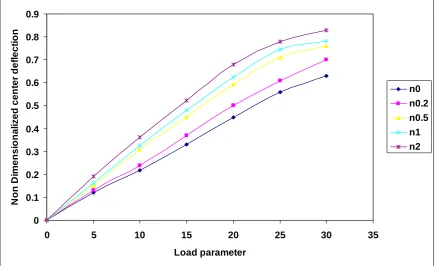
The center deflection and load parameter are presented here in non-dimensional form using the following. 4
4 0 0
;
h
E
a
q
P
h
w
w
m
-0.6 -0.5 -0.4 -0.3 -0.2 -0.1 0 0.1 0.2 0.3 0.4 0.5 0.6
0 0.1 0.2 0.3 0.4 0.5 0.6 0.7 0.8 0.9 1
Volume fraction v(z)
Th
ickness
co-o
rd
in
at
e (
z
/h
)
n=0.2
n=0.5
n=1
n=2
Fig 2: Thickness Co-ordinate Vs Volume fraction for Functionally Graded Material
0 0.1 0.2 0.3 0.4 0.5 0.6 0.7 0.8 0.9
0 5 10 15 20 25 30 35
Load parameter
N
on D
im
e
ns
io
na
li
z
ed c
e
n
te
r def
le
c
ti
o
n
n0 n0.2
n0.5
n1 n2
Non Linear-NL ___ Linear-L
---0 0.02 0.04 0.06 0.08 0.1 0.12 0.14 0.16 0.18 0.2
0 10 20 30 40 50
side-to thickness ratio(a/h)
N
on-di
m
e
ns
iona
li
z
e
d
C
e
nt
e
r
De
fl
e
c
ti
o
n
NLn0
NL0.5
NLn1
NLn2
NL0.2
Ln0
Ln0.2
Ln0.5
Ln1
Ln2
cc c
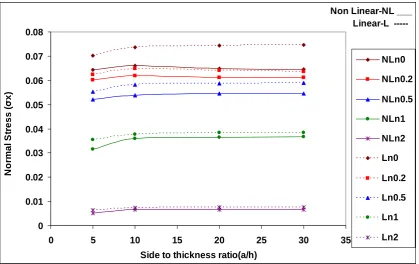
Fig 4: Non-dimensionalized center deflection (w) Vs Side to thickness ratio (a/h) For a simply supported FGM plate for displacement model
Non Linear-NL ___ Linear-L
---0 0.01 0.02 0.03 0.04 0.05 0.06 0.07 0.08
0 5 10 15 20 25 30 35
Side to thickness ratio(a/h)
N
o
rm
al
S
tr
ess
(
σ
x)
NLn0
NLn0.2
NLn0.5
NLn1
NLn2
Ln0
Ln0.2
Ln0.5
Ln1
Ln2
Non Linear-NL ___ Linear-L
---0 0.005 0.01 0.015 0.02 0.025 0.03 0.035 0.04 0.045 0.05
0 5 10 15 20 25 30 35
side-to-thickness ratio(a/h)
N
o
rm
al
S
tr
ess (
σ
y)
NLn0
NLn0.2
NLn0.5
NLn1
NLn2
Ln0
Ln0.2
Ln0.5
Ln1
Ln2
Fig 6: Non-dimensionalized normal stress (y) Vs Side to thickness ratio (a/h) for a simply supported FGM plate for displacement model
Non Linear-NL __ Linear-L
----0 0.1 0.2 0.3 0.4 0.5 0.6
0 5 10 15 20 25 30 35
side-to-thickness ratio(a/h)
sh
e
ar
st
ress
(
T
xy)
NLn0
NLn0.2
NLn0.5
NLn1
NLn2
Ln0
Ln0.2
Ln0.5
Ln2
Ln1
Non Linear-NL ___ Linear-L
----0 0.02 0.04 0.06 0.08 0.1 0.12 0.14 0.16 0.18 0.2
0 1 2 3 4 5 6
Aspect Ratio (a/b)
N
o
n-D
im
e
nsi
o
nal
ized C
e
nt
er
D
ef
lect
io
n
NLn0 NLn0.2 NLn0.5 NLn1 NLn2 Ln0 Ln0.2 Ln0.5 Ln1 Ln2
Fig 8: Non-dimensionalized center deflection (w) Vs Aspect ratio (a/b) for a simply supported FGM plate for displacement model
Non Linear-NL ___ Linear-L
----0 0.01 0.02 0.03 0.04 0.05 0.06 0.07 0.08
0 1 2 3 4 5
Aspect ratio(a/b)
N
o
rm
al
S
tr
ess (
σ
x)
NLn0
NLn0.2
NLn0.5
NLn1
NLn2
Ln0
Ln0.2
Ln0.5
Ln1
Ln2
Non Linear-NL __ Linear-L
----0 0.01 0.02 0.03 0.04 0.05 0.06 0.07 0.08 0.09 0.1
0 1 2 3 4 5
Aspect Ratio(a/b)
N
o
rm
al
S
tr
ess (
σ
y)
NLn0
NLn0.2
NLn0.5
NL1
NL2
Ln0
Ln0.2
Ln0.5
Ln1
Ln2
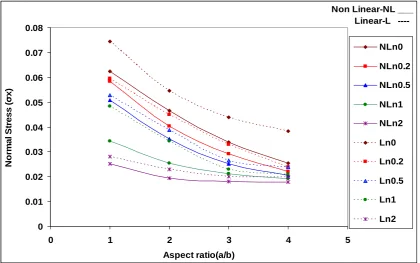
Fig 10: Non-dimensionalized normal stress (y) Vs Aspect ratio (a/b) for a simply supported FGM plate for displacement model
Non Linear-NL ___ Linear-L
---0 0.1 0.2 0.3 0.4 0.5 0.6
0 1 2 3 4 5
Aspect ratio(a/b)
sh
ear
st
ress(
T
xy)
NLn0 NLn0.2
NLn0.5
NLn1
NLn2 Ln0
Ln0.2
Ln0.5
Ln1 Ln2
4. Conclusions
The following conclusions are drawn from the results for functionally gradient material plates:
The effect of nonlinearity in functionally graded composite plates is to decrease the central deflections with increase of side to thickness ratio. This effect is found to be more predominant in decreasing the deflections in thin plates for side to thickness ratio beyond 30.
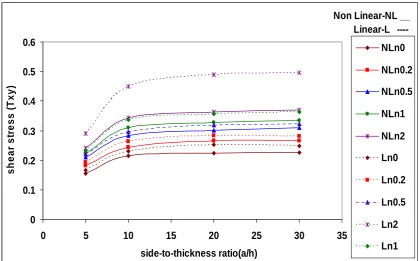
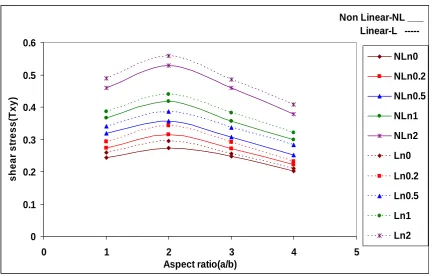
The effects of geometric nonlinearity is to decrease the transverse shear stresses, transverse normal stresses with increase in side to thickness ratio, when compared to linear analysis, due to the consideration of Von-Karman strains in strain-displacement relations.
The central deflections, transverse normal stresses, transverse shear stresses for nonlinear analysis are less than the linear analysis for a particular value of load. It means that the capability to withstand for large values of load is increasing more than the capability predicted by linear analysis. Hence the plate will be in the elastic state for large deflections also.
Functionally graded composite materials are combination of ceramic and metal and their volume fraction varies by the material variation parameter (n).The stress values for various material variation parameters and load parameter values, it is found that the stress values decreases with increase in the material variation parameter for the same load application.
References
[1] Y.Miyamoto, M.Niino and M.Koizumi, FGM research programs in Japan-from structural to functional uses, Proceedings of the 4th international symposium on Functionally Graded Materials, AIST Tsukuba Research center, Tsukuba, Japan, October 21-24,1996, pp.1-8.
[2] Masoud Tahani , Seyed Mahdi Mirzababaee, Non-linear analysis of functionally graded plates in cylindrical bending under thermomechanical loadings based on a layerwise theory, European Journal of Mechanics A/Solids 28 (2009) 248–256, doi:10.1016/j.euromechsol.2008.05.002.
[3] Akhavan, Hamed (2010, April 7). Functionally Graded Plates. SciTopics. Retrieved September 3, 2010.
[4] Reddy, J.N., Analysis of functionally graded plates.” International Journal for Numerical Methods in Engineering” (U.K.). Volume 47, no.1-3, pp.663-684.10-30 Jan.2000.
[5] Hui-Shen Shen, Generalized shear deformation theory for bending analysis of functionally graded plates. “International Journal of Mechanical Sciences”.Volume 44, Issue 3, March 2002, Pages 561-584.
[6] Ashraf M.Zenkour, Generalized shear deformation theory for bending analysis of functionally graded plates. “Applied Mathematical Modeling”. Volume 30, Issue 1, March 2006, Pages 67-84.
[7] Praveen G.N. and Reddy.J.N., A Simple higher-order non-linear shear deformation plate theory. “International Journal of Solids and Structures”. Volume 35,Issue 33, November 1998, Pages 4457-4476.
[8] Lee K.H., Senthilnathan N.R, Lim S.P, and Chow S.T.,Nonlinear bending response of functionally graded plates subjected to transverse loads and in thermal environments. “International Journal of Non-Linear Mechanics”. Volume 24,Issue 2, November 1989, Pages 127-137.
[9] Sasaki M, Wang y, Hirano T,hirai T. Design of SiC/C FGM and its propogation by chemical vapour deposition. J Ceramic Soc japan 1989; 97(5): 539-43.
[10] Fukui Y, Yamanaka N. Elastic analysis for thick–walled tubes of FGM subjected to internal pressure. Int J Japan Soc Mech eng Ser A 1992; 35:379-85.
[11] Victor Birman, Larry. W Byrd. Modeling and Analysis of Functionally Graded Materials and Structures.” Applied Mechanics Reviews” September 2007 Volume 60, Issue 5, pp.195-216.
[12] J. Aboudi, M.J. Pindera, and Steven M. Arnold, “Higher-Order Theory for Functionally Graded Materials” (June 2000).
[13] Aboudi, J.; Pindera, M.J.; and Arnold, S.M.: Higher-Order Theory for Functionally Graded Materials. Composites Part B--Engineering, vol. 30, no. 8, 1999, pp. 777-832.
[14] Hirai, T.: Functional Gradient Materials. Processing of Ceramics, pt. 2, vol. 17B, Richard J. Brook, et al., eds., Weinheim, New York, NY, 1996, pp. 293-341.
[15] Tanigawa Y. Some basic thermoelastic problems for non homogeneous structural materials. Applied mechanical review 1995; 48: 377-389.
[16] J. Yang, K.M. Liew and S. Kitipornchai, “Stochastic analysis of compositionally graded plates with system randomness under static loading”, International Journal of Mechanical Sciences 47, 1519-1541 (2005).
[17] Golmakani ME, Kadkhodayan M. Nonlinear bending analysis of annular FGM plates using higher-order shear deformation plate theories. Compos Struct (2010), doi:10.1016/j.compstruct.2010.06.024
[18] T. Kant, B. N. Pandya, A Simple Finite Element Formulation of a Higher-order Theory for Unsymmetrically Laminated Composite Plates, Journal. Composite Structure sVol. 9 (1988) 215-246.
[19] B. N. Pandya & T. Kant, Finite Element Analysis of Laminated Composite Plates using a Higher-Order Displacement Model, Journal. Composites Science and Technology, vol.32 (1988) 137-155.
[21] T. Kant and Mallikarjuna, “A higher-order theory for free vibration of unsymmetrically laminated composite and sandwich plate~finite element evaluations, Journal. Computers and structures, Vol. 32, No.5. PP.1125-1132, 1989.
[22] T. Kant, K. Swaminathan, “analytical solutions for free vibration of laminated composites and sandwitch plates based on higher order refined theory. J. of composite structures, vol. 53, 2001, Pp. 73-85.