PERFORMANCE COMPARISON OF
SOLID STATE AND INCANDESCENT
BASED CAP LAMP FOR
UNDERGROUND COALMINES
Ramjee Prasad Gupta
Department of Electrical Engineering B.I.T., Sindri, Dhanbad ,Jharkhand
Dr. Upendra Prasad
Department of Electrical Engineering B.I.T., Sindri, Dhanbad ,Jharkhand Abstract
The paper deals with the technical aspects of lighting system of underground coalmines using Light Emitting Diode (LED) and incandescent (INC) based Cap lamp. The purpose of the paper is to ensure numerous complex and interrelated factors that must be considered to design and implement a LED based efficient lighting system suitable for underground coalmines, which will satisfy human, needs for good vision and comfort. The workers of mines are very much dependent on visual cues to recognize underground mining hazards. On the other hand, illumination plays a critical role in miners’ safety. Some hazards are located in the miners’ peripheral field-of-view off-axis (10 to about 60) or on-axis (0) . It has been observed that by the end of the 9-hour cycle, the light output levels of the INC systems were approximately 64 % (nickel-hydride battery) and 40% (lead-acid battery) of the initial value. Whereas in case of LED based lighting system the drop is approximately 5% over the 9-hour period. Recent research has indicated that an increased short-wavelength content of the spectral power distribution of LEDs relative to incandescent lamps improves peripheral visual performance for low-light conditions. As LED produce light at required the lighting fixture as compared to the white light produced by incandescent bulb hence less energy consumes wavelength. Result of experiments demonstrated the effect of spectral power distribution (SPD) of LED as lighting system for underground coalmines.
Keywords : INC, LED, CAP LAMP, Spectral Power Distribution .
Introduction
The general goal of industrial lighting is to improve visibility for safety and higher production. Compare to other industry, underground coalmines are one of the most hazardous industries and mining personnel should, therefore, benefit most significantly from the use of lighting. The underground lighting must have following objectives:
(1). Increase the visibility to minimize hazards.- Because of the low luminance levels highly variable atmospheric temperature ,and poor contrast in coal mines, hazards have always been difficult to visually identify. A few examples of such hazards include frayed or cut cables, misplaced tools and timbers that may prevent a tripping hazard and slips in roof rock. A primary goal of mine lighting is to increase the visibility of these objects and hence, reduce injuries that may result if the hazards go undetected. In recent research the author observed increase in the ability of miners to see loose rock as illuminance increased from 500 to 1500 lux [1].
(2). Increase visual response of the peripheral field to enable early detection of hazards.-With the narrow-beamed cap lamp alone, movement of personnel, machines, and roof or rib material is difficult to detect when it occurs in a miner's peripheral field of vision, outside the localized main beam of the cap lamp. Another major goal of mine lighting is to allow miners to quickly detect even subtle movement anywhere in their normal field of vision. This will provide additional time for personnel to react and thereby avoid injuries.
the solution of these problems. If they are carefully designed and implemented, lighting systems provide mine workers improved visibility and contribute to improved safety, productivity and morale. Properly designed lighting systems can improve visibility and safety during working in the underground coalmines. Also it can prove to be a very cost-effective investment for the mine operator. Typically, 90% of our perception is obtained visually. Human process visual data at about five times the rate of audible information. For mining, important audible data (i.e., verbal communications and audible warning alarms) are less useful given the noisy mine environment. Prior Cap lamp research aimed to improve safety by increasing the light output as defined by quantifying illuminance. Indian researchers conducted a comparative study of Cap lamp light output verses battery discharge for various battery capacities. The light output increased 20% to 22% during the period of a working shift when batteries increased 35% from 10 ampere hours (Ah) to 13.5 Ah [2]. Other research has focused on the spectral characteristics of light. Lighting research indicates that LEDs with a visible spectrum containing more of the shorter wavelengths can enable significant improvement in peripheral visual performance at mesopic conditions for automotive applications [3]. Furthermore, research findings indicated that, in comparison to INC lighting for Cap lamp, cool-white LEDs do enhance peripheral visual performance from 15% to 20% for high-contrast targets [4]. Cool white LED-based miner Cap lamps can also enable visual performance improvements with respect to slip/trip/fall hazard detection [5]. In the present paper performance of INC and LED based Cap lamps has been analyzed with respect to environment of underground coalmines. Photometric and spectral characteristics of INC and LED light sources used in miner Cap lamps as a function of battery discharge has been observed.
Methodology
In the testing of performance of LED based lighting system and INC based lighting system the Phosphor converted white LEDs has been selected because of its optical features which is suitable for underground coalmines. The light sources of both the systems were new at the time of testing. Each system has been tested for three cycles of discharge. The difference between the three cycles in all cases was 6% to 7%. Hence, the data were averaged. Two types of battery i.e. nickel-hydride battery and lead acid battery has been used for power source. Each discharge cycle lasted approximately for 9 hours without interruption during the discharge cycles. Relative lumen maintenance and SPD has been observed.
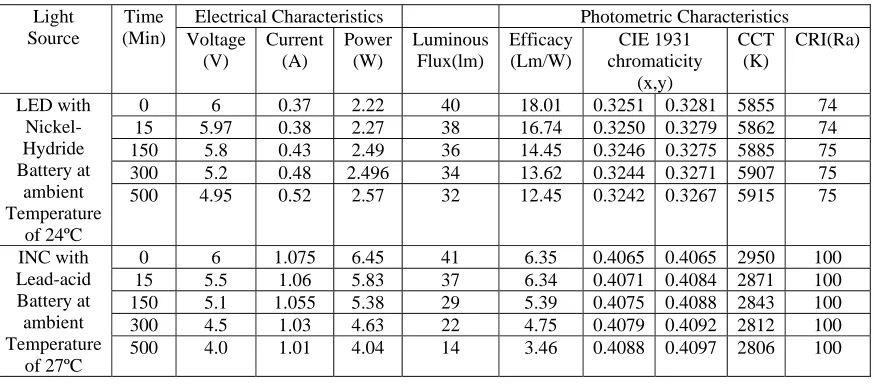
Table 1 Electrical and Photometric Characteristics of LED based and INC based Cap lamp
Light Source
Time (Min)
Electrical Characteristics Photometric Characteristics Voltage (V) Current (A) Power (W) Luminous Flux(lm) Efficacy (Lm/W) CIE 1931 chromaticity (x,y) CCT (K) CRI(Ra) LED with Nickel-Hydride Battery at ambient Temperature of 24ºC
0 6 0.37 2.22 40 18.01 0.3251 0.3281 5855 74
15 5.97 0.38 2.27 38 16.74 0.3250 0.3279 5862 74
150 5.8 0.43 2.49 36 14.45 0.3246 0.3275 5885 75
300 5.2 0.48 2.496 34 13.62 0.3244 0.3271 5907 75
500 4.95 0.52 2.57 32 12.45 0.3242 0.3267 5915 75
INC with Lead-acid Battery at ambient Temperature of 27ºC
0 6 1.075 6.45 41 6.35 0.4065 0.4065 2950 100
15 5.5 1.06 5.83 37 6.34 0.4071 0.4084 2871 100
150 5.1 1.055 5.38 29 5.39 0.4075 0.4088 2843 100
300 4.5 1.03 4.63 22 4.75 0.4079 0.4092 2812 100
Fig1: Relative Light Output of LED and INC based Cap lamp tested over 9 Hours
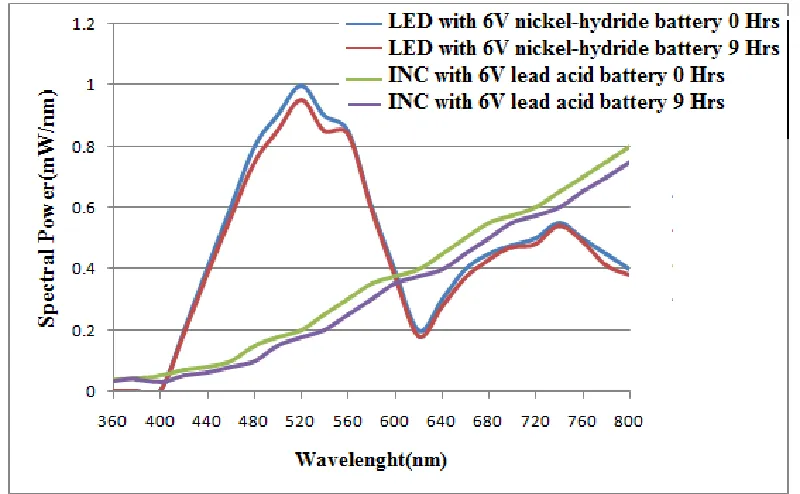
Figure 2 SPD of the LED and INC based lighting system
Results and Discussion
period. This indicates that LED based lighting system is more efficient than INC based lighting system. Even if in case of LED this drop can be reduced by considering junction temperature of LED. Luminous Flux as a function of junction temperature for LEDs is given by :
Ф(T2)= Ф(T1)e-kΔT --- [1] Where,
Ф(T2) = Luminous flux at junction temperature T2.
Ф(T1) =Luminous flux at junction temperature T1. k = Temperature coefficient.
ΔT = change in junction Temperature ie, T2 - T1.
Hence, by considering above equation furthermore, the efficiency of LED based lighting system can be improved. In the experiments all of these measurements were taken at ambient temperature with negligible airflow. In case of LED ambient temperature has been adjusted as 24ºC where as in case of INC it has been adjusted at 27ºC. Different LED technologies have different sensitivities to temperature, both in the short and the long period of utilisation. Junction temperature (Tj) is usually the main determinant of life, light output, power, and color shift of LEDs. Tj is partially determined by the forward current and partially by the ambient temperature and airflow of the environment in which the LED is operating. Measurements for an INC Cap lamp over a wide ambient temperature of 27°C ±10°C will yield relatively consistent results over this temperature range because for incandescent lamps the effect of ambient temperature is limited. However, ambient temperature can play a major role in LED performance because the temperature at the junction depends in part on the ambient conditions. Thus, measurements over the same ambient temperature range for an LED Cap lamp will result in a wide range of performance and inconsistent results across tests. Considering a typical ambient temperature in a coalmine is 13°C, it would be reasonable to expect a slight increase in the performance of LED systems and almost no change for INC systems [6]. The light output of phosphor-converted white LEDs changes from about -0.25%/°C to -0.33 %/°C depending on the manufacturer [7][8]. Recent research has shown that the depreciation rate of phosphor-converted white LEDs doubles with every 10°C increase in junction temperature [9]. Thus, the estimated life of an LED system operating in an environment of underground coalmines could be significantly longer than that when operating in an environment at 24°C. The practical implications of a low ambient temperature would include the opportunity to optimize a LED Cap lamp in terms of light output, battery discharge time, LED life, and heat sink requirements. In case of LED Cap lamp vertical average illuminance increases where as in case of INC Cap lamp vertical average illuminance decreases. The results for other LED Cap lamps will vary depending on the individual LED cap lamp design, especially as the design relates to thermal management of the LED. Phosphor converted white LEDs offer an obvious advantage over INC lamps for mines vision because, being based on blue LEDs, they have a greater proportion of short-wavelength light than INC lamps.[11] LED SPDs are rich in short-wavelength energy as evidenced by the typically high correlated color temperatures (in the order of 5000 K and higher).
Fig 2 shows the SPD of the INC lamp tested and phosphor converted white LED. To observe the spectral change as a function of battery discharge luminance calculations has been done at different period of operation. Table 1 shows the electrical and photometric characteristics of the INC Cap lamp and LED based Cap lamp at different stage of life cycle. As the light level decreases, the relative effectiveness of the LED system compared to the INC one is more evident. For the same luminance the LED Cap lamp could be up to 30% more efficient than the INC Cap lamp with at the end of the 9-hour operating cycle. The main points to be consider from this test are a large decrease in light output and the spectral shift. In terms of light output depreciation, the observed value was approximately 25%. This depreciation is considerable, especially given that the light output will decrease another 50% to 60% over the period of a 9 hour shift. The main implication of the light output depreciation over the life of an INC lamp is that even when a Cap lamp may pass all the photometric tests when new, it is quite possible the minimum intensity requirement of 1 cd [10] would not be met at some point as the lamp ages, resulting in reduced visibility of miners. Again, this problem is compounded by the light output reduction over the length of spectral shift.
Conclusion
In the present paper performance tests of INC based Cap lamp and LED based Cap lamp were conducted. On the basis of results following points can be concluded:
(1) In case of underground coalmines LED systems can provide higher system efficacy, resulting in improved lighting conditions for the same battery run time over an INC based lighting system.
(2) By using LEDs more compact lighting system can be designed by the use of smaller batteries.
(3) By using suitable controlling circuitry, the lighting conditions provided by phosphor-based white LEDs, system can adjusted to deliver almost constant intensity of light over the long duration.
References
[1] Trotter, D. and Kopeschny, F. Cap lamp improvements in Canadian mines. Applied Occupational and Environmental Hygiene. 1997 Dec.
[2] Nigam, U. S.; Das, N. L., and Sankar, S. (Central Mining Research Institute). Standard of illumination in Indian coal mines -problems and issues. 27th International Conference of Safety in Mines Research Institutes; New Delhi, India. 1997.
[3] Van Derlofske, J.; Bullough, J. Spectral Effects of high-intensity discharge automotive forward lighting on visual performance. Society of Automotive Engineers. 2003; (Paper No. 2003-01-0559).
[4] Sammarco JJ; Reyes, MA; Bartels, J.; Gallagher, S. Evaluation of peripheral visual performance when using incandescent and LED miner cap lamps. In: Proceedings of the IEEE Industry Applications Society 43rd Annual Meeting. Edmonton, Canada. October 2008 [5] Sammarco JJ; Lutz, TJ. Visual Performance for Incandescent and Solid-State Cap Lamps in an Underground Mining Environment. In:
Proceedings of the IEEE Industry Applications Society 42nd Annual Meeting. New Orleans. Sept. 2007
[6] Rea MS (ed.). 2000. IESNA Lighting Handbook: Reference and Application, 9th ed. New York, NY: Illuminating Engineering Society of North America.
[7] Cree. 2007. Cree XLamp XR-E Data Sheet CLD-DS05.008. http://www.cree.com/products/xlamp7090_xre.asp Cree, Inc.: Durham, NC.
[8] Philips Lumileds Lighting Company 2007. Technical Datasheet DS56 (07/2007).
http://www.lumileds.com/products/line.cfm?lineId=18 Philips Lumileds Lighting Company: San Jose, CA
[9] Gu, Y. N. Narendran, and J.P. Freyssinier. 2005. White LED performance. Proceedings of SPIE, International Society for Optical Engineering 5530, 119 (2004), DOI:10.1117/12.567677.
[10] U.S. Department of Labor Mine Safety and Health Administration, Code of Federal Regulations Title 30, Part 19 Electric Cap Lamps, Section 16(d). July 1, 2007.