An Efficient Method for Texture
Classification with Local Binary Pattern
Based on Wavelet Transformation
Hamid Reza Eghtesad Doost
Islamic Azad University, Majlesi Branch Shahre Majlesi, IRAN
Javad Rahebi
Department of Electrical & Electronics Engineering Gazi University
Ankara, Turkey [email protected]
Abstract
In this paper, we present an efficient method for texture classification with local binary pattern based on wavelet transformation. We improve the Local Binary Pattern approach with Wavelet Transformation to propose the texture classification. We used four class of Brodatz textures data base for proposed method. Each class is divide to 64 texture image and then wavelet transformation is applied to each texture. After transformed texture from wavelet the feature extraction matrix is formation using LBP. We verify the other method and proposed method is very good and efficient for classification texture image.
Keywords: Local Binary Pattern; Wavelet Transformation; Texture Classification.
1. Introduction
Texture classification is a fundamental issue in computer vision and image processing, playing a significant role in a wide range of applications that includes medical image analysis, remote sensing, object recognition, document analysis, environment modeling, content-based image retrieval and many more [3]. The local binary pattern (LBP) is one of the most used texture descriptors in image analysis. In this paper, we extend the original LBP with continues wavelet transformation for texture analysis and classification. The proposed method presents the comparative results of classification using both feature sets separately and in combination. The paper is organized as follows. In the next section, a brief introduction for demonstrating basic concepts of Local Binary Pattern (LBP) is given. In the section 3 Continues Wavelet Transformation is introduced. In the Section 4 the Feature extraction and proposed method is described and in the section 5 experimental results of this method are given. The conclusion of this paper is given in section 6.
2. Local Binary Pattern
The LBP is an operator that was first introduced by Ojala et al. [1], and has been shown to be an effective descriptor in texture classification [2]. Firstly, the LBP operator labels the pixels of an image by thresholding the 3 × 3-neighborhood of each pixel with the center value and the result as a binary number. Then a decimal number of the binary number is used to label the center pixel. At last, the histogram of the labels can be used as a texture descriptor. Images are probed locally by sampling grayscale values at a central point x0,0 and p points
xr,0,…xr,p-1 spaced equidistantly around a circle of radius r centered at x0,0. Formally,
10
0 , 0 , ,
0
,
0
0
,
1
)
(
,
2
)
(
p n
n n
r r
p
x
x
x
s
x
x
s
LBP
(1)(a) (b) (c) (d) (e)
Fig. 1. The basic LBP operator, (a) Original texture image, (b) Sub-Image, (c) Gray level intensity value, (d) Threshold value with center pixel, (e) Binary pattern Labeled by a decimal number.
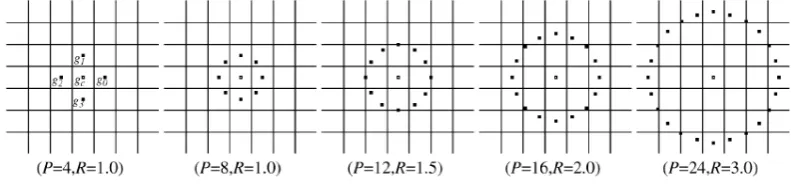
The extended LBP operator uses neighborhoods of different sizes and shapes to label each pixel by bilinear interpolation. Because of using circular neighborhood and bilinear interpolation, any radius and number of pixels are chosen in the neighborhood. For neighborhoods we will use the notation (P, R) which means P sampling points on a circle of radius of R. Figure 2 shows some examples of the circularly symmetric neighborhoods.
Fig. 2. Circularly symmetric neighbor sets for different (P,R).
The gray values of neighbors which do not lie precisely in a pixel location may be estimated by interpolation. Given an N_M image I, let LBPp,r(i,j) be the identified LBP pattern of each pixel (i, j), then the whole texture
image is represented by a histogram vector h of length K:
N 1 i M 1 j rp,
(i,
j)
-
k)
(LBP
)
(
k
h
(2)Where
0
k
K
1
, andK
2
p is the number of all the LBP codes. Feature h has attractive properties: grayscale invariance, low complexity, few parameters, and satisfactory discriminating power. However, the basic LBP operator produces rather long histograms (2
p distinct values), and it becomes an intractable problem to estimate h due to the overwhelming dimensionality of h with large p. Moreover, it is easy to realize that due to the way LBP numbers are created, they are very sensitive to noise. Another extension to the original operatoruses the certain local binary pattern termed “uniform patterns” , 2 riu
r p
LBP
. A LBP is called uniform if it contains at most tow bitwise transitions or discontinuities from 0 to 1 or vice versa in the circular presentation of the pattern. The improved operator not only possesses a property of gray scale and rotation invariant operator, but also allows for detecting “uniform pattern” at circular neighborhoods of any quantization of the angular space and at any spatial resolution. Both the two properties are important for palm print recognition [2].
otherwise
p
LBP
U
if
x
x
s
LBP
prp n n r riu r p
,
1
2
)
(
,
)
(
, 1 0 0 , 0 , 2, (3)
Where
1 0 0 , 0 ) , 1 mod( , 0 , 0 , ,)
(
)
(
)
(
p n p n r n r rp
s
x
x
s
x
x
LBP
U
(4)The superscript riu2 denotes the rotation invariant “uniform” patterns that have U values at most 2. Therefore, mapping from
LBP
p,r toLBP
priu,r2results in only p+2 distinct groups of patterns, leading to a much shorter histogram representation.
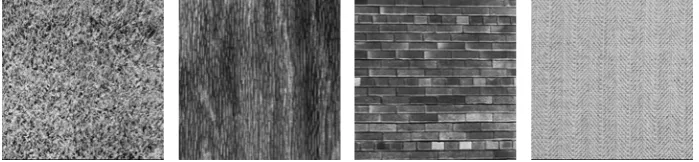
Figure 3: The four textures obtained from the Brodatz database. From left to right: D6, D19, D94 , D16.
In the above four textures, they all have the same sets of dominant patterns with very similar proportions, and the pattern type labelled with 24 is one of the dominant patterns. As we can see, the numbers of such dominant patterns in each texture are very close to each other. However, the distribution properties of this pattern in these four texture images are very different with each other. Therefore, the ContinuousWavelet Transformation is a very important property to describe the textures, which will be further illustrated in the Experimental Results section.
3. Continuous Wavelet Transformation
The WT is designed to address the problem of nonstationary signals. It involves representing a time function in terms of simple, fixed building blocks, termed wavelets. These building blocks are actually a family of functions which are derived from a single generating function called the mother wavelet by translation and dilation operations. Dilation, also known as scaling, compresses or stretches the mother wavelet and translation shifts it along the time axis [5,8,10,12].
The WT can be categorized into continuous and discrete. Continuous wavelet transform (CWT) is defined by
x
t
t
dt
b
a
CWT
(
,
)
(
)
a,b(
)
(5)where x(t) represents the analyzed signal, a and b represent the scaling factor (dilatation/compression coefficient)
and translation along the time axis (shifting coefficient), respectively, and the superscript asterisk denotes the complex conjugation.
a,b(
)
is obtained by scaling the wavelet at time b and scale a:
)
(
1
)
(
,
a
b
t
a
t
b a
(6)where ψ(t) represents the wavelet [8,10].
Continuous, in the context of the WT, implies that the scaling and translation parameters a and b change continuously. However, calculating wavelet coefficients for every possible scale can represent a considerable effort and result in a vast amount of data.
4. Feature extraction and proposed algorithm
method. From the viewpoint of managing large quantities of data, it would still be most useful if irrelevant or redundant attributes could be segregated from relevant and important ones, although the exact governing rules may not be known. In this case, the process of extracting useful information from a large data set can be greatly facilitated [8–10]. In the feature extraction stage, numerous different methods can be used so that several diverse features can be extracted from the same raw data. The wavelet transform (WT) provides very general techniques which can be applied to many tasks in image processing. Wavelets are ideally suited for the analysis of sudden short-duration image changes.
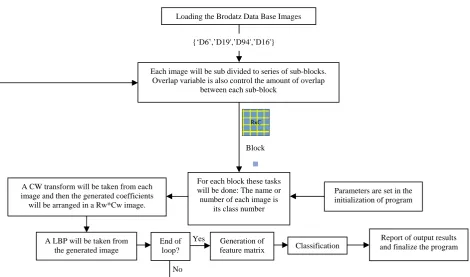
4.1. Summary of texture classification with LBP based on CWT Summary of the proposed method in the figure (5) is shown.
Fig. 5. Abstract the performance of proposed method for texture classification
5. Experimental Result
The classification accuracies of Timo Ojala et al. approaches under different environments are listed in Table 1. According to the experimental results, the proposed LBP approach can already outperform the other method under different conditions. Also, by embedding the wavelet transformation information of dominant patterns (WTDP) with the LBP, the classification performance is better than using LBP alone.
TABLE 1
Proportions (%) of “riu2” for some samples in the Brodatz database. Patterns for Each Texture Used in the Experiments and Their Average over All Textures
Timo Ojala et al. [2] Proposed Method
Texture P = 8, R = 1 P = 16, R = 2 P = 24, R = 3 Texture P = 8, R = 1 P = 16, R = 2 P = 24, R = 3 Grass 85.5 63.3 45.6 Grass 95.5 85.6 83.3
Woolen cloth 91.8 74.2 52.8 Woolen cloth 92.6 95.6 90.9
Brick wall 88.9 71.0 55.0 Brick wall 95.23 93.5 91.3
weave 76.6 50.9 32.1 weave 85.65 91.9 95.6
Average 85.7 64.85 46.375 Average 92.24 91.6 90.27
6. Conclusion
In this paper, we have proposed an efficient method for texture classification with local binary pattern based on wavelet transformation. Also, we find that the wavelet transformation of dominant patterns (WTDP) actually is a very powerful feature for describing the characteristics of the texture image as it includes the location information of the dominant patterns in the texture images. It has been evaluated by comparing with Timo Ojala
et al. approaches with Brodatz databases. It is experimentally shown that our approach has excellent performance in texture classification and is very robust to histogram equalization and random rotation.
For each block these tasks will be done: The name or number of each image is
its class number
Parameters are set in the initialization of program A CW transform will be taken from each
image and then the generated coefficients will be arranged in a Rw*Cw image.
A LBP will be taken from the generated image
End of loop?
Generation of
feature matrix Classification
Report of output results and finalize the program
No Yes
Loading the Brodatz Data Base Images
{‘D6’,’D19',’D94',’D16'}
Each image will be sub divided to series of sub-blocks. Overlap variable is also control the amount of overlap
between each sub-block
Computational simplicity is another advantage of our proposed method as the features can be obtained with only a few calculations and comparisons without the need of performing any image filtering.
References
[1] Ojala, T., Pietikainen, M.: A Comparative Study of Texture Measures with Classification based on Feature Distributions. Pattern Recognition, Vol. 29, 1996, pp. 51–59.
[2] Ojala, T., Pietikainen, M.: Multiresolution Gray-Scale and Rotation Invariant Texture Classification with Local Binary Patterns. IEEE Transactions on Pattern Analysis and Machine Intelligence, Vol. 24, 2002, No. 7, pp. 971–987.
[3] M. Tuceryan and A.K. Jain, Texture analysis, in: C.H. Chen, L.F. Pau, and P.S.P.Wang (Eds.), Handbook Pattern Recognition and Computer Vision, World Scientific, Singapore, 1993, pp. 235–276.
[4] N. Kwak, C.-H. Choi, Input feature selection for classification problems, IEEE Trans. Neural Networks 13 (1) (2002) 143–159. [5] E.D. Übeyli,˙I Güler, Feature extraction from Doppler ultrasound signals for automated diagnostic systems, Comp. Biol. Med. 35 (9)
(2005) 735–764.
[6] M. Akay, Time Frequency and Wavelets in Biomedical Signal Processing, Institute of Electrical and Electronics Engineers, New York, 1998.
[7] Duda, R.O., Hart, P.E., Stork, G.: Pattern Classification. John Wiley (2001).
[8] I. Daubechies, The wavelet transform time-frequency localization and signal analysis, IEEE Trans. Inform. Theory 36 (5) (1990) 961– 1005.
[9] P. Brodatz, Textures: A Photographic Album for Artists and Designers. Dover, 1966.
[10] S. Soltani, On the use of the wavelet decomposition for time series prediction, Neuro computing 48 (2002) 267–277.
[11] Coifman, R.R., Wickerhauser, M.V.: Entropy-based algorithms for best basis selection. IEEE Transactions on Information Theory 38(2) (1992) 713-718.