PROCESS QUALITY ANALYSIS OF
PERFECTIVE MAINTAINABILITY FOR
COMPONENT-BASED SOFTWARE
SYSTEMS USING ASPECT-ORIENTED
PROGRAMMING TECHNIQUES
Jyothi R
Assistant Professor, Computer Science and Engineering Dept. Research Scientist CORI, Peoples ES Institute of Technology, 100 feet ring road, BSK 3rd Stage, Bangalore,
Karnataka-560085, India [email protected] http://www.pes.edu Dr. V. K. Agrawal
Professor CORI Lab, Peoples Education Society Institute of Technology, 100 feet ring road, BSK 3rd Stage, Bangalore,
Karnataka-560085, India [email protected]
http://www.pes.edu
Abstract:
Maintainability occupy’s the major role in the software development life cycle (SDLC). Once the software product comes out of this SDLC, major cost and effort goes to the modification/ enhancement of the different components in a component-based software systems. This research presents the modeling work and prototyping techniques, which highlights the importance of process quality analysis for perfective maintainability. This analysis comprising of time, quality and efficiency of the derived solution and it is based on the type of modification/enhancement request from the customers of the software product. Here we are proposing a mathematical approach for time evaluation, which includes the summation of response time and the solution production time. Quality analysis is based on the qualitative and quantitative approach. Efficiency analysis requires the potential operational performance for component-based software systems. This needs high execution speed for handling complex algorithms and huge volumes of data. For this we are proposing an aspect-oriented programming techniques which increases the development speed, modularity, as well as it provides the best software efficiency and design quality.
1. INTRODUCTION
Maintainability plays a very important role in the software development life cycle. Since majority of the software development costs goes to maintenance phase. Among four different types of maintainability namely corrective maintainability, adoptive maintainability, perfective and preventive maintainability, major costs go to the enhancement/modifications of components in component-based software systems [3]. Perfective maintainability establishes the change control procedure to initiate enhancement/modification request, to evaluate modification/enhancement request, to approve and implement changes to a baseline [5]. Process quality analysis of perfective maintainability is based on three parameters they are Time, Quality, and Efficiency. Aspect-oriented-programming technologies aim to improve system efficiency and modularity by modularizing crosscutting concerns. These are the concerns that span across multiple modules in a program. In several programs, global properties of design issues lead to crosscutting concerns. This problem can be overcome by using a separation of concerns through concepts of Aspect-oriented-programming (AOP) [4]. This technique can be used to find all the objects affected by changes. However, this technique suffers from common problems of Object-Oriented programming such as crosscutting concerns [4]. In AOP we have found some improvements over object-oriented programming like modularization of data enhances the quality of software product. AOP introduces language mechanism for identifying and capturing crosscutting concerns and it is considered as a good candidature for modularizing the different aspects of concern in a system. It provides a mechanism for encapsulating crosscutting concerns into modular units; this mechanism provides an easy approach during the evaluation of the quality of perfective maintainability.
This research paper has the following subsection section 2 briefly describes about the administration activities required for the perfective maintainability for component-based software systems. Section 3 describes about the procedure for process quality analysis of perfective maintainability, section 4 gives the simulation of different activities involved in the administration of perfective maintainability. Section 5 briefs about conclusion and future work.
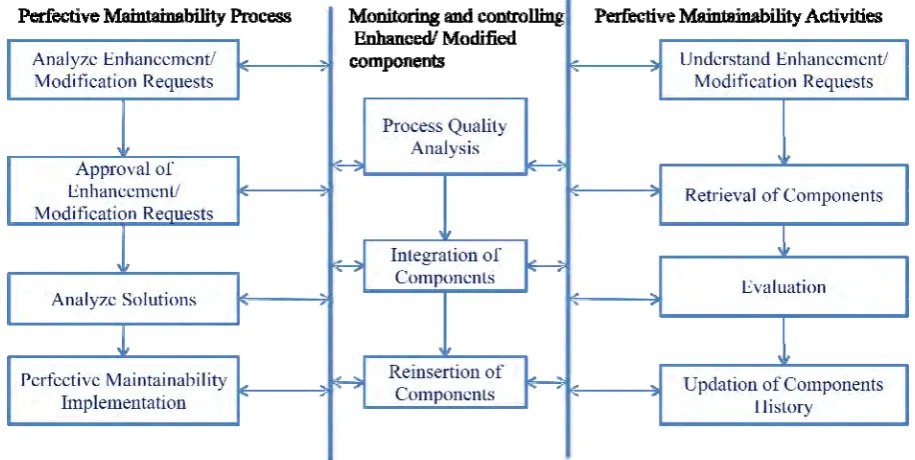
2. ACTIVITIES FOR PERFECTIVE MAINTAINABILITY
Fig 1. Administration Activities of perfective maintainability
3. PROCEDURE FOR PROCESS QUALITY ANALYSIS OF PERFECTIVE MAINTAINABILITY
Evaluation of process quality would be derived from the following parameters. I. Time
II. Quality III. Efficiency I. Time:
Measure of time comprises of two parameters; response time and average answering time. The analysis of complete source code efficiency and scalability provides a clear picture of the response time. This again depends on the type of enhancement/ modification request and also the associated components.
Average answering time is the time interval that elapses from the arrival of a request into the maintenance request buffer until the required enhancement/ modification has done to fulfill the user requirements. The time taken to fulfill the user requirements based on the type of enhancement/modification requirement. This can be calculated as follows.
Tcr = Σ P (Ai) *T (Ai)
Tcr-> is time taken to complete the enhancement/ modification requirements.
P (Ai) ->is the probability of receiving a good acceptable modification/enhancement request.
T (Ai) -> is the Mean Time for answering i.e., fulfilling the identified request. This is different for different requests.
This time taken includes the time taken for reconstruction of components I. Quality:
Quality of perfective maintainability is the extent to which software system possesses desirable characteristics. Quality analysis is performed through qualitative and quantitative approaches [5]. The qualitative approach is based on the identification of critical programming errors that may encountered whenever any enhancement/modification request has been fulfilled. This approach involves proper analysis for correcting the errors in each of the aspects or components affected by that request. This also includes identification of aspects of all affected components. Identification of aspects is done by the concepts of separation of concerns. Design consists of redesigning the system based on the understanding of the
modifications/enhancements necessary for the components using AOP AspectJ programming techniques. During redesign, identified aspects are rewritten based on the requirements. Once the aspects are redesigned, the modifications done to this affects all the other concerns related to the aspect. Outcome of this redesign results into new aspects with required modifications/enhancements and an updated version of the same aspects. Documents are generated for new aspects and also for updated version once the requirements are fulfilled. If the requirements are not fulfilled completely then it is required to repeat the procedure. In this redesigning process we changed only one aspect without spending much time in analyzing and identifying each and every class related to that concern, and this will drastically reduces the time compared to Object-oriented programming techniques.
II. Efficiency
Efficiency of component-based software systems requires analysis of some of the software engineering best practices and technical attributes, they are
1. Component-based software system architectural practices 2. Interactions among different components in the system 3. Coding practices for the software development
4. Compliance with Aspect-oriented programming and Object-oriented programming techniques.
Main aim of efficiency is to ensure centralization of clients’ enhancement/modification requests and reduction of data flow among different modules in intra and inter components of systems. Aspect-oriented programming (AOP) techniques impacts on code quality improvements. This technique enhances a system feature such as modularity, readability and simplicity. AOP techniques would provides a better modularization of crosscutting concerns, which leads to an implementation of a component-based software systems as a less complex and easily readable software [11]. This in turn increases the software development efficiency, so that the system would be maintained efficiently than object-oriented programming techniques. AOP affects software development efficiency in terms of the time needed to develop the system. Programming paradigms of AOP would simplify the development process, so that the software product may be created faster.
Development Time is the metric, we identified here to measure the efficiency. Here we are defining active time as the time needed for software development by writing code and passive time as the time spends on the other activities concerned in the development of the software project. AOP affects efficiency of perfective maintainability in terms of Active Time (TA), and Passive Time (TP).Whenever any enhancement/ modification requests comes, if programmer have prior knowledge about following activities such as, how to handle the requests, what are the activities necessary to fulfill the requests, which parts of the source code needs to be changed and also about different modules and components where the changes have to be made, then the fraction of passive time in total time will become smaller. This will drastically increases the efficiency of component-based software systems.
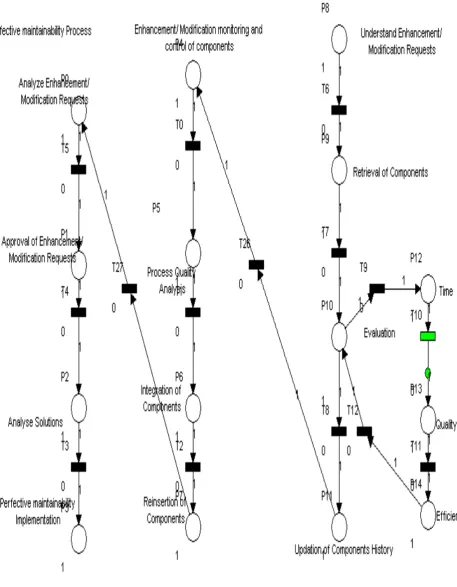
4. SIMULATION USING PETRINETS
Petrinets are a Mathematical and graphical modeling tool, it was first introduced in Carl Adam Petri’s dissertation in 1962[10]. This tool helps in modeling of concurrent systems, for that reason we are using this tool for concurrent evaluation of process quality activities of perfective maintainability for component-based software systems. Major application areas for petrinets are Performance Evaluation, communication protocols and other interesting applications which include Modeling and analysis of distributed software systems.
aspect-oriented programming technique would likely to improve efficiency of perfective maintainability for component-based software systems.
5. CONCLUSIONS
To provide better process quality of perfective maintainability for component-based software systems, we have proposed a set of activities necessary for a process quality analysis of perfective maintainability, by using three important parameter such as time, quality, and efficiency. The proposed approach helps in achieving better efficiency of perfective maintainability with the concepts of aspect-oriented programming, when any modifications/enhancements have been done for specific modules in component based software systems. We also provided the simulation of the above activities by using petrinets. This technique reduces the time taken for maintainability and increases the performance of the component-based systems. We will use this approach in our future work for maintainability of component-based software systems and also in architecture development. In future performance evaluation of perfective maintainability for component-based software systems could be a future area of research.
6. ACKNOWLEDGEMENTS
We gratefully acknowledge the financial support we have received from the PES Institute of Technology. Our sincere thanks to Prof. K N B Murthy, Principal, Prof. Nitin V Pujari, HOD, Department of Computer Science and Engineering for their constant encouragement to carry out my research work. I would also like to thank Sree Rekha, Assistant Professor, MCA Dept., for her support.
7. REFERENCES
[1] Software Quality Improvement through process assessment. A view from the UK Martyn A Ould. [2] Software Maintenance, Gerardo Canfora and Aniello Cimitile [email protected],
[3] [email protected] University of Sannio, Faculty of Engineering at Benevento Italy 29 November, 2000.
[4] NTNU Empirical study of Component Based Software Engineering with Aspect Oriented Programming by Axel Anders Kvale Trondheim, 1. November 2004.
[5] Kiczales, G., Lamping, J., endhekar, A., Maeda, C., Lopes, C.V., Loingtier, J.-M., and Irwin, J.: ‘Aspect- oriented programming’. Proc. European Conf. Object-Oriented Programming (ECOOP 1997) vol. 1241 of Lecture Notes in Computer Science, Jyva¨skyla¨, Finland, June 1997, pp. 220–242.
[6] Software Maintenance Process Analysis Using Discrete-Event Simulation Ivana Podnar and Branko Mikac 0-7695-1028-0/0$11 0.00 0 2001 IEEE, Department of Telecommunications Faculty of Electrical Engineering and Computing University of Zagreb, Croatia
[7] Martin, R.C.: ‘OO design quality metrics: an analysis of dependencies’. Available at: http://www.objectmentor.com/resources/articles/oodmetrc.pdf, accessed September 2006)
[8] Software Maintenance, Gerardo Canfora and Aniello Cimitile [email protected], [email protected] University of Sannio, Faculty of Engineering at Benevento Palazzo Bosco Lucarelli, Piazza Roma 82100, Benevento Italy 29 November, 2000. [9] Framework for software quality measurement, Sinclair Guillaume, Stockman, Alan Richard Todd, and Gerald Anthony Robinson,
IEEE Journal on Selected areas in communications, vol 8, No.2, Feb. 1990 [10] http://www. n.wikipedia.org/wiki/Software quality
[11] Petri Nets: Properties, Analysis and Applications, Tadao Murata, Proceedings of the IEEE, VOL 77, No.4, April 1989.
[12] Impact of aspect-oriented programming on software development efficiency and design quality: an empirical study, L. Madeyski and
Ł. Szała, IET Softw., Vol. 1, No. 5, October 2007