Exact Analytical Solutions in Three-Body Problems and Model of Neutrino
Generator
N.Zh. Takibayev,a
Institute of Experimental and Theoretical Physics, Ave Tole-bi 154, Almaty, Kazakhstan
Abstract. Exact analytic solutions are obtained in three-body problem for the scattering of light particle on the subsystem of two fixed centers in the case when pair potentials have a separable form. Solutions show an appearance of new resonance states and dependence of resonance energy and width on distance between two fixed centers. The approach of exact analytical solutions is expanded to the cases when two-body scattering amplitudes have the Breit-Wigner’s form and employed for description of neutron resonance scattering on subsystem of two heavy nuclei fixed in nodes of crystalline lattice. It is shown that some resonance states have widths close to zero at the certain values of distance between two heavy scatterer centers, this gives the possibility of transitions between states. One of these transitions between three-body resonance states could be connected with process of electron capture by proton with formation of neutron and emission of neutrino. This exoenergic process leading to the cooling of star without nuclear reactions is discussed.
1 Introduction
Exact solutions are of importance in quantum mechanics since they give rise to plain comprehension into phenom-ena occurring in the systems being considered. Usually ex-act solutions in analytic form can be obtained in simple models and grown effective tools for investigation of more complicated problems. It should be noted that revealed fea-tures of model problems take place actually in appropriate real physical systems.
Some of model problems are of the significant impor-tance in quantum physics. So, there are well known the Thomas effect of collapse into a center in system of three identical particles whose pair interactions have a zero range [1] and the Efimov effect of the condensation of levels in three particle spectrum and growth of their number as the ratio of the pair scattering length to the range of pair forces increases [2]. Note the investigation of threshold anomalies in cross sections and phenomena of long-range characters in [3, 4].
In nuclear physics, for example, solutions to specific physical problems are usually obtained by means of cum-bersome numerical calculations. At the same time, the pres-ence of model problems that admit solutions in an analytic form could provide the possibility of performing an exact analysis of many phenomena inherent in system of compli-cated internal structure. A determination and investigation of such model problems is the main objective of the present study.
In model problem of light particle scattering on two heavy fixed centers analytic solutions demonstrate how the new resonances appear in three-body system. They show
a e-mail:[email protected]
that positions and widths of these resonances depend on distance between two centers.
Analytic solutions for the problem of light particle scat-tering on two heavy particles are found if two associated simplifications are acting in the system [5]:
- the limit of ζ = m/M → 0, where m - mass of light particle and M - mass of heavy particles, identical for sim-plicity;
- and pair ti-matrices have a separable form (i - number of pare): ti=|νi> ηi< νi|.
This model is used for description of resonance scat-tering in system where the light particle is a neutron and two nuclei are placed in fixed centers.
In the case when two-body neutron-nucleous scattering amplitudes have the resonance Breit-Wigner’s form ana-lytic solutions are also obtained and three-body scattering amplitudes manifest the resonance behavior, too.
Moreover, solutions for amplitudes of neutron scatter-ing on subsystem of two fixed heavy nuclei show that sets of new resonance states appear in the three-body system. It is remarkable that positions and widths of resonances de-pend on b - distance between two heavy scatterer centers, and there are values of b when resonance widths come to zero. It seems that these quasi-bound states must have very big lifetimes.
The model of subsystem consisted of twoα-particles taken as scatterer centers is considered to investigate neu-tron and proton scattering amplitudes. The comparison of their resonance states displays that some proton states are situated on energy scale more than 0.8 MeV above the neu-tron ones.
In this case the reactions of electron capture by proton with emission of neutrino become possible. It gives cause for consideration of neutrino generator model.
DOI:10.1051/epjconf/201005028
© Owned by the authors, published by EDP Sciences, 2010
The proposal of experiment is suggested to investigate behavior, appearance and parameters of new three-body resonances, for instance, with using of monocrystals un-der high pressure and low temperature. Some applications of the exact solution method interesting in physics are dis-cussed.
2 Three-body problem with two-body
separable interactions
A mathematically rigorous solution to three-body prob-lems was given by Faddeev [6]. The set of Faddeev equa-tions for the T -matrix elements can be written in the form:
Ti,j=tiδi j+
X
tiG0(Z) ¯δi,lTl,j (1)
where ti=Vi+ViG0(Z)tiare pair t matrices associated with pair interaction potentials Viand determined in the space of three particles, (i,j,l =1,2,3), G0- the Green’s function for three free particles, Z is a parameter that characterizes the problem and which corresponds to E - the total energy of the three-particle system, and ¯δi,j = 1−δi,j. The total
T -matrix is the sum over the indices i and j, T =PT
i,j. Let us consider the example of simple pair separable potentials Vi = |νi > λi < νi| , where λi is a pair cou-pling constant. Sandwiched between free wave functions, the operator Viassumes the conventional form of a func-tion of coordinates or momenta, depending on the choice of representation for these wave functions. For such po-tentials, pair ti- matrices are completely determined in an analytic form [7]
ti=|νi> ηi< νi|, (2)
where
η−i1=λ−i1−< νi|G+0(E)|νi> . (3) Sometimes, they are referred toηias enhancement factors; in this way, the similarity of the shapes of the potential and amplitude and the dependence of the amplitude onλiand the energy of the subsystem are emphasized.
In the common case short-range pair interactions can be represented as sums of separable members
Vi=
X
n
|←−νi,n> λi,n <→−νi,n|, (4)
where n can be a set of indices and contains the number of separable member and also discrete quantum numbers
L,S,J.
In (4) overarrows point out the presence of spherical function, for example
<→−νi,n|q>=νi,n(q)=νi,n(q)| ·YLM( ˆq). (5) Therefore t-matrix can be written in the form
ti=
X
n,m
|←ν−i,n> ηi;n,m<→−νi,m|, (6)
where
ηi;n−1,m=δnmλ−i,n1−<→−νi,n|G0(E)|←−νi,m> . (7) For simplicity, we come back to simple form (2), sup-posing that transition to the complicated form (6) does not meet any difficulties.
Introducing Pi jmatrix by form
Ti,j=tiδi j+|νi> ηiPi,jηj< νj|, (8) we arrive at
Pi,j=Λi,j+
X
Λi,kηkPk,j, (9)
whereΛi,j=< νi|G+0(E)|νj>, i,j .
It is important that Λi,i ≡ 0 - i.e. the diagonal ele-ments vanish identically. This distinctive feature of Fad-deev equations ensures the compactness of kernels in re-spective integral equations and the existence and unique-ness of solutions. Indeed, the singularities of the Born terms become weaker upon successively iterating Faddeev equa-tions, while the kernels of the integral equations become normalizable; therefore, solutions exist and are obtainable [6, 8].
In common case (see, for example [5]) when the two-body interaction between heavy particles exists we can de-termine ”the nuclear equation”
P1,1′=V1,1′+
X
1”
V1,1”η1”P1”,1′. (10)
Here the effective potential between heavy particles
V1,1′=
X
k,l=2,3
Λ1,kηk(δkl+Mk,l)ηlΛl,1′, (11)
can be determined by means of ”electronic equation”:
Mk,l=Λk,l+
X
ρ=2,3
Λk,ρηρ Mρ,l. (12)
Above-mentioned terms are given from the well-known Born-Oppenheimer approximation. This approximation is the assumption that the electronic motion and the nuclear motion in molecules can be separated. The electronic wave-function depends upon the nuclear positions R2,3 but not upon their velocities, i.e., the nuclear motion is so much slower than electron motion that they can be considered to be fixed.
In the case of fixed heavy centers we have to solve only Eq. (12), which gives total description of light particle scat-tering amplitude on these centers [5].
3 The scattering problem on two heavy
centers
The total energy of the system is E = Pp2 0i/2mi =
p20/2m , where p01 =p0- being initial momentum of the light particle. The heavy particles are labeled with the in-dices of 2 and 3. For the sake of simplicity, we assume them to be identical.
In the limitζ → 0, the form factors for the pair po-tentials of interaction between the light particle and any of the heavy particles ceases to depend on the heavy-particle momentum:ν(q12 → ν(p), ν(q13 → ν(p), since q12 = (m2p1 −m1p2)/(m2+m1) → p1 = p and, accordingly, q13 =(m3p1−m1p3)/(m3+m1)→p1=p.
The enhancement factors in the t matrices for these pairs become functions only from the initial energy of the light particle - that is, they are functions of its initial mo-mentum:η2=η3 →η(p0).
In the limitζ →0 the expression forΛk,lin ”electronic equation” (12) is
Λ2,3=2m
ν2(p)ν3(p)
p20−p2+i0 ≡ f (p0,p). (13)
Taking into account the conservation of total momentum in three-particle system p = −p2−p′
3 , we represent the potentialΛ2,3in the integral form
Λ2,3(p2,p′3)=
Z
dr exp(irp2)J2,3(p0; r) exp(irp′3), (14)
where
J2,3(p0; r)=
Z
dp exp(irp) f (p0; p). (15)
In Eq. (14), we label heavy-particle variables at the exit from interaction region with a prime; at the entrance, they carry no primes. We will use this notation below.
Then we determine the Fourier transform of the solu-tion Mk,l≡Mk,l(p0; pkp′l)→ Mk,l(r,r′), namely
Mk,l(r,r′)=
Z
dpkdp′lMk,lexp(ir′p′l−irpk). (16)
Take into consideration the relation (14) we obtain from Eq. (12) equation
Mk,l(r,r′)=Jk,l(p0; r)δ(r+r′)+
+X
ρ
Jk,ρ(p0; r)Mρ,l(−r,r′). (17)
Since the delta function removes the integration on the right-hand side of (17), the equation for Mk,l(r,r′) is re-duced to the extremely simple form.
As a result, the solution of light particle scattering prob-lem on two heavy centers can be represented in analytical form
Mi,j(r,r′)=
1
I−Bi,i(r)
Ki,j(r,r′), (18)
where i,j=2,3 - numbers of heavy centers, r - the radius-vector according to the position of initial scattering center and r′- the radius-vector according to the position of final
scattering center in c.m. of system.
Elements of diagonal matrix Bi,i(Bi,j=0 if j,i) are
Bi,i(r)=
X
k=2,3
Ji,k(p0; r)ηk(p0)Jk,i(p0;−r)ηi(p0). (19)
Elements of matrix Ki,j(r,r′) are given as
Ki,i(r)=
X
k=2,3
Ji,k(p0; r)ηk(p0)Jk,i(p0;−r)δ(−r+r′), (20)
if j=i, and
Ki,j(r)=Ji,j(p0; r)δ(r+r′), (21)
where j,i .
And we can write out two modes of solution Mi,j(r,r′)
Mi,j(r,r′)=M+i,j(r)δ(r+r
′)
+M−i,j(r)δ(−r+r′), (22) where
Mi+,j(r,p0)=
1
I−Bi,i(r)
Ji,j(r,p0), (23)
and
Mi−,i(r,p0)=
1
I−Bi,i(r)
Bi,i(r,p0)η−i1(p0), (24)
as M−i,j=0 if j,i.
In the case when pair potentials are sums of separable terms, expressions (13) - (24) have to be considered as the matrix expressions with respect to additional indices.
We assume above that heavy particles are strictly fixed at points R2and R3=R2+b. We introduce the wave func-tions for these centers of identical heavy particles in the form [5]
Ψi(r,Ri)=C exp
"
−(r−Ri) 2
2∆2
#
, (25)
for heavy particle is localized in a bounded region centered at the point Ri, i=2,3.
The obvious normalization condition< Ψi|Ψi >= 1 gives C2 = (∆2π)−3/2. In order to determine the physical scattering amplitude, it is necessary to sandwich the ex-pression for T - matrix between the wave functions for ini-tial and final states of the system< Ψin|T|Ψf >.
The structure of these functions is obvious, for exam-ple,< Ψin|=< χ1Ψ2Ψ3|, whereχ1is the free wave function for the light particle.
It should be emphasized that positions of heavy parti-cles are specified in the c.m. frame of all three partiparti-cles. This concerns their coordinates and momenta. It is then obvious that R2=−b/2 and R3=b/2.
The scattering amplitude of light particle on two heavy centers is determined by the form:
f (b; p0)=
X
i,j=2,3
< Ψi(r,Ri)|Mi j(r,r′)|Ψj(r′,Rj)> . (26)
In the limit∆→0, this amplitude comes to the expres-sion
f (b; p0)=M(b/2,p0)+M(−b/2,p0), (27)
where M(b/2) = M+(b/2)+M−(b/2) as following from
3.1 Zeros ofD-function
It is clear that zeros of D-function, where D=det(I−B),
correspond to poles of three-body amplitude M(b/2; p0) in complex plane of p0 (see (18)). And we can determine paths of motion of these zeros in complex plane of energy. For example, we can take the simple pair potential of Yamaguchi form acting in S -wave which has form-factors
ν(p)=Const/(1+p2/β2), (28)
where Const = p8π/(2mβ),β- the inverse range of nu-clear forces. In this case the enhancement factor is
η−1(p0)=λ−1+(1−ik)−2, (29)
k=p0/β. We take~=1,c=1, for simplicity. Then we can get
J=2exp(−˜b)−exp(i˜bk) ˜b(1+k2)2 +
exp(−˜b)
(1+k2), (30) where J=Ji j =Jji, ˜b=bβ/2.
We note that, by definition, the coupling constant λ
is real-valued. This follows from the unitarity and micro-causality conditions even at the two-particle level [10]. This leads to a relation between the coupling constantλand the coordinates of those points kres =kR+ikI in the complex plane of k
[1+k2R−k2I]2−4kR2k2I
λ =
h
1+k2R−k2Iiexp(−˜b)+
+exp(−˜b)−exp(−kI˜b) cos(kR˜b)
˜b/2 −
h
1−k2Ii2 , (31)
and
−2kI(1+k 2 R−k
2 I)
λ =1−kI
1+exp(−˜b)+
+
exp−kI˜b
sinkR˜b
kR˜b
. (32)
Owing to this, the value of kI = 0 is forbidden for any
kR,0 and realλ,0, and of course positive ˜b.
This means that the zeros of the function D(˜b,k) cannot
intersect the real axis of the complex plane of k, or, in other words, they cannot be in the physical region of scattering.
The problem can be further simplified if the pair in-teraction between the light particle and each of the fixed centers is taken to be contact.
The corresponding solutions follows from (30) upon going over to the limitβ→ ∞and fixed value of the quan-tityκ0; EB =−κ20/2m. The function D then takes the form
D=1+2exp(ibp0/2)
b(κ0+ip0)
. (33)
Zeros of D-function give the values of xRand xI, where
x=bp0/2, x= xR+ixI, can be found from the algebraic equations [5]:
xI =x0+cos(xR) exp(−xI), (34)
xR =−sin(xR) exp(−xI),
where x0 = bκ0/2. In the case of xR = 0 the relationship analogous (34) is well-known [3].
In the last case,
xI =x0+exp(−xI), (35)
xI >x0- that is, the three particle system is always bound more strongly than the two-particle subsystem. This is the reason why the light particle can be bound by the system of two fixed centers even if it is underbound by one isolated center [3].
The existence condition for a bound three-particle state is x0>−1 , which is possible at anyλobeying the inequal-ityλ≤0 but at specific values of b that satisfy the recursive relation (35).
As for quasistationary states, the values of xR and xI can be found for them from the set of equations (34). Here, the condition xI < 0 always holds, so that the resonance poles always lie in the lower half-plane of the complex plane of x.
It is remarkable that energies and widths of three-body resonances depend on parameter b - the distance between the scattering centers. This dependence is an important fea-ture of the three-body system. It is clear that bound, vir-tual and quasi-stationary states will be moving in complex plane of p0with changing of distance between scattering centers [5].
Note that in common case, for example, of more com-plicated pair potentials in S -wave or of higher partial waves, zeros of function D can intersect the real complex plane of
k. That is the some of resonance points can get kI =0 but
kR,0 at specific values of b.
4 Corrections to exact analytical solutions
Supposing that Mk,lin (7) and (12) are already defined (see above Sect. (3)) we resort to estimation of corrections to exact analytical solutions.
In order to determine these corrections one can use iter-ative method within the framework of Faddeev equations. Note that the convergence of iterative procedure has an ex-ponential behavior, that is more fast in comparison with the ordinary perturbation theory [8].
Also the method of coupling constant evolution may be used to find corrections to energies of bound or resonant states [10, 11].
First of all we can find three-body wave functions. Fol-lowing (9) and Lippmann-Schwinger equations we get wave functions in continuum
|Ψ >=X
j
|φi> δi j+G0|νi> ηiPi jλj< νj|φj>
, (36)
where|φi>- two-body wave functions.
In the case of spectrum we can connect the wave func-tion of three-body state with the residue of T -matrix in the pole
T (E)E→En →
V|Ψn>< Ψn|V
E−En
According to (8), (18) and (19), for instance, in S -wave this amounts to
|Ψn>=G0
X
i
|νi>Rn, (38)
where Rn=
p
(En−E2,res)/(2J) to the accuracy of phase. Here E2,resis the energy whereη−i1 = 0. This energy corresponds to the two-body ”resonance” state - it may be bound or virtual, or quasi-stationary one.
Meanwhile En = En(b/2; p0) corresponds to the res-onance state of three-body system. J = Ji j(En,b/2) =
Jji(En,b/2) as fixed heavy particles are identical.
Now we know solutions of our simple model, i.e. ele-ments of T -matrix, wave functions and energies of states. After that we can construct scheme for determination of corrections.
For example, in framework of coupling constant evolu-tion method we can consider the evoluevolu-tion of system with increasing of small parameterζ. Resonance energy shifts are determined by equation
dEn
dζ =
< Ψn|Hζ|Ψn>
< Ψn|Ψn>
, (39)
where Hζ =dH/dζ, and shifts of wave functions by
d|Ψ >
dζ =
1
E−H
Hζ−Eζ
|Ψ > , (40)
Eζ =dE/dζ[10, 11]. Exact analytical solutions are taken here as boundary conditions for H, En and|Ψ >at limit
ζ→0.
Moreover, we can take into account small motions of heavy centers in expression (25). Decomposing expression (26) in respect of∆,0 (but∆/b<<1) one can obtain that the amplitude in resonance point∼∆−1, and corrections to resonance energy and width are linear with∆/b<<1.
Putting Wk,i=Tk,i−tiδki, we can write expressions
W1,1=
X
k=2,3
t1G0(E)Wk,1,
Wk,1=|νk> ηk· ρk,1+Fk,1, (41)
where k,1, and
ρk,1=< νk|G0(E)·T1,1,
Fk,1 =
X
l=2,3
Mk,l·ηl·ρl,1. (42)
Then we can take a pair interaction between two heavy centers in arbitrary form not only separable one. Writing
W11 =V1·W˜11, we obtain ˜
W11 =V
e f 11+V
e f 11G
−1
1 G0W˜11, (43) where
V11e f =X
k,l,1
G1|νk> ηk
η−k1δkl+Pkl
ηl< νl|G0t1. (44)
In the case when V1 has a separable form, equations (43) and (44) can be reduced to (10) and (11).
Analytic solutions to the problem of light particle scat-tering on pair of interacting heavy particles are found in limitζ →0 and the method is stated in detail in [5].
It turns out that off-shell effects of light particle rescat-tering on heavy particles are contained only in the effective potential (11). That is, off-shell effects in the interaction of heavy particles are absorbed in the equation for the ampli-tude (10), where the effective potential is an on-shell quan-tity.
5 The scattering problem with two-body
amplitudes of Breit-Wigner form
Now we consider the problem of neutron scattering on two fixed centers if the two-body scattering amplitudes have the Breit-Wigner resonance form:
ti=−
1
πρ(E)
Γ2/2
E−ER,2+iΓ2/4
. (45)
The energy and width of this two-body resonance can be written through real and imaginary parts of resonance wave number: ER,2 = (p2R,2−p
2
I,2)/2m andΓ2 = 2|pR,2pI,2|/m. Here, index 2 marks two-body parameters (below index 3 will mark three-body parameters).
It is known that the residue of resonant amplitude comes to factorization form in the region near to point of polar singularity. In this region the representation (37) can be transformed to separable form (2). It is convenient to deter-mine parameters of two-body separable potential in terms of resonance energy and width of two-body scattering.
We can normalize form-factors of two-body potential so that
ν(p)≈ pΓ2/2πρ(E), (46)
if p≈pR,2, and take hold of
η−i1=−(E−ER,2+iΓ2/2) (47)
instead of simple form (3).
So, exact solutions can be obtained in the case when pair t-matrices have Breit-Wigner resonance form, too. For isolated pair resonance with energy ER,2and widthΓ2we can get elements of J-matrix from (13) - (15) in analytic form.
Therefore, zeros of D-function are determined by equa-tion
E−ER,2+i
Γ2 2 −J
·
E−ER,2+i
Γ2 2 +J
=0. (48)
Then, introducing real and imaginary parts of E=Eres,3=
ER,3−iΓ3when D=0 and J=JR+iJI, we write out two branches of three-body resonances:
ER,3=ER,2−JR, Γ3=Γ2−2JI, (49)
and
Note that J = J(b/2,p0) has the oscillating behavior. For example, form-factors of two-body potentials in (46) acting in S -wave give
Ji j=Jji=J=−Γ2
exp(ibp0/2)
bpR,2
. (51)
Therefore, every branch contains sets of three-body reso-nances.
Some of them are situated at energy scale above the en-ergy of two-body resonance, and others - under this enen-ergy. Some of three-body resonances will have more narrowed width, others - more widen
Remarkably that there are several points where func-tionΓ3 = Γ3(b/2,p0)= 0. It means that lifetime of reso-nance in these points becomes infinite. It is possible only in simple model, although in real situation lifetime of reso-nances can be enlarged substantially if distortions are sup-pressed.
Note, there are no principal difficulties to include more complicated forms of two-body separable potentials and other partial components into the model.
At next subsections we consider the model of scatterer subsystem which consists of nuclei in the capacity of fixed centers. It is important that these nuclei have resonance interaction with neutron. And their two-body resonances give rise to body resonances. We investigate three-body resonance positions in dependence on b - distance between centers. And we indicate specially points where imaginary part of resonance energy comes to zero.
5.1 The scattering of neutron on two fixed α-particles
At first we consider the low energy resonance scattering of neutron on subsystem of two fixedα-particles.
It is known that two-body n, α-system does not have bound or resonant states in S -wave at low energies as re-pulsive forces act between nucleon andα-particle in this case. However, there are resonances in other partial waves. The respective amplitudes have resonances in the P-wave components PLJ,S, where the total momentum J =
3/2,1/2, orbital - L = 1, and S = 1/2. We take into ac-count the distinct resonance P3/21,1/2 which has parameters
ER,2≈0.9 MeV andΓ2≈0.6 MeV [12].
This resonance can be described satisfactorily by the simple separable potential, for instance, involving the form factors (see (5))
νP(p)=Const p/β
1+p2/β2 , (52) which give rise to
η−P1=λ−P1+ 1−2k
(1−ik)−2 , (53)
whereηP=η3/21,1/2(k), k=p0/β, and Const=
p
8π/(2µβ). The two-body amplitude has the pole at the point k =
kres,2, whereη−P1(kres,2)=0.
The resonance parameters, ER,2andΓ2, can be associ-ated with potential parametersλP andβ. So, there are two relationships:λP = −(1+kI,2) and kR2,2 =−kI,2(1+kI,2), where kres,2 = ±kR,2 +ikI,2. It follows that the values of
kI,2 = −0.0256, kR,2 = 0.158, from which we can deter-mine parameters of the nuclear potential:λP=−0.974 and
β=1.175 f m−1.
Moreover, we can describe n, α-scattering in S -wave with simple separable potential (28), too. In this case (see (29)) the positive coupling constant gives the repulsive char-acter of the S -wave interactionλS =15,βS =1.4 f m−1.
Note that the enhancement factor in (53) can be pre-sented in form similar to (47)
η−P1=−(E−Eres,2)·AP(E,Eres,2), (54)
where Eres,2=ER,2−iΓ2/2
AP(E,Eres,2)=
Z
dp νP(p)ν
∗
P(p)
(E−Ep+i0)(Eres,2−Ep)
, (55)
and Ep =p2/2m.
Thus, the matrix J (see (15)) contains submatrix in re-spect of indices of two-body partial waves - S and P:
J= J0 J12
21 0
!
, J12 =J21=JS P =
JS S JS P
JPS JPP
!
.
It is obvious that we can write JS P-element as
JS P(p0; r)=
Z
dp exp(irp)νS(p)νP(p)
E−Ep+i0
, (56)
and other elements of JS P-submatrix in analogous form. For S -wave components of B-matrix elements we have
BL,L′=
X
K
JL,KηK(p0)JK,L′ηL′(p0), (57)
5 10 15 20 25 30 r
-10 -7.5 -5 -2.5
2.5 5 7.5 10
A
5 10 15 20 25 30 r
-10 -7.5 -5 -2.5
2.5 5 7.5 10
B
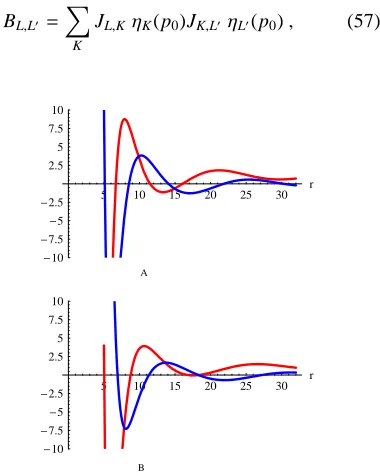
Fig. 1. D-function of neutron scattering amplitude on (α, α) sub-system. The red color marks Re(D), and the blue one - Im(D). Graphs A and B show curves with k = p0/β = 0.17 and
k = 0.1537, accordingly. In the latter case the point where
where L,L′,K=S,P.
Then it is not difficult to determine D-function and cal-culate values of resonant energy Eresin three-body system and b - distance between two heavy centers. Curves cor-responding to real and imaginary parts of D-function are shown in Fig 1.
In framework of the method we obtained exact analytic solutions for ”quasi-bound” states when the widthsΓ3=0. It is remarkable that near this points pI,3 may cross zero and be even positive (see Fig 1, B). Our calculations con-cerned a region of low energy only. Table 1 demonstrates values of resonance energies - ER,3and parameters bk- dis-tance between fixedα-particles whenΓ3=0.
Our calculation gives two resonance states withΓ3=0, which named here as ”quasi-bound” states.
Table 1. ”Quasi-bound” states (withΓ3 = 0 ) of neutron and proton in model of two fixedα-particles. ER,3;kare given in MeV and bk- in f m, k - number of resonance state.
Three-body system ER,3;1 b1 ER,3;2 b2
n+α, α 0.88 18 1.37 31
p+α, α 1.78 14 2.36 24
Then we turn our attention to the proton scattering on subsystem of two fixedα-particles.
It is known that two-body p, αscattering amplitude has resonance in this P-wave too, with parameters: ER,2≈1.9 MeV andΓ2 ≈ 1.5 MeV [12]. For comparison between parameters of (n, α, α) and (p, α, α) resonances the calcu-lation data are shown in Table 1.
The estimations of (p, α, α) resonance parameters have been performed on the base of two-body resonance in P-wave without ordinary repulsive Coulomb force between the proton and α-particles in S -waves and between two alpha-particles.
As a rule [3, 11] repulsive Coulomb forces result in widening of distance between centers and shifting of three-body resonance levels to higher energies. It is important that the difference of 1 MeV or more between resonance energies of (p, α, α)- and (n, α, α)-systems is remaining.
5.2 The neutron resonance scattering on subsystem of two fixed nuclei
Now we consider the cases when more heavy nuclei than
α-particles are fixed in two-body scatterer subsystem. Sub-systems with nuclei of atoms of oxygen and magnesium are interesting objects because they have similar features of interaction with neutron asα-particle.
The fact is that two-body scattering amplitudes of neu-tron on16O as well as on24Mg have P-wave resonances at low energy region. Moreover, in these cases repulsive forces act in S -wave like in N, α-particle scattering ampli-tude.
We take into account only the lowest isolated neutron-nucleus resonance states in body systems. The two-body resonance parameters are ER,2 = 435 keV,Γ2 =40
keV in the case of (n,16O), and ER,2 = 84 keV, Γ2 = 13 keV in the case of (n,24Mg).
As above we describe neutronnucleus scattering in S -wave with simple separable potential (28) with the same positive coupling constantλS =15 andβS =1.4 f m−1.
Two-body resonances in P-wave can be described with separable potentials involving the form factors (52), where potential and resonance parameters have to be coordinated with each other. It is resulted inλP = 0.999,βP = 6,076
f m−1in case of16O, and inλ
P=0.998,βP =1,635 f m−1 in case of24Mg.
Then we determine three-body quantities following the scheme of previous subsection. The main aim is the deter-mination of D-function and positions of zeros of this func-tion.
Calculations give the points whereΓ3 = 0. Energies of these quasi bound states of neutron in subsystem of two fixed nuclei and distances between these centers are shown in Table 2.
Table 2. Neutron ”quasi-bound” states (withΓ3 =0) in model of two fixed nuclei. ER,3;k are given in keV and bk in f m, k
-number of resonance state.
Three-body system ER,3;1 b1 ER,3;2 b2
n+(16O,16O) 231 10.53 286 12.18
n+(24Mg,24Mg) 82 63.27 117 70.37
It should be noted that nuclei with more heavy mass taken as fixed centers give rich and complicated pictures of three-body resonance states.
6 The model of neutrino generator
Note that the position of two-body p, α- resonance on en-ergy scale is nearly 1 MeV above the position of n, α- res-onance. Moreover, the resonances in (p, α, α)-system have the energies more than 1 MeV above energies of corre-sponding resonances in (n, α, α)-system (see Table 1).
Thus, if certain systems exist or can be made to keep these resonance states together the observation of transi-tions between these states becomes possible.
It seems that this kind of systems can be formed during the evolution of massive cold stars, for example, in depth of white dwarfs. Indeed, the core inside of massive star can transform into solid crystalline body under very high pressure [13].
In this connection we consider the model of ideal crys-tal where nuclei are fixed in nodes of the lattice. It is sup-posed that distances between nodes of this perfect crys-talline lattice can be changed and become small, for in-stance, as a result of very big pressure from outside [14].
energies and widths are functions not only of two-body in-teraction parameters but also of lattice parameter b - dis-tance between nodes.
It is very important that there are some values of pa-rameter bk for which certain widths of three-body reso-nance states are close to zero (see, Table 1).
For example, a system consisting of one neutron and two fixedα-particles has the resonance energy ER,3≈1.37 MeV withΓ3≈0 when b≈31 f m. The analogous system consisting of one proton and two fixedα-particles has the resonance too, with the energy ER ≈ 2.4 MeV and small width near this b.
We suppose that distance between nodes ofα-particle crystalline lattice b is near to b1=31 f m.
Here one might ask: How can neutron appear in the lattice?
Note that the part of protons can penetrate inside crys-tal from external surroundings if they have enough energy for channeling in the lattice. Furthermore, some protons can be inside of lattice ever since the time of lattice forma-tion [13].
Then, owing to reaction p+e− → n+νprotons can
turn into neutrons because it is the exoenergic reaction. So, neutrons appear in the (n, α, α)∗- quasi-bound states.
Neutrinos with energy Eν ≈0.2 MeV are produced in this reaction, after what they leave the lattice.
This (n, α, α)∗-quasi-bound state hasΓ3 ≈ 0 and very big lifetime if b≈31 f m. Besides, the decay of neutron is suppressed in the crystal.
In the case of distortions the condition in the lattice for existence of this neutron states is not supported and via
β-decay the neutron turns into proton, producing electron and antineutrino.
So, we assume that the following reaction can be stim-ulated in the crystalline lattice:
(p, α, α)∗2.36MeV+e−→(n, α, α)∗1.37MeV+νe, (58)
and then
(n, α, α)∗1.37MeV →n+(α, α)→ p′+e−+ν¯e+(α, α). (59)
Here, (∗) marks the quasi-bound state of nucleon in (N, α, α) system, and its resonance energy is shown in subscript. Note, that Ep′ ≈Ep−2.3 MeV.
The lattice distortions may be created periodically by satellites of star. As a result the star will generate clouds of neutrinos spreading outside in space.
The situation with neutrinos generation can be similar in the cases of stellar crystalline cores of16O and especially 24Mg, and more heavy nuclei.
7 Conclusion
The exact analytical solutions have been considered above in three-body problems, when one light particle interacts with subsystem of two heavy particles fixed in coordinate space. It is important that solutions of problem can be fol-lowed out, i.e. obtained in analytic forms.
These solutions can show the main three-body char-acteristics, for example, amplitudes, resonance states and their dependences on b - distance between scatterer cen-ters. Thus, exact solutions can be used as principle approx-imations in many problems of three-body quantum me-chanics.
It would be remarkable to create a setting, where b -distance between nodes, could be changed in order to in-vestigate properties of neutron resonance scattering on dif-ferent monocrystals. Of course, this setting should operate with special monocrystals kept under very high pressures and very low temperatures.
In this setting transitions between three-body p and n resonance states in monocrystal could be determined. It means to discover new neutrino generator and possibly the new mode of star cooling without nuclear reactions.
The analogous model of exotic particle interactions with the nodes of quark lattice or substructure may be interest-ing. In this case huge mass of heavy neutrinos or exotic neutral particles generated by star or galaxy center would be expanding and increasing far out to the galaxy frontiers and cripple the motion of satellites. Similar models might be useful for solving the problem of dark matter.
In any case it is clear that three-body effects and body resonances as well as quantum mechanics of three-body systems on the whole will give an important contri-bution in modern astrophysics.
References
1. L.H. Thomas, Phys. Rev. 47, (1935) 903
2. V. Efimov, Physics of Atomic Nuclei 12, (1970) 589 3. A.I. Baz’, Ya. B. Zeldovich, and A.M. Perelomov,
Scattering, Reactions and Decay in Nonrelativistic Quantum Mechanics (Nauka, Moscow, 1971) 465
pages
4. F.M. Pen’kov and N.Zh. Takibayev, Physics of Atomic Nuclei 57, (1994) 1232
5. N.Zh. Takibayev, Physics of Atomic Nuclei 78, (2008) 405
6. L.D. Faddeev, Mathematical Aspects of the
Three-Body Problem in Quantum Scattering Theory (Davey,
New York, 1965)
7. R.G. Newton, Scattering Theory of Waves and
Par-ticles (Springer-Verlag, Berlin-Heidelberg-New
York-Tokyo, 1982) 743 pages
8. S.P. Merkur’ev, L.D. Faddeev, Quantum Mechanics
of Three-Body Systems (Nauka, Moscow 1987) 400
pages
9. N.Zh. Takibayev et al., Vestnik KazNU 6, (2008) 76 10. D.A. Kirzhnits, G.S. Kruchkov, N.Zh. Takibayev,
Par-ticles and Nuclei 10, (1979) 741-783
11. N.Zh. Takibayev, Physics of Atomic Nuclei 68, (2005) 1147-1152
12. F. Ajzenberg-Selone, Nucl. Phys. A 490, (1988) 1 13. D.A. Kirzhnits, Zh.Eksp.Teor.Fiz. 38, (1960) 503-510 14. V.A. Volodin, D.A. Kirzhnits, Zh.Eksp.Teor.Fiz.