Publisher: Asian Economic and Social Society
Teachers’ Self- Perceived Professional Development Needs Regarding Classroom Assessment Skills
O.O Adedoyin (University of Botswana)
14 Introduction
Teachers who are very successful in the classroom have a deep understanding of the subject matter they teach, use appropriate instructional methods, and also apply various classroom assessment strategies or skills for effective teaching and learning outcomes. This shows that, classroom assessment is an important integral part of teaching and learning in schools. But many classroom teachers still lack the necessary assessment skills to judge students‟ performance, achievements or learning outcomes. In educational measurement of learning outcomes of students, classroom assessment involves all the processes in making correct decisions about students‟ learning outcomes which includes the observation of students‟ written work, their answers to questions in class and performance on teacher made tests and standardised tests and also to provide information about classroom instructional practices. McMillan (2000) suggested that „teachers with a solid background in classroom assessment skills are well positioned to integrate assessment with instruction so that they utilize appropriate forms of teaching‟, which means that the primary significance of
classroom assessments is to assess a student's level of achievement with regards to a particular subject or topic and the second function of classroom assessments is to provide instructors with feedback about the effectiveness of their teaching. It is only through effective assessments of students‟ learning outcomes that teachers can tailor instruction directly to individual student‟s needs.
But most teachers in schools still require some professional development to be efficient in all their classroom practices, skills and techniques. Professional development is now becoming the key determining factor for effective teaching and learning outcomes in schools and especially in the area of classroom assessment skills, since most classroom teachers are not competent in classroom assessment procedures for them to make correct decisions about students‟ learning outcomes or achievements. Hea-Jin Lee. (2001) specified that „ effective professional development of teachers are designed to help them build new understanding of teaching and learning‟. The assessment of students‟ learning in the classroom is always aimed at improving students‟ acquisition of required knowledge and also to improve the instructional practices in the classroom. Classroom assessment is one of the most basic but difficult tasks that teachers are required to perform effectively to Teachers’ Self- Perceived Professional Development Needs Regarding
Classroom Assessment Skills
Abstract
Author (s)
O.O Adedoyin University of Botswana. E-mail:[email protected]
Keywords: Classroom assessment, Professional Development needs
15 adequately assess students‟ learning outcomes. But
according to researchers on educational assessment (Galluzzo, 2005; Mertler, 2003; Zhang &Burry‐Stock, 1997), teachers‟ assessment and evaluation practices are characterised as largely incongruent with recommended best practice. (Bachor & Baer, 2001; Campbell & Evans, 2000; Graham, 2005). also emphasized that pre-service teachers also tend to utilize unsound assessment and evaluation practices in the classrooms. (La Marca, 2006; Stiggins, 2006) acknowledged and stated that „regrettably, when most of today‟s teachers completed their teacher-education programs, there was no requirement or evidence that they learn anything about educational assessment. For these teachers, their only exposure to the concepts and practices of educational assessment might have been a few sessions in educational measurement and assessment courses.
The Problem
Assessing students‟ performance is one of the most critical aspects of the job of a classroom teacher, however many teachers in Africa and especially in Botswana do not feel adequately prepared to assess their students' performance or learning outcomes. Many of Botswana junior secondary teachers are always asking for more effective training on classroom assessments skills. From literature, it can also be observed that it is not only Botswana junior secondary school teachers that are lacking in classroom assessment skills to assess effectively their students learning outcomes, but many teachers all over the world. For example, Rogers (1991) emphasized that classroom teachers are now demanding for more training due to their perceived lack of preparedness to adequately assess their students learning outcomes.
Plake (1993) also stressed that „many in-service teachers reported that they were not well prepared to assess student learning outcomes and these teachers often claimed that the lack of adequate preparation was largely due to inadequate pre-service training in the area of educational assessments. Stiggins (1999) used the term “assessment literacy”, which is a way of defining the particular kinds of assessment skills teachers needed. He noted that many teachers did not have coursework in their pre-service programs to develop these assessment skills.
This shows that classroom assessment has been a problem to teachers all over the world including Botswana junior secondary schools teachers. The purpose of this study is then to identify Botswana junior secondary school teachers‟ self -perceived
professional development needs on classroom assessment skills. The overall effect would be to improve the quality of classroom assessment that would impact positively on the quality of the teaching-learning process and outcomes in Botswana junior secondary schools.
Research Questions
(i) What are Botswana junior secondary school teachers‟ self perceived professional development needs in relation to classroom assessment skills?
(ii) Is there any gender significant difference of Botswana junior secondary school teachers‟ self -perceived professional development needs on classroom assessments skills?
Literature Review
With respect to teachers‟ levels of assessment preparation, Plake (1993) found out that over 70% of teachers who responded to a national survey on classroom assessment were exposed to tests and measurement content (either through a course or in-service training), had previous coursework/training scored significantly higher on a test of assessment literacy than those who have not, but there was little significant difference between classroom teachers who had training on assessment skills than the teachers who had no training on assessment skills.
Mertler ( 1999) asked in-service teachers in a statewide study about their level of preparedness from their teachers‟ preparation programs to assess their students‟ learning , the median response was “slightly prepared”. When asked about their current level of preparedness, the median response improved to “somewhat prepared.” Mertler (1999) concluded that this potentially implies that teachers tend to develop assessments skills on the job, as opposed to structured environments such as courses or workshops. Stiggins (1999a) reiterated this implication, stating that many teachers were left unprepared to assess student learning as a result of both pre-service and graduate training and they normally acquire what assessment “expertise” and skills they possess while on the job.
16 good grasp of statistical concepts and this discomfort
may lead to a devaluing of their use.
With respect to teachers‟ assessment practices, Mertler (1999) found that teachers did not perform statistical analyses of test data (e.g., estimating reliability, conducting item analyses) very often. Mertler, (2000) also indicated that teachers followed specific steps to insure validity and reliability about half of the time or less. When asked to list specific steps that teachers follow to insure validity, a wide variety (N = 611) of responses were offered by the teachers. Only half of those responses provided procedures that were appropriate (or at least approximate); about one-third were simply not appropriate (e.g., “I check reliability,” “I use statistical analyses,” etc.); less than 20% focused on content-related evidence of validity (which is most appropriate for teacher-made tests); numerous teachers provided "procedures" that were troubling, to say the least (e.g., “It can't be done,” “I don't have time,” “I don't know what validity even is,” “teachers don't have time for this,” and “You'll just figure out what works for you”). When asked to list specific steps that teachers follow to insure reliability, again a wide variety (N = 431) of responses offered (Mertler, 2000). Only 10% indicated that they used statistical analyses (the appropriate response); over half said they are automatically reliable if you use teacher-made tests, or provided other troubling comments (e.g., “There are no specific steps,” “I have no time to do this,” “Is there really a difference between validity and reliability?,” and “Worrying about reliability is way down on list of priorities”).
Black and Wiliam (1998) also studied over 500 classroom assessment research studies that were conducted around the world between 1987 and 1997. They asked three research questions:
Does classroom assessment make a difference? How much difference does it make?
What kinds of things make that difference?
In answer to the first question, „does classroom assessment make a difference‟, the answer was a resounding yes. In response to the second question, „how much difference does it makes‟, they explained that if Britain had been doing the kinds of things that make a difference rather than being middle of the pack in the International math assessment (TIMMS), they would have been in the top five. The third question, what kinds of things make a difference, resulted in Black and Wiliam (1998), highlighting three key assessment actions:
1. Involve students in the classroom assessment process.
2. Increase descriptive, specific feedback, and
3. Decrease evaluation feedback.
Shepard (2000) defined the need for new classroom assessment skills based on emerging research and discipline-based standards documents. She suggested that teachers need to make the following changes in their assessment practices:
Change the nature of conversations with students so that students develop greater knowledge of and responsibility for learning goals.
Assess students‟ prior knowledge and use that information in planning better instruction to meet student needs and match student interests.
Give students feedback in ways that go beyond grades such that they are helped to understand what quality work or thinking looks like.
Get clearer about the explicit criteria for open-ended/performance tasks and involve students in self-assessing.
In addition to the improvements listed above, others have found that the typical assignments and assessments given to students offer limited intellectual challenge. That is, too many students receive low-level, less than challenging work assignments (Puma, Karweit, Price, Ricciuti, Thompson, & Vaden-Kiernan, 1997).
From the literature reviewed, it can be concluded that, in most countries of the world, teachers need professional development with regards to classroom assessment skills and techniques for effective teaching and learning outcomes. More research is needed to identify the professional development needs of teachers in relation to classroom assessments.For this study, Botswana junior secondary teachers will be asked to specify their self- perceived professional development needs on classroom assessment skills.
Methodology Sampling procedure
17 Instrument
The questionnaire consisted of two sections A and B. In section A, the junior secondary school teachers were asked about their background information, and section B consisted of thirty (30) closed ended questions in statements form, which was constructed based on literature on the concepts of classroom assessment skills in relation to effective learning and teaching outcomes in the classroom by Zhang and Burry- Stock (2003), Mertler (2003), Gronlund (2006) and Gallagher (1998).The junior secondary school teachers were asked to indicate their self- perceived professional development needs on classroom assessment skills on a four likert rating scale, strongly disagree (SD), disagree (D) agree (A) and strongly agree (SA). The instrument was reviewed by experts in the area of classroom assessments for face and content validity. For the reliability analysis, the internal consistency reliability coefficient, Cronbach‟s Alpha formula was computed for the items in the instrument (the questionnaire) and the value was 0.874.
Data Analysis
The responses of the sixty- two (62) junior secondary school teachers were analysed statistically using SPSS (version 18) descriptive analysis (means and standard deviations), one sample t- test at 0.05 alpha level (with test value of 2.5) was used to find out the teachers self-perceived professional development needs on classroom assessment skills and independent t- test at 0.05 alpha level to find the gender significant difference of teachers‟ self perceived professional development needs on classroom assessment skills.
Presentation And Discussions Of Results
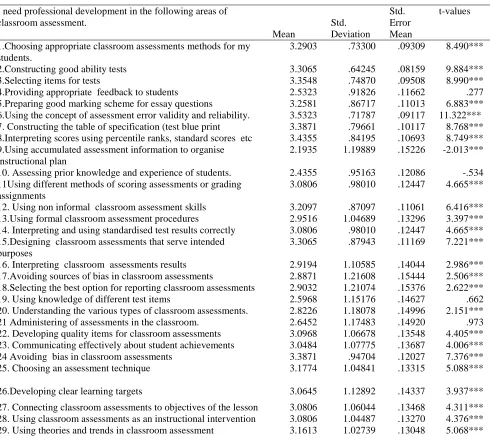
Table 1 summarised the results of the descrptive analysis of teachers‟ responses to the self- perceived professional development needs on classroom assessment skills, with the result of one sample t-test and the level of significance at 0.05 alpha level. The mean values ranges from 2.1935 to 3.5323, these values show junior secondary school teachers agreeing that they need professional development on classroom assessment skills.
(i) What are Botswana secondary school teachers‟ self perceived professional development needs on classroom assessment skills?.
From table 1 above, the teachers‟ self professional development needs were extracted , out of the thirty (30) items on self perceived professional development needs on classroom assessment skills, twenty four (24) items on the questionnaire were
significant since their calculated t-values were greater than the table t-test value of 1.6702 at 0.05 alpha level as shown in table 1 with the t-values ranging from (2.013 to 11.322) and p< 0.05 alpha level. From the responses analysed on teachers‟ self -perceived professional development needs on classroom assessment skills, Botswana junior secondary school teachers perceived that they need professional development on the concepts of classroom assessment skills that were significant (p< 0.05) for effective teaching and learning outcomes. Only four (4) were not significant at 0.05 alpha level, (that is they do not require professional development in the following areas as follows;
Item 4 Provide appropriate feedback to students ( t(61) = .277, p >.05 )
Item 10 Able to assess prior knowledge and experience of students (t(61)=-.534, p>.05) Item 19 Knowledge of different test items.(t
(61)=.662,p>.05)
Item 21 Administering of assessments in the classroom(t(61) =.973,p>.05)
Is there any significant gender difference of Botswana junior secondary school teachers‟ self - perceived professional development needs on classroom assessment skills?
From group statistics analysis for gender on teachers‟ self –perceived professional development needs on classroom assessment skills, it was observed that the mean responses for the male teachers are higher than the mean responses for the female teachers, which indicates that the male teachers need more
professional development on classroom assessment skills in the following areas :
Item 11 Using different methods of scoring assessments or grading assignments (M = 3.59, SD =.57 ) for male group and (M= 2.64, SD= 1.06 ) for female group.
Item 13 Using formal classroom assessment procedures (M = 3.45, SD = .83) for male group and (M= 2.52, SD=1.03 ) for female group
Item 14 Understanding the various types of classroom assessments (M =3.59, SD =.50) for male group and (M= 2.64, SD=1.08 ) for female group.
18 Table 1: Results of responses from teachers to the questionnaire on self perceived professional
development needs on classroom assessments showing the mean, standard deviation and t-test values I need professional development in the following areas of
classroom assessment.
Mean
Std. Deviation
Std. Error Mean
t-values
1.Choosing appropriate classroom assessments methods for my students.
3.2903 .73300 .09309 8.490***
2.Constructing good ability tests 3.3065 .64245 .08159 9.884***
3.Selecting items for tests 3.3548 .74870 .09508 8.990***
4.Providing appropriate feedback to students 2.5323 .91826 .11662 .277
5.Preparing good marking scheme for essay questions 3.2581 .86717 .11013 6.883*** 6.Using the concept of assessment error validity and reliability. 3.5323 .71787 .09117 11.322*** 7. Constructing the table of specification (test blue print 3.3871 .79661 .10117 8.768*** 8.Interpreting scores using percentile ranks, standard scores etc 3.4355 .84195 .10693 8.749*** 9.Using accumulated assessment information to organise
instructional plan
2.1935 1.19889 .15226 -2.013***
10. Assessing prior knowledge and experience of students. 2.4355 .95163 .12086 -.534 11Using different methods of scoring assessments or grading
assignments
3.0806 .98010 .12447 4.665***
12. Using non informal classroom assessment skills 3.2097 .87097 .11061 6.416*** 13.Using formal classroom assessment procedures 2.9516 1.04689 .13296 3.397*** 14. Interpreting and using standardised test results correctly 3.0806 .98010 .12447 4.665*** 15.Designing classroom assessments that serve intended
purposes
3.3065 .87943 .11169 7.221***
16. Interpreting classroom assessments results 2.9194 1.10585 .14044 2.986*** 17.Avoiding sources of bias in classroom assessments 2.8871 1.21608 .15444 2.506*** 18.Selecting the best option for reporting classroom assessments 2.9032 1.21074 .15376 2.622***
19. Using knowledge of different test items 2.5968 1.15176 .14627 .662
20. Understanding the various types of classroom assessments. 2.8226 1.18078 .14996 2.151*** 21 Administering of assessments in the classroom. 2.6452 1.17483 .14920 .973 22. Developing quality items for classroom assessments 3.0968 1.06678 .13548 4.405*** 23. Communicating effectively about student achievements 3.0484 1.07775 .13687 4.006***
24 Avoiding bias in classroom assessments 3.3871 .94704 .12027 7.376***
25. Choosing an assessment technique 3.1774 1.04841 .13315 5.088***
26.Developing clear learning targets 3.0645 1.12892 .14337 3.937***
27. Connecting classroom assessments to objectives of the lesson 3.0806 1.06044 .13468 4.311*** 28. Using classroom assessments as an instructional intervention 3.0806 1.04487 .13270 4.376*** 29. Using theories and trends in classroom assessment 3.1613 1.02739 .13048 5.068*** 30.Using assessment results to make decisions. 3.0323 1.03967 .13204 4.031***
***p<0.05
Item 17 Avoiding sources of bias in classroom assessments (M =3.28, SD =1.13 ) for male group and (M=2.55, SD=1.20 ) for female group.
Item 24 Avoiding bias in classroom assessments (M =3.66, SD =.77 ) for male group and (M= 3.15, SD= 1.03) for female group.
Item 29 Using theories and trends in classroom assessment (M = 3.45, SD =.78 ) for male group and (M= 2.91,SD=1.16 ) for female group.
19 But in the following items 23,25 and 28 on teachers‟
self-perceived professional development needs on classroom assessment skills, the females mean responses are higher than the male mean responses. This indicates that the female teachers need more professional development on these classroom assessment skills than the male teachers.
Item 23 Communicating effectively about student achievements (M = 2.35, SD =.97 ) for male group and (M=3.67 , SD=.74 ) for female group.
Item 25 Choosing an assessment technique (M =2.90 , SD =1.01) for male group and (M= 3.42, SD=1.03 ) for female group.
Item 28 Using classroom assessments as an instructional intervention (M =2.41 , SD =.95) for male group and (M=3.67 , SD= .74 ) for female group.
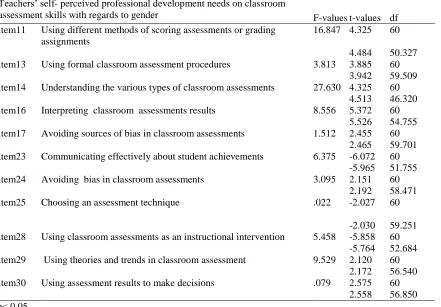
Table 2 summarised the results of the independent sample t-tests on the gender significant difference of Botswana junior secondary school teachers‟ self - perceived professional development needs on classroom assessments skills analysed using independent t-test analysis with their F-values, degrees of freedom and t-test values at 0.05 alpha level. The results revealed statistically significant differences with respect to gender on self-perceived professional development needs of junior secondary school teachers on classroom assessment skills in the following areas as shown in Table-2 with p<0.05.
The analysis and results of this present study is in line with researchers‟ viewpoint that „teachers‟ classroom assessment skills are generally weak‟ (Campbell, Murphy, & Holt, 2002). The findings for this study are very consistent with studies examining teachers‟ assessment practices (Bol et al., 1998). Several researchers like Zhang and Burry-Stock (2003) have also examined classroom assessment practices of teachers and arrived at a conclusion that courses in teacher education programs should be aligned with the skills teachers need for classroom assessment.
Conclusions and Recommendations
Most of the classroom teachers are not competent, efficient and knowledgeable in classroom assessment procedures in order to make correct decisions about students‟ learning outcomes or achievements and also improve on teaching processes in the classroom. Stiggins (2001) was also in agreement when he stated
that he observed unacceptably low levels of assessment literacy among practicing teachers and administrators in schools. He continued by stating that, this assessment il-literacy has resulted in inaccurate assessment of students, causing them to fail to reach their full potential. Stiggins, (1999a) new research on the relationship between classroom assessments and student performance on standardized tests revealed that improving the quality of classroom assessments can increase average scores on large scale assessments as much as 3/4 of a SD (as much as 4 grade equivalents or 15-20 percentile points), representing a huge potential.
Based on the findings of this study, it can be concluded that Botswana junior secondary schools teachers need professional development on classroom assessment skills. There is then an urgent need to expose junior secondary school teachers to assessment skills, techniques required in the classroom for effective teaching and learning. The following are recommended:
That teacher preparatory programmes in Botswana should put more emphasis on exposing pre-service teachers on classroom assessment skills.
Workshops and seminars on effective classroom assessment should be organized for in-service junior secondary school teachers.
There should be monitoring of classroom assessment skills by professionals, experts in educational measurement and assessment in the country.
References
Hea-Jin Lee. (2001). “Enriching the professional development of mathematics teachers”. ERIC DIGEST.
Graham, P. (2005). Classroom‐based assessment: Changing knowledge and practice through pre-service teacher education. Teaching and Teacher Education, Vol.21,pp.607‐21.
20 Table 2: Results of the independent sample t-tests on the gender significant difference of
teachers’ self - perceived professional development needs on classroom assessment skills.
Teachers‟ self- perceived professional development needs on classroom
assessment skills with regards to gender F-values t-values df
item11 Using different methods of scoring assessments or grading assignments
16.847 4.325 60
4.484 50.327 item13 Using formal classroom assessment procedures 3.813 3.885 60
3.942 59.509 item14 Understanding the various types of classroom assessments 27.630 4.325 60
4.513 46.320 item16 Interpreting classroom assessments results 8.556 5.372 60
5.526 54.755 item17 Avoiding sources of bias in classroom assessments 1.512 2.455 60
2.465 59.701 item23 Communicating effectively about student achievements 6.375 -6.072 60
-5.965 51.755
item24 Avoiding bias in classroom assessments 3.095 2.151 60
2.192 58.471
item25 Choosing an assessment technique .022 -2.027 60
-2.030 59.251 item28 Using classroom assessments as an instructional intervention 5.458 -5.858 60
-5.764 52.684 item29 Using theories and trends in classroom assessment 9.529 2.120 60
2.172 56.540 item30 Using assessment results to make decisions .079 2.575 60
2.558 56.850 p< 0.05
Campbell, C., & Evans, J. A. (2000). "Investigation of preservice teachers‟ classroom assessment practices during student teaching" The Journal of Educational Research, Vol.93, No.6,pp.350‐55.
Galluzzo, G. R. (2005). "Performance assessment and renewing teacher education". Clearing House, Vol.78, No.4,pp.142‐45.
La Marca. P. (2006,June). Assessment literacy: Building capacity for improving student learning. Paper presented at the National Conference on Large-Scale Assessment, Council of Chief State SchoolOfficers, San Francisco, CA.
McMillan, J. H. (Ed.). (2007). Formative classroom assessment: Theory into practice. New
York: Teachers College Press.
Gallagher, D., Jo. (1998). Classroom assessment for teachers. Upper Saddle River, NJ: Merrill.
Shepard, L. A. (2000). The role of assessment in a learning culture. Paper presented at the
Annual Meeting of the American Educational
Research Association. Available
http://www.aera.net/meeting/am2000/wrap/praddr01. htm
Black, P., & Wiliam, D. (1998). "Inside the black box: Raising standards through classroom assessment" Phi Delta Kappan, Vol.80, No.2,pp.139-148.
21 Orleans, LA. (ERIC Document Reproduction Service
No. ED298174)
Bol, L., Stephenson, P. L., O’Connell, A. A., & Nunnery, J. A. (1998). "Influence of experience, grade level, and subject area on teachers‟ assessment practices". The Journal of Educational Research, Vol.91, pp.323 – 330.
Gallagher, D., Jo. (1998). Classroom assessment for teachers. Upper Saddle River, NJ: Merrill.
Gronlund, N. E. (1998). Assessment of student achievement (6th ed.). Boston: Pearson.
Gronlund, N. E. (2006). Assessment of student achievement (8th ed.). Boston: Pearson.
Mertler, C. A. (1998, October). Classroom assessment practices of Ohio teachers. Paper
presented at the meeting of the Mid-Western Educational Research Association, Chicago, IL.
Mertler, C. A. (1999, October). Teachers' (Mis)conceptions of classroom test validity and reliability. Paper presented at the meeting of the Mid-Western Educational Research Association, Chicago, IL.
Mertler, C. A. (2003, October). Preservice versus in-service teachers‟ assessment literacy: Does classroom experience make a difference? Paper presented at the meeting of the Mid-Western Educational Research Association, Columbus, OH.
Zhang, Z., & Burry-Stock, J. A. (1994). Assessment Practices Inventory. Tuscaloosa, AL: The University of Alabama.
Campbell, C., Murphy, J. A., & Holt, J. K. (2002, October). Psychometric analysis of anassessment literacy instrument: Applicability to preservice teachers. Paper presented
at the annual meeting of the Mid-Western Educational Research Association,
Columbus, OH.
McMillan, J. H. (2001). "Secondary teachers' classroom assessment and grading practices" Educational Measurement: Issues and Practice, Vol. 20, No.1,pp.20-32.
Mertler, C. A. (1999). "Assessing student performance: A descriptive study of the classroom assessment practices of Ohio teachers". Education, Vol.120, No.2,pp.285-296.
Mertler, C. A. (2000). "Teacher-centered fallacies of classroom assessment validity and reliability" Mid-Western Educational Researcher, Vol.13, No.4,pp. 29-35.
Mertler, C. A. (2003). Classroom assessment: A practical guide for educators. Los Angeles, CA: Pyrczak.
North Central Regional Educational Laboratory. (n.d.). Indicator: Assessment. Retrieved July
24, 2011, from
http://www.ncrel.org/engauge/framewk/pro/literacy/p rolitin.htm
Plake, B. S. (1993). "Teacher assessment literacy: Teachers' competencies in the educational assessment of students" . Mid-Western Educational Researcher, Vol.6, No.1,pp.21-27.
Rogers, W. T. (1991). "Educational assessment in Canada: Evolution or extinction?" The Alberta Journal of Educational Research, Vol.37, No.2,pp. 179-192.
Stiggins, R. J. (1995). "Assessment literacy for the 21st century". Phi Delta Kappan, Vol.77, No.3,pp. 238-245.
Stiggins, R. J. (1999a). "Are you assessment literate?" The High School Journal, Vol.6, No.5,pp. 20-23.
Stiggins, R. J. (1999b). "Evaluating classroom assessment training in teacher education programs". Educational Measurement: Issues and Practice, Vol.18, No.1, pp. 23-27.
Stiggins, R. J. (2001). "The unfulfilled promise of classroom assessment". Educational Measurement: Issues and Practice, Vol.20, No.3, pp.5-15.