IJEDR1904065 International Journal of Engineering Development and Research (www.ijedr.org) 372
IoT Based Real Time Water Quality System
1Nihil R, 2Riya Rajan, 3Rangit Varghese
1PG student, 2Assistant Professor, 3Head of the Deapartment Mount Zion College Of Engineering
_____________________________________________________________________________________________________
Abstract - One of the finite resource as essential to agriculture and industry as well as basic human existence is freshwater.
Water quality monitoring is an important tool in the management of freshwater resources. The traditional method of testing water quality is to assemble samples of water manually and send them to the lab for testing and analyzing. This method is time consuming, wastage of man power, and not economical. The water quality measuring system that we have implemented checks the quality of water in real time through various sensors to measure the quality of water. As a variation in the value of this parameter points towards the presence of pollutants. The Wi-Fi module in the system transfers data collected by the sensors to the microcontroller, and transfers the data to the smart phone/PC. This proposed system keeps a strict check on the pollution of the water resources and be able to ensure an environment for safe drinking water.
keywords - Water quality, PH, Conductivity, Temperature, Turbidity, IOT, Wi-fi (ESP8266).
_____________________________________________________________________________________________________
I.INTRODUCTION
Water is known to be the universal solvent, plays an important role in the survival of various forms of life on earth. Furthermore, quenching our thirst, this transparent chemical substance is used for several other purposes. It is used to fulfill several household tasks. Water is also used for agricultural purpose and industrial use. Only 3% of the world’s water is suitable for drinking and 2% of which is found mainly in glaciers and ice so in reality, only 1%of the earth’s water is accessible and potable!
Historically, the development of civilizations has led to a shift in the pattern of water use from rural/agricultural to urban/industrial, generally according to the following sequence: drinking and personal hygiene, fisheries, navigation and transport, livestock watering and agricultural irrigation, hydroelectric power, industrial production, industrial cooling water, recreational activities and wildlife conservation. Auspiciously, the water uses with the highest demands for quantity often have the lowest demands for quality. By contrast, drinking water requires the highest quality water but in relatively small quantities. With increase in the industrialization and the growth of large urban centers have been accompanied by increases in the pollution stress on the aquatic environment. From ancient times, water in rivers, lakes and oceans has also been considered as a convenient receiver of wastes. This abuse conflicts with almost all other uses of water and most seriously with the use of freshwater for drinking, personal hygiene and food processing.
The breakneck development of the society and legion human activities speeded up the contamination and deteriorated the water resources. Water quality monitoring is essential to identify any changes in water quality parameters from time-to-time to make sure its safety in real time. The Central Pollution Control Board (CPCB) has established a series of monitoring stations on water bodies across the country which monitor the water quality on either monthly or yearly basis[1],[2]. This is done to ensure that the water quality is being maintained or restored at desired level. It is important that it is monitored on regular basis. Water quality monitoring helps in estimating the nature and extent of pollution control required, and suasiveness of pollution control measures. Information we get by checking the quality of water helps us to manage the state's water resources now and into the future.
II.RELATEDWORKS
Water quality monitoring has gained more interest among researchers in this twenty first century. Numerous works are either done or ongoing in this topic focusing various aspects of it. The main theme of all the projects was to develop an efficient, cost effective, real time water quality monitoring system which will integrate wireless sensor network and internet of things.
IJEDR1904065 International Journal of Engineering Development and Research (www.ijedr.org) 373 Water pollution is one of the biggest threats for the green globalization. Water pollution affects human health by causing waterborne diseases. To prevent the water pollution, necessary steps are to be taken. First step is to estimate the water parameters like pH, turbidity, conductivity etc., as the variations in the values of these parameters point towards the presence of pollutants. In the present scenario, water parameters are detected by chemical tester laboratory test, where the testing equipment’s are stationary and samples are provided to testing equipment’s. Thus, it is a manual system with weary process and is very time consuming. In order to minimize the time and to make the system automated, the testing equipment’s can be placed in the river water and detection of pollution can be made remotely. To ensure the safe supply of drinking water, the quality should be monitored in real time for that purpose Arduino based water quality monitoring has been proposed.
III.INTERNETOFTHINGS
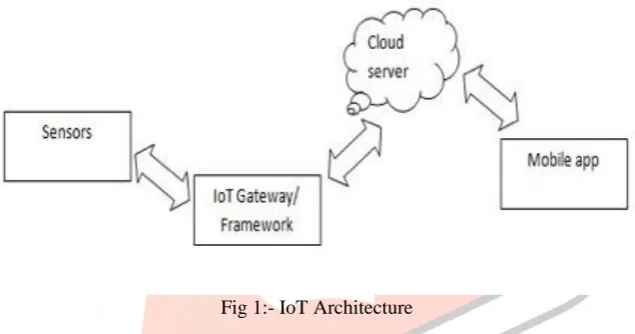
The Internet of Things is a simple stereotype which means taking all the things in the world and connecting them to the internet. It is a giant network of interrelated computing devices, digital and mechanical machines, objects, animals or people which is provided with UIDs and the ability to send data over a network without the help of human or human-to-computer interaction[9]. Figure 1 shows the IoT architecture in a simple form. The IoT can be described as a huge web of embedded objects designed with built-in wireless technologies such that they can be monitored, controlled and linked within the existing Internet infrastructure. Each device has a unique identification and must be able to capture real-time data autonomously. The Fundamental building blocks of IoT consist of sensors, processors, gateways, and applications. By 2020,[10] it is estimated that 50 billion ‘things’ will be connected to the Internet. Wireless technologies such as the Wi-Fi, Bluetooth, ZigBee, RFID, 6LoWPAN (IPv6 Low power Wireless Personal Area Network) allow the device to be connected to the Internet and to each other. The cloud services collect, store and analyze the data collected by the sensors and allow people to take decision accordingly.
Fig 1:- IoT Architecture
Because of the rapid spread of mobile phones, mobile data management applications are being increased. Now Smart phones has become a platform both for computing and communication. Mobile phones are becoming cheaper, easier to use, and can be used for multiple types of information transmission. Along with sensor technology, the mobile data applications can improve the efficiency as well as accuracy of the data reporting for water quality monitoring system. Smart phones/tablets having sensors embedded with display and keypad can be connected to the Internet with an IP address (satisfies every requirement of an IoT device)[11]. They will work as the hub or remote control for IoT. Smart things are part of the Internet; authorized users have access to information; servers act as a sink to collect data from each object in Ubiquitous Network Architecture.
IV.IMPLEMENTATION
This system makes use of many sensors (pH, conductivity, turbidity, temperature, oxidation-reduction potential), processing module microcontroller, These sensors capture the data in the form of analog signals. The ADC converts these signals into the digital format. These digital signals are sent to the microcontroller via a Wi-Fi module. The microcontroller will furtherance the digital information, analyze it, and further communication is done by the Wi-fi module. The Wi-Fi module sends an Information with the water quality parameters onto the smart phone or PC of the concerned user, which also displayed on the LCD of the micro controller. In this water quality monitoring system, microcontroller accepts and processes the data collected from the sensors to the Web. page via Wi-Fi module. This is carried out with the help of coding. The code is written in Embedded-C and using the Arduino software to simulate the code.
IJEDR1904065 International Journal of Engineering Development and Research (www.ijedr.org) 374 \
Fig 2:-Water Quality Monitoring System A.ARDUINOUNO
The Arduino Uno microcontroller is based on real time emulation and embedded trace support. It supports embedded high speed flash memory. It is good to use where size is a key requirement for access control and point-of-sale applications, due to its low power consumption and small size. It is suitable for gateways and protocol converters in communication, soft modem, voice recognition, low resolution imaging, and provides high processing power and large buffer size[12].
B.WI-FIMODULE
The ESP8266 is a low cost Wi-Fi module consists of Wi-Fi chip with full TCP/IP stack and micro controller chip manufactured by M/S Espruino. It is a WLAN network, which hosts the applications or offload Wi-Fi network functions from other application processor. It boots up directly from external flash, during hosting the applications. Because of its integrated cache, performance of the system is improved and memory requirement is also minimized. Using CPU AHB bridge interface or UART interface, wireless Internet access can be introduced to any microcontroller based design when Wi-Fi module works as Wi-Fi adapter.
It uses serial transceiver (Tx/Rx) to send and receive data in Ethernet buffers, and serial commands to query and change configurations of the Fi module[13]. It only requires two wires (Tx/Rx) to communicate between a microcontroller and Wi-Fi module. It offloads Wi-Wi-Fi-related tasks to the module, allowing the microcontroller code to be very light-weighted. Wi-Wi-Fi Module is addressable over SPI and UART, making it easy to build an Internet of Things application. We use AT commands to connect to Wi-Fi networks and open TCP connections without need to have TCP/IP stack running in our own microcontroller. By just directing connecting the microcontroller to this module, we can start pushing data up to the Internet (Central server). C.SENSORS
A transducer device used to detect events or changes in its environment, and then provide a corresponding electrical output is called a sensor. Precision, resolution, linearity, and speed are the most important characteristics of a sensor. Sensor calibration improves the sensor performance. By removing structural errors in the sensor outputs, its performance can be enhanced. Such errors can be find out by taking difference between sensor's measured output and its expected output[14]. Above repeatable errors obtained during calibration are compensated in real time during measurements carried out by sensors.
1. pH Sensor
pH is defined as a measure of how acidic or basic alkaline the water is! It is circumscribed as the negative log of the hydrogen ion concentration. The pH scale is logarithmic and its value goes from 0 to 14, and pH term translates the values of the hydrogen ion concentration. It is low for acidic and high for alkaline solutions. The pH of pure water is around 7. The hydrogen ion concentration decreases ten-fold and water becomes less acidic, for each increase in number of pH. A pH sensor has two electrodes namely; measuring electrode and a reference electrode. The positive terminal of a battery is connected to the measuring electrode and negative terminal to the reference electrode. The reference electrode gives fixed potential and when pH sensor immersed in the solution, the reference electrode does not change with changing hydrogen ion concentration.
2 Conductivity Sensor
IJEDR1904065 International Journal of Engineering Development and Research (www.ijedr.org) 375 current flow through the water is proportional to the concentration of dissolved ions in the water, which measures the electrical conductivity.
3 Turbidity Sensor
Turbidity is defined as the quantitative measure of suspended particles in a fluid. It can be soil in water or chocolate flakes in your favorite milk shake. While chocolate is something we so want in our drinks, soil particles are totally undesired. Keeping aside the potable purposes, there are several industrial and household solutions that make use of water in some or other manner - for example, a power plant needs them to cool the reactors, washing machines and dish washers depend on water.
4 Temperature Sensor
A chip that tells you what the ambient temperature is called an Analog temperature sensor. To determine the temperature, these sensors use a solid-state technique .That’s to mention, they don’t use mercury, bimetallic strips, nor do they use thermistors. Instead, they use the actual fact as temperature will increase; the voltage across a diode will increase at an acknowledged rate. In Technical aspect, this is actually the voltage drop between the base and emitter-the Vbe- of transistor. By amplifying the voltage change, it is simple to generate an analog signal that is directly proportional to temperature. In this, we are using LM35 sensor.
5 ORP Sensor
An Oxidation Reduction Potential Sensor measures the activity of oxidizers and reducers in an aqueous solution. ORP sensor is a potentiometric measurement from a two-electrode system similar to a pH sensor. Sometimes it is also referred to as a redox measurement. An ORP sensor measures the ratio of oxidized to reduced forms of all chemical species in solution, unlike a pH sensor.
6 Salinity Sensor
A Sensor precisely measures the total dissolved salt content in an aqueous solution is the salinity sensor. They measure water with a wide variety of salinities, from brackish water to ocean water, and even hyper-saline environments. The Salinity sensor is capable of measuring the entire range of 24-52,000 ppm (parts per million). One of the most basic tests conducted in solutions is salinity. It determines the total concentration of salts in a sample. In a solution, current flows by ion transport. Increase in the concentration of ions in the solution will result in higher conductivity values. The Salinity sensor contains two carbon electrodes. A potential difference is applied to these electrodes which results in a current proportional to the concentration of the solution.
D.THINGSPEAK
HTTP over Internet. Anyone can create applications like sensor logging, location tracking, and social network of things with status updates with the help of ThingSpeak[15]. It is an public domain IoT application and API to store and retrieve data from things with the help of HTTP and MQTT protocol over the Internet or via a Local Area Network. it enables the creation of sensor logging applications, location tracking applications, and a social network of things with status updates API of ThingSpeak permits processing of numeric data like averaging, median, summing, rounding and time scaling. it supports 8 data fields, elevation, latitude, longitude, and status. they can send sensors data to cloud to store data in a channel using sensors and websites. Cloud provides easy access to the stored data. ThingSpeak channel data can be analyzed, visualized , calculate new data, or interact with web sites and social media. With this one can calculate new data, and visualize data in the form of plots, charts, and gauges using analytical tools online. ThingSpeak can access MATLAB to provide sensor data. It uses instruments for devices to communicate for actions. One can react both to raw data and new data in a channel and also can help devices to execute by queuing the commands.
V.RESULT
Authorized users can access data by logging on ThingSpeak website. On entering the registered user ID and password, it will be directed to the web page where the parameters are displayed in real-time in the form of plots. The credentials of water quality monitoring system can be enhanced to obtain more efficient reliable results. The number of parameters to be sensed can be increased by the addition of multiple sensors to measure dissolved oxygen (DO), chemical oxygen demand (COD), biochemical oxygen demand (BOD), ammonia nitrogen, nitrate, nitrite, phosphate. The system can be further upgraded using wireless sensor networks. The system can be expanded to pay continued attention to hydrologic, air pollution, industrial and agricultural production and so on. It has widespread application and extension value.
VI.CONCLUSION
The Water Quality Monitoring System is a real time system for water quality measurement based on GSM. The system is incredibly versatile and economical. This system that measures numerous parameters pertaining to the water and send them to the monitoring center. It can monitor water quality automatically, and it is low in cost and doesn't need individuals on duty. The system has good flexibility. It is a versatile system, because of which simply by replacing the sensors and by making some changes within the computer code, the system can be used to measure some other parameters of water. The proposed system is reliable , easy to maintain and it can be extended to measure water pollution as well. By effectively using the proposed system, one can save time and cost can also be reduced.
VII. REFERENCES
IJEDR1904065 International Journal of Engineering Development and Research (www.ijedr.org) 376 [3]. Tuan Le Dinh, Wen Hu, PavanSikka, Peter Corke, L. Overs, Stephen Brosman, "Design and Deployment of a Remote Robust Sensor Network: Experiences from Outdoor Water", 32nd IEEE Conf. on Local Computers, pp 799-806, Feb., 2007 [4]. Quio Tie-Zhn, Song Le, "The Design of Multiparameter On line Monitoring System of Water Quality based on GPRS", Report: Advanced Transducers and intelligent Control System Lab, Taiyuan Technical University, Taiyuan, China, 2010 [5]. Steven Silva, Hoang N Ghia Nguyen, Valentina, Tiporlini, Kamal Alameh, "Web based Water Quality Monitoring with Sensor Network: Employing ZigBee and WiMAX Technology", 36th IEEE Conf. on Local Computer Networks, 2011 [6]. Donge He, Li-Xin Zhang, "The Water Quality Monitoring System based on Wireless Sensor Network" Report: Mechanical and Electronic Information Institute, China University of Geo- Science, Wu Hen, China, 2012
[7]. Pavlos Papageorgiou, "Literature Survey on Wireless Sensor Networks", Report: University of Maryland, 16 July 2003 [8]. SatishTurken, Amruta Kulkarni, "Solar Powered Water Quality Monitoring System using Wireless Sensor Network", IEEE Conf. on Automation, Computing, communication, control, and compressed sensing, pp281-285, 2013
[9] Jayti Bhatt, Jignesh Patoliya, Iot Based Water Quality Monitoring System, IRFIC, 21feb,2016.
[10]. Liang Hu, Feng Wang, Jin Zhou and Kuo Zhao "A Survey from the Perspective of Evolutionary Process in the Internet of Things", International Journal of Distributed Sensor Networks, Article ID 462752, 2015
[11] ZulhaniRasin and Mohd Abdullah International Journal Engineering &Technology, "Water Quality Monitoring System Using ZigBee Based Wireless Sensor Network", 2016.
[12]. User Manual Arm7-LPC2148 Development kitPantech Solutions.
[13]. ESP8266 serial Wi-Fi wireless Transceiver Module for IoT, ESPRUINO-Wireless.
[14] Nikhil Kedia, Water Quality Monitoring for Rural Areas- A Sensor Cloud Based Economical Project, in 1st International Conference on Next Generation Computing Technologies (NGCT-2015) Dehradun, India, 4-5 September 2015. 978-1-4673-6809-4/15/$31.00 ©2015 IEEE