Volume 2009, Article ID 785927,15pages doi:10.1155/2009/785927
Research Article
Evaluation of Different Power Saving Techniques for
MBMS Services
Antonios Alexiou,
1, 2Christos Bouras,
1, 2and Vasileios Kokkinos
1, 2 1Research Academic Computer Technology Institute, N. Kazantzaki Street, GR-26500 Patras, Greece 2Computer Engineering and Informatics Department, University of Patras, GR-26500 Patras, GreeceCorrespondence should be addressed to Christos Bouras,[email protected]
Received 6 October 2008; Accepted 26 February 2009
Recommended by Dongmei Zhao
Over the last years we have witnessed an explosive growth of multimedia computing, wireless communication and applications. Following the rapid increase in penetration rate of broadband services, the Third Generation Partnership Project (3GPP) is currently standardizing the Evolved-Multimedia Broadcast/Multicast Service (E-MBMS) framework of Long Term Evolution (LTE), the successor of Universal Mobile Telecommunications System (UMTS). MBMS constitutes a point-to-multipoint downlink bearer service that was designed to significantly decrease the required radio and wired link resources. However, several obstacles regarding the high-power requirements should be overcome for the realization of MBMS. Techniques, such as Macrodiversity
Combining and Rate Splitting, could be utilized to reduce the power requirement of delivering multicast traffic to MBMS users. In
this paper, we analytically present several power saving techniques and analyze their performance in terms of power consumption. We provide simulation results that reveal the amount of power that is saved and reinforce the need for the usage of such techniques.
Copyright © 2009 Antonios Alexiou et al. This is an open access article distributed under the Creative Commons Attribution License, which permits unrestricted use, distribution, and reproduction in any medium, provided the original work is properly cited.
1. Introduction
UMTS is the third Generation (3G) upgrade for the Global System for Mobile communications (GSM) family. Nowa-days, UMTS is the premier 3G wireless technology that is gaining prominence and is dominating the global market. UMTS networks offer high capacity; however, without substantial enhancements, UMTS is very likely to fall victim of its own success. Due to the dramatic increase in the number of users and their demand for more advanced services, the available resources have to be utilized efficiently [1].
The 3GPP realized the need for broadcasting and mul-ticasting in UMTS and proposed some enhancements on the UMTS architecture that led to the definition of the MBMS framework. MBMS is a point-to-multipoint service in which data is transmitted from a single source entity to multiple destinations, allowing the networks resources to be shared. In this way, MBMS increases the efficiency of radio and wired link resources drastically compared to Wideband Code Division Multiple Access (WCDMA) unicast bearers
[2,3]. Higher efficiency supports a greater number of users accessing the network.
Nevertheless, providing multicast or broadcast services to a meaningful proportion of a cell coverage area may require significant amounts of power dedicated to the multicast or broadcast transmission. Therefore, minimizing the required transmission power is one of the challenges in delivering rich media streaming with MBMS. In this paper, we examine the multicast mode of MBMS, and we introduce several techniques that could significantly decrease the Node B’s (Base Station) power consumption. We analyze the performance of each technique, and we present simulation results that demonstrate the amount of power that is saved.
(HS-DSCH). These transport channels have different char-acteristics in terms of power control. Thus, we present an extended analysis of Node B’s power consumption for each channel in order to define the appropriate switching scheme between dedicated (multiple DCHs), common (a single FACH) and shared (a single HS-DSCH) resources during the MBMS multicast transmission. This scheme actually constitutes a contribution to the MBMS Counting Mech-anism [4]. MBMS counting mechanism examines whether it is more economic to transmit the multimedia services in point-to-point (PtP) or point-to-multipoint (PtM) modes. This mechanism evaluates whether it is preferable to use dedicated, common, or shared resources. The criteria for the decision of this switching point should be based on the downlink radio resource efficiency.
This paper is structured as follows. In Section 2 the related work in this research field is presented, while
Section 3 provides an overview of the UMTS and MBMS architecture. Section 4 underlines two of the main prob-lems during an MBMS service and analyzes the proposed techniques to overcome these problems.Section 5presents some important aspects of power control in MBMS and
Section 6analyzes the assumptions of the simulations. The results of the simulations are presented inSection 7. Finally, the planned next steps and the concluding remarks are briefly described in section 8.
2. Related Work
A detailed analysis of techniques such as Selective Combining and Maximum Ratio Combining is presented in [5], where the authors mainly focus on the MBMS Counting Mecha-nism and propose some modifications in order to establish a new criterion decision for shifting from PtP to PtM modes and viceversa. In [6] the authors present an overview of several power saving techniques, such as Dynamic Power Setting, Rate Splitting, and Space Diversity. However, both these works do not take into consideration the HS-DSCH for the transmission of the multicast traffic over the UTRAN interfaces and the selection of the most efficient transport channel for the transmission of the data over the above interfaces.
In addition, several studies and simulations have been carried out focusing on the threshold for switching between dedicated and common resources in terms of transmission power. The 3GPP MBMS Counting Mechanism was the prevailing approach mainly due to its simplicity of imple-mentation and function [4]. According to this mechanism, the decision on the threshold between PtP and PtM bearers is operator dependent, although it is proposed that it should be based on the number of serving MBMS users. In other words, a switch from PtP to PtM resources should occur, when the number of users in a cell exceeds a predefined threshold. In [7], it is claimed that for an FACH with transmission power set to 4 Watts, this threshold is around 7 User Equipments (UEs) per cell, while in [8] the threshold is 5 UEs. However, only the information about the number of users in a cell may not be sufficient so as to select the appropriate radio bearer
(PtP or PtM) for the specific cell. The decision has to take into account the total power required for the transmission of the multicast data in the PtP and PtM cases.
The inefficiencies of the MBMS Counting Mechanism and the power limitations motivated novel approaches, indicating that there is no need for a priori information and predefined switching thresholds, while the assignment of the radio bearer should be performed in order to minimize the Node B’s power requirements [9]. An interesting study under these assumptions is presented in [10], where the authors propose a switching point between PTP and PTM bearers, based on power consumption. Furthermore, in work [11], the authors propose a power control scheme for the efficient radio bearer selection in MBMS. Finally, the authors in [12] present an analysis of the factors that affect the switching point (based on power consumption) between multiple DCHs and FACH in micro, and macrocell environments.
3. Overview of UMTS and MBMS Architecture
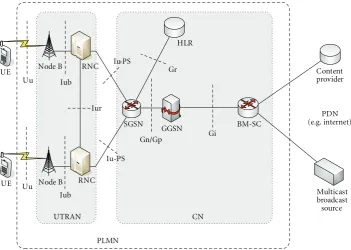
UMTS network is split in two main domains: the User Equipment (UE) domain and the Public Land Mobile Network (PLMN) domain. The UE domain consists of the equipment employed by the user to access the UMTS services. The PLMN domain consists of two land-based infrastructures: the Core Network (CN) and the UTRAN (Figure 1). The CN is responsible for switching/routing voice and data connections, while the UTRAN handles all radio-related functionalities. The CN is logically divided into two service domains: the Circuit-Switched (CS) service domain and the Packet-Switched (PS) service domain [1,13]. The PS portion of the CN in UMTS consists of two kinds of General Packet Radio Service (GPRS) Support Nodes (GSNs), namely Gateway GSN (GGSN) and Serving GSN (SGSN) (Figure 1). SGSN is the centerpiece of the PS domain. It provides routing functionality interacts with databases (like Home Location Register (HLR)) and manages many Radio Network Controllers (RNCs). SGSN is connected to GGSN via the Gn interface and to RNCs via the Iu interface. GGSN provides the interconnection of UMTS network (through the Broadcast Multicast–Service Center or BM-SC) with other Packet Data Networks (PDNs) like the Internet [1].
UTRAN consists of two kinds of nodes: the first is the RNC and the second is the Node B. Node B constitutes the base station and provides radio coverage to one or more cells (Figure 1). Node B is connected to the User Equipment (UE) via the Uu interface (based on the WCDMA technology) and to the RNC via the Iub interface.
PLMN
CN UTRAN
Node B
Gn/Gp
Iub Uu
Uu
HLR
Multicast broadcast source PDN (e.g. internet)
Iu-PS Iu-PS
SGSN
Node B
Iub
GGSN BM-SC Gi
Gr Content
provider
RNC
RNC Iur
UE
UE
Figure1: UMTS and MBMS architecture.
on the provision of streaming MBMS services. The major modification compared to the existing GPRS platform is the addition of a new entity called BM-SC (Figure 1). The BM-SC communicates with the existing UMTS GSM networks and external PDNs [2,14].
Regarding the transmission of the MBMS packets over the Iub and Uu interfaces, it may be performed on common (FACH), on dedicated (DCH), or on shared channels (HS-DSCH). As presented in [3], the transport channel that the 3GPP decided to use as the main transport channel for PtM MBMS data transmission is the FACH with turbo coding and QPSK modulation at a constant transmission power. DCH is a PtP channel, and hence, it suffers from the inefficiencies of requiring multiple DCHs to carry the data to a group of users. However, DCH can employ fast closed-loop power control and soft handover mechanisms and generally is a highly reliable channel [1,15]. The allocation of HS-DSCH as transport channel affects the obtained data rates and the remaining capacity to serve R99 users (users served by DCH). HSDPA cell throughput increases when more HSDPA power is allocated, while DCH throughput simultaneously decreases [16].
3GPP specifications assume that the above mentioned transport channels could be utilized so as to deliver stream-ing MBMS services (like Mobile TV) to mobile users. The broadcast nature of the FACH makes it a strong candidate so as to serve streaming MBMS services. On the other hand, the performance of the available PtP channels for serving such services depends mainly on the number of the users that are served. However, the utilization of these channels could ensure reduced power consumption, especially when the number of serving users is small. This is the main reason
that 3GPP specifications have considered DCH and HS-DSCH for serving streaming MBMS services.
Three new logical channels are considered for PtM transmission of MBMS: MBMS point-to-multipoint Control Channel (MCCH), MBMS point-to-multipoint Scheduling Channel (MSCH), and MBMS point-to-multipoint Traffic Channel (MTCH). These logical channels are mapped on FACH. In case of PtP transmission Dedicated Traffic Channel (DTCH) and Dedicated Control Channel (DCCH) are used and are mapped on the dedicated channel, DCH [4], several enhancements in HSDPA technology allow DTCH and DCCH to be mapped also on the HS-DSCH [16].
4. Problem Statement and Proposed Techniques
In this section, the two main problems during an MBMS session are highlighted, and the proposed techniques to overcome these problems are presented. The analysis that follows will constitute the guide for our assumptions and simulation experiments.
The first problem during an MBMS session, in terms of power consumption, is the exceedingly high fixed power levels when allocating FACH as transport channel. As an example, we mention that in order to provide a 128 kbps MBMS service with an FACH coverage set to the 95% of the cell, 16 Watts of power are required [10]. If we contemplate that the maximum transmission power of the Node B is 20 Watts (which should be shared among all the users of the cell and among all the possible services), it becomes comprehensible that this level of power makes impossible the provision of services with such bit rates. Techniques4.1,4.2,
partly overcome this problem, since they reduce the FACH transmission power levels.
The second problem during an MBMS service (in order to be more precise, this is a general problem and not only in the case of MBMS) is that although each Node B knows exactly the instantaneous transmitted power of each user that it serves, the RNC does not have this information and needs to know what the exact number of PtP connections that are “equivalent” to a single PtM connection is. In other words, the appropriate switching points between multiple DCHs, FACH, and HS-DSCH should be determined with precision. The determination will provide the RNC with the possibility of commanding the Node B to switch between these channels based only on the number of users, with main objective the reduction of the required power. The easiest way to overcome this problem is to use only the FACH for the delivery of the MBMS service (DCHs and HS-DSCH will never be deployed). However, since the Node B will have high losses of power (specifically when the number of users is small), this way is immediately rejected. In other words, the determination of the appropriate switching points seems to be a one way road. The techniques4.4,4.5, and4.6are proposed in order to overcome this problem.
4.1. Dynamic Power Setting. Dynamic Power Setting is the
technique where the transmission power of the FACH can be determined based on the worst user’s path loss. In this way, the FACH transmission power is allocated dynamically; and the FACH transmission power will need to cover the whole cell only if one (or more) user is at the cell boundary. To perform Dynamic Power Setting, the MBMS users need to turn on measurement report mechanism while they are on the Cell FACH state. Based on such measurement reports, the Node B can adjust the transmission power of the FACH [6].
4.2. Usage of Longer TTI and Space Diversity. These two
methods can be employed in the physical layer to benefit every member of the MBMS group in a cell. Space-time processing techniques exploit diversity in both the spatial and temporal domains. On the one hand, an increment in Trans-mission Time Interval (TTI) length (from 20 millisecond to 80 millisecond) can provide significant power gain; however, the use of longer TTI introduces more complexity and larger memory space requirement in the mobile station. On the other hand, space diversity assumes two transmit antennas and a single data stream in order to improve the signal quality and reduce the power requirements. The main benefit of using space-time transmit diversity is a reduction in the downlinkEb/N0requirement. These improvements inEb/N0
requirement impact upon both downlink system capacity and downlink service coverage [17,18].
4.3. Macrodiversity Combining. Diversity is a technique to
combine several copies of the same message received over different channels. Macro Diversity is normally applied as diversity switching where two or more base stations serve the same area, and control over the mobile is switched among
them. Basically, the Diversity Combining concept consists of receiving redundantly the same information bearing signal over two or more fading channels and combines these multiple replicas at the receiver in order to increase the overall received Signal-to-Noise Ratio (SNR). The main idea with regard to Macro Diversity is to decrease the power level from a Node B when it serves users near the cell edge. As the user receives data from two Node Bs, simultaneously the required power of the first Node B is decreased; however, the total required power remains the same, while in some cases, depending on the coverage area, the total required power could be higher [10].
4.4. Rate Splitting. The Rate Splitting technique assumes that
the MBMS data stream is scalable, thus it can be split into several streams with different QoSs. Only the most important stream is sent to all the users in the cell to provide the basic service. The less important streams are sent with less amount of power or coding protection and only the users who have better channel conditions (i.e., the users close to Node B) can receive those to enhance the quality on top of the basic MBMS. In this way, transmission power for the most important MBMS stream can be reduced because the data rate is reduced, and the transmission power for the less important streams can also be reduced because the coverage requirement is relaxed [19].
4.5. Mixed Usage of Multiple DCH Channels and FACH. The
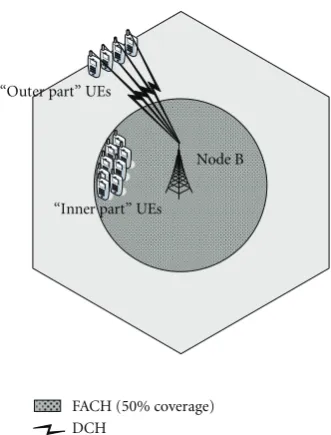
mixed usage of DCHs and FACH can significantly decrease the Node B’s transmission power, depending on the number and the location of the users that receive the MBMS service. In this approach, the FACH channel only covers the inner part of the sector (50% of the sector area) and provides the MBMS service to the users that are found in this part. The rest of the users is served using DCH to cover the remaining outer cell area. The total downlink power consumption including FACH and dedicated channels obviously depends on the number of users who are served by DCHs and their location [20].
4.6. Efficient Channel Selection. We mention this technique
5. Power Planning of MBMS in UTRAN
Power control is one of the most important aspects in MBMS due to the fact that Node B’s transmission power is a limited resource and must be shared among all MBMS users in a cell. Power control is essential in order to minimize the transmitted power, thus avoiding unnecessary high power levels and eliminating intercell interference. The main requirement is to make an efficient overall usage of the radio resources. This makes the common channel, FACH, the favorite choice, since many users can access the same resource at the same time. However, other crucial factors such as the number of users belonging to the multicast group and their distance from the serving Node B, the type of service provided, and the QoS requirements (represented by Eb/N0targets) affect the choice of the most efficient transport
channel in terms of power consumption.
On the PtP downlink transmissions, where multiple DCHs are used, fast power control is used to maintain the quality of the each link and thus to provide a reliable connection for the receiver to obtain the data with acceptable error rates. Transmitting with just enough power to maintain the required quality for the link also ensures that there is minimum interference affecting the neighboring cells. Transmission power allocated for all MBMS users in a cell that are served by multiple DCHs is variable. It mainly depends on the number of UEs, their location in the cell (close to the Node B or at cell edge), the required bit rate of the MBMS session, and the experienced signal quality Eb/N0for each user. Equation (1) calculates the Node B’s total
transmission power required for the transmission of the data tonusers when multiple DCHs are used [22]:
PT=
where PT is the total transmission power for all the DCH
users in the cell,PPis the power devoted to common control
channels, Lb,i refers to the path loss for user i,Rb,i the bit
rate for useri,Wthe bandwidth,PN the background noise, f the orthogonality factor (0: perfect orthogonality) and Eb/N0is the signal energy per bit divided by noise spectral
density. Parameterxiis the intercell interference observed by
user igiven as a function of the transmitted power by the neighboring cellsPT j, j = 1,. . .,K and the path loss from
On the other hand, in PtM downlink transmissions, a single FACH is established and essentially transmits at a fixed power level since fast power control is not supported in this channel. AN FACH common channel must be received by all UEs throughout the cell due to its broadcast nature. Consequently, the fixed power should be high enough to ensure the requested QoS in the whole coverage area of the cell, irrespective of the UEs location. FACH power efficiency depends on maximizing diversity as power resources are
Table1: Indicative FACH Tx power levels.
Cell Coverage % Service Bit Rate(kbps) Required Power(Watt)
50 32 1.8
64 2.5
95 32 4.0
64 7.6
limited. Diversity can be obtained by the use of a longer TTI, for example, 80 millisecond instead of 20 millisecond, to provide time diversity against fast fading (fortunately, MBMS services are not delay sensitive) and the use of combining transmissions from multiple cells to obtain macrodiversity [23]. The bit rate of the MBMS service and the desirable coverage area of the cell are also factors that affect the allocated power for an FACH. The FACH transmission power levels (presented in Table 1) correspond to the case where no Space Time Transmit Diversity (STTD) is assumed. In addition, TTI 80 millisecond and 1% BLER target is assumed [10,18].
Finally, regarding the HS-DSCH, it has to be mentioned that it is rate controlled and not power controlled. There are mainly two different modes for allocating HSDPA transmission power to each Node B. In the first power allocation mode, the controlling RNC explicitly allocates a fixed amount of HSDPA transmission power per cell and may update HSDPA transmission power allocation any time later, while in the second mode the Node B is allowed to use any unused power in the cell (the remaining power after serving other, power controlled channels) for HS-DSCH transmission [16]. Each mode has a different impact on the obtained data rates and on capacity remaining to serve R99 users. As expected, HSDPA cell throughput increases when more HSDPA power is allocated, while DCH throughput simultaneously decreases. In this paper, we assume a fixed power allocation mode. More specifically, 35% of total Node B power is allocated to HSDPA [16]. With the above mentioned portion, MBMS services with higher bit rates can be supported, depending on the number of the users. This occurs because there is a strong relationship between the HS-DSCH-allocated power and the obtained MBMS cell throughput [16]. The target MBMS cell throughput, for instance, if a 64 Kbps MBMS service should be deliv-ered to a multicast group of 10 users, will be equal to 640 Kbps.
6. Topology and Simulation Assumptions
In this section, the topology deployment that was used in our simulation is presented.Figure 2depicts the macrocell environment, which consists of 18 hexagonal grid cells, while the main simulation assumptions are presented in Table 2
[10,18,24].
Table2: Simulation assumptions.
Parameter Value
Cellular layout Hexagonal grid
Number of neighboring cells 18
Sectorization 3 sectors/cell
Site to site distance 1 Km
Cell radius 0,577 Km
Maximum BS Tx power 20 W (43 dBm)
Other BS Tx power 5 W (37 dBm)
Common channel power 1 W (30 dBm)
Propagation model Okumura Hata
Multipath channel Vehicular A (3 km/h)
Orthogonality factor
0.5 (0 : perfect orthogonality)
Eb/N0target 5 dB
HS-DSCH Tx power 7 W
UEs
UEs Node B
Figure2: Macrocell topology.
which, considering a carrier frequency of 2 GHz and a base station antenna height of 15 meters, is transformed to:
L = 128.1 + 37.6 log 10 (R) (3) where R represents the distance between the UE and the Node B in Km [24].
7. Simulation Results
In this section, analytical simulation results, distinctly for each of the aforementioned techniques, are presented. More-over, combinations of these techniques are examined in order to reveal the additional power gain. Transmission power levels when using DCH, FACH, or HS-DSCH channels are depicted in the most of the following figures. The aim for this parallel plotting is to determine the most efficient transport channel (i.e., the appropriate switching points) in terms of power consumption, for the transmission of the MBMS data.
7.1. Dynamic Power Setting. Setting the Node B’s
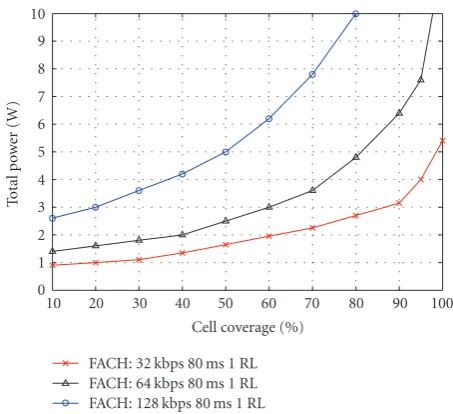
transmis-sion power to a level high enough so as to cover the whole cell is wasteful if not even one MBMS user is close to the cell edge. This is presented inFigure 3, where the Node B sets its transmission power-based on the worst user’s path loss (i.e., distance). The information about the path loss is sent to the Node B via uplink channels.
0 1 2 3 4 5 6 7 8 9 10
To
ta
l
p
o
w
er
(W
)
10 20 30 40 50 60 70 80 90 100
Cell coverage (%) FACH: 32 kbps 80 ms 1 RL FACH: 64 kbps 80 ms 1 RL FACH: 128 kbps 80 ms 1 RL
Figure3: FACH Tx power with Dynamic Power Setting (RL: Radio Link).
Table3: Indicative FACH Tx power levels with Usage of longer TTI and space diversity.
Cell Coverage (%) TTI (millisecond) Required Power (Watt)
50
20-no STTD 3.2
20-with STTD 2.2
80-no STTD 2.5
80-with STTD 1.6
95
20-no STTD 11.8
20-with STTD 7.0
80-no STTD 7.6
80-with STTD 5.4
The examination of Figure 3reveals that 4.0 Watts are required in order to provide a 32 kbps service to the 95% of the cell. However, supposing that all the MBMS users are found near the Node B (10% coverage), only 0.9 Watt are required. In that case, 3.1 Watts (4.0 Watts minus 0.9 Watt) can be saved while delivering a 32 kbps service, as with Dynamic Power Setting the Node B will set its transmission power so as to cover only the 10% of the cell. The corresponding power gain increases to 6.2 Watts for a 64 kbps service and to 13.4 Watts for a 128 kbps service. These high sums of power underline the need for using this technique.
7.2. Usage of Longer TTI and Space Diversity. Fortunately,
some MBMS services are not delay sensitive. In that case, diversity can be obtained by using a longer TTI, for example, 80 millisecond instead of 20 millisecond, so as to provide time diversity against fast fading (Figure 4).
0
Figure 4: FACH Tx power with Usage of longer TTI and Space Diversity (RL: Radio Link)
Table 4: Indicative FACH Tx power levels with macrodiversity combining.
Cell Coverage (%) Radio Links (RL) Required Power (Watt)
50
The above power levels are indicative of the sums of power that can be saved by using a longer TTI and Space Diversity.
7.3. Macro Diversity Combining. Figure 5presents how the FACH transmission power level changes with cell coverage when Macro Diversity Combining is applied. For the needs of the simulation we considered that a 64 kbps service should delivered, using 1, 2, or 3 Node Bs (or radio links). TTI is assumed to be 80 millisecond. As already mentioned the main idea with regard to Macro Diversity is to decrease the power level from a Node B when it serves users near the cell edge. However, as we assume 3 sectors per cell (seeTable 2), this technique can also be used for distances near the Node B, where each sector is considered as one radio link (RL). Succinctly, inTable 4we mention some cases that reveal the power gains with this technique.
As the user receives data from two (or three) Node Bs, simultaneously the required power of each Node B is decreased; however, the total required power remains the same, and sometimes it is higher. Nevertheless, this technique is particularly useful in the case when the power
0
Figure5: FACH Tx power with macrodiversity combining (1RL, 2RLs and 3RLs).
Figure6: MBMS provision with rate splitting.
level of a specific Node B is high, while, respectively, the power level of its neighboring Node B is low.
7.4. Rate Splitting. According to this technique, we consider
that a 64 kbps service can be split in two streams of 32 kbps. The first 32 kbps stream (basic stream of the 64 kbps service) is provided throughout the whole cell, as it is supposed to carry the important information of the MBMS service. On the contrary, the second 32 kbps stream is sent only to the users who are close to the Node B (50% of the cell area) providing the users in the particular region the full 64 kbps service.Figure 6depicts the way this technique functions, in terms of channel selection and cell coverage.
Node B
“Innerpart” UEs “Outerpart” UEs
FACH (50% coverage) DCH
Figure7: . MBMS provision with Mixed DCHs and FACH.
Watts. Thus, 1.8 Watt can be saved through the Rate Splitting technique. However, it is worth mentioning that this power gain involves certain negative results. Some of the users will not be fully satisfied, as they will only receive the 32 kbps of the 64 kbps service, even if these 32 kbps have the important information. As the observed difference will be small, the Node B should weigh between the transmission power and the users’ requirements.
7.5. Mixed Usage of Multiple DCH Channels and FACH. Figure 7represents the way of providing a 64 kbps service in the Mixed Usage of Multiple DCH channels and FACH case. According toFigure 7, FACH channel covers the inner part (50%) of the sector and provides the 64 kbps service to the users that are found in this part (called “inner part” users from now on). The users that reside at the outer part (called “outer part” users from now on) are served using DCH.
The main goal is to examine how the transmission power is affected by the number of users. To this direction
Figure 8represents the Node B’s total transmission power as a function of the number of the “outer part” users. The total power inFigure 8includes the power that is required in order to cover the 50% of the cell with FACH (i.e., 2.5 Watts). The number of the “inner part” users is assumed to be greater than 17, so as to justify the choice of FACH as the transport channel in the inner part (seeSection 7.6for 50% coverage).
Figure 8also depicts the power levels that are required in order to deliver a 64 kbps service using FACH and HS-DSCH with 95% coverage. This addition aims at the determination of the appropriate switching point between multiple DCHs and FACH or between multiple DCHs and HS-DSCH. When the “outer part” users are more than six (or seven), the total power, that is, the power to cover the inner part with FACH plus the power to cover the outer part with DCHs, exceeds the power that is required in order to cover the whole cell with FACH (or with HS-DSCH, resp.). Thereby, it is more
3 4 5 6 7 8 9 10 11 12
To
ta
l
p
o
w
er
(W
)
0 2 4 6 8 10 12
Number of “outer part” UEs DCHs: 64 kbps 80 ms 1 RL 95% coverage FACH: 64 kbps 80 ms 1 RL 95%coverage HS-DSCH: 80 ms 1 RL 95% coverage
Figure8: Node B’s Tx power with Mixed Usage of Multiple DCH channels and FACH.
“power efficient” to use an FACH (or an HS-DSCH) with 95% coverage. Thus, the appropriate switching point, which is independent of the number of “inner part” users, is 7 “outer part” UEs (or 6 “outer part” UEs for the HS-DSCH). At this point it is worth mentioning that this switching point refers to the worst case, where all the “outer part” users are found at the cell edge. There would be an increase in the switching point if the distance of the “outer part” users from the Node B decreased.
Apart from the power gain, this technique has one more advantage which does not become immediately perceptible. This advantage has to do with the fact that DCHs can support soft handover, while FACH and HS-DSCH cannot. Since with this technique the users that are found near the cell edge are served with DCHs, their transition to another cell will be much smoother, as the service will be provided uninterruptedly.
7.6. Efficient Channel Selection. As there are many factors
that affect the Node B’s transmission power levels during an MBMS session, it should be mentioned that the figures in this paragraph correspond to the simulation assumptions presented in Table 2. Consequently, two different cases are examined, depending on the region that is desired to be covered. In the first case the region is the 50% of the cell (Figure 9), while in second the 95% of the cell (Figure 10). Each figure presents the power required for the transmission of an MBMS service (32 or 64 kbps) as a function of the number of users, in the cases when DCH, FACH, or HS-DSCH channels are used.
1 Figure9: Node B’s Tx power for 50% coverage.
0 Figure10: Node B’s Tx power for 95% coverage.
gain reaches 2.7 Watts (or 5.7 Watts compared to HS-DSCH) for a 32 kbps service and 6.0 Watts (or 5.4 Watts compared to HS-DSCH) for a 64 kbps service. The power savings decrease as the number of users increases, in both figures, while from a number of users and above a switch from DCHs to FACH (or from DCHs to HS-DSCH) should take place.
As these figures present, when DCHs are used as transport channel, the starting value of the total power is 1 Watt [22]. This is the power devoted to common control channels (termPp in (1)) that is added for the calculation
of the power when DCHs are used. According to (1), this constant term is only added once, regardless of the UEs’ number and their location.
Indicative switching points between DCHs and FACH or between DCHs and HS-DSCH are demonstrated inTable 5:
Table5: Indicative switching points.
Cell
Above these numbers of UEs, FACH or HS-DSCH are the most appropriate channels for the transmission of the multicast data in terms of power consumption. This is the only information that the RNC needs in order to command the Node B to change the transport channel. Many more cases could be distinguished, since there are many factors that influence the transmission power. However, the above two figures are representative of how this technique can considerably decrease the Node B’s transmission power.
7.7. Combination of Techniques 4.1, 4.2, and 4.3. In this
section we present the simulation results in terms of power consumption, regarding the combination of the techniques:
(i) dynamic Power Setting (4.1),
(ii) usage of longer TTI and Space Diversity (4.2), and (iii) macro Diversity Combining (4.3).
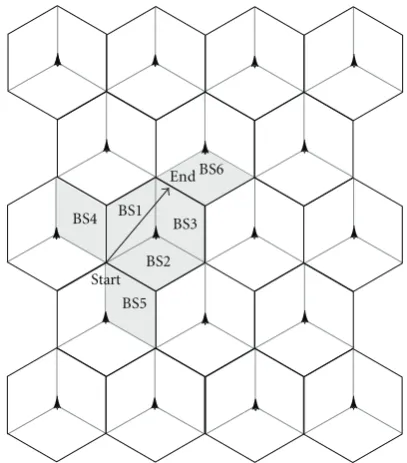
A real-world scenario which simulates the movement of a UE while receiving a 64 kbps MBMS service is examined. The route of the moving UE is depicted inFigure 11. According to the scenario, we assume a moving UE that, at simulation time 0 second begins moving from the Start point toward the End point as shown inFigure 11. The simulation lasts for 1220 seconds. During its route, the moving UE enters and leaves successively the coverage area of two different sectors’ areas, served by base stations BS1 and BS3. However, as we assume that the Macro Diversity Combining technique (technique
4.3) is applied, the moving UE is served by 6 different sectors in total (BS1 to BS6 inFigure 11).
Main objective of this scenario is to demonstrate the sums of power which could be saved via the combination of techniques4.1,4.2, and4.3. As already mentioned, these techniques could be applied to efficiently reduce the FACH transmission power requirements. For simplicity reasons, we assume that the moving UE is served only by FACH during its route. In other words, each “active” sector detects the distance of the UE and adjusts its power so as to provide the UE with the MBMS service through the FACH (Dynamic Power Setting or4.1technique). It is also worth mentioning that the TTI is assumed to be 80 millisecond throughout the whole simulation (i.e., the gain through the longer TTI technique (4.2) has been merged).
represents the total, cumulative required power of the base stations in order to serve the moving UE. Finally, for comparison reasons, the fixed transmission power of the FACH in the “static power setting” case has been added with dashed line in the graphics of BS1 and BS3 that would have served the moving UE during its route if the techniques were not applied, and in the graphic of the total power (bottom graphic inFigure 12). According to the static power setting case, only one sector serves the user at each time instant, using an FACH with such power so as to cover the 95% of its area (i.e., 7.6 Watts for a 64 kbps service, 80 millisecond TTI). More specifically, fromFigure 12 we observe that in the static power setting case (without the combination of the techniques), BS1 would have served the moving UE from the beginning of the simulation until the simulation time 963 seconds (requiring 7.6 Watts), while for the time interval 963 seconds until the end of the simulation, the moving UE remains at the area that is covered by BS3 and is served by this base station.
Even a quick look in the graphic of BS1 (first graphic in
Figure 12) reveals that when the UE remains at the coverage area of the specific sector (i.e., for the time interval 0 to 963 seconds), the power that is required with the combination never exceeds the power that is required with the static power setting. Even in the cases where the moving UE is found at the cell edge (start point) the power that is required from this sector is much smaller than the power that is required with the static power setting. This occurs because at the cell edge (and at the sector edge where the moving UE approaches the coverage area of BS3) Macro Diversity Combining is applied, that is, the mobile user receives the MBMS data from two or three sectors simultaneously.
Furthermore, according toFigure 12at time period from 160 to 829 seconds the moving UE is served only by BS1. Even in this case, power is saved because BS1 adjusts its power-based on the distance of the moving UE (Dynamic Power Setting). This makes more sense after looking at
Figure 11(shortly after the Start point until shortly before it enters the coverage area of BS3). During this period, BS1 does not have to cover its entire area, as the moving UE is never found at the area edge. Consequently, the closer the moving UE is from BS1, the smaller the required power is, or better, the higher the power gain is. Similar results can be extracted from the graphic of BS3 for the time interval 963 seconds until the end of the simulation, when the UE remains at the coverage area of BS3. During this time interval, the combination of Dynamic Power Setting and Macro Diversity Combining ensures reduced power consumption for BS3.
Nevertheless, as already mentioned in Sections4.3and
7.3, the utilization of Macro Diversity Combining does not ensure the lowest total power consumption. Indeed, the bottom graphic of Figure 12 reveals that the cumulative required power of the sectors that serve the moving UE may be higher than the total power that is required with the static power setting case. Therefore, the Macro Diversity Combining should be applied when the power levels of the sectors BS1 and BS3 are high, while, respectively, the power levels of their neighboring Node Bs are low.
BS4
BS5 BS1
BS3
BS2 BS6
Start
End
Figure11: Route of the moving UE according to the scenario.
At this point, we have to mention that regarding the Macro Diversity Combining, the RNC has the responsibility for applying this technique or not. Let us explain this statement through an additional scenario in Figure 11. According to the scenario, BS4 has to provide a 64 kbps service to 25 MBMS users that are located at 50% of its coverage area, requiring 2.5 Watts with an FACH. Moreover, BS1 has to provide the same MBMS service to 15 users at the borders of BS1 and BS4, requiring 7.6 Watts with an FACH. In this case, BS4 may increase its transmission power from 2.5 Watts to 4 Watts, so as in combination with BS1 (with transmission power 4 Watts and not 7.6 Watts) to serve the MBMS users that are found in the borders of BS1 and BS4 (Macro Diversity Combining). Therefore, on one hand, BS4 (with 4 Watts transmission power) will serve the 25 users that are located at 50% of its coverage area (since the FACH transmission power will be higher than the required 2.5 Watts), while on the other hand BS4 will improve the signal quality of the users that are served by BS1, so that they receive satisfactorily the MBMS service. As already mentioned, RNC is the responsible node for applying the Macro Diversity Combining technique or not. The RNC is aware of the users’ distribution throughout the topology and of the transmission power of each sector. Consequently, if RNC observes that sector BS4 can allocate the additional 1.5 Watts, then the RNC will command BS4 to increase its transmission power and simultaneously command BS1 to decrease its transmission power, so as to serve all the 40 users (via the Macro Diversity Combining technique).
0
0 200 400 600 800 1000 1200
Time (s)
BS1: FACH Tx power with combination
(a)
0 200 400 600 800 1000 1200
Time (s)
BS2: FACH Tx power with combination
(b)
0 200 400 600 800 1000 1200
Time (s)
BS3: FACH Tx power with combination
(c)
0 200 400 600 800 1000 1200
Time (s)
BS4: FACH Tx power with combination
(d)
0 200 400 600 800 1000 1200
Time (s)
BS5: FACH Tx power with combination
(e)
0 200 400 600 800 1000 1200
Time (s)
BS6: FACH Tx power with combination
(f)
0 200 400 600 800 1000 1200
Time (s)
Total FACH Tx power with combination
(g)
Figure12: FACH Tx power with combination of techniques4.1,4.2and4.3
7.8. Combination of Techniques4.4,4.5, and4.6. The
com-bination of techniques presents special interest as additional power gain can be saved. In order to reveal this additional power gain, one more scenario will be examined, in which it is more efficient to use the combination of the following techniques:
(i) rate Splitting (4.4),
(ii) mixed Usage of Multiple DCH channels and FACH (4.5), and
(iii) efficient Channel Selection (4.6).
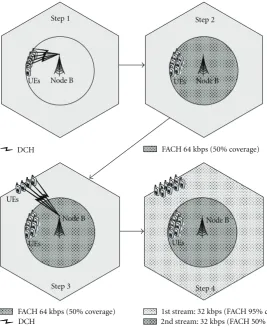
This scenario examines which is the most efficient channel (or channel combination) for the transmission of a 64 kbps MBMS service, as more and more users in the cell request the service.Figure 13presents the way that the users appear, according to the scenario and the most efficient channel in each step. AsFigure 13depicts, the first group of users that require the MBMS service is found at a distance equal to half of the cell radius (Steps 1 and 2). The number of users in this group increases from 1 to 26. When the number of the “first group users” becomes 26, users begin to appear
at the cell edge (Steps 3 and 4 inFigure 13). Thus, the 27th user is the first user presented at the cell edge. The number of users in the second group is increasing, while the number of the “first group users” is kept constant. The scenario is completed when the total number of users reaches 40 (26 UEs in the first group and 14 UEs in the second group).
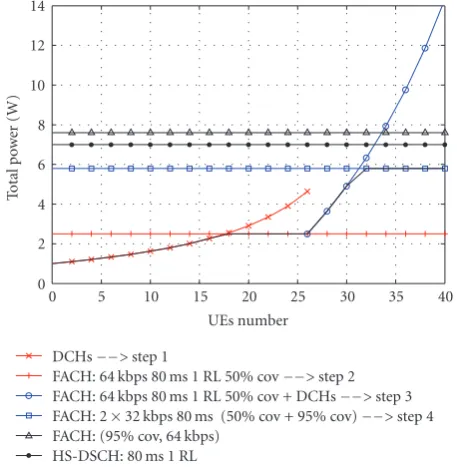
The results of the simulation are presented inFigure 14. The bold line presents the Node B’s total transmission power while combining the three techniques. In Figure 14, the action of Efficient Channel Selection technique is appeared for number of users up to 17, the action of Mixed Usage of Multiple DCH channels and FACH technique for 18 up to 31 users, while the action of Rate Splitting technique for 32 users and above. The results can be distinguished in three categories. The power gain when using the combination is compared to the gain when using
(i) the static power setting technique, (ii) only Rate Splitting technique,
Node B
UEs UEs Node B
Node B
UEs UEs
DCH
Node B
UEs Step 1
Step 3 Step 4 Step 2
DCH
FACH 64 kbps (50% coverage)
FACH 64 kbps (50% coverage)
1st stream: 32 kbps (FACH 95% coverage) 2nd stream: 32 kbps (FACH 50% coverage)
Figure13: Scenario steps.
As already mentioned in the previous section, when static power setting is used, an FACH with fixed power level should be used in order to serve the whole cell. This fixed power level appears inFigure 14with the legend: FACH(95%Cov, 64kbps). With the combination of techniques, the required power (bold line) never reaches this power level, as presented inFigure 14. The power gain reaches 6.6 Watts for the case of one user and 1.8 Watt when the number of users forces the Node B to transmit at the power level that is required for the Rate Splitting technique (for more than 31 users). Consequently, about 9% to 33% of maximum Node B’s transmission power can be saved, leaving this power for other applications (e.g. voice calls, web browsing, etc.).
The importance of the combination compared to the case of using only the Rate Splitting technique appears in Figure 14 for UEs’ number up to 31 (this number may changes depending on the scenario or more precisely depending on number of users that are served by the FACH with 50% coverage). As the power that is required for Rate Splitting technique is constant (Section 7.4), the power gain with the combination can reach 4.8 Watts (24% of maximum Node B’s transmission power).
Finally, the combination can produce power gain com-pared to the case of using only the Mixed Usage of Multiple DCH channels and FACH technique. In our scenario this
gain is presented for UE population smaller than 17. Substantially, this is the switching point between DCHs and FACH when 50% coverage is required (seeFigure 9). Up to 1.4 Watt (or 7% of maximum Node B’s transmission power) can be saved through the combination.
Summarizing, the usage of the combination in the particular scenario is the optimal solution. According to
Figure 14, for any UE population the required Node B’s power is decreased compared to the case when static power setting or only one of the technique was used. There are many other scenarios that can verify that the usage of combination outperforms compared to the usage of each technique separately.
7.9. Determination of Switching Points and Most Efficient
Techniques. Up to this point, we have studied all the
0 FACH: (95% cov, 64 kbps)
HS-DSCH: 80 ms 1 RL Node B’s Tx power
Figure14: Node B’s Tx power with combination of techniques4.4,
4.5, and4.6.
FACH per user throughput (Tx power: 7.6 W) HS-DSCH per user throughput (Tx power: 7 W)
Figure15: HS-DSCH versus FACH.
of “inner part” users as the main parameter. We will define which is the most efficient technique (depending on the number of the “outer part” users), while the number of “inner part” users changes.
In order to determine the switching point scheme with accuracy, one final issue should be solved. From Table 1,
Table 2,Figure 8,Figure 10andFigure 14, it can be noticed that the fixed transmission power of the FACH is higher than the transmission power of HS-DSCH. This remark arise a reasonable question. What is the point in using the FACH to deliver the multicast data if HS-DSCH is more “power efficient”?
As the HS-DSCH is not power controlled but rate controlled the best way to answer this question, would be by examining the “per user throughput” of each channel, while their fixed power remain in relatively similar levels. InFigure 15the transmission power for FACH is set to 7.6 Watts and for HS-DSCH to 7 Watts. By allocating 7.6 Watts of the Node B’s power to an FACH, a 64 kbps service can be supported regardless of the UEs’ number and position (for a 128 kbps service 16 Watts should be allocated). At this point, it should be mentioned that without any power saving techniques FACH can only support services with bit rates up to 128 kbps. More advanced solutions are needed for higher bite rates such as 256 kbps [10]. On the other hand, by allocating 7 Watts to HS-DSCH, depending on the number of UEs, MBMS services with various bit rates can be supported. For a 64 kbps service about 35 users can receive the MBMS service (Figure 15). If the number of the users that desire the service increases, the rest of them will be kept unsatisfied.
Figure 15indicates that for a small number of UEs the HS-DSCH outperforms compared to the FACH. Although their fixed power remains in a relatively similar level, the first can support services with higher bit rates (depending on the number of UEs). However, for large UEs population, FACH is the most appropriate channel for the transmission of the multicast data, as it can support all the UEs, leaving none of them unsatisfied. In other words, the Node B should weigh the allocated power and the per user throughput so as to decide which is the most appropriate channel for the delivery of the MBMS data.
After taking into consideration the previous analysis
Table 6can be extracted. The number of “inner part” users and the switching points (or the number of “outer part” users) that are presented inTable 6refer to the worst case, where the “outer part” users are found at the cell edge and “inner part” users at the half distance. Having covered the worst case, it is obvious that any other cases are covered having small losses of power. This is a convention that should be made in order to keep the scheme in accordance with the 3GPP specifications. 3GPP MBMS Counting Mechanism constitutes an easy-to-implement and predefined scheme that switches between the available transport channels, based on the number of serving MBMS users (the switching thresholds in MBMS Count Mechanism are also based on the worst case scenario). Table 6 constitutes an alterna-tive/enhanced approach of the MBMS Counting Mechanism that incorporates several power saving techniques, while simultaneously it is easy to implement, stable, and offer a predefined switching threshold scheme.
8. Conclusions and Future Work
Table 6: Switching points and most efficient techniques as a function of the “inner part” users.
“Inner Part” “Outer Part” Efficient Channel
Users Users or Technique
the most annoying problems during an MBMS service– the exceedingly high fixed power levels when allocating FACH as transport channel for the delivery of the MBMS service and the definition of the appropriate switching points between the available transport channels–and we mentioned several techniques that could be used in order to overcome these problems. These techniques that could substantially decrease the Node B’s transmission power were investigated thoroughly, and the power gain that each technique has was determined. Moreover, we examined two scenarios where different techniques were combined. These scenarios revealed the additional power gain that could be saved through the combination and led to the determination of the appropriate switching points between DCHs, FACH, and HS-DSCH.
Having examined all these techniques, an ambitious future step will be the determination of the most suit-able technique, or the most suitsuit-able combination for the transmission of an MBMS service. For the determination of the most appropriate scheme many more experiments and research should take place. Further examination of the impact that HS-DSCH has on the total transmission power of the multicast mode of MBMS is also of high importance, as HSDPA is a key technology for MBMS that improves the MBMS performance and increases bit rate speeds in order to support new MBMS services [25].
References
[1] H. Holma and A. Toskala,WCDMA for UMTS: Radio Access for
Third Generation Mobile Communications, John Wiley & Sons, New York, NY, USA, 2004.
[2] 3GPP and Technical Specification Group Services and System Aspects, “Multimedia Broadcast/Multicast Service; stage 1 (release 7),” Tech. Rep. TS 22.146 v7.1.0, 3GPP, Cedex, France, 2006.
[3] 3GPP and Technical Specification Group Services and System Aspects, “Multimedia Broadcast/Multicast Service (MBMS); architecture and functional description (release 6),” Tech. Rep. TR 23.846 v6.1.0, 3GPP, Cedex, France, 2002.
[4] 3GPP and Technical Specification Group Radio Access Net-work, “Introduction of the Multimedia Broadcast Multicast Service (MBMS) in the Radio Access Network (RAN); stage 2
(release 7),” Tech. Rep. TS 25.346 v7.1.0, 3GPP, Cedex, France, 2006.
[5] A. Soares and A. Correia, “Transmission power saving meth-ods for multimedia broadcast/multicast services in UMTS
networks,” inProceedings of the 6th IEE International
Con-ference on 3G and Beyond (3G ’05), pp. 67–71, London, UK, November 2005.
[6] M. Chuah, T. Hu, and W. Luo, “UMTS Release 99/4 airlink
enhancement for supporting MBMS services,” inProceedings
of IEEE International Conference on Communications (ICC
’04), vol. 6, pp. 3231–3235, Paris, France, June 2004.
[7] IST-2001-35125 (OverDRiVE), Deliverable of the project
(D08), “Spectrum efficient multicast and asymmetric services
in UMTS”.
[8] J. De Vriendt, I. Gomez Vinagre, and A. Van Ewijk, “Multime-dia broadcast and multicast services in 3G mobile networks,”
Alcatel Telecommunications Review, no. 4-1, pp. 17–24, 2003-2004.
[9] 3GPP and Technical Specification Group Radio Access Net-work, “Radio resource management strategies (release 7),” Tech. Rep. TR 25.922 v7.1.0, 3GPP, Cedex, France, 2007. [10] IST-2003-507607 (B-BONE), Deliverable of the project
(D2.5), “Final Results with combined enhancements of the Air Interface”.
[11] A. Alexiou, C. Bouras, and E. Rekkas, “A power control scheme
for efficient radio bearer selection in MBMS,” inProceedings of
IEEE International Symposium on a World of Wireless, Mobile and Multimedia Networks (WOWMOM ’07), pp. 1–8, Espoo, Finland, June 2007.
[12] A. Alexiou, C. Bouras, V. Kokkinos, and E. Rekkas, “MBMS power planning in macro and micro cell environments,” in
Proceedings of the 12th IEEE Symposium on Computers and Communications (ISCC ’07), pp. 33–38, Aveiro, Portugal, July 2007.
[13] 3GPP and Technical Specification Group Services and System Aspects, “General Packet Radio Service (GPRS); service description; stage 2 (release 7),” Tech. Rep. TS 23.060 v7.0.0, 3GPP, Cedex, France, 2006.
[14] 3GPP and Technical Specification Group Services and System Aspects, “Multimedia Broadcast/Multicast Service (MBMS); architecture and functional description (release 6),” Tech. Rep. TS 23.246 v6.9.0, 3GPP, Cedex, France, 2005.
[15] A. Boni, E. Launay, T. Mienville, and P. Stuckmann, “Multi-media broadcast multicast service—technology overview and
service aspects,” in Proceedings of the 5th IEE International
Conference on 3G Mobile Communication Technologies (3G
’04), pp. 634–638, London, UK, October 2004.
[16] H. Holma and A. Toskala,HSDPA/HSUPA for UMTS: High
Speed Radio Access for Mobile Communications, John Wiley & Sons, New York, NY, USA, 2006.
[17] 3GPP TSG-RAN WG1#28, “Evaluation of combining gains for MBMS (incl. STTD),” Qualcomm R1-021234, 3GPP, Cedex, France, 2002.
[18] 3GPP and Technical Specification Group Radio Access Net-work, “S-CCPCH performance for MBMS, (release 6),” Tech. Rep. TS 25.803 v6.0.0, 3GPP, Cedex, France, 2005.
[19] 3GPP TSG-RAN WG1#28, “MBMS power usage,” Lucent Technologies R1-021239, 3GPP, Cedex, France, 2002. [20] 3GPP TSG-RAN WG1#28, “Power usage for mixed FACH
and DCH for MBMS,” Lucent Technologies R1-021240, 3GPP, Cedex, France, 2002.
[21] A. Alexiou, C. Bouras, V. Kokkinos, and E. Rekkas, “Power
efficient radio bearer selection in MBMS multicast mode,” in
and Simulation of Wireless and Mobile Systems (MSWiM ’07), pp. 261–268, Crete Island, Greece, October 2007.
[22] J. Romero, O. Sallent, R. Agusti, and M. Diaz-Guerra,Radio
Resource Management Strategies in UMTS, John Wiley & Sons, New York, NY, USA, 2005.
[23] S. Parkvall, E. Englund, M. Lundevall, and J. Torsner, “Evolv-ing 3G mobile systems: broadband and broadcast services in
WCDMA,”IEEE Communications Magazine, vol. 44, no. 2, pp.
30–36, 2006.
[24] 3GPP and Universal Mobile Telecommunications System (UMTS), “Selection procedures for the choice of radio transmission technologies of the UMTS (UMTS 30.03 version 3.2.0),” Tech. Rep. TR 101.102 v3.2.0, 3GPP, Cedex, France, 1998.
[25] 3G/UMTS, “Evolution: towards a new generation of broad-band mobile services,” UMTS Forum, white paper, December