4779
Exploring the Impact of Absorptive Capacity on
Technology Transfer Effectiveness: A
Conceptual Framework
Aamer Hafeez, Alina Binti Shamsuddin, Bilal Saeed, Ayyaz Mehmood, Naima Andleeb
Abstract: In competitive business environment, organizations try to continuously improve their products, services and performance through effective technology transfer to attain a better market position. However, as technology is advancing rapidly, technical information and skill is improving aggressively and accordingly the product life cycle is being shortened. Innovation in technical aspects is becoming extremely important so to have leading position in the market and can earn more revenue in return. In order to advance in technical innovation, organizations have to develop and increase their absorptive capacity to utilize external technology, skills and knowledge in an effective way. Effective technology transfer provides the opportunity to access and acquire technology which can be used for economic growth of less developed countries. The purpose of this study is to propose a conceptual framework after systematic review of literature on the term Technology Transfer Effectiveness. Reviewing grounding theory of Organizational Learning, Technology Transfer models and factors influencing Technology Transfer Effectiveness from literature, two influencing v ariables Absorptive capacity (ACAP) and Organizational innovation (OI) which affect Technology Transfer Effectiveness (TTE) have been selected. This paper will explore the impact of identified variable ACAP on TTE and further validate the role of OI as mediator in Service Industry. This study explores the factors of Absorptive Capacity (ACAP) into Acquisition, Exploitation, Assimilation and Transformation and (TTE) Technology Transfer Effectiveness with Product and Process Performance, Human Recourse Capability and Business Performance. An empirical analysis will be performed to measure the impact of these four factors of Absorptive Capacity on three factors of Technology Transfer Effectiveness through Organizational Innovation. Finally, this paper finalized a conceptual model after exploring previous studies and propose an empirical investigation for validation in future for researchers and practitioners.
Index Terms: Technology Transfer Effectiveness, Technology Transfer, Absorptive Capacity, ACAP, Organizational Innovation, OI, TTE
—————————— ——————————
1. INTRODUCTION
We are living in the brink of Fourth Industrial Revolution. This revolution is going to bring a complex and whole sale transformation in the industry [1]. Industrial transformations are in continuation to the previous Industrial trends and systems and it will leverage the existing third digital revolution [2]. In such scenarios, organizations of a country must be fully functional and in line with the market trends and needs. Some of the main contributors in the operational success of an organization are effective acquisition and utilization of new technologies and trends from outside sources [3].
To have a reasonable market share, it is mandatory for the organizations to have state of the art new products and in this respect, organizations constantly stay well-informed with the rapidly changing technological environment. There can be two strategies, either to develop new technology internally with new innovations or to implement new manufacturing techniques through acquired technology from external sources. However , the added advantage in the second method is that it is not time taking [4].
Salem (2016), in his work concluded that forging direct investment and technology transfer from other developed countries are crucial for the developing countries to progress and critical for their economic growth [6]. However according to Estep (2017), transfer of Technology can only be declared successful if the host country can utilize the transferred technology effectively and eventually integrate it. Transfer of Technology is not only the transfer of equipment or physical goods but it also involves transfer of expertise and technical information [7]. Owusu-Manu, Pärn, Antwi-Afari, & Edwards (2017) concluded that in developing countries effective technology transfer is vital for the social infrastructure and economic progress [8]. As transfer of Technology has always been remained in the roadmap of developing countries across the world and in existing literature on effective technology transfer employment and usage is also under discussion. However, technology transfer effectiveness (TTE) can be measured is a little discussed topic in literature [9].Various researchers in previous literature have explored multiple factors that significantly influence Technology Transfer Effectiveness. However, some researches have also been conducted to measure the impact of absorptive capacity of organizations on the effectiveness of Technology Transfer. Absorptive capacity is defined as the ability of an organization to recognize the worth of new external knowledge, assimilate and implement it commercially. Absorptive Capacity is mandatory for the organizations to have innovative capabilities for new trends and techniques [10]. Firms have to cultivate absorptive capabilities so that they can exploit external knowledge for innovation and organizational change. Therefore, focusing on organizational structure as basis of absorptive capacity, organizations can attain higher absorptive capacity. However, it has been found that due to higher Organizational Innovation, some organizations have greater absorptive capacity and they are capable to absorb new external information than others [11].Ali, Seny Kan, & Sarstedt
————————————————
Aamer Hafeez. Faculty of Technology Management and Business, Universiti Tun Hussein Onn Malaysia, Parit Raja, Batu Phat, Johar, Malaysia. E-mail: [email protected]
Alina Binti Shamsuddin. Faculty of Technology Management and Business, Universiti Tun Hussein Onn Malaysia, Parit Raja, Batu Phat, Johar, Malaysia. E-mail: [email protected]
Bilal Saeed. Faculty of Technology Management and Business, Universiti Tun Hussein Onn Malaysia, Parit Raja, Batu Phat, Johar, Malaysia. E-mail: [email protected]
Ayyaz Mahmood. Faculty of Technology Management and Business, Universiti Tun Hussein Onn Malaysia, Parit Raja, Batu Phat, Johar, Malaysia. E-mail: [email protected]
4780 (2016) in their research, concluded that different structures or
dimensions of absorptive capacity and organizational innovation conditions result in better contribution towards organizational performance [12] . Hence there is a need to explore the effect of absorptive Capacity of organizations on Technology Transfer Effectiveness through Organizational Innovation which is a research gap as very less researches have been performed in previous studies. This study is supposed to fill this research gap. Purpose of this study is a systematic review of existing literature on Technology Transfer Effectiveness from different databases in broader prospective and then narrow down both qualitative and quantitative investigations by reviewing different academic journals and conference papers. After reviewing related theories from different quality management journals, we found the theory of Organizational Learning under pinning the concept of our proposed conceptual framework [13]. Different Technology Transfer models [14], [15], [16], [17], [18], [19], [20] are taken under consideration to investigate the impact of different enablers on Technology Transfer effectiveness. Based on systematic literature review, technology transfer models and refined empirical researches different factors are identified influencing technology transfer effectiveness in both service and production industries. Two factors Absorptive Capacity and Organizational Innovation seems to be influencing and
inclining appropriately towards Technology Transfer
Effectiveness.
2 A
SYSTEMATIC
LITERATURE
REVIEW
ON
TECHNOLOGY TRANSFER EFFECTIVENESS
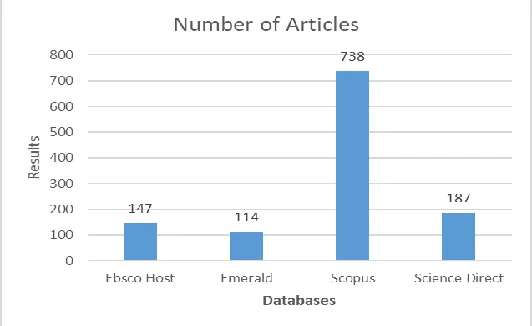
A systematic literature review on the term “Technology Transfer Effectiveness” was conducted from four databases Scopus, Emerald Insight, Science Direct, EBSCO host. Based on the search by keyword “Technology Transfer Effectiveness” used in quality journals, the returned results in border prospective are shown in Figure 1 with enough theoretical but limited empirical findings.
Figure 1: Search results of “Technology Transfer Effectiveness ” from different databases
3 CONCEPT
OF
TECHNOLOGY
TRANSFER
AND
TECHNOLOGY
TRANSFER
EFFECTIVENESS
Technology Transfer according to International Code of Conduct on the Transfer of Technology formulated by UNCTAD (United Nations Conference on Trade and Development) and published in 1979, is the transfer of
systematic knowledge for the product manufacturing
4781 forced by the market to search for new product developments
and inventions to meet the market requirements in a limited time span. Generally companies are not in position to develop new technology independently in their Research Centers due to the involvement of high cost and risk [34]. Development of new technology is a time taking process and its transfer from one place is dependent on the technological capability enhancement involving low cost, risk and increased efficiency at the same time [35], [36], [37], [38].For the industrial development of the developing countries, there is a need to fill the technological gap between developing and developed countries and the significance of technology transfers and its role is unavoidable. However Technology transfer is conducted in various methods and it all depends on the conditions of the Transferor and Transferee [25]. J. Jabar & Soosay (2010) in their research work explore that for technology transfer, the effect of both organizations, available resources, absorptive capacity and opportunistic behavior effect the process [39]. However Noor, Yusoff, & Hashim (2010) in their work show that technology transfer is mostly affected by technology compatibility and absorptive capacity [41].Whangthomkum et al.(2006), concluded that every technology transfer is done in the light of well-defined objectives of the company and Technology Transfer Effectiveness (TTE) is the long term and short term achievement of those objectives. Whangthomkum et al.(2006) identified three dimensions of TTE which are
Product and Process Performance (PPP), Business
Performance (BP), and Human Resources Capability (HRC) which are used to measure the objectives of that Technology Transfer [9]. To achieve business objectives and HR capability in the firms focusing on Technology Transfer for creation of
commercially viable products, services and process,
technology transfer contribute a vital role. Companies essentially transfer modern technology from other companies for one of the two purposes, one is to produce new product/service and secondly to launch a new process necessary for the production process [42]. The goals for technology transfer regarding a product, service or process is to accelerate business performance and a company’s ability in making a product or launch the production process so to advance business involving capable man power [9]. Man power development is the core of any technology transfer process as training and development of this resource lead the proper operation of hardware and software of equipment [43].
4 TOWARDS THEORY OF TECHNOLOGY
TRANSFER
Organizational learning is a change in organizational knowledge and it results in one of the three possibilities which
are enhancement, transformation or reduction in
organizational knowledge [44]. Organizational Learning practices include wide-ranging perspectives of management and identify numerous variables shaping the learning results, such as the organizational absorptive capacity, problem-solving skills , employee involvement, learning environment [45]. It is a process of learning within organizations which
involves individual interaction and collective (intra
organizational and inter organizational) levels of analysis and ultimately helpful in achieving the goals of an organization which is called Organizational Learning [46]. Organizational learning theories are helpful in understanding the processes which lead to changes or bar organizational knowledge
changes. Further these theories are used to understand the learning and knowledge effects on organizational outcomes and behaviors [44].
M. Göhlich (2016) mentioned that Argyris & Schön theory is the most significant organizational learning theory in the 1980s and 1990s and still it is very popular [47], [48], [49], [50], [47]. Argyris & Schön (1997) explored that in organizational learning, detection and correction of error are involved [51].
However, organizational learning processes within
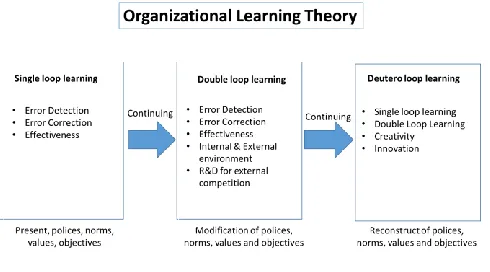
organizations have different complexity levels and results. Three loops of learning (Single Loop Learning, Double loop learning and Deutero Loop Learning) discussed by them are shown in Fig 2.
Figure 2: Three loops of learning (Single Loop Learning, Double loop learning and Deutero Loop Learning)
At the lower or Single Loop level learning, error detection and correction is based on its present policies to achieve its objectives [49] [48]. As a result an association is built between behaviors and outcomes according to environment and ultimately organizational effectiveness is improved [49], [50], [52], [53], [54]. At double-loop learning, error is detected and corrected involving modification of organizations policies, objectives and norms [48]. At this level organizations build new capabilities after restructuring their knowledge and memories [49], [50], [55], [52], [56], [57]. At the level of Triple-loop learning (deutero learning), organizations are enabled to learn about the effectiveness of their learning processes [49], [50]There is a relationship between Organization effectiveness and Organizational Learning as some authors in their studies [49], [58] [52] imply that organizational effectiveness must be enhanced so that occurrence of that organizational learning can be claimed [56].Organizational Learning theory highlights for organizations to acquire knowledge and Technology from outside and in order to made it effective, absorptive capacity of individuals and organizations should be increased with modification and innovation in internal setup and environment.
5 TECHNOLOGY
TRANSFER
EFFECTIVENESS
MODELS
4782 Transfer Process. According to them many factors influence
the outcome of the technology transfer process. Three categories explored are technological factors, organizational factors and environmental factors. Size and age of the technology are clustered in technological factors. The organizational factors include capacity, capability and efficiency of the organization and they indirectly depend on the organizational absorptive capacity [60]. The environmental factors are the national environment, the national business environment and the (international) industry environment Wang, Tong, & Koh (2004) studied technology transfer process in a subsidiary from a Multinational companies and in their model explored that the transfer of knowledge mainly depend on the Capacity to Learn of Transferee (focusing on workers qualifications and effectiveness of training provided) and Intent to learn of employees of Transferee [61]. They further added that capacity to learn is similar to the absorptive capacity concept given by Cohen & Levinthal (1990b). Research on technology/knowledge transfer has proved that absorptive capacity of the transferee effects the knowledge transfer [62], [63]. Factors affecting capacity to Learn about Transferee comprising of its employees qualifications (Firm’s absorptive capacity which is path dependent and is built on the absorptive capacity of its individual members) and the emphasis on training as there is need for all employees to have prior knowledge and new employees lack in it [64]. Training boosts absorptive capacities of individuals and ultimately it enhances the total Organizational learning capacity. The other factor is Organization’s intent to learn which is mandatory for organizational learning [65].
Figure 3: An integrated Wang, Tong and Koh Model of knowledge transfer from MNC parent to China subsidiary
In their study, Waroonkun & Stewart (2008) proposed a conceptual model for Technology Transfer process in Construction Industry to improve the International Technology Transfer success rates in developing countries [16]. The five variables which influence the effectiveness of Technology
Transfer are Transferor Characteristics, Transferee
Characteristics, Transfer Environment, Learning Environment and TT Value added. Further sub factors of Transferee characteristic are also explored which are Willingness to learn, Degree of experience, Transferee management, Knowledge base. The capacity to transfer and adopt technology also depend on each individuals existing knowledge base and the gap between this knowledge level and the level required to utilize the transferred technology which has been termed as absorptive capacity [15], [66], [60]. It was also emphasized that the TT processes should be kept under evaluation so that absorption of knowledge and skills by Transferee can be ensured [16].
Figure 4: Waroonkun & Stewart Conceptual Model for international TT in construction projects
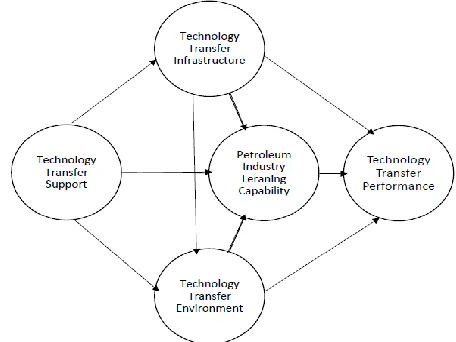
A Technology transfer model is proposed in 2012 for petroleum industry as shown in Figure 4 [17]. They explored four
enablers like TT infrastructure (involving information
technology, Research and Development, Host Sub con, Training Programs, Standards and administration), TT environment (involving experience, knowledge, complexity of technology, communications, and teamwork) and Transferee Learning capability (including culture, adoption, absorption, exposure, supervision of the TT process), TT Government support (Management of local oil companies, Government Policies and enforcement procedures) which influence the effectiveness of Technology Transfer process.
.
Figure 5. Mohamed, Sapuan. Ahmad, Hamouda,Tuah Conceptual model for technology Transfer in the Libyan oil industry.
4783 Government support, transferor characteristics, transferee
Characteristics, TT Process environment, and learning centers. This model was verified in ICT Sector of Libya.
Figure 6. ITT Model for ICT based SME
Bozeman, Rimes, & Youtie (2015) , in their Contingent Effectiveness (Revised) Model of Technology Transfer studied the influence of Innovation on TTE but did not consider it as variable [20]. Here five classes of technology transfer effectiveness factors or contingencies were identified. These are characteristics relating to transfer agent, transfer media, transfer object, transfer recipient and demand environment. Effectiveness Criteria includes out-the-door (was anything transferred?), economic development, market impact, political advantage, development of scientific and technical human capital, opportunity cost considerations and public value (value that an organization contributes to society).
Figure 7. Contingent Effectiveness (Revised) Model of Technology Transfer
6
FACTORSAFFECTING
TECHNOLOGY
TRANSFER
In literature, various studies have explored many factors which influence technology transfer. Some of them are listed below: Table 1 has enlisted different research in this regard.
TABLE.1. FACTORS AFFECTING TECHNOLOGY TRANSFER
Factors Reference
Type of transferred technology [71] [72]
Transfer channel [72]
R&D activity Training [73][74] [75]
Communication [29] [71]
Culture [76][72][29] [77][75]
Existing technological capability [76] [78]
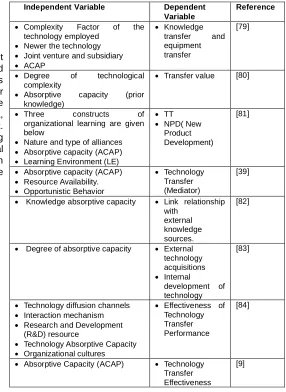
In literature, studies discussing the influence of absorptive capacity on technology transfer effectiveness are tabulated in Table 2.
TABLE.2. DIFFERENT RESEARCHES IN TECHNOLOGY TRANSFER
Independent Variable Dependent Variable
Reference
Complexity Factor of the technology employed
Newer the technology
Joint venture and subsidiary
ACAP
Knowledge transfer and equipment transfer
[79]
Degree of technological complexity
Absorptive capacity (prior knowledge)
Transfer value [80]
Three constructs of organizational learning are given below
Nature and type of alliances
Absorptive capacity (ACAP)
Learning Environment (LE)
TT
NPD( New Product Development)
[81]
Absorptive capacity (ACAP)
Resource Availability.
Opportunistic Behavior
Technology Transfer (Mediator)
[39]
Knowledge absorptive capacity Link relationship with
external knowledge sources.
[82]
Degree of absorptive capacity External technology acquisitions
Internal
development of technology
[83]
Technology diffusion channels
Interaction mechanism
Research and Development (R&D) resource
Technology Absorptive Capacity
Organizational cultures
Effectiveness of Technology Transfer Performance
[84]
Absorptive Capacity (ACAP) Technology Transfer Effectiveness
[9]
4784
7 ABSORPTIVE CAPACITY
In their study on international technology transfer , Kedia & Bhagat (1988), first used the term “absorptive capacity”. However, the contribution is generally accepted as the founding paper [85], [86]. Cohen & Levinthal (1990) in their work investigated that any organization can have innovative capabilities if it is capable to identify the worth of new external knowledge , assimilate it and apply to commercial end and this capability is called firm's absorptive capacity [10]. They further considered absorptive capacity as intangible and its benefits are indirect [60]. Zahra & George (2002) debated on the work of Cohen and Levinthal that firms can obtain and integrate knowledge, but they probably cannot be capable to transform and exploit the knowledge for commercial purposes and they accordingly decompose absorptive capacity into potential absorptive capacity (PACAP) and realized absorptive capacity (RACAP) [87]. PACAP relates to knowledge acquisition (Organization ’s capability to identify and acquire knowledge which has been externally generated and is mandatory for its operations) and knowledge integration, (Organizational procedures for evaluating, processing, interpreting and understanding the externally acquired knowledge). On the other end, RACAP is related to transformation capability (Organization’s capability for developing and refining the procedures that facilitate the merging of prevailing and the newly acquired and integrated knowledge) and exploitation capability (organizational capability based on the routines
allowing refining, extending, and leverage existing
competencies or to create new ones.). Zahra and George were the first who explicitly conceptualize absorptive capacity as a dynamic capability [87].If two identical organizations explore the same external knowledge with same objectives, but one is not successful in acquiring and exploiting the external knowledge to commercial end while the other is successful, then it can be explained that successful organization is bearing higher absorptive capacity[88].
Jukevicenen (2015) identified three levels of absorptive
capacity’s analyzing aspects which are individual,
Organizational and Regional [89]. In their work , Patrick van der Heiden & Pohl (2016) discussed five learning sub-processes of absorptive capacity which are Information acquisition, Distribution, Interpretation, Integration, and Organizational memory [91]. As the references to absorptive capacity in the literature are numerous and wide ranging so
literature about absorptive capacity and its basic
characteristics (e.g., components, determinants, measurement modes, and outcomes) is exceptionally diverse. There is ambiguity in the use of ACAP among different researchers [92] [93]. Many researchers use Research and Development as an indicator of absorptive capacity. According to them massive expenditure in such activity can improve the company’s ability to exploit the external knowledge which is not always correct especially in SMEs and Low Tech Industrial Units [93]. Concluding the literature survey, it should be emphasized that despite different names and conceptualizations, it is concluded that absorptive capacity (ACAP) is a firm’s capability to handle a rapidly changing scenarios. In other words it is a competence composing of individual skills which are built on each other and this ultimately empower that particular organization to achieve such advantages so that it can survive in competitive scenarios [93]. On the basis of literature survey, dimensions used for absorptive capacity are tabulated in Table 4.
TABLE 4: DIMENSIONS OF ABSORPTIVE CAPACITY USED IN LITERATURE
S.No Dimensions Reference
1 Acquisition [94] [95] [96] [97] [98] [99] [100] [101] [102] [103] [104] [105] [106] [107]
2 Assimilation [94] [96] [97] [104] [108] [105] [106] [107]
3 Exploitation [94] [96] [98] [99] [100] [101] [103] [104] [109] [110] [106] [107]
4 Dissemination [95] [98] [99] [100] [101] [103]
5 Transformation [96] [98] [99] [100] [101] [103] [109] [110] [106] [107]
6 Environment Scanning [111]
7 Integration [111]
8 Absorption [102]
9 Exploratory [109] [110]
10 Learning [109] [110]
11 Sharing [108]
12 Interpreting [108]
13 Routines [108]
14 Potential ACAP [112] [113] 15 Realized ACAP [112] [113] 16 Utilization as a single
meta-construct [105]
17 Integration 106]
18 Application 106]
19 Recognition [114]
Acquisition, Assimilation, Transformation and application / Exploitation are popular dimensions of Absorptive Capacity and are tabulated in Table 5. These dimensions are also being used in proposed conceptual framework.
TABLE 5: DIMENSIONS OF ABSORPTIVE CAPACITY IN THIS RESEARCH
Dimensions Meaning Reference
Acquisition Organization’s ability of finding, identifying and obtaining outside knowledge
[115] [92] [95]
Assimilation Organization’s ability of understanding and absorbing external knowledge.
[116] [92]
Transformation Organization’s ability of combing the existing knowledge with the obtained knowledge.
[117] [118]
Application / Exploitation
Organizational capacity of using and implementing the knowledge.
4785
8 ORGANIZATIONAL INNOVATION
Introduction of new methods and strategies in an organization for the management of business in the work unit and/or in the coordination between a company and outside agents is defined as Organizational Innovation (OI) [119]. The importance of OI cannot be undermined as it has been referred to a capability of an organization to initiate and implement innovations with a speed, is a focal point to its existence and development [120]. Armbruster, Bikfalvi, Kinkel, & Lay (2008) [122], [123] found diversity in the literature available on organizational innovation and there is no single definition of OI and hence it is ambiguous. Armbruster, Bikfalvi, Kinkel, & Lay (2008) divided literature on OI into three approaches. First approach is concerned about the innovative organization structure and its effects on technical process and product innovations. Second approach is concerning about organizational and development changes theories. Third approach deals the organizational innovations development at the grass root level in an organization [121]. The adoption of a new ideas results in an organizational change and ultimately affect the organizational performance. These two types of Innovations are termed as Technical Innovations and Administrative innovations [124]. However Totterdell, Leach, Birdi, Clegg, & Wall (2002), in their work discussed different types of organizational innovation. He explored two types of technical innovations which are Product/Services and Technological Innovations, and two types of administrative innovations which are HRM and work design Innovations and another type which is organizational restructuring [126] . Tan (2013) stressed that organizations should realize the importance of Innovation as it is a driving force for business and is critical for their success [128] . . Organizational innovation characterizes firms stress on research and development and new technical knowledge and ideas into new products and processes [129]. It has been further highlighted
in literature that the implementation of innovative
organizational concepts is considered to be substantial for competitiveness of an organizations [121]. Organizational Innovation studies are context dependent , multidimensional and multilevel[130]. Firms need to have innovation for their long life and it is very essentially required as it is like an engine for their growth [131]. In this perspective, organizational innovation encourages or allows organizational change, helping the organization’s renewal, adaptation and effectiveness [132]. Organizational change is correlated with the improvement in performance [133] and improvement is related to the use of new management tools, techniques, trends and practices that permits organizational change and better competitiveness and effectiveness in Organizations [134]. Organizational innovation is related with the close coordination and cooperation of the internal and external
agents of the organization [135]. In this situations
organizations also face internal barriers which are in the shape of less commitment from HR , unskilled or less skilled man power, higher risk, huge costs and less financial resources [136], Unavailability or less availability of the right persons for the right jobs [137], Intra organizational resistances, e.g. Management and Employees attitude towards change, and the firm’s management hierarchy [119]. In such scenarios,
Organizational building is mandatory to tackle the
organizational constraints and barriers [138].The
organizational innovation can result to strategic significances or outcomes that influence whole company. These outcomes
may effect company positively or negatively [139]. In the literature we find that mostly research focuses on product or process innovation outcomes. Some studies examine innovation outcomes at the financial performance. However, they don’t focus negative innovation outcomes. Laforet, (2013) in his study explored that innovation leads to increase in
production, profit, market position, better working
atmospheres and safety in organizations. On the other end, innovation does lead to degradation in operational efficiency, and brain drain from the company. He also showed that outcomes of OI depend on age and size of Organization, Sector of business, and which types of innovation has been employed [140].Different authors in literature have presented
different dimensions of Organizational Innovativeness.
However, on the other hand in literature various researchers have also used Organizational Innovation as dimensionless. H. Lin (2007) in his work used Firm innovation capability as dimensionless dependent variable [141]. Further Fartash et
al.(2018) also used Organizational innovation as
dimensionless mediator [143]. In his work Tan (2013) , also used Organizational Innovation as dependent variable [128].
9 ABSORPTIVE CAPACITY AND ECHNOLOGY
TRANSFER EFFECTIVENESS
It literature review of various high impact factor journal identified the relationship between absorptive capacity and Technology Transfer.Patrick van der Heiden, Pohl, Mansor, & van Genderen (2016b) in their work investigated that absorptive capacity (ACAP) is a topic of attention from researchers who are studying International Technology Transfer because ACAP is one of the most weighty factors which define organizational learning [91]. Smith (2007) in his research concluded that Transferring technology can only be effective if the organization has a high absorptive capacity like R&D strength [146]For efficient and effective TT, Malik (2002) in his research explored that involved organizations should create an atmosphere of mutual trust between Transferor and Transferee through effective communication. The main element for creation of such environment is through building of absorptive capacity [148]. However, Patrick van der Heiden et al.(2016b) emphasized that due to necessitated absorptive capacity, an organization builds a systematic way to create and enhance a strong internal setup comprising of intra
organizational and inter organizational agents and
4786 has not been taken care, then cost and time of Technology
Transfer will be increased and Learning growth will be smaller as per expectations [151]. In their work transfer Danquah et al. (2018) used absorptive capacity as mediating variable. They used data from 18 sub-Saharan Africa countries and the empirical results show that absorptive capacity has a positive
effect between technology transfer and efficiency
[153].Gandenberger, Bodenheimer, Schleich, Orzanna, & Macht (2016) in their work proved that technology transfer directly depends on the absorptive capacity of the recipient country [154]. However Bank (2008) in his research describes absorptive capacity as collection of governance, business environment, technological know-how, financial resources and
preemptive policies [155]. Fazal, Al Mamun, Wahab, &
Mohiuddin (2017) in their research work discovered that government policies, market environment and absorptive capacity considerably effect innovative knowledge adoption which also has a positively influence on corporate sustainability [157]. Whangthomkum et al.(2006) in her study explores the relationship of Absorptive Capacity (ACAP) to Technology Transfer Effectiveness (TTE) in Thailand industrial Sector relating to flexible packaging. She evaluated the relationship of each dimension of Absorptive Capacity to each Technology Transfer Effectiveness dimension. Researchers found that Technology Transfer Effectiveness is related to all Absorptive Capacity elements, but their effectiveness is not of same degree at all elements. The dimensions used for TTE are Business Performance Capability, Product and Process Performance and Human Resources capability and Absorptive Capacity used four dimensions (recognizing ability, acquiring
ability, assimilation ability, application ability) [9].
Whangthomkum et al.(2006) showed that all dimensions of Absorptive Capacity elements to have a positive correlation with Product and Process Performance and human resources capability. However, two Absorptive Capacity dimensions (ability to assimilation ability and application ability the new technology) showed a strong positive relationship with Business Performance (third dimension of TTE) [9]. Patrick van der Heiden et al.(2016b) provided a new model relating necessitated absorptive capacity and meta routines in International transfer of technology. This model is extensively related to ITT as it further stresses the importance of Absorptive Capacity perspective, its characteristic and effectiveness [91].
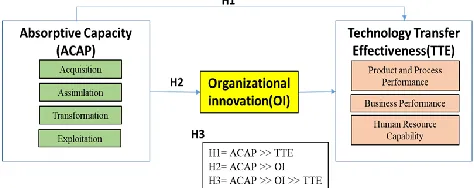
H1:Absorptive Capacity has a significant relationship with Technology Transfer Effectiveness.
10 ABSORPTIVE CAPACITY (ACAP) AND
ORGANIZATIONAL INNOVATION (OI)
In literature there is various empirical evidences of the relationship between Absorptive Capacity (ACAP) and Organizational Innovation (OI). Generally , it is known that highly innovative organizations achieve higher performance than less innovative organizations [158] and one source of innovativeness is the internal research related activities [159]. However, this is not only the research activities but a complete frame work of the absorptive capacity which enhances OI [160].Ali et al.(2016b) in his research pointed out that literature has showed a positive relationship between absorptive capacity (ACAP), organizational innovation (OI), and performance [12]. They also claimed that in literature, there is no comprehensive model exists which analyzes this
relationship empirically [12]. Hence, their research work is a contribution in literature as it is the first analysis which studies the effect of each dimension of ACAP on organizational innovation and performance. It is also empirically investigated that that OI can be used as a mediator and absorptive capacity impacts positively on OI when dependent variable is Product Innovation. In their work they also verified that OI is positively mediating between ACAP and Technical Innovation [161]. Another research on the direct relationship between ACAP and OI indicated that Knowledge alone is not sufficient and an organization should have some methodology to exploit and transform this embedded knowledge in new organizational innovations [162]. This mechanism which is used to exploit and transform is called absorptive capacity. Further, Murovec & Prodan (2008) in their studies mentioned if the innovativeness of country’s organizations is low, then it is necessary that Management and policy makers should analyze the factors which influence an organization’s innovation and one of these factors is absorptive capacity of the Organization due to which OI is low [164]. Vítor Costa1 and Samuel Monteiro in his research explored the relationship among knowledge creation, absorptive capacity, knowledge acquisition, knowledge sharing and organizational innovation. They formulate the hypothesis that Absorptive capacity is a mediation variable between knowledge acquisition and knowledge innovation [165] . Roberts & Dinger (2016) in their research investigated the degree to which interactivity in virtual customer communities effects the relationship between a absorptive capacity of an organization and the degree to which a firm enhances Organizational innovations like incremental and radical innovations [166]. They further developed a research question to inquire the effects virtual customers’ communities have on the relationship between ACAP and OI [166]. In the proposed model, Organizational Innovation has been picked as mediating variable. Based on the review of the literature, the hypotheses developed are:
H2: Absorptive Capacity has a significant effect on
Technology Transfer effectiveness.
H 3: Absorptive Capacity with mediation of Organizational
Innovation have significant effect on Technology Transfer Effectiveness
Theoretical Framework: This study as shown in Fig.8, proposes a conceptual framework to execute this research. By employing this model, the companies can improve the effectiveness of technology transfer
4787
11
CONCLUSIONTechnology transfer is being done globally in different organizations and the importance of effectively using and employing a transferred technology in the respective areas is a good research topic in literature. However, there been a very few studies which have gauged technology transfer effectiveness. Further, successful Technology Transfer in the field of Service Industry is very crucial for the development of developing countries. However, it is being realized that Service Industry has not been developed and is depending on developed counties for Technology Transfer. Purpose of this conceptual paper is to systematically review the existing literature on Technology Transfer Effectiveness and exploring related theories and models, how TTE is contributing with exceptional performance in service industry. This study aims to confirm that absorptive capacity a strong positive influence on Technology Transfer effectiveness. Hence this study attempts to contribute to the literature by validating the effect of absorptive capacity on technology transfer effectiveness. The contribution of this research study is also evident with the fact that it is going to explore the mediating effect of Organizational Innovation between Absorptive Capacity and technology transfer effectiveness together in a proposed model that have not been previously empirically tested. The conceptual framework is proposed on the bases of exiting literature, theory and models, however its empirical investigation is left for future researchers and practitioners.
REFERENCES
[1] K. Schwab, “The Fourth Industrial Revolution, Crown
Business,” New York, 2017.
[2] S. Birudavolu and B. Nag, “Business Innovation and ICT
Strategies,” Bus. Innov. ICT Strateg., pp. 1–12, 2018. [3] G. N. Stock and M. V. Tatikonda, “Typology of
project-level technology transfer processes,” J. Oper. Manag., vol. 18, no. 6, pp. 719–737, 2000.
[4] J. Jabar, “Strategic Technology Alliances , Technology
Transfer and the Performance of Malaysian
Manufacturers,” vol. 3, no. June, 2012.
[5] A. Salem, “Forging Direct Investment and Technology
Transfer in Developing Countries : A Comparative Study of Libya and Egypt,” vol. 1, no. 1, pp. 28–45, 2016.
[6] A. Salem, “Forging Direct Investment and Technology
Transfer in Developing Countries: A Comparative Study of Libya and Egypt,” Noble Int. J. Econ. Financ. Res., vol. 1, no. 1, pp. 28–45, 2016.
[7] J. Estep, “Development of a Technology Transfer Score
for Evaluating Research Proposals: Case Study of Demand Response Technologies in the Pacific Northwest,” ProQuest Diss. Theses, p. 253, 2017. [8] [D. G. Owusu-Manu, E. A. Pärn, M. F. Antwi-Afari, and
D. J. Edwards, “Modelling a conceptual framework of technology transfer process in construction projects: An empirical approach,” J. Constr. Proj. Manag. Innov., vol. 7, no. 1, pp. 1824–1842, 2017.
[9] N. Whangthomkum, B. Igel, and M. Speece, “An
empirical study of the relationship between absorptive capacity and technology transfer effectiveness,” Int. J. Technol. Transf. Commer., vol. 5, no. 1–2, pp. 31–55, 2006.
[10] W. M. Cohen and D. A. Levinthal, “Absorptive Capacity:
A New Perspective on Learning and Innovation,” Adm. Sci. Q., vol. 35, no. 1, p. 128, 1990.
[11] S. Duchek, “Enhancing Absorptive Capacity for
Innovation and Change: The Role of Structural Determinants,” J. Chang. Manag., vol. 15, no. 2, pp. 142–160, 2015.
[12] M. Ali, K. A. Seny Kan, and M. Sarstedt, “Direct and configurational paths of absorptive capacity and organizational innovation to successful organizational performance,” J. Bus. Res., vol. 69, no. 11, pp. 5317– 5323, 2016.
[13] C. Argyris, “A learning framework,” J. Manag. Psychol., vol. 10, no. 6, pp. 20–26, 1995.
[14] H.-J. Steenhuis and E. J. de Bruijn, “International technology transfer: Building theory from a multiple case-study in the aircraft industry,” Unpubl. Ph. D. Diss. Univ. Twente, Enschede, Netherlands, 2000.
[15] P. Wang, T. W. Tong, and C. P. Koh, “An integrated model of knowledge transfer from MNC parent to China subsidiary,” J. World Bus., vol. 39, no. 2, pp. 168–182, 2004.
[16] T. Waroonkun and R. A. Stewart, “Modeling the
international technology transfer process in construction projects: evidence from Thailand,” J. Technol. Transf., vol. 33, no. 6, pp. 667–687, 2008.
[17] A. S. Mohamed, S. M. Sapuan, M. M. H. M. Ahmad, A.
M. S. Hamouda, and B. T. H. T. Bin Baharudin, “Modeling the technology transfer process in the petroleum industry: Evidence from Libya,” Math. Comput. Model., vol. 55, no. 3–4, pp. 451–470, 2012.
[18] A. HASSAN and Y. Jamaluddin, “Exploring the Factors
Affecting the ICT Technology Transfer Process: An Empirical Study in Libya,” Mod. Appl. Sci., vol. 10, no. 7, p. 156, 2016.
[19] A. Hassan, “Analysis of Success Factors of Technology
Transfer Process of the Information and Communication Technology,” pp. 14–16, 2016.
[20] B. Bozeman, H. Rimes, and J. Youtie, “The evolving
state-of-the-art in technology transfer research:
Revisiting the contingent effectiveness model,” Res. Policy, vol. 44, no. 1, pp. 34–49, 2015.
[21] United Nations Conference on Trade and Development,
“Virtual institute teaching material on transfer of technology,” p. 124, 2012.
[22] R. J. Calantone, M.-T. Lee, and A. C. Gross, “Evaluating
international technology transfer in a comparative marketing framework,” J. Glob. Mark., vol. 3, no. 3, pp. 23–46, 1990.
[23] B. Bozeman, “Technology transfer and public policy: a review of research and theory,” Res. Policy, Vol. 29, S, pp. 627–655, 2000.
[24] S. A. Wahab, R. C. Rose, and S. I. W. Osman, “Defining
the Concepts of Technology and Technology Transfer: A Literature Analysis,” Int. Bus. Res., vol. 5, no. 1, 2011. [25] Z. Farhadikhah and S. M. H. Husseini, “A Review of
Methods and Models of Technology Transfer,” Int. Lett. Soc. Humanist. Sci., vol. 62, no. Unido 1989, pp. 173– 181, 2015.
[26] D. S. Mauricio Sanchez and X. P. López Mendoza, “A systematic literature review on technology transfer from university to industry,” Int. J. Bus. Syst. Res., vol. 12, no. 2, p. 197, 2018.
4788 2, p. 197, 2018.
[28] D. V. Gibson and R. W. Smilor, “Key variables in
technology transfer: A field-study based empirical analysis,” J. Eng. Technol. Manag., vol. 8, no. 3–4, pp. 287–312, 1991.
[29] 29D. V Gibson and R. W. Smilor, “Key variables in technology transfer: A field-study based empirical analysis,” J. Eng. Technol. Manag., vol. 8, no. 3–4, pp. 287–312, 1991.
[30] M. A. Cusumano and D. Elenkov, “Linking international
technology transfer with strategy and management: a literature commentary,” Res. Policy, vol. 23, no. 2, pp. 195–215, 1994.
[31] E. Mansfield, Technology transfer, productivity, and
economic policy. Norton, 1982.
[32] K. Ramanathan, “The polytrophic components of
manufacturing technology,” Technol. Forecast. Soc. Change, vol. 46, no. 3, pp. 221–258, 1994.
[33] M. Taleghani, “Determine the Factors Affecting the
Technology Transfer in the Development of Iranian Oil Fields By Using Contingent Effectiveness Model of Technology,” vol. 5, no. 7, pp. 76–90, 2016.
[34] M. Hollmer, “Technology transfer plays a larger role in region’s innovation’,” Bost. Bus. J., vol. 23, no. 39, p. S4, 2003.
[35] L. Kim, “Building technological capability for
industrialization: analytical frameworks and Korea’s experience,” Ind. Corp. Chang., vol. 8, no. 1, pp. 111– 136, 1999.
[36] B. Burger, “How important is foreign direct investment for late industrialising countries?,” Intereconomics, vol. 34, no. 3, pp. 115–123, 1999.
[37] B. L. Kedia and R. S. Bhagat, “Cultural Constraints on Transfer of Technology Across Nations: Implications for
Research in International and Comparative
Management,” Acad. Manag. Rev., vol. 13, no. 4, pp. 559–571, 1988.
[38] W. Bratic and S. Warren, “Do’s and don’ts of technology
transfer’,” Manag. Intellect. Prop., vol. 106, p. 3, 2001.
[39] J. Jabar and C. Soosay, “An assessment of technology
transfer in Malaysian manufacturers and the impact on performance and innovativeness,” 5th IEEE Int. Conf. Manag. Innov. Technol. ICMIT2010, pp. 983–989, 2010.
[40] S. M. Noor, R. Z. Yusoff, and F. Hashim, “Firms’
absorptive capacity and technology compatibility in transferred technology,” CSSR 2010 - 2010 Int. Conf. Sci. Soc. Res., no. Cssr, pp. 613–617, 2010.
[41] S. M. Noor, R. Z. Yusoff, and F. Hashim, “Firms’
absorptive capacity and technology compatibility in
transferred technology,” in 2010 International
Conference on Science and Social Research (CSSR 2010), 2010, pp. 613–617.
[42] V. Wong, V. Shaw, and P. J. Sher, “Intra-firm learning in
technology transfer: A study of Taiwanese information technology firms,” Int. J. Innov. Manag., vol. 3, no. 4, pp. 427–458, 1999.
[43] F. O. Akinyemi, “Technology transfer: Assessing the
impact of ITC/Rectas desktop cartography course on mapping professionals in Nigeria (1998–2001),” Int. Arch. Photogramm. Remote Sens. Spat. Inf. Sci., vol. 34, no. Part 6, p. W6, 2002.
[44] M. Schulz and J. A. C. Baum, “Rganizational earning,” 2001.
[45] C. L. Wang and P. K. Ahmed, A review of the concept of
organisational learning. Citeseer, 2002.
[46] I. V. Popova-Nowak and M. Cseh, “The Meaning of
Organizational Learning: A Meta-Paradigm Perspective,” Hum. Resour. Dev. Rev., vol. 14, no. 3, pp. 299–331, 2015.
[47] M. Göhlich, “Theories of organizational learning as
resources of organizational education,” in Organisation und Theorie, Springer, 2016, pp. 11–21.
[48] C. Argyris and D. a Schön, Organizational Learning: A Theory of Action Perspective, vol. 77. 1997.
[49] C. Argyris and D. A. Schoen, “Organizational learning: A
theory of action research,” Reading, MA Addision-Wesley, 1978.
[50] D. A. Schön and C. Argyris, “Organizational learning II: Theory, method and practice,” Read. Addison Wesley, vol. 305, no. 2, 1996.
[51] C. Argyris and D. A. Schön, “Organizational learning: A
theory of action perspective,” Rev. Esp. Invest. Sociol., no. 77/78, pp. 345–348, 1997.
[52] C. M. Fiol and M. A. Lyles, “Organizational Learning,” Acad. Manag. Rev., vol. 10, no. 4, pp. 803–813, Oct. 1985.
[53] Y. L. J. Lam, “Toward reconceptualizing organizational learning: a multidimensional interpretation,” Int. J. Educ. Manag., 2001.
[54] B. Levitt and J. G. March, “Organizational learning,” Annu. Rev. Sociol., vol. 14, no. 1, pp. 319–338, 1988. [55] L. Argote, “Organizational Learning: Creating, retaining,
and transferring knowledge. np Kluwer,” Norwell, MA, 1999.
[56] G. P. Huber, “Organizational Learning: The Contributing
Processes and the Literatures,” Organ. Sci., vol. 2, no. 1, pp. 88–115, 1991.
[57] K. D. Mackenzie, “The science of an organization. Part I: A new model of organizational learning,” Hum. Syst. Manag., vol. 13, no. 4, pp. 249–258, 1994.
[58] C. M. Fiol and M. A. Lyles, “Organizational learning Academy of Management Review, 10 (4), 803-813,” Gartner, W, B,(1985). A Concept. Framew. Descr. Phenom. new Ventur. Creat. Acad. Manag. Rev. I, pp. 696–706, 1985.
[59] N. Kundu, C. Bhar, and V. Pandurangan, “Development
of framework for an integrated model for technology transfer,” Indian J. Sci. Technol., vol. 8, no. 35, 2015.
[60] W. M. Cohen and D. a. Levinthal, “A new perspective on
learning and innovation,” Adm. Sci. Q., vol. 35, no. 1, pp. 128–152, 1990.
[61] P. Wang, T. W. Tong, and C. P. Koh, “An integrated model of knowledge transfer from MNC parent to China subsidiary,” J. World Bus., vol. 39, no. 2, pp. 168–182, 2004.
[62] A. K. Gupta and V. Govindarajan, “Knowledge flows
within multinational corporations,” Strateg. Manag. J., vol. 21, no. 4, pp. 473–496, 2000.
[63] P. J. Lane, J. E. Salk, and M. A. Lyles, “Absorptive capacity, learning, and performance in international joint ventures,” Strateg. Manag. J., vol. 22, no. 12, pp. 1139– 1161, 2001.
[64] O. Jones, “Developing absorptive capacity in mature
organizations: The change agent’s role,” Manag. Learn., vol. 37, no. 3, pp. 355–376, 2006.
4789 information systems,” Accounting, Organ. Soc., vol. 2,
no. 2, pp. 113–123, 1977.
[66] M. Saad, S. Cicmil, and M. Greenwood, “Technology
transfer projects in developing countries—furthering the Project Management perspectives,” Int. J. Proj. Manag., vol. 20, no. 8, pp. 617–625, 2002.
[67] M. Bell, “The acquisition of imported technology for industrial development: Problems of strategies and management in Arab region,” Baghdad ESCWA, United Nations Univ., 1987.
[68] L. Wei, “International technology transfer and
development of technological capabilities: a theoretical framework,” Technol. Soc., vol. 17, no. 1, pp. 103–120, 1995.
[69] S. Lall, Developing countries as exporters of technology.
Springer, 1982.
[70] L. K. Mytelka, “Stimulating effective technology transfer: The case of textiles in Africa,” International technology transfer. New York: Praeger, 1985.
[71] M. L. Ounjian and E. B. Carne, “A study of the factors which affect technology transfer in a multilocation multibusiness unit corporation,” IEEE Trans. Eng. Manag., no. 3, pp. 194–201, 1987.
[72] R. T. Keller and R. R. Chinta, “International technology transfer: strategies for success,” Acad. Manag. Perspect., vol. 4, no. 2, pp. 33–43, 1990.
[73] R. Grosse, “international Technology Transfer in
Services,” J. Int. Bus. Stud., vol. 27, p. 782, 1996.
[74] A. N. Hakam and Z. Chang, “Patterns of technology
transfer in Singapore: The case of the electronics and computer industry,” Int. J. Technol. Manag., vol. 3, no. 1–2, pp. 181–188, 1988.
[75] A. Ahad M. Osman-Gani, “International technology
transfer for competitive advantage: A conceptual analysis of the role of HRD,” Compet. Rev. An Int. Bus. J., vol. 9, no. 1, pp. 9–18, 1999.
[76] B. L. Kedia and R. S. Bhagat, “Cultural constraints on transfer of technology across nations: Implications for
research in international and comparative
management,” Acad. Manag. Rev., vol. 13, no. 4, pp. 559–571, 1988.
[77] E. Y. Chen, “Research on issues in Cross-Cultural
Technology Transfer (CCTT): a fact finding research focused on Japanese invested (owned) Taiwanese companies,” Inst. Int. Stud. Train., 1997.
[78] G. N. Stock, N. P. Greis, and M. D. Dibner, “Parent-subsidiary communication in international biotechnology R&D,” IEEE Trans. Eng. Manag., vol. 43, no. 1, pp. 56– 68, 1996.
[79] C. Gandenberger, M. Bodenheimer, J. Schleich, R.
Orzanna, and L. Macht, “Factors driving international technology transfer: empirical insights from a CDM project survey,” Clim. Policy, vol. 16, no. 8, pp. 1065– 1084, 2016.
[80] A. Winkelbach and A. Walter, “Complex technological
knowledge and value creation in science-to-industry technology transfer projects: The moderating effect of absorptive capacity,” Ind. Mark. Manag., vol. 47, pp. 98– 108, 2015.
[81] J. Jabar, C. Soosay, and R. Santa, “Organisational
learning as an antecedent of technology transfer and new product development: A study of manufacturing firms in Malaysia,” J. Manuf. Technol. Manag., vol. 22,
no. 1, pp. 25–45, 2011.
[82] X. Wu, T. Ma, and Y. Tian, “The Empirical Impact of Internal Knowledge Structure on the Endogenous Industrial Clusters Innovation,” pp. 721–725, 2010. [83] C. Haro-domı, D. A. Ã, A. Ruı, and F. J. Llore, “The
impact of absorptive capacity on technological acquisitions engineering consulting companies,” vol. 27, pp. 417–425, 2007.
[84] C. Lin, B. Tan, and S. Chang, “The critical factors for technology absorptive capacity,” Ind. Manag. Data Syst., vol. 102, no. 5–6, pp. 300–308, 2002.
[85] W. M. Cohen and D. A. Levinthal, “Innovation and
Learning: The Two Faces of R & D,” Econ. J., vol. 99, no. 397, p. 569, 1989.
[86] H. Volberda, N. Foss, and M. Lyles, Absorbing the
concept of absorptive capacity: How to realize its potential in …, vol. 5. 2009.
[87] S. A. Zahra and G. George, “Absorptive capacity: A review, reconceptualization, and extension,” Acad. Manag. Rev., vol. 27, no. 2, pp. 185–203, 2002.
[88] L. R. Newey and S. A. Zahra, “Absorptive Capacity: The
Concept and its Usefulness,” Wiley Encycl. Manag., no. 1990, pp. 1–3, 2015.
[89] V. Jukevicene, “Development of Absorptive Capacity in a Regional Innovation System: Experience of Lithuanian Regions.,” J. Educ. Cult. Soc., vol. 1, no. September, p. 257, 2015.
[90] P. van der Heiden and C. Pohl, “Organizational barriers
to absorptive capacity building for international technology transfer to Malaysia,” 2016 IEEE Int. Geosci. Remote Sens. Symp., pp. 7627–7630, 2016.
[91] P. Van Der Heiden and C. Pohl, “Organizational barriers
to absorptive capacity building for international technology transfer to Malaysia,” Int. Geosci. Remote Sens. Symp., vol. 2016-Novem, pp. 7627–7630, 2016. [92] S. A. Zahra and G. George, “Absorptive Capacity : a
Review , Reconceptualization , and Extension,” Acad. Manag. Rev., vol. 17, no. 2, pp. 185–203, 2002.
[93] M. S. Lewandowska, “Capturing Absorptive Capacity:
Concepts, Determinants, Measurement Modes and Role in Open Innovation,” Int. J. Manag. Econ., vol. 45, no. 1, pp. 32–56, 2015.
[94] G. George, S. A. Zahra, K. K. Wheatley, and R. Khan, “The effects of alliance portfolio characteristics and absorptive capacity on performance: A study of biotechnology firms,” J. High Technol. Manag. Res., vol. 12, no. 2, pp. 205–226, 2001.
[95] J. Liao, H. Welsch, and M. Stoica, “Organizational
absorptive capacity and responsiveness: An empirical investigation of growth–oriented SMEs,” Entrep. Theory Pract., vol. 28, no. 1, pp. 63–86, 2003.
[96] J. J. P. Jansen, F. A. J. Van Den Bosch, and H. W. Volberda, “ERIM REPORT SERIES RESEARCH IN MANAGEMENT ERIM Report Series reference number Managing Potential and Realized Absorptive Capacity: How do Organizational Antecedents matter?,” Acad. Manag. J., 2005.
[97] C. Gray, “Absorptive capacity, knowledge management
and innovation in entrepreneurial small firms,” Int. J. Entrep. Behav. Res., vol. 12, no. 6, pp. 345–360, 2006.
[98] S.-H. Liao, W.-C. Fei, and C.-C. Chen, “Knowledge
4790 industries,” J. Inf. Sci., vol. 33, no. 3, pp. 340–359,
2007.
[99] A. McKelvie, J. Wiklund, and J. C. Short, “The new venture innovation process: Examining the role of absorptive capacity,” in Entrepreneurial Strategic Processes, Emerald Group Publishing Limited, 2007, pp. 159–185.
[100]S. Gao, K. Xu, and J. Yang, “Managerial ties, absorptive
capacity, and innovation,” Asia Pacific J. Manag., vol. 25, no. 3, pp. 395–412, 2008.
[101]K. Kostopoulos, A. Papalexandris, M. Papachroni, and G. Ioannou, “Absorptive capacity, innovation, and financial performance,” J. Bus. Res., vol. 64, no. 12, pp. 1335–1343, 2011.
[102]F. Huang and J. Rice, “The role of absorptive capacity in facilitating" Open innovation" outcomes: A study of Australian SMEs in the manufacturing sector,” Int. J. Innov. Manag., vol. 13, no. 02, pp. 201–220, 2009.
[103]Y.-S. Chen, M.-J. J. Lin, and C.-H. Chang, “The positive
effects of relationship learning and absorptive capacity on innovation performance and competitive advantage in industrial markets,” Ind. Mark. Manag., vol. 38, no. 2, pp. 152–158, 2009.
[104]A. Escribano, A. Fosfuri, and J. A. Tribó, “Managing external knowledge flows: The moderating role of absorptive capacity,” Res. Policy, vol. 38, no. 1, pp. 96– 105, 2009.
[105]K. Iyengar, J. R. Sweeney, and R. Montealegre,
“Information technology use as a learning mechanism: The impact of IT use on knowledge transfer effectiveness, absorptive capacity, and franchisee performance.,” Mis Q., vol. 39, no. 3, 2015.
[106]J. Backmann, M. Hoegl, and J. L. Cordery, “Soaking it up: Absorptive capacity in interorganizational new product development teams,” J. Prod. Innov. Manag., vol. 32, no. 6, pp. 861–877, 2015.
[107]N. Roberts, “Absorptive capacity, organizational
antecedents, and environmental dynamism,” J. Bus. Res., vol. 68, no. 11, pp. 2426–2433, 2015.
[108]M. Hughes, R. E. Morgan, R. D. Ireland, and P. Hughes,
“Social capital and learning advantages: A problem of absorptive capacity,” Strateg. Entrep. J., vol. 8, no. 3, pp. 214–233, 2014.
[109]T. Biedenbach and R. Müller, “Absorptive, innovative and adaptive capabilities and their impact on project and project portfolio performance,” Int. J. Proj. Manag., vol. 30, no. 5, pp. 621–635, 2012.
[110]Y. A. Kim, H. Akbar, N. Tzokas, and H. Al-Dajani, “Systems thinking and absorptive capacity in high-tech small and medium-sized enterprises from South Korea,” Int. Small Bus. J., vol. 32, no. 8, pp. 876–896, 2014.
[111]A. Arbussa and G. Coenders, “Innovation activities, use
of appropriation instruments and absorptive capacity: Evidence from Spanish firms,” Res. Policy, vol. 36, no. 10, pp. 1545–1558, 2007.
[112]M. Ebers and I. Maurer, “Connections count: How
relational embeddedness and relational empowerment foster absorptive capacity,” Res. Policy, vol. 43, no. 2, pp. 318–332, 2014.
[113]K.-F. Huang, K.-H. Lin, L.-Y. Wu, and P.-H. Yu,
“Absorptive capacity and autonomous R&D climate roles in firm innovation,” J. Bus. Res., vol. 68, no. 1, pp. 87–94, 2015.
[114]A. Domurath and H. Patzelt, “Entrepreneurs’
assessments of early international entry: The role of foreign social ties, venture absorptive capacity, and generalized trust in others,” Entrep. Theory Pract., vol. 40, no. 5, pp. 1149–1177, 2016.
[115]P. J. Lane and M. Lubatkin, “Relative absorptive
capacity and interorganizational learning,” Strateg. Manag. J., vol. 19, no. 5, pp. 461–477, 1998.
[116]G. Szulanski, “Exploring internal stickiness:
Impediments to the transfer of best practice within the firm,” Strateg. Manag. J., vol. 17, no. S2, pp. 27–43, 1996.
[117]B. Kogut and U. Zander, “Knowledge of the firm,
combinative capabilities, and the replication of technology,” Organ. Sci., vol. 3, no. 3, pp. 383–397, 1992.
[118]F. A. J. Van Den Bosch, H. W. Volberda, and M. De Boer, “Coevolution of firm absorptive capacity and knowledge environment: Organizational forms and combinative capabilities,” Organ. Sci., vol. 10, no. 5, pp. 551–568, 1999.
[119]Oslo Manual. OECD, 2005.
[120]R. F. Hurley and G. T. M. Hult, “Innovation, market orientation, and organizational learning: an integration and empirical examination,” J. Mark., vol. 62, no. 3, pp. 42–54, 1998.
[121]H. Armbruster, A. Bikfalvi, S. Kinkel, and G. Lay, “Organizational innovation: The challenge of measuring non-technical innovation in large-scale surveys,” Technovation, vol. 28, no. 10, pp. 644–657, 2008. [122]H. Armbruster, A. Bikfalvi, S. Kinkel, and G. Lay,
“Organizational innovation: The challenge of measuring non-technical innovation in large-scale surveys,” Technovation, vol. 28, no. 10, pp. 644–657, 2008. [123]K. E. Knight, “A Descriptive Model of the Intra-Firm
Innovation Process,” J. Bus., vol. 40, no. 4, p. 478, 2002.
[124]W. M. Evan, “Organizational Innovation and
Performance : The Problem of " Organizational Lag " Author ( s ): Fariborz Damanpour and William M . Evan Source : Administrative Science Quarterly , Vol . 29 , No . 3 ( Sep ., 1984 ), pp . 392-409 Published by : Sage Publica,” vol. 29, no. 3, pp. 392–409, 2018.
[125]T. Totterdell, Peter Leach, Desmond Birdi, Kamal Clegg,
Chris Wall, “an Investigation of the Contents and Consequences of Major Organizational Innovations,” Int. J. Innov. Manag., vol. 06, no. 04, pp. 343–368, 2002.
[126]P. TOTTERDELL, D. LEACH, K. BIRDI, C. CLEGG, and
T. WALL, “an Investigation of the Contents and Consequences of Major Organizational Innovations,” Int. J. Innov. Manag., vol. 06, no. 04, pp. 343–368, 2002.
[127]Y. Tan, “An empirical investigation on organizational innovation and individual creativity,” no. August, 2013. [128]J. Peng, G. Zhang, Z. Fu, and Y. Tan, “An empirical
investigation on organizational innovation and individual creativity,” Inf. Syst. E-bus. Manag., vol. 12, no. 3, pp. 465–489, 2014.
[129]P. Soto-Acosta, S. Popa, and D. Palacios-Marqués,
“E-business, organizational innovation and firm