287
Affect Of Cultural Factor On Consumer Behaviour
In Online Shop
Agnita Yolanda, Nurismilida, Vivi Herwinda
Abstract: Consumer behavior is an action taken by a person in making a decision to search for, purchase, acquire, use of goods and services that will satisfy their needs. The purpose of this study is presented to determine how much the behavior of consumers to choose online shopping and direct shopping at Management of Higher School ( STIM) Sukma Medan. The method used in this research is descriptive method with quantitative data that has been obtained through the data directly from the company. The data collected with the spaciousness of research and literature in the form of distributing questionnaires to 52 (fifty-two) consumers. Processing data using SPSS statistical test tools version 17.00. Based on the results of the 4 (four) and the indicator above the 8 (eight) questions as well as 52 (fifty-two) consumers. Results showed that the most influential in choosing online shopping is a cultural factor with a percentage of 26.14%, while the most influential in choosing the direct spending is psychological factors with the percentage of 26.50%.
Index Terms: Consumer behavior, online shopping, culture factor.
————————————————————
1
I
NTRODUCTIONThe times today requires consumers to be smart, thorough, efficient and effective in selecting the desired product. The consumer’s attitude will not be disappointed with what they had bought. In the everyday life of consumers faced with a variety of needs is relentless, because basically humans cannot be separate from the need and will not be satisfied of their needs. Consumers also have their own way to buy what they need. Now the development of advanced technology, in transportation, electronic communication even on social media. Therefore, the lifestyle of today's society also changed because of the influence of the development of these technologies, one of the most striking of these is the tendency of technological development activities in cyberspace, such as online shopping or more commonly referred to as online shopping. There are two ways in which to shop online shopping and shopping directly. Shopping online is the buying and selling activities or that allows consumers to directly purchase goods or services from sellers practically through the medium of internet. While shopping in person is the buying and selling activities are conducted with the sellers were hawking wares and can choose or see the goods in person. According to 5, analyzes the consumer behavior which shopping in traditional markets. There are two reasons why it is necessary to understand the consumer behavior that is rapid development of trading today shows that more products are offered to consumers than demand and marketers need to know the desires and needs of consumers. Management and Higher School (STIM) Sukma Medan is a private university in the city of Medan that is based on high technology and have people who are enthusiastic in following the development of the times, especially in buying and selling online as well as directly.
The problem of this study is comparison of consumer behavior
in the environment of Management of Higher School (STIM) Sukma Medan, how much consumer behavior in choosing shopping online and in person.
DEFENITION OF MARKETING
Marketing is a total system of business activities designed to plan, price, promotion, and distribute goods that can satisfy the desire and achieve the target market as well as the company's goals (8). Meanwhile, according to (2), Marketing is a total system of business activities designed to plan, price, promote and distribute the goods that can satisfy both desires and services to consumers both current and potential customers. From the above opinion in principle is the same formulation of the notion of marketing a total system of business activities designed to plan, price, promotion, and distribute the goods to satisfy customers and achieve the target market as well as the company's goals.
CONSUMER BEHAVIOUR
Consumer behavior is an action that a person to select, buy and use the products and services as satisfying the needs and desires of consumers. According to (7), Consumer behavior is defined as the process of decision making and physical activity involving individuals in evaluating, acquiring, using goods and services. Consumer behavior includes all actions taken by someone to find, buy, use, evaluate, and spent a good product and service products that they hope will satisfy their needs (4).
CONSUMER DECISION MAKING PROCESS
According to (5), the process used by the consumer to make a decision to buy consists of five (5) stages: Introduction of a problem is the first stage of the buyer decision process in which consumers recognize a problem or need. A search for information is a step in the process of purchasing decision where consumers have been interested to find more information. Consumers can obtain information from any source such as family, friends, advertising, mass media and others. Evaluation of alternatives which is a stage in the process of decision making purchases which consumers use the information to evaluate alternative brands in the arrangement of choice. The purchase decision is a step in the process of purchasing decision until consumers actually buy the product. Usually consumers' purchase decisions are buying preferred brand. Post-purchase behavior is a step in ______________________________
Agnita Yolanda, Nurismilida, Vivi Herwinda
Program Study Business Administration, Politeknik LP3I Medan, Indonesia, Telp.061-7867311 Fax. 061-7874466, E-mail: [email protected]
Program Study Linguistic, University Islam Sumatera
the purchase decision-making process in which consumers take further action after purchase based on the decision or the satisfaction they feel.
ONLINE SHOPPING AND DIRECT SHOPPING
Shopping even easier. For those of you who have plenty of time to get around the mall and shop for a target, can direct expenditure came to the shop. However, if you do not have much time and want a practical, can visit the online store. Currently there are many sites that offer online shopping, such as: Lazada, tokopedia, elevania, Q10, sunmall.com, Zalora and so on. But not a few who feel harmed from online business transactions. Police get nearly 100 reports of online sales fraud victims in April 2016 (14). Advantages of Online Shopping are a flexible, online shopping allows you to shop for items without having much of the time. Shopping can be done in their spare time or on the sidelines of rush hour. Price Bolder mostly online shopping many of which offer much lower prices compared to shopping at the store directly. A more varied goods, shopping online allows you to find many products that cannot be found when shopping directly. Unlimited, online shopping gives special rights to prospective buyers, namely by providing shopping time at any time. While the lack of online shopping, the lag time of payment and delivery of goods in payment transactions and delivery of goods, there is a long lag time. Shipping charges, online shopping delivery fees which will add to the total expenditure. The farther the destination address, it is more expensive shipping costs. The items on display are sometimes not in accordance with the expectations of the buyer. In online shopping, a risk that could happen is a case of fraud. Besides, the total value of e-commerce market Indonesia mid-2013 2013-January 2014 predicted by Vela Asia and Google will reach USD 8 billion and is predicted to continue to increase to reach USD 24 billion. To avoid this, choose a secure online site and is already trusted. Visa estimates that online shopping in Indonesia will grow 40% this year and 53% next year, from 23% last year (Directorate General of Taxes Ministry of Finance, October 17, 2014). Given the rapid growth of e-commerce is required regulations and regulations to bring the rules of the game is clear and provide legal certainty to the perpetrators of e-commerce business in Indonesia, the rules related to e-commerce has been widely regulated in Law No. 7 Year 2014 on Trade. In addition, the government also uses the main approach in Law No. 8 of 1999 on Consumer Protection (UU PK) and Government Regulation No. 82 of 2012 on Electronic System and Transaction (PP PSTE). PP PSTE itself is a derivative of Law number 11 Year 2008 on Information and Electronic Transactions (UU ITE). Of all the laws and regulations, it is nothing but protecting consumers from unwanted actions. Direct shopping is the directly check the goods before deciding to buy, you can immediately check the goods and to think first. Direct spending you avoid fraud on the quality of goods. By looking directly, then you can judge for yourself the quality of the goods. No errors book, you could do no wrong in the booking. This will prevent you from spending too much. If you are confused in choosing or specify the goods, you can ask for advice to staff the store. While the lack of direct spending that is time-consuming, direct spending requires you to come directly to the store. This certainly could be done if you have ample time to walk around and buy stuff. Direct spending have time-limited time, depending on the policies of the stores that sell them. Direct shopping tends to
be located in one place and requires people to come directly. A limited market reach, because the location is in one place, it is the buyer who comes possibility only in the surrounding area. This research was conducted in STIM Sukma Medan Jl. Sakti Lubis, Medan City. Data used in this study is the original primary data collected to answer the research question specifically to be obtained directly from the source (8). Data obtained by the author directly from STIM Sukma Medan through questionnaires and still need to be processed before being served. Researchers used data sources internal and external data. Internal data used by the author are the data associated with online comparison shopping and shopping directly at STIM Sukma Medan. While external data, in this study, for example, in that the data derived from the results of previous research in the form of journals, books, thesis and other literature. As for the population in this study is in the neighborhood STIM Sukma Medan ever shopped online and shop directly with the number of 350 people. While the methods used in the sampling are incidental samples, i.e. anyone who by chance met with the author at the time of the writer distributing questionnaires. In order to facilitate the research process, to measure samples in this study used the formula Arikunto (1), as follows:
Information:
n = number of samples N = large population
By using the above formula can be calculated the size of the sample unit of the population of the following:
n = 15% X 350 = 52
= 52 Samples
FACTORS AFFECTING CONSUMER PURCHASE
BEHAVIOR
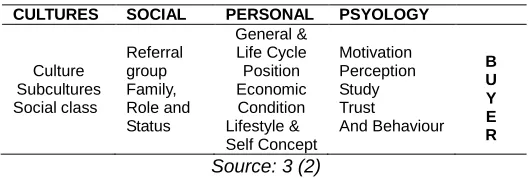
According to (2), Consumer purchases are influenced by four factors. Where these factors are cultural factors, social factors, personal factors, and psychological factors. Each factor will affect for each purchase as illustrated in Figure Table 1.
Table 1. Factors influencing consumer behavior
CULTURES SOCIAL PERSONAL PSYOLOGY
Culture Subcultures Social class
Referral group Family, Role and Status
General & Life Cycle Position Economic Condition Lifestyle & Self Concept
Motivation Perception Study Trust
AndBehaviour B U Y E R
Source: 3 (2)
From Table 1 it can be seen that:
1. Cultural Factors, culture has the most extensive influence and in the consumer behavior. Divided into three (3) the role that culture, subculture, and social class.
a. Culture, culture is forming the most basic of desires and behavior.
b. Subculture, subcultures is an important marketing segment and marketers often make the design of products specifically tailored desire segments.
c. Social Class, Division of permanent and tiered society, its members have values, interests, and similar behavior.
289
Social factors consist of a reference group, family, and the role and status.
a. Reference group, the reference group contributes directly or indirectly as a comparison or reference to the formation of attitudes and behavior.
b. Family, family members can influence the behavior of buyers. The family is the "organization of consumer purchase" the most important in a society that has been studied extensively.
c. The role and status, the position of a person in each group can be determined by the role and status. A rule consists of the activities Carried out According to expectations the people around.
3. Personal factors / Personal
A buyer's decision was Also influenced by personal characteristics such as age and life-cycle, position title, state economic, lifestyle, and personality, as well as the concept of self.
a. Age and level of cycle-life, goods and services purchased will change in the course of his life. Then the changes of life cycle must be properly addressed by the marketers who do not want to fail.
b. Position, position of a person affects the goods and services purchased. A company can even specialize to make the products and services required by the particular position.
c. Economic conditions someone would affect the goods purchased. Sensitive goods marketers must observe the opinion of earnings trends as well as personal savings and interest rates.
d. Lifestyle is a lifestyle that is expressed as a psycho graphed. It concerns activities (work, hobbies, shopping, sports, social events), interest (food, fashion, family and recreation) and opinions (about themselves, social issues, business, products). e. Personality and Self-Concept, personality is
expressed in terms of the smallest units: believe this could be very useful to analyze consumer behavior on specific products and brands. Many marketers use the concepts related to the personality, the concept of self-identity or self-image, therefore "we are what we have."
4. Factors Psychology
Spending someone more determined by psychological factors, namely, motivation, perception, learning, and beliefs and attitudes.
a.The motivation, according (4), described as a boost of motivation within the individual person and force him to do. The impetus generated by the pressure arising from an unmet need.
b.The perception motivated person is ready to act, the act is influenced by perceptions. Perception is receiving, selecting, organizing and personal assessment. The marketers need to work hard to attract the attention of consumers to be the message delivered on the target.
c.Learning to describe the changes in individual behavior incurred by the experience. Learning occurs through a tangle of encouragement, stimulation, cues, feedback and reinforcement.
d.Trust and Attitude describe the person's mind about something. This belief may stem from real knowledge, opinions, or emotionally charged. While the attitude is
a condition in a person to behave like or dislike when faced with a situation and attitude research illustrates, feelings, and tendencies toward the object.
3.1. Method of collecting data
Methods of data collection conducted by the authors in this study is that the authors gave questionnaires to consumers based on the number of samples used for the existing population on the object of research described into Table 2.
Table 2. Determination Score Questionnaire Answers
No Alternative Answers Score
1 Strongly Agree 4
2 Agree 3
3 Disagree 2
4 Strongly Disagree 1
3.2. Operational Definition of Variables
Operational definitions of the variables are the elements of research that provides an explanation or description of the operational variables that can be observed or measured in Table 3.
Table 3. Defenition of Operational Variable
Variable No Indicator Definiation Scale
Factors that Affect the Consumer Behavior
1 Cultural Factor
Society characters as a whole as well as the determinants of the most basic desires and behavior
Rating Scale
2 Social Factor
A number of groups that divide the group in some strata levels
Rating Scale
3 Personal Factor
Characteristics that have a very direct impact to follow closely on consumer behavior
Rating Scale
4
Psychol ogy factor
The elements that directly, in the short term and long term consumer behavior
Rating Scale
3.3. Data analysis method
The analytical method used in this research is descriptive quantitative research using the tools of statistical test SPSS (Statistical Product and Service Solutions) in describing the data that have been obtained through the data questionnaire distributed to consumers in STIM Sukma Medan.
3.4. Validity test
3.5. Reliability test
Reliability test is used to see if the measuring instrument used (questionnaire) showed consistency in measuring the same symptoms (6). Tests carried out using SPSS 17.0 the questions that have been declared valid in the validity of the test determines reliability criteria or a positive alpha If is> r table, then the question is reliable and if it is negative or alpha r r table then the question is not reliable.
RESULT AND DISCUSSION
This researcher uses quantitative techniques by giving questionnaires to consumers who choose to shop online and in person at STIM Sukma Medan. The questionnaire that the writers and answered by the respondents consisted of four (4) indicators used, namely cultural factors, social factors, personal factors, and psychological factors. To 4 (four) indicators are used to determine what possible influence consumer behavior in choosing shopping online and in person. The number of questionnaires that have spread to the respondent author has been returned to the author of 100%. The data have been obtained by the authors can be viewed in tabular form below:
Table 4. Characteristics of respondents by sex
No Gender Amount Percent
1 Man 25 48.1 %
2 Woman 27 51.9 %
Total 52 100%
Source: Results of the study (2016)
According to the table 4. note that of the 52 respondents who had the largest percentage of respondents manifold female sex as many as 27 people (51.9%) and the rest are men of 25 people (48.1%). According to the Table 5. The note of 52 the largest percentage of students over the age of 19-25 years as many as 48 people (92.3%), while those aged 25-30 years as many as four people (7.7%), for ages 30-35 years of (0%), and 35 years or older at (0%).
Table 5. Characteristics of Respondents by Age
No Age Amount Percent
1 19-25 year 48 92.3 %
2 25-30 year 4 7.7 %
3 30-35 year 0 0 %
4 >35 year 0 0 %
Amount 52 100%
Source: Results of the study (2016)
According to table 6. The note of 52 respondents who had the largest percentage of students as many as 42 people (80.8%), while for the work of lecturers by 1 person (1.9), and his work as employees were 9 people (17.3).
Table 6. Characteristics of Respondents by job
No Job Amount Percent
1 Students 42 80.8 %
2 Lecturer 1 1.9%
3 Staff 9 17.3%
Amount 52 100%
Source: Questionnaire Results of Research (2016)
4.1.Results Questionnaire Answers
The list of questions consists of 8 (eight) questions for 4 (four) indicators. The description of the response of each statement on the indicator is as follows:
4.1.1. Cultural Factor
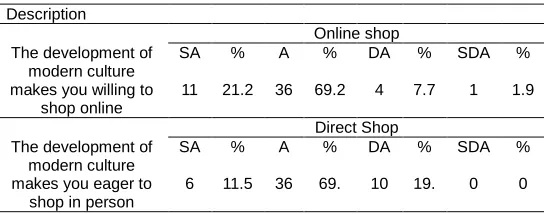
According to table 7 can be seen that the percentage of the cultural factors in online shopping is the biggest lie in respondents who answered agreed that as many as 36 people (69.2%), whereas the cultural factors in the direct expenditure of the biggest lies in respondents answered agree that as many as 36 people (69.2%). It concluded that cultural factors as large influence on the consumer because of the development of modern culture that makes consumers willing to spend.
Table 7. Distribution respondent to cultural factors
Description
Online shop The development of
modern culture makes you willing to
shop online
SA % A % DA % SDA %
11 21.2 36 69.2 4 7.7 1 1.9
Direct Shop The development of
modern culture makes you eager to
shop in person
SA % A % DA % SDA %
6 11.5 36 69. 10 19. 0 0
4.1.2.Social Factor
According to table 8, can be seen that the percentage of the social factor in online shopping is the biggest lie in respondents who answered agreed that as many as 39 people (75.0%), while the social factors in the direct expenditure of the biggest lies in respondents answered agree that as many as 35 people (67.3%). It can be concluded the respondents agreed that social factors influence consumers to choose alternative shopping and percentages in choosing expenditure because of the influence of the people around him are shopping online.
Table 8. Distribution respondent to social factors
Description
Online shop You choose online
shopping because of the influence from
people around you
SA % A % DA % SDA %
3 5.8 39 75.0 9 17.3 2 3.8
Direct Shop You choose the
direct shopping because of the influence from people around you
SA % A % DA % SDA %
5 9.6 35 67.3 12 23.1 0 0
Source: Questionnaire Results of Research (2016)
4.1.3.Personal Factor
291
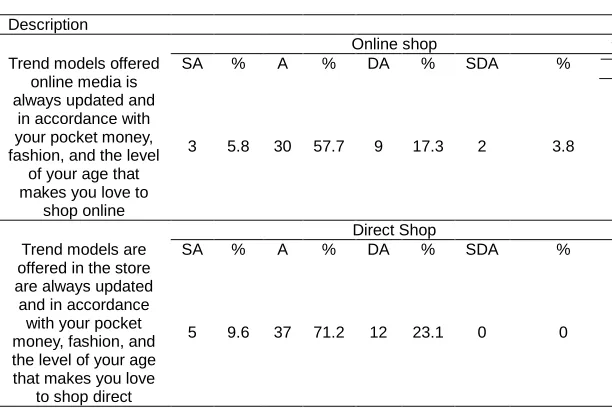
accordance with the allowance, fashion, and the level of consumer age and the percentage of the most popular consumer is spending directly.
Table 9. Respondent distribution to personal factors
Description
Online shop Trend models offered
online media is always updated and
in accordance with your pocket money, fashion, and the level
of your age that makes you love to
shop online
SA % A % DA % SDA %
3 5.8 30 57.7 9 17.3 2 3.8
Direct Shop Trend models are
offered in the store are always updated and in accordance
with your pocket money, fashion, and the level of your age that makes you love
to shop direct
SA % A % DA % SDA %
5 9.6 37 71.2 12 23.1 0 0
Source: Questionnaire Results of Research (2016)
4.1.4. Psychological Factor
According to table 10, can be seen that the percentage of the psychological factor in online shopping is the biggest lie in respondents who answered agreed that as many as 32 people (61.5%), while the social factors in the direct expenditure of the biggest lies in respondents answered agree that as many as 37 people (71.2%). It can be concluded the respondents agreed that psychological factors affect consumers in shopping and most popular consumer is spending directly.
Table 10. Distribution respondent to psychological factors
Description
Online shop You choose online
shopping because of the influence from
people around you
SA % A % DA % SDA %
3 5.8 39 75.0 9 17.3 2 3.8
Direct Shop You choose to shop
online for quality, comfort and security
of goods guaranteed to make you believe so as to encourage you to
shop online
SA % A % DA % SDA %
5 9.6 37 71.2 12 23.1 0 0
Source: Questionnaire Results of Research (2016)
4.2. Percentage Results of Data Collection Based on Indicators
Based on the table above, the obtained data are as follows: From the results in Table 11, it can be concluded that personal factors most influential provide added value in choosing online shopping and shopping direct is the largest percentage of cultural factors in online shopping that is 26.14%, while the largest percentage of psychological factors in direct expenditure is 26.50%. This can be seen in Figure 1.
Table 11. Percentage table of data based on indicators
No Variabel Online Direct
Score % Score % 1 Cultural Factor 161 26.14 152 24.72 2 Social Factor 148 24.03 149 24.23 3 Personal Factor 156 25.32 151 24.55
4 Psychological
Factor 151 24.51 163 26.50 Amount 616 100 615 100
26% 25% 24%
25%
Pyscology factor Cultural factor
Personal factor Social factor
25% 24%
25% 26% Psycology factor Cultural factor Personal factor Social factor
Figure 1. Percentage Factors of Consumer Behavior
4.3. Discussion
Data researchers get in this study are based on the statements set forth in the form of a questionnaire relating to the factors of consumer decisions in choosing online shopping and shopping directly by giving questionnaires to consumers in STIM Sukma Medan with a sample of 52 people. Based on the research results obtained from the questionnaires using four (4) indicators, namely the Cultural Factors, Social Factors, Personal Factors, and Psychological factors are as follows:
Cultural Factor
Based on the average total variable cultural factors of these questions, then the score obtained by choosing online shopping at 161 with a percentage of 26.14% and the score obtained by choosing the direct expenditure of 152 with a percentage of 24.72%. This shows that cultural factors are more in demand by consumers to shop online rather than directly as consumers keep abreast of modern times today by shopping online.
Social Factor
24.23%. This shows that social factors have a few percent difference between shopping online and shopping directly. Consumers strongly agree that in conducting online shopping as well as directly due to the influence of the people around.
Personal Factor
Based on the average total variable personal factors of these questions has a score obtained in choosing an online shopping $ 156 with a percentage of 25.32% and the score obtained by choosing the direct expenditure of 151 with a percentage of 24.55%. This shows that the personal factor more in demand by consumers to shop online rather than directly due to the trend of models offered by the online media is always updated, in accordance with the allowance, fashion and consuming age level.
Psychological factors
Based on the average total variable psycoloical factors of these questions have a score that is obtained by choosing online shopping at 151 with a percentage of 24.51% and the score obtained by choosing the direct spending by 163 with the percentage of 26.50%. This shows that the greater influence of psychological factors in the shop in person rather than online shopping, because the quality of goods, convenience and safety items are guaranteed to make consumers prefer to shop in person/direct shop.
Based on the results from all indicators of cultural factors, social factors, personal factors, and psychological factors that are most influential in choosing online shopping is a cultural factor with a value of 26.14%, because they more closely follow the development of culture in this modern age, that any activities done online completely from transport, communications and media as well as social while the most influential in choosing the direct spending is psychological factors with a value of 26.50% as consumers prefer shopping in person because they can see first hand the quality of the goods sold and does not need to fear for the security of goods. Moreover, for a layman who does not own a gadget, or do not know the online media they prefer to shop in person by visiting the place.
CONCLUSIONS
Based on the results of research and discussion analysis outlined it can be concluded there are four (4) factors of consumer behavior in purchasing decisions. The average yield of this study was obtained from the four (4) factors: Cultural Factors, Social Factors, Personal Factors, and Psychological Factors. The four indicators above have an influence in conducting research on consumer behavior. Overall the results obtained that 4 (four) indicators have significant influence in the behavior of consumers in STIM SUKMA Medan is the cultural factor to shop online and psychological factors to shop directly. Cultural factors that most influence the consumer in the purchase of shopping online with a percentage of 26.14%. This shows that consumers shop online because it follows the development of modern culture. While psychological factors that most influence the consumer in the purchase of a shopping directly with the percentage of 26.50%. This shows that consumers shop directly for the drive needs items to be purchased and the facilities, the quality of goods is guaranteed, so that consumers have more confidence to shop directly.
R
EFERENCES[1]. Arikunto, S, “Research Procedure“, Jakarta, Rineka Cipta Publisher., 2010.
[2]. Ginting, N F H, “Marketing Management”, First Edition, Bandung, Yrama Widya Publisher, 2011.
[3]. Kotler, Philip and Keller Kevin, Lane, “Marketing Management”, Edition 13, Series 1, Jakarta, Erlangga Publisher, 2009.
[4]. Nitisusastro, M, “Consumer Behavior In Perspective Entrepreneurshi”, First Edition, Matter Kesatu, Bandung, CV. Alfabeta, 2012.
[5]. Soewadji, J, “Introduction to Research Methods”, Jakarta, Media Discourse Partners, 2012
[6]. Sugiyono, “Business Research Methods”, Sixth Print, Bandung, Alfabeta, 2012,
[7]. Sunyoto, D, “Consumer Behavior: Simple Research Guide to Recognize Consumer”, First Printing, Jakarta, PT. Exciting Books, 2013.
[8]. Sunyoto, D, “Basic Concept of Consumer Marketing & Behavior Research”, First Printing, Jakarta, PT. Exciting Books, 2012.
[9]. Law no. 7 of 2014. The Law on Independence. Indonesia.
[10]. Law no. 8 of 1999. The Law on Consumer Protection. Indonesia.
[11]. Law no. 11 of 2008. Law on Information and Electronic Transactions. Indonesia.
[12]. Https://creditgogo.com/article/Life-style-/shop-shoing in-Online--shop-VS-shop-Offline.html. Accessed by Herwinda, Saturday, February 20, 2015, at 11:10 pm.
[13]. Http://www.pajak.go.id/content/e-commerce-in-Indonesia-even-manage-in-rules-trading