Themed Section: Science and Technology
Online Voting System
Komal Dwivedi, Ms. Pratiksha Asati MamDepartment of Computer Engineering, MEDI-Caps Institute of Technology and Management, Indore, Madhya Pradesh, India
ABSTRACT
In present system, voting is done manually where storing of data as well as processing of result requires a lot of time and sometimes voters are not aware of the candidates standing in the elections. To overcome this problem we need to design and implement a new system which will make voting process more convenient and may therefore lead to improve the turnout. Online voting system is an information management system that has been developed for automating the process of election proceedings that take place between the people, and the government. The system needs consistent flow of information at different levels within the automated ballot vote. Data maintenance becomes a vital component with proper relation at all different stages. The systems also become false proof for data attractions at any stage, because the overall control of information is kept in the hands of different administrations working at different levels. The proposed system can handle voting at different levels such as Parliamentary, Municipality, State legislative assembly, etc simultaneously. The project will bring transparency in the voting process by assuring the voters that their votes will be in favour of the candidates of their choice and also they can view the details of the candidate standing in the election before voting. Electronic recording and counting of votes will be faster, more accurate and less labour intensive. Results will also be generated with better analysis report using graphs.
Keywords : Voting System, Data Management, online vote, Electronic
I.
INTRODUCTIONPresently voting is performed by using ballot paper and the counting is done manually, hence it consumes a lot of time. There can be possibility of invalid votes. In our Proposed system, voting and counting is done with the help of computer system. It saves time, avoid error in counting and there will be no invalid votes. It makes the election process easy.
In a manual, paper-based election, the electorates cast their votes to select their candidates, where they simply deposit their designated ballots in sealed boxes distributed across the electoral circuits around a given country. By the end of the election period, all these boxes are officially opened and votes counted
manually in the presence of certified representatives of all the candidates until the numbers are compiled.
Economic justification is generally the “Bottom Line” consideration for most systems. Economic justification includes a broad range of concerns that includes cost benefits analysis. In this we weight the cost and the benefits associated with the candidate system and if it suits the basic purpose of the organization i.e. profit making, the project is making to the analysis and design phase. The financial and the economic questions during the preliminary investigation are verified to estimate the following:-
The cost to conduct a full system investigation.
The benefits in the form of reduced cost
The proposed system will give the minute information; as a result, the performance is improved.
This feasibility checks whether the system can be developed with the available funds. The Online Voting System does not require enormous amount of money to be developed. This can be done economically if planned
judicially, so it is economically feasible. The cost of project depends upon the number of man-hours required.
The technical feasibility is frequently the most difficult area encountered at the stage. It is essential that the process of analysis and definition be conducted in parallel with an assessment to technical feasibility.Technical feasibility centers on the existing manual system of the test management process and to what extent it can support the system. According to feasibility analysis procedure the technical feasibility of the system is analyzed and the technical requirements such as software facilities, procedure, inputs are identified. It is also one of the important phases of the system development activities. The system offers greater levels of user friendliness combined with greater processing speed. Therefore, the cost of maintenance can be reduced, processing speed is very high and the work is reduced in the maintenance point of view management convince that the project is operationally feasible.
II.
EXPERIMENTAL OBJECTIVE ANDMETHODOLOGY
The main concept of this project is to build a website, which will allow people to cast their vote by online voting system. The project “Online Voting System” is making the voting process easy in cooperative societies.
Presently voting is performed by using ballot paper and the counting is done manually, hence it consumes a lot of time. There can be possibility of invalid votes. In our Proposed system, voting and counting is done with the help of computer system. It saves time, avoid error in counting and there will be no invalid votes. It makes the election process easy.
Existing voting system allows us to vote manually through EVM. But the main disadvantage of this system is difficulty in data maintenance. In addition to this, process is time consuming and expensive as well as requires lot of labour.
People are inherently resistant to change and computer has been known to facilitate changes. An estimate should be made of how strong the user is likely to move towards the development of computerized system. These are various levels of users in order to ensure proper authentication and authorization and security of sensitive data of the organization.
METHODOLOGY: Platform Specification: a) At the Developer End:
Hardware Requirements–
WAN-LAN
Server
PC
RAM
ROM
Modem
Software Requirements-
Web Browser
Operating System
Eclipse Neon
JavaScript
JSP
SQLYOG database
c) At the End User:
Hardware Requirements –
Modem
WAN-LAN
PC
RAM
ROM
Software Requirements-
Web Browser
Operating System
CODING:
The coding has been done in “Online Voting System” has been divided into the following modules:
Admin module - controls all the functions Voter‟s module - login, registration, view
Home page
Candidate module - login, registration, update profile, forget password
1. The registration forms can be well designed by CSS forms.
Database connectivity:
Class.forName("com.mysql.jdbc.Driver"); Connection con
=DriverManager.getConnection("jdbc:mysql://lo calhost:3306/voting_application", "root", "root"); 2. After login check each & every credentials
should be checked with the stored information in the database.
If it is wrong, then display error message & ask to refill the details:
request.setAttribute("errorMessage", " Please confirm your username or password again!!! "); <jsp:forward page="Login_candidate.jsp" ></jsp:forward>
3. After login the login id is maintained throughout till session expires:
String cand_id =request.getParameter("cid");
session.setAttribute("candidate_voterid",cand_id );
4. Registration id should be provided by using „Random Function‟ in java.
5. To generate OTP usually gateway is required but this also works well i.e. we can use api integration code for developing project on low scale using „JavaScript‟:
$(document).ready(function(){ var otp='';
$("#btn").click(function(){ var mno=$("#mno").val(); var start=1000;
var end=9999;
otp=Math.floor(Math.random() * ((end-start)+1) )+ start;
alert(mno);
var settings =
{"async":true,"crossDomain":true"url":"http://control. msg91.com/api/sendotp.php?authkey=202925AHld2e9 bj5aa97512&message=Your%20OTP%20is"+otp+"&sen der=MSGTXT&mobile="+mno+"otp, "method": "POST","headers": {}
}
$.ajax(settings).done(function (response) { console.log(response);
6. Trigger function to generate OTP: $("#sub").click(function(){
var
party=$("input[type='radio']:checked").val(); var
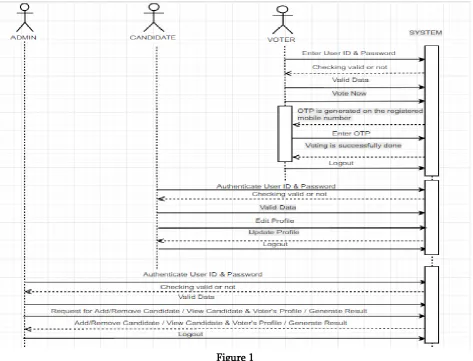
Sequence Diagram of the system:
Figure 1
III.
TESTING OF THE SYSTEM
The first level of testing is called unit testing which is done during the development of the system. Unit testing is essential for verification of the code produced during the coding phase. Errors were been noted down and corrected immediately. It is performed by the programmer. It uses the program specifications and the program itself as its source. Generally performed by developers, run in "friend classes" with code-level access to read and manipulate objects. Thus, our modules are individually tested here. . Here different dependent modules are assembled and tested for any bugs that may surface due to the integration of modules. Thus, the
here. System testing verify that the system performs the consisting of software technicians and users. It uses the System Requirements document, the System Architectural Design and Detailed Design Documents standard as its sources. Documentation is recorded and saved for system testing.
a product feature and tests all of the functionality contained within that feature.
System testing generally combines multiple features into an end-to-end process or scenario. Black box testing treats the software as a “black box” i.e. without any knowledge of internal implementation. White box testing is when the tester has access to the internal data structures and algorithms including the code that implement these. White-box testing was applied at the unit, integration and system levels of the software testing process, it was usually done at the unit level.
IV.
CONCLUSION
1. The votes can be easily and early counted. The overall percentage of the voting can be done without any error and soon. Result is evaluated fast.
2. Voters need to provide their registration id before voting.
3. Voters are provided with the description of candidates. They need to vote in the specified time limit and need to enter OTP before their submission of vote.
V.
REFERENCES
[1].Mohammed Khasawneh, Mohammad Malkawi,
Omar Al-Jarrah, Laith Barakat, Thaier S. Hayajneh, Munzer S. Ebaid, "A biometric-secure e-voting system for election processes", 2008 5th International Symposium on Mechatronics and Its Applications, IEEE, 14 October 2008.
[2].Drew Springall, Travis Finkenauer, Zakir Durumeric, Jason Kitcat, Harri Hursti, Margaret MacAlpine, and J. Alex Halderman, "Security Analysis of the Estonian Internet Voting System", In Proceedings of the 21st ACM Conference on Computer and Communications Security (CCS ‟14), November 2014.
[3].Ankit Anand, Pallavi Divya, "An Efficient Online Voting System", International Journal of Modern Engineering Research (IJMER), Vol.2, Issue.4, July-Aug. 2012 pp-2631-2634.
[4].Ahmed Ben Ayed, "A Conceptual Secure Blockchain- Based Electronic Voting System", International Journal of Network Security & Its Applications (IJNSA) Vol.9, No.3, May 2017. [5].Tadayoshi Kohno, Adam Stubblefield, Aviel D.
Rubin, Dan S. Wallach, "Analysis of an Electronic Voting System" IEEE Symposium on Security and Privacy 2004.