801
UTFPR at SemEval-2019 Task 6:
Relying on Compositionality to Find Offense
Gustavo Henrique Paetzold
Universidade Tecnol´ogica Federal do Paran´a / Toledo-PR, Brazil
Abstract
We present the UTFPR system for the Of-fensEval shared task of SemEval 2019: A character-to-word-to-sentence compositional RNN model trained exclusively over the train-ing data provided by the organizers. We find that, although not very competitive for the task at hand, it offers a robust solution to the ortho-graphic irregularity inherent to tweets.
1 Introduction
Text classification tasks can take a wide variety of forms, and some of them, such as sentiment and emotion analysis, have managed to grab a lot of attention from researchers in recent years. More recently, however, the public’s growing engage-ment in debates on the topics of free speech and politics has led the Natural Language Processing (NLP) and Machine Learning (ML) communities to take an interest in classification tasks related to identifying and categorizing patterns of profan-ity, hate speech and offense. The prominence of shared tasks held on these topics, such as those of
Fersini et al.(2018) andWiegand et al.(2018), are great examples of the research community com-ing together to attempt to create more reliable so-lutions for these challenges.
While hate speech is commonly characterized by specific slurs and other offensive expressions that convey prejudice against a certain group or individual, offensive speech is often more chal-lenging to identify because it encompasses a more broad spectrum of language, featuring expressions that do not necessarily convey prejudice (Malmasi and Zampieri, 2018). Technologies that identify these types of patterns could, for instance, help a social media platform on profiling users and take appropriate action whenever someone breaks user agreements and/or terms of use.
Identifying offensive language within the con-tent of social media platforms is particularly chal-lenging, since this type of content is usually lit-tered with irregular orthography, meta-characters, slang and others. Since a lot of the effort from the research community focuses on identifying offen-sive language in social media platforms, an NLP approach for such a task must be able to overcome those hurdles in some way. Some of the preferred methods for handling the orthographic irregular-ity of social media content are using word embed-dings trained over tweets (Rozental et al.,2018) or regularizing unusual spellings (Bertaglia and das Grac¸as Volpe Nunes, 2017), but neither of them ensure that every possible orthographically irreg-ular word will be understood by the NLP model in question. Recently, however, there have been a lot of contributions that present compositional neural models that learn numerical representations of words based on the sequence of characters that compose them (Kim et al.,2016;Ling et al.,2015;
Balazs et al., 2018;Paetzold,2018). These mod-els have been demonstrated to be both effective in text classification, and robust when faced with or-thographic irregularity.
In this paper, we present the UTFPR system submitted to the OffensEval shared task of Se-mEval 2019, which employs compositional neural models to identify offensive language in tweets. In the following sections we describe the task (sec-tion 2), our model (section 3) and experiments (sections4to5).
2 Task Summary
identify-ing and categorizidentify-ing offensive tweets. This shared tasks has 3 sub-tasks:
• Task A: Binary classification task that con-sists in judging whether a tweet is offensive or not.
• Task B: Binary classification task that con-sists in identifying whether or not an offen-sive tweet was targeted towards a specific person or group.
• Task C: Consists in identifying whether an offensive tweet was targeted at a person, group or something else (3-class classifica-tion).
We decided to focus our efforts on Task A ex-clusively. The organizers provided participants a training set with13,240instances, a trial set with
320, and a test set with860. Each instance is com-posed of a tweet and its respective labels for tasks A, B and C. The datasets were annotated by hu-mans of undisclosed background (Zampieri et al.,
2019a).
3 The UTFPR Model
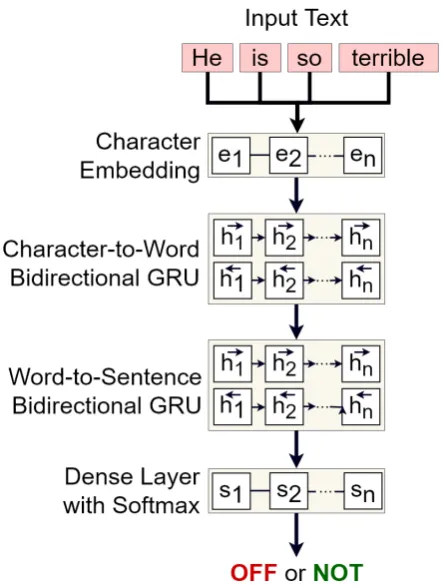
As we have previously mentioned, ours is a com-positional Recurrent Neural Network (RNN) in-spired by the ones introduced byLing et al.(2015) andPaetzold(2018). Our RNN learns word rep-resentations based on the sequence of characters that compose them, then learns sentence represen-tations based on the word represenrepresen-tations previ-ously learned. Figure1illustrates the architecture of our model in detail.
The model takes as input a potentially offensive tweet. It first produces character embeddings for the characters of each word in the sentence, then passes them through a sequence of bidirectional RNN layers in order to produce character-to-word numerical representations for them. These word representations are then passed onto another se-quence of bidirectional RNN layers, which in turn produce a single word-to-sentence numerical rep-resentation for the sentence. A dense layer con-nected to a softmax layer produces the final binary class, which can be OFF (for offensive) and NOT (for not offensive).
Because the dataset provided for training is rather small, we suspected that the character-to-word representations produced through this train-ing data would not be reliable enough for the task.
Because of that, we decided to train two different model variants:
• UTFPR-Scratch: The model depicted in
Figure1trained from scratch over the shared task’s training set exclusively.
• UTFPR-Reuse: The same model depicted
in Figure 1, except instead of training its character-to-word RNN layers from scratch along with the rest of the model, they are taken from a similar compositional model pre-trained byPaetzold (2018) over a much larger dataset for the Emotion Analysis shared task held at WASSA 2018 (Klinger et al.,2018). The training set of the WASSA 2018 shared task has153,383instances, each composed of a tweet with a target emotion word replaced with a [#TRIGGERWORD#] marker, and an emotion label that could be ei-ther joy, sad, disgust, anger, surprise, or fear.
The architecture of our models is identical, and their specifications are:
• Size of character embeddings:15
• RNN layer type:Gated Recurrent Units
• RNN layer depth:2 (for all layers sets)
• RNN layer size:60 (for all layers)
• Dropout proportion:25%
• Loss function:Cross-entropy
• Framework used:PyTorch1
We chose to use the PyTorch framework due to the fact that it employs dynamic computational graphs, and hence they do not require us to set a fixed maximum size for the words in the dataset. This feature of PyTorch only allows us to cre-ate a much more flexible model that can handle any word size, but also disregards the needs for padding.
To train our models, we split the training set into a training portion (10,000instances) and a de-velopment portion (3,240instances). The models were left training for hundreds of iterations, and after each iteration a version of each model was saved. The final selected models were the ones with the lowest attained error on the development
Figure 1: Architecture of the UTFPR system.
portion of the data. We conducted a preliminary evaluation over the trial set to determine which of the variants to submit. The macro-averaged F-scores, which are illustrated in Table 2, show that using pre-trained character-to-word RNN lay-ers actually compromised the performance of our model in this instance, hence we opted to submit the UTFPR-Scratch variant.
System F-score
UTFPR-Scratch 0.770
[image:3.595.339.493.480.591.2]UTFPR-Reuse 0.599
Table 1: Macro-averaged F-scores for the trial set
4 Performance on Shared Task
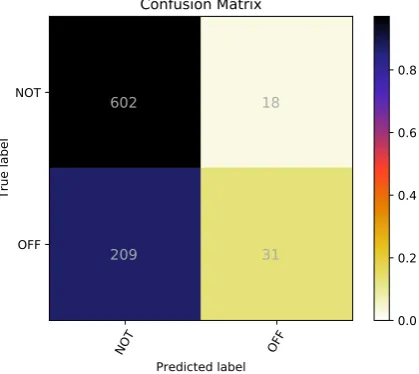
The systems submitted to the shared task were evaluated through their macro-averaged F1-score. The results on Table 2 showcase the results ob-tained by UTFPR-Scratch, as well as the top 3 and bottom 3 systems submitted to Task A. As it can be noticed, our system did not perform very well, placing 93rd out of 103 teams. The confu-sion matrix of UTFPR-Reuse in Figure 3 shows that the main reason behind this poor showing was the large amount of false negatives predicted.
Upon inspecting the labels predicted, we found that the UTFPR-Scratch system would predict of-fense mostly for tweets with a lot of profanity and with hashtags associated with the Donald Trump administration, such as “#BuildTheWall”.
Rank System F-score
1 pliu19 0.829
2 anikolov 0.815
3 lukez 0.814
93 UTFPR 0.528
101 hamadanayel 0.458
102 magnito60 0.422
103 AyushS 0.171
Table 2: Macro-averaged F-scores for the trial set
5 Robustness Assessment
Figure 2: Results of our robustness experiments. The vertical and horizontal axes presents macro-averaged F-scores and the percentage of words with noise introduced to them, respectively. The dots represent the F-scores obtained by the regular UTFPR-Scratch model and a frozen version that treats all words outside of the training set as out-of-vocabulary words.
NOT OFF
Predicted label NOT
OFF
True label
602 18
209 31
Confusion Matrix
0.0 0.2 0.4 0.6 0.8
Figure 3: Confusion matrix of the UTFPR-Scratch model on the test set.
input that differs considerably from the input pre-sented during training.
In this experiment, we assess the robustness of our UTFPR models. First, we generated “jammed” versions of the shared task’s trial set (since the test set was not made available) with increasing volumes of noise introduced to them. To create a jammed test set, we simply added a noise-inducing modification toN% randomly se-lected words of each sentence. The modifications were randomly selected between either removing a randomly selected character form the word (50% chance) or duplicating it (50% chance). We cre-ated 11 jammed versions by using0≤N≤100in intervals of 10. Words with a single character that were subjected to removal were simply discarded
from the sentence.
We compared the regular UTFPR-Scratch model (Regular) with a modified version with frozen character-to-word RNN layers (Frozen). The frozen version only produces a numerical rep-resentation of a word if it is present in the train-ing set, otherwise, it produces a vector full of 1’s signaling an out-of-vocabulary word. The results in Figure2 show that using the frozen version is much less robust than the regular model, specially when the input sentence has 70% or more of its words out of the training set vocabulary.
6 Conclusions
[image:4.595.77.287.293.480.2]7 Acknowledgments
We gratefully acknowledge the support of NVIDIA Corporation with the donation of the Ti-tan V GPU used for this research.
References
Jorge Balazs, Edison Marrese-Taylor, and Yutaka Mat-suo. 2018. Iiidyt at iest 2018: Implicit emotion clas-sification with deep contextualized word representa-tions. InProceedings of the 9th WASSA, pages 50– 56.
Thales Felipe Costa Bertaglia and Maria das Grac¸as Volpe Nunes. 2017. Exploring word embeddings for unsupervised textual user-generated content normal-ization. CoRR, abs/1704.02963.
Elisabetta Fersini, Debora Nozza, and Paolo Rosso. 2018. Overview of the evalita 2018 task on auto-matic misogyny identification (ami). InProceedings of the 6th EVALITA.
Yoon Kim, Yacine Jernite, David Sontag, and Alexan-der M Rush. 2016. Character-aware neural language models. In Proceedings of the 2016 AAAI, pages 2741–2749.
Roman Klinger, Orphee De Clercq, Saif Mohammad, and Alexandra Balahur. 2018. Iest: Wassa-2018 im-plicit emotions shared task. In Proceedings of the 9th WASSA, pages 31–42.
Wang Ling, Chris Dyer, Alan W Black, Isabel Tran-coso, Ramon Fermandez, Silvio Amir, Luis Marujo, and Tiago Luis. 2015. Finding function in form: Compositional character models for open vocabu-lary word representation. InProceedings of the 2015 EMNLP, pages 1520–1530.
Shervin Malmasi and Marcos Zampieri. 2018. Chal-lenges in discriminating profanity from hate speech. Journal of Experimental & Theoretical Artificial In-telligence, 30(2):187–202.
Gustavo Paetzold. 2018. Utfpr at iest 2018: Exploring character-to-word composition for emotion analysis. InProceedings of the 9th EMNLP, pages 176–181.
Alon Rozental, Daniel Fleischer, and Zohar Kelrich. 2018. Amobee at iest 2018: Transfer learning from language models. InProceedings of the 9th WASSA, pages 43–49.
Michael Wiegand, Melanie Siegel, and Josef Ruppen-hofer. 2018. Overview of the germeval 2018 shared task on the identification of offensive language. In Proceedings of GermEval 2018.
Marcos Zampieri, Shervin Malmasi, Preslav Nakov, Sara Rosenthal, Noura Farra, and Ritesh Kumar. 2019a. Predicting the Type and Target of Offensive Posts in Social Media. InProceedings of NAACL.