Themed Section: Science and Technology
Implementation of Smart Attendance System Using Raspberry
Pi
Rashmi R. Rumane1, Dr. Ajay. A. Gurjar2
1M.E Student, Department of Electronics & Communication Engineering, Sipna College of Engineering and
Technology, Amravati, Maharashtra, India
2Professor, Department of Electronics & Communication Engineering, Sipna College of Engineering and
Technology, Amravati, Maharashtra, India
ABSTRACT
Being one of the most successful applications of the image processing, face detection and recognition has a vital role in technical field especially in the field of security purpose. Human face detection and recognition is an important field for verification purpose especially in the case of attendance system. Maintaining the attendance is very important in all the institutes for checking the presence of students. Every institute has its own method in this regard. Some are taking attendance manually using the traditional pen and paper or file based approach. This system is developed for deploying an easy and a secure way of taking down attendance. The system first captures an image of all the students and stores the information into database. The system then stores the image by mapping it into a face coordinate structure. Next time whenever the registered student enters the premises the system recognizes the student and marks his attendance along with the time. In this project, we come up with a new hardware system for human face detection which makes use of Raspberry Pi. It is a credit-card sized computer with the components mounted on a credit card sized motherboard, running a dedicated version of Linux. It plugs into TV and a keyboard. It is a capable little computer which can be used in electronic devices and for much functionality that a desktop computer can perform. It comes at a very low price
Keywords: Raspberry pi, Face Detection, Face Recognition, Attendance System, Linux (Python)
I.
INTRODUCTIONOrganizations of all sizes use attendance systems to record when student or employees start and stop work and the department where the work is performed. Some organizations also keep detailed records of attendance issues such as who calls in sick and who comes in late. An attendance system provides many benefits to organizations. Traditional approach for attendance is professor calls student name & record attendance. It takes some time to record attendance. Suppose duration of class of one subject is about 50 minutes & to record attendance takes 5 to 10 minutes. For each lecture this is wastage of time. To avoid these
God has given everyone a unique face. Face is the most important part of our body, so that it can reflect many emotions of a person. There are traditional ways are being utilized even today but with vast resources wanted to be more secured. There are two types of biometric as physiological characteristics (face, fingerprint, finger geometry, hand geometry, palm, iris, ear and voice) and behavioral characteristics (gait, signature and keystroke dynamics). Sometimes your behavioral traits may change because of illness, fear, hunger etc. Face detection and recognition system is more expensive, exact, easy to understand and non intrusive process as compare to other biometrics. The system will fall into two categories as face detection (1:1) and face recognition (1:N). In the face detection we have to classify between face versus non face region while in recognition process we have to compare that single face image with multiple images from the input image.
While capturing an images from a webcam we have to come across some problems like pose (position of camera), presence of structural components (spectacles and beard), facial expression, occlusion (obstructed by someone), image orientation (variation in rotation), imaging condition (lightning and camera characteristics) etc.
A Face Detection and Face recognition System is a system which automatically identifies and/or verifies the identity of a person from digital images or a video frame from a video source. A general statement of the face recognition problem (in computer vision) can be formulated as follows: Given still or video images of a scene, identify or verify one or more persons in the scene using a stored database of faces.
II.
LITERATURE REVIEWTwo researchers Visar Shehu and Agni Dika proposed in [1] a system which introduces an
implemented using a non-intrusive digital camera installed on a classroom, which scans the room, detects and extracts all faces from the acquired images. After faces have been extracted, they are compared with an existing database of student images and upon successful recognition a student attendance list is generated and saved on a database. This paper addresses problems such as real time face detection on environments with multiple objects, face recognition algorithms as well as social and pedagogical issues with the applied techniques.
In [2] PAN Xiang described work process of a system: When a person wants to enter the access control system, he used the RFID card to swiping card by non-touch way. The system reads the information in the card and meanwhile the video camera is started to take photos of the person. Then the face can be detected in a short time. The identity information in the card is compared to the information from the database and the corresponding face data will be obtained. If the identity information and the face data are all matched to the information from the database, the person will be passed. Else he can‟t enter. The manager can do the manage work such as query the records.
This match is compared with a predecided threshold value, which decides the identity of the person.
The [4] Jian Xiao, Gugang Gao, Chen Hu, Haidong Feng proposed a framework for fast embedded face detection system based on three modules. One fast face detection method based on optimized AdaBoost algorithm with high speed and high detection rate, one SOC hardware framework to speed up detection operations and one software distribution strategy to optimize the memory sub-system.
The [6] describes a Real Time System developed for Multi-face detection. As most of the system are based on software algorithms. This proposed system is based on hardware design to enhance the processing time. The different stages of this hardware design includes skin color detection, morphology, Fast connected-component labeling algorithm, Implementation of the Fast connected-component labeling algorithm, Lip feature extraction, Horizontal edge detection.
III.
PROPOSED WORK3.1 SYSTEM DESIGN
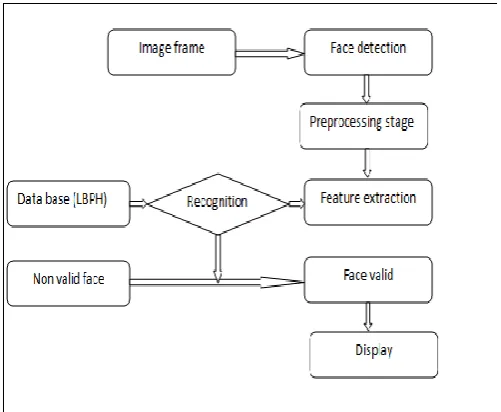
The aim of our dissertation is to provide a attendances system using face detection and recognition on Raspberry Pi board and send an alert message to the authorized person via mobile device or internet server This will increase the security of our Dissertation. Whatever the system that we have to implement it should work in real time with low false detection rate. Figure. 1 shows the block diagram for real time face detection and recognition system that will contain various hardware and software components.
Figure 3.1: Proposed work diagram of Face Detection and Recognition
The proposed work follows:
The first part was booting the Raspberry Pi board by installing the Operating system Raspbian OS and installing the essential libraries and packages.
1) Interfacing of camera module with raspberry pi B3 model. Capture face image using USB Webcam i.e. image acquisition take place
2) Create a database of authorized person using face detection process. After created database save into folder.
3) Capture current face, compare with data base image. Using face detection and face recognition process. Algorithms are used for face detection and recognition.
3.2 SYSTEM ARCHITECTURE
Figure 3.2: Architectural block diagram of Implementation of human face detection and
recognition system for attendances
WORKING
Above figure show the basic block diagram our dissertation system can be operated in two different sections, i.e. one for capturing and creating a data base and the other section is to capture the image and which is used for identifying or comparing the images in the database for attendances mechanism.
3.2.1 USB Webcam
The imaging module in the proposed system is realized using a USB webcam.USB Webcam connects to the raspberry pi b3 module. Its resolution is 8megapixel and still picture resolution 640x480, Max image transfer rate 1080p: 30fps. USB Webcam module is used for captures an image and send captured image to the Raspberry pi module. At the first time camera module captures images to create a database of the authorized person as a train faces then secondly take a test face or live captured image to compare with train faces (Data base).
Figure 3.3: USB Webcam
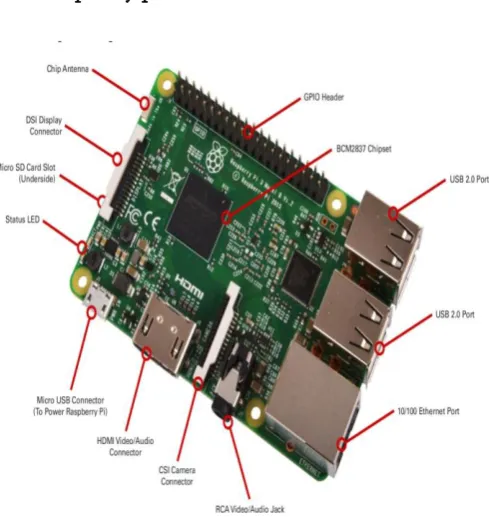
3.2.2 Raspberry pi B3 Module
Fig3.4: Raspberry pi B3 Model
CV library in which we can write algorithm in JAVA, Python..
Raspberry pi B3 module is small computer board. Webcam interface with raspberry pi model this capture face image fed to the raspberry pi model. Raspberry pi contain SD card i.e. memory card face image of database authorized person stored on this. W captures face image compare with database image. Face not recognized with database then send message to person mobile.
IV.
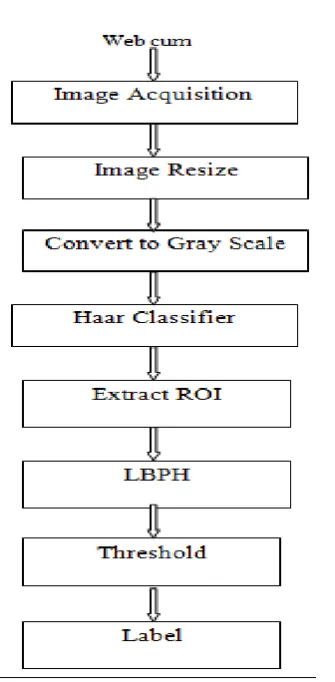
IMPLEMENTATIONBelow figure shows that the flowchart of implementation of Human face detection and recognition system using raspberry pi
Figure 4.1 Flow chart of Implementation of Human Face Detection and recognition System for
attendances system using Raspberry pi
Following is implementation process of dissertation
Step 1: Setting up Raspberry PI
SD card into the SD card slot on the Raspberry Pi, which will only fit one way. Next, plug the USB keyboard and USB mouse into the USB slots on the Raspberry Pi. Make sure that the monitor or TV is turned on, and that the right input is selected. Then Connect the HDMI cable from your Raspberry Pi to the monitor or TV. If the Raspberry Pi is needed to be connected to the internet, plug an Ethernet cable into the Ethernet port next to the USB ports. When all the required cables and SD card are plugged then, plug in the micro USB power supply. First of all the Linux OS is installed into the Raspberry Pi board via Micro SD card and appropriate code is written in Python language for the object detection using the Open CV libraries and is dumped in the board. The USB Camera is interfaced; the GPIO pins are programmed using commands in Linux and Python in this stage. The camera is interfaced to the Pi via the USB port and the door lock module is interfaced via the GPIO pins on the Pi.
Step 2: Image Acquisition
Webcam connect to the raspberry pi kit. When person standing in front of camera then webcam capture face image of that person. Resize the captured face image.
Step 3: Pre-processing
The data which is collected from Input unit that is captured Image and Video frames input is fed into the processing unit in the processing unit. Here the processing unit is nothing but a Raspberry Pi board. Along with code scripts of the implemented modules.
Step 4: Face detection
In face detection process haar cascade algorithms are used for face detection.
First capture face image by using webcam then resize the image.
Initially, the algorithm needs a lot of positive images (images of faces) and negative images (images without faces) to train the classifier. Then we need to extract features from it. In this face detection process, captured colour face image is converted into black and white image i.e. gray scale image. It reduce the number of pixel for simplification of detection. Then selection of ROI take place i.e. face detection process is done.
Step 5: Create Data base of Authorized Person
In Face detection process first create database of authorized person. The captured face of current poses creates a data base of the authorized person and stores this. At the next time camera module will capture the current live face of the person. All this process is done in Raspberry pi module. Create our own database. The images stored in a folder, storing database images and store it as a train faces in the test 1 folder.
Step 6: Face Recognition
The most important step of our dissertation is face recognition. In Face recognition process LBPH algorithms are used.
The image is divided into small connected regions called cells, and for the pixels within each cell, a histogram of gradient directions is compiled. For improved accuracy, the local histograms can
be normalized by calculating a measure of the intensity across a larger region of the image, called a block, and then using this value to normalize all cells within the block.
The final step in object recognition using Local binary pattern(LBP) algorithm.
Step 7: Output
When captured face match with database face image i.e. face recognized successfully. When person are
V.
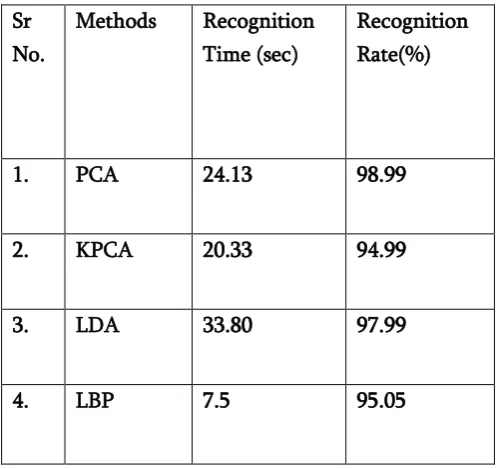
RESULTFive basic face recognition techniques are compared for different algorithms based on recognition rates (percentage) and elapsed time is shown in table 5.1. The common training data set and test data set is used for comparison in all four used techniques. In this work, basically the comparison of various algorithms as stated above i. e; PCA, KPCA, LDA , LEM and LBP is done on the basis of recognition time used in face recognition procedure.
Table No 5.1: Comparison of various methods on the basis of recognition rate and recognition time
Sr No.
Methods Recognition Time (sec)
Recognition Rate(%)
1. PCA 24.13 98.99
2. KPCA 20.33 94.99
3. LDA 33.80 97.99
4. LBP 7.5 95.05
After executing all the step of implementation as discussed above we get following results as shown in figures given below:
5.1 database generation
Figure 5.1: Created database
Fig.5.1 shows that database of enrolled student is successfully generated and stored in default folder,
5.2 Face detection of enrolled student
Now live captured image is taken as a test face shown in figure 5.2 to identify whether the student is enrolled or not.
Fig 5.2: face detection after entering a classroom
Fig 5.2 shows that captured imaged is detected and it is available in the database and hence face is indicated by blue coloured rectangle and also shows name of the
known person, therefore attendance of present student is automatically marked.
5.3 face detection of unknown student
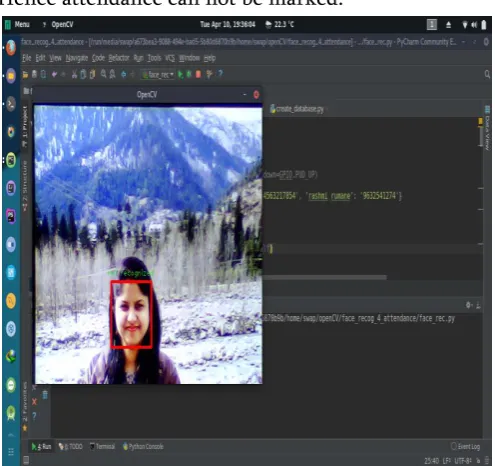
Figure.5.3 shows that the captured image is of unknown person. Because we have created an enrolled students database in the system and this captured image is unknown to the system after comparing with the database and hence indicated by red colored rectangle.
Hence attendance can not be marked.
Fig 5.3:image captured of unknown person
Fig 5.4: Email sent to the head authority
Fig 5.4 shows that attendance of present students during the lecture is recorded and sent to the authority along with the detected image and name.
5.5 Attendance sheet
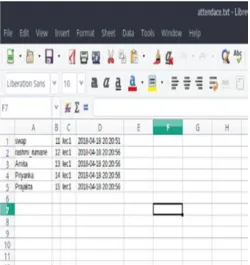
After completion of the lecture, attendance sheet is generated and stored in default folder.
This attendance sheet consists of name of student, roll number, date and time.
Fig 5.5: attendance sheet of present students
Fig 5.5 shows attendance sheet of students present for the lecture along with roll number and time.
VI.
CONCLUSIONWe have to study face detection and recognition system on Raspberry Pi module. Face detection and recognition is currently a very active research area. Some of the more algorithms are still too computationally cheap to be applicable for real time processing. Other processors are costlier than Raspberry Pi along with large memory, accuracy and speed. Using Python and Open CV in Raspberry Pi, made our project flexible. But in future it can be used in Orange Pi and Banana Pi board. This has more RAM.
VII.
REFERENCES[3] hanekula,‟‟ Face Recognition Based Attendance Management System with Raspberry PI 2 using Eigen Faces Algorithm, ‟‟ARPN journal vol -11, NO.13, july 2016.
[4] Raspberry Pi Face Recognition Treasure Box Created by Tony Di Cola.
[5] MedakTeenaRavali, Prof. RangasaiKomaragiri
“Image Processing Platform On Raspberry Pi For Face Recognition” Global
Journal of Advanced Technologies, ISSN 2277-6370 Vol3, Issue4- 2014.
[6] R.Pahune ,A.A.Chaudhuri,”Face Detection System for Security Purpose Using Raspberry PI,”ICEIS-2016.
[7] Richard Mo Adnan Shaout, ‟‟Portable Facial Recognition Jukebox using Fisher Faces, ‟‟IJACSA Vol.7, No.3, 2016.
[8] Subhanishaik, Antomicheal,‟‟Automatic Age and Gender Recognition in Human face Image Data Set Using Convolutional Neural Network System,‟‟IJARCSMS Vol 4, issue 2, Feb 2016 .ISSN:2321-7782.
[9] Danwei, ‟‟Distributed Compressive Sensing Based Near Infrared and Visible Images Fusion for Face Recognition,‟‟ IJSP, IPPR vol.9, No.4 (2016), pp.281-292.
[10]Unsoojang and Eui Chul lee, ‟‟Performance Analysis of Pixel Based Face Recognition Method, ‟‟IJBSBT Vol.8, No. 2(2016), PP.197-206.
[11]Li yongqiang and panjin, „„one sample image Recognition algorithm based on improved sub-pattern principle component analysis, ‟‟IJSP,IPPR vol.8,NO.9(2015),PP.77-84.
[12] Maryam Moghaddam, Saeed
Meshgini,”Automatic face Recognition via Local Directional Patterns,” journal of Artificial Intelligence in Electrical Engineering, vol.4, NO.15, DEC 2015.
[13]Navin Prakash, Dr. Y. singh, ‟‟Support vector Machines for Face Recognition ‟‟IRJET Vol: 02 issue: 08|Nov-2015.
[14]JunLee, Jeong-Sik Park, Gil-Jin Jang and Yong-Hoseo,‟‟ Efficient Head Pose Determination and its Application to face Recognition on Multi-Pose face DB,‟‟IJMUE Vol.11.No2 (2016).
[15] G. Senthilkumar, K. Gopalakrishnan, V.S.Kumar,‟‟ Embedded Image Capturing System Using Raspberry PI System,‟‟ IJETTCS Volume 3, Issue 2, March-April 2014.
[16]Gheorghita Ghinea ,Rajkumar Kannan and Suresh Kannaiyan, ”Gradient orientation-based PCA Subspace for Novel Face Recognition ”in IEEE Access, Vol 2,2169-3536 2014.
[17]Mounika B.R Reddy N. Jand Reddy V.B.D,‟‟A Neural Network Based Face Detection Using Gabor Filter Response, ‟‟IJNN ISSN:2249 -2763 &ESSN: 2249-2771, volume 2 ,Issue 1, 2012 ,PP.-06-09.
[18] Tudor Barbu,‟‟Gabor Filter –Based Face
Recognition Technique, ‟‟Processing of the Domain Academy, Series A, Vol 11, No 31 2010,PP.277-283.
[19]H.R.Kanan and K.Faez,‟‟Adaptively Weighted Sub –Gabor Array for Single Model –based human face Recognition‟‟. IJECE DEC 2010.
[20]P. Shih and, C. Liu, ‟‟Face Detection using Discriminating Feature Analysis and Support Vector Machine, ‟‟.Pattern Recognition Vol.39, NO.2, Feb 2006, PP.260.276.
[21]S.K.Nabeena. N. V. Narayana Rao,‟‟ Implementation of Video Surveillance Using Raspberry PI 2,‟‟ IJMETMR ISSN No:2348-4845.