What Makes Co-Teaching Work?
Identifying The Essential Elements
Nancy L. Bacharach, St. Cloud State University Teresa Washut Heck, St. Cloud State University Kathryn R. Dahlberg, St. Cloud State University
ABSTRACT
This paper will share the process used in the development of the What Makes Co-teaching Work instrument used to support the successful implementation of a co-teaching model of student teaching.
INTRODUCTION
eacher education programs have long utilized student teaching as the capstone experience to becoming a certified teacher. While student teaching is a widely accepted practice, the nature of the experience itself has been largely unchanged over the past 100 years (Guyton & McIntyre, 1990). The innovative use of a co-teaching model of student teaching is gaining national attention (Bacharach, Heck, & Dahlberg, 2007; Heck, Bacharach, Dahlberg, Ofstedal, Mann & Wellik, 2007; Heck, Bacharach, Ofstedal, Mann, Wellik, & Dahlberg, 2006; Perl, Maughmer, & McQueen, 1999). In a co-teaching experience, the cooperating teacher and teacher candidate collaboratively plan and deliver instruction from the very beginning of the experience. Cooperating teachers are taught to make their instructional decisions more explicit in order to make the invisible workings of the classroom more visible to the teacher candidate. As the experience continues, the pair seamlessly alternate between assisting and/or leading the planning, teaching, and evaluation. As this occurs, the classroom teacher partners with the student teacher rather than giving away the responsibility. This enhances the learning opportunities for students, combines the knowledge and strengths of both teachers, and models a positive adult working relationship. As the term progresses, the student teacher assumes more responsibility, ultimately taking the lead in planning, teaching and assessing, including directing the contributions of the cooperating teacher.
METHODS
In order to thoroughly examine the impact of co-teaching on P-12 learner outcomes, a comprehensive study was undertaken at a mid-sized state university in the Midwest comparing co-taught classrooms with non-co-taught classrooms. Two academic measures were employed including the Minnesota Comprehensive Assessment (State No Child Left Behind approved assessment) and the Woodcock Johnson III -Research Edition. Each assessment offered a unique view of achievement that together provided the scope of data desired. Both assessments focused on the Reading and Math skills of co-taught students versus non-co-taught students. Results from two years of study on the use of a co-teaching model of student teaching demonstrate an increase in academic achievement for K-12 students in co-taught classrooms (Bacharach, Heck, Dahlberg & Hoover, under revision; Bacharach, Heck, & Dahlberg, 2007). Additional data shows the positive impact a co-teaching model of student teaching has on teacher candidates and cooperating teachers (Heck, Bacharach, & Dahlberg, 2007).
participants to rate their level of agreement with eight value statements about co-teaching, including perceived challenges.
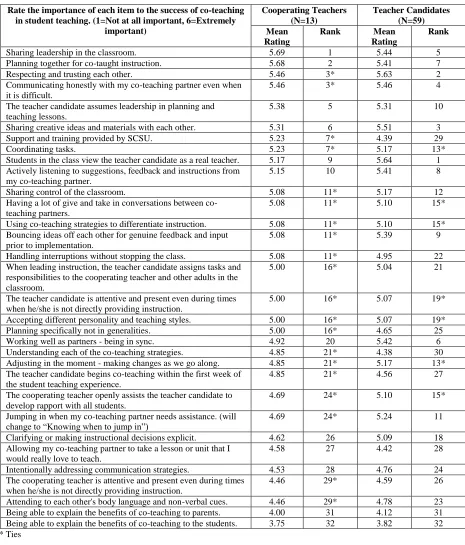
Table 1
What Makes Co-Teaching Work (WMCW)? Focus Group Feedback – Spring 2007 Rate the importance of each item to the success of co-teaching
in student teaching. (1=Not at all important, 6=Extremely important) Cooperating Teachers (N=13) Teacher Candidates (N=59) Mean Rating
Rank Mean Rating
Rank
Sharing leadership in the classroom. 5.69 1 5.44 5
Planning together for co-taught instruction. 5.68 2 5.41 7
Respecting and trusting each other. 5.46 3* 5.63 2
Communicating honestly with my co-teaching partner even when it is difficult.
5.46 3* 5.46 4
The teacher candidate assumes leadership in planning and teaching lessons.
5.38 5 5.31 10
Sharing creative ideas and materials with each other. 5.31 6 5.51 3
Support and training provided by SCSU. 5.23 7* 4.39 29
Coordinating tasks. 5.23 7* 5.17 13*
Students in the class view the teacher candidate as a real teacher. 5.17 9 5.64 1 Actively listening to suggestions, feedback and instructions from
my co-teaching partner.
5.15 10 5.41 8
Sharing control of the classroom. 5.08 11* 5.17 12
Having a lot of give and take in conversations between co-teaching partners.
5.08 11* 5.10 15*
Using co-teaching strategies to differentiate instruction. 5.08 11* 5.10 15* Bouncing ideas off each other for genuine feedback and input
prior to implementation.
5.08 11* 5.39 9
Handling interruptions without stopping the class. 5.08 11* 4.95 22 When leading instruction, the teacher candidate assigns tasks and
responsibilities to the cooperating teacher and other adults in the classroom.
5.00 16* 5.04 21
The teacher candidate is attentive and present even during times when he/she is not directly providing instruction.
5.00 16* 5.07 19*
Accepting different personality and teaching styles. 5.00 16* 5.07 19*
Planning specifically not in generalities. 5.00 16* 4.65 25
Working well as partners - being in sync. 4.92 20 5.42 6
Understanding each of the co-teaching strategies. 4.85 21* 4.38 30 Adjusting in the moment - making changes as we go along. 4.85 21* 5.17 13* The teacher candidate begins co-teaching within the first week of
the student teaching experience.
4.85 21* 4.56 27
The cooperating teacher openly assists the teacher candidate to develop rapport with all students.
4.69 24* 5.10 15*
Jumping in when my co-teaching partner needs assistance. (will change to “Knowing when to jump in”)
4.69 24* 5.24 11
Clarifying or making instructional decisions explicit. 4.62 26 5.09 18 Allowing my co-teaching partner to take a lesson or unit that I
would really love to teach.
4.58 27 4.42 28
Intentionally addressing communication strategies. 4.53 28 4.76 24 The cooperating teacher is attentive and present even during times
when he/she is not directly providing instruction.
4.46 29* 4.59 26
Indicate how much you agree with the following statements about co-teaching. (1=Strongly disagree; 6=Strongly agree)
Cooperating Teachers (N=13)
Teacher Candidates (N=59) Mean
Rating
Rank Mean Rating
Rank
(For Cooperating Teachers only) Co-teaching provides the cooperating teacher professional growth and development as an educator.
5.42 1 N/A
Collaboration skills improve as a result of co-teaching. 5.23 2 5.17 1 Co-teaching provides an opportunity to enhance and practice
effective communication skills.
5.08 3 5.08 2
Co-teaching provides a common language to discuss instructional strategies and classroom issues.
5.00 4 4.64 3
(For Cooperating Teachers only) Co-teaching provides the cooperating teacher with renewed passion for teaching.
4.92 5 N/A
Co-teaching results in a teacher candidate relying too heavily on the cooperating teacher.
3.31 6 2.64 6
Co-teaching inhibits a teacher candidate’s ability to develop classroom management skills.
3.08 7 2.92 5
Co-teaching inhibits a teacher candidate’s ability to manage class time.
3.07 8 3.36 4
* Ties
This pilot tool was sent to 30 cooperating teachers that were identified by university supervisors as successful co-teachers. These teachers were asked to complete the WMCW and were invited to a half day workshop to discuss the instrument and findings. Sixteen teachers completed the instrument, and 15 attended the workshop. An outside evaluator facilitated a discussion during which teachers identified essential elements of co-teaching that they felt were missing from the WMCW and which elements, if any, should be modified or excluded. Based on the cooperating teachers’ feedback, minor revisions were made to the instrument.
Teacher candidates who utilized co-teaching were subsequently invited to participate in a focus group to discuss what makes co-teaching work. These sixty teacher candidates were asked to brainstorm those elements they believed were essential to successful co-teaching. Candidates were also asked to complete the WMCW. Upon completion of the instrument, the teacher candidates engaged in a discussion regarding the WMCW and its contents. The same process was used in a focus group with additional cooperating teachers utilizing the co-teaching model.
RESULTS
The five most critical elements in the eyes of the cooperating teachers were: sharing leadership in the classroom, planning together for co-taught instruction, respecting and trusting each other, communicating honestly with each other even when it was difficult and the teacher candidate assuming leadership in planning and teaching lessons. The teacher candidates agreed that three of those elements were in the top five (respect and trust, communicating honestly, and sharing leadership) but added that students in the class saw them as a “real” teacher, and sharing creative ideas and materials with each other. Table 1 contains the complete list of rankings by cooperating teachers and teacher candidates.
DISCUSSION
There were several areas in which significant discrepancies occurred between the rating of the cooperating teachers and the teacher candidates. Cooperating teachers were more likely than teacher candidates to rate the following items as more important to the success of co-teaching:
Teacher Candidates on the other hand, were more likely than cooperating teachers to identify the following as being important to the success of co-teaching:
Students in the class view the teacher candidate as a real teacher Working well as partners – being in sync
Teacher candidates often lack the practical experience that provides a base of comparison for cooperating teachers. As such, it follows that they would not fully understand the importance of the training and support provided by the university since they have had no previous student teaching experience with which to compare. Cooperating teachers, however, who have hosted previous candidates using a traditional model, recognize that the support and training provided by the university is pivotal to the success of the co-teaching model of student teaching. Likewise, teacher candidates do not have a base of comparison for planning or handling interruptions any other way.
Cooperating teachers on the other hand, are removed from the concern of being seen as a true professional, or a real teacher. They perhaps have forgotten how important it is to a young teacher to by in sync with a more experienced teaching partner – a sure sign that they will be able to hold their own as a teacher.
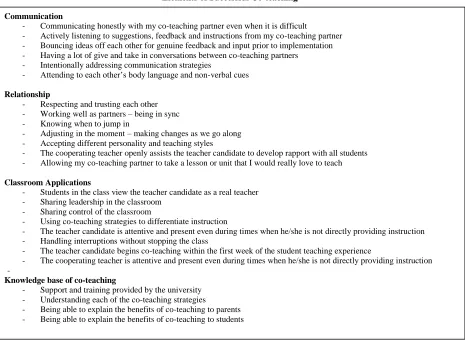
In analyzing the results of this instrument, researchers grouped items into five broad categories: planning, communication, relationship, classroom applications, and co-teaching knowledge base. These are the five over-riding themes in this data as well as in the focus group discussions with cooperating teachers and teacher candidates. Figure 1 shows the breakdown of the key elements. A mean rating was then calculated for each broad category.
Figure 1
Elements of Successful Co-teaching
Planning
- Sharing creative ideas and materials with each other - Planning together for co-taught instruction
- Teacher candidate assumes leadership in planning and teaching lessons - Coordinating tasks
- When leading instruction the teacher candidate assigns tasks and responsibilities to the cooperating teacher and other adults in the classroom
- Clarifying or making instructional decisions explicit - Plan specifically not in generalities
Communication
- Communicating honestly with my co-teaching partner even when it is difficult
- Actively listening to suggestions, feedback and instructions from my co-teaching partner - Bouncing ideas off each other for genuine feedback and input prior to implementation - Having a lot of give and take in conversations between co-teaching partners
- Intentionally addressing communication strategies
- Attending to each other’s body language and non-verbal cues
Relationship
- Respecting and trusting each other - Working well as partners – being in sync - Knowing when to jump in
- Adjusting in the moment – making changes as we go along - Accepting different personality and teaching styles
- The cooperating teacher openly assists the teacher candidate to develop rapport with all students - Allowing my co-teaching partner to take a lesson or unit that I would really love to teach
Classroom Applications
- Students in the class view the teacher candidate as a real teacher - Sharing leadership in the classroom
- Sharing control of the classroom
- Using co-teaching strategies to differentiate instruction
- The teacher candidate is attentive and present even during times when he/she is not directly providing instruction - Handling interruptions without stopping the class
- The teacher candidate begins co-teaching within the first week of the student teaching experience
- The cooperating teacher is attentive and present even during times when he/she is not directly providing instruction
-Knowledge base of co-teaching
- Support and training provided by the university - Understanding each of the co-teaching strategies
Based on the six point Likert scale, with 1 = not at all important and 6 = extremely important, the mean ratings of each category were as follows in Table 2.
Table 2
Descriptive Statistics – Essential Elements of Co-teaching
Element Number of Items Range of ratings Mean Standard Deviation
Planning 497 2-6 5.17 .87
Communication 432 2-6 5.12 .91
Relationship 495 1-6 5.11 .94
Classroom Applications 572 1-6 5.06 1.06
Co-teaching Knowledge Base 270 1-6 4.24 1.35
It is evident from this data that the five broad areas identified as essential to co-teaching are intertwined. In other words, it is not possible to successfully co-teach without dedicated planning time and good communication skills. Knowledge of the co-teaching strategies alone is not sufficient to create successful co-teaching. On the other hand, developing a supportive relationship is insufficient in and of itself. Successful co-teachers also need knowledge of the strategies, and an understanding and commitment to applying these in a classroom setting. In order for co-teaching in student teaching to be successful, each of the five elements must be explicitly addressed and nurtured.
SUMMARY
As co-teaching expands into the realm of student teaching, it is essential for universities and their partner districts to examine those components that are critical to the success of a co-teaching partnership. The results of this study delineate five inter-related components critical to the success of co-teaching including planning, communication, relationship, classroom applications and co-teaching knowledge. We must not assume that these components occur naturally in the student teaching partnership. Each of these key elements must be purposefully incorporated into the co-teaching experience. As universities begin adopting a co-teaching model of student teaching, the findings presented here provide guidance for establishing strong and successful co-teaching partnerships.
REFERENCES
1. Bacharach, N, Heck, T, & Dahlberg, K. (2007). Collaboratively researching the impact of a co-teaching model of student teaching. Paper presented at the annual meeting of the American Educational Research Association, Chicago, IL.
2. Bacharach, N., Heck, T., Dahlberg, K., & Hoover. (2007). Changing the face of student teaching through Co-teaching. Manuscript under revision for Journal of Teacher Education. .
3. Guyton, E., & McIntyre, D. (1990). Student teaching and school experiences. In W.R. Houston, M Haberman, 7 Sikula (Eds). Handbook of research on Teacher Education, New York: Macmillan. 4. Heck, T., Bacharach, N., & Dahlberg, K. (2007). Changing the face landscape of student teaching: The
Co-teaching experience. Paper presented at the annual meeting of the Association of Teacher Educators, San Diego, CA.
5. Heck, T. Bacharach, N., Dahlberg, K., Ofstedal, K., Mann, B., & Wellik, J. (2007). Extreme Makeover: Student Teaching Edition. Paper presented at the annual meeting of the Association of Teacher Educators, San Diego, CA.
7. Perl, M., Maughmer, B. & McQueen, C. (1999). Co-teaching: A different approach for cooperating teachers and student teachers. Paper presented at the annual meeting of the American Educational Research Association, Chicago, IL.