University of Pennsylvania
ScholarlyCommons
Publicly Accessible Penn Dissertations
1-1-2016
High-Level Abstractions for Programming
Network Policies
Yifei Yuan
University of Pennsylvania, [email protected]
Follow this and additional works at:
http://repository.upenn.edu/edissertations
Part of the
Computer Sciences Commons
This paper is posted at ScholarlyCommons.http://repository.upenn.edu/edissertations/2119
For more information, please [email protected].
Recommended Citation
Yuan, Yifei, "High-Level Abstractions for Programming Network Policies" (2016).Publicly Accessible Penn Dissertations. 2119.
High-Level Abstractions for Programming Network Policies
Abstract
The emergence of network programmability enabled by innovations such as active
network-ing, SDN and NFV offers tremendous flexibility to program network policies. However,
it also poses a new demand to network operators on programming network policies. The
motivation of this dissertation is to study the feasibility of using high-level abstractions to
simplify the programming of network policies.
First, we propose scenario-based programming, a framework that allows network operators to program stateful network policies by describing example behaviors in representative
scenarios. Given these scenarios, our scenario-based programming tool NetEgg automatically infers the controller state that needs to be maintained along with the rules to process network events and update state. The NetEgg interpreter can execute the generated policy implementation on top of a centralized controller, but also automatically infers
flow-table rules that can be pushed to switches to improve throughput. We study a range of policies
considered in the literature and report our experience regarding specifying these policies using scenarios. We evaluate NetEgg based on the computational requirements of our synthesis algorithm as well as the overhead introduced by the generated policy implementation. Our results show that our synthesis algorithm can generate policy implementations in seconds, and the automatically generated policy implementations have performance comparable to their hand-crafted implementations. Our preliminary user study results show that NetEgg was able to reduce the programming time of the policies we studied.
Second, we propose NetQRE, a high-level declarative language for programming quantitative network policies that require monitoring a stream of network packets. Based on a novel theoretical foundation of parameterized quantitative regular expressions, NetQRE integrates regular-expression-like pattern matching at flow-level as well as application-level payloads with aggregation operations such as sum and average counts. We describe a compiler for NetQRE that automatically generates an efficient implementation from the specification in NetQRE. Our evaluation results demonstrate that NetQRE is expressive to specify a wide range of quantitative network policies that cannot be naturally specified in other systems. The performance of the generated implementations is comparable with that of the manually-optimized low-level code. NetQRE can be deployed in different settings. Our proof-of-concept deployment shows that NetQRE can provide timely enforcement of quantitative network policies.
Degree Type Dissertation
Degree Name
Graduate Group
Computer and Information Science
First Advisor Rajeev Alur
Second Advisor Boon T. Loo
Keywords
network policy, network programming
HIGH-LEVEL ABSTRACTIONS FOR PROGRAMMING
NETWORK POLICIES
Yifei Yuan
A DISSERTATION
in
Computer and Information Science
Presented to the Faculties of the University of Pennsylvania in Partial
Fulfillment of the Requirements for the Degree of Doctor of Philosophy
2016
Rajeev Alur
Zisman Family Professor of Computer and Information Science Supervisor of Dissertation
Boon Thau Loo
Associate Professor of Computer and Information Science Co-Supervisor of Dissertation
Lyle Ungar
Professor of Computer and Information Science Graduate Group Chairperson
Dissertation Committee
Andreas Haeberlen, Associate Professor of Computer and Information Science (Chair)
Jonathan M. Smith, Professor of Computer and Information Science
Insup Lee, Cecilia Fitler Moore Professor of Computer and Information Science
Sanjit A. Seshia, Associate Professor of Electrical Engineering and Computer Sciences,
HIGH-LEVEL ABSTRACTIONS FOR PROGRAMMING NETWORK POLICIES
COPYRIGHT
2016
Acknowledgments
First of all, I would like to thank my advisors Professor Rajeev Alur and Professor
Boon Thau Loo. Rajeev provided me with well-framed training in formal methods and
Boon introduced me into the area of computer networks. With their mentoring, I was able
to find this dissertation topic and complete this work. I also learned from Rajeev and Boon
essential academic skills; both of them provided me with constructive advice on shaping my
research ideas, solving the research problems and presenting the results.
I would also like to thank my dissertation committee, including Professor Andreas
Hae-berlen, Profesor Jonathan M. Smith, Professor Insup Lee and Professor Sanjit A. Seshia.
They offered me insightful comments and detailed feedbacks on the dissertation, which
helped me significantly on improving it.
I also want to give credit to my collaborators who have helped me on this dissertation
work. Dong Lin, Shanni Xi, Harsh Verma and Siri Anil worked with me on the NetEgg
project, and Dong Lin, Ankit Mishra, Sajal Marwaha collaborated with me on the NetQRE
project. Their contribution was remarkably valuable in the implementation and the
exper-iments of both projects.
In addition, I feel grateful for my family’s unconditional support on my career pursuit.
Their love always encourages me and inspires me in my life. I specially want to thank my
wife with whom I spent an enjoyable and enriched time during my Ph.D. years at Penn.
Moreover, I am thankful for the friends I made throughout these years at Penn: Mingchen
Zhao, Zhepeng Yan, Ang Chen, Chen Chen, Loris D’Antoni, Mukund Raghothaman,
Ab-hishek Udupa, Salar Moarref, Nimit Singhania and many others. In particular, I should
thank Ang Chen for his help on submitting the hard copy of this dissertation for me while
This dissertation work was partially supported by NSF Expeditions in Computing award
ABSTRACT
HIGH-LEVEL ABSTRACTIONS FOR PROGRAMMING NETWORK POLICIES
Yifei Yuan
Rajeev Alur
Boon Thau Loo
The emergence of network programmability enabled by innovations such as active
network-ing, SDN and NFV offers tremendous flexibility to program network policies. However,
it also poses a new demand to network operators on programming network policies. The
motivation of this dissertation is to study the feasibility of using high-level abstractions to
simplify the programming of network policies.
First, we propose scenario-based programming, a framework that allows network
opera-tors to program stateful network policies by describing example behaviors in representative
scenarios. Given these scenarios, our scenario-based programming tool NetEgg
automati-cally infers the controller state that needs to be maintained along with the rules to process
network events and update state. The NetEgg interpreter can execute the generated policy
implementation on top of a centralized controller, but also automatically infers flow-table
rules that can be pushed to switches to improve throughput. We study a range of policies
considered in the literature and report our experience regarding specifying these policies
us-ing scenarios. We evaluate NetEgg based on the computational requirements of our synthesis
algorithm as well as the overhead introduced by the generated policy implementation. Our
results show that our synthesis algorithm can generate policy implementations in seconds,
and the automatically generated policy implementations have performance comparable to
their hand-crafted implementations. Our preliminary user study results show that NetEgg
was able to reduce the programming time of the policies we studied.
Second, we propose NetQRE, a high-level declarative language for programming
quan-titative network policies that require monitoring a stream of network packets. Based on
a novel theoretical foundation of parameterized quantitative regular expressions, NetQRE
payloads with aggregation operations such as sum and average counts. We describe a
compiler for NetQRE that automatically generates an efficient implementation from the
specification in NetQRE. Our evaluation results demonstrate that NetQRE is expressive to
specify a wide range of quantitative network policies that cannot be naturally specified in
other systems. The performance of the generated implementations is comparable with that
of the manually-optimized low-level code. NetQRE can be deployed in different settings.
Our proof-of-concept deployment shows that NetQRE can provide timely enforcement of
Contents
1 Introduction 1
2 NetEgg: Scenario-based Programming for SDN Policies 6
2.1 Overview of NetEgg . . . 7
2.1.1 Illustrative Example . . . 7
2.1.2 State Tables . . . 9
2.1.3 Policy Tables . . . 10
2.1.4 Interpreter . . . 11
2.2 NetEgg Model . . . 12
2.2.1 Scenario-based Programming Framework . . . 12
2.2.2 Policy Model . . . 14
2.3 Policy Generation . . . 16
2.3.1 The Policy Learning Problem . . . 16
2.3.2 Conflict Detection . . . 17
2.3.3 Policies withouttests. . . 20
2.3.4 Policies withtests . . . 21
2.3.5 Putting It Together . . . 23
2.3.6 Additional Heuristics . . . 24
2.4 Policy Execution . . . 25
2.5 Use Cases . . . 27
2.5.1 Learning Switch . . . 27
2.5.2 Stateful Firewall . . . 28
2.5.4 ARP Proxy . . . 30
2.6 Evaluation . . . 32
2.6.1 Feasibility . . . 32
2.6.2 Performance Overhead . . . 34
2.6.3 Rule Installation . . . 36
2.7 User Study . . . 37
2.7.1 Setup . . . 37
2.7.2 Results . . . 38
2.8 Discussion . . . 41
3 NetQRE: Specification and Implementation for Quantitative Network Policies 43 3.1 Overview . . . 44
3.1.1 Examples . . . 45
3.2 The NetQRE Language . . . 48
3.2.1 Pattern Matching over Streams . . . 49
3.2.2 Conditional Expressions . . . 50
3.2.3 Stream Split . . . 51
3.2.4 Stream Iteration . . . 53
3.2.5 Aggregation over Parameters . . . 53
3.2.6 Stream Composition . . . 54
3.3 Use Cases . . . 55
3.3.1 Flow-level Traffic Measurements . . . 55
3.3.2 TCP State Monitoring . . . 57
3.3.3 Application-level Monitoring . . . 58
3.4 Compilation Algorithm . . . 59
3.4.1 Compilation of PSRE . . . 60
3.4.2 Compilation ofsplit . . . 62
3.4.3 Compilation ofiter . . . 63
3.4.4 Compilation of Aggregation . . . 65
3.5 Implementation . . . 66
3.6 Evaluation . . . 67
3.6.1 Expressiveness . . . 67
3.6.2 Throughput Performance . . . 68
3.6.3 Real-time Response . . . 69
3.6.4 Summary of Evaluation . . . 72
4 Related Work 73 4.1 Domain Specific Languages in Networking . . . 73
4.2 Network Verification and Testing . . . 75
4.3 Program Synthesis . . . 76
4.4 Other Topics . . . 76
4.4.1 Streaming Database Languages . . . 77
4.4.2 Intrusion Detection Systems and Protocol Analyzers . . . 77
4.4.3 Deep Packet Inspection . . . 77
5 Conclusion 78 5.1 Contributions . . . 78
5.2 Future Work . . . 79
5.2.1 Interaction between Network Programmer and Programming Frame-work . . . 79
5.2.2 Network Verification and Synthesis . . . 79
List of Tables
2.1 The policy table for the learning switch. . . 10
2.2 An inconsistent policy table. . . 16
2.3 A consistent yet restrictive policy table. . . 17
2.4 A policy table sketch for the learning switch. . . 21
2.5 The policy table for the learning switch. . . 28
2.6 The policy table for the first stateful firewall. . . 28
2.7 The policy table for the second stateful firewall. . . 29
2.8 The policy table for the third stateful firewall. . . 30
2.9 The policy table for the TCP firewall. . . 31
2.10 The policy table for the ARP proxy. . . 32
2.11 Network policies generated from scenarios. #SC is the number of scenarios used to synthesize the policy, #EV is the total number of events in scenarios, Time is the running time of the synthesizer. . . 33
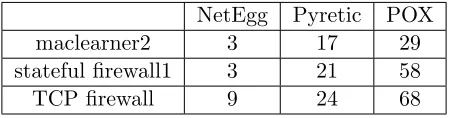
2.12 Lines of code to implement policies in different programming abstractions. We report the total number of events in scenarios for NetEgg, lines of code for Pyretic and POX implementations. . . 34
List of Figures
1.1 High-level programming framework. . . 4
2.1 NetEgg architecture. . . 8
2.2 A scenario describing the learning switch. In the scenario, a packet is denoted by a 3-tuple: hincoming port, source MAC, destination MACi. . . 8
2.3 The interpreter pseudocode. . . 11
2.4 An illustrative execution. . . 12
2.5 Scenario-based programming model. . . 13
2.6 The scenario corresponding to Figure 2.2 for the learning switch example. . . . 13
2.7 A firewall example. . . 21
2.8 Scenario-based program for the learning switch. . . 27
2.9 Scenario-based program for the first stateful firewall. . . 28
2.10 The modified scenario for the second stateful firewall. . . 29
2.11 The added scenario for the third stateful firewall. . . 29
2.12 Scenario-based program for the TCP firewall. . . 31
2.13 Scenario-based program for the ARP proxy. . . 32
2.14 Response time for POX and NetEgg implementations. . . 35
2.15 HTTP connection time. . . 36
2.16 Effects of flow table rule installation. . . 37
2.17 Web-based GUI of NetEgg. . . 38
2.18 Programming time comparison. . . 39
2.19 The “Score of intuitiveness” rate. . . 40
3.2 Syntax of NetQRE expressions. . . 49
3.3 Illustration of split. . . 52
3.4 Illustration ofiter. . . 53
3.5 An example PSA. . . 60
3.6 Example run ofsplit. . . 62
3.7 Example run ofiter. . . 65
3.8 Normalized throughput comparison. . . 68
3.9 SYN flood: Bandwidth utilization (Mbps) at the server. . . 70
3.10 Heavy hitter detection: Bandwidth utilization (Mbps) at the server. . . 71
Chapter 1
Introduction
Recent years have seen the emergence of programmability in computer networks enabled
by a wave of revolutionary innovations, including active networking [85], SDN [65], and
NFV [30]. For example, software-defined networking (SDN) [65] promises rapid service
provisioning and agile network management by decoupling the control plane and the data
plane in networks. A logically centralized controller in SDN offers a global view of the
network and application programming interfaces (API) to enforce a variaty of network
policies. Furthermore, network functionality virtualization (NFV) [30] aims at shifting
network functions from a range of dedicated hardware to software deployed on
general-purpous computers. By programing network functions in software, NFV promises low
cost and high flexibily in deploying and managing network services. Not even mentioning
previous proposed active networking
This new wave of innovations offers network operators tremendous flexibility to
pro-gram custom network policies, ranging from traffic steering [14, 46, 90] to dynamic access
control [55, 71], from dynamic service chaining [39, 74] to network function migration [42].
While network programmability promises the aforementioned benefits, it poses a higher
(if not totally new) demand to network operators on programming. In order to thoroughly
understand the innovation trend and the challenges that come with it, in the fall of 2015 we
conducted informal interviews with 101 network operators, architects and engineers from
universities, telcos, service providers and router vendors, in the NSF I-Corps program [7].
that network operators will need to program networks in the future. Second, they might lack
the required programming skills to program reliable networks. Our observations are
consis-tent with the online discussions we studied [10, 24, 25], which suggest that programming is
becoming an essential skill set for network operators, and it requires network operators to
have a deeper understanding on network programming.
To ease the job of programming network policies, in this disseratation, we study the
feasibility of using high-level abstractions for programming a range of network policies.
First, we consider stateful network policies which make decisions on each packet based
on the state it maintains and also update the state accordingly. As an example, consider
the following policy.
Example 1 (Learning switch). Consider the example where a network operator wants to
program a learning switch policy supporting migration of hosts on top of the controller for a
single switch. The learning switch learns incoming ports for hosts. For an incoming packet,
if the destination MAC address is learned, it sends this packet out to the port associated
with the destination MAC address; otherwise it floods the packet. To support migration of
hosts, the learning switch needs to remember the latest incoming port of a host.
To implement this policy, a network operator first has to manually maintain the state
indicating whether a port has been learned for a MAC address and also the mapping between
the hosts and incoming ports. Second, the network operator has to implement the logic to
update the state as each packet arrives. Third, in order to improve the throughput, the
network operator may need to manually update the flow table rules on the switch as the
state changes, which is nontrivial and error-prone [88]. As a result, it may be difficult and
time-consuming to implement this policy (see Section 2.6 and 2.7).
On the other hand, illustrating how the policy behaves seems much simpler and more
intuitive. For example, one can describe the behavior of this policy in a scenario using an
ex-ample trace of packets together with the actions that should be applied to each packet in the
trace. An interesting question is that can wesynthesize the desired policy implementation
automatically from the example behaviors.
Second, we consider the network policies which may involve quantitative metrics
addi-tionally. As an example, consider the following policy.
mon-itors the usage of Voice-over-IP (VoIP) for each user, and alert the user whose usage is
significantly higher than the average usage over all users. We use the Session Initiation
Protocol (SIP) used in VoIP applications as our example. Typically, a call based on SIP
consists of three phases, init, call, and end. In the init phase, the caller and the callee
exchange messages (e.g. call ID, user name, the connection channel) in order to set up the
call session. Once established, the call phase allows VoIP data to be transmitted between
the caller and callee using the channel defined in the first phase. Finally, either side can
end the call as shown in theend phase.
To analyze the SIP call in the midst of network traffic from all types of protocols,
the protocol analyzer is required to (1) identify all SIP traffic traversing the network, (2)
separate the SIP traffic into different sessions for different caller/callee pairs, (3) group
packets within each session into phases (init, call, and end), and then perform a count
of bytes within the second (call) phase. Again, the network operator may face a set of
difficulties in manually maintaining the state (e.g. the state of SIP, the VoIP traffic count
of each call) and implementing the logic to update the state.
Unlike the previous example, it is not clear how to describe this policy using its example
behaviors. Instead, we explore the feasibility of specifying the policy in a high-level
declar-ative fashion. The challenge is to design a reasonably expressive specification language to
capture a wide range of such quantitative policies, together with the compilation techniques
in order to compile the specifications into efficient implementations.
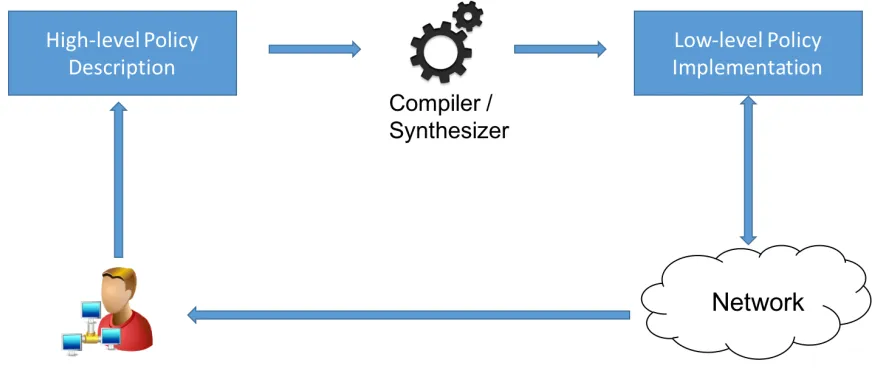
Figure 1.1 illustrates the overview of our framework. To program a network policy,
the network operator simply describes the network policy in a declarative way using
high-level abstractions. The network operator does not need to implement low-high-level details of
the policy, such as what state to maintain and how to update it. Given the high-level
description of the network policy, a tool (e.g. a compiler, a synthesizer) automatically
generates the correponding low-level policy implementation that can run efficiently on the
network. As part of this generation, the tool automatically infers the state that needs to
be maintained from the high-level description, and generates the code that is necessary to
update the state.
In particular, this dissertation proposes the following two high-level programming
Figure 1.1: High-level programming framework.
• First, we propose scenario-based programming, a framework that allows network
op-erators to program stateful SDN policies, such as the one described in Example 1, by
describing itsexample behaviors in representative scenarios.
We have developed the NetEgg tool, including a synthesis algorithm and an interpreter
for executing policies. Given the scenarios as input, our synthesizer automatically
generates a controller program that is consistent with example behaviors, including
inferring the state that needs to implement the network policy, and rules for processing
packets and updating the state. The interpreter executes the generated policy program
for incoming network events on the controller, as well as infers rules that can be pushed
onto switches.
We validate the NetEgg tool by synthesizing SDN programs that use the POX
con-troller directly from examples. Our tool is agnostic to the choice of SDN concon-trollers,
and can also be used in non-SDN settings. We demonstrate that using our approach,
we are able to synthesize a range of network policies using a small number of
exam-ples in seconds. The synthesized controller program has low performance overhead
and achieves comparable performance to equivalent imperative programs implemented
manually in POX. Moreover, the example scenarios are concise compared to
equiv-alent imperative programs. Our preliminary user study results show that NetEgg is
• Second, we propose NetQRE, a specification language and toolkit for quantitative
network policies, such as the example policy in Example 2.
NetQRE is declarative language for monitoring network packet streams based on a
novel theoretical foundation ofparameterized quantitative regular expressions(PQRE).
PQRE extends prior work on QRE [18], which provides a formal foundation of
combin-ing traditional regular expressions with numerical computations. NetQRE integrates
regular-expression-like pattern matching at flow-level and application-level payloads
with aggregation operations such as sum and average counts.
We developed a compiler that can automatically generate efficient NetQRE
imple-mentations. As part of the compilation process, the compiler automatically infers the
state that needs to be maintained for NetQRE programs, and optimizes the compiled
imperative code. A NetQRE runtime then executes the generated code efficiently.
We have developed a NetQRE prototype which we evaluate over a range of
quanti-tative network policies. As a proof-of-concept deployment, we consider an evaluation
scenario where the NetQRE runtime taps into mirrored traffic within SDN switches,
and is integrated with an SDN controller. Our evaluation results demonstrate that
NetQRE can express a wide range of quantitative network policies that cannot be
naturally specified in other systems, results in performance that is comparable with
optimized manually-written low-level code and is significantly more efficient compared
to monitoring solutions based on Bro [73] and OpenSketch [91].
In the rest of the dissertation, we first elaborate NetEgg in Chapter 2, followed by the
description of NetQRE in Chapter 3. We discuss related work in Chapter 4. Finally, we
conclude the dissertation and discuss potential research directions related to this topic in
Chapter 2
NetEgg: Scenario-based
Programming for SDN Policies
In this chapter, we decribe the tool NetEgg. NetEgg is a scenario-based programming
frame-work that allows netframe-work operators to program netframe-work policies by describing representative
example behaviors. Given these scenarios, the synthesis algorithm automatically infers the
controller state that needs to be maintained along with the rules to process network events
and update state. The NetEgg policy interpreter can execute the generated policy
imple-mentation on top of a centralized controller, but also automatically infers flow-table rules
that can be pushed to switches to improve throughput.
The rest of this chapter is organized as follows. First, we provide an overview of NetEgg
in Section 2.1. We use the learning switch policy as an example to illustrate the use of
NetEgg. Second, in Section 2.2 we describe the scenario-based programming framework,
which allows network operators to specify network policies using example behaviors in
sce-narios. Third, in Section 2.3 we describe the synthesizing algorithm that takes the scenarios
as input, and automatically generates a controller program that is consistent with example
behaviors, including inferring the state that is needed to implement the network policy and
rules for processing packets and updating states. Section 2.4 discusses how the interpreter
executes the generated policy program for incoming network events on the controller, as well
as infers rules that can be pushed onto switches. We show how to use NetEgg to program
which show that the synthesized policy implementation has low performance overhead and
achieves comparable performance to equivalent imperative programs implemented manually
in POX. We present our preliminary user study result in Section 2.7. Finally, we end this
chapter with a discussion in Section 2.8.
This chapter is based on the work orginially published in [93, 94].
2.1
Overview of NetEgg
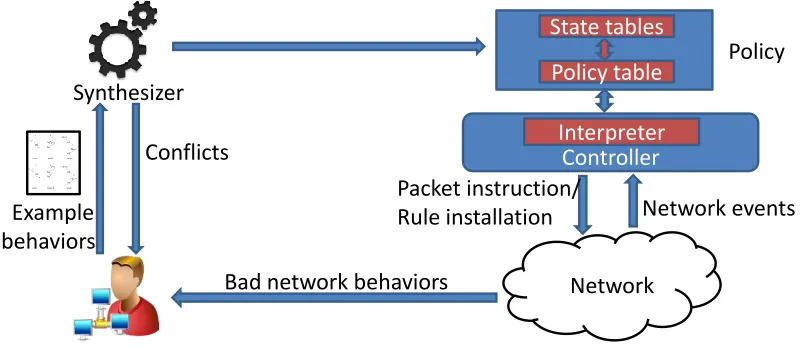
Figure 2.1 provides a high-level overview of NetEgg. The network operator describes
ex-ample behaviors about the desired network policy in representative scenarios to NetEgg.
These scenarios can be expressed either in network timing diagrams using the graphic user
interface (see Figure 2.17), or in a configuration language, which we will describe in
Sec-tion 2.2. Given these scenarios, NetEgg first checks whether there exist conflicts among
the scenarios. If two scenarios conflict with one another, NetEgg displays the conflict to
the network operator. After the operator resolves all conflicts, NetEgg tries to generate a
policy described in the scenarios.
The generated policy uses a set of state tablesand a policy table. State tables maintain
the state used to remember the history of a policy execution. The policy table dictates
the actions for processing incoming network events and updates to state tables for various
cases.
When executing the policy, the interpreter, sitting on top of the controller, looks up the
policy table for incoming network events (e.g. packetin, connectionup and other events),
which will determine state table updates and actions to be applied to the network events.
Moreover, NetEgg automatically infers rule updates to the data plane from current state of
the policy execution, thus reducing controller overhead and network delay.
While NetEgg is general to handle any network events, we focus on packetin events in
this paper in order to simplify our presentation.
2.1.1 Illustrative Example
To illustrate the use of NetEgg, let us revisit the learning switch example introduced in
Network
Example
behaviors
Synthesizer
Policy table
Controller
Interpreter
Policy
Conflicts
Network events
Packet instruction/
Rule installation
State tables
Bad network behaviors
Figure 2.1: NetEgg architecture.
supporting migration of hosts on top of the controller for a single switch. The learning
switch learns incoming ports for hosts. For an incoming packet, if the destination MAC
address is learned, it sends this packet out to the port associated with the destination MAC
address; otherwise it floods the packet. To support migration of hosts, the learning switch
needs to remember the latest incoming port of a host.
To program the policy, the network operator simply describes example behaviors of the
policy in representative scenarios, in the form of network timing diagrams. Figure 2.2 shows
a scenario described by network operators.
Scenario 1
flood
<
P
1,
h
1,
h
2>
<P
2,
h
3,
h
1>
send(P
1)
<P
3,
h
2,
h
3>
send(P
2)
Figure 2.2: A scenario describing the learning switch. In the scenario, a packet is denoted by a 3-tuple: hincoming port, source MAC, destination MACi.
the policy using three packets. The first packet arriving on port P1 with source MAC
addressh1 and destination MAC addressh2 is flooded by the switch, since no port has been
learned for h2. The second packet from h3 to h1 should be sent directly to the port P1,
according to the port learned from the first packet. The third packet from h2 toh3 should
be sent to the port P2, since the second packet indicts that h3 is associated with port P2.
Note that instead of using real port numbers and MAC addresses in the packet, the network
operator uses variablesfor each field. The variables stand for a variety of concrete values.
Given this scenario, NetEgg automatically synthesizes the desired program. The
syn-thesized program can be executed on the SDN controller, as well as install flow table rules
onto switches. As part of the program generation, NetEgg automatically generates the data
structures and code necessary to implement the policy.
Network operators may further test the synthesized program using existing verification
and testing techniques, and refine the program if needed. As part of refinement, network
operators simply illustrate new scenarios (e.g. obtained from counter examples) to NetEgg,
and NetEgg automates the refinement by synthesizing a new program from the new set of
scenarios. We will demonstrate more use cases in Section 2.5.
Using the learning switch example, in the following subsections, we first describe the
state tables that are generated by our tool, before describing the policy.
2.1.2 State Tables
In our example, the learning switch needs to remember whether a port is learned for a
MAC address, and if learned, which port is associated with the MAC address. Hence, the
generated policy maintains a state table ST, which stores a state and a value (in this case a port number) for each MAC address. An example of the snapshot ofST is shown below.
MAC state value
A 1 2
OP... ... ...
1. Initially, the program assigns all states in the table to be0. The program accounts for
two cases: 1) When the destination port is unknown, it floods the packet through all ports;
2) When the incoming packet’s destination port is known, it sends the packet out through
the port associated with the destination MAC address. In both cases, the state associated
with the source MAC address is set to be 1, and the incoming port for the source MAC
address is remembered.
2.1.3 Policy Tables
The state table is manipulated by rules implementing the desired policy. These rules are
captured in a policy table, as shown in Table 2.1 for the learning switch example. We delay
the discussion of its generation to Section 2.3.
match test actions update
* ST(dstmac).state=0 flood ST(srcmac):=(1, port)
* ST(dstmac).state=1 send(ST(dstmac).value) ST(srcmac):=(1, port) Table 2.1: The policy table for the learning switch.
The policy table contains two rules, represented as the two rows in the table,
corre-sponding to the two cases in the program described above. Every rule has four components:
match, test, actions and update. The match specifies the packet fields and corresponding
values that a packet should match. In this example, no matches need to be specified and
we use ∗ to denote the wildcard. The test is a conjunction ofchecks, each of which checks
whether the state associated with some fields in a state table equals a certain value. For
ex-ample, thetestin the second rule has onecheckST(dstmac).state=1, which checks whether the state associated with the dstmac address of the packet is 1 in ST. Theactions define the actions that are applied to matched packets. In this example, the action in the first rule
floods the matched packet to all ports and the action send(ST(dstmac).value) in the second rule first reads the value (in this case, the port) stored inST for the dstmac address of the matched packet, and sends the packet to that port. Theupdateis a sequence ofwrites, each
of which changes the state and value associated with some fields in a state table to certain
address of the packet to the port of it.
2.1.4 Interpreter
The interpreter processes incoming packets at the controller using the policy table. The
pseudocode of the interpreter is shown in Figure 2.3. The interpreter matches each incoming
packet against each rule in the policy table in order. A rule is matched, if the packet fields
match the match and all checks in the test of the rule are satisfied. The first matched
rule applies actions to the packet, and state tables are updated according to the update
of the rule. Moreover, NetEgg automatically infers the rules that can be installed on the
data plane from the latest configuration of state tables. The corresponding function is
update flowtable in the pseudocode. We will describe policy execution in more detail in
Section 2.4.
Input: a packet p
for i= 1 to ndo
if rule ri matchesp then
execute the actionsand updateof rule ri onp
update flowtable(p) return
end if end for
apply default actions to p
Figure 2.3: The interpreter pseudocode.
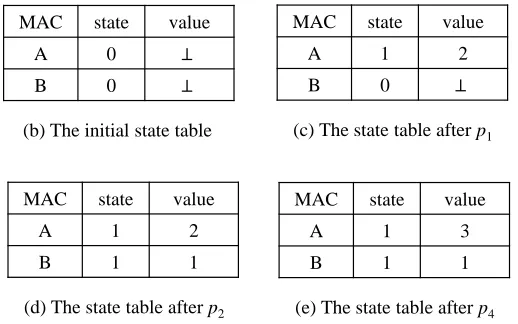
Example. Figure 2.4 shows an illustrative execution for the incoming packet trace in
subfigure (a). Since the purpose of this example is to illustrate how a policy table is
executed, we assume that every packet is processed on the controller. Initially, all states
in the state tableST are0, and all values are⊥, meaning unknown, as shown in subfigure (b). The first packetp1 is matched against each rule in Table 2.1 in order at the controller.
The first matched rule is the first rule, sincep1 matches thematch (∗) and the state of the
field dstmac ofp1 inST is0, satisfying thecheck (ST(dstmac).state=0) intest of the rule.
Therefore, the rule applies the actionwhich instructs the switch to flood p1, and updates
the state table as in subfigure (c). The second packet p2 in the trace matches the second
2, which is stored in the state table associated with MAC address A. Applying the update
of the rule, we get the state table as in subfigure (d). The third packet p3 matches the
second rule in the policy table, and the updated state table remains the same and thus not
shown here. The last packet p4 suggests that the host with MAC address A has migrated
to port 3. This packet matches the second rule in the policy table and gets sent to port 1.
Subfigure (e) shows the state table after applying theupdate.
p2:<port=1, srcmac=B, dstmac=A>
p3:<port=2, srcmac=A, dstmac=B>
p4:<port=3, srcmac=A, dstmac=B>
p1:<port=2, srcmac=A, dstmac=B> MAC state value
A 0 ⊥
B 0 ⊥
(a) An example packet trace (b) The initial state table (c) The state table after p1
MAC state value
A 1 2
B 0 ⊥
(d) The state table after p2
MAC state value
A 1 2
B 1 1
(e) The state table after p4
MAC state value
A 1 3
B 1 1
Figure 2.4: An illustrative execution.
2.2
NetEgg Model
In this section, we first describe the scenario-based programming model of NetEgg, and
explain how this model allows the operator to describe example network behaviors in
repre-sentative scenarios. Second, we define the policy model, which includes the model of state
tables and policy tables. We will show how to generate a policy from scenarios in the next
section.
2.2.1 Scenario-based Programming Framework
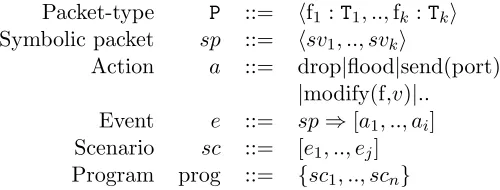
NetEgg provides a configuration language for expressing network timing diagrams. In this
language, variables and fields of packets are typed. Examples of base types we use are
bool,PORT,IP ADDR(set of IP addresses),MAC ADDR (set of MAC addresses). A packet-type
Packet-type P ::= hf1 :T1, ..,fk:Tki
Symbolic packet sp ::= hsv1, .., svki
Action a ::= drop|flood|send(port) |modify(f,v)|..
Event e ::= sp⇒[a1, .., ai]
Scenario sc ::= [e1, .., ej]
Program prog ::= {sc1, .., scn}
Figure 2.5: Scenario-based programming model.
the packet-type consists of three fields and is given by hport : PORT, srcmac : MAC ADDR,
dstmac : MAC ADDR i.
A (concrete) packet specifies a value for each field of type corresponding to that field.
A symbolic value of a typeTis either a concrete value of type T, or a variablex of type T. A symbolic packet specifies a symbolic value for each field.
We useActto denote the set of action primitives for processing packets. For the action
primitives with parameters, the user can use either concrete values or variables of the
corresponding type.
In NetEgg, we provide a library that supports standard packet fields and actions such
as drop, flood, send(port) (send to a port), modify(f,v) (modify the value of field f to v). Our tool also supports user-defined packet-type using customized field names and types, as
well as user-defined actions. One can generalize it by providing handlers for user-defined
fields and action primitives.
An event is a pair of a symbolic packet sp and a list of actions [a1, ..al], denoted as
sp ⇒ [a1, .., al]. A scenario is a finite sequence of events. A scenario-based program is a
finite set of scenarios.
With the notation, the scenario of Figure 2.2 can be written as in Figure 2.6.
P1,h1,h2⇒flood
P2,h3,h1⇒send(P1)
P3,h2,h3⇒send(P2)
Figure 2.6: The scenario corresponding to Figure 2.2 for the learning switch example.
A scenario is concrete if all the symbolic packets and actions appearing in the scenario
have only concrete values. A scenario-based program with symbolic scenarios can be viewed
by every possible value of the corresponding type with the following requirements. First, a
variable can only take values that have not appeared in the scenario-based program. Second,
if the same variable appears in multiple symbolic packets and actions in the program, then
it gets replaced by the same value. Third, different variables in a program get replaced by
different values. Thus, the symbolic scenario of Figure 2.2 corresponds to Πi=0,1,2(n−i)(l−i)
concrete scenarios if the typeMAC ADDRandPORTcontainnandldistinct values, respectively. The language itself is simple and can be viewed more as a configuration language rather
than a general-purpose programming language. We also build a visual tool that takes as
input scenarios drawn as actual network timing diagrams, and generate the configuration
(see Figure 2.17).
2.2.2 Policy Model
A policy consists of a policy table along with state tables that store the history of policy
execution.
State Tables. A state table is a key-value map that maintains states and values for
relevant fields. Let Tij be some base type appearing in the packet-type, S be a state set
with finitely many states, and the packet-type be hf1 : T1,..,fk : Tki. Ad-dimensional state
table ST stores a state in S and a value of typeTid+1, for all keys of typeTi1 ×..×Tid
The operations we allow on a state table are reads,checksand writes.
Let ST be a state table of type T1 ×..×Td → S ×Td+1, let f1,..fd be field names
of type T1,..,Td, respectively. A read of ST indexes some entry in ST, and is of the form
ST(f1,..,fd). AcheckofST checks whether the state associated with some key is a particular
state. Syntactically, it is a pair of aread and a state, written asST(f1,..,fd).state=s, where
s∈S is a state. In our example, ST(dstmac).state=0is a checkwith the field dstmac. In contrast to acheck, awriteof a state table changes the state along with the value associated
with some key. AwriteofST is of the formST(f1,..,fd):=(sv,fv). Here, sv is either a state,
or - representing no change. fv is either a concrete value of type Td+1, - representing no
change, or a field name of type Td+1. In our example, ST(srcmac):=(1,port) is a write of
ST with the field srcmac.
initial configuration of the state table in our example maps every MAC address to (0,⊥)
as shown in figure 2.4(b). Here, we use ⊥to represent the fact that no value is stored. A
read ST(f1,..,fd) for a packet p at a configuration c returns the state-value pair stored in
ST for the key (p.f1, .., p.fd) atc. We useST(f1,..,fd).state andST(f1,..,fd).value to denote
the state and value in the returned pair. Acheck ST(f1,..,fd).state=sis true for a packetp
at a configuration c if the state read from ST at the configuration c is s. In the example in Figure 2.4, ST(dstmac).state=0 is true for p1 at the initial configuration (subfigure
(b)) of ST. A write ST(f1,..,fd):=(sv,fv) for a packet p writes the state-value pair to the
corresponding entry indexed by the read. Note that if sv(fv, resp.) is -, the writedoes not
write any state(value, resp.) toST, and if fv specifies a field name, the value ofp.fv should be written.
Policy Tables. Given a set of state tablesT, a ruler based onT has four components, namely, match, test, actions and update. match is of the form hf1=v1,..,fk=vki, where fi is
a name of a packet field, and vi is a concrete value or a wildcard. A packet p matches
hf1=v1,..,fk=vki iff vi is a wildcard, or p.fi = vi for all i = 1 to k. The actions is a list
of actions using action primitives in Act. In the case where an action primitive accepts
parameters, the parameters can be concrete values or values read from state tables in T
using reads. test is a conjunction ofchecks and update is a sequence of writes, where each
check/write is of some state table in T. As an example, last two rows in Table 2.1 are two
rules. Apolicy table based onT is an ordered list of rules, and every rule is based on T.
A configurationC of a policy consists of all the configurations of each state table inT,
on which the policy table is based. A packet p matches a rule at a configuration C iff p
matches match and every check in test is true for p at the corresponding configuration in C. Suppose the first matched rule for a packet p at a configuration C is r. Then actions of r will be executed onp and every writein update of r will be executed. We denote the execution for packet p as C −p/as−−→P T C0, with C0 the new configuration, and as the actions
2.3
Policy Generation
Given a set of scenarios describing a policy, our synthesizer first checks if there are conflicts
among the scenarios. If there are no conflicts existing in the scenario, NetEgg tries to
generate a policy consistent with all scenarios.
In this section, we first describe the objective policies NetEgg aims to generate. Then we
describe how to detect conflicts in the scenarios. Finally, we present the synthesis algorithm
for scenarios without conflicts in steps.
2.3.1 The Policy Learning Problem
First, we note that, since the input scenarios describe the behaviors of the desired policy
in representative scenarios, the generated policy should beconsistentwith all the behaviors
described in all scenarios.
Definition 1 (Consistency). Given a concrete scenario SC = [sp1 ⇒as1, .., spk⇒ask], a
policy table P T is consistent with SC iff Ci−1
spi/asi
−−−−→P T Ci for i= 1, .., k, where C0 is the initial configuration in which every state table maps every key to the initial state 0 and a
value of ⊥. A policy table is consistent with a scenario-based program, iff it is consistent
with all the concrete scenarios represented by the scenario-based program.
As an example, the policy given in Table 2.1 is consistent with the scenario in Figure 2.2.
However, the following policy is not consistent with the scenario, since it floods the third
packet in the scenario instead of sending it toP2.
match test actions update
* ST(dstmac).state=0 flood ST(srcmac):=(1, port)
* ST(dstmac).state=1 send(ST(dstmac).value) ST(srcmac):=(-, -) Table 2.2: An inconsistent policy table.
In addition to consistency, NetEgg also aims to generate a generalized policy from input
scenarios. For this, we aim at generating a consistent policy with minimal number of rules.
To see how this heuristic can help to generate a general policy, let us consider the 3-rule
policy table in Table 2.3. It can be verified that the policy is consistent with the scenario
fourth packet such as hP1, h4, h2i, because this packet would be flooded by the policy. On
the other hand, the desired policy in Table 2.1 only uses two rules, and can handle the
fourth packet mentioned above correctly.
match test actions update
* ST(dstmac).state=0 flood ST(srcmac):=(1, port)
* ST(dstmac).state=1 send(ST(dstmac).value) ST(srcmac):=(2, port) * ST(dstmac).state=2 send(ST(dstmac).value) ST(srcmac):=(-, -)
Table 2.3: A consistent yet restrictive policy table.
We summarize the major computational problem as the following policy learning
prob-lem.
Policy learning problem. Given scenarios SC1, ..., SCn, the policy learning problem
seeks a set of state tablesT and a policy tableP T based onT, such that (1)P T is consistent with all scenariosSCi. (2)P T has the smallest number of rules among all consistent policy
tables.
2.3.2 Conflict Detection
Two concrete scenarios conflict with one another if they describe different behaviors for a
same sequence of packets. Thus, there is no policy consistent with a scenario-based program
if there exist two conflicting concrete scenarios represented by the scenario-based program.
In this subsection, we describe how NetEgg detects conflicts in the input
scenario-based program. In particular, our conflict detection algorithm checks whether there exist
two concrete scenarios represented by the scenario-based program which conflict with one
another. The conflict detection accounts for two cases. First, the two concrete scenarios are
represented by a single symbolic scenario in the scenario-based program. Second, the two
concrete scenarios are represented by two symbolic scenarios in the scenario-based program.
For the first case, let us consider two concrete conflicting scenarios S1 and S2, and
suppose they are obtained from the symbolic scenario SC. Let us further suppose that S1
and S2 first differ at the i-th event. That is, 1) all events before thei-th one are the same
in both S1 and S2; 2) the i-th event p1 ⇒ as1 in S1 and the i-th event p2 ⇒ as2 in S2
there must exist a position k, such that thek-th action ak1 in as1 is different from the k-th
actionak2 inas2. Since bothS1 andS2 are obtained fromSC by instantiating the variables
inSC, both ak1 andak2 must have the same action primitive, but different parameters that are instantiated from a variable x in SC. Therefore, it must be the case thatx have not appeared in any symbolic packetsspj inSC, for all j≤i. Here,spj is the symbolic packet
in thej-th event inSC. Otherwise,S1 andS2 describe different packets at eventjfor some
j≤i.
To summarize the above idea, Algorithm 1 shows the algorithm to detect conflicts for
this case.
Algorithm 1 detect conflicts case1
1: foreach scenario SC do 2: for i= 1 to |SC|do
3: letspi ⇒asi be the i-th event ofSC
4: if asi contains a variable that does not appear in any ofspj forj≤ithen
5: return conflict found in scenarioSC at eventi
6: end if 7: end for 8: end for
9: return no conflict
Similarly, for the second case, the algorithm checks whether two symbolic scenarios
describe conflicting behaviors for a same sequence of packets.
Algorithm 2 describes the algorithm for detecting conflicts for the second case. For
every pair of scenariosSC1 and SC2 in the scenario-based program (line 1), the algorithm
checks whether there exist conflicts for the sequence of packetsp1...pi in the two scenarios
(line 4-21). The algorithm first pre-processes the variables in the two scenarios (line 2)
by replacing each variable x in SC1 using a new variable x1. This pre-process accounts
for the fact that the variable x in SC1 can be replaced by a value that is different from
the value used in SC2. The algorithm further maintains a constraint C which is used for
checking whether the sequence of packetsp1...pi exists. Initially,C contains the constraints
indicating that all variables are different from one another in a scenario, and also different
from all concrete values appeared in the scenario (line 3). The checking process is conducted
incrementally. In each iteration in the for loop at line 4, the algorithm checks whether the
Algorithm 2 detect conflicts case2
1: foreach pair of scenarios (SC1,SC2) do
2: replace each variable x byx1 inSC1 andx2 inSC2 3: initialize the constraint C
4: for i= 1 to min(|SC1|,|SC2|)do
5: letspji ⇒asji be the i-th event ofSCj,j= 1,2
6: for allfieldf in the packet do
7: C=C∧ {sv1 =sv2},svj is the symbolic value of field f inspji
8: end for
9: if C is satisfiablethen
10: if 1)|as1i| 6=|as2i|or 2) from some k,as1i[k] andas2i[k] have different primitives or different number of parametersthen
11: return conflict found inSC1 and SC2 at eventi 12: end if
13: foreach symbolic valuesv1 appeared inas1i and the symbolic valuesv2 appeared
inas2i at the same positiondo
14: if C∧ {sv1 6=sv2} is satisfiablethen
15: return conflict found inSC1 and SC2 at event i
16: end if
17: end for 18: else
19: no conflict inSC1 and SC2; continue for the next pair of scenarios 20: end if
21: end for 22: end for
23: return no conflict
symbolic packet inSC2. Therefore, the algorithm needs to check for each field whether the
symbolic values of that field can be the same in the two symbolic packets by adding the
corresponding constraint to C (line 7). If C becomes unsatisfiable, we conclude that the packet sequencep1...picannot exist, therefore the algorithm reports no conflicts inSC1 and
SC2, and continues the checking for the next pair of scenarios (line 19). However, if C is
satisfiable, such a packet sequence exists, thus the algorithm further checks whether SC1
and SC2 may contain different actions for it (line 9-18). SC1 and SC2 may conflict with
each other in two cases. First, the action lists have different length in two scenarios, or they
contains different action primitives at some position, or some actions at a position accepts
different number of parameters (line 10-11). Second, the variables used as parameters at
some position in the action lists can represent different values (line 13-17). For the second
constraint is satisfiable (line 14).
In the following sections, we describe the synthesis algorithm for scenarios without
conflicts. We break our synthesis algorithm into steps, and discuss each step separately.
2.3.3 Policies without tests
First, let us consider the simplest case where the desired policy table does not havetests. In
this case, each rule in the policy table only consists of amatch andactions. Thus, it suffices
to generate an ordered list ofmatches, together with the corresponding list of actions.
Generate ordered match list. We first describe the algorithm which generates a list
of matches from the input scenarios, shown in Algorithm 3. As defined in our
scenario-based programming model, a symbolic packet represents a set of concrete packets, which
is obtained by replacing symbolic values by concrete field values. Therefore, Algorithm 3
generates amatchfor each symbolic packet in the scenarios, by replacing symbolic values by
∗(line 3). Moreover, to ensure that the generated match does not mismatch unrepresented
packets, the algorithm inserts the generated match to the list, such that nomatch under it
is completely covered (line 4). Note that for two generatedmatches which are overlapping
with each other, we can order either one above the other. We will explain this through an
example later in this subsection.
Algorithm 3 generate orderedmatch list([SCi])
1: L=∅
2: for allpacketsp=hfi=vii in every scenarioSCi do
3: let m=hfi=mii, wheremi = vi if vi is a concrete value else∗
4: insert mtoL
5: end for 6: return L
Search for actions. With the ordered list of matches, it is straightforward to search for
theactionsfor everymatchin the list: we can simply search the first matched matchin the
list for each symbolic packet and check consistency between the actions with the packet and
actionswith thematch. Ifactionsfor thematch are not set, we can set them to the actions
associate with the symbolic packet. A consistent policy table is returned when all actions
in every symbolic events are consistent.
A, ip1⇒ send(1)
ip2, B⇒ send(2)
A, C ⇒ drop
(a) A scenario for the policy.
match actions
srcip=A, dstip=C drop srcip=A, dstip=∗ send(1) srcip=∗, dstip=B send(2)
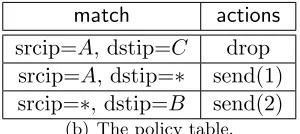
(b) The policy table.
Figure 2.7: A firewall example.
symbolic packet is expressed by hsrcip, dstipi. The generated policy table is shown in
Figure 2.7(b). Thematch column of the policy table is generated by Algorithm 3. We note
that if the second rule is swapped with the third rule in the policy table, the resulted policy
table is still consistent with the scenario. The reason is that by definition the variablesip1 andip2 only represent values other thanA, B, C. Thus, the packethA, Biis not represented by any symbolic packets in the scenario.
2.3.4 Policies with tests
Now we consider synthesizing policies that usetests. As an example, consider the scenario
for the learning switch in Figure 2.2. One can verify that a consistent policy table for the
scenario requires tests. In fact, the onlymatch in thematch list generated by Algorithm 3
ish∗i, and every packet in the scenario matches it. However, their actions differ from each
other. Therefore, in addition to the only match h∗i, a consistent policy table must have
tests. In this subsection, we will assume that alltestsin the policy table are given, and show
the algorithm to synthesize the policy. We will relax this assumption in the next subsection.
Sketch. Suppose the tests used in the policy for learning switch are ST(dstmac).state=0 and ST(dstmac).state=1. Composing the match and test, we know that the policy table has the form as shown in Table 2.4.
match test actions update
* ST(dstmac).state=0 ax1
ST(srcmac):=(sx1,ux1)
ST(dstmac):=(sx2,ux2)
* ST(dstmac).state=1 ax2 ST(srcmac):=(sx3,ux3)
ST(dstmac):=(sx4,ux4)
Table 2.4: A policy table sketch for the learning switch.
in rules using variables. We call such symbolic representations policy table sketches (or
sketches in short). In this sketch, we derive all possible writes in update from the state
tables that are used in each rule’s tests. In this example, since the only state table accepts
keys of typeMAC ADDR, the state table can be updated using either srcmac or the dstmac of
a packet. Therefore, we have twowritesper rule in itsupdate, andsx’s range over all states (in this example,{0,1}) plus a special symbol - meaning no update, andux’s range over all field names plus -. For ease of presentation, we intentionally ignore potential overwrittings
due to the two writes in each rule’s update. In practice, we need to consider other orders
of writes as well. We use variables ax’s to represent possible actions for each rule. In this example, ax’s can range from {flood, send(ST(srcmac)), send(ST(dstmac))}, which are obtained from actions appearing in the scenario. To distinguish variables appearing in
sketches from variables appearing in the scenarios, we will call these variables appearing in
a sketch as sketch variables.
Algorithm 4 shows the algorithm of generating sketches given the match list L and tests. The setC contains all possiblereadsto the state tables appearing inT EST S (line 1-line 4), and this set is used to derive writes in each rule (line 7). The sketch is generated
by composing eachmatchandtest inT EST S (line 5-line 6), and every rule has all possible writes derived fromreads inC (line 7).
Algorithm 4 generate sketch(L,T EST S)
1: letC =∅
2: for allstate tableST appearing inT EST S do
3: add all reads ST(f1,..,fk) to C, where fi is a field name of the corresponding type.
4: end for
5: for allmatch match inL in orderdo 6: for alltest test inT EST S do
7: construct a ruler= (match, test, ax, update), whereaxis a new variable foractions, andupdate= [readi:=(sxi,uxi)],∀readi ∈C,sxi,uxi fresh variables.
8: add ruler tosketch
9: end for 10: end for
Search for sketch variables. Using the sketch, we can search concrete values for sketch
variables, with the goal that the obtained policy table is consistent with all scenarios. To
all sketch variables. The algorithm is shown in Algorithm 5.
Algorithm 5 search sketch([SCi], sketch)
1: stack= []
2: for allscenariosSCi do
3: for allevents ej inSCi do
4: letr be the first matching rule
5: initialize actions of r and push the sketch variable to stack, if r’s actions are not set
6: if actionsof ri are consistentthen
7: initialize any sketch variables in r’supdate and push them to stack, if they are not assigned values yet
8: applyupdateof r
9: else
10: backtrack(stack)
11: return FAILED if stack is emptyelse restart from line 2 12: end if
13: end for 14: end for
15: return sketch
The algorithm maintains a stack of sketch variables together with the values assigned
to them. Whenever a sketch variable is assigned a value, it ensures that the sketch variable
is pushed to the stack (line 5, 7). For each symbolic event in every scenario, the algorithm
checks consistency of the first matching rule’s actions (line 6). Whenever inconsistency
encountered (line 9), it performs standard backtracking procedure on the stack (line 10-11);
and when it is consistent, the algorithm executes theupdate of the rule (line 8) and carry
on to the next symbolic event.
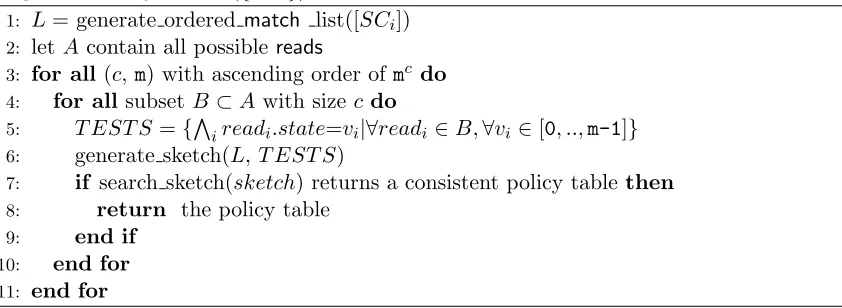
2.3.5 Putting It Together
Now we describe the overall synthesis algorithm (Algorithm 6), using the procedures
de-scribed in previous subsections. At a high level, the synthesis algorithm enumerates sketches
by increasing the number of rules, in order to generate a consistent policy table using as few
rules as possible. For each sketch, it invokes Algorithm 5 to search for a consistent policy
using the sketch.
Example. We use the learning switch example in Figure 2.2 to illustrate how Algorithm 6
Algorithm 6 synthesize({SCi})
1: L= generate orderedmatch list([SCi])
2: letA contain all possiblereads
3: for all(c,m) with ascending order ofmc do 4: for allsubset B⊂Awith size cdo 5: T EST S={V
ireadi.state=vi|∀readi∈B,∀vi ∈[0, ..,m-1]}
6: generate sketch(L,T EST S)
7: if search sketch(sketch) returns a consistent policy tablethen 8: return the policy table
9: end if 10: end for 11: end for
each of which corresponds to a combination of field names, and a state table with the
corresponding type. Because two state tables with the same type can be merged into a
single state table with larger states, we only construct one state table per type. Then the
algorithm constructs a sketch, where each rule has c checks, and its state ranges from 0 to m-1. Thus the generated sketch has mc|L| rules. Note that, when m is 1 or c is 0, the generated sketch does not usetestsessentially, hence enumeration of the pair (c,m) can start from (1,2). When picking reads from A (line 4), we pick reads with high dimension first. As an example for the learning switch, the first generated set B with size 1 in line 4 is {ST(port,srcmac,dstmac)}, followed by otherreads with dimension two.
2.3.6 Additional Heuristics
In addition to the basic synthesis algorithm described above, the synthesizer has
imple-mented other heuristics.
Lazy initialization. Algorithm 5 initializes sketch variables and pushes them to the stack
as soon as applyingupdateof the matching rule. This eager initialization could push
irrele-vant sketch variables to the stack and increase the search depth. For example, the variables
sx2, ux2 in Table 2.4 are not used when checking consistency for any symbolic packet in
Figure 2.2, and hence irrelevant to the consistency checking. Thus, the synthesizer takes a
lazy initialization heuristic. That is, only when an uninitialized sketch variable is read from
state tables, the synthesis algorithm initializes it and pushes it to the stack.
post processing to the policy table in order to simplify the policy table. These includes: (1)
If a rule in the policy table is not matched by any symbolic packet in the input scenarios,
this rule can be removed; (2) The synthesizer removes writes in each rule’s update, if they
do not change the state table; (3) When multiple rules can be merged into one without
causing inconsistency, the synthesizer will merge these rules.
2.4
Policy Execution
Given the synthesized policy, our tool uses the interpreter to process packets on the
con-troller. As described in Section 3.3, the interpreter simply iterates through all rules in the
policy table and picks the first matched rule for the incoming packet. Then it updates all
state tables based on the updateof the matched rule, and instructs the switch to apply the
action of the rule to the packet.
While processing packets on the controller is sufficient for executing the policy, it is not
practically efficient and degrades the performance of the network. In this section, we show
how the tool infers flow table rules which can be installed onto switches, thus reducing the
overhead of controller and delay of packet delivery.
Our key observation is the following theorem.
Theorem 1. A packet can be handled on switches if and only if handling this packet on the
controller does not change any state tables.
Indeed, if a packet p is handled on switches, the controller will not be aware of the packet and thus the state tables remain unchanged. On the other hand, if p is sent to the controller for execution and the updated state tables remain the same as before, we know
handlingp on switches would not affect future packets execution. Therefore, it is sufficient and necessary to install rules on switches for the packets whose execution will not change
current configuration of state tables.
Based on this observation, we have implemented a reactive installation approach which
installs flow table rules that only match necessary fields. Moreover, to keep the installed
rules up to date, we update installed rules when the policy configuration changes, and
way based on this observation. We leave the implementation of proactive approaches to
future work.
Algorithm 7 update flowtable(p)
1: let ruler be the matched rule forpin the policy table
2: if r does not update state tables, or the updated state tables remain unchangedthen 3: match← hfi1=p.fi1,..,fik=p.fiki, for all field fij appearing in the policy table
4: addmatch→r.actionsto the flow table, if the actionsajapplied topbyris supported
by the switch
5: end if
6: for allinstalled rulematch0 →[a01, .., a0l] in the flow tabledo 7: let p0 be a packet matchesmatch0
8: let rule r be the matched rule in the policy table forp0
9: if r does not update state tables or the updated state tables remain unchangedthen 10: update the installed rule tomatch0 →r.actions, if the actions aj applied topby r
is supported by the switch
11: else
12: remove the installed rule from the flow table
13: end if 14: end for
Algorithm 7 shows the installation strategy. First the algorithm checks whether the
matched rule r for p will change the configuration of state tables. The rule r will not change the configuration, ifrdoes not havewrites, or the updated states and values remain the same as the old ones (line 2). If executing p would not change the configuration, the algorithm installs a flow table rulematch→[a1, .., al] onto the switch, wherematchspecifies
the values for fields related to the policy, andaj’s are the actions that should be applied to
p (line 3-4). The algorithm also needs to check whether previously installed rules are still correct. For this, the algorithm repeats a similar process for each installed rule (line 6-14).
Example. Revisit the example run in Figure 2.4. By the interpreter’s algorithm shown in
Figure 2.3, the first packet is processed on the controller, and the state table is updated
to the one shown in subfigure (c). Applying Algorithm 7, the matching rule r for p1
would be the first rule in the policy table shown in Table 2.1. Since port 2 is already
remembered for the srcmac A, r would not change the state table. Therefore, a flow table rule f r1 = hport=2,srcmac=A,dstmac=Bi →flood, which matches the port, srcmac and
dstmac of p1 is pushed down to the switch. After processing the second packet p2, the
down. Moreover, the algorithm checks the installed flow table rulef r1. Since nowp1 would
match the second rule in the policy table, and the applied action top1 is different from the
installed flow table rule, the action of f r1 is updated to send(1).
2.5
Use Cases
In this section, we demonstrate scenario-based programming for four policies. For each
policy, we will show the packet-type we use, the scenarios that can be used to synthesize
the desired policy, and the policy table generated from the scenarios. To this end, we
manually validate that the synthesized policy is the correct policy. One can also formally
verify the correctness of the generated policy against logical specifications using control
plane verification tools such as Vericon [20] and Nice [27]. We plan to explore light-weight
verification tools for the custom policy abstraction in the future.
2.5.1 Learning Switch
First, we revisit our motivating example. Recall that we can program the learning switch
application for a single switch using a scenario in Figure 2.2. Now we show how to adapt the
scenario to program the learning switch for a network. That is, the policy needs to maintain
the port of each switch for hosts. To program this policy, we need a field specifying which
switch the packet is located. Therefore, we use the packet-type hswitch : SWITCH, port
: PORT, srcmac : MAC ADDR, dstmac : MAC ADDR i. For the scenario, we simply add the
switch field to each symbolic packet in the scenario in Figure 2.2. This modified scenario
suffices for NetEgg to synthesize the network-wide learning switch policy. The scenario and
synthesized policy table is shown in Figure 2.8 and Table 2.5.
scenario 1:
s1,P1,h1,h2⇒flood
s1,P2,h3,h1⇒send(P1)
s1,P3,h2,h3⇒send(P2)