Themed Section: Science and Technology
Technical Review of Additive Manufacturing technique in
Patternless Casting Manufacturing
Yashkumar Patel*, Ankit Kahar, Dhaval Doshi
Mechanical Engineering Department, Vadodara Institute Of Engineering, Vadodara, Gujarat, India
ABSTRACT
In casting industries with the development of technology there is need to cast complex and intricate parts very accurately in dimension and geometry with the good surface finish. after the development of additive manufacturing technologies the casting industries are able to improve casting by improving pattern making up to certain limit and also some special casting processes like investment casting becomes more easier because of direct manufacturing of wax pattern using 3D printers but due to different joints in complex component manufacturing industries and also automobile industries require Mechanical joint less casting. So, now it becomes necessary for casting industries to make direct mold without the use of pattern. Also, there is development in additive manufacturing technology in material compatibility. This paper reviews the Additive manufacturing technologies for growing patternless casting manufacturing.
Keywords: Patternless casting, Additive manufacturing, Sand Casting
I.
INTRODUCTION
In current industrial development, especially in developing country, it is required to achieve the highest quality in quick time as well as with the lowest price.
In metal industry qualities like strength, dimensional & geometrical tolerance on component depends on removal of mechanical joints from complex component, this can be done by improving design of part or component but there is limitation that in complex part we can reduce mechanical joint by improving component design & we cannot completely eliminate mechanical joints from complex part by design improvement.
So for completely eliminating it is required to improve casting technique i.e. we are required to make a complex part in one single piece rather than multi-piece casting of a complex component. As we know
that there is a certain limitation to make single piece casting of the complex component due to a limitation in pattern making of a complex part. also, if however, it is possible to make a pattern for the complex component, it bears very more time & cost, also requires very high pattern making the experience as well as skill.therefore it is required to remove the pattern from mold making process.
With the development of additive manufacturing concept, it is possible to remove the pattern from mold making process and this trend leads world towards patternless casting manufacturing by developing various kinds of the 3d printer which works on the different principle of additive manufacturing technique.
II.
LITERATURE REVIEW
Wei-yuan Dzan analyzed manufacturing time in making of FRP- ship design. He shows that how pattern less casting method reducing time in making of FRP ship. He shows that FRP ship from design to manufacturing takes a long time with the conventional way of producing the part. But it revealed by the experimental results in this research that Patternless casting manufacture system not only greatly reduce the period of manufacturing and promoting large-scale products, but also decreases the cost of product prototype design.it also suitable for rapid and nimble production and opens up a new field in the ship and large-scale mold production [1].
Munish Chhabra and Dr. Rupinder Singh analyzed the feasibility of ZCast RC solution using the 3DP technique to generate Aluminium casting and Benchmark is the part which is used in the suspension system of Automobile also investigated by reducing the shell wall thickness from 12mm to 2mm The feasibility of RC solution has been assessed in terms of dimensional accuracy and surface roughness of the castings. . He concluded from the experiment is that it is feasible to reduce the shell mold wall thickness from 12(mm) to 5(mm) for generating Aluminum casting using ZCast501 RC solution.
The experimental results indicate that at the 5mm shell thickness, the production time was reduced by 48.05% less comparison to 12mm shell mold thickness [2].
R. Pastircak, A. Sladek, and E. Kucharcikova analyzed surface roughness of mold. They produce a number of blocks for making molds of gypsum and gypsum drying process technology Thermo mold. In this block they make cavities by milling were cast test castings from AlSi10MgMn alloy by gravity casting. At machining of the mold cavity, they varied feed rate of the tool of cemented carbide. From the experiments,
they select for the best suitable conditions regarding surface roughness (from 2.39 to 3.9 μm) the speed in the range from 5000 to 7000 rev. /min [3].
Nicholas A. Meisel, Christopher B. Williams, and Alan Druschitz describe their progress towards exploring the use of metal casting into 3D printed sand molds for creating cellular materials and sandwich panels. The use of 3D printing allows for the fabrication of sand molds without the need for a pattern, and thus enables the creation of cellular structures from a bevy of metal alloys. The results from several cast aluminum cellular parts of varying geometry are presented in this paper, along with a discussion of overall truss diameter variation.
And it can be concluded that indirect 3D printing is advantageous and relatively inexpensive, and the casting sand powders used for printing allow processing of many different alloys. The resulting part quality, it partially dependent on part geometry and size, demonstrates that this method is capable of producing completely filled truss structures with minimal diameter variation [4].
Ivan Stefanic, Pero Raos, Ivan Samardzic, Boris Tintor, and Edo Musser analyzed the use of 3D printing in the production of Rapid Cores and the proved in this paper is that 3D Printing sand casting saves money and time needed for producing casting core. By using this technology, some costly phases in the process of making casting cores could be avoided, such as
construction analysis, drawing for modeling
Cost comparison of Conventional Casting with 3D Printing
Philip Hankey and Richard Wooldridge worked on
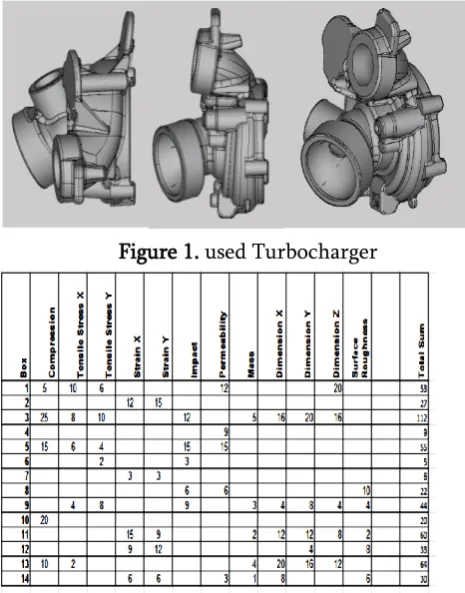
optimization of different characteristics of the 3D Sand Printing process to traditional produced Furan mold tools, with an automotive turbocharger as a case study, to validate the build parameters optimization process. They actually did five types of experimentation in the process which was tensile, compressive and accuracy tests on printed sand parts and also visual analysis and Co-ordinate Measuring Machine testing on the turbocharger component. A selection matrix was used to calculate which box setting is the most appropriate for rapid casting. The setting is done on S-max 3D printer.
On the Box setting 11, they got the best suitable condition with 2.4% better than other six Box setting. For Box setting 11, they use less binder to produces a higher quality part. The disadvantage of this setting is that the molds and cores are significantly weaker and more susceptible to damage. The parts produced in this setting had the highest quality and surface finish [6].
Figure 1. used Turbocharger
Experimental result of the Box setting for getting the highest surface finish
N.I.S.Hussein, M.N.Ayof, and N.I.Mohamed Sokri uses two sets of binders and catalyst one is Phenolic and Easter and other is Furan and Sulphonic acid is used in order to understand the different ratio of binders and hardness to the mechanical properties such as Tensile, Compressive and Transverse properties of the mold to develop new biodegradable bonded Sand casting.
The Experimental results are as follows In phenolic-ester bonded sand casting mold, the effect of phenolic resin on the tensile, transverse and compression strength is significant as compared to the effect of ester hardener. Were in a Furan-sulphonic acid mold having sulphonic acid has a high impact on tensile, transverse and compression strength[7].
flux they use COMSOL numerical software. After analyzing they find out that Sand molds with internal hollow structures can be used to control the local cooling of castings.
The hollow structures have heat insulation effect in the mold, and this effect of multiple layers of air cavities was better than that of a single layer of air cavity [8].
Prof. D.V. Mahindru and Prof. Priyanka Mahendru give the basic difference between conventional and rapid prototyping in manufacturing approaches. The various RP techniques are Stereolithography (SLA), Fused Deposition Modeling (FDM), Laminated Object Manufacturing (LOM), Selective Laser Sintering (SLS), Solid Ground Curing (SGC), and Ink-Jet Printing (IJP). The common methodology of rapid prototyping is, CAD model creation; Conversion to STL format; Slicing of STL file; Layer by Layer Construction; Cleaning and finishing. Authors had compared wooden and ABS (Acrylonitrile Butadiene Styrene) materials and found More dimensional accuracy and high surface quality, increased productivity and flexibility [9].
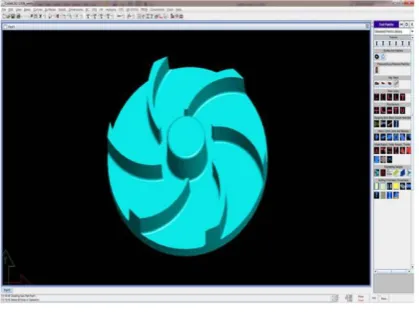
Himanshu Khandelwal presents an alternate process for casting metal part by combining three relatively low-cost processes:- plastic 3D printing, no-bake molding, and direct casting since direct metal powder additive manufacturing technology become little expensive. The author had performed an experiment using pump impeller geometry as shown in fig. and He showed that this combined process gives a low cost, good dimensional accuracy and surface finish, better than either green sand or CO2 molding process. Also, state that relevant equipment is compact; the process is quick, clean and affordable. It is highly suitable for the rapid manufacture of one-off small intricate parts for prototyping and replacement purposes [10].
Figure 2. CAD model of the pump impeller
Dr. P. Nageswara Rao, Dr. Yury Lerner, and Vladimir Kouznetsov gives applications of rapid prototyping in metal casting in different ways:-
Direct tooling - use of the RP-generated model as a substitution for a traditional tooling.
Indirect tooling - use of RP-generated models as means for production of an actual tooling.
Tool-less processes - technological processes in which actual cores or molds are made without traditional tooling, directly by an RP-system. Authors had also suggested following major consideration for selecting system:-
Type of material of prototypes (plastic, wax, sand, metal etc.).
Maximal required size of prototypes.
Desired (required) the accuracy of prototypes; resolution (layer thickness).
The desired durability of prototypes (pattern or mold life).
Maximum allowable cost per prototype [11].
relationship between the variables independent and dependent variable. From the positive strong relationship between green compression strength of the dependent variable and the two independent variables of clay content and moisture content, it is shown that 72% of the variation in green compression strength coming from the combined effect of clay content and moisture content. Thus statistical approach is of crucial nature and provides a good method for finding green compression strength of green sand mold[12].
J.P. Kruth, X. Wang, T. Laoui and L. Froyen defined that SLS has the ability to process about any powder material: polymers like elastomers, amorphous and semi-crystalline polymers, metals, hard metals, ceramics, and sand. The quality of laser sintered parts depends on proper selection of the processing parameters like laser power, spot size, scanning speed, the type of laser (wavelength) and the powder composition (materials, mixture ratios, grain sizes, etc.). Therefore, the SLS process is controlled by the amount and speed of energy supply, the basic laser-material interaction. Thus SLS is one of the most rapidly growing rapid prototyping techniques (RPT) [13].
III.
CONCLUSION
This Review paper provides an overview of Additive manufacturing technology in casting is not limited to only casting process where wax or plastic pattern is being used. But it allows us to make a mold of sand without the use of pattern. using Binder jetting principle we can make a sand mold with high compressive strength without the use of pattern by injecting suitable binder material in a required location on a layer of mold sand. By this patternless casting manufacturing, we are able to reduce cost and time of making a pattern and we can achieve good surface finish and high-quality casting by improving mold design with complexities so this become flexible for casting industries.
IV.
REFERENCES
[1]. Wei-Yuan Dzan The Methodology of Patternless Casting Manufacturing International Journal Of Systems Applications, Engineering & Development Issue 4, Volume 5, 2011
[2]. Munish Chhabra, Dr. Rupinder Singh, Experimental Investigation of Pattern-less Casting Solution Using Additive Manufacturing Technique, MIT International Journal of Mechanical Engineering Vol. 1, No. 1, Jan 2011, pp 16-24 ISSN No. 2230-7699 MIT Publications [3]. R. Pastircak, A. Sladek, and E. Kucharcikova,
The Production of Plaster Molds with Patternless Process Technology, Archives of foundry engineering
[4]. Nicholas A. Meisel, Christopher B. Williams, Alan Druschitz, Lightweight metal cellular structures via indirect 3d printing And casting. [5]. Ivan Stefanic, Pero Raos, Ivan Samardzic, Boris
Tintor, and Edo Musser, Rapid prototyping of casting cores.
[6]. Philip Hankey and Richard Wooldridge, optimisation of additive manufactured sand printed mould material for aluminium castings. 27th International Conference on Flexible Automation and Intelligent Manufacturing,FAIM2017, 27-30 June 2017, Modena, Italy
[7]. N. I. S. Hussein, M. N. Ayof, and N. I. Mohamed Sokri, Mechanical Properties and Loss on Ignition of Phenolic and Furan Resin Bonded Sand Casting. International Journal of Mining, Metallurgy & Mechanical Engineering (IJMMME) Volume 1, Issue 3 (2013) ISSN 2320-4052; EISSN 2320-4060.
[9]. Prof. D.V. Mahindru & Prof. Priyanka Mahendru, Review of Rapid Prototyping-Technology for the Future.
[10]. Himanshu Khandelwal, Dr. B. Ravi, 3D Printing Enabled Rapid Manufacture of Metal Parts at Low Cost.
[11]. Dr. P. Nageswara Rao, Dr. Yury Lerner, Vladimir Kouznetsov, Rapid Prototyping Applications in Metal Casting.
[12]. Aondona Paul Ihom, Aniekan Offiong, the Study of Green Compression Strength of a Green Sand Mould Using Statistical Approach.
[13]. J.P.Kruth, X.Wang, T.Laoui and L. Froyen,