Abstract
Today,the process oriented approach is more systematic and efficient through the application of Information Communication and Technology (ICT).During 21st Century, the real force driving India's development isthe evolution of industries. Among whichthe Information technology sector is the shining star and creates huge opportunities for the young community. It brands India as a number one technology delivery solution center to the world. The IT projects executesmainly in India followsWaterfall and Agile methodologyfor managing the work on time and budget. The study was conducted to evaluate the proficiency of project managers working in IT sector at Cochin and Bangalore.Three dimensions were used to develop the study such as Engagement Traits, Experience and Education level of ICT project manager to evaluate the efficiency and professionalism in work.Moreover, italso reveals other supporting factors such as new skill developmentand Third-party certification which would bring more professionalism in project management job. The Project Management Institute (PMI) identified that there will be a requirement of 400,000 certified project managers every year till 2020 [1]. It is proven that project management certificationswould improve the project management maturity at global level [2]. The article concludes stating that engagement traitsand education along with experience in career would help to differentiate the leadership of project managers and improve the project success rate.
Keywords: Project Manager, Certification, Education, Experience, Engagement Traits,ICT
Introduction
The project manager (PM) is the central figure for accomplishing the project in any sector [3]. It is his responsibility to manage the project from end to end and ensure to deliver the quality expected within planned budget and targeted time. Day and Bobeva stated the importance of project manager for the success of IT projects [10].In addition, PM should be skillful in various areas such as experience, relationship, education etc. to build the competitivenessin market.
A Study to Compare the Empiricism of
Project Manager in IT Sector
– Eldho Roshan Rajan* – Dr. V A Santhosh**
* Research Student-Bharathiar University Address: Kattarukudyil House, Allapra P O,Perumbavoor, Cochin- 683556 Email:[email protected]
The IT projects are transferred to India for thepast years because of the quality of service and technological agility [4]. The advantage of availing resource for meeting the business requirement and reduced development cost while comparing with global environment, makes the striking factors for Indian IT Sector. The process builds the confidence level from client to offload more work to India which should be managedin a systematic way.The Indian IT sector is divided into 4 areas such as Business Process Management (BPM), Software Products & engineering services, IT services and Hardware[11]. According to Gartner report, India is the fastest growing market in data center business which touches US$ 2.2 billion business so far and expected to reach US$ 4.4 billion by 2018 [12].
In IT, people start the career mainly in the technical domain during the initial days. But after gaining the required experience they have an option to diversify the career fieldby performing project management role or exploring new areas in technical domain. The technical field develops resources to Architect role for building core applications. Similarly, the project management would help to perform project or program or portfolio management role for organization. A project is a temporary endeavor undertaken to create unique product, service or result [5]. For example, a company have been started to build a data center in India as part of Disaster Recovery strategy. The defined project plan with other artifacts related to project should be maintained for making the quality deliverables. Program is part of managing group of related or similar projects which should be coordinated to get the benefits and controls not available by managing them individually [6]. The best example that can be consideredis Prestige group, a reputed builder, who ownsthe business for flat construction as first line and secondly supporting the construction of big infrastructure like IT parks across country. Portfolio is group of related or non-related projects or programs [7]. For example, the Reliance group chaired by Anil Ambani is running the business for various portfolios such as Reliance Communications, Reliance Entertainment, General Insurance etc. It has bigger scope and objectives than program and project management.
The proposed study is conducted to know how the project manager experience should impact the management skills. The analysis helps to explore the other supporting factor such as Education, Certification along with Experiencehas to build more professionalism in work. The sample size considers the profiles from Kerala and Karnatakawho were working for IT projects. Primarily, they were used to manage Application and Infrastructure projects and had experienced in managing most of international clients. The leadership for building rapport with team mates is an important factor for improving the project success rates. Hence the study was framedby considering all the relevant areas in three dimensions used to differentiate the professionalism of software project managers at two locations.
Objectives
• To analysis the know-how of ICT project managers in 3 dimensions- Engagement Traits, Education and Experience.
• To find the correlation, if any, among Engagement Traits, Education and Experience.
• To evaluate the influence of project management certification and profession.
Background of The Study
Earlier approach used for drivingICT projects were traditional water fall model. In that case,the project should be small and requirements very clear. But it is inefficient for long and ongoing projects. The working product is not visible until the end of all phase [6]. This motivates management to practice Agile models in software project with a focus for rapid delivery.Here, the project manager should perform the role of scrum master for managing each sprint. It will increase the quality and visibility to all stakeholders. Furthermore, training and certification are the acceptable method for upskilling and utilizing agile methodology in software projects to gain the final results.
The first dimension used for the analysis is Engagement traits. It is defined as the volunteerism, readiness, and capabilities of employees for managing the organization success [13].To emphasize, business has involved high level of engagement from employeesto create a positive energy for change or build a congenial work environment. After all, engagement traits are essential and enormous which can improve productivity, profitability and customer satisfaction for business.
Education is considered to be the second dimension for evaluating project manager skills required in project success.Many studies have proven that education and experience were the key factors required for pursuing project management job [14]. People can explore different sources for education through self- study of books or blogs. Moreover, PMP (Project Management Professional) and PRINCE2 (PRojects IN Controlled Environments) are the leading PM certifications available in the market for IT professionals to practice various aspects of project management like know-how to plan, schedule, Monitor and report the project progress [15].
Finally, the experience of project manager is used as the third dimension for the study. It involves track record, size, project management hours, complexity mode and independent references [16]. Project manager should use strategic approach for defining the scope of work. The capability of managing quality deliverables, agreed by business, within budget and on time are required to demonstrate under proven experience category. All things considered, project manager must be capable of manage troubled team, handled similar scope and bring efficiency in work progress.
followinganalysis attemptsto comparethe project management skills of resources working at Bangalore and Cochin. The example shows that people who had certification in project management should be more productive and have the aspiration for good reputation in career.
Nowsoftware companiesdemand their employees to earnthe certifications in the adopted methodology for managing the project whichensure to maintain consistency in work at global level.
Figure 1 shows the median salary for PMP certified project managers across India,
Figure 1 Median Salary of PMP Certified Project Managers by city wise
Source: PayScale Report, July 2017
The analysis illustrates that people are earning high median salary of Rs. 18,37,728 /- at Gurgaon and low median salary ofRs. 14,03,313/- at New Delhi after earning PMP credentials in career.
Figure 2 Median Salary for PMP certified project manager by industry wise
Source:PayScale Report, Jul 2017
From analysis, it reveals that median salary of project managers varies with industry significantly. The highest median salary of ?1,936,792 /- offered by Banking industry in order to keep best practice in work and lower payment of? 1,493,395 /- for consulting work due to work concentrated on undefined areas.
Figure 3 Median Salary for PMP certified project manager by Gender wise
From figure 3, Male population receives higher median salary around ?1,643,911 /- for people who earned PMP credentials in earlier stages of career and which can help to build best practice in profession.Now,women isalso keeping more professionalism in work which aligned to PM frameworks and certification should be one of the pathways for achievement.
Figure4 Median Salary for PMP certified project manager by degree wise
Source:PayScale Report, Jul 2017
The higher median salary ispaid for those with Master of Science degreewhich is around ? 2,637,343 and lower for Bachelor of Technology is ? 588,853 on Figure 4. However, the value is varying whiledepending on experience and technology.
Methodology and Framework
In this day and age,every business is putting more importance for project management task for bringing efficiency and effectiveness in project. Finally, it proves that the success of projects should be project managers responsibility. The direction and organizing skills of PM ensure to manage the project within budget and on time. The secondary skills like Education, Experience and Certification helps to develop more professionalism in career. The analysis conducted to explore those information from people who are in ICT sector by doing project management work.
From analysis, it understood that more than 100 professionals who attended the survey which inherently builds the reliability of results. The combination shows most of them are experienced in both Waterfall and Agile Methodology. As a result, the following analysis brought more clarity to the objective of work.
Earlier organization adopt traditional methodology as Waterfall model. But now the business especially in IT would like to view result in short span so they follow Agile methodology for same.
Figure 5 Framework of the study
Source: Developed for research
The framework designed in figure 5 is startedwith topic finalizedfor the survey and finally produce the result which should make the comparison study.
The first step designed in the framework to finalize the comparison of project managers who are working in ICT sector. The sample size isconsidered from Cochin and Bangalore as these cities exhibit mostpotential IT hubs among cities in South India.
Secondly, the questionnaire is developed to cover all aspects decided for study. The scope of work focusses to develop questions more about general skills maintained by ICT Project Managers. Those questions differentiated into three areas such as Engagement Traits, Education and Experience required for IT sectors. A total of 12 supporting questions are created to conduct more study on those areas.
For data collection, the sample is considered from people who are working in Cochin and Bangalore. It helps to collect inputs from those who are already working in both Agile and Waterfall models. It also reveals other factors such as professional certification could bring more value to profession.
The IBM SPSS software is used to make various type of analysis with collected data. It elaborates clearly that how each factor correlated each other.
Finally, the analysis weighs the statement and concludes the facts consider for the study.
Waterfall Model
Figure 6 Waterfall Model
Source: Creative Commons Graphic (Peter Kemp/Paul Smith. 2010, https://en.wikipedia.org/wiki/ Waterfall_model)
Agile Model
It is an incremental model [9]. The model, figure 7, is designed to maintain the quality of work throughout each phaseof project. The main attractive featuresof Agilemethodology is ability to maintain continuity in Software Delivery, improvedcustomer satisfaction, customer can provide feedback at any time and changes incorporated responsiveto market demand. However,it lacks the detailed documentation procedure limiting ability to predict the associatedrisks.
Figure 7 Iteration cycle of Agile Project
Analysis and Findings
1. Location wise comparison of ICT Project Manager
Table 1: Comparison of ICT Project Manager Location wise
Working Location
N Mean Std.
Deviation
Engagement Traits
Cochin 53 4.4367 .47991 Bangalore 54 4.4603 .45992 Education Cochin 53 3.5786 .93861 Bangalore 54 3.4877 .86805 Experience Cochin 53 3.4811 .85464 Bangalore 54 3.6759 .85868
The analysis conducted on Table 1 compares the Engagement Traits, Education and Experience of ICT project managers working at Cochin and Bangalore.
Further analysis shows the difference among each area. The soft skill Engagement Traits are more (4.4603) for Bangalore and less for Cochin (4.4367). It happened as there is diversified opportunity available in Bangalore with its cosmopolitan population.
But the education spacegivesmore weightage (3.5786) to Cochin than Bangalore (3.4877). From data, it shows people are keen on education and so they will try their best to attain higher education qualification in career.
Bangalore is known as the Silicon Valley of India. So obviously the IT opportunities would be more compared to any other place in India. The analysis supports higher value atBangalore (3.6759) which shows thatpeople are experienced, especially in diversetechnologies, than Cochin (3.4811). The risk factor is higher at Cochin if project is on specific technology.
2.
Correlation Analysis
Table 2: Correlation Analysis
Engagement Traits
Education Experience
Engagement Traits
Pearson Correlation 1 .268** .303**
Sig. (2-tailed) .005 .002
N 107 107 107
Education Pearson Correlation .268** 1 .577**
Sig. (2-tailed) .005 .000
N 107 107 107
Experience Pearson Correlation .303** .577** 1 Sig. (2-tailed) .002 .000
N 107 107 107
The table 2 illustrate the correlation between the variable selected for analysis. The strong correlation identified between Education and Experience (0.577) in the analysis. The correlation between Engagement traits and Experience is 0.303. The relationship between Education and Engagement trait variable is 0.268. All results provide positive correlation. So, it may be concluded that if there is any change in one variable then it will change the other proportionately.
3.
Comparison between Engagement Traits, Education and Experience
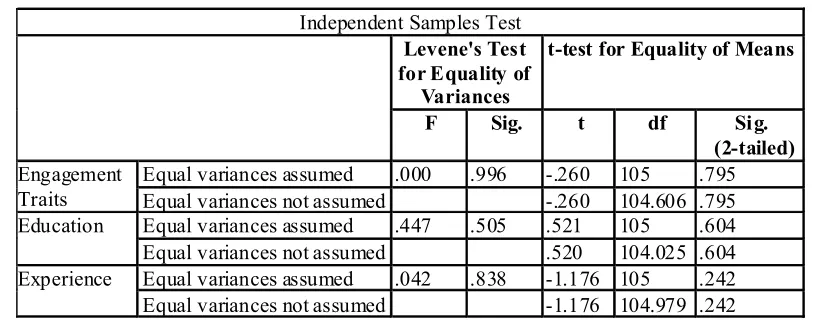
Table 3: Independent Sample Test
Independent Samples Test
Levene's Test for Equality of
Variances
t-test for Equality of Means
F Sig. t df Sig.
(2-tailed)
Engagement Traits
Equal variances assumed .000 .996 -.260 105 .795 Equal variances not assumed -.260 104.606 .795 Education Equal variances assumed .447 .505 .521 105 .604 Equal variances not assumed .520 104.025 .604 Experience Equal variances assumed .042 .838 -1.176 105 .242 Equal variances not assumed -1.176 104.979 .242
4.
Descriptive analysis
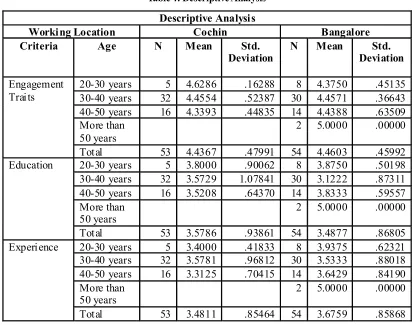
Table 4: Descriptive Analysis
Descriptive Analysi s
Worki ng Location Cochin Bangalore
Criteria Age N Mean Std.
Deviation
N Mean Std.
Deviation
Engagement Traits
20-30 years 5 4.6286 .16288 8 4.3750 .45135 30-40 years 32 4.4554 .52387 30 4.4571 .36643 40-50 years 16 4.3393 .44835 14 4.4388 .63509 More than
50 years
2 5.0000 .00000
Total 53 4.4367 .47991 54 4.4603 .45992 Education 20-30 years 5 3.8000 .90062 8 3.8750 .50198 30-40 years 32 3.5729 1.07841 30 3.1222 .87311 40-50 years 16 3.5208 .64370 14 3.8333 .59557 More than
50 years
2 5.0000 .00000
Total 53 3.5786 .93861 54 3.4877 .86805 Experience 20-30 years 5 3.4000 .41833 8 3.9375 .62321 30-40 years 32 3.5781 .96812 30 3.5333 .88018 40-50 years 16 3.3125 .70415 14 3.6429 .84190 More than
50 years
2 5.0000 .00000
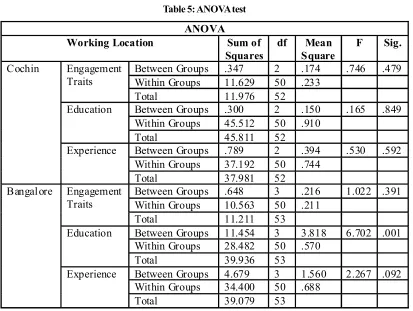
Table 5: ANOVA test
ANOVA
Working Location Sum of
Squares
df Mean
Square
F Sig.
Cochin Engagement Traits
Between Groups .347 2 .174 .746 .479 Within Groups 11.629 50 .233
Total 11.976 52
Education Between Groups .300 2 .150 .165 .849 Within Groups 45.512 50 .910
Total 45.811 52
Experience Between Groups .789 2 .394 .530 .592 Within Groups 37.192 50 .744
Total 37.981 52 Bangal ore Engagement
Traits
Between Groups .648 3 .216 1.022 .391 Within Groups 10.563 50 .211
Total 11.211 53
Education Between Groups 11.454 3 3.818 6.702 .001 Within Groups 28.482 50 .570
Total 39.936 53
Experience Between Groups 4.679 3 1.560 2.267 .092 Within Groups 34.400 50 .688
Total 39.079 53
The analysis conducted among 53 ICT project managers in Cochin and 54 ICT project managers.Generally, it shows similarity for all resources among both location. It may be noted that 2 respondentsfrom Bangalore who were aged more than 50 years chose highimportance for all criteriadefined.
5.
Descriptive Statics
Table 6: Descriptive statistics
Statistics
Working Location Age
Group
Highest Education
Level
Gender group
Working Location
Cochin N Valid 53 53 53 53
Missing 0 0 0 0
Mean 2.21 2.96 1.21 1.00 Std. Deviation .600 .999 .409 .000 Bangalore N Valid 54 54 54 54
Missing 0 0 0 0
Mean 2.19 2.80 1.11 2.00 Std. Deviation .729 1.071 .317 .000
The analysis shows that around 53 people attended from Cochin and 54 from Bangalore. The mean of the data at Cochin is 2.21 for Age Group, 2.96 for Highest Education Level, 1.21 for Gender group. But the mean for working location at Bangalore is 2.00.
6.
Age wise composition
Figure 8 Age wise composition
7.
Education wise composition
Figure 9 Education wise composition
The above bar chart shows the classification of education qualification of people who attened the survey. It supports the above fact that people from Cochin has put more importance in higher education. Therefore, the statics shows 22 of them completed MBA/PGDM program, 16 for B-Tech/ BE, 8 of them completed M-Tech/MS , only 2 for BA/BS and remaining 5 for other programs in Cochin. But from Bangalore, the majority received were B-Tech/BE graduates around 20 nos, MBA/ PGDM is 18 resources, M-Tech/MS is 7, BA/BS is 4 and finally 5 for others.
8.
Gender wise combination
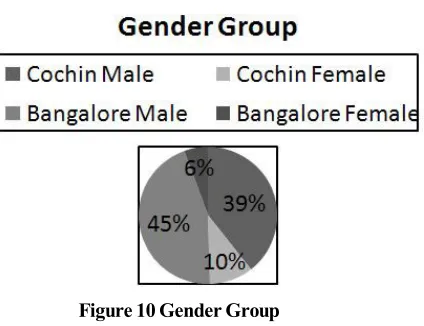
Figure 10 Gender Group
The pie chart represents the gender wise composition of people who have attended the survey at both locations. The total participants were 107 ofwhich 39% and 45% are respectively male candidatesfromCochin and Bangalore.
Conclusion
Cochin in various technologies. This may be due to a higher degree ofopportunity being available in Bangalore. The name "Silicon Valley of India" is attributed to Bangalore due to the concentration of technology companies in Bangalore. The people ofCochin have put more weightage to higher education along with employment. Finally,this review establishes the fact that increased skill levels are required for future development.
The new generation is focused onbuilding a good foundation through better education indirectly creates new opportunity as well. The world is growing at a faster rate which is directly proportionatewith consumer demand. The technology is maturing to ease the human work but it would be happening through backend engineering. The growth rate of India highly depends on the education acquired by people and that motivates to build skills for new things in career.
Soft skills should be acquired with practice from school days itself.This willhelp develop the career path. The key factors toEngagement traits such as Communication and Decision-making skills should be developed in people to exploit more opportunities in India. From study, fewMNCswerehesitated to delegate more work to India because new generation managers do not take accountability. Most recently,SundarPichai, CEO of Google, advised the young people of India to earn new skills forcreating new space of opportunity globally.
Finally, it summarizes that a person should add value to his career through experience. There are a lot of opportunities to start the career in ICT,by which they can reach the destination with hard work and dedication. From analysis, the Indian IT profile has more acceptance in global market.
All the abovefactors arerequired for a person todevelop a successful career.
References
1. Skitmore, W. W. (2004). Project Management Competencies: A Survey of Perspectives from Project Manager in Sout East Queensland. QUT ePrints, 2.
2. A Guide To The Project Management Body of Knowledge. (1996). In W. R. Duncan. Pennsylvania: Project Management Institute.
3. Haughey, D. (2017). What is Project Portfolio Management? Retrieved from Project Smart: https:// www.projectsmart.co.uk/what-is-project-portfolio-management.php
4. Naveen. (2017). What is Waterfall Model in software testing and what are advantages and disadvantages of Waterfall Model. Retrieved from Testingfreak: http://testingfreak.com/waterfall-model-software-testing-advantages-disadvantages-waterfall-model/
5. Day, J. and Bobeva, M. 2003. 'Successful IS project leaders: a situational theory perspective'.Electronic Journal of Information Systems Evaluation, 6(2): 75-86
7. Udo, N. &Koppensteiner, S. (2004). What are the core competencies of a successful project manager? Paper presented at PMI® Global Congress 2004-EMEA, Prague, Czech Republic. Newtown Square, PA: Project Management Institute
8. Why is Bangalore called the Silicon Valley of India? (2016, February 29). Retrieved February 01, 2018, from http://www.iamin.in/blogs/why-bangalore-called-silicon-valley-india
9. Admin. (2008, October 23). The Agile Movement. Retrieved from Agile Methodology: http:// agilemethodology.org/
10. 5 Reasons Why Companies Outsource to India. (2013, June 07). Retrieved from Flatworld Solutions: https://blog.flatworldsolutions.com/5-reasons-why-companies-outsource-to-india/
11. Florentine, S. (2015, July 8). Top 10 project management certifications for 2017. Retrieved from CIO FROM IDG: http://www.cio.com/article/2945413/certifications/top-10-project-management-certifications.html#slide1
12. Jacoby, M. (2015, August 05). 6 Traits of An Engaged Employee. Retrieved January 31, 2018, from https://www.huffingtonpost.com/margaret-jacoby/6-traits-of-an-engaged-em_b_7928024.html
13. Bridges, J. (2016, March 07). The Difference Between a Program Manager and a Project Manager. Retrieved from Project Manager: https://www.projectmanager.com/training/the-difference-between-a-program-manager-and-a-project-manager
14. PTI. (2016, November 16). India needs 4 lakh new project managers annually till 2020: Report. Retrieved from The Economic Times: http://economictimes.indiatimes.com/jobs/india-needs-4-lakh-new-project-managers-annually-till-2020-report/articleshow/55500713.cms
15. Kochi to become country's next IT hub: CBRE. (2017, April 01). The New Indian Express. Retrieved February 1, 2018, from http://www.newindianexpress.com/cities/kochi/2017/apr/01/kochi-to-become-countrys-next-it-hub-cbre-1588401.html
16. Nair, P. (2017, June 20). A look at the Indian data center market in 2017. Retrieved January 30, 2018, from http://www.datacenterdynamics.com/content-tracks/design-build/a-look-at-the-indian-data-center-market-in-2017/98511.fullarticle
17. Florentine, S. (2017, July 27). Top 11 project management certifications for 2017. Retrieved February 01, 2018, from https://www.cio.com/article/3210765/certifications/top-project-management-certifications.html
18. Why Bengaluru is known as the Silicon Valley of India. (2017, October 1). Bangaloredays.in. Retrieved February 1, 2018, from http://bangaloredays.in/why-bengaluru-is-known-as-the-silicon-valley-of-india/