372
International Journal of Pharmaceutical Sciences and Drug Research 2018; 10(5): 372-378
Research Article
ISSN: 0975-248X
CODEN (USA): IJPSPP
A Highly Validated RP-HPLC Method Development for the
Simultaneous Estimation of Dapagliflozin and Saxagliptin in
Tablet Dosage Forms
B. Reddy Padmaja
1, B. Sivagami
1*, R. Chandrasekar
2, M. Niranjan babu
21Department of Pharmaceutical Analysis, Seven Hills College of Pharmacy, Venkataramapuram, Tirupati, Chitoor Dist,
517561, Andhra Pradesh, India
2Department of Pharmacognosy, Seven Hills College of Pharmacy, Venkataramapuram, Tirupati, Chitoor Dist, 517561,
Andhra Pradesh, India
Copyright © 2018 B. Reddy Padmaja et al. This is an open access article distributed under the terms of the Creative Commons Attribution-NonCommercial-ShareAlike 4.0 International License which allows others to remix, tweak, and build upon the work non-commercially, as long as the author is credited and the new creations are licensed under the identical terms.
ABSTRACT
A simple, accurate, precise method was developed for the simultaneous estimation of Dapagliflozin and
Saxagliptin in Tablet dosage form. Chromatogram was run through Standard BDS C8 column (50 × 4.6 mm, 5)
The Mobile phase containing Potassium dihydrogen phosphate: Acetonitrile in the ratio 55:45, pH was adjusted to 3.8 with dilute orthophosphoric acid. The solution was pumped through the column at a flow rate of 1 ml/min. The column temperature was maintained at 30°C. Optimized wavelength selected was 210 nm. Retention time of Dapagliflozin and Saxagliptin were found to be 2.266 min and 2.805 min. % RSD of the Dapagliflozin and Saxagliptin were found to be 0.5 and 0.5 respectively. % Recovery was obtained as 98.98% and 98.72% for Dapagliflozin and Saxagliptin respectively. LOD, LOQ values obtained from regression equations of Dapagliflozin and Saxagliptin were 0.20, 0.60 and 0.26, 0.79 respectively. Regression equation of Dapagliflozin is y = 37377x + 89244, and y =12254x + 3122 of Saxagliptin. The retention times were decreased so that the run time also decreased. So the method developed was simple and economical that can be applied successfully for simultaneous estimation of both Dapagliflozin and Saxagliptin in bulk and combined tablet formulation.
Keywords:Dapagliflozin, Saxagliptin, RP-HPLC, Validation, Simultaneous estimation.
DOI: 10.25004/IJPSDR.2018.100503 Int. J. Pharm. Sci. Drug Res. 2018; 10(5): 372-378
*Corresponding author: Mrs. B. Sivagami
Address: Department of Pharmaceutical Analysis, Seven Hills College of Pharmacy, Venkataramapuram, Tirupati, Chitoor Dist, 517561, Andhra Pradesh, India
Tel.: +91-8297908154
E-mail: [email protected]
Relevant conflicts of interest/financial disclosures: The authors declare that the research was conducted in the absence of any commercial or financial relationships that could be construed as a potential conflict of interest.
Received: 11 July, 2018; Revised: 20 August, 2018; Accepted: 22 August, 2018; Published: 23 September, 2018
INTRODUCTION
Dapagliflozin is a sodium-glucose co-transporter 2 (SGLT2) inhibitor used as an adjunct to diet and
6R)-2-[4-chloro-3-(4-Int. J. Pharm. Sci. Drug Res. September-October, 2018, Vol 10, Issue 5 (372-378)
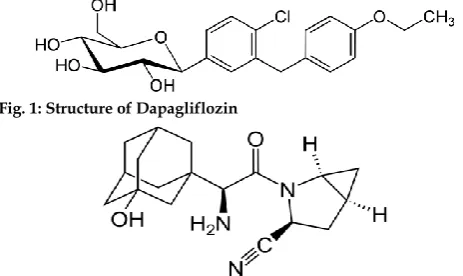
ethoxybenzyl) phenyl]-6-(hydroxymethyl) tetrahydro-2H pyran-3, 4, 5-triol as shown in (figure 1). Common side effects include yeast infections of the vagina or penis, urinary tract infections, and changes in urination, including urgent need to urinate more often, in larger amounts, or at night. [1-9]
Dapagliflozin inhibits subtype 2 of the sodium-glucose transport proteins (SGLT2), which is responsible for at least 90% of the glucose reabsorption in the kidney. Blocking this transporter causes blood glucose to be eliminated through the urine. The efficacy of this medication class has yet to be determined, but in initial clinical trials, Dapagliflozin lowers HbA1c by
0.90 percentage points when added to metformin. [1-9]
Saxagliptin, is a new oral hypoglycemic (anti-diabetic drug) of the new dipeptidyl peptidase-4 (DPP-4) inhibitor class of drugs. Saxagliptin is chemically called as (1S, 3S, 5S)-2-[(2S)-2-amino-2-(3-hydroxy-1-adamantyl) acetyl]-2-azabicyclo [3.1.0] hexane-3-carbonitrile as shown in (figure 2.) [1, 10, 11]
Fig. 1: Structure of Dapagliflozin
Fig. 2: Structure of Saxagliptin
Saxagliptin is a dipeptidyl peptidase-4 (DPP-4) inhibitor antidiabetic for the treatment of type 2 diabetes. DPP-4 inhibitors are a class of compounds that work by affecting the action of natural hormones in the body called incretins. Incretins decrease blood sugar by increasing consumption of sugar by the body, mainly through increasing insulin production in the pancreas, and by reducing production of sugar by the liver. [Bristol-Myers Squibb Press Release] DPP-4 is a membrane associated peptidase which is found in many tissues, lymphocytes and plasma. DPP-4 has two main mechanisms of action, an enzymatic function and another mechanism where DPP-4 binds adenosine deaminase, which conveys intracellular signals via dimerization when activated. Saxagliptin forms a reversible, histidine-assisted covalent bond between its nitrile group and the S630 hydroxyl oxygen on DPP-4. The inhibition of DPP-4 increases levels active of glucagon like peptide 1 (GLP-1), which inhibits glucagon production from pancreatic alpha cells and increases production of insulin from pancreatic beta cells. [1, 10, 11]
The literature review revealed that several analytical methods have been reported for Dapagliflozin and
Saxagliptin in UV-Spectrophotometry, RP-HPLC, individually and in combination. This research work implicates the simultaneous estimation of Dapagliflozin and Saxagliptin by RP-HPLC in tablet dosage forms. This present study reports simultaneous estimation of Dapagliflozin and Saxagliptin by RP-HPLC in tablet dosage form. [12-18]
MATERIALS AND METHODS Materials
Dapagliflozin and Saxagliptin pure drugs (API), Combination Dapagliflozin and Saxagliptin tablets (QTERN), Distilled water, Acetonitrile, Phosphate buffer, Methanol, Potassium dihydrogen phosphate buffer, Ortho-phosphoric acid. All the above chemicals and solvents were obtained from Rankem.
Instruments
Electronics Balance-Denver, pH meter-BVK enterprises, India, Ultrasonicator-BVK enterprises, WATERS HPLC 2695 SYSTEM equipped with quaternary pumps, Photo Diode Array detector and Auto sampler integrated with Empower 2 Software. UV-VIS spectrophotometer PG Instruments T60 with special bandwidth of 2 mm and 10 mm and matched quartz cells integrated with UV win 6 Software was used for measuring absorbances of Dapagliflozin and Saxagliptin solutions.
Methods
Diluent: Based up on the solubility of the drugs,
diluent was selected, Acetonitrile and Water taken in the ratio of 50:50.
Preparation of Standard stock solutions: Accurately
weighed 10 mg of Dapagliflozin, 5 mg of Saxagliptin and transferred to individual 10 ml volumetric flasks separately. 3/4th of diluents was added to both of these
flasks and sonicated for 10 minutes. Flasks were made up with diluents and labeled as Standard stock solution 1 and 2 (1000µg/ml of Dapagliflozin and 500µg/ml of Saxagliptin).
Preparation of Standard working solutions (100% solution): 1 ml from each stock solution was pipetted out and taken into a 10ml volumetric flask and made up with diluent (100µg/ml Dapagliflozin of and 50µg/ml of Saxagliptin).
Preparation of Sample stock solutions: 5 tablets were
weighed and the average weight of each tablet was calculated, then the weight equivalent to 1 tablet was transferred into a 10 ml volumetric flask, 5 ml of diluents was added and sonicated for 25 min, further the volume was made up with diluent and filtered by HPLC filters (1000µg/ml of Dapagliflozin and 500µg/ml of Saxagliptin).
Preparation of Sample working solutions (100% solution): 1 ml of filtered sample stock solution was transferred to 10ml volumetric flask and made up with diluent (100µg/ml of Dapagliflozin and 50µg/ml of Saxagliptin).
Preparation of buffer
0.01N KH2PO4 Buffer: Accurately weighed 1.36 g of
Int. J. Pharm. Sci. Drug Res. September-October, 2018, Vol 10, Issue 5 (372-378)
Volumetric flask add about 900 ml of milli-Q water added and degassed to sonicate and finally make up the volume with water then 1 ml of Triethylamine was
added and then pH was adjusted to 3.8 with dil. Orthophosphoric acid solution.
Method development
Method development was done by changing various, mobile phase ratios, buffers etc.
Parameters Trial 1 Trial 2 Trial 3 Trial 4 Trial 5 Optimized Method
Mobile phase Water and Methanol (50:50) Water: Acetonitrile (50:50)
0.01N KH2PO4
(4.8):Acetonitr ile (50:50) 60% OPA buffer:40% Acetonitrile 55% 0.1% OPA buffer:45% Acetonitrile 55% buffer: 45% Acetonitrile
Flow rate 1 ml/min 1 ml/min 1 ml/min 1 ml/min 1 ml/min 1 ml/min
Column
Discovery C18 (4.6 × 250 mm,
5µm)
Discovery C18 (4.6 × 250 mm,
5µm)
Discovery C18 (4.6 × 250 mm,
5µm)
ODS C18 (4.6 × 250 mm,
5µm)
BDSC18 (4.6 × 150 mm,
5µm)
BDSC8 (4.6 × 150 mm, 5µm)
Detector wave
length 210 nm 210 nm 210 nm 210 nm 210 nm 210 nm
Column Temp 30°C 30°C 30°C 30°C 30°C 30°C
Injection
volume 10L 10L 10L 10L 10L 10L
Run time 8.0 min 14 min 10 min 10 min 10 min 6 min
Diluent
Water and Acetonitrile in the ratio 50:50
Water and Acetonitrile in the ratio 50:50
Water and Acetonitrile in the ratio 50:50
Water and Acetonitrile in the ratio 50:50
Water and Acetonitrile
in the ratio 50:50
Water and Acetonitrile in the ratio 50:50
Optimization of chromatographic conditions
Trials Results
Trial 1 Dapagliflozin was not eluted, so further
trial was carried out.
Trial 2 Both peaks were eluted but peak shapes
are not good So, Further trial was carried out.
Trial 3 Dapagliflozin Saxagliptin both peak are
eluted but Saxagliptin peak having tailing, Dapagliflozin having lees plate count and fronting so, further trial was carried out.
Trial 4 Dapagliflozin & Saxagliptin both peak
are eluted but Dapagliflozin was eluted at void time, peak shapes were not goo and base line is not good so, further trail was carried out.
Trial 5 Both peaks were eluted, but both peaks
having fronting So further trial was carried out.
Optimized
method Both peaks have good resolution, tailing Factor, theoretical plate count and resolution.
RESULTS AND DISCUSSION
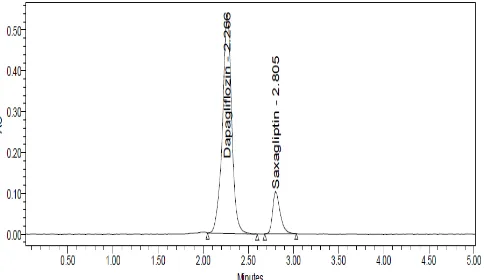
Observation: Dapagliflozin and Saxagliptin were
eluted at 2.266 min and 2.805 min respectively with good resolution. Plate count and tailing factor was very satisfactory, so this method was optimized and to be validated (Fig. 3).
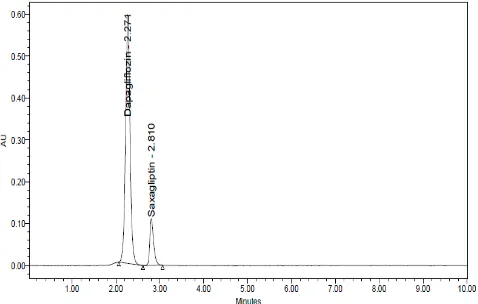
System suitability: All the system suitability
parameters were within the range and satisfactory as per ICH guidelines [12] (Table 1 and Fig. 4).
Linearity: Six linear concentrations of Dapagliflozin
(25-150µg/ml) and Saxagliptin (12.5-75µg/ml) were injected in a duplicate manner. Average areas were mentioned above and linearity equations obtained for Dapagliflozin was y =37377x + 89244 and of Saxagliptin was y = 12254x + 3122 Correlation coefficient obtained was 0.999 for the two drugs (Table 2 and Fig. 5 & 6).
Precision: From a single volumetric flask of working
standard solution six injections were given and the obtained areas were mentioned above. Average area, standard deviation and % RSD were calculated for two drugs. % RSD obtained as 0.6% and 0.2% respectively for Dapagliflozin and Saxagliptin (Table 3).
System Precision: Table 3.
Repeatability: Average area, standard deviation and %
RSD were calculated for two drugs and obtained as 0.5% and 0.5% respectively for Dapagliflozin and Saxagliptin (Table 4).
Int. J. Pharm. Sci. Drug Res. September-October, 2018, Vol 10, Issue 5 (372-378)
Table 1: System suitability parameters for Dapagliflozin and Saxagliptin
S. No Dapagliflozin Saxagliptin
Inj RT(min) USP Plate Count Tailing RT(min) USP Plate Count Tailing Resolution
1 2.257 2619 0.98 2.802 5618 1.33 1.6
2 2.261 2727 0.97 2.803 5730 1.34 1.6
3 2.266 2751 0.97 2.803 5286 1.39 1.7
4 2.270 2598 0.96 2.803 4994 1.41 1.7
5 2.272 2561 1.03 2.804 5144 1.31 1.6
6 2.275 2530 1.01 2.805 5772 1.37 1.6
Table 2: Linearity table for Dapagliflozin and Saxagliptin
Dapagliflozin Saxagliptin
Conc (μg/mL) Peak area Conc (μg/mL) Peak area
0 0 0 0
25 1051797 12.5 154760 50 2031439 25 306194 75 2942756 37.5 473244 100 3811209 50 618538 125 4743235 62.5 771469 150 5666991 75 914419
Table 3: System precision table of Dapagliflozin and Saxagliptin S. No Area of Dapagliflozin Area of Saxagliptin
1. 3824237 616187
2. 3867517 614797
3. 3842883 614559
4. 3871852 615571
5. 3809148 617990
6. 3837088 615398
Mean 3842121 615750
S.D 24338.7 1240.3
%RSD 0.6 0.2
Table 4: Repeatability table of Dapagliflozin and Saxagliptin S. No Area of Dapagliflozin Area of Saxagliptin
1. 3809246 611715
2. 3827051 613026
3. 3855433 615976
4. 3823260 616734
5. 3812089 618397
6. 3855001 611720
Mean 3830347 614595
S.D 20380.5 2827.0
%RSD 0.5 0.5
Table 5: Intermediate precision table of Dapagliflozin and Saxagliptin
S. No Area of Dapagliflozin Area of Saxagliptin
1. 3929409 1088672
2. 3904203 1095698
3. 3925132 1099574
4. 3914937 1095548
5. 3926559 1097245
6. 3926559 1101211
Mean 3921133 1096325
S.D 9678.7 4355.2
%RSD 0.2 0.4
Intermediate precision: Average area, standard
deviation and % RSD were calculated for two drugs and obtained as 0.2% and 0.4% respectively for Dapagliflozin and Saxagliptin (Table 5).
Accuracy: Three levels of Accuracy samples were
prepared by standard addition method. Triplicate injections were given for each level of accuracy and mean %Recovery was obtained as 98.98% and 98.72% for Dapagliflozin and Saxagliptin respectively (Table 6 & 7, Fig. 7, 8 & 9).
Sensitivity: Table 8.
Fig. 4: System suitability chromatogram
Fig. 5: Calibration curve of Dapagliflozin
Fig. 6: Calibration curve of Saxagliptin
Table 6: Accuracy table of Dapagliflozin %
Level
Amount Spiked (μg/mL)
Amount recovered
(μg/mL) % Recovery
Mean %Recovery
50%
50 49.4969366 98.99
98.98% 50 49.1189769 98.24
50 49.2521337 98.50
100%
100 99.2575648 99.26 100 99.6980228 99.70 100 99.8285844 99.83
150%
Int. J. Pharm. Sci. Drug Res. September-October, 2018, Vol 10, Issue 5 (372-378)
Table 7: Accuracy table of Saxagliptin %
Level
Amount Spiked (μg/mL)
Amount recovered
(μg/mL) % Recovery
Mean %Recovery
50%
25 24.6866329 98.75
98.72% 25 24.7202546 98.88
25 24.5829933 98.33
100%
50 49.0874816 98.17 50 49.1721071 98.34 50 49.61433 99.23
150%
75 73.9643382 98.62 75 74.185164 98.91 75 74.4015016 99.20
Fig. 7: Accuracy 50% chromatogram of Dapagliflozin and Saxagliptin
Fig. 8: Accuracy 100% chromatogram of Dapagliflozin and Saxagliptin
Fig. 9: Accuracy 150% chromatogram of Dapagliflozin and Saxagliptin
Table 8: Sensitivity table of Dapagliflozin and Saxagliptin
Molecule LOD LOQ
Dapagliflozin 0.20 0.60 Saxagliptin 0.26 0.79
Table 9: Robustness data for Dapagliflozin and Saxagliptin S. No Condition Dapagliflozin %RSD of Saxagliptin %RSD of
1 Flow rate (-) 0.9 ml/min 1.4 0.5
2 Flow rate (+) 1.1 ml/min 1.6 1.6
Fig. 10: Flow minus chromatogram of Dapagliflozin and Saxagliptin
Fig. 11: Flow plus chromatogram of Dapagliflozin and Saxagliptin
Table 10: Assay data of Dapagliflozin
S. No Standard Area Sample area % Assay 1 3824237 3809246 99.05 2 3867517 3827051 99.51 3 3842883 3855433 100.25 4 3871852 3823260 99.41 5 3809148 3812089 99.12 6 3837088 3855001 100.23 Avg 3842121 3830347 99.59 St dev 24338.7 20380.5 0.5299
%RSD 0.6 0.5 0.5
Table 11: Assay data of Saxagliptin
S. No Standard Area Sample area % Assay 1 616187 611715 99.25 2 614797 613026 99.46 3 614559 615976 99.94 4 615571 616734 100.06 5 617990 618397 100.33 6 615398 611720 99.25 Avg 615750 614595 99.71 St dev 1240.3 2827.0 0.46
%RSD 0.2 0.5 0.46
Robustness: Robustness conditions like Flow minus
Int. J. Pharm. Sci. Drug Res. September-October, 2018, Vol 10, Issue 5 (372-378)
Assay: AstraZeneca pharmaceuticals (Qtern), bearing
the label claim Dapagliflozin 10mg, Saxagliptin 5mg. Assay was performed with the above formulation. Average % Assay for Dapagliflozin and Saxagliptin obtained was 99.59% and 99.71% respectively (Table 10 & 11).
Degradation Studies: Degradation studies were
performed with the formulation and the degraded samples were injected. Assay of the injected samples was calculated and all the samples passed the limits of degradation. Regarding the pH adjustment in mobile phase for the acid and base degradation studies have movement in retention time of drugs. But due to neutralized acid sample with 2N Base solution and base sample with 2N Acid solution there will be no change in retention time (Table 12 & 13, Fig. 12, 13, 14 & 15).
Table 12: Degradation data of Dapagliflozin
S. No Degradation Condition Degraded % Drug Purity Angle Threshold Purity 1 Acid 4.71 0.110 0.295 2 Alkali 2.63 0.110 0.295 3 Oxidation 1.91 0.286 0.619 4 Thermal 0.87 0.286 0.315
Table 13: Degradation data of Saxagliptin
S. No Degradation Condition Degraded % Drug Purity Angle Threshold Purity 1 Acid 4.98 0.259 0.971 2 Alkali 2.69 0.060 0.939 3 Oxidation 1.85 0.619 0.747 4 Thermal 0.54 0.619 0.747
Fig. 12: Acid chromatogram of Dapagliflozin and Saxagliptin
Fig. 13: Base chromatogram of Dapagliflozin and Saxagliptin
Fig. 14: Peroxide chromatogram of Dapagliflozin and Saxagliptin
Fig. 15: Thermal chromatogram of Dapagliflozin and Saxagliptin
A simple, Accurate, precise method was developed for the simultaneous estimation of the Dapagliflozin and Saxagliptin in Tablet dosage form. The RP-HPLC method developed and validated allows a simple and rapid quantitative determination of Dapagliflozin and Saxagliptin in tablet dosage forms. All the validation parameters were found to be within the limits according to ICH guidelines. The proposed method was found to be simple, accurate and specific for the drugs of interest irrespective of the excipients present and the short retention times allows the analyst to analyze number of samples in a short period. The method developed was found to be simple, accurate, precise, rugged, robust and stable under forced degradation conditions. So the established method can be successfully applied for the routine analysis for marketed formulations.
REFERENCES
1. Bristol-Myers Squibb: FORXIGA (Dapagliflozin Propanediol Monohydrate) product information. Noble Park, VIC: Bristol-Myers Squibb Pty. Ltd., 2012.
2. List JF, Woo V, Morales E, Tang W, Fiedorek FT. Sodium-glucose cotransport inhibition with Dapagliflozin in type 2 diabetes. Diabetes Care. 2009; 32:650–57.
3. Kalra S, Ghosh S, Aamir AH, Ahmed MT, Amin MF, Bajaj S,
et al. Safe and pragmatic use of sodium–glucose co-transporter 2 inhibitors in type 2 diabetes mellitus: South Asian Federation of Endocrine Societies consensus statement. Indian J Endocrinol Metab. 2017; 21(1): 210-230.
Int. J. Pharm. Sci. Drug Res. September-October, 2018, Vol 10, Issue 5 (372-378)
5. Hinnen D.Glucuretic effects and renal safety of Dapagliflozin in patients with type 2 diabetes. Ther Adv Endocrinol Metab. 2015; 6(3): 92–102.
6. Kilov G, Leow S, Thomas M. Clinical SGLT2 inhibition with Dapagliflozin A novel approach for the management of type 2 diabetes. AFP 2013; 42(10):706-710.
7. Chao EC. Do SGLT-2 Inhibitors: A New Mechanism for Glycemic Control. Clin Diabetes 2014; 32(1): 4–11.
8. Vivian EM. Sodium-glucose co-transporter 2 (SGLT2) inhibitors: a growing class of antidiabetic agents. Drugs Context. 2014; 3: 212264.
9. Bays H. Sodium Glucose Co-transporter Type 2 (SGLT2) Inhibitors: Targeting the Kidney to Improve Glycemic Control in Diabetes Mellitus. Diabetes Ther. 2013; 4(2): 195– 220.
10. Pathak R, Bridgeman MB. Dipeptidyl Peptidase-4 (DPP-4) Inhibitors in the Management of Diabetes. P T. 2010; 35(9): 509–513.
11. Crepaldi G, Carruba M, Comaschi M, Del Prato S, Frajese G, Paolisso G. Dipeptidyl peptidase 4 (DPP-4) inhibitors and their role in Type 2 diabetes management. J Endocrinol Invest. 2007; 30(7):610-4.
12. ICH Harmonised Tripartite Guideline, validation of analytical procedures: Text methodology, Q2 (R1) (2005). International Conference on Harmonization, Geneva, pp: 1-13.
13. Debata J, Kumar S, Jha SK, Khan A. A New RP-HPLC Method Development and Validation of Dapagliflozin in Bulk and Tablet Dosage Form. International Journal of Drug Development and Research. 2017; 9:48-51.
14. Yunoos M, Sankar G.A validated stability indicating high-performance liquid chromatographic method for simultaneous determination of Metformin HCl and Dapagliflozin in bulk drug and tablet dosage form. Asian J Pharm Clin Res. 2015; 8(3): 320-326.
15. Prasad PBN, Satyanaryana K, Krishnamohan G. Development and Validation of a Method for Simultaneous Determination of Metformin and Saxagliptin in a Formulation by RP-HPLC. American Journal of Analytical Chemistry. 2015; (6): 841-850.
16. Patel PD, Pandya SS. Validated RP – HPLC Method for Simultaneous Estimation of Dapagliflozin and Saxagliptin Hydrochloride in Tablet Dosage Form. International Journal for Pharmaceutical Research Scholars. 2018; 7 (1): 9-15. 17. Singh N, Bansal P, Maithani M, Chauhan Y. Development
and validation of a stability indicating RP-HPLC method for simultaneous determination of Dapagliflozin and Saxagliptin in fixed-dose combination. New J. Chem. 2018; 42: 2459-2466. 18. Deepan T, Dhanaraju MD. Stability indicating HPLC method
for the simultaneous determination of Dapagliflozin and Saxagliptin in bulk and tablet dosage form. Curr. Issues Pharm. Med. Sci. 2018; 31(1):39-43.
HOW TO CITE THIS ARTICLE: Reddy Padmaja B, Sivagami B, Sireesha R, Chandrasekar R, Niranjan babu M. A Highly Validated RP-HPLC Method Development for the Simultaneous Estimation of Dapagliflozin and
Saxagliptin in Tablet Dosage Forms. Int. J. Pharm. Sci. Drug Res. 2018; 10(5): 372-378. DOI: