Page 56 www.ijiras.com | Email: [email protected]
Technology Transfer In Developing Countries: Issues And Way
Forward
Mr Temitope Damilola Rotimi
University of IBADAN, Ado-Ekiti, Ekiti State, Nigeria
I. INTRODUCTION
In the last few decades, technology and knowledge have been considered very important resources in contributing to economic growth (Loren and Susan, 2005). The increased global competition for technological capabilities among developing and emerging economies has impelled several nations to look beyond their national boundaries for technological transfer. This technology acquisition drive among countries has led to the adoption of several mechanisms for innovation importation from developed countries to the developing ones. Various strategies have been adopted by different countries to stimulate the flow of technical knowledge ranging from direct to indirect ones, market-mediated and non-market mediated means. It is noteworthy to say that, the reasonable price associated with transfer rather than self-grown technical capabilities gears nations to opt for the former (Maskus, 2004).
The catching-up phrase mostly attributed to the growth process of developing & emerging countries has been largely intertwined with the acquisition of technological capacities.
The compressed development expressed by recent developer such as Japan, South Korea and Taiwan shows the immense importance of technology transfer in development. These Asian Tigers have gained from various means of technology transfer using the market and the non-market means within few decades (Harry, 2004). These countries have also been able to use their indigenous capacities to absorb and assimilate these transfers to provide solutions to immediate and global needs; hence, they have increased in their world share of high tech goods and income significantly.
Like many countries, Nigeria has shown her desire for technical progress through various industrialisation strategies since the 1960s’. For instance, the acquisition of foreign technologies to improve local production was placed at high stake in the 70s’ and 80s’ with a measure of import substitution strategy. Despite these measures, the country is still staggering in increasing her technological base. Evidently, this has adversely affected her manufacturing-prowess, reducing the benefits of forward and backward sectoral linkages in the economy.
Abstract: There has been intensive competition for increased technological capabilities among developing and emerging economies, which has impelled several nations to look beyond their national boundaries for technological transfer. The compressed development tagged ‘miracle’ expressed by the Asian Tigers shows the immense importance of technology transfer in development. These countries have been able to use their indigenous capacities to absorb and assimilate these transfers to provide solutions to immediate and global needs; hence, they have increased in their world share of high tech goods and income significantly. Using qualitative data, this study modelled the actor-trajectory framework of technological transfer to explain the interactions between the chains of processes and actors required for the acquisition, assimilation and absorption of technical knowledge. This study gives insight to developing countries on strategies to spur innovation through technology transfer. It provides linkages that are quintessential to successful technology transfer in various countries by pinpointing to the vial roles to the success of the transfer process.
Keywords: Technology transfer, assimilation, imitation, absorption, national innovation system
Page 57 www.ijiras.com | Email: [email protected] In line with Keller (2004) that a better grasp of
technology diffusion could make some developing countries catch-up with some rich nations, this paper looks into the various strategies adopted by development latecomers and some emerging economies in technological transfer and developed framework for the analysing technology transfer with the ultimate goal is to pinpointing, policy stances and strategies for the technology transfer necessary for the catch-up phase in developing economy. The paper adopted a qualitative analysis for policy prescriptions in the area of technology transfer for developing countries. Chapter one focuses on issues around technology transfer, the next chapter explains the evidences and analysis of transfer in South Korea and China. Chapter three shows the analytical framework while the fourth draws out lessons for developing countries.
A. TECHNOLOGY AND TECHNOLOGY TRANSFER
TECHNOLOGY
Technology may be defined as the information necessary to achieve a certain production outcome from a particular means of combining or processing selected inputs (Maskus, 2004). It is also the information integrated in products, materials or processes which can be used in productive or creative activities. Implying that, technology can be embodied in machineries and software or disembodied as seen in blueprint. Physical entity can be the base of technology or not; however, knowledge is intrinsic (Bozeman, 2000).
TECHNOLOGY TRANSFER
Technology transfer has been defined as the process whereby technology is moved from one physical or geographic location to another for the purpose of application toward an end product (Perlmutter and Sagafi-neja, 1981). Chesnais (1986) defines technology transfer as the transition of the capability to manufacture a product or process from firms in one country to firms in another. He further argues that this transfer includes the capacity to assimilate and later reproduce technology independently. As such, technology transfer encompasses: product acquisition, assimilation, adaptation to local use, imitation and development.
Trans-boundary movement of technology has been of great importance since the wake of 1960, reaching its peak in the 1980s’ signalled by the UNCTAD negotiation on the code of conduct on the transfer of technology. Various developing countries have implemented different mechanism of technological transfer, however, the economies of the East and Southeast Asia have demonstrated momentous pattern of technology transfer using various Channels at different degrees for substantial catch-up.
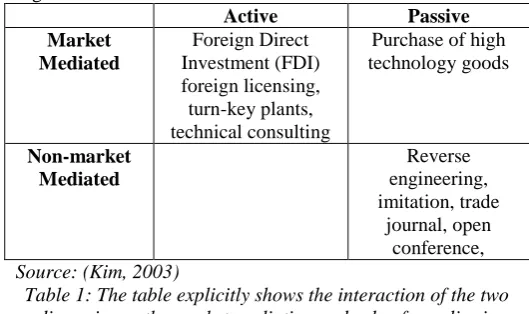
Kim (2002) used two dimensions to analyse the transfer of technology namely, the market mediation and the role of foreign supplier. These dimensions show if receiver of technology make payment for the usage or not and also if foreign suppliers are actively or passively involved in the passage to the second party. Market approach includes: turnkey contracts, licensing agreement, international subcontracting, foreign direct investment and joint venture.
While non-market approach of transfer includes: reversed engineering, importation of high technology products, exchange of scientific and technical personnel, open literature, technology conference and employee in international organisation.
Active Passive
Market Mediated
Foreign Direct Investment (FDI) foreign licensing, turn-key plants, technical consulting
Purchase of high technology goods
Non-market Mediated
Reverse engineering, imitation, trade
journal, open conference, Source: (Kim, 2003)
Table 1: The table explicitly shows the interaction of the two dimensions - the market mediation and role of supplier in
technology transfer
II. EVIDENCE AND ANALYSIS OF TECHNOLOGY TRANSFER
Newly industrialized economies such as Japan, Korea and Taiwan have used several technology transfer strategies changed at different development phases to build evidently high tech industries, bearing influence on their growth and income. Likewise, the second tier newly industrialised economies have stood on the shoulders of the developed using similarly strategies. A thorough consideration of the strategies adopted by South-Korea and China within their socio-economic sphere would create evidence and analysis of technology transfer and strategies used. More so, insight could be drawn for ‘industrial struggling nations’.
A. THE KOREAN EXPERIENCE
The 'Korean Miracle’ has intrigued a lot of researchers into exploring the factors that hightailed the economy to the developed class, facing off the ‘middle income trap’ and other development challenges in less than half of a century. Aside the brevity of development turned ‘miracle’, the nation’s strategic disposition to technology transfer and human development has surfaced widely in the literature. It is widely believed among researchers that the development of science and technology was crucial to the compressed growth of South-Korea (Ji woongYoon, 2014) with the interplay of the government, private entrepreneurs and other key actors in the macroeconomic framework.
Page 58 www.ijiras.com | Email: [email protected] development of her processing and assembly corporation
largely through reserved engineering, imitation and OEM. While simple technology equipment was imitated and reversed engineered due to paucity of funds to purchase enough foreign licences (Ji woon Yoon, 2014; Kim, 1997), the OEM was used in shoe making, textile and garment making because foreign buyers were available to provide them with the necessary product design, quality control and materials (Chung 2007). The ability to import technology from developed countries, adapt for local use and imitate gave Korea leverage in building ‘self-made’ technology products.
In the 1980s’ the Korean government advanced her industrialisation ambition by stimulating indigenous R&D and encouraging competition needed to upgrade their products in the face of emerging threats at from other newly industrialising markets in Asia. This successfully launched the Korean economy into a high tech market, with Korean companies owning a large number of Patents in the world.
B. THE CHINESE EXPERIENCE
The Chinese economy has been marked with increasing competitiveness in high tech products and stunning economic growth in the last few decades. This has greatly challenged a lot of developing nations to taking a look at the macro-economic policies especially on technology innovation in china. Studies have shown that China is one of the developing countries with the largest influx of foreign direct investment, reaching the tone of $26 billion (US) in 1993 despite her hostility towards globalization prior to 1979. This influx promoted technological transfers and management style copied by Chinese enterprises (NBER-EASE, 1996)
Early transfer of technology in China during the 1950s’ and early 60s’ were majorly through the turnkey project investment from the USSR, US and Western Europe; however, they were limited. The deficiencies associated with turn-key project in that it was too expensive and limiting technology capacities led to a review in 1978. The cautious market reform in China led to the creation of Special Economic Zones (SEZs) that had remarkable result though it was marked with investment in low-tech goods and light industries. This pushed further for the creation of Economic and Trade Development Zones (ETDZs); Free Trade Zones (FTZs) and High Technology Development Zones (HTDZs) which increased the flow of FDI into the country. Also, the positioning of the economy towards high tech product was fuelled by the government’s encouragement of pillar industries namely: electronics, petrochemical, automobiles and construction materials. International Joint Ventures were granted special grants and incentives such as preferential taxation, freedom to import input materials and equipment, interest free loans and simpler licensing procedures. The influx of FDI into the Chinese economy did not guarantee the assimilation of these technologies; however, their absorption was stimulated in several ways. The clustering of Multinational Corporations (MNCs) in SEZ aided assimilation as this gave rise to the diffusion of knowledge and the creation of network externalities between MNCs, local producers and suppliers. Also this setting allowed observation of production processes, enhancing knowledge transfer. The presence of
skilled Chinese in IJVs facilitated the transfer of knowledge form the MNCs to local industries. Particularly, government policies on preferential hiring of returning students abated the brain drain resulting from Tiananmen. These incentives facilitated the return of Chinese who studied abroad following their undergraduate and graduate course work (Kyna, 1996).
III. ANALYTICAL FRAMEWORK
The framework used in this study combines the technology transfer trajectory noticed among recent developers and the actors responsible for them, which are mostly referred to as the National Innovation System (NIS) in the literature. This helps to analyse the progression of developing countries in the building of their technical capabilities with the elements responsible for accumulating these capabilities.
A. THE TECHNOLOGY TRANSFER TRAJECTORY
MODEL
This model opines that technological transfer in developing countries is usually in a particular order or follows a chain of processes. Kim (1980) developed a three phase model of technology transfer – acquisition, assimilation and improvement - extending the work of (Utterback and Abernathy, 1975). He postulated that developing countries cultivate production processes through the acquisition of technical know-how, product specification and processes from advanced countries. Success in this phase leads to the absorption and diffusion of the knowledge involved. With indigenous research and engineering, the assimilated knowledge is improved. However, Lee, Bae and Choi (1988) added that the trajectory noticed by Kim (1980) repeats itself when developing countries engage in creative imitation (Maskus, 2003).
This study discovered that technology evolve among recent developers in five phases, which are: local base technical development; acquisition of technology; assimilation of technology; adaptation and imitation and innovation. It also goes further to show that this process continues even after the attainment of high technology however, at a decreased rate and with a different strategy. The diagram below shows the chain of these phases beginning with local base technical development.
FIRST PHASE: Development of local base technology
Acquisition Assimilation Adaptation and Imitation of technology Innovation
CONTINUOUS PHASE: Research and Development
Adaptation and Imitation Innovation
Page 59 www.ijiras.com | Email: [email protected] the base technology in China was aided by the culture of Kung
Fu and a repertoire of local producers. The strength of this phase gears other phases as domestic technology exploration, through learning and entrepreneurial activities birth outward looking activities and ability to see new ideas.
The use of various technology transfer mechanism marks the next phase of the trajectory. This comes as a result of the need to advance local production and spur the technological development of a country. Mechanism such as: foreign direct investment, licensing, turnkey project, equipment purchase, original equipment manufacturer (OEM) are used in transferring technology. While China acquired technology largely from foreign direct investment, South Korea got technology from equipment purchase, original equipment manufacturer and licensing.
It is important to note that the acquisition of technology through various strategies is not the end in itself; however, it is a means to an end. Hence, acquisition of technology does not equate to transfer. Madeuf (1984) explained that innovation importation can only be successful, when the recipient is able to use, reproduce and advance the technologies at his own pace. This phase is marked by internalisation of knowledge input for the purpose of product adaption and imitation. Success in the learning of technology is followed by it adaptation to local use and the creative imitation of innovation processes. The adaptation and imitation of assimilated knowledge is an attempt to produce learnt technology taking cognizance of local priorities and needs. In this phase the acquired technical knowledge is used to make products with local features and priorities. Kim (2002) described the 'duplicative imitation' learning strategy used by Korean firms at the early industrialization stage, in that they took advantage of lesser technologies that were no longer cutting edge from foreign technology learning and adapting them to local need. At this stage, the capability of the local firms is tested from their ability to imitate and adapt learnt technology. Second tier new emerging economies such as Brazil, Mexico and Malaysia are currently in this phase.
The innovative phase is marked by a surge in research and development in the local firms, research and tertiary institutions coupled with a reduction in importation of innovation. Self-developed technologies and little creative imitations characterise this stage. Studies have shown that technology transfer helps to place a country on the path of technical progress in the short run, Ali and Adnan (1990) paving way for higher pedestal of technical growth through indigenous research and development (Kim and Nelson, 2000). It is important to note that this does not completely stop technology transfer; rather it places countries on a better platform for creative imitation. This is expressly in line with the conclusion of Cohen and Levithan (1989) that R&D does not just generate knowledge but also increases the firm's absorptive capacity. The experience of South Korea shows that an upward movement in technical development initiated by transfers were marked by increase in R&D and a simultaneous decrease in innovation importation. The research and development activities of the country keep the technology transfer cycle persistent as Adelowo et al (2017) said that R&D involves absorbing existing knowledge beyond national boundary and creating a new knowledge directly.
This framework postulates that, although technology transfer to developing countries can help attain high technological capability and good innovation system, this does not completely face-out the cycle. The knowledge gathered could still be used to absorb higher technology from other innovation advanced countries.
B. TECHNOLOGY ACTORS INTERACTION MODEL
This model relates to the linkages and interrelationships among various entities prominent in the transfer of technology. These actors have been collectively identified as the National Innovation System (NIS) in the literature. NIS is defined as the network of institutions in the public and private sectors whose activities and interactions initiate, import, modify and diffuse new technologies (Adelowo et al, 2017; Freeman, 1987). Adeoti (2002) postulated that NIS is an integrated system of economic and institutional agents directly promoting the generation and use of innovation in a national economy. The various elements of the national innovation system are considered very vital to the transfer and development of technology in a country. The Asian tigers and BRICS countries have leveraged on the innovation system to develop regional and national interactions among the actors for industrial and technological transfer (Adelowo et al, 2017)
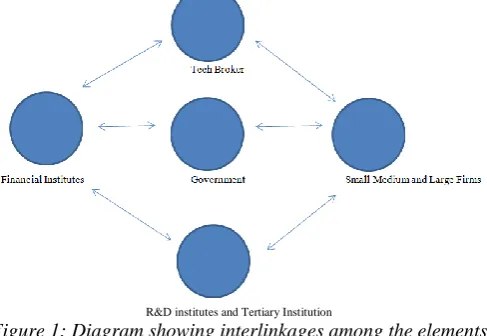
Gubriel (2002) identified the crucial elements of national innovation system as the central government, innovators and commercialisations. Also he added other transfer entities, which includes: technology transfer brokers, financial institutions, R&D institutes and higher institutions into the cycle of technology transfer participants. This study however defined the actors in the national innovation system as: the Government, the financial sector, technology broker, R&D institutes, Small and Medium Enterprises (SMEs) and large scale business.
R&D institutes and Tertiary Institution
Figure 1: Diagram showing interlinkages among the elements of technological transfer
Page 60 www.ijiras.com | Email: [email protected] Chinese who studied abroad facilitated the acquisition of
embodied and disembodied technology and also helped local suppliers assimilate skill required for the imitation. The government also evolve policies and created good macroeconomic atmosphere that would be conducive for tech brokers, entrepreneurs and R&D institutes.
The diagram shows the various linkages of the government with all other elements. The Government plays a vital role in supporting entrepreneurial activities through easing the means of business, giving loans, grants and partnership. The importance of government’s interaction with research institutes and higher education cannot be belittled. Aside financial support, the stance of government gives direction to the activities of research in the country. Little stimulants and policy support from the government on research and development leads to miniscule activities in this sector.
The entrepreneurs are individuals and firms that facilitate the acquisition of foreign technology and expertise through various means, in order to meet the need of local citizenry. The interaction of entrepreneurs with technology brokers facilitates the transfer of technology and partnership for technology transfer. The entrepreneur also connects with the financial institutions to finance high cost of acquisition and innovation. Meanwhile, in other to learn and improve imported innovations an interaction with R&D institutes which includes higher institutions is crucial.
The R &D institutes play a special role in the adaptation, imitation and innovation of technology. The interaction between this actor, technology brokers and entrepreneur is pivotal to revolutionizing existing technology. However, R&D institutes depend on the entrepreneur, government and financial institutions for funding to undertake research.
C. THE ACTOR-TRAJECTORY FRAMEWORK OF
TECHNOLOGY TRANSFER
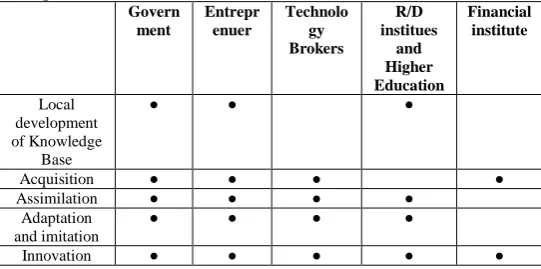
This framework incorporates the phases of technology transfer and the interaction of actors involved in the technology of transfer in developing countries. Although this framework does not try to give a universal trend to actors’ interactions at a particular phase, it shows the interactions and roles played by various actors at different stages for the purpose of an import innovation and development of technical capabilities. This also helps to point the attention of developing countries to the cruse of developing technical capabilities.
Govern ment
Entrepr enuer
Technolo gy Brokers
R/D institues
and Higher Education
Financial institute
Local development of Knowledge
Base
● ● ●
Acquisition ● ● ● ●
Assimilation ● ● ● ●
Adaptation and imitation
● ● ● ●
Innovation ● ● ● ● ●
Table 2: The Actor-Trajectory Technology Transfer Matrix
At the development of local knowledge base, the roles and interactions of the government, entrepreneurs, research and higher institutions are vital to building a strong foundation for future innovations through technology transfer. Particularly, the activities of government in improving education, vocational training, foreign networks and macroeconomic climate will significantly affect the knowledge base required for assimilation, acquisition and imitation of technology. At this phase, the rudimentary knowledge of science and technology is needed for the development of local base technology. Therefore, the government plays a vital role in promoting access to education for a wider coverage of primary, secondary and technical education, which is necessary to ensure the usage of rudimentary knowledge among local producers and artisans. For instance, in the Korean economy, the free access to primary education and life-long learning among worker helped in the evolution of a learned country. While the ambitious industrial policy of the Korean government in the 60's paved way for the diversification of the manufacturing into steel, chemical and machinery. In an effort to increase the efficiency and application of science and technology to development in China, the government established the National Science Foundation (NSF) with the power to give grants to researches on a competitive basis, especially those with applicability in industrial/commercial sector (Frieman, 1997)
The attainment of the elementary knowledge of the technology and the needed entrepreneurial activities gives rise to the next phase- the acquisition of technology. At this stage the luring stances of the government and entrepreneurs pull the technology brokers to transfer technology through different means. Also, the ability of the entrepreneurs to import technology through the formal and informal means, with the support of the government and financial institutions speaks volume about this phase. The Korean government enhanced the acquisition of foreign technology using long-term foreign loans, which were used to finance the purchase of capital goods and turn-key plants for reversed engineering purpose (Chung, 2007).
The assimilation of the acquired technology marks the next phase with the interaction of four major players; the government, entrepreneur, the technology broker, research and Higher institutions. Technology brokers and research institutes are usually at the fore front of deciphering technology either through market or non-market ways. Technology brokers help in the assimilation of technology by producing technical assistance, trade materials and managerial processes needed in grasping the innovation. Also the interaction on the phase is similar to the adaptation and imitation phase. The ability to fully grasp the technology leads to the adaptation and imitation stage by the entrepreneurs, technology brokers, research and higher institutions. The interaction of entrepreneurs and higher learning institutes scale up at this phase to fine-tune imported innovation.
Page 61 www.ijiras.com | Email: [email protected] in it duty of enhancing quality human development, through
the improvement in education, research and vocational activities. With this, a good leverage for industry-education interaction is enhanced, causing a multiplier effect on the national innovation system. The post 1985 projects such as the: ‘863’, ‘Spark’, ‘Torch’ and Golden projects initiated by the Chinese central government gave way to new technologies and their applicability in agriculture and communication sector. Specifically, the golden project led to the development and application of the fibre-optic communication networks in sectors such banking, customs and tax collection, telecommunication infrastructure, medical and health information, and academics or scientific work. (Wendy, 1997). Also, in South Korea the government invested in her IT by increasing her share in R&D expenditure from 13% in 1997 to 33.5% in 2002 bearing positive influence on the IT sector and other sectors (Chung, 2007).
IV. LESSONS FOR DEVELOPING ECONOMIES
The actor-trajectory framework of technology transfer provides insights for developing countries on the roles of actors at different phases of the transfer trajectory. Although, it is impossible to cover the inexhaustible role of the different players, this work provides linkages that are quintessential to successful technology transfer in various countries.
A. THE PIVOTAL ROLE OF THE GOVERNMENT
This paper opines that the government is the central coordinating force in technological assimilation and absorption; consequently, the governments of developing countries will need to play active roles in interacting with other elements of the chain. Beyond creating an enabling environment for businesses, governments should create institutions and policies for their specific targets. The general atmosphere might not be a sufficient condition for the take-off of some industries. For instance, the creation of industrial zone is not a sufficient condition to attract foreign direct investment in the automobile industry. Other institutional provisions such as dedicated research centres and policies on automobiles might be necessary to ensure technological transfer. The government has the role of providing short and long term vision of technical growth especially, taking the lead in innovation by providing the vision, creating incentives for followership and policies for conducive partnership. The government has the role of reducing emigration of skilled workers in a country to avert incidences of brain drain. In the other way round, government can evolve different policies to attract skilled citizen resident in other countries of the world. This can serve a viable means of connecting with technology brokers to transfer skills and knowledge embodied in humans.
B. THE PIVOTAL ROLE OF EDUCATIONAL AND RESEARCH INSTITUTES
Developing countries must pay attention to building strong educational foundations that would enhance easy grasps of technical knowledge. Although, building a strong primary
and secondary education is vital, attention must be placed on technical and vocational studies, research and life-long trainings. Technical and vocation studies will equip students with pragmatic skills in different areas of work while continued or life-long training will hone the capacity of the workforce to keep pace with the evolving utilities of a fast globalising world.
C. THE PIVOTAL ROLE OF ENTREPRENEURSHIP
The orientation of entrepreneurship in many developing countries has been focused on ‘quick profit’ generation rather than assimilation for creative imitation. Importation of new technologies has generally been limited to the short term monetary gains, which could be explained by the myopic outlook and lack of incentives in transferring international technology, limited linkage among the actors and the dearth of skilled workers. Other activities and policies that could eradicate the ‘quick profit’ fix would require interaction among various actors particularly, the research and higher institutions with entrepreneurs.
D. THE IMPORTANCE OF THE LINKAGES AMONG THE TECHNOLOGICAL TRANSFER ACTORS
To ensure a successful transfer of technology, developing countries must pay attention to regional and national interaction among technological transfer actors. Synergy must be built between government, research and tertiary institutions and firms to ensure the dissemination of knowledge. Also, synergy must be built among financial institutions, technology brokers and others to ease funding activities for tech transfer. The ability of government to properly visualise, coordinate and foster interactions among these actors determine the extent to which a country can reap the dividends of technological transfer.
V. CONCLUSION
Technological transfer is a potent tool that can be used to spur industrial development in third world countries. By standing on existing products, material or knowledge already gotten by tech savvy nations, developing countries can gain insight into the vast wealth of knowledge for innovation. However, there must be a local base of knowledge sufficient for the transfer of technology acquired, whether through market or non-market mediated means. The acquisition of technology can be done by the government, entrepreneurs, external agents (the tech brokers) or a mixture of these agents; however, the assimilation, adaptation and imitation of the acquired materials, product or knowledge signal the end of the means. Through the complementary efforts of research and development creative imitation can be translated to innovation.
Page 62 www.ijiras.com | Email: [email protected] be impeded greatly. It is important to note that the study does
not give an exhaustive conclusion on the linkages between the actors at different stages of development; rather it gives insights to the myriads of networks that can exist to enable the success of technology transfer.
REFERENCES
[1] Adelowo, C.M., Akinwale.Y.O., & Olaopa, O.R. (2017). Innovation and knowledge transfer in Nigeria, International Journal for Research, Innovation and Commercialization, I(I), 57-73
[2] Adeoti, J.O. (2002). Building technological capability in the less developed countries: the role of a national system of innovation, Science and Public Policy, 29(2), 95-104. [3] Bozeman, B. (2000). Transfer and Public Policy: a review
of research and theory, Research Policy 29(2000) 627-655 [4] Brandt, L. & Zhu S. C., (2005). Technology adoption and absorption: the case of Shanghai firms, Working Paper of Department of Economics, Michigan State University [5] Chesnais, F. (1986). Science, technology and
competitiveness, STI Review, 1(85)
[6] Chung.S. (2007). Excelsior: The Korean innovation story, Issues in Science & Technology, [Online], Available: http://www.issues.org/24.1/index.html
[7] Cohen, W.M., & Levinthal D.A., (1990). Absorptive capacity: a new perspective on learning and innovation, Administrative Science Quarterly, 35, 128-152.
[8] Cohen, W.M., & Levinthal D.A., (1989). Innovation and learning: the two faces of R&D, Economic Journal, 99, 569-596.
[9] Freeman, C. (1987). Technology policy and economic performance: lessons from Japan, London: Frances Pinter. [10]Gubriel, (2002). Impact of innovation and technology transfer on economic growth: the central and eastern Europe
[11]Keller, W. (2004). International technology diffusion, Journal of Economic Literature, 62(3), 75-82
[12]Kim, L., Nelson, R.R. (Eds.), Technology, learning, and innovation: experiences of newly industrializing economies. Cambridge: Cambridge University Press, 13– 68.
[13]Kim, L. (1980). Stages of development of industrial technology in a developing country: a model, Research Policy, 9, 254-277.
[14]Kim, L. (2002). Technology Transfer and Intellectual Property rights: Lessons from Korea’s experience, UNCTAD/ICTSD working paper.
[15]Kim, L. (1997a). Imitation to innovation: the dynamics of Korea’s technological learning, Harvard Business School Press: Boston.
[16]Kyna, R. (1996). Go west, look east, Far Eastern Economic Review
[17]Lee, J., Bae, Z., et al. (1988). Technology development process: a model for a developing country with a global perspective, R&D Management, 18(3), 225–250
[18]Madeuf, B. (1984). International technology transfer and international technology payments: definitions, measurements and firm‟ behaviour”; Research Policy 13(3), 125 -140
[19]Maskus, K.E. (2003). Encouraging international technology transfer, ICTSD/UNCTAD, 7, Available on: www.iprsonline.org
[20]NBER-EASE, (1996). Financial deregulation and integration in east Asia”, University of Chicago Press, 77-105
[21] Perlmutter, H. V., & Sagafi-nejad, T., (1981). International technology transfer, guidelines, codes and muffled quadrilogue, Pergamon Press Inc., Oxford. [22]Utterback, J.M., Abernathy, W.J., (1975). A dynamic
model of Ž. process and product innovation, Omega ,3(6), 640–656.