A Distributed Mobile Cloud Computing for Secure Mobile Data
Anand T M1 and Thiruvenkatasuresh M P2
1PG Student, Department of Computer Science and Engineering, Excel Engineering College, Komarapalayam, India . 2Assistant Professor, Department of Computer Science and Engineering, Excel Engineering College, Komarapalayam, India.
Article Received: 01 March 2018 Article Accepted: 09 April 2018 Article Published: 28 April 2018
1. INTRODUCTION
Cloud computing is internet-based computing in which large groups of remote servers are networked to allow
sharing of data-processing tasks, centralized data storage, and online access to computer services or resources.
Clouds can be classified as public, private or hybrid. Cloud computing is a type of computing that relies on sharing
computing resources rather than having local servers or personal devices to handle applications. The main enabling
technology for cloud computing is virtualization.
Virtualization software allows a physical computing device to be electronically separated into one or more
"virtual" devices, each of which can be easily used and managed to perform computing tasks. Cloud computing
adopts concepts from Service oriented Architecture (SOA) that can help the user break these problems into services
that can be integrated to provide a solution. Cloud computing provides all of its resources as services, and makes
use of the well-established standards and best practices gained in the domain of SOA to allow global and easy
access to cloud services in a standardized way. An individual or an organization may not require purchasing the
needed storage devices.
Instead they can store their data backups to the cloud and archive their data to avoid any information loss in case of
hardware / software failures. Even cloud storage is more flexible, how the security and privacy are available for the
outsourced data becomes a serious concern. Preserving authorized restrictions on information access and
disclosure. The main there at accomplished when storing the data with the cloud. Guarding against improper
information modification or destruction and ensuring timely and reliable access to and use of information.
mous sensors to monitor physical or environmental conditions, such as temperature, sound, pressure, etc. and to
cooperatively pass their data through the network to a main location. The more modern networks are bi-directional,
also enabling control of sensor activity Wireless sensor network (WSN) are spatially distributed autonomous
sensors to monitor physical or environmental conditions, such as temperature, sound, pressure, etc. and to
A B S T R A C T
A cloud system is difficult to synchronize login and authentication data between external clouds and internal systems without exposing internal security data. The cloud technologies are rapidly being adopted throughout the Information Technology (IT) due to their various attractive properties. In spite of their spread, they have raised a range of significant security and privacy concerns which interrupt their adoption in sensitive environments. In existing scheme makes a good tradeoff between the functionality and the efficiency. To better express the relevance between the query and files, we introduce the TF-IDF rule into our design.
cooperatively pass their data through the network to a main location. The more modern networks are bi-directional,
also enabling control of sensor activity Each such sensor network node has typically several parts: a radio
transceiver with an internal antenna or connection to an external antenna, a microcontroller, an electronic circuit for
interfacing with the sensors and an energy source, usually a battery or an embedded form of energy harvesting. The
development of wireless sensor networks was motivated by military applications such as battlefield surveillance.
2. BACKGROUND AND RELATED WORK
In this paper, a solution is to apply a distributed self proxy re encryption technique, propose a Proxy Server (PS). It
coordinates and chooses keys by Key Manager (KM) whenever group membership changes. The distributed SPS
provides not only encryption and decryption keys but also immediate re encryption keys for shared data. After
communicating with KM, it automatically receives necessary keys from KM by self created algorithm. A
distributed SPS scheme is one solution where multiple proxies are automatically deployed in several clouds. In this
Module, the cloud service provider can able to login with their provided credentials and can able to View
Application Service Provider Details, View Data Owner Details. In this module the Payment from Data Owner will
be performed. The details includes of the payments are Cloud storage provider id, data owner id, date of payment,
file details and the payment amount.
2.1. Cloud Data Owner
Data The Data Owner (DO) has data to be stored in the cloud and rely on the cloud for data computation, consists of
both individual consumers and organizations. The data owner of MCP shares data to many other cloud users. The
data is encrypted with a key from KM and then stored in the cloud along with access control list indicating the user
group. Upon access request from a user, the cloud communicates with SPS, based on access control list, and Self
Proxy Server (SPS) requests for the key.
According to the key request to the SPS, uses re-encryption to transfer the encrypted format that can be decrypted
by the user‟s private key. The user can download the encrypted data from the cloud and use the decryption key. In
this data owner module, the data owner can View the Application service provider Details, View CSP Details after
logged into the system.
The data owner can also Upload Content to the cloud storage with the description of file description, category of the
file and cloud storage provider details along with application service provider details. The data owner can also
View the Download Request from the users and Provide Keys to the download request files by the end users.
2.2. Infrastructure with cloud services
The existing system has provided comprehensive information regarding the cloud security problems. It has been
estimated the security problem from cloud architecture point of view, the cloud stakeholders‟ point of view and at
configurations need to be organized and each service should be maintained a level at runtime. From service
delivery model prospective, the cloud management security issues and cloud access method security issues are also
highlighted.
The existing system has presented details about the security issues which cloud service providers are facing when
they dig deep for cloud engineering. There are some serious issues and challenges which cloud computing are
facing in the domain of cyber security. The paper also covers security management models for the cloud service
providers in order to meet security compliance. The existing system has identified the serious threats and risks
related to privacy and security for the mass and corporate users when they will integrate their mobile hand held
devices with the cloud infrastructure.
3. PERFORMANCE ANALYSIS
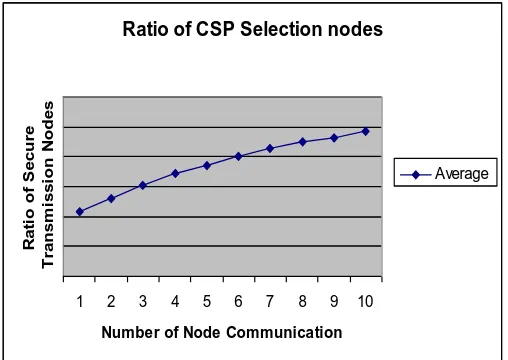
The following Table 7.1 describes experimental result for existing system secure transmission node analysis. The
table contains number of time slot interval and given time interval to calculate average numbers of CSP details are
shown:
S.NO NUMBER OF
TIME SLOT (M)
RATIO OF SELECTION
CSP
1 10 0.43
2 20 0.52
3 40 0.61
4 60 0.69
5 80 0.74
6 100 0.80
Ratio of CSP Selection nodes
1 2 3 4 5 6 7 8 9 10
Number of Node Communication
R
a
ti
o
o
f
S
e
c
u
re
T
ra
n
s
m
is
s
io
n
N
o
d
e
s
7 120 0.86
8 140 0.90
9 150 0.93
10 160 0.97
3.1. Mechanism of existing system
Input central keywords with certain adjunct words as the query keywords when searching documents. The
importance of each query keyword depends on the search intension of a user. So far many works have demonstrated
the importance of keywords. The super-increasing sequence is to show the preference factors of keywords to
indicate the importance of keywords in a query keyword set.
However, users need to sort keywords according to their importance, which increases the users‟ input cost. Due to
the lack of the super-increasing sequence, the last keyword the user inputs are more important than all the other
keywords. The existing model built a user interest model for individual user by analyzing his search history.
However, when inputting unusual keywords, it needs to re-build a new interest model. In this project, our use the
grammatical relations as standards to show the weight of each keyword, and this enables users to retrieve relevant
documents from the cloud based on their own interests.
In addition with all the existing system mechanism, a correlated Authentication aspect with combination of the
cloud storage provider, application service provider and end user is also considered. In addition, time limit is
provided to end user to access the Application Service Providers (ASPs). So at different time intervals, different
kinds of tariffs can be applied to end users to access the service. Likewise, the security aspects provided by the
cloud storage provider is also taken by ASPs to increase the security more. In addition, trusted third party
authentication mechanism is included.
3.2. Term Frequency Analysis
Each Term Frequency – Inverse Document Frequency (TF-IDF)
The TF measures how frequently a particular term occurs in a document. It is calculated by the number of times a
word appears in a document divided by the total number of words in that document. It is computed as TF(the) =
(Number of times term the „the‟ appears in a document) / (Total number of terms in the document). The IDF
measures the importance of a term. It is calculated by the number of documents in the text database divided by the
number of documents where a specific term appears. While computing TF, all the terms are considered equally
important. That means, TF counts the term frequency for normal words like “is”, “a”, “what”, etc. Thus we need to
know the frequent terms while scaling up the rare ones, by computing the following: IDF(the) = log_e(Total
For example, Consider a document containing 1000 words, wherein the word give appears 50 times. The TF for
give is then (50 / 1000) = 0.05. Now, assume that, 10 million documents and the word give appears in 1000 of these.
Then, the IDF is calculated as log(10,000,000 / 1,000) = 4. The TF-IDF weight is the product of these quantities −
0.05 × 4 = 0.20.
REDUCED ERROR RATE FOR EXISTING AND PROPOSED SYSTEM
Member Node Existing System (%) Proposed System (%)
8 72.54 78.62
12 76.13 78.11
16 82.42 83.13
24 86.66 84.67
30 88.13 89.78
32 80.44 82.66
38 78.33 80.21
42 87.22 89.76
46 79.22 80.65
50 91.22 92..62
REDUCED ERROR RATE FOR EXISTING AND PROPOSED SYSTEM
0 20 40 60 80 100
1 2 3 4 5 6 7 8 9 10
AVG Cloud Services Provider
A
V
G
E
rr
o
r
R
a
te
[
%
]
Existing System (%)
3.3. End user Search
In this process, the end user search the data can able to view the Cloud Storage Provider Details, Application
Service Provider Details and Data Owner Details. The user can also Search for Content from the cloud storage and
they can download the file by means of send request to the data owner to obtain the key to download the contents.
The user can download the encrypted data from the cloud and use the decryption key.
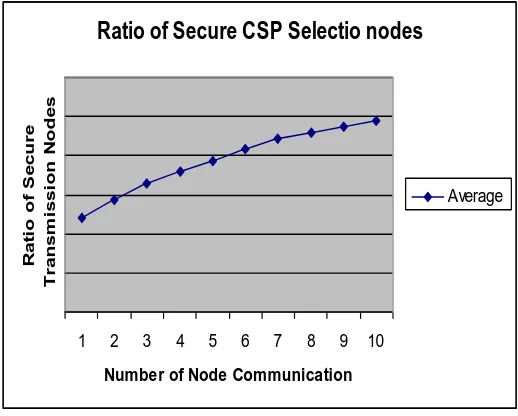
The following Table 7.2 describes experimental result for proposed system secure transmission node analysis. The
table contains number of time slot interval and given time interval to calculate average numbers of send
transmission node details are shown:
S.NO NUMBER OF
TIME SLOT (M)
RATIO OF CSP NODE
1 10 0.48
2 20 0.57
3 40 0.66
4 60 0.72
5 80 0.77
6 100 0.83
7 120 0.89
8 140 0.92
9 150 0.95
10 160 0.98
Selection Multi Cloud Services Provider- Ratio Analysis
Ratio of Secure CSP Selectio nodes
1 2 3 4 5 6 7 8 9 10
Number of Node Communication
3.4. Application Service Providers
Input central keywords with certain adjunct words as the query keywords when searching documents. The
importance of each query keyword depends on the search intension of a user. So far many works have demonstrated
the importance of keywords. The super-increasing sequence is to show the preference factors of keywords to
indicate the importance of keywords in a query keyword set.
However, users need to sort keywords according to their importance, which increases the users‟ input cost. Due to
the lack of the super-increasing sequence, the last keyword the user inputs are more important than all the other
keywords. The existing model built a user interest model for individual user by analyzing his search history.
However, when inputting unusual keywords, it needs to re-build a new interest model. In this project, our use the
grammatical relations as standards to show the weight of each keyword, and this enables users to retrieve relevant
documents from the cloud based on their own interests.
In addition with all the existing system mechanism, a correlated Authentication aspect with combination of the
cloud storage provider, application service provider and end user is also considered. In addition, time limit is
provided to end user to access the Application Service Providers (ASPs). So at different time intervals, different
kinds of tariffs can be applied to end users to access the service. Likewise, the security aspects provided by the
cloud storage provider is also taken by ASPs to increase the security more. In addition, trusted third party
authentication mechanism is included.
3.5. Cloud Service Provider Mechanism
In this process, the admin user can able to add the cloud service provider details, application provider details and
data owner details, the details which are stored into the corresponding tables in the data base
Cloud Service Provider details includes the Cloud service provider id, name of the cloud provider, website and
password details will be stored into the CSProviders table. Application Service Provider details includes the
Application service provider id, name of the application service provider, password are stored into the ASProviders
table. Data Owner details includes the data owner id, name of the data owner and password details are stored into
the DataOwner table.
Also the admin user assigns the Cloud Service Provider to Application Service Provider and Assign Cloud Service
Provider to Data Owner. And the admin user can able to view the Cloud Service Providers details, Application
Service Providers details, Data Owners Details; View Users details and view downloads
4. CONCLUSIONS
In this experimental study, the existing system is describing the problem of secure authentication for storage in
cloud. In this paper, proposed FA which carries out a flexible file-sharing scheme between an owner who stores the
shows that our N-FA (Novel Fuzzy Authorized) scheme provides a thorough security of outsourced data, including
confidentiality, integrity and secure access control. Novel-Fuzzy Authorized approach reduces the storage
consumption compared to other similar possible authorization schemes. It also asserts that our scheme could
efficiently achieve distance tolerance and realize fuzzy authorization in practice research study. This work mainly
addresses the reading authorization issue on cloud storage. And it results to enable the TPA to perform audits for
multiple users simultaneously and efficiently
REFERENCES
[1] Tassanaviboon and G. Gong, “OAuth and ABE based authorization in semi-trusted cloud computing,” in
Proc. 2nd Int. Workshop Data Intensive Comput. Clouds, 2011, pp. 41–50.
[2] K. Ren, C. Wang, and Q. Wang, “Security challenges for the public cloud,” IEEE Internet Comput., vol.
16, no. 1, pp. 69–73, Jan./Feb. 2012.
[3] Agudo, “Cryptography goes to the cloud,” in Proc. Workshop Secure Trust Comput., Data Manage. Appl.,
2011, pp. 190–197.
[4] J. Xu, E.-C. Chang, and J. Zhou, “Weak leakage-resilient clientside deduplication of encrypted data in
cloud storage,” in Proc.8th ACM SIGSAC Symp. Inf., Comput. Commun. Security, 2013, pp. 195–206.
[5] Wang, S. S. Chow, Q.Wang, K. Ren, and W. Lou, “Privacy-preserving public auditing for secure cloud
storage,” IEEE Trans.Comput., vol. 62, no. 2, pp. 362–375, Feb. 2013.
[6] Y. Zhu, H. Wang, Z. Hu, G.-J. Ahn, H. Hu, and S. S. Yau,“Dynamic audit services for outsourced storages
in clouds,” IEEE Trans. Serv. Comput., vol. 6, no. 2, pp. 227–238, Apr.–Jun. 2013.
[7] Q. Wang, C. Wang, K. Ren, W. Lou, and J. Li, “Enabling public auditability and data dynamics for storage
security in cloud computing,” IEEE Trans. Parallel Distrib. Syst., vol. 22, no. 5, pp. 847–859, May 2011
[8] T. O. Eiichiro Fujisaki, “Secure integration of asymmetric and symmetric encryption schemes,” J.
Cryptol., vol. 26, no. 1, pp. 80–101, 2013.
[9] Lynn, “On the implementation of pairing-based cryptosystems,” Ph.D. dissertation, Dept. Comput. Sci.,
Stanford Univ., Stanford, CA, USA, Jun. 2007.
[10] R. Berlekamp and L. R. Welch, “Error correction for algebraic block codes,” U.S. Patent US 4 633 470 A,
Sep. 27, 1983.
[11] Gorenstein, W.W. Peterson, and N. Zierler, “Two-error correcting Bose-Chaudhuri codes are
quasi-perfect,” Inf. Control, vol. 3, no. 3, pp. 291–294, 1960.
[12] Reed and G. Solomon, “Polynomial codes over certain finite fields,” J. Soc. Ind. Appl. Math., vol. 8, no. 2,
pp. 300–304, 1960.
[13] L. R. Welch. (1997). The original view of reed-solomon codes [Online]. Available:
http://csi.usc.edu/PDF/RSoriginal.pdf
[14] M. Backes, C. Cachin, and A. Oprea, “Secure key-updating for lazy revocation,” in Proc. 11th Eur. Conf.
[15] C. J. Mifsud, “Algorithm 154: Combination in lexicographical order,” Commun. ACM, vol. 6, no. 3, p.
103, 1963.
[16] Y.-C. Chen, E. M. Nahum, R. J. Gibbens, D. Towsley, and Y. Lim,“Characterizing 4G and 3G networks:
Supporting mobility with multi-path TCP,” Univ. Massachusetts Amherst, Amherst, MA,USA, Tech. Rep.
UM-CS-2012-022, 2012.