78:12–2 (2016) 19–28 | www.jurnalteknologi.utm.my | eISSN 2180–3722 |
Jurnal
Teknologi
Full Paper
M
ANAGEMENT
S
YSTEM
P
ROTOTYPE
F
OR
I
NTELLIGENT
M
OBILE
C
LOUD
C
OMPUTING
F
OR
B
IG
D
ATA
Nur Syahela Hussien, Sarina Sulaiman
*, Siti Mariyam Shamsuddin
UTM Big Data Centre, Ibnu Sina Institute for Scientific and Industrial
Research, Faculty of Computing, Universiti Teknologi Malaysia,
81310 UTM Johor Bahru, Johor, Malaysia
Article history Received 5 September 2016 Received in revised form
14 November 2016
Accepted
8 November 2016
*Corresponding author
[email protected]
Graphical abstract
Abstract
The current challenge of mobile devices is the storage capacity that has led service providers to develop new value-added mobile services. To address these limitations, mobile cloud computing, which offers on-demand is developed. Mobile Cloud Computing (MCC) is developed to augment device capabilities, facilitating to mobile users store, access to a big dataset on the cloud. Even so, given the limitations of bandwidth, latencies, and device battery life, new responses are required to extend the use of mobile devices. This paper presents a novel design and implementation of developing process on intelligent mobile cloud storage management system, also called as Intelligent Mobile Cloud Computing (IMCC) for android based users. IMCC is important for cloud storage user to make their data effectively and efficiently for saving the user time. IMCC provided convenience for user to use multiple cloud storage using one application and easy for users to store their data to any cloud storage. The result shows using IMCC it only took 8 seconds to access the data, which is faster compared with traditional MCC, it took 23.33 seconds. IMCC reduce 65.71% of latency occur using the MCC in managing a user data. The developed IMCC prototype is accessible through the Google Play Store.
Keywords: Mobile cloud computing, mobile cloud storage, prototype development, management system
© 2016 Penerbit UTM Press. All rights reserved
1.0 INTRODUCTION
Mobile Cloud Computing (MCC) is referred to as the infrastructure where both the data storage and the data processing happen outside of the mobile device. While, mobile cloud storage is a form of cloud storage that is accessible on mobile devices such as laptops, tablets, and smartphone. With the pervasive usage of mobile handheld computing devices, mobile business processing becomes possible and grows largely during commercial traveling [1]. The most top usages of cloud storages are Dropbox, SkyDrive, OneDrive and Box [2-4]. Mobile cloud storage providers offer services that allow the users to create and organize files, folders, music,
and photos, similar to other cloud computing models. Services are used by both individuals and companies. It helps users store and sharing the data in the cloud. This MCC has replaced the existing storage device like hard drives for user stores their data. Today mostly the users have a huge of data to be stored that are commonly not enough space to be stored in their local storage because they're a big data.
Consequently, cloud storage are introduced to the world to be solving this problem. With MCC, it easier for the users to use it because the users no need to bring the hardware like hard drives anywhere when wants to use the data. The users can access the data everywhere unless they are having a connection to the Access IMCC application system
Log-in any one of cloud services
NO
Login successful?
Access data in cloud service
Open / download the
data files
Upload / store / delete a file
Share data file with supported application integrated in device
Access most visited cloud service
Internet. However, most cloud file storage providers offer limited free use and charge for additional storage once the free limit is exceeded. These costs are usually charged at a monthly subscription rate and have different rates depending on the amount of storage desired. Consequently, mostly user tends to have multiple cloud storage at one time to store their large data. The user has difficulty managing their data when there are having large data file and too many cloud services used at the same time [5][6][7]. Besides, they waste a time to finding and access their current data if having multiple cloud storage because need to search the data one by one in cloud store.
In this paper, we propose a prototype of Intelligent Mobile Cloud storage Computing (IMCC) to tackle the above challenges. Therefore, user easy manages their data by IMCC that allowed access multiple cloud storage using one application only. Beside IMCC allowed user easy to store data to any cloud storage. IMCC reduces the user time to access the data by pre-fetching technique that predicts the most visited pages. Hence, the user can access directly based on pre-fetching result that saving user times and easy to manage their big data on the cloud.
The basically approach for mobile cloud storage is the adaptation of already known and mostly utilized cloud storage services be fond of Apple iCloud, Google Drive, Microsoft SkyDrive, or Dropbox [8], and cloud storage back-ends such as Amazon S3 [9] and Windows Azure Storage [10]. At this time, one of the most used cross-platform solution is Dropbox, which offers a platform-independent storage, applications for almost every mobile and desktop platforms, secured data with AES-256 encryption, and highly-reliable Amazon S3 as a storage system back-end. Besides, it uses binary-delta encoding functions to minimize the impact of synchronization, to only upload the modification on every file. Apple iCloud, Google Drive, and Microsoft SkyDrive are leading alternatives and have the benefit of being embedded into their respective operating systems, but as their main negative point, they are cross-plat- form restricted and lack some of the features offered by Dropbox.
Cloud storage systems are immediately associated with distributed files systems, which usually offer the file management infrastructure. In real fact, cloud storage can be visualized as the evolution of distributed file systems for domestic users in front of typically business or study learning distributed file systems. Ceph [11] distributed file system is currently growing in popularity. In order to avoid metadata access bottlenecks, Ceph takes advantage of a distributed metadata cluster architecture based on Dynamic Sub-tree Partitioning [12]. The file organization is partitioned by giving weight for sub-trees of the hierarchy of dissimilar metadata servers. This solution allows distributing the workload across the metadata hierarchy, which is fully self-regulating. Ceph and GFS [13] save all the necessary information about the file to metadata servers and access directly from the I/O nodes without any further metadata access. Ceph and GFS follow a similar replication scheme, in which data object replicas are
distributed through the cluster, at least one copy in the same rack and another outside of the rack containing the original data.
In addition, there are issues on Cloud Computing (CC) in managing the data deluge study by Balasubramaniyan and Ramachandran in [14], European Commission [15] and Assunção et al., [16]. This big data usually come from the consumer that use a digital form of data and this will increase the network bandwidth and reduce the CC performance. This issue required to improve in structuring data and mechanisms to handle it. It also leads to latency problem, so it will slow down the overall progress of CC services.
According to European Commission [15] they have come out with several lists of topic need to be supported so that the European IT industry can overcome current barriers to entry to the market and maintain the CC performance for businesses needed. The first had been list of European is managing the data deluge which is in context of volume, media types and streaming to provide confidence that cloud can maintain the best performance when deal with this different media. Hence, it requires improvement in structuring data and mechanisms to handle big data.
Today, there are high demands on using the CC service that needs the CC manage the increasing number of jobs with stable performance. Due to this situation, it brings a challenge for data management systems. Hence, the research focus on the data storage management. CC usually be used in normal website, but it also can be used in Mobile CC environment. This technology predicted to be grown according to the increasing growth of technology. Many users bring mobile phone everywhere, so it is highly increasing in the number of demands for MCC to easy user works.
However, today user are mostly used a Smartphone in daily life. With a Smartphone user can access the cloud data at anytime and anywhere. However, when there a big data to be stored in the cloud the latency occurs and difficult to manage especially having multiple cloud services. There are some cloud storage applications that support multiple cloud storage, therefore user allowed access to any cloud storage using one application. Even though, there are some limitations on the current mobile cloud storage. Hence, in this paper proposed a novelty of prototype cloud computing storage. The next topic explained the details on the existence of cloud computing storage in the market.
limitation because it only can view the data on current data existing in mobile phone. It cannot read the data on cloud services using this application. Besides, the features are limited compared with others.
The proposed work has similarity with Otixo, however IMCC consist some features that are not support to other current cloud computing storage include the Otixo. The new features are IMCC able to sort the most visited pages that allowed the user to visit current data faster and easier, read a used storage size and make
recommendation for user to store their data on which cloud service without checking one by one which cloud storage are available. Using IMCC, users are able to access their big data in any cloud storage services. They can manage and access big data store more effectively by using pre-fetching technique because IMCC be pre-fetch the data being requested feature by the user. Hence, it reduces the loading time and only fetches the right data. The next topic explains the details on methodology for the proposed prototype Intelligent Mobile Cloud Computing (IMCC).
Table 1 Comparison between Mobile Cloud Storage Management Applications in Market
Products
Features IMCC Otixo Cloud
Storage Manager
Clouds All Cloud
Storage
Access all data on multiple cloud storage with a single log-in
Share function
Upload files
Download files
Delete files
Sort most visit page
Read storage size
i ) used size
ii) Free storage (available)
iii) Total storage
Recommended to store data on available storage (in progress)
2.0 METHODOLOGY
Intelligent Mobile Cloud Computing storage (IMCC) is proposed in this paper to provide more features to users. The novelty of this IMCC including that IMCC is able to read the used size storage of each cloud. It is easy to user to know how big capacity that they have been used on each cloud when handling big data storage. Moreover IMCC allowed user to visit the current cloud service based on the most visited using
recommended cloud storage services with available capacity.
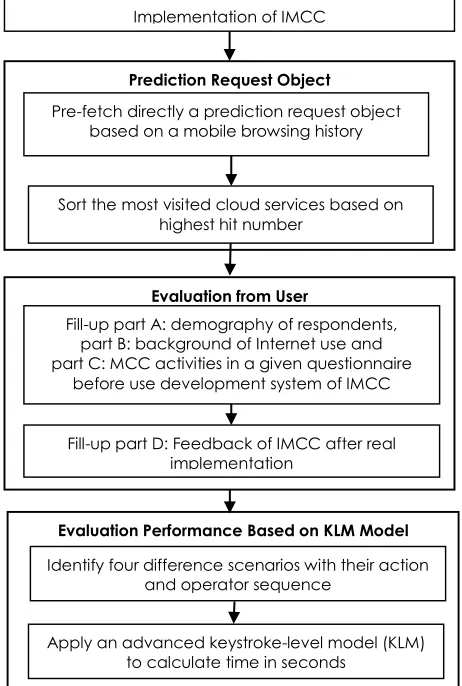
To develop the IMCC for the experiment, it needs some process and the process is illustrated as in Figure 1. This system work by accumulating their hit number based on user most visited cloud services. Users reduce their time in accessing the data based on pre-fetching technique. Then, the work has evaluated by users and the prototype IMCC able to access in Google Play Store. Furthermore, IMCC being evaluated, supported by using the advanced Keystroke-Level Model (KLM) model for mobile phones by Holleis et al. [17] to calculate the time consuming in access the data compared with traditional cloud storage services. Advanced KLM model in [17-21] be used to evaluate the scalability of data storage management based on the proposed work.
In addition, the prototype was evaluated based on the time consuming during access the data with different scenario and the average total time is recorded. As a result, using IMCC spends less in access the user data. Hence, IMCC reduces the latency and speed up the accessing time.
Figure 1 Experimental framework for IMCC
The system flow of the IMCC is important to structure the flow of system to being developed by developers. Figure 2 illustrated the process flow of
mobile application for the IMCC. It starts with user install the IMCC get from Google Play Store then user access the IMCC application. Then, users must login to any cloud storage services, which one user wants to use. User only needs to login one time only for the first access, and then the user can access the entire data file that is stored on those cloud services. If the user cannot login, user need back to the main menu and repeat the step.
After login, user bring at home page of cloud service, subsequent user allowed to manage their data. For instance, open or download the data file, upload a new data into any cloud storage services, delete the data, share any data to others using supported integration application in mobile phone. IMCC able user to read the size used, size available and the total size of storage on any cloud services. Furthermore, users can access the data faster by visiting the most visited cloud storage. Hence, the user can access to most visited cloud storage.
Figure 2 Process flow of mobile application for the IMCC
The proposed simulation implementation is based on CC environment. Figure 2 shows the process of mobile application for the intelligent mobile Web Pre-fetching implemented in the CC services. The figure shows the different flow with normal browsing or with the pre-fetching browsing. The user can access the data more effectively and faster even there are a big data by using pre-fetching browsing because the data already in local storage before the user request
Open / download the data files
Access IMCC application system
Upload / store / delete a file
Log-in any one of cloud services
Share data file with supported application
integrated in device Access data in cloud service
Log-in successful?
Access most visited cloud service
Read of used, free and total size storage Evaluation from User
Prediction Request Object
Evaluation Performance Based on KLM Model Implementation of IMCC
Pre-fetch directly a prediction request object based on a mobile browsing history
Sort the most visited cloud services based on highest hit number
Fill-up part A: demography of respondents, part B: background of Internet use and part C: MCC activities in a given questionnaire
before use development system of IMCC
Fill-up part D: Feedback of IMCC after real implementation
Identify four difference scenarios with their action and operator sequence
Apply an advanced keystroke-level model (KLM) to calculate time in seconds
it. The figure also illustrates the basic sample of application by applying the pre-fetching technique to reduce the latency problem. Furthermore, the figure shows the prediction of storage space available. The calculation based on the used space and free space available. The result output with the availability with the highest space and most favorite CC service.
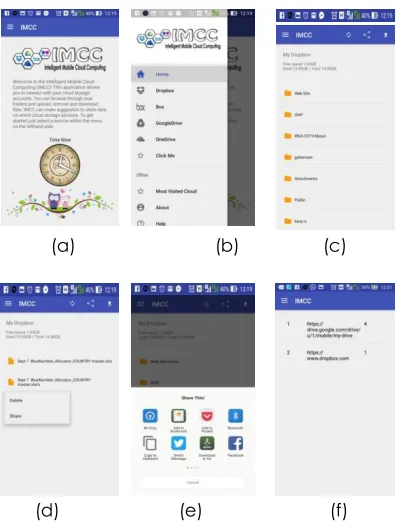
Figure 3 (a) show the home page of IMCC that describe a little about IMCC application system. In this proposed system, each user run and browse through IMCC, including Dropbox, One drive, Googledrive, and Box along with their detail services as in Figure 3 (b) and the other features provided on IMCC. Even though, Dropbox application was chosen to represent in this experiment. This is because this CC application is in the top-ten popular in the world with a huge number of users from different background [2]. Figure 3 (c) illustrated the list of user’s item that consist in the cloud service. User can delete and share a data file by press long at the selected file as depicted in Figure 3 (d). While Figure 3 (e) shows the share with function that are supported on user’s mobile phone. In addition, the user is able to access the data based on most visited cloud services as shown in Figure 3 (f).
(a) (b) (c)
(d) (e) (f)
Figure 3 (a-f) IMCC Interface for whole application systems
3.0 RESULTS AND DISCUSSION
The developed prototype was delivered to the later users to collect their feedback. The prototype was published in Google play store to get feedback from users. The users had the opportunity to evaluate the application on their own without any additional
guidance by the software developers. The collected comments were very positive. Some examples:
Besides, the prototype of IMCC was collecting a feedback from Facebook user how interest they are with IMCC. The results have shown around 400 user interests with the IMCC covered from many countries, mostly are Malaysia, Indonesia, Thailand as illustrated in Figure 4. Figure 5 illustrated the genre interest on IMCC. Mostly men are more interested on IMCC application compared with women's categories by ages.
Figure 4 User Interest on IMCC based on Country
Figure 5 Genre Interest on IMCC
Figure 6 defines the evaluation result of an IMCC based on the users’ experience while interacting with the system to browse through Dropbox Element. 55 and 37 users from 122 respondents agree and strongly agree, respectively, that IMCC speed up their browsing, and it is comparable to the traditional Dropbox application without IMCC.
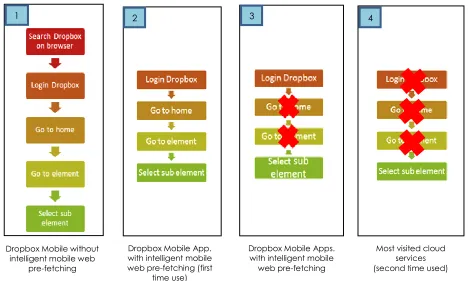
Besides, IMCC was evaluated based on the total time consuming in accessing the user data by comparing with four different scenarios as shown in Figure 7. It shows the difference of flow process by implementation with and without the proposed system for IMCC application. First, it shows the flow
90
6.6
1.7 1.7
1 10 100
Indonesia Thailand Malaysia Saudi
Arabia
Per
ce
n
tage
(%
)
process for the Dropbox application without using the IMCC that consist of five steps. It begins with the log in, the system followed by login the Dropbox, then user goes to the home page of Dropbox, user allowed to select any element and then go to sub- element. Seconds, it shows the flow for the system as before this, but this time with the intelligent mobile Web Pre-fetching system for the first time using the Dropbox
application. The flow process is same as before. Next, the flow process for the system with IMCC for the first time login, which is only two steps is needed. After user login the Dropbox, the system will allow the user to direct to the sub element. The last scenario shows the flow when the user direct access the most visited function without login the system and application because the user already log into the system.
Figure 6 Users’ feedback on the IMCC application system
Figure 7The Different Dropbox Mobile usage with and without effective features of IMCC Application System
1 2 3 4
Dropbox Mobile without intelligent mobile web
pre-fetching
Dropbox Mobile App. with intelligent mobile web pre-fetching (first
time use)
Dropbox Mobile Apps. with intelligent mobile
web pre-fetching
Most visited cloud services (second time used)
1 6
23
55
37
0 10 20 30 40 50 60
1(strongly
disagree) 2(disagree) 3(ModerateAgree) 4(agree) 5(stronglyagree)
nu
mber
of
res
p
ond
ent
Rating
Another experiment was proposed to compare the execution time of Dropbox application using IMCC and without IMCC system. An advanced KLM was used to compare the performance [17, 22]. This model also have discussed by other researchers [17-20, 23].
To obtain results for this experiment, four situations be applied in this experiment. There are some facts need be followed:
Average non-secretariat typist (40 Web Pre-fetching): 0.28 seconds
User A, username (sample default name): syahela Password (sample password): 1234
(i) First Scenario:
This Situation is used for a user that is not using Intelligent Mobile Web Pre-fetching at all. The user must open the web browser, then type the
URL of Dropbox mobile
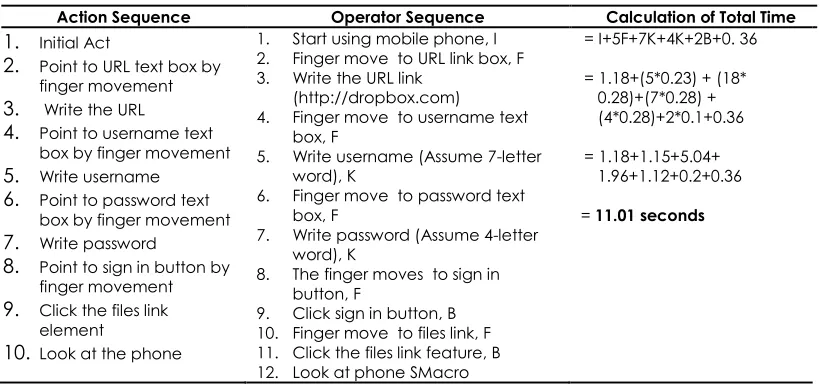
(http://www.dropbox.com). A calculation of the time duration is provided as Table 2.
(ii) Second Scenario:
User logs in Dropbox Mobile without Intelligent Mobile Web Pre-fetching system, and the home element display. Then, the user continues to browse on other elements. For instance, user A wants to see their files. Users do not need to key in the username and password in the system. It is assumed that the users use the similar username and password. Hence, it saves the time to write username and password and also click the login button.
As explained in the third situation, the users do not need to insert Dropbox Mobile password again (refer Table 3).
(iii) Third Scenario:
For the first time login, a user must complete some of steps as in the first situation. Even though, for the second and the next logins, the user is only required to fill in the username and password in the system, and users will directly to the files, pages as it assumes the files have the highest hit number (refer Table 4).
(iv) Fourth Scenario:
Users open the most visited features, then clicks on the link for the user want to visit or view (refer Table 5).
The results of the proposed work of the IMCC show that it can increase the speed when accessing information using the mobile-based technology for the MCC. Moreover, an access time comparison of the four scenarios is presented to explain the performance time difference based on scenario in Figure 7. The total time using advanced KLM is plotted in Figure 8; approximately 11.01 seconds is needed for situation 1, which uses the normal browsing via mobile phone. It is different when using the Intelligent Mobile Web Pre-fetching that is implemented in a mobile environment, as this required only 2.2 seconds for the user to access the data, which the faster time taken compare with others. Based on this result, the proposed IMCC for the intelligent technique can be seen to be faster than the traditional Dropbox Mobile application access.
Table 2 1st Scenario to get the total time
Action Sequence Operator Sequence Calculation of Total Time
1. Initial Act
2. Point to URL text box by finger movement 3. Write the URL
4. Point to username text box by finger movement 5. Write username
6. Point to password text box by finger movement 7. Write password
8. Point to sign in button by finger movement 9. Click the files link
element
10. Look at the phone
1. Start using mobile phone, I 2. Finger move to URL link box, F 3. Write the URL link
(http://dropbox.com) 4. Finger move to username text
box, F
5. Write username (Assume 7-letter word), K
6. Finger move to password text box, F
7. Write password (Assume 4-letter word), K
8. The finger moves to sign in button, F
9. Click sign in button, B 10. Finger move to files link, F 11. Click the files link feature, B 12. Look at phone SMacro
= I+5F+7K+4K+2B+0. 36
= 1.18+(5*0.23) + (18* 0.28)+(7*0.28) + (4*0.28)+2*0.1+0.36
= 1.18+1.15+5.04+ 1.96+1.12+0.2+0.36
11.01
5.74 5.41 2.2 0
20
0 1 2 3 4
Tota
l Ti
me
(s
ec
ond
s)
Scenarios
Total Time using Advanced KLM Model Table 3 2nd Scenario to get the total time
Action Sequence Operator Sequence Calculation of Total Time
1. Initial Act
2. Point to username text box by finger movement 3. Write username
4. Point to password text box by finger movement 5. Write password
6. Point to login button by finger movement 7. Click the files link feature 8. Look at the phone
1. Start using mobile phone, I 2. Finger move to username
text box, F
3. Write username (Assume 7-letter word), K
4. Finger move to password text box, F
5. Write password (Assume 4-letter word), K
6. Finger move to login button, F
7. Click login button, B 8. Finger move to files link, F 9. Click the files link feature, B 10.Look at phone SMacro
= I+4F+7K+4K+2B+0. 36
= 1. 18 + (4*0.23) + (7*0.28) + (4*0.28)+2*0.1+0.36
= 1.18+0.92+1.96 +1.12+0.2 +0.36
= 5.74 seconds
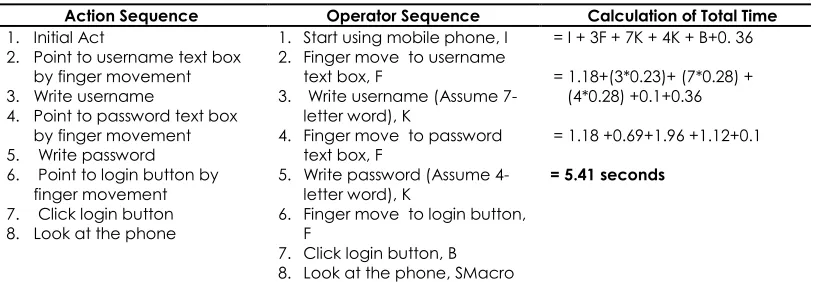
Table 4 3rd Scenario to get the total time
Table 5 4th Scenario to get the total time
Action Sequence Operator Sequence Calculation of Total Time
1. Initial Act
2. Point to most visted feature by finger movement 3. Click the feature page 4. Point to files feature by
finger movement 5. Click the files feature 6. Look at the phone
1. Start using mobile phone, I
2. The finger moves to most visted feature, F 3. Click the most visted
page feature, B 4. Finger move to files
feature, F
5. Click the files feature, B
6. Look at the phone, SMacro
= I+2F+2B+0. 36
= 1.18+(2*0.23)+(2*0.1)+0.36
= 2.2 seconds
Figure 8 Four Scenario to get the total times
Action Sequence Operator Sequence Calculation of Total Time
1. Initial Act
2. Point to username text box by finger movement 3. Write username
4. Point to password text box by finger movement 5. Write password 6. Point to login button by
finger movement 7. Click login button 8. Look at the phone
1. Start using mobile phone, I 2. Finger move to username
text box, F
3. Write username (Assume 7-letter word), K
4. Finger move to password text box, F
5. Write password (Assume 4-letter word), K
6. Finger move to login button, F
7. Click login button, B 8. Look at the phone, SMacro
= I + 3F + 7K + 4K + B+0. 36
= 1.18+(3*0.23)+ (7*0.28) + (4*0.28) +0.1+0.36
= 1.18 +0.69+1.96 +1.12+0.1
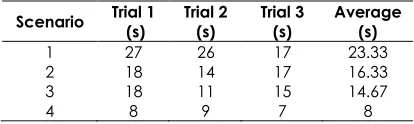
Moreover, the evaluation was supported by calculating the total time consuming for user access the data based on four scenarios on Figure 7. Each scenario was evaluated by three time and get the average total time in second (s) as depict in Table 6. Based on Table 6, with IMCC as in scenario 4 it only took 8 seconds to access the data, which faster compared with scenario 1 for the traditional mobile cloud computing, it took 23.33 seconds. IMCC reduces the latency and enhance the efficiency in accessing the data file on mobile cloud storage.
Table 6 Total time accessing user’s data file
4.0 CONCLUSION
In this study, IMCC integrated with multiple cloud storage services have been developed and tested in order to provide real time accessing cloud storage and cloud storage management. Through this study, the IMCC able to provide data access for user to any cloud storage services and determine the data being requested by the user to reduce access time and speed up time management. The proposed IMCC was evaluated by comparing with four different scenarios. The results provide evidence, using IMCC it reduces the latency and users speed up in accessing their data with effective data management handled even on big data storage. In the future work, the prototype of IMCC will be develop and implement in real work and for real publishing. Besides, the work will undergo on evaluation by comparing with traditional cloud storage and the proposed IMCC.
Acknowledgement
This research is supported by KPT and Universiti Teknologi Malaysia (UTM). This paper is financially supported by MYBRAIN, Ministry of Higher Education Malaysia, UTM Flagship Grant Q.J130000.2428.02G70, FRGS Grant, R.J130000.7828.4F634, E-Science Fund, R.J130000.7928.4S117, RUG Tier 1 of UTM Grant, Q.J130000.2528.13H48 and IDG Grant, R.J130000.7728.4J170. The authors would like to express their deepest gratitude to the UTM Big Data Centre (BDC), for their support in providing the data sets to ensure the success of this research, as well as a Soft Computing Research Group (SCRG) for their continuous support and fondness in making this research possible. Last but not least, credit to the National Science Foundation (grants NCR-9616602 and NCR-9521745) for
the approved fund which makes this important research viable and effective.
References
[1] Arpaci, I. 2016. Understanding And Predicting Students’ Intention To Use Mobile Cloud Storage Services. Comput. Human Behav. 58: 150-157.
[2] Casserly M. 2015. 7 Best Cloud Storage Services - 2014's Best
Online Storage Sites Revealed. Available at:
http://www.pcadvisor.co.uk/features/internet/3506734/best -cloud-storage-services-review. [Accessed July 16, 2015]. [3] Lilly, P. 2015. Top 20 Cloud Storage Service. Available at:
http://www.pcadvisor.co.uk/features/storage/3421715/top-20-cloud-storage-services. [Accessed February 16, 2015]. [4] Mitroff, S. 2015. Which Cloud Storage Service Is For You.
Available at:
http://www.cnet.com/news/onedrive- dropbox-google-drive-and-box-which-cloud-storage-service-is-right-for-you. [Accessed February 16, 2015]. [5] Pawlish, M., Varde, A. S. and Robila, S. A. 2012. Cloud
Computing for Environment-Friendly Data Centers. CloudDB ’12 Proc. Fourth Int. Work. Cloud Data Manag. 43-48.
[6] Hussien, N. S., Sulaiman, S. and Shamsuddin, S. M. 2014. Evaluation of Intelligent Mobile Web Pre- fetching System for Mobile Cloud Environment. Front. Artif. Intell. Appl. New Trends Softw. Methodol. Tools Tech. 265: 374-387.
[7] Ercan, T. 2010. Effective Use Of Cloud Computing In Educational Institutions. Procedia - Soc. Behav. Sci. 2(2): 938-942.
[8] Drago, I., Mellia, M., Munafo, M.M. , Sperotto, A., Sadre, R., Pras, A. 2012. Inside Dropbox: Understanding Personal Cloud Storage Services. Proceedings of the 2012 ACM Conference on Internet Measurement Conference, IMC ’12, ACM, New York, NY, USA. 481-494.
[9] Palankar, M.R. , Iamnitchi, A., Ripeanu, M., Garfinkel, S. 2008. Amazon S3 For Science Grids: A Viable Solution? Proceedings of the 2008 International Workshop on Data-Aware Distributed Computing, ACM. 55-64.
[10] Calder, B., Wang, J., Ogus, A., Nilakantan, N., Skjolsvold, A., McKelvie, S., Xu, Y., Srivastav, S., Wu, J., Simitci, H., Haridas, J., Uddaraju, C., Khatri, H., Edwards, A., Bedekar, V., Mainali, S., Abbasi, R., Agarwal, A., Haq, M.F.u., Haq, M.I. u., Bhardwaj, D., Dayanand, S., Adusumilli, A., McNett, M., Sankaran, S., Manivannan, K., Rigas, L. 2011. Windows Azure Storage: A Highly Available Cloud Storage Service With Strong Consistency. Proceedings of the Twenty-Third ACM Symposium on Operating Systems Principles, SOSP ’11, ACM, New York, NY, USA. 143-157.
[11] Weil, S. A. Brandt, S. A., Miller, E. L., Long, D. D. E., Maltzahn, C. 2006. Ceph: A Scalable, High-Performance Distributed File System. Proceedings of the 7th Symposium on Operating Systems Design and Implementation, OSDI ’06, USENIX Association, Berkeley, CA, USA. 307-320.
[12] Weil, S. A., Pollack, K. T.,Brandt, S. A., Miller, E. L. 2004. Dynamic Metadata Management For Petabyte-Scale File Systems. Proceedings of the 2004 ACM/IEEE Conference on Supercomputing, SC ’04, IEEE Computer Society, Washington, DC, USA, 2004.
[13] Ghemawat, S., Gobioff, H., Leung, S.-T. 2003. The Google File System. SIGOPS Oper. Syst. Rev. 37(5): 29-43.
[14] Balasubramaniyan, J. and Ramachandran, S. 2012. An Intelligent Cloud System Adopting File Pre-fetching, Proceedings of the 2011 International Conference on Advanced Computing, Networking and Security. 19-27. [15] European Commission. 2012. A Roadmap for Advanced
Cloud Technologies Under H2020. Recommendations by the Cloud Expert Group. 1-35.
[16] Assunção, M. D., Calheiros, R. N., Bianchi, S., Netto, M. a. S., and Buyya, R. 2014. Big Data Computing And Clouds: Trends And Future Directions. Journal of Parallel and Distributed
Scenario Trial 1 (s) Trial 2 (s) Trial 3 (s) Average (s) 1 27 26 17 23.33 2 18 14 17 16.33 3 18 11 15 14.67
Computing. 70: 3-15. http://doi.org/10.1016/j.jpdc.2014.08.003
[17] Holleis, P. Otto, F., Hußmann, H. and Schmidt, A. 2007. Keystroke-Level Model for Advanced Mobile Phone Interaction. CHI 2007 Proc. Model. Mob. Interact. 1505-1514. [18] Jimenez, Y. and Morreale, P. 2013. Design and Evaluation of
a Predictive Model for Smartphone Selection. Springer-Verlag Berlin Heidelb. 4: 376-384..
[19] Karousos, N., Katsanos, C., Tselios, N. and Xenos, M. 2013. Effortless Tool-based Evaluation of Web Form Filling Tasks using Keystroke Level Model and Fitts Law. Web Ecommerce CHI 2013 Chang. Perspect. Paris, Fr. 1851-1856.
[20] Li, H., Liu, Y. Zhonglu, D. Liu, J. Li, Y., Rau, P. P. and Wang, X. 2010. Extended KLM for Mobile Phone Interaction : A User Study Result. 3517-3522.
[21] Card, S. K., Moran, T. P. and Newell, A. 1983. The Psychology of Human-Computer Interaction. Hillsdale, NJ, USA: Lawrence Erlbaum Associates.
[22] Holleis, P., Scherr, M., and Broll, G. 2011. A Revised Mobile KLM for Interaction with Multiple NFC-Tags. International Federation for Information Processing IFIP. 4: 204-221. [23] Michael, P., Gary, B. and Alan, S. 2007. An Extended