e-ISSN: 2278-067X, p-ISSN: 2278-800X, www.ijerd.com
Volume 13, Issue 11 (November 2017), PP.01-06
PAPR Reduction Using Extended BCH Code with Biasing Vector
Technique in OFDM System
Shaik Riyaz
1, MVS Sairam
2 1System Engineer, TCS, Hyderabad, Telangana, India. 2Professor & HoD, Department of ECE, GVP College of Engineering (Autonomous), Visakhapatnam, AP, India. Corresponding Author: Shaik Riyaz
ABSTRACT:-
Orthogonal Frequency Division Multiplexing (OFDM) is a distinct form of multicarrier modulation which is well suitable for high data-rate wireless and wired applications. Nevertheless, the foremost drawback of OFDM is that the time domain signal which is a sum of multiple sinusoids leads to high Peak to Average Power Ratio (PAPR). This paper aims to condense the PAPR using (8, 4) Extended BCH (E-BCH) code with biasing vector technique. (7, 4) BCH code is transformed in to (8, 4) E-BCH code by appending Redundant Bit (RB) intended for effective execution of Inverse Fast Fourier Transform (IFFT)/Fast Fourier Transform (FFT) in OFDM system. Then using biasing vector technique, favourable bias vector which contributes minimum PAPR is recognized. The codeword can be acquired at the receiver by XOR-ed with bias vector and removing RB. Results confirm that significant amount of PAPR is condensed in the proposed scheme.Keywords:-
OFDM, PAPR, BCH, E-BCH, RB, BV.--- --- Date of Submission: 13-10-2017 Date of acceptance: 02-11-2017 ---
---I. INTRODUCTION
OFDM functions over large bandwidth and therefore naturally the data-rate is higher. Hence OFDM has become a significant Physical layer (PHY) transmission technique, which is employed in 4G wireless standards such as IEEE 802.11a/g [1], HIPERLAN2 [2], digital audio and video broadcast (DAB/DVB) [3, 4]. In OFDM, when all sub-carriers are added coherently, the peak power surges that origins the high PAPR. Therefore, the challenging issue in OFDM system is the high PAPR of the transmitted signal, which sources in-band distortion and out-of-band radiation when the signals are passed through a nonlinear power amplifier. Until now, various schemes for PAPR reduction have been suggested [7-9]. The techniques are classified as signal distortion and distortion less. In signal distortion techniques the original OFDM signal is distorted and hence error rate is increased. However distortion less techniques such as channel coding are most favoured since they can be used for both error controlling and PAPR reduction simultaneously. In this paper we proposed E-BCH code as channel coding and biasing technique is used to control the PAPR further.
The remainder of this paper is organized as follows. In section II, introduction to PAPR is discussed. E-BCH code is presented in section III. Section IV introduces proposed scheme. The results are discussed in section V. In section VI, conclusions are presented.
II. PEAK TO AVERAGE POWER RATIO
In OFDM system, N-point IFFT is employed for the data sequence, ( ) , so as to produce ( ) , the samples for the sum of N orthogonal sub-carrier signals. Therefore the discrete-time OFDM signal is expressed as [5]
( ) ∑ ( ) ( )
The PAPR of the discrete-time OFDM signal x(n) is defined as [6]
[ ( )]
| ( )|
where E [] denotes the expectation operator.If the average power of the OFDM signal is supposed to be 1, the PAPR of the signal is become N2 and the PAPR in dB = 20 log N.
PAPR Calculation
Let us consider codeword be 0 0 0 0 0 0 0 0 and employ phase shift keying (PSK) modulation. Then OFDM signal can be stated as
( )
Therefore, | ( )| ( ) ( )
( )( )
| ( )| occurs at | ( )| or t = 0
Substitute for t in equation (1), we obtain
| ( )| = 64 (assume the average signal power = 1) Form equation (2) PAPR = 64 and PAPR in dB = 18.0 dB.
III. (8, 4) EXTENDED BCH CODE
Bose, Chaudhuri, and Hocquenghem (BCH) code is remarkable error correcting code [10]. For a BCH code (n, k), n = number of code words, k = number of message bits, any integer m3 and for t error correction(t <
2m-1), there exists a primitive BCH code with the following factors:
Block length : n= 2m -1
Parity check bits : n– kmt Minimum distance : d2t + 1
Generator polynomial of BCH code can be expressed as
g(x) = LCM[mt0(x), mt0+1(x),….., mt0+2t-1(x)]
wheremt0(x) is the minimal polynomial of αt0є GF(qm).g(x) of BCH code is the lowest-degree polynomial over GF(2) which has α, α2, … α2t among its roots. If is a primitive element of GF(2m), g(x) is the polynomial of lowest degree over GF(2) with , 2, 3, ,2t as roots.
In our paper, we employed (7, 4) BCH code, which is single error correcting code. For single error correcting code, generator polynomial is only the primitive polynomial m1(x), therefore g(x) = x3+x+1.
Algorithm for (7, 4) BCH codeword generation
Step-1: Select 4 bit length message Step-2: Fix g(x) =x3+x+1
Step-3: Pad the zero bits to message bits equal to the highest degree of g(x)\ Step-4: Obtain the parity bits by dividing the modified message polynomial by g(x) Step-5: Append the remainder to the message bits for codeword generation Step-6: Repeat the above steps for all combination of message bits.
Example:
Let message be 0001
Pad 3 zeroes (highest degree of g(x)) to the message, which makes 0001000 Convert the g(x) into binary form, i.e. g(x) = 1011
Divide the modified message bit by g(x) as given below:
1010
1011
1000
1011
011
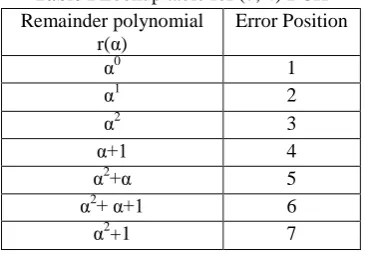
Here the remainder is 011. Hence, the code word becomes 1001110. Algorithm for Error Correction Step-1: Received codeword is divided by g(x) = x3+x+1, to get remainder polynomial, r(α) Step-2: Error correction can be done using the lookup table as shown below: Table I Lookup table for (7, 4) BCH Remainder polynomial r(α) Error Position α0 1 α1 2 α2 3 α+1 4 α2+α 5 α2+ α+1 6 α2 +1 7 Where α is the primitive root of unity and α3= α+1, α4=α2+α, α5=α2+ α+1, α6=α2+1. Example: Let the transmitted codeword be 0001011 corresponding to message 0001. Csase-1: Let the error be 1st position. Then the received codeword is 0001010. Perform the division operation to get remainder 1011)0001010 1011
0001
r(α)for 0001 is α0, hence from lookup table error position is 1st position. Case-2: Let the error be 2nd position. Then the received code word is 0001001. 1011)0001001 1011
0010
r(α)is α1 , hence from lookup table, error position is 2nd position. Case-3: Let the error be 3rd position. Then the received code word is “0001111”. 1011)0001111 1011
0100
r(α)is α2, hence from lookup table, error position is 3rd position.
IV. PROPOSED SYSTEM FOR PAPR REDUCTION
For efficient IFFT/FFT implementation it is essential that the number of carriers to be in power of two. For this purpose, RB (bit 0 or 1) is appended as LSB.
Fig. 1 Proposed Encoder
Fig. 2 Proposed Decoder
In our work, we consider 0 as RB. Then (7, 4) BCH code is transformed in (8, 4) E-EBC code. Then a BV of the same length is XOR-ed with code word. Any one of 28 probable BVs’ is nominated and PAPR is computed for all possible (28) codes and maximum PAPR is identified from the computed values of PAPR. Similarly for all other possible BVs, maximum PAPR has been calculated. The BV, which has given the lowest of the maximum PAPRs is considered as the favourable BV.
Reciprocal operation is performed at the receiver as shown in Fig. 2. The received code is XOR-ed with the same BV as used in encoder so that the original E-BCH code is generated at the receiver. Then RB is detached to get (7, 4) BCH code. The BCH decoder decodes message from the codeword.
V. RESULTS AND ANALYSIS
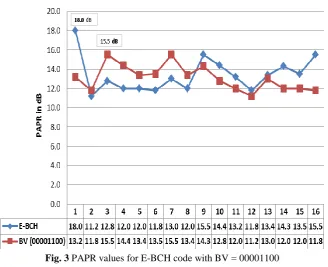
The simulation results are presentd to evaluate the performance of the proposed scheme. Table II presents PAPR values of E-BCH code and with BV = 00001100, 00001100, 00001100. In Fig. 3, the PAPR values of E-BCH code and with BV = 00001100 are presented.
Table II PAPR values with and without BV = 00001100, 00001100, 00001100
(7, 4) BCH code PAPR in dB
E-BCH BV =
00001100 E-BCH BV =
00001100 E-BCH BV = 00001100
0000000 18.0 13.2 18.0 13.7 18.0 15.5
0001011 11.2 11.8 11.2 14.3 11.2 12.0
0010110 12.8 15.5 12.8 12.7 12.8 14.8
0011101 12.0 14.4 12.0 12.8 12.0 15.5
0100111 12.0 13.4 12.0 15.5 12.0 13.2
0101100 11.8 13.5 11.8 14.2 11.8 12.0
0110001 13.0 15.5 13.0 14.4 13.0 12.0
0111010 12.0 13.4 12.0 13.2 12.0 14.6
1000101 15.5 14.3 15.5 12.0 15.5 13.2
1001110 14.4 12.8 14.4 14.9 14.4 14.6
1010011 13.2 12.0 13.2 15.5 13.2 14.9
1011000 11.8 11.2 11.8 12.0 11.8 12.7
1100011 13.4 13.0 13.4 12.0 13.4 12.8
1101000 14.3 12.0 14.3 13.4 14.3 11.2
1110010 13.5 12.0 13.5 13.6 13.5 15.0
Fig. 3 PAPR values for E-BCH code with BV = 00001100
From Fig. 3, it is perceived that the PAPR performance of the OFDM system is superior when biasing vector technique is employed. The amount of PAPR reduced can be expressed as
( )
( )
( ) ( )
For example, from figure 3, it is obsrved that the maximum PAPR without BV is 18.0 dB. However, it decreases to 15.5 dB when BV = 00001100 is used. Eventually, the proposed shcmee reduces PAPR of 2.5 dB.
VI. CONCLUSION
In this paper, we proposed (8, 4) E-BCH code with biasing vector technique to control the PAPR in OFDM system. (7, 4) BCH code is transferred into (8, 4) E-BCH code by appending RB. Then using biasing vector technique, the BV which condenses PAPR is identified. Reciprocal operation is used at the receiver to get the original message. The results show that the proposed scheme reduces the PAPR significantly and the performance of the proposed system is verified different combinations of BVs. For instance, with BV = 00001100, the maximum PAPR without and with BV is 8.0 dB and 5.5 dB, respectively. Eventually PAPR of 2.5 dB PAPR is reduced.
REFERENCES
[1]. “IEEE 802.11 working group for wireless local area networks”.
[2]. ETS 300 652, “High performance radio local area networks (HIPERLAN) type 1”, June 1996.
[3]. ETSI EN 300 744 V1.5.1, “Radio broadcasting systems; Digital Audio Broadcasting (DAB) to mobile, portable and fixed receivers”.
[4]. ETSI EN 300 744 V1.5.1, “Digital Video Broadcasting (DVB); framing structure, channel coding and modulation for digital terrestrial television”.
[5]. Alan V. Oppenheim and Ronald W. Schafer, “Discrete-Time Signal Processing”, 3rd ed., Prentice Hall, 1999.
[6]. R. W. Bauml, R. F. H. Fisher, and J. B. Huber, “Reducing the Peak -to -Average Power Ratio of Multicarrier Modulation by Selected Mapping ", Electronics Letters, vol. 32, No. 22, pp. 2056-2057, Oct.1996.
[8]. A. E. Jones and T. A. Wilkinson, “Combined Coding for Error Control and Increased Robustness to System Nonlinearities in OFDM”, Proceedings of IEEE 46th Vehicular Technology Conference, Vol. 3, pp. 904-908, 1996.
[9]. Jiang Tao, Zhu Guangxi, and Zheng Jianbin, “Block Coding Scheme for reducing PAPR in OFDM Systems with Large Number of Subcarriers”, Journal of Electronics, Vol. 21, No. 6, pp. 482-489, 2004. [10]. Bernard Sklar, “Digital Communications Fundamentals and Applications”, 2nd ed., Pearson Education,
2001.