Abstract—In supplier selection decisions two issues are of particular significance. One is what criteria should be used and other, what methods can be used to compare suppliers. In real world, the criteria, constraints for supplier selection process are subjective in nature and with an emerging application of internet and tether-free communication technologies; e-intelligence is forcing companies to shift their manufacturing operations rapidly from the traditional factory-integration philosophy to e-manufacturing philosophy. Thus researchers and managers of firms should see the need to evaluate the fitness of supplier selection criteria and methods when applied to newly created enterprises to ensure effective and profitable exploitation of market opportunities. Hence in the current research It is proposed to investigate the criteria to be considered and methods for prioritization best Internet Service Providers (ISPs) for e-manufacturing. The proposed model is to be tested with correlation test as well as hypothesis test to see the validation of the proposed methodology.
Index Terms—E-manufacturing, Bell shape fuzzy membership, Function, Internet Service Provider (ISP).
I. INTRODUCTION
For the past decade, the impact of web-based technologies added velocity to the design, manufacturing, and aftermarket service of a product. Today’s competition in manufacturing industry depends not just on lean manufacturing, but also on the ability to provide customers with total solutions and life-cycle costs for sustainable value and thus manufacturers are now under a tremendous pressure to improve their responsiveness and efficiency in terms of product development, operations, and resource utilization with a transparent visibility of production. With an emerging application of internet and tether-free communication technologies, the impact of e-intelligence is forcing companies to shift their manufacturing operations from the traditional factory-integration philosophy to an e-factory and other wise called e-manufacturing philosophy. In the current work an attempt is made to evaluate the criteria to be considered and methods for the selection of Internet Service Providers (ISPs) in the context of e-manufacturing, because firm’s environments affect the decisions; the researchers and managers of firms should see the need to evaluate the fitness of ISPs selection criteria and methods when applied to newly created enterprises of e-manufacturing.
Since internet based businesses have grown rapidly 1995, selection criteria is changed with a great deal,
Manuscript received January 17, 2011; revised March 12, 2011.
corresponding to the business environmental changes. Thus to meet requirements of e-manufacturing, ISPs criteria evaluation and selection method, Multi Criteria Decision Models(MCDM) have been reviewed and in spite of many MCDM models, TOPSIS method is being a popular approach was widely used in the literature for vendor selection. Differing from earlier research, current research proposes an Interdependency Criteria Clusters and QFD in Hierarchical fuzzy TOPSIS for evaluation of ISPs for e-manufacturing firm using Phi-fuzzy membership function to address the uncertainty in ISPs selection process for newly evolved firms like E-manufacturing firms. Nevertheless the proposed approach has not been applied to the ISPs selection problem yet. Finding the issues of e-manufacturing through the available literature, this research reveals the e-manufacturing characteristics and capabilities compared to traditional manufacturing and the issue of prioritization ISPs in the conjunction with e-manufacturing with a new framework.
A. E-Manufacturing System
E-Manufacturing is a transformation system that enables the manufacturing operations to achieve predictive near-zero-downtime performance as well as to synchronize with the business systems through the use of web-enabled and tether-free (i.e., wireless, web, etc.) infotronics technologies. It integrates information and decision-making among data flow (of machine/process level), information flow (of factory and supply system level), and cash flow (of business system level) and hence e-Manufacturing is a business strategy as well as a core competency for companies to compete in today’s e-business environment. It is aimed to complete integration of all the elements of a business including suppliers, customer service network, manufacturing enterprise, and plant floor assets with connectivity and intelligence brought by the web-enabled and tether-free technologies and intelligent computing to meet the demands of e-business/e-commerce practices that gained great acceptance and momentum over the last decade. Also, e-Manufacturing is a transformation system that enables e-Business systems to meet the increasing demands through tightly coupled supply chain management (SCM), enterprise resource planning (ERP), and customer relation management (CRM) systems as well as environmental and labor regulations and awareness. Thus e-Manufacturing allows geographically separated manufacturers to build partnerships so as to embrace external resources and services without owning them. Though web technology seems to promise in early explorations, most of the presently developed e-manufacturing systems are still prototypes for studying the feasibility and potential of web technologies in advanced manufacturing, where every
A Proposal for Criteria Evaluation and Selection of ISPs
for E-manufacturing
aspect becomes a vital part, more particularly suppliers, and participates into the enterpriswide profit process. As, e-manufacturing is different from traditional e-manufacturing by its characteristics, the criteria to be considered as well as the supplier selection methods are to be reviewed. It is found in the literature that no researcher pointed out the issue of supplier selection criteria and methodology in the context of e-manufacturing. As e-manufacturing is rapidly developing arena for the past decade, and to cope up to the issues pertaining to e-manufacturing criteria and supplier evaluation methods, an attempt is made in the current research.
B. Supplier Selection-Criteria
Traditionally organizations have been divided in operative functions such as production, planning, purchasing, marketing etc., in which supply chain is a strategy that integrates these functions, and also involved in manufacturing of a product from the procurement of raw materials to the distribution of final products to the clients. Over the years the significance of supplier selection has been long recognized and emphasized; also one of the important purchasing decisions is selection and maintenance of a competent group of suppliers. In supplier selection decisions two issues are of particular significance. One is what criteria should be used and other, what methods can be used to compare suppliers. It is pointed out that supplier selection decisions were complicated by the fact that various criteria that must be considered and meanwhile, different approaches could be employed to make the selection. The criteria Delivery, Quality, Cost/Price, Financial position, and Communication & technology were recognized as the commonly used criteria, which are facts, confirmed from empirical results as well as in previous literature. However other criteria such as ISO certification, Reliability, Credibility, Good references and Product development were also identified. These criteria had existed before but did not receive the same attention in previous studies. This show that focus is shifting from solely relying on quantitative factors to include qualitative criteria. Thus it infers that the criteria are to be reviewed in view of e-manufacturing philosophy
Many authors have identified several criteria for supplier selection since 1996 as criteria are a key issue in supplier assessment process since it measures the performance of supplier. It is to be noticed that, earlier scholars have paid attention towards criteria for supplier selection more particularly, for a traditional manufacturing firms. However, as it is believed that e-manufacturing is different from traditional manufacturing by its characteristics & capabilities and selection of suppliers as well as criteria preferences to be considered must vary. Also, there is no evidence that the earlier researchers have pointed out the issues related to the criteria and supplier selection methods in conjunction with e-manufacturing because, different situations require the use of different models and criteria for supplier selection.
II. PREVIOUS RESEARCH
As the proposal of identifying the issue of supplier selection criteria and methods in conjunction with
e-manufacturing is a notion, and unique, the literature available is very limited under this heading and the review of literature is presented in the following sections.
• Evolution of E-manufacturing philosophy and
observations.
• Supplier selection criteria & Supplier selection methods and observations.
III. E-MANUFACTURING SYSTEMS
E-manufacturing as a term was introduced some years ago by semiconductor industry, enabling to handle large production quantities in different locations. Due to globalization, nowadays individual and small-batch production oriented tooling companies’ need web-based simple manufacturing, planning and monitoring systems
Kaia Lõun et.al (2009).As e-manufacturing is supported by
information technology it has got the capability in multi-site management and it will improve the competitive capability of manufacturing in the global competition Wang, LD
(2007). E-manufacturing includes providing real-time
visibility and collaborative engineering Nof, S. Y (2006),
Cheng, K. et.al (2008). Today, even with the best
implemented lean manufacturing practices, many companies still face the following problems, which are all interrelated to each other and are Defect parts, High downtime, High energy utilization and cost, Long changeover and ramp up time, long lead time for new product realization, and Slow decision making. Realizing the merits of the Web technology in manufacturing over traditional approach, researchers and developers have been actively exploring and developing Web-based design and manufacturing systems Subhash Chandra Bose P. et
al-(2007). Dick (2004) wrote JAVA technology powering
e-Manufacturing, and reported that ‘Emation’ is an industrial automation provider that leverages Internet technologies to connect a wide range of manufacturing verticals to Web-based systems. Pande (2006) presented product design and manufacturing activities have become “costumer centric rather than manufacturer driven”. Karina Rodriguez et.al
(2007) have said that the companies have adopted a
geographically distributed working approach in order to remain competitive in a global market. Shyamal M Tanna
(2008) stated that the better management of stores and
inventory at the organizations is by employing the best practices of managing the inventory and tracking the item movements in the manufacturing units.
Sridhar CNV et.al (2010) Said that the manufacturers as
criteria for supplier selection must vary based on the changing scenario of manufacturing such as Digital manufacturing, Agile manufacturing, e-manufacturing, and this is an issue need to pay attention. In the vendor managed inventory system crucial delays and recognizing that there are problems causing loss of sales was a critical factor where suppliers’ network is to be reviewed.
IV. ISPS SELECTION
The vast majority of the publications have been written in the context of selecting a supplier for the purchase of a product to be used in a manufacturing environment. From a point of view of reflecting purchasing significance in sectors other than manufacturing, e.g. service industry, it would be worthwhile to investigate and illustrate the specific of using decision methods in supplier selection in those areas as well (Aissaoui et al., 2007; De Boer et al., 2001). The major difference between parts and services purchasing is that services cannot be 'stored' and so there are no inventory costs associated with service purchasing (Aissaoui et al., 2007). Degraeve and Roodhooft (2000) proposed an effective methodology to the service sector in developing an airline selection model for the procurement of business travel. Oliveira and Lourenço (2002) discussed the problem of selecting suppliers for the construction of pipeline networks for gas distribution. They developed a source and multi-period model that allocated construction orders to a pool of pre-qualified set of suppliers. Degraeve et al. (2004) used the concept of a total cost of ownership to select airlines for a major company. They developed a large com-plex mixed integer program that accounts for several airline fare discounting schemed. Klundert, Kuipers, Spieksma, and Winkels (2005) reported on a model for selecting international telecommunication carriers for a major telecommunication service provider. They accounted for volume discounts and showed that a special case of their model results in a min-cost flow model. Bottani and Rizzi (2006) presented a multi-attribute approach for the selection and ranking of the most suitable 3PL service provider. To our knowledge, no supplier selection model for ISP selection and evaluation has been published. In addition Maria Jose et.al (2009), reported that, in the last few years, there has been an increasing growth in the number of collaborative partnerships between suppliers and manufacturers as a means to meet more complex customer needs and remain competitive. Then the suppliers have been classified into suitable suppliers and unsuitable suppliers, from the viewpoint of the firm Arpan Kumar Kar, (2009). Weber et
al. (1991) wrote, “In today’s competitive environment it is
impossible to successfully produce low cost, high quality products without satisfactory vendors.
Supplier selection, the process of finding the right suppliers who are able to provide the buyer with the right quality products and/or services at the right price, at the right time and in the right quantities, is one of the most critical activities for establishing an effective supply chain. Giuseppe et.al (2009) reported that the supplier selection problem consists of analyzing and measuring the
performance of a set of suppliers in order to rank and select them for improving the competitiveness of the whole supply system. Many conflicting factors should be taken into account in the analysis, both qualitative and quantitative and a key role is played by the supplier evaluation process (Saen,
2007). In most of the proposals, triangular fuzzy numbers
are used as a pair-wise comparison scale for deriving the priorities of different criteria and attributes. In general, the combination between AHP and optimization methods is utilized to deal with the order allocation problem. Bayazit
(2006) proposed an ANP model to tackle the supplier
selection problem. Ng (2008) developed a weighted linear programming model for the supplier selection problem, with an objective of maximizing the supplier score. Similar to AHP, it involves the decision makers in determining the relative importance weightings of criteria. Ramzi et.al
(2009), have proposed a mathematical model for the design
of supply chains in the delocalization context. Wu (2009)
considered uncertainty in vendor selection and compares stochastic DEA and stochastic dominance.
Ha and Krishnan (2008) applied an integrated approach in an auto parts manufacturing company for supplier selection. Kull and Talluri (2008) utilized an integrated AHP-GP approach to evaluate and select suppliers with respect to risk factors and product life cycle considerations. However, the researches and applications in recent years are: applied analytical hierarchy process (Kokangul et.al 2009) used analytic network process, proposed neural network (Lee & Ou-Yang, 2009), and proposed a fuzzy model (Lee, 2009; Lee, Kang, & Chang, 2009), proposed a hybrid method (Moghadam et.al, 2008) and proposed fuzzy hierarchical TOPSIS for the supplier selection problem (Wang, Cheng, & Kun- Cheng, 2009). Thus the supplier selection is a multi-criteria problem that includes both qualitative and quantitative criteria. In order to select the best suppliers it is crucial to make a tradeoff between these tangible and intangible criteria, some of which may be contradictory. Since mathematical programming is geared towards the constraints in the problem, it is much easier than other approaches to work with a large number of constraints.
In all the attempts to create criteria suitable for the evaluation of ISPs, no particular mention was made as regards a set of criteria that could be used in the supplier selection process in conjunction with the new manufacturing philosophy e-manufacturing. Thus this gap created impetus to this research.
V. CHARACTERISTICS OF E-MANUFACTURING From the overview of the e-manufacturing and its capabilities, specific characteristics have been drawn in order to levy the criteria for suppliers’ selection in conjunction with e-manufacturing philosophy, because different situations require the use of different criteria with different preferences for suppliers’ selection and the Characteristics in brief are:
• E-manufacturing is to achieve predictive near-zero-downtime performance through the use of web-enabled technologies.
• E-manufacturing gives agility to react quickly to the changes in market, technology, and clients.
• Total asset management that aims in improving the utilization of plant floor assets using a holistic approach.
• Sensitive communication between the clients and the server is carried over Transport Layer Security, thereby ensuring confidentiality.
• Transparent, seamless, information exchange
process between clients and manufacturing firm.
• It enables to meet the increasing demands through tightly coupled supply chains.
• Status of equipments, orders, products, changes in the processes across the enterprise can be monitored.
• There should not be any block holes in the real time flow of information, including outsourcing suppliers, customers etc,.
• The entire system is flexible enough to change with the varying market demand conditions in a short lead-time.
Hence, from the above mentioned few specific characteristics it is felt that the criteria preferences are reviewed in conjunction with e-manufacturing for prioritization of suppliers.
VI. RESEARCH METHOD
A. Criteria clusters
Clustering is concerned with grouping of objects or elements (Criteria) into homogeneous clusters (groups) based on the object features or interdependency. The Interdependencies among the criteria may have an effect in the decision making process of selecting suppliers for a given firm. The current research tried to identify the existence of interdependencies and formation into clusters. The Strategic Sourcing Group (SSG) of the firm involved in evaluating the criteria clusters using the following three step procedure.
Step 1: Determining the pair wise relation:
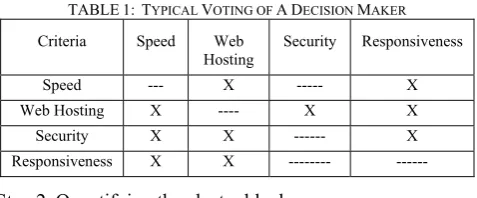
Several sets of pair wise relations are needed to make by decision making experts (SSG Team) where decision makers are asked to make the pair wise relations typically using interdependency five point scale and dependency of one criteria with another is determined in terms of numerical value and an example is shown in the Table I
TABLE 1: TYPICAL VOTING OF A DECISION MAKER
Criteria Speed Web
Hosting
Security Responsiveness
Speed --- X --- X
Web Hosting X ---- X X
Security X X --- X
Responsiveness X X --- ---
Step 2: Quantifying the cluster blocks:
In order to present the comprehensive framework for the criteria clusters formation further quantifying pair wise relations by
considering only top half of the M×M matrices and is shown in
Table 1.
Step 3: Formation of Clusters:
In the third step the Equation (1) is used to determine
which block of the M×M interdependency matrix is qualified to represent interdependency.
Q = √N ÷ 2 (1)
Q = Interdependency index
N =Total score attained from interdependency scale by the decision makers.
If Q is ≥ 4.2 the block is qualified to form into cluster with respective criteria and
If Q is ≤ 4.2 the block is not qualified to form into a cluster.
The value 4.2 is square root of the number of decision makers and in the current research the number of decision makers is 18. Thus from the above three steps, a set of pair wise comparisons between interdependent criteria is conducted in the form of questionnaire and thus identifying these interdependencies the respective clusters have been formed.
Clusters
C1 {Web Accessibility (A) Speed (S)
Web Hosting (W) } C2 {Responsiveness (R) Security (S) } C3 {Extra Services (E) Reliability (Re)
Roaming (Ro) } C4 {Effective Marketing & Promotion (E)
Financial Strength (F) Management Stability (M)
Technology (T) } C5 {Experience (Ex)
Network Topology (N) Strategic Allowances (St)
Support Resources (Su) } C6 {Installation Charges (Ic)
Monthly charge (Mc) } C7 {Legal Taxes }
C8 {Network Links }
Fig.1. Framework for the proposed model
In the current research the QFD model is composed to take into account both qualitative and quantitative criteria in supplier selection process and thus based on interdependency clusters the Framework of the current research model with QFD and Criteria clusters is shown in the Figure.1. Hence with an aid of the framework for the current research, a numerical interpretation can be made with e-manufacturing firm to evaluate ISPs a Phi- fuzzy membership function.
VII. METHODOLOGY:PRIORITIZATION OF SUPPLIERS
of finding the best option from all of the feasible alternative suppliers. In almost all such problems the multiplicity of criteria for judging the alternatives is pervasive.
A. Bell-shape fuzzy membership function
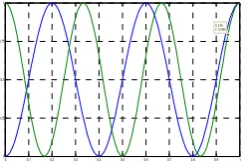
Fuzzy set theory is based on the extension of the classical definition of a set. In a classical set theory, each element of universe either belongs to a set or not, where as in fuzzy set theory an element belongs to a set within a degree of certain membership. Membership functions of fuzzy need not be symmetric and typical so-called bell-shaped membership function, which captures conception of a large number in the context of each particular application. Even though there are situations in which non-linear membership functions are more suitable, most practitioners’ have found that triangular and trapezoidal membership functions are sufficient for developing an approximate solutions for the problems they wish to solve but differentiable or non-linear membership functions have certain advantages in evaluating more exact solutions rather than approximate solutions, an attempt is made with a Phi- membership function in the current research shown in the Figure.2. The behavior of Bell-shaped membership function used currently in the research is drawn and defined by the mathematical Equation (2)(George
J.Klir-2002) and using the program code written in
MATLAB 9.0.
(1+Cos(pπ(X-r))/2) Where X€ [r-1/p, r+1/p]
X= (2) 1 Otherwise
where r denotes the real number for which the membership grade is required to be one and p is parameter that determines the rate at which, for each x, the function decreases with the increasing difference (r-x).
0 0.1 0.2 0.3 0.4 0.5 0.6 0.7 0.8 0.9 1 0
0.25 0.5 0.75 1
X: 0.95 Y: 0.7939
Fig .2.Bell-shaped fuzzy set with Linguistic variables
Thus the scale formed is shown in the Table II and Table III is used for criteria weighting. Each linguistic variable is defined by eleven fuzzy numbers as the Bell-shaped curve is a non linear. The range of each fuzzy linguistic variable is also given for a given scale range between 0 and 1.
B. Proposed Methodology with Hierarchical Fuzzy
TOPSIS Algorithm
TOPSIS method is a Technique for Order Preference by Similarity to Ideal Solution, one of the known classical Multi Criteria Decision Making (MCDM) methods. It is based upon the concept that the chosen alternative should have the shortest distance from Positive Ideal Solution (PIS). The PIS solution is a solution that maximizes the benefit criteria and minimizes the cost criteria, whereas the Negative Ideal Solution (NIS) also called anti-ideal solution, which maximizes the cost criteria and minimizes the benefit
criteria. The so-called benefit criteria are those for maximization, while the cost criteria are those for minimization. The best alternative is the one, which is the closest to the ideal solution and farthest from the negative ideal solution. However the classical TOPSIS methods do not have a hierarchical structure and the only method that considers the hierarchy between criteria and sub-criteria is AHP and Hierarchical fuzzy TOPSIS is developed by
Mohammad Taghi T (2008) and the same algorithm is used
in the current research but differs in the usage of membership function. In addition interdependency Criteria clusters are used. The following steps have been used to implement the Hierarchical fuzzy TOPSIS.
TABLE II LINGUISTIC SCALE FOR CRITERIA WEIGHTS
Linguistic Scale Range
Very Low 0 to 0.17
Low 0 to 0.4
Medium Low 0.17 to 0.5
Medium 0.4 to 0.8
Medium High 0.5 to 0.84
High 0.8 to 1
Very High 0.84 to 1
TABLE III THE LINGUISTIC VARIABLE FOR WEIGHING EACH CRITERION
Fuzzy Linguistic Variables
Very High
High
Medium
High
Medium
Medium
Low
Low
Very Low
0.84,0.89,0.92,0.95,1,1,1,1,1
0.8,0.87,0.9,0.93,1,1,1,1,1
0.5,0.55,0.58,0.61,0.67,0.72,0.75,0.84
0.4,0.47,0.5,0.53,0.6,0.67,0.7,0.73,0.8
0.17,0.22,0.25,0.28,0.3,0.330.39,0.42,0.4
5,0.5
0,0.07,0.1,0.13,0.2,0.27,0.3,0.33,0.4
0,0,0,0,0,0.06,0.08,0.11,0.17
Step 1: Identification of Criteria
Choosing proper criteria for supplier selection is the prior step i.e., Evaluation of Criteria for ISPs selection in conjunction with e-manufacturing characteristics and capabilities.
Step 2: Calculation of Weights of Criteria
While calculating weights of criteria, assume that w̃i the weight of ithcriteria in clusters and w̃
ij is the weight of jth sub- criteria of its associated criteria. Final weight of each sub-criterion is calculated separately, by multiplying these two kinds of weights as shown in Equation 3 where k =1, 2...
m and m is the number of all sub-criteria.
W̃k = w̃i * w̃ij (3) As in the current research Bell-shaped membership function is used the fuzzy weights are shown in Equation( 4)
= (α1i α´1j, a2i a´2j ,……, a11i a´11j) (4)
Step 3: Computation of Final Score Calculation of final score for prioritization of suppliers
consists of the decision makers to evaluate potential suppliers based on fuzzy TOPSIS method and defined clustered criteria. First a decision matrix, D, of dimension n*mis defined where xij is rating of supplier Ai( i = 1,2,...., n ) with considering sub-criteria Cj ( j 1,2,..., m). Then xijis a fuzzy number presented by a Bell-shaped linguistic number.
i.e., xij = (aij, bij… z11) C1 C2 ……....Cm
A1 X11 X12…….. X1m
A2 X21 X22…….. X2m
- -- -- ……… --
- -- -- ……… -- (5) - -- -- ……… --
An Xn1 Xn2…….. Xnm
Step 4: Normalization
In order to make an easy procedure similar to Saghafian
et.al (2005), all fuzzy numbers in this model are defined
in close interval [0,1] so the normalized decision matrix is obtained directly. The weighted normalized f u z z y decision matrix is calculated by using Equation 6
Vij = xij* W̃k (6) V= [ vij ] kxm
where
V = Weighted normalized f u z z y decision matrix. vij =Normalized positive Bell-shape fuzzy numbers. k =Number of alternatives.
m =Number of criteria.
Then fuzzy positive ideal solution and fuzzy negative ideal solution is determined.
Step 5: Largest and Smallest generalized mean
The results are all crisp and are defined as A* and A-, v
j* and v j- are the fuzzy numbers with the largest
generalized mean and the smallest generalized mean, respectively as given in Equation 7 & 8
A* = [v1*… vn*] (7) A- = [v
1-… vn- ] (8) where Ṽj* = max { vij } and
ṽj- = min { vij1 } Step 6: Distance Measurement
The distance of each supplier Ai (i =1, 2... n) from A* and A- is calculated by using Vertex method as follows
d*i ( vij , vj*)=∑[1/11( (a1ij–a1j*) 2 +(a2ij- a2j* )2 +....+(a11ij-a11j*)2 )] 0.5 (9)
d
-i ( vij , vj-)= ∑[1/11( (a1ij–a1j-)2 +(a2ij- a2j) 2 + ....+( a11ij- a11j-)2 )] 0.5 (10)
where vij = xij (.) W̃k and vij = (aij , bij , cij)
ṽj- = min{ vij1 } ,where j=1,2,3,…n v
-j =( a-j, b-j , c-j ) v*
j= ( a*j, b*j , c*j ) and
ṽj* = max {vij} where j =1,2,3,…n Step 7: Calculation of Closeness Coefficient
The closeness coefficient is defined to determine the ranking order of all possible suppliers or alternatives. The closeness coefficient represents the distances to the fuzzy positive ideal solution and the fuzzy negative-ideal solution
simultaneously by taking the relative closeness to the positive- ideal solution. The Closeness Coefficient (Cci) of each alternative supplier is calculated from Equation (11)
Cci = d*i / d*i + d-i (11) Hence all the suppliers are ranked in a descending order. The larger the index value, the better the performance of the supplier and the next section deals with the implementation part.
The final step includes calculating Closeness coefficients (Cci) by using the Equation (11). The closeness coefficient for alternatives to be considered; the best among alternatives is selected.
VIII. SENSITIVE ANALYSIS
The TOPSIS method had implemented against all the three models (Phi, triangular fuzzy sets).Thereby extracting the best ISPs based on the closeness coefficient values. Moreover the significance levels for each model with respect to other model are’ also found out by CORRELATION method which implies the phi-curve values and triangular (with clusters) value is more significant pair and the proposed method seems to be valid as shown in Table IV.
TABLE IV: CORRELATIONS TEST
Correlations Bell Triangle
Bell Pearson Correlation
Sig. (2-tailed)
N
1
5
.990**
.001
5 Triangle Pearson Correlation
Sig.(2-tailed)
N
.990**
.001
5
1
5 **. Correlation is significant at the 0.01 level (2-tailed).
IX. CONCLUSIONS
The present paper explains the extraction of best supplier for an organization in the context of e-manufacturing. So far the attempts had made on TRIANGULAR and TRAPEZOIDAL method but this research made an attempt on Phi- FUZZY method, which reduces the vagueness to further extent.
REFERENCES
[1] Aissaoui et al., 2007; Aissaoui, N., Haouari, M., & Hassini, E. (2007). Supplier selection and order lot sizing modeling: A review. Computers and Operations Research, 34(12), 3516-3540.
[2] Arpan Kumar Kar (2009), "Modeling of Supplier Selection in e-procurement as a Multi-Criteria Decision Making Problem," http://sprouts.aisnet.org/9-40
[3] Bayazit, O., (2006). Use of analytic network process in vendor selection decisions. Benchmarking: An International Journal 13 (5), 566–579.
[4] Bottani and Rizzi (2006) Bottani, E., & Rizzi, A. (2006). A fuzzy TOPSIS methodology to support outsourcing of logistics services. Supply Chain Management: An International Journal, 11 (4), 294-308.
an R&D strategic alliance partner” Computers & Industrial Engineering2009, doi:10.1016/j.cie.2009.10.006
[6] Cheng, K. and Bateman, R. J (2008) “e-Manufacturing: Characteristics, applications and potentials” Progr. Nat. Sci., 2008, 18, 1323–1328.
[7] Chou SY, Chang YH (2008) “A decision support system for supplier selection based on a strategy-aligned fuzzy SMART approach” Expert Systems with Applications, 34(4), 2241–2253.
[8] De Boer et al., 2001 De Boer, L., Labro, E., & Morlacchi, P. (2001). A review of methods supporting supplier selection. European Journal of Purchasing and Supply Management, 7(2),75-89.
[9] Degraeve, Z., & Roodhooft, F. (2000). A mathematical programming approach for procurement using activity based costing. Journal of Business Finance andAccounting, 27(1-2), 69-98. [10] Degraeve, Z., Labro, E., & Roodhoofi, F. (2004). Total cost of
ownership purchasing of a service: The case of airline selection at Alcatel Bell. European Journal ofOperational Research, 156(1), 23-40.
[11]Desheng Wu (2009) “Supplier selection: A hybrid model
using DEA, decision tree and neural network” Expert Systems
with Applications 36 (2009) 9105–9112
[12] Dick S, (2004), Online: http// www.sun.com.
[13] Giuseppe B, Andrea G, Renato P (2009) “The analytical hierarchy process in the supplier selection problem” E-mail: [email protected]
[14] Ha, S.H., Krishnan, R., (2008). A hybrid approach to supplier selection for the maintenance of a competitive supply chain. Expert Systems with Applications 34(2), 1303-11.
[15] Kaia Lõun, Tauno Otto and Jüri Riives (2009) “E-manufacturing concept solution for tooling sector” Estonian Journal of Engineering, 2009, 15, 2, 108–120.
[16] Karina Rodriguez, Ahmed Al-Ashaab (2007) “Knowledge web-based system to support e-manufacturing of injection molded products” International Journal of Manufacturing Technology and Management 2007 - Vol. 10, No.4 pp. 400-418
[17] Keskin GA, Ilhan S, Ozkan CK (2010) “The Fuzzy ART algorithm: A categorization method for supplier evaluation and selection” Expert Systems with Applications 37 (2010) 1235–1240
[18] Klundert, J. M., Kuipers, J., Spieksma, F. C. R., & Winkels, M. (2005). Selecting telecommunication carriers to obtain volume discounts. Interfaces, 35(2),124-132.
[19] Kokangul, A., & Susuz, Z (2009) “Integrated analytical hierarch process and mathematical programming to supplier selection problem with quantity discount”. Applied Mathematical Modeling, 33, 1417– 1429
[20] Kull, T.J., Talluri, S., (2008). A supply-risk reduction model using integrated multi-criteria decision making. IEEE Transactions on Engg., Management 55 (3), 409-419.
[21] Lee A H I, Kang H, & Chang, C (2009) “Fuzzy multiple goal programming applied to TFT-LCD supplier selection by downstream manufacturers” Expert Systems With Applications, 36, 6318–6325 [22] Lee SW, Ryu KY, Nam SH, ChoiYS and Choi HZ (2008)
“e-Manufacturing: Korean-style manufacturing innovation strategy promoting balanced regional growth based on collaboration. Smart manufacturing application” In Proc. International Conference on Smart Manufacturing Application Gyeonggi-do, Korea, 2008 [23] Lee, A H I (2009) “A fuzzy supplier selection model with the
consideration of benefits, opportunities, costs and risks” Expert Systems with Applications, 36, 2879–2893
[24] Maria Jose V, Juan Jose A and Raul R (2009), “supplier selection for CNPD: an application to the automotive industry” Proceedings of the International Symposium on the Analytic Hierarchy Process 2009 [25] Mendoza, A, & Ventura, J.A (2008) “An effective method to supplier
selection and order quantity allocation” International Journal of Business and Systems Research 2(1), 1-15
[26] Moghadam MRS, Afsar A, & Sohrabi B (2008) “Inventory lot-sizing with supplier selection using hybrid intelligent algorithm” Applied Soft Computing, 8,1523–1529
[27] Mohammad Taghi T, Danial Mirheydari (2008) “Anew framework for evaluation and Prioritization of Suppliers using a Hierarchical Fuzzy TOPSIS” World academy of science, Engineering and Technology, Vol. 41 pp 604-61.
[28] Ng WL (2008), “An efficient and simple model for multiple criteria supplier selection problem” European Journal of Operational Research 186(3) 1059–1067
[29] Nof, S. Y(2006) “ Collaborative e-work and e-manufacturing: challenges for production and logistics managers” Journal of Intelligent Manufacturing., 2006, 17, 689–701.
[30] Oliveira, R. C., & Lourenço, J. C. (2002). A multi-criteria model for assigning new orders to service suppliers. European Journal of Operational Research, 139(2), 390-399.
[31] Pande S S, (2006), “Internet based product design and manufacturing” the copy made available on request at: [email protected].
[32] Ramzi H, Yannick F, Atidel B (2009) “A strategic-tactical model for the supply chain design in the delocalization context: Mathematical formulation and a case study” Int. J. Production Economics 122 (2009) 351–365
[33] Saaty, (1980). “The Analytic Hierarchy Process.” NY: McGraw-Hill, 1980.
[34] S aen, R.F., (2006). A decision model for selecting technology suppliers in the presence of non discretionary factors. Applied Mathematics and Computation 181 (2), 1609-1615.
[35] Shyamal M Tanna (2008) “The role of ERP in production and Purchase sector” The ICFAI university journal of systems and management, 2008 Vol. vi, No. 3, pp 51-68.
[36] Sridhar CNV, Vijayakumar Reddy K, Venugopal Reddy V (2010) “Evolution of E-Manufacturing and Capabilities-A Review”. The Technology World-Malaysia, ISSN 2180-1614, Vol. V, Issue-1, March- April 2010. Pp 25-34
[37] Subhash Chandra Bose P, Srikiran S, Rao CSP, (2007), “ A web integrated manufacturing system for turned components using SINUTRAIN and AutoCAD” National Convection on Factory Automation, Robotics and Soft Computing 18-19, January 2007, NIT Warangal.
[38] Wang J, Cheng C, & Kun-Cheng H (2009) “Fuzzy hierarchical TOPSIS for supplier selection” Applied Soft Computing, 9, 377–386 [39] Wang, L. D(2007) “ An information-integrated framework to support
e-Manufacturing. Int. J. Adv. Manufacturing. Technology”, 2007, 32, 625–630.
[40] Weber, C. A., Current, J. R. and Benton, W. C. (1991), “Vendor selection criteria and methods”, European Journal of Operational Research, Vol. 50, pp.2-18.
[41] Wu, D. (2009) “Performance evaluation: An integrated method using data envelopment analysis and fuzzy preference relations” European Journal of Operational Research, 194(1), 227–235.
First A. Prof A. Rama Rao is born in Ongole, Prakasam District , India in the year 1970, September 20. He did his graduation in Mechanical Engineering from KLC, Vijayawada in the year 1993, and M.Tech from SV University tirupati in the year 1997. He is about to Obtain his PhD from Andhra University, Visakhapatnam. His field of interests includes Fuzzy logics, Advanced Manufacturing. Etc., Currently he is working as a professor in the department of Mechanical Engineering, at SVVSN Engineering College, affiliated to Acharya Nagarjuna University.
Second B. Dr. Ch. Ratnam is born in Kandukur, Prakasam District, India in the year 1958, April 04. He did his graduation in Mechanical Engineering from Andhra University, Visakhapatnam in the year 1980 and M.Tech from Andhra University, Visakhapatnam in the year 1982. He obtained PhD from IIT Madras in the year 1993. Currently he is working as a professor in the department of Mechanical Engineering, AU College of Engineering, Andhra University, Visakhapatnam.