Medium Access Control Protocol for Wireless
Sensor Network – a Survey
Salman Faiz Solehria
1, Sultanullah Jadoon
21
Faculty of Computer Science & IT, Sarhad University, Peshawar (Pakistan)
2
Department of Information Technology, Hazara University, Haripur Campus (Pakistan)
2[email protected], 1[email protected]
Abstract-- One of the most active research areas for computer science and telecommunication researcher is the wireless sensor networks. Usually after the deployment of sensor nodes in the hazardous, hostile or remote areas, these nodes work on their own. These sensors nodes will have to perform their function with scare and none replenish able power resources. One of the main design objectives for these networks is Energy efficiency. This paper presented the obstacle and challenges in the design and development of power aware medium access control protocol for wireless sensor networks. In this paper we depict numerous medium access control protocols for the sensor networks, and highlight their potency and limitations wherever possible. In the end some future research directions are describe for the design of medium access control protocol for wireless sensor networks.
Index Term-- Energy Efficiency, Medium Access Control, Wireless Sensor Network, Strengths, Weakness.
1. Introduction
The Potential usages of the Wireless Sensor Networks (WSNs) in scientific and defense applications have proved it to be as one of the dominant technology trends of this decade (2000-2010). The applications of these WSNs is not limited to only military, or surveillance but it serves different purposes such as target tracking, intrusion detection, wildlife habitat monitoring, climate control and disaster management [10]. A common node of a Wireless Sensor Network consists of a sensor, a processing module, small amount of processing memory, transmitter / receiver module and a power source.
There are a lot of resource constraints for these Sensors, and energy must be conserved in order to function properly when needed. The most energy consuming task or operation in sensor networks is when they coordinate among themselves i.e communication or data transmission. Most the research is focused on the design of low power electronic devices so that the energy consumption the sensors should be minimized. In order to overcome the limitations in the hardware, further efficiency can be achieved through the design of energy efficient communication protocols. To ensure the successful operations of the network one of the most important techniques is Medium Access Control (MAC). MAC protocol tries to avoid collisions from interfering nodes, which is considered as one of the main function of these protocols. Most of the energy is wasted during the idle listening period by the classical IEEE 802.11MAC protocol for wireless local area network. One of the ways to prolong the life time of the network is to design energy efficient
MAC protocols.
2. Design Matrices for MAC Protocols
The medium access control protocol must achieve the following two challenges;
i. The creation of the sensor network infrastructure. A large number of sensor nodes are deployed and the MAC scheme must establish the communication link between the sensor nodes. ii. To share the communication medium fairly and
efficiently.
2.1 Characteristics of Efficient MAC Protocol
The following attributes are to be considered, while design a good MAC protocol for the wireless sensor networks [2].
i. Energy Efficiency: The sensor nodes are battery
powered and it is often very difficult to change or recharge batteries for these sensor nodes. Sometimes it is beneficial to replace the sensor node rather than recharging them.
ii. Latency: Latency requirement basically depends on
the application. In the sensor network applications, the detected events must be reported to the sink node in real time so that the appropriate action could be taken immediately.
iii. Throughput: Throughput requirement also varies
with different applications. Some of the sensor network application requires sampling the information with fine temporal resolution. In such sensor applications it is better that sink node receives more data.
iv. Fairness: In many sensor network applications when bandwidth is limited, it is necessary to ensure that the sink node receives information from all sensor nodes fairly. However among all of the above aspects the energy efficiency and throughput are the major aspects. Energy efficiency can be increased by minimizing the energy wastage.
2.2 Major Causes of Energy Wastes in Wireless Sensor Network
i. Collision: The first one is the collision. When a transmitted packet is corrupted due to interference, it has to be discarded and the follow on retransmissions increase energy consumption. Collision increases latency also.
ii. Overhearing: The second is overhearing,
meaning that a node picks up packets that are destined to other nodes.
iii. Packet Overhead: The third cause is control
packet overhead. Sending and receiving control packets consumes energy too and less useful data packets can be transmitted.
iv. Idle listening: The last major source of inefficiency
is idle listening i.e., listening to receive possible traffic that is not sent. This is especially true in many sensor network applications. If nothing is sensed, the sensor node will be in idle state for most of the time. The main goal of any MAC protocol for sensor network is to minimize the energy waste due to idle listening, overhearing and collision.
2.3 Performance Matrices for MAC Protocol
The research community consider the following matrices in order to evaluate and compare the performance of energy conscious MAC protocols.
i. Energy Consumption per Bit: The energy
efficiency of the sensor nodes can be defined as the total energy consumed / total bits transmitted. The unit of energy efficiency is joules/bit. The lesser the number, the better is the efficiency of a protocol in transmitting the information in the network. This performance matrices gets affected by all the major sources of energy waste in wireless sensor network such as idle listening, collisions, control packet overhead and overhearing.
ii. Average Delivery Ratio: The average packet delivery ratio is the number of packets received to the number of packets sent averaged over all the nodes.
iii. Average Packet Latency: The average packet
latency is the average time taken by the packets to reach to the sink node.
iv. Network Throughput: The network throughput is
defined as the total number of packets delivered at the sink node per time unit.
3. Categories of MAC Protocols
The medium access control protocols for the sensor networks can be classified broadly into two categories: Contention based and Schedule based.
3.1 Contention Based
The contention based protocols on the other hand relax time synchronization requirements and can easily adjust to the topology changes as some new nodes may join and others may die few years after deployment. These protocols are based on Carrier Sense Multiple Access (CSMA) technique and have higher costs for message collisions, overhearing and idle listening.
3.1.1 IEEE 802.11
The IEEE 802.11 [19] is a well known contention based medium access control protocol which uses carrier sensing and randomized back-offs to avoid collisions of the data packets. The Power Save Mode (PSM) of the IEEE 802.11 protocol reduces the idle listening by periodically entering into the sleep state. This PSM mode is for the single-hop network where the time synchronization is simple and may not be suitable for multi-hop networks because of the problems in clock synchronization, neighbor discovery and network partitioning.
3.1.2 PAMAS
Power Aware Multi-Access [15] is one of the earliest contention based MAC protocol designed with energy efficiency as the main objective. In this protocol nodes which are not transmitting or receiving are turned "OFF" in order to conserve energy. This protocol uses two separate channels for the data and control packets. It requires the use of two radios in the different frequency bands at each sensor node leading to the increase in the sensors cost, size and design complexity. Moreover, there is significant power consumption because of excessive switching between sleep and wakeup states.
3.1.3 Sensor – MAC (S – MAC)
is no reception/transmission.
Fig. 3.1.3.1. Basic S – MAC Scheme, Node 1 Transmits Data to Node 2
3.1.4 Time Out MAC (T – MAC)
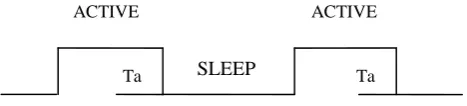
Timeout T-MAC [3] is the protocol based on the S-MAC protocol in which the Active period is pre – empted and the sensor goes to the sleep period if no activation event has occurred for a time 'Ta' as shown in Fig. 3.1.4.1. The event can be reception of data, start of listen/sleep frame time etc. The time 'Ta' is the minimal amount of idle listening per frame. The interval Ta > Tci + Trt + Tta + Tct where Tci is the length of the contention interval, Trt is the length of an RTS packet, Tta is the turn-around time (time between the end of the RTS packet and the beginning of the CTS packet) and Tct is the length of the CTS packet. The energy consumption in the Timeout T- MAC protocol is less than the Sensor S-MAC protocol. But the Timeout T-MAC protocol has high latency as compared to the S-MAC protocol.
Fig. 3.1.4.1. Basic T-MAC Scheme
3.1.5 Optimized MAC
In the Optimized MAC protocol [5], the sensors duty cycle is changed based on the network load. If the traffic is more than the duty cycle will be more and for low traffic the duty cycle will be less. The network load is identified based on the number of messages in the queue pending at a particular sensor.
The control packet overhead is minimized by reducing the number and size of the control packets as compared to those used in the S-MAC protocol. This protocol may be suited for applications in which apart from energy efficiency there is need for low latency.
3.1.5 Berkeley Media Access Control (B-MAC)
The Berkeley Media Access Control (B-MAC) [10] is a contention based MAC protocol for WSNs. B-MAC is similar to Aloha with Preamble Sampling [11], which duty cycles the radio transceiver i.e. The sensor node turns ON/OFF repeatedly without missing the data packets. However in B-MAC, the preamble length is provided as parameter to the upper layer. This provides optimal trade-off between energy savings and latency or throughput. The paper also presents an analytical model for monitoring application to calculate and set B-MAC parameters in order to optimize the power consumption. The experimental results show B-MAC has better performance in terms of latency, throughput and often energy consumption as compared to S-MAC.
3.2 Scheduled Based
The schedule based protocol can avoid collisions, overhearing and idle listening by scheduling transmit & listen periods but have strict time synchronization requirements.
3.2.1 Traffic Adaptive Medium Access Protocol
(TRAMA)
The traffic adaptive medium access (TRAMA) [6] is a Contention based protocol that has been designed for energy efficient collision free channel in WSNs. In this protocol the power consumption has been reduced by ensuring collision free transmission and by switching the nodes to low power idle state when they are not transmitting or receiving. This protocol consists of three main parts:
i. The Neighbor Protocol is for collecting the information about the neighboring nodes.
ii. The Schedule Exchange Protocol is for exchanging the two – hop neighbor information and their schedule
iii. The Adaptive Election Algorithm decides the transmitting and receiving nodes for the current time slot using the neighborhood and schedule information. The other nodes in the same time slot are switched to low power mode.
The TRAMA is shown to be more energy efficient and has higher throughput than Sensor S-MAC protocol. However, the latency of TRAMA is more as compared to the other contention based MAC protocol such as S-MAC and IEEE 802.11. This protocol may be suitable for applications which are not delay sensitive but require higher energy efficiency and throughput.
SYNC RTS CTS Recvd Data ACK
Received
SYNC
Recvd Head
RTS Recvd CTS DATA Rece ACK
SYNC
Recvd
RTS Recvd
Data
CTS ACK
Received Listen Period Sleep Period
Node 1
Node 2
Node
3 Sleep Period
ACTIVE ACTIVE
SLEEP
3.2.2 Self Organizing Medium Access Control for Sensor Networks (SMACS)
SMACS [9] is a schedule based medium access control protocol for the wireless sensor network. This MAC protocol uses a combination of TDMA and FDMA or CDMA for accessing the channel. In this protocol the time slots are wasted if the sensor node does not have data to be sent to the intended receivers. This is one of the drawbacks of this MAC scheme.
3.2.3 Aloha with Preamble Sampling
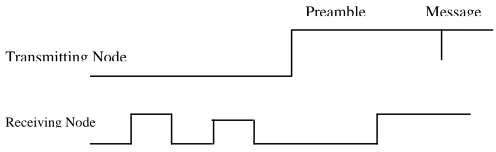
Aloha with Preamble Sampling is proposed in [11] where the ALOHA protocol [20] has been combined with the preamble sampling technique. The main drawback of the Carrier Sense Multiple Access (CSMA) is the energy wastage due to idle listening. El-Hoiydi in [11] proposed low power listening technique that efficiently duty cycles the radio (i.e., turns it ON periodically).This approach works at the physical layer based on the PHY Header going to sensor's radio. The Header starts with the Preamble which intimates the receiver of upcoming messages. The receiver periodically turns radio ON to sample for the incoming messages and if the preamble is detected, it continues listening for the normal message transfer. If the preamble is not detected it turns OFF radio till next sample. This carrier sensing approach is shown in Fig. 3.2.3.1 was combined with ALOHA by El-Hoiydi in [11] and named it Aloha with Preamble Sampling which is suitable for low traffic wireless sensor network applications. This paper also presents the power consumption, delay performance and life time computed by analytical methods.
Fig. 3.2.3.1. Low Power Listening and Preamble Sampling
3.2.4 Wise MAC
Wise MAC [14] medium access control protocol was developed for the “Wise NET” wireless sensor network. This protocol is similar to Spatial TDMA and CSMA with Preamble Sampling protocol [13] where all the sensor nodes have two communication channels. TDMA is used for accessing data channel and CSMA is used for accessing control channel. However, Wise MAC [14] needs only one channel and uses non-persistent CSMA with preamble sampling technique to reduce power consumption during idle listening. This protocol uses the preamble of minimum size based on the information of
the sampling schedule of its direct neighbors. The sleep schedules of the neighboring nodes are updated by the acknowledgement message (ACK) during every data transfer. Wise MAC is adaptive to the traffic loads and provides low power consumption during low traffic and high energy efficiency during high traffic.
3.2.5 Low Energy Adaptive Clustering Hierarchy (LEACH)
Energy Aware Scheduled Based MAC [16] protocol assumes the formation of clusters in the network. Each of the cluster sensor nodes is managed by the cluster head. The cluster head collects the information from the other sensor nodes within its cluster, performs the data fusion, communicates with the other cluster head and finally sends the data to the control center. The assignment of the time slots to the sensor nodes within its cluster is performed by the cluster head. The cluster head inform the other nodes about the time slot when it should listen to other nodes and the time slot when it can transmit own data.
3.2.6 Data Gathering MAC (D-MAC)
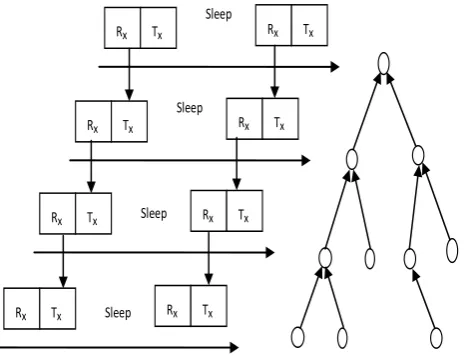
The Data-Gathering Medium Access Control (D - MAC) [12] is a schedule based MAC protocol which has been designed and optimized for tree based data gathering (converge cast communication) in wireless sensor network. The main objective of this MAC protocol is to achieve low latency and still maintaining the energy efficiency. In this protocol the time is divided in small slots and runs carrier transmit/receive one packet. The sensor node periodically executes the basic sequence of '1' transmit, '1' receive and 'n' sleep slots. In this approach a single packet from a source node at depth 'k' in the tree reaches the sink node with a delay of just 'k' time slots. This delay is very small and it is in the order of tens of milliseconds. A data gathering (converge cast) tree with staggered DMAC slots is shown in Fig. 3.2.6.1.
D-MAC includes an overflow mechanism to handle the problem when each single source node has low traffic rate but the aggregate rate at intermediate node is larger than the basic duty cycle. In this mechanism the sensor node will remain awake for one extra time slot after forwarding the packet.
Transmitting Node
Receiving Node
Fig. 3.2.6.1. Data Gathering tree in D-MAC scheme
Therefore, if two children were contending for parents receive slot, the loosing child will get a second chance to send its packet. The D-MAC uses a separate control packet named MTS (More to Send) to solve the problem of the interference between nodes on the different branches of the tree. The MTS packet makes all the nodes on the multi-hop path to remain active in case of nodes failure due to interference.
D-MAC protocol outperforms the Sensor S-MAC protocol in terms of energy efficiency, latency and throughput in both multi-hop chain topology and random data gathering tree topology.
4. Conclusion
Recently several medium access control protocols for the wireless sensor network have been proposed by the researchers. However, no protocol is accepted as standard. This is because the MAC protocol in general will be application specific. Therefore, there will not be one standard MAC protocol for the WSNs.
The schedule based (TDMA) have collision free access to the medium but the synchronization is critical. Moreover, there is difficulty in adapting to the changes in the network topology because of the addition and deletion of nodes. The contention based (CSMA) have low latency and high throughput. However, it still suffers from the collisions. The Frequency Division Multiple Access (FDMA) scheme also allow collision free access to the media but the extra circuitry required to dynamically communicate with different radio channels increases the cost of the sensor nodes This contradicts the main objective of the wireless sensor networks (WSNs).
The Code Division Multiple Access (CDMA) scheme also offers collision free access to the medium. However, the high computational complexity is the limitation in the lower energy consumption needs of the sensor network.
REFERENCES
[1] I. Akyildiz, W. Su, Y. Sankarasubramaniam and E. Cayirci: A Survey on Sensor Networks, IEEE Communication
Magazine, pp. 102-114 (August 2002).
[2] Wei Ye, J.Heidemann and D. Estrin: An Energy- Efficient MAC Protocol for Wireless Sensor Networks, IEEE INFOCOM, New York, Vol. 2, pp. 1567-1576 (June 2002). [3] Tijs van Dam, Koen Langendoen: An Adaptive Energy
Efficient MAC Protocol for Wireless Networks, in Proceedings of the First ACM Conference on Embedded Networked Sensor Systems (November 2003).
[4] Changsu Suh, Young-Mi Song, Young-Bee Ko, and We Duke Cho: Energy Efficient & Delay Optimized MAC for Wireless Sensor Networks, in Proceedings of the Workshop in the Seventh International Conference on Ubiquitous Computing (Ubicomp'05) (September 2005).
[5] Rajesh Yadav, Shirshu Varma and N.Malaviya: Optimized Medium Access Control for Wireless Sensor Network, IJCSNS International Journal of Computer Science and Network Security, Vol. 8, No.2, pp. 334 -338 (February 2008).
[6] V. Rajendran, K. Obraczka and J.J. Gracia- Luna-Aceves: Energy Efficient, Collision Free Medium Access Control for Wireless Sensor Networks, in ACM International Conference on Embedded Networked Sensor Systems (SenSys), pp. 181-192 (November 2003).
[7] L. Bao and J.J. Garcia-Luna-Aceves: A New Approach To Channel Access Scheduling for Ad Hoc Network, in Seventh Annual International Conference on Mobile Computing and Networking, pp. 210-221 (2001).
[8] M. Ali, Saif, A. Dunkels, T. Voigt, K. Romer, K. Langendoen, J. Polastre, Z. A. Uzmi: Medium Access Control Issues in Sensor Networks, ACM SIGCOMM Computer Communication Review, Vol. 36, No. 2 (April 2006).
[9] K. Sohrabi, J.Gao, V.Ailawadhi and G.J.Pottie: Protocols for Self Organization of a Wireless Sensor Network, IEEE Personal Communication, Vol. 7, Issue 5, pp. 16-27 (October 2000).
[10] J. Polastre, J. Hill, D. Culler: Versatile low Power Media Access for Wireless Sensor Networks, Proceedings of the 2nd ACM Conference on Embedded Networked Sensor Systems (SenSys'04), Baltimore, MD, (November 2004).
[11] A. El-Hoiydi: Aloha with Preamble Sampling for Sporadic Traffic in Ad-hoc Wireless Sensor Networks", in Proceedings of IEEE International Conference on Communications (April 2002).
[12] G. Lu, B. Krishnamachari, C. Raghavendra: An Adaptive Energy Efficient and Low Latency MAC for Data Gathering in Wireless Sensor Networks, Proceedings of 18thth International Parallel and Distributed Processing Symposium (April 2004).
[13] A. El-Hoiydi: Spatial TDMA and CSMA with Preamble Sampling for Low Power Ad-hoc Wireless Sensor Network, Proceedings of ISCC '02, Seventh International Symposium on Computers and Communications, pp. 685-692 (July 2002).
[14] C.C. Enz, A. El-Hoiydi, J.-D. Decotignie, V. Peiris: WiseNET: An Ultralow-Power Wireless Sensor Network Solution, IEEE Computer, Vol. 37, Issue 8 (August 2004). [15] S. Singh and C. Raghavendra: PAMAS: Power Aware
Multi-Access Protocol with Signaling for Ad-hoc Network, ACM SIGCOMM Computer Communication Review (July 1998). [16] K. Arisha, M. Youssef and M. Younis: Energy Aware
TDMA based MAC for Sensor Network, in IEEE Workshop on Integrated Management of Power Aware Communications Computing and Networking (IMPACCT'02) (2002).
[17] Zhihui Chen, Ashfaq Khokhar: Self Organisation and Energy Efficient TDMA MAC Protocol by Wakeup for Wireless Sensor Networks, in Proceedings of the IEEE Conference (SECON'04) (August 2004).
[18] M. Ali, Saif, A. Dunkels, T. Voigt, K. Romer, K. Langendoen, J. Polastre, Z. A. Uzmi: Medium Access Control Issues in Sensor Networks, ACM SIGCOMM Computer Communication Review, Vol. 36, No. 2 (April 2006).
[19] C. Karlof, N. Sastry, and D. Wagner: TinySec: A Link Layer Security Architecture for Wireless Sensor Networks", in Proceedings SenSys'04, pp. 162-175 (November 2004).
Rx Tx Rx Tx
Rx Tx Rx Tx
Rx Tx Rx Tx
Rx Tx
Sleep
Sleep
Sleep