FROM FUNCTIONAL LITERACY INCREASE OF ENGINEERING STUDENTS TO PROJECT-ORIENTED SMART-UNIVERSITIES
Rymbek A. Torgayev
Kazakh-British Technical University
59 Tole bi street, Almaty 050000, Kazakhstan
Abstract
This paper states some development directions of CALS-technologies in educational projects efficiency increase based on its opportunities study results applied to project-oriented smart-universities.
Key words: CALS-technologies, functional literacy, life cycle of specialists training, university processes, integrated informational environment, smart-university, project team
Common tendencies of educational services market evolution for engineering universities are characterized by strategies aimed to individual production of specialists; convergence of universities’ and company-customers’ interests; globalism of educational environment; rough universities’ competency; necessity of rapid reaction on companies requests to adapt and cooperate with other universities and etc. Main production value becomes the category “competence”. Competence in turn is founded on functional literacy fundament.
According to researches, functional literacy increase of engineering students with usage of information technologies based on CALS-technologies principals might be achieved by following [1,2]:
1. Provision of students papers theme actuality for companies based on inclusion of potential employers into the list of member in academic team and information interaction with them in IIS;
2. Parallel independent completion of course paper and diploma projects aimed to increase their quality and also to comparative evaluation of their functional literacy level;
3. Wide usage of object visualization tools in course and diploma papers;
4. Interaction and functioning of universities processes’ main members’ in IIS environment;
5. Complex computerization of educational processes and etc.
6. Besides, CALS-technologies are able to positively influence on following universities processes:
7. their quality increase based on information support system QM (quality management) improvement;
8. increase of processes production by development of paperless technologies;
9. processes ordering, their optimization and automation;
10. processes planning support (planning stage);
11. processes execution support (execution stage) using automated workflow management;
12. processes and “products” evaluation support (testing stage) through storage and students information management;
13. analysis of evaluation results support using PDM-systems which integrate data from all work processes in university;
14. processes improvement support through usage of PDM-system for discrepancy and change management;
15. students data management and educational processes control support.
Using CALS-technologies, informational support of university products along all their life cycle stages including following may be done:
1. educational programs development;
2. provision of educational processes support;
3. education process by itself;
4. skills, knowledge and abilities evaluation;
5. students employment after graduation
6. modernization (training courses and addition education).
According to written above, basic requirements to IIS and university processes participants are formed.
Implementation of this technology presumes execution of following practical measures and requirement pattern:
1. integration of Professors board (PB) module, library, administration into one integrated channel of information exchange by merger of various databases types in one independent database;
2. implementation of system of secured data exchange between university partners and third-party organizations in order to provide proper conditions for students’ functional literacy increase;
3. taking into consideration the requirements for engineering majors along with requirements arising from CALS-technologies principals;
4. distribution of diploma project preparation process among all departments aimed to provide proper quality level and to use students’ papers and projects common database;
5. implementation of software and equipments (existing) into education process which allows students to start their project items construction from the very first year of education and to continue till thesis defense moment analyzing situation, materials, equipment, tools, technologies and etc.
6. update of requirements for competence and functional literacy level of undergraduate students aimed to successive clarification of list of subjects and their division into groups as already performed in major 050702 – “Automation and management”;
7. evaluation of functional literacy of engineering students using proposed method.
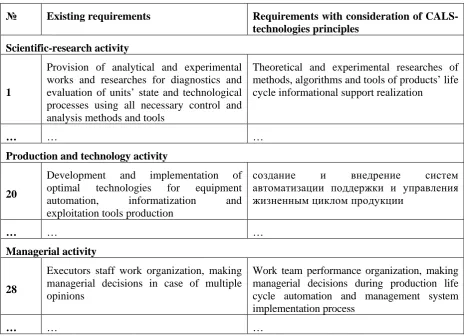
Moreover, it is advisable to clarify requirements to majors considering CALS-technologies principles (example in table 1).
Table 1 – Requirement of major “Automation and Management” with consideration of CALS-technologies principles.
In order to implement this technology in example of one university, functional model has been developed illustrating improvement of university processes in IIS conditions. This functional model has been developed based on university processes analysis results using IDEF (IntegratedDEFinition) methodologies which were founded in a technology group Structured analysis and design SADT (StructuredAnalysisDesignTechnique). They aimed to deal with various methods of processes description and analysis, workflows, manufacturing structures and organizational systems in order to improve their characteristics. The structure of IDEF model is shown in picture 1.
№ Existing requirements Requirements with consideration of CALS-technologies principles
Scientific-research activity
1
Provision of analytical and experimental works and researches for diagnostics and evaluation of units’ state and technological processes using all necessary control and analysis methods and tools
Theoretical and experimental researches of methods, algorithms and tools of products’ life cycle informational support realization
… … …
Production and technology activity
20
Development and implementation of optimal technologies for equipment automation, informatization and exploitation tools production
создание и внедрение систем автоматизации поддержки и управления жизненным циклом продукции
… … …
Managerial activity
28
Executors staff work organization, making managerial decisions in case of multiple opinions
Work team performance organization, making managerial decisions during production life cycle automation and management system implementation process
… … …
Picture 1 - The structure of IDEF model
Based on this model, list of technological normative documents (TND) was developed which further needs to be implemented, clarified and complemented.
Following TND groups are included into the mentioned list:
1. functional;
2. informational;
3. technical exchange;
4. information security;
5. computer-generated signature (CGS);
6. integrated informational models.
Besides, technological normative documents need to be fulfilled by new. Among them, following TND are recommended to be developed primarily:
1. IIS data provision regulation;
2. Functional requirements to processes regulation;
3. IIS data exchange rules;
4. IIS data exchange instructions;
5. CGS use regulations;
6. CGS use instructions;
7. IIS data integration rules;
8. Scientific research laboratory (SRL) regulations (with supplement);
9. Forming of priority areas of Scientific research works of students (SRWS) with consideration of potential employers requirements rules (supplement to Faculty board regulations) and etc.
In total, initial functional model illustrating mentioned university processes is changed with consideration of IIS implementation and CALS-technologies principles. Picture 2 illustrates common model of IIS.
Picture 2 - Common model of proposed IIS.
Interaction and intercommunication processes with employers are taken into consideration while forming the list of SRWS themes and with laboratories in order to provide all the necessary information-tools support of technical part of thesis. Carrier unit and SRL units are added which further decomposed into following units:
1. Provision of the list of SRWS priority areas from employers;
2. Employers search for uploading them into IIS database;
3. Receiving the list of priority areas from employers;
4. Distribution of the themes among departments;
5. Selection of informational-tools environment consulting;
6. Technical issues consulting;
7. Prototype realization issues consulting and etc.
Aimed to provide proper conditions in university for keeping and improving students’ functional literacy , data exchange between university partners and third-party companies is made possible. This will lead to effective selection of employment places for students by generation of students profile including the list of tasks that student has to be able to solve for further selection of appropriate position in companies. Also, the unit working with Scientific research centers (SRC) will allow to synchronically interact with databases of third-party companies for provision of actual information for PB and students use. For provision of proper activity of mentioned units, center of carrier and department working with SRC will be founded and additional changes will be made in functions of registrar’s office.
Following additions are proposed to be made in functions of Carrier center:
1. Search of employers for uploading into IIS database;
2. Matching the list of executed tasks of particular students to list of tasks required by employer;
3. Conduction of new subject implementation proposals or existing subjects’ syllabus update.
Functions of department working with SRCs are corrected as well by following:
1. Conclusion of cooperation contracts with various scientific centers;
2. Monitoring of synchronization process and circulating among databases data security.
Supplement to registrar’s office functions:
1. Registration of students and PB in IIS;
2. Students information entry to database of IIS (transcript, SRWS, grades);
3. Existing students’ and PB accounts administration;
4. Entry/deletion of students in/out subject data.
In order to further improve existing informational-tools environment of technical university in conditions of information technology based on CALS-technologies principles following is proposed (in example of one university):
1. Autodesk software could be replaced by modern and up-to-date software Siemens PLM due to switch of worldwide leading companies to Siemens PLM software.
2. During students preparation use of Invensis – the only automated systems manufacturer, Altera – releasing tools for built-in software development of Programming logic device (PLD) and compiler for the processor core of personal development and etc;
3. For interaction with manufacturers improvement widely use opportunities of Internet;
4. During software selection determine common system requirements and requirements dictated by constitution of applicable tasks of university for informational-tools environment in CALS-technologies conditions, including:
4.1 software, used for creation and conversion of information which usage doesn’t depend on realization of this technologies;
4.2 software, which use directly connected to this technology.
First group includes traditionally used products which are intended for automation of various informational and university processes and procedures. At the market of software listed above groups of software are widely presented.
Second group consists of software and systems which could be considered for university processes:
1. items data management and their configuration (PDM systems – Product Data Management );
2. project management and etc;
For further development of informational-tools and educational environment in whole following is attracting interest.
Nowadays leading worldwide universities are oriented to use mobile application and interfaces in education which support abilities of acknowledge touches and movements, improved searching technologies, voice control, wide multimedia opportunities for users authentication, rapidly growing popularity of biometrical methods identification (visual acknowledgment of face geometry: iris, fingerprints and etc).
As the most perspective infrastructure solutions for educational companies, following are distinguished:
1. organization of cloud infrastructure of educational and science –research space (for functioning of communication services; organization of content storage; virtualization of educational resources; execution of highly performing calculations and etc. ), use of services models (PaaS, IaaS, SaaS);
2. building strategy of university informatization based on BYOD principles (BringYourOwnDevice) implied use of personal mobile devices of students: media tablet, smartphones, electronic books, notebooks and etc;
3. unified authorization and identification of member in various communication canals and services which allows to personalize profile using different informational resources.
Among the most demanded pedagogical tools following are outlined:
1. gamification of educational and research processes using approaches and methods for computer games used with consideration of game intellection’ specifics in non-game space. Such approach allows to provide phased diving into the educational process, receive measurable feedback, provide dynamical correction of students behavior and etc;
2. multimedia and interactive technologies for modeling and forecast of educational processes and phenomenon, conduction of experiments at condition of real experience imitation on computer (trainers, telepresence, virtual laboratory, virtual reality, additive realty and etc);
3. opportunities of social media for joint forming and use of collective knowledge (blogs, social networking, wiki projects, social multimedia, social searching tools and bookmarking service, social geoinformational system, multiplayer network games, virtual world and etc).
Besides, for development and management of educational content it is advisable:
1. inclusion of application store and educational content (AppStore) into educational and research processes infrastructure which provide opportunity of remote access to electronic educational and scientific resources, their download, reproduction, ratings, their usage experience exchange and etc;
2. use of computer linguistics tools with help of artificial intellect technology (speech synthesis, voice and speech recognition);
3. voice search, automated translation of text and speech;
4. geolocation and geopositiong (determination of location , search of geographical objects, receiving of maping information, movement tracks building and etc).
As shown above, nowadays main accent in electronic education has been made majorly to technologies. At the same time, leading universities of the world do not “distract” on qualified development of informational database but deal with problems of diversification electronic education method. These issues relate to Smart Education. Smart Education is able to provide maximal highest level of education, corresponding tasks and opportunities of today’s world, it will allow new specialists to adapt to rapidly changing environment tasks, provide transitivity from book content to active one.
It is widely known that Smart Education – merger of universities and professors board for joint educational activities in Internet based on common standards, cooperation and technologies: Smart Education or in other words smart learning – flexible education in interactive educational environment using content from all around the world existing in free access. Key of understanding Smart Education – wide access to knowledge.
There is a need to solve questions as following:
1. not single dimensional and fragmented electronic educational environment and lack of joint projects among universities;
2. growing tendency of communication networks commercialization among experts;
3. lack of unified standards, agreements and technologies;
4. necessity of having created and using shared content for Smart Education in open projects;
5. necessity of overcoming issues related to differentiated universities ( research, governmental, independent and etc) and with specifics of regional control of education;
6. regulatory provision of further development through this way;
7. education processes efficiency of gain through transfer of education process into electronic environment mainly through creation of environment for creativity and etc.
Actual development field of Smart universities is project-oriented smart-university, when university switch to functioning on entrepreneurship management principles.
Besides, university structure could be represented as multidimensional matrix. At intersection of rows and columns there are group of employees – project teams. They fulfill specific educational science and technological and other projects. In case of third-party company entry into project team – “virtual enterprise” are created and all necessary regulatory documentations are prepared.
Every project teams technological product development management also beneficial to setup through CALS technologies. This is due to principles of this technology are invariant against different production fields. Therefore, also beneficial to investigate impact of this technology to quality of end product of project teams, as well as to impact on quality of product life cycle processes within university environment.
References
1. R. Torgayev 2011, ‘Enhancement of quality of students’ works and their functional literacy using opportunities of “cals – technologies’, Kazakh-British Technical University, Journal of Scientific International Publications: Educational Alternatives, Volume 10, Part 4, pp. 158 – 165.
2. I. Torgayeva, A. Kasymbekov 2014, ‘Engineering students functional literacy increase’, Proceedings of 6th international scientific and practice conference “Innovative development problems of oil & gas industry”, Almaty, KBTU, 87-91 pp.
3. Ivanchenko D. A 2010, ‘ Build of informational infrastructure of university using model SaaS’, Higher education in Russia, #10, 11-12 pp.
4. Grudzinskii A. O. 2010, ‘Concept of project-oriented university’, University management, # 3 (26), 24-37 pp.