www.nonlin-processes-geophys.net/17/593/2010/ doi:10.5194/npg-17-593-2010
© Author(s) 2010. CC Attribution 3.0 License.
Nonlinear Processes
in Geophysics
Stability of the strahl electron distribution function and its dynamics
V. I. Shevchenko and V. L. Galinsky
University of California, San Diego, Electrical and Computer Engineering Department, La Jolla, CA, USA
Received: 2 July 2010 – Revised: 13 September 2010 – Accepted: 29 September 2010 – Published: 26 October 2010
Abstract. It is shown that core-strahl electron system in the solar wind plasma is unstable with respect to excitation of the lower hybrid waves at anomalous Doppler resonance due to anisotropy of the strahl electron velocity distribution. Dy-namics of the strahl electron distribution due to interaction with excited waves is studied.
1 Introduction
Observations have revealed that the solar wind electron dis-tribution can be considered to consist of a dense core com-ponent and more tenuous suprathermal population. The ther-mal core (T ∼10 eV) contains∼95% of the total electron density while the supra-thermal population contains∼5% of the electron density. The suprathermal population consists of two energetic components: (i) a halo that can be approxi-mated by Maxwellian distribution with hotter temperature in comparison with a core distribution and (ii) an anisotropic component, so called strahl – anti-sunward moving electrons with narrow pitch angle distribution (Rosenbauer et al., 1977; Feldman et al., 1978; Lin et al., 1981; Pillip et al., 1987; Ogilvie et al., 2000; Gosling et al., 2001, 2003, 2004a, b; Steinberg et al., 2005; Pagel et al., 2005, 2007). It was re-vealed that the relative number of halo electrons is increas-ing while the relative number of strahl electrons is decreasincreas-ing with distance from the sun thus providing evidence that the heliospheric electron halo population consist partly of elec-trons that have been scattered out of the strahl (Maksimovich et al., 2005; Stverak et al., 2009).
The physical mechanisms of the strahl origin were investi-gated in theoretical studies of the evolution of the electron ve-locity distribution function in high speed solar wind streams
Correspondence to: V. L. Galinsky
from the dominated corona and into the collision-less interplanetary space. It was shown that the strahl compo-nent can develop in the high corona as a result of two possi-ble mechanisms. The first one is so called velocity filtration, due to the energy dependence of the coulomb cross section when only electrons with large energy can escape to inter-planetary space (Scudder and Olbert, 1979; Scudder, 1992, 1994). In second mechanism the electron distribution func-tion is mainly determined by the electric ambipolar field and the expanding geometry and consists of a population with almost isotropic core which is bound in the electrostatic po-tential and a high-energy tail of the electron distribution that can stream freely outward in the corona (Lie-Svendsen et al., 1997).
Numerous observations have found that the strahl pitch an-gle widths are larger than the one that can be found by con-sidering the focusing effect due to conservation of the first adiabatic invariant in the divergent solar wind. In the ab-sence of Coulomb collisions (Ogilvie et al., 2000), that could be explained only by invoking wave-particle interaction pro-cesses, specifically, cyclotron resonant interaction. The main question that remained was what type of waves is responsible for pitch angle scattering of the strahl electrons and what are the sources of these waves.
Studies, that were recently performed by using quasi-linear approach (Vocks and Mann, 2003; Vocks et al., 2005) and by particle-in-cell numerical simulations (Saito and Gary, 2007a, b), assumed that a likely scattering process for suprathermal electrons is their resonant interaction with right-hand polarized whistlers on normal Doppler resonance
k||v||=ωk−ωce, ωce=
|e|B0
mec
(1)
wherek|| andv|| are the wave vector and electron velocity components parallel to the magnetic field,ωkandωceare the
It was assumed these whistlers are provided by the inter-planetary turbulence. A study of additional potential sources of enhanced whistler populations (Saito and Gary, 2007a, b) found that whistlers can be generated through electro-magnetic instabilities like the whistler cyclotron instability driven by the electron core anisotropyT⊥> T||(Sagdeev and Shafranov, 1961), or whistler heat flux instability (Gary et al., 1975). However, it was shown that these electromagnetic instabilities, do not strongly scatter suprathermal electrons at relatively high energies (Scime et al., 2001; Saito and Gary, 2007a, b).
The purpose of this paper is to analyze another physi-cal mechanism of pitch-angle diffusion of the strahl elec-trons that appears due to anisotropy of their distribution func-tion. We will answer the questions: What is the role of the anisotropy of the strahl electron distribution function? Is this non-equilibrium distribution unstable and, if yes, what electron pitch angle scattering will be developed by excited waves?
2 The “fan” instability of the strahl distribution
As was discussed in the introduction, a tail of suprather-mal electrons – a strahl is formed on the electron distri-bution function in collision-dominated corona and streams outward. We will study a new effective mechanism of the pitch angle scattering of the strahl electrons due to their res-onant interaction with lower hybrid (LH) waves at anoma-lous Doppler resonance. This mechanism emerges as a re-sult of so-called “fan” instability (Kadomtsev and Pogutse, 1968; Shapiro and Shevchenko, 1968) – cyclotron instabil-ity in the case when there is anisotropy in the particle ve-locity distribution with free energy in the direction parallel to the magnetic field. It can be understood by considering the quantum treatment of the wave emission by a charged particle. The charged particle is an oscillator with energy levels nhω¯ c(n=0,±1,±2,...) moving along the magnetic
field. Both the energy of longitudinal motion and the oscil-lator energy may change upon emission of a wave quantum. The resonance condition
ωk=k||v||+nωc (2)
follows from conservation of energy and momentum in the process of the wave quantum emission
1ε= ¯hωk=1p||v||+nhω¯ c, 1p||= ¯hk||. (3) Forn=0 (Cherenkov resonance) the oscillator energy does not change. For n=1,2... (Normal Doppler resonance) emission of the quantum is accompanied by transition of the oscillator to a lower energy level. For n= −1,−2... (Anomalous Doppler resonance) the oscillator energy in-creases and emission occurs at the expense of the parallel motion.
We would like to stress that this is just what takes place in the problem under investigation – the energy source for this instability is parallel energy of the anisotropic strahl elec-tron distribution function. The elecelec-tron distribution function with high-energy tail is unstable with respect to excitation of LH waves on anomalous Doppler resonance (Shapiro and Shevchenko, 1968, 1988; Omel’chenko et al., 1992):
k||v||=ωk+ωce (4)
Hereωk is the frequency of the lower hybrid waves.
The lower hybrid waves are dominantly electrostatic os-cillations of plasma in magnetic field propagating obliquely to the magnetic field with frequencies in the intervalωcp
ωωce(ωce,ωcpare electron and proton cyclotron
frequen-cies). The dispersion relation for these waves has the form ω2k=ω2LH 1+mp
me
k2|| k2
!
(5)
Here ωLH=ωpi/
1+ω2pe/ωce21/2 is the frequency of the lower-hybrid resonance,ωpe,ωceare the electron plasma and
cyclotron frequencies,k||andk⊥are the wave vector compo-nents along and transverse to the magnetic field.
As a result of the “fan” instability, the pitch angle diffu-sion of electrons takes place and their perpendicular velocity grows. Thus this mechanism can be an effective plausible candidate to explain the broadening the electron pitch an-gle distributions in strahls and in solar electron bursts. It is the natural mechanism, since the source of the oscillations is the instability of the anisotropic distribution function of the strahl electrons that leads to decrease of the anisotropy by pitch angle scattering of electrons.
As we discussed above, the energy source for the fan in-stability is an anisotropy of the energetic electrons distribu-tion and a positive slope over parallel velocity distribudistribu-tion is not needed for its development. Instead, electrons having ei-ther a plateau or even a monotonically decreasing distribution function over the parallel velocity in the form of high-energy tail can generate waves through the fan instability (Shapiro and Shevchenko, 1988). In this sense the question of stabil-ity of strahl electron distribution in the solar wind is similar to the problem of stability of electron beam in magnetized plasma (Shapiro and Shevchenko, 1968) as well as stability of precipitating auroral electrons in magnetospheric plasma (Omelchenko et al., 1994).
3 Equations and solution
The instability leads to the LH wave generation that causes the electron diffusion over pitch angle and formation of the shell distribution function (“fan” distribution on the (v||,v⊥) plane). The diffusion lines are circles in velocity space with center at the point (ω/ k||,0):
w=v⊥2+ v||−ω/ k|| 2
To study the nonlinear evolution of the strahl electrons dis-tribution function we will use a self-consistent quasi-linear approach. We will study the problem in local approxima-tion where we can neglect the mirror force. We assume thatmpk2||
.
mek21 andωpeωce. Then it follows from
(5) that the frequency of generated waves in this case is ω=ωcek||k. The system of quasi-linear equations that de-scribe the evolution of the electron distribution function and the spectrum of lower hybrid waves excited by strahl elec-trons at anomalous Doppler resonance has the form (Shapiro and Shevchenko, 1968):
∂f0
∂t = 1 2π
e2 m2
e
Z
k⊥dk⊥Lˆ
( k2|| k2
J12 k⊥v⊥ωce
v||−vg||
|Ek|2Lfˆ 0
)
v||=(ωce+ωk)k|| (7)
∂|Ek|2
∂t =
π n0
k⊥2k|| k5 ω
3 ce
Z dv⊥J12
(k⊥v⊥/ωce)Lfˆ 0
v||=(ωce+ωk)k||
|Ek|2 (8)
In these equationsLψˆ =∂ψ ∂v||+
ωk−k||v||
v⊥k||
∂ψ
∂v⊥,f0is the dis-tribution function of the electrons averaged over time that is large in comparison with the characteristic wave period (background distribution function), Ek, ωk are the electric
field and frequency of the lower hybrid waves excited by the instability, vg||=∂ω
∂k|| is the wave group velocity. J1(k⊥v⊥
ωce)is Bessel function, subscripts||and⊥denote
components parallel and perpendicular to the background magnetic fieldB0.
The initial distribution of the electrons consists of isotropic distribution of core electrons and anisotropic distribution of more tenuous strahl electrons with densitynsnc=0.05 with
maxwellian distribution over perpendicular velocities with perpendicular temperatureT⊥,sTc=0.5 and with
decreas-ing distribution over parallel velocity fs(t=0)=
ns
T⊥me
1 1
vmin−1vmax
1 v2
z e−mev2⊥
2T⊥
Heren,T andvT are electron density, temperature and
ther-mal velocity, subscripts c and s denote the core and strahl electrons. We solved Eqs. (7)–(8) for two sets of parameters S1:T⊥,sTc=0.5,vmin=2vT ,c and vmax=20vT ,c
as well as S2:T⊥,s
Tc=1,vmin=vT ,c and vmax=20vT ,c
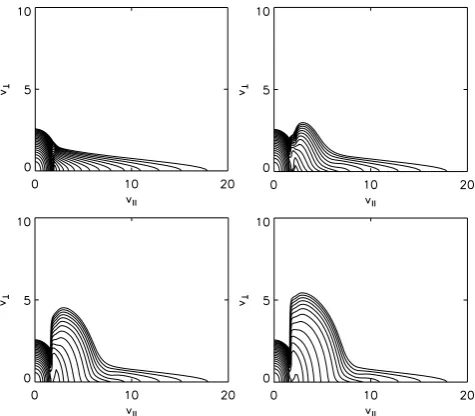
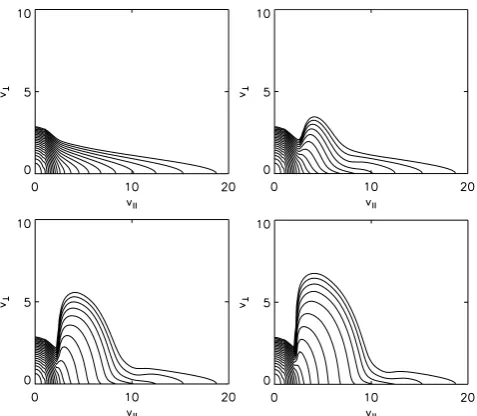
Results of integration of Eqs. (7)–(8) with a very small level of initial wave amplitudes are shown in Figs. 1 and 2 (set S1) and (3)–(4) (S2). In the Figs. 1 and 3 the dynamics
Fig. 1. Spectral density of the lower hybrid waves as function
of the parallel wave number for S1 set of parameters at times
t=(0;7.7×10²;9×10²;9.7×10²;1.1×10³)ω1
ce. The wave
num-ber is measured inωcevT ,c.
Fig. 2. Electron distribution function for S1 set of parameters at
timest=(0;7.7×10²;9.7×10²;1.1×10³)ω1
ce. Velocities are
mea-sured invT ,c.
of the LH wave power density is shown. Reduction of the wave intensity at small wave numbers is due to decrease of the density of strahl electrons. A strong decline of the power spectrum atk≈ωcevT ,c is a consequence of the damping
Fig. 3. Spectral density of the lower hybrid waves as function of
the parallel wave number at timest=(0;2.2×10³;2.7×10³;2.9× 10³;3.2×10³)ω1
ce for S2 set of parameters.
Fig. 4. Electron distribution function at times t=(0;2.2× 10³;2.9×10³;3.2×10³)ω1
ce for S2 set of parameters. Velocities
are measured invT ,c.
4 Conclusions
As was discussed above, previous studies of the velocity dif-fusion mechanisms of the strahl electrons were based on their interaction with whistlers provided by interplanetary turbu-lence. The goal of this paper was to consider another po-tential mechanism of pitch angle diffusion of the strahl elec-trons. We studied here a natural mechanism where waves needed for the electron pitch angle diffusion are excited by the instability caused by anisotropy of the strahl electron ve-locity distribution. The strahl electrons have more energy in parallel motion because of their narrow pitch angle
distri-bution along the magnetic field. This distridistri-bution is unstable with respect to excitation of waves at anomalous Doppler res-onance. We studied in local approximation the lower hybrid waves (electrostatic whistlers) excitation and pitch angle dif-fusion of strahl electrons due to this instability.
We would like to note that we limited ourselves in this study by considering only resonant electron-particle interac-tion in quasi-linear approximainterac-tion. The results of the pitch angle diffusion shown in the Fig. 2 indicate that halo can be formed as a result of diffusion of strahl electrons. How-ever the dynamics of the halo creation cannot be described in this approximation. The numerical simulations will be used to study the halo formation from the scattered strahl elec-trons and results will be compared with a model by Gosling et al. (2001) that describes the formation of the halo by as-suming that there is a source of an isotropic population of sunward directed electrons. We defer discussion of the halo formation to a subsequent paper.
Another unsolved problem is how mirror force will influ-ence the width of the pitch angle distribution of the strahl electrons and how densities of halo and strahl electrons change as function of the distance from the sun. Analysis of observed radial evolution of a halo and a strahl (Mak-simovich et al., 2005; Strevak et al., 2009) has shown that the halo and the strahl relative densities vary in an opposite way. With increasing distance from the sun, the density of the strahl electrons decreases while the number of the halo electrons increases. These results suggest as well that the halo is created by the strahl electrons and that there are some mechanisms in the solar wind that scatter the strahl electrons into the halo (Strevak et al., 2009). One can find from results of solution that characteristic scales at which instability de-velops is reasonable small. For example at distances on the order of 1 AU whereωce≈103s−1, the characteristic time
for the instability development is on the order of 3–4 s that gives a spatial scale of instability about (5÷6)×103km, that is much smaller than a characteristic scales of change of the solar wind parameters. Thus, the discussed above instability almost instantly will create a shell distribution of the strahl electrons at each distance from the sun that is reached by the strahl. Therefore, the quasi-linear terms in equations will be-come very small. In this case the macroscopic mirror forces will focus the strahl electrons and create the unstable distri-bution. A scale separation model (Galinsky and Shevchenko, 2000, 2007) should be used to study theoretically the radial evolution of the strahl and halo electrons. We will consider these questions in detail elsewhere.
Acknowledgements. The authors are grateful to David Schriver and another anonymous reviewer for a number of important comments and suggestions. The NASA grant No NNX09AG95G is acknowledged for support of this study.
Edited by: G. Morales
References
Feldman, W. C., Asbridge J. R.,, Bame, S. J., Gosling, J. T., and Lemons, D. S.: Characteristics electron variations across sim-ple high speed solar wind streams, J. Geophys. Res., 83(A11), p. 5285, doi:10.1029/JA083iA11p0528583, 1978.
Galinsky, V. L. and Shevchenko, V. I.: Nonlinear energy balance model of particle acceleration by collisionless parallel shock waves, Astrophys. J., 669, p. L109, doi:10.1086/523940, 2007. Galinsky, V. L. and Shevchenko, V. I.: Nonlinear cyclotron resonant
wave-particle interaction in a nonuniform magnetic field, Phys. Rev. Lett., 85, p. 90, doi:10.1103/PhysRevLett.85.90, 2000. Gary, S. P., Feldman, W. C., Forslund, D. W., and Montgomery, M.
D.: Electron heat flux instabilities in the solar wind, Geophys. Res. Lett., 2, p. 79, 1975.
Gosling, J. T., de Koning, C. A., Skoug, R. M., Steinberg, J. T., and McComas, D. J. Dispersionless Modulations in Low-Energy Solar Electron Bursts and Discontinuous Changes in the Solar Wind Electron Strahl, J. Geophys. Res., 109, A05102, doi:10.1029/2003JA010338, 2004a.
Gosling, J. T., Skoug, R. M., and McComas, D. J.: Low-Energy So-lar Electron Bursts and SoSo-lar Wind Stream Structure at 1 AU, J. Geophys. Res., 109, A04104, doi:10.1029/2003JA01309, 2004b. Gosling, J. T., Skoug, R. M., and McComas, D. J.: Solar Elec-tron Bursts At Very Low Energies: Evidence For Acceler-ation in the High Corona?, Geophys. Res. Lett., 30, 1697, doi:10.1029/2003GL017079, 2003.
Gosling, J. T., Skoug, R. M., and Feldman, W. C. Solar Wind Elec-tron Halo Depletions at 90 Pitch Angle, Geophys. Res. Lett., 28, 4155–4158, 2001.
Kadomtsev, B. B. and Pogutse, O. P.: Electric conductivity of a plasma in a strong magnetic field, Sov. Phys. JETP, 26, p. 1146, 1968.
Lie-Svendsen, O., Hansteen, V. H., and Leer, E.: Kinetic electrons in high-speed solar wind streams: Formation of high-energy tails, J. Geophys. Res., 102, p. 4701, doi:10.1029/96JA03632, 1997.
Lin, R. P., Potter, D. W., Gurnett, D. A., and Scarf, F. L.: Energetic Electrons and Plasma Waves Associated with a Solar Type III Radio Burst, Astrophys. J., 251, 364–373, 1981.
Maksimovich, M., Zouganelis, I., Chaufray, J.-Y., Issautier, K., Scime, E. E., Littleton, J. E., Marsch, E., McComas, D. J., Salem, C., Lin, R. P., and Elliott, H.: Radial evolution of the electron dis-tribution functions in the fast solar wind between 0.3 and 1.5 AU, J. Geophys. Res., 110, A09104, doi:10.1029/2005JA011119, 2005.
Ogilvie, K. W., Fitzenreitter, R., and Desch, M.: Electrons in the Low-Density Solar Wind, J. Geophys. Res, 105, 27277–27288, 2000.
Omelchenko, Yu. A., Shapiro, V. D., Shevchenko, V. I., Ashour-Abdalla, M., and Schriver, D.: Modified lower hybrid fan insta-bility excited by precipitating auroral electrons, J. Geophys. Res., 99, p. 5965, doi:10.1029/93JA01323, 1994.
Pagel, C., Crooker, N. U., Larson, D. E., Kahler, S. W., and Owens, M. J.: Understanding electron heat flux sig-natures in the solar wind, J. Geophys. Res., 110, A01103, doi:10.1029/2004JA010767, 2005.
Pagel, C., Gary, S. P., deKoning, C. A., Skoug, R. M., and Stein-berg, J. T.: Scattering of suprathermal electrons in the so-lar wind: ACE observations, J. Geophys. Res., 112, A04103, doi:10.1029/2006JA011967, 2007.
Pilipp, W. G., Miggenrieder, H., Montgomery, M. D., Muhlhauser, K. H., Rosenbauer, H., and Schwenn, R.: Characteristics of Elec-tron Velocity Distributions in the Solar Derived From the Helios Plasma Experiment, J. Geophys. Res., 92, p. 1075, 1987. Rosenbauer, H., Schwenn, R., Marsch, E., Meyer, B., Miggenrider,
H., Montgomery, M. D., Mulhauser, K.-H., Pilipp, W. G., Voges, W., and Zink, S. M.: A survey of initial results of the Helios plasma experiment, J. Geophys., 42, p. 561, 1977.
Sagdeev, R. Z. and Shafranov, V. D.: On the instability of a plasma with an anisotropic distribution of velocities in a magnetic field, Sov. Phys. JETP, 12, 130–132, 1961.
Saito, S. and Gary, S. P.: All whistlers are not created equal-ity: scattering of strahl electrons in the solar wind via particle-in-cell simulations, Geophys. Res. Lett., 34, L01102, doi:10.1029/2006GL028173, 2007a.
Saito, S. and Gary, S. P.: Whistler scattering of suprathermal elec-trons in the solar wind: Particle-in-cell simulations, J. Geophys. Res., 112, A06116, doi:10.1029/2006JA012216, 2007b. Scime, E. E., Littleton, J. E., Gary, S. P., Skoug, R., and
Lin, N.: Solar cycle variations in the electron heat flux: Ulysses observations, Geophys. Res. Lett., 28, p. 2169, doi:10.1029/2001GL012925, 2001.
Scudder, J. D.: Ion and electron suprathermal tail strengths in the transition region: Support for the velocity filtration mechanism in the corona, Astrophys. J., 487, p. 446, 1994.
Scudder, J. D.: Why all stars should possess circumstellar tempera-ture inversions, Astrophys. J., 398, p. 319, doi:10.1086/171859, 1992.
Scudder, J. D. and Olbert, S.: A theory of local and global processes which affect solar wind electrons, 1, The origin of typical 1 AU velocity distribution functions – Steady state theory, J. Geophys. Res., 84, p. 2755, doi:10.1029/JA084iA06p02755, 1979. Shapiro, V. D. and Shevchenko, V. I.: Quasi-linear theory of
relax-ation of an electron beam in a magnetoactive plasma, Sov. Phys. JETP, 27, p. 635, 1968.
Shapiro, V. D. and Shevchenko, V. I.: Astrophysical plasma turbu-lence, Sov. Sci. Rev. Astrophys. Space Phys., 6, p. 425, 1988. Steinberg, J. T., Gosling, J. T., Skoug, R. M., and Weins, R. C.:
Suprathermal Electrons in High-Speed Streams from Coronal Holes: Counterstreaming on Open Field Lines at 1 AU, J. Geo-phys. Res, 110, A06103, doi:10.1029/2005J011027, 2005. Stverak, S., Maksimovich, M., Travnicek, P., Marsch, E.,
Faza-kerley, A., and E. Scime, E.: Radial evolution of nonther-mal electron population in the low-latitude solar wind: He-lios, Claster and Ulysses observations, J. Geophys. Res., 114, A05104, doi:10.1029/2008JA013883, 2009.
Vocks, C. and Mann, G.: Generation of suprathermal electrons by resonant wave-particle interaction in the solar corona and wind, Astrophys. J., 593, 1134, doi:10.1086/376682, 2003.