47 | P a g e
CLUSTERING-BASED FEATURE SUBSET SELECTION
ALGORITHM USING FAST
Mr. Akshay S. Agrawal
Assistant Professor, Department of Computer Engineering, SSJCET, Asangaon, (India)
ABSTRACT
Feature selection involves identifying a subset of the most useful features that produces compatible results as the original entire set of features. A feature selection algorithm may be evaluated from both the efficiency and effectiveness points of view. While the efficiency concerns the time required to find a subset of features, the effectiveness is related to the quality of the subset of features. Based on these criteria, a fast clustering-based feature selection algorithm (FAST) is proposed. Duplicate detection is the process of identifying multiple representations of same real world entities. Today, duplicate detection methods need to process ever larger datasets in ever shorter time: maintaining the quality of a dataset becomes increasingly difficult. The algorithm maximizes the gain of the overall process within the time available by reporting most results much earlier than traditional approaches. The FAST algorithm works in two steps. In the first step, features are divided into clusters by using graph-theoretic clustering methods. In the second step, the most representative feature that is strongly related to target classes is selected from each cluster to form a subset of features. Features in different clusters are relatively independent; the clustering-based strategy of FAST has a high probability of producing a subset of useful and independent features. To ensure the efficiency of FAST, the efficient minimum-spanning tree (MST) clustering method is adopted.
Keywords: Clustering, Feature subset selection, Minimum Spanning Tree, T-Relevance, F-
Correlation.
I. INTRODUCTION
Data are among the most important assets of a company, but due to data changes and sloppy data entry, errors such
as duplicate entries might occur, making data cleansing and in particular duplicate detection indispensable.
However, the pure size of today’s datasets renders duplicate detection processes expensive. This project identifies
most duplicate pairs early in the detection process. Instead of reducing the overall time needed to finish the entire
process, progressive approaches try to reduce the average time after which a duplicate is found. Early termination in
particular then yields more complete results on a progressive algorithm than on any traditional approach.
With the aim of choosing a subset of good features with reverence to the target concepts, feature subset is an
efficacious way for reducing dimensionality, abstracting extraneous data, incrementing learning precision, and
48 | P a g e
machine learning applications. They can be divided into four broad categories: the Embedded, Wrapper, Filter, andHybrid approaches[1]. The embedded methods incorporate feature selection component of the training process and
are conventionally concrete to given learning algorithms, and consequently may be more efficient than the other
three categories. Traditional machine learning algorithms like decision trees or artificial neural networks are
examples of embedded approaches. The wrapper methods utilize the predictive accuracy of a predetermined learning
algorithm to determine the goodness of the selected subsets, the precision of the learning algorithms is customarily
high. However, the generality of the selected features is inhibited and the computational intricacy is immensely
colossal. The filter methods are independent of learning algorithms, with good generality. Their computational
complexity is low, but the accuracy of the learning algorithms is not ensured. The hybrid methods are a combination
of filter and wrapper methods by using a filter method to reduce search space that will be considered by the
subsequent wrapper. They mainly focus on combining filter and wrapper methods to achieve the best possible
performance with a particular learning algorithm with homogeneous time complexity of the filter methods.
The wrapper methods are computationally extravagant and incline to over fit on small training sets [1]-[9]. The filter
methods, in addition to their generality, are usually a good choice when the number of features is very large. Thus,
focus will be on the filter method in this report. With respect to the filter feature selection methods, the application
of cluster analysis has been demonstrated to be more effective than traditional feature selection algorithms. In cluster
analysis, graph-theoretic methods have been well studied and used in many applications. Their results have,
sometimes, the best agreement with human performance. The general graph-theoretic clustering is simple: Compute
a neighborhood graph of instances, then delete any edge in the graph that is much longer/shorter than its neighbors.
The result is a forest and each tree in the forest represents a cluster.
In the proposed study, a graph theoretic clustering method has been applied to features. In particular, the minimum
spanning tree (MST) predicated clustering algorithms is adopted because it is assumed that data points are grouped
around centers or dissevered by a customary geometric curve and have been widely utilized in practice.
Based on the MST method, a Fast clustering-bAsed feature Selection algoriThm (FAST) is proposed. The FAST
algorithm works in two steps. In the first step, features are divided into clusters by using graph-theoretic clustering
methods. In the second step, the most representative feature that is strongly related to target classes is selected from
each cluster to form the final subset of features. Features in different clusters are relatively independent; the
48 | P a g e
II REVIEW OF LITERATURE
Table No. 2.1: Comparative Study
Sr. No Paper Name Author Name Technology / Algorithm
Advantages Disadvantages
01
A Fast Clustering-Based
Feature Subset Selection
Algorithm for High
Dimensional Data [1]
Qinbao Song, Jingjie Ni
and Guangtao Wang FAST
1.Improve the performance
of
The classifiers.
2.Efficiently and effectively
deal with both irrelevant and
redundant features, and
obtains
--
02
Fast Correlation Based
Filter (FCBF) with a
Different Search Strategy
[1]
Baris Senliol, Gokhan
Gulgezen1 , Lei Yu2 and
Zehra Cataltepe
FCBF
1. FCBF compares only
individual features with each
other.
2. Select fewer features with
higher accuracy.
Cannot detect
some features.
03
An efficient k-means
clustering algorithm:
analysis and
implementation [14]
T. Kanungo
K-MEAN
1. K-Means produce tighter
clusters.
2. Fast, robust and easier to
understand.
1. Fixed number of
clusters can make
it difficult to
predict.
2. Does not work
well with
non-globular clusters.
3. Different initial
partitions can
result in different
final clusters.
4. It does not work
well with clusters
(in the original
data) of Different
size and Different
49 | P a g e
04A Simulated
Annealing-Based Multiobjective
Optimization Algorithm
[15]
Sanghamitra
Bandyopadhyay Simulating
Annealing
Accuracy, Useful for small
datasets
Single feature for
Single turn.
05
Clustering Approach to
Collaborative Filtering
Using
Social Networks [16]
Emir Cogo and Dzenana
Donko
Filter
Approach
Suitable for very large
features.
Accuracy is not
Guaranteed.
III EXISTING SYSTEM
The embedded method incorporate feature selection as a part of the training process and are usually specific to given
learning algorithms, and therefore may be more efficient than the other three categories. Traditional machine
learning algorithms like decision trees or artificial neural networks are examples of embedded approaches. The
wrapper methods use the predictive accuracy of a predetermined learning algorithm to determine the goodness of the
selected subsets, the accuracy of the learning algorithms is usually high. However, the generality of the selected
features is limited and the computational complexity is large. The filter methods are independent of learning
algorithms, with good generality. Their computational complexity is low, but the accuracy of the learning algorithms
is not guaranteed. The hybrid methods are a combination of filter and wrapper methods by using a filter method to
reduce search space that will be considered by the subsequent wrapper. They mainly focus on combining filter and
wrapper methods to achieve the best possible performance with a particular learning algorithm with similar time
complexity of the filter methods.
Limitations:
Lacks speed
Cannot detect some features.
Performance Related Issues
The generality of the selected features is limited and the computational complexity is large.
The accuracy of the learning algorithms is not guaranteed.
So the focus of our new system is to enhance the throughput for any basis to eliminate the data security lacks therein
and make a system prominent handler for handling data in an efficient manner.
IV PROPOSED SYSTEM
Feature subset selection can be viewed as the process of identifying and removing as many irrelevant and redundant
features as possible. This is because irrelevant features do not contribute to the predictive accuracy and redundant
features do not redound to getting a better predictor for that they provide mostly information which is already
present in other feature(s). Of the many feature subset selection algorithms, some can effectively eliminate irrelevant
48 | P a g e
redundant features. Overall the system will be effective in generating more relevant and accurate features which canprovide faster results. To remove irrelevant features and redundant features, the FAST [14] algorithm has two
connected components. Irrelevant feature removal and redundant feature elimination are the two most important
aspect of FAST Algorithm. The irrelevant feature removal is straightforward once the right relevance measure is
defined or selected, while the redundant feature elimination is a bit of sophisticated. In our proposed FAST
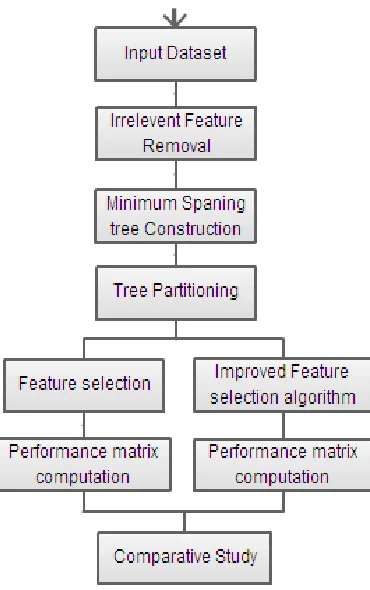
algorithm, it involves 1) the construction of the minimum spanning tree from a weighted complete graph; 2) the
partitioning of the MST into a forest with each tree representing a cluster; and 3) the selection of representative
features from the clusters.
Advantages:
Good feature subsets contain features highly correlated with (predictive of) the class, yet uncorrelated with (not
predictive of) each other.
The efficiently and effectively deal with both irrelevant and redundant features, and obtain a good feature subset.
Generally the algorithm achieves significant reduction of dimensionality by selecting only a small portion of the
original features.
Generally the algorithm is also used for increasing learning accuracy and improving result comprehensibility.
V PROPOSED SYSTEM DESIGN
49 | P a g e
Algorithm:Algorithm 1: FAST
inputs: D(𝐹1, 𝐹2, ..., 𝐹𝑚, 𝐶) - the given data set 𝜃- the T-Relevance threshold.
output: S - selected feature subset .
//==== Part 1 : Irrelevant Feature Removal ====
1 for i = 1 to m do
2 T-Relevance = SU (𝐹𝑖, 𝐶) 3 if T-Relevance >𝜃then
4 S = S ∪ {𝐹};
//==== Part 2 : Minimum Spanning Tree Construction ====
5 G = NULL; //G is a complete graph 6 for each pair of features {𝐹′𝑖, 𝐹′}⊂Sdo 7 F-Correlation = SU (𝐹′,′𝑗 )
8 𝐴𝑑𝑑𝐹′𝑖𝑎𝑛𝑑/𝑜𝑟 𝐹′ with F-Correlation as the weight of the corresponding edge;
9 minSpanTree = Prim/Kruskal(G); //Using Prim/Kruskal Algorithm to generate the min spanning tree
//==== Part 3 : Tree Partition and Representative Feature Selection ====
10 Forest = minSpanTree
11 for each edge Ei,j∈Forestdo
12 if SU (𝐹′,′𝑗 ) < SU(𝐹′𝑖, C) ∧SU(𝐹′𝑖, 𝐹′𝑗)<SU(𝐹′j, C) then 13 Forest = Forest − Eij
14 S = 𝜙
15 for each tree Ti∈Forestdo 16 FjR=argmax𝐹𝑘∈𝑇𝑖SU(𝐹′k, C) 17 S = S ∪ {F jR};
18 return S
The major amount of work for Algorithm 1 involves the computation of 𝑆𝑈 values for T-relevance and F-Correlation, which has linear complexity in terms of the number of instances in a given data set. The first part of the
algorithm has a linear time complexity (𝑚) in terms of the number of features 𝑚. Assuming (1 ≤ 𝑘≤ 𝑚) features are selected as relevant ones in the first part, when 𝑘= 1, only one feature is selected. Thus, there is no need to continue the rest parts of the algorithm, and the complexity is (𝑚). When 1 <𝑘≤ 𝑚, the second part of the algorithm firstly
50 | P a g e
graph using Prim algorithm whose time complexity is 𝑂(𝑘2). The third part partitions the MST and chooses the representative features with the complexity of (𝑘). Thus when 1 <𝑘≤ 𝑚, the complexity of the algorithm is (𝑚+𝑘2).This means when 𝑘≤√ 𝑚, FAST has linear complexity (𝑚), while obtains the worst complexity (𝑚2) when 𝑘= 𝑚. However, 𝑘is heuristically set to be ⌊ √𝑚lg𝑚⌋in the implementation of FAST. So the complexity is (𝑚lg2𝑚), which is typically less than (𝑚2) since 𝑙𝑔2𝑚<𝑚. This can be explained as follows. Let (𝑚) = 𝑚− lg2𝑚, so the derivative 𝑓′(𝑚) = 1 − 2 lg𝑒/𝑚, which is greater than zero when 𝑚>1. So (𝑚) is a increasing function and it is greater than (1)
which is equal to 1, i.e., 𝑚>lg2𝑚, when 𝑚>1. This means the bigger the 𝑚is, the farther the time complexity of
FAST deviates from (𝑚2). Thus, on high dimensional data, the time complexity of FAST is far more less than (𝑚2). This makes FAST has a better runtime performance with high dimensional data.
Mathematical Model:
H(X) is the entropy of a discrete random variable X. Let (x) be the prior probabilities for all values of X, then (X) is
defined by,
Gain (X | Y) determines the amount by which the entropy of Y decreases. It is given by,
Gain (X | Y) = H(X) – H(Y)
= H(Y) – H(X)
Where, H(X | Y) is the conditional entropy and is calculated as,
Where, X is a Feature and Y is a Class.
The symmetric uncertainty (SU) is defined as follows,
2 * Gain (X / Y)
SU(X,Y) =
H(X) + H(Y)
Given that (X, Y)be the symmetric uncertainty of variables X and Y, the relevance T-Relevance between a feature
and the target concept C, the correlation Correlation between a pair of features, the feature redundancy
F-Redundancy and the representative feature R- feature of a feature cluster can be defined as follows. T-Relevance -
The relevance between the feature Fi ∈ F and the target concept is referred to as the T-Relevance of Fi and C, and
denoted by SU (Fi,C). If SU (Fi,C) is greater than a predetermined threshold 𝜃,Symmetric Uncertainty of each
51 | P a g e
VI . RESULT
Figure No. 6.1: Home Page Figure No. 6.2: Database Uploading
Figure No. 6.3: Report Figure No. 6.4: Relevant Features
52 | P a g e
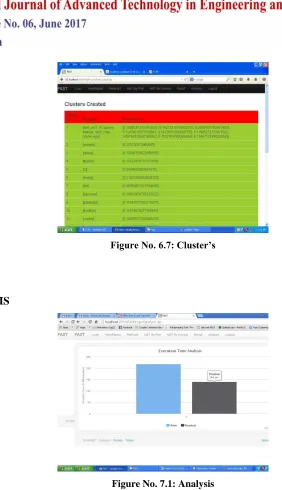
Figure No. 6.7: Cluster’sVII . ANALYSIS
Figure No. 7.1: Analysis
VIII FUTURE SCOPE
For the future it is planned to explore different types of correlation measures, and study some formal properties of
feature space.
Different correlation measure along with fuzzy logic can be included in the present algorithm. Symmetric
Uncertainty can be extended for extracting the feature subset selection.
IX CONCLUSION
This paper explains about the feature subset selection. In the proposed algorithm, a cluster consists of features. .
53 | P a g e
Generally, the proposed algorithm obtained the best proportion of selected features, the best runtime, and the bestclassification accuracy.
A novel clustering-based feature subset selection algorithm for high dimensional data is presented. The algorithm
involves removing irrelevant features, constructing a minimum spanning tree from relative ones, and partitioning the
MST and selecting representative features.
REFERENCES
[1] Qinbao Song, Jingjie Ni and Guangtao Wang, “A Fast clustering based feature subset selection algorithm for
high dimensional data”, In proceedings of the IEEE Transactions n Knowledge and data engineering, 2013. [2] L. Yu and H. Liu, “Feature Selection for High Dimensional Data: A Fast Correlation-Based Filter Solution,”
Proc. 20th Int’l Conf. Machine Leaning, vol. 20, no. 2, pp. 856-863, 2003.
[3] M. Dash, H. Liu, and H. Motoda, “Consistency Based Feature Selection,” Proc. Fourth Pacific Asia Conf.
Knowledge Discovery and Data Mining, pp. 98-109, 2000.
[4] A New Clustering Based Algorithm for Feature Subset Selection (IJCSIT) International Journal of Computer
Science and Information Technologies, Vol. 5 (4) , 2014, 5272-5275.
[5] Ding Cheng Feng, Feng Chen_, and Wenli Xu “Efficient Leave-One-Out Strategy for Supervised Feature
Selection” TSINGHUA SCIENCE AND TECHNOLOGY ISSNll1007- 0214ll09/10llpp629 635 Volume 18,
Number 6, December 2013.
[6] Houtao Deng, George Runger “Feature Selection via Regularized Trees” The 2012 International Joint
Conference on Neural Networks (IJCNN), IEEE, 2012.
[7] Yijun Sun, Sinisa Todorovic “Local Learning Based Feature Selection for High Dimensional Data Analysis”
IEEE TRANSACTIONS ON PATTERN ANALYSIS AND MACHINE INTELLIGENCE, VOL. 32, NO. 9,
SEPT.2010.
[8] Sriparna Saha “Feature selection and semi-supervised clustering using multiobjective optimization” Springer
Plus 2014, 10.1186/2193-1801-3-465.
[9] R. Munieswari,“A Survey on Feature Selection Using FAST Approach to Reduce High Dimensional
Data”,IJETT, Volume 8 Number 5- Feb 2014.
[10] Jesna Jose,”Fast for Feature Subset Selection Over Dataset” International Journal of Science and Research
(IJSR), Volume 3 Issue 6, June 2014.
[11] Baker L.D. and McCallum A.K., Distributional clustering of words for text classification, In Proceedings of the
21st Annual international ACM SIGIR Conference on Research and Development in information Retrieval, pp
96- 103, 1998.
[12] Fayyad U. and Irani K., Multi-interval discretization of continuous-valued attributes for classification learning,
54 | P a g e
[13] Senliol, Baris, et al. "Fast Correlation Based Filter (FCBF) with a different search strategy." InternationalSymposium on Computer and Information Sciences (ISCIS 2008). Istanbul Technical University, Suleyman
Demirel Cultural Center, Istanbul, Turkey, 2008.
[14] Kanungo, Tapas, et al. "An efficient k-means clustering algorithm: Analysis and implementation." IEEE
transactions on pattern analysis and machine intelligence 24.7 (2002): 881-892.
[15]Bandyopadhyay, Sanghamitra, et al. "A simulated annealing-based multiobjective optimization algorithm:
AMOSA." IEEE transactions on evolutionary computation 12.3 (2008): 269-283.
[16] Cogo, Emir, and Dzenana Donko. "Clustering approach to collaborative filtering using social networks." 2013
IEEE 4th International Conference on Electronics Information and Emergency Communication. 2013.
[17] Agrawal Akshay S., and S. Bojewar. "Comparative study of various clustering techniques" International
Journal of Computer Science and Mobile Computing 3.10 (2014): 497-504.
[18] Agrawal Akshay S., and S. Bojewar. “A FAST clustering based Feature Subset Selection Algorithm”
International Research Conference on Recent Innovations in Science, Engineering and Management in