298 |
P a g e
FEEDBACK BASED LOCATION AWARE
RECOMMENDER SYSTEM
Shreelakshmi C.M
1, Radha Sudharshan
21
Departement of CSE ,GSSIETW (VTU) Mysuru , (India)
2
Associate Professor & Head , Dept of CSE, GSSSIETW, Mysuru, (India)
ABSTRACT
Conventional recommender systems neither consider item location nor the user location to recommend the items
of user’s choice. In online purchasing Feedback Based Recommender Systems(FBLARS) considers both the
user as well as item location to recommend the items to the users. Existing recommender systems used to
recommend the items to the users by considering the parameters like (user, item ,rating) that are ill-equipped to
provide location based recommendations. The FBLARS considers the parameters like(user, item, rating, item
location, user location) to provide location based recommendations to the users. FBLARS uses Item Based
Collaborative Filtering to provide recommendations. It uses a travel distance filtering technique to exploit the
user locations without effecting the scalability as well as the quality of recommendation and avoids access to all
the items in a large search space.
Keywords: FBLARS, Items, Location, Scalability, Rating, User
I. INTRODUCTION
Recommender systems generally try to provide what the most suitable products or services are, based on the
user’s preferences and constraints. In order to complete such a computational task, recommender systems collect
from users their preferences, which are either explicitly expressed, e.g., as ratings for products, or are inferred
by interpreting user actions. Recommender system development initiated from a simple observation:
individuals often rely on recommendations provided by others in making routine, daily decisions[1,2]. “Item” is
the general term used to denote what the system recommends to users. Traditional recommender systems neither
consider item location nor user location. FBLARS is a location based recommendation system gives
recommendation by considering following parameters like[3] (user, uloc, ratings, item) where uloc is user
location,(user, rating, item, iloc) where iloc is the location of item and (user, uloc, rating, item, iloc) . FBLARS
uses travel distance filtering technique that avoids exhaustive access to all spatial items. It uses pyramid
maintenance data structure to represent huge data in a efficient manner.
II. METHODS
2.1 Content-Based Filtering
In content based filtering the system learns to recommend items that are similar to the ones that the user liked in
the past[6]. The similarity of items is calculated based on the features associated with the compared items. For
example, if a user has positively rated a movie that belongs to the comedy genre, then the system can learn to
recommend other movies from this genre. Content-based filtering systems are designed mostly to recommend
299 |
P a g e
2.2 Collaborative Filtering
2.2.1 The Collaborative Filtering Works as Follows [4]
User preferences are considered from large search space.
Using similarity count the similarity between the subgroup of the user and the user who are seeking
recommendation is considered.
Predicted rating is calculated using similarity count in order to find what may be the rating of the user who
has not yet rated the item which is already rated by the different user.
Collaborative filtering is the most widely used technique for recommendation[10].
2.3 Two Types of Collaborative Filtering are [4]
Memory based collaborative filtering. Model based collaborative filtering.
2.3.1 Memory Based Collaborative Filtering
This method uses the matrix of user ratings for items of the entire database to find users that are similar to the
active user, and use their preferences to predict ratings for the active user.
2.3.2 Model Based Collaborative Filtering
This method extracts some information from dataset and uses that as a “model” to make recommendations
without having to use complete dataset every time. It first develops a model of user ratings. Then computes the
expected value of a user prediction , given his/her ratings on other items.
2.4 Item Based Collaborative Filtering
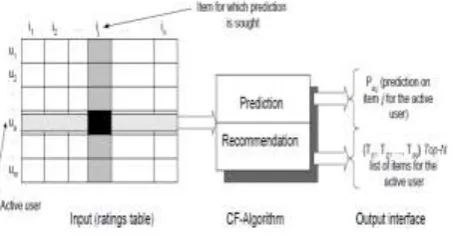
The task of item based collaborative filtering algorithm to find item likeliness is of two forms[6]:
2.4.1 Prediction
A numerical value, expressing the predicted likeliness of an item the user hasn’t expressed his/her opinion
about.
2.4.2 Recommendation
A list of N items the active user will like the most (Top-N recommendations).
The Fig 1 shows the item based collaborative filtering approach[5].
Fig 1 Item Based Collaborative Filtering approach
300 |
P a g e
The adjusted cosine similarity is given by :III. MODEL BUILDING
This iteration calculates the similarity score sim(ip,iq) for each set of objects ip and iq that have at least one
common rating by the same user. Where R and U are the number of ratings and users, List L ,only the most
similar items with the highest similarity score
3.1
The Pearson Correlation is Given by
where U is the set of all users who have rated both items i and j, ru,i is the rating of user u on item i, and ¯ri is
the average rating of the ith item across users. Figure below shows item based collaborative filtering model
generation.
Fig 2 Item Based Collaborative Filtering Model Generation
3.2 Hybrid Filtering
Hybrid filtering combines collaborative and content-based methods, which helps to avoid certain limitations of
content-based and collaborative systems [8].
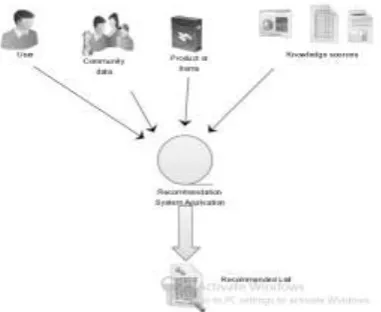
3.2.1 FBLARS System Architecture
301 |
P a g e
User in online purchasing purchases the item of his/her choice and rates the particular item. Using thecommunity opinion the new user will get recommendations through collaborative filtering.
IV. ALGORITHMS
4.1 Item Based Collaborative filtering
Item based collaborative filtering recommends items by considering the similarity between the co-rated items
through cosine similarity.
4.2 Maintenance Algorithm
As time goes by, new users, ratings, and items will be added to the system. This new data will both increase the
size of the collaborative filtering models maintained in the pyramid cells[9], as well as alter recommendations
produced from each cell. To account for these changes, FBLARS performs maintenance on a cell-by-cell basis.
4.3 Travel Penalty Algorithm for Spatial Items
Query processing for spatial items using the travel penalty technique[7] employs a single system-wide
item-based collaborative filtering model to generate the top-k recommendations by ranking each spatial item i for a
querying user u based on RecScore(u, i), computed as:
RecScore(u, i) = P(u, i) − TravelPenalty(u, i).
P(u, i) is the standard item-based CF predicted rating of item i for user u. TravelPenalty(u, i) is the road network
travel distance between u and i normalized to the same value range as the rating scale.
V. EXPERIMENTAL RESULTS
The paper is implemented in java. Item based Collaborative filtering as well as travel distance filtering
algorithm is been implemented to provide location based recommendations to the user . The present work takes
user id, user location ,product id, product location and the user rating for the product they have already
purchased. The system provides the recommended products to the querying user by considering item as well as
the user location. FBLARS first applies the item based collaborative filtering to find the similarity between the
co-rated items and then calculates the predicted rating using the similarity count to predict the rating of the
product that are not rated by the querying users.
5.1 Performance
FBLARS Provides increased performance compared to the conventional recommender system as it considers
location based ratings it avoids exhaustive access to all the items in the large search space. Hence increases the
performance to the greater extent.
5.2 Scalability
FBLARS is scalable compared to conventional recommender systems. The implementation of FBLARS with
travel distance filtering makes the system scalable without affecting the quality of location based
recommendation.
5.3 Quality Analysis
The recommendation quality increases to a greater extent as travel distance filtering is used along with the item
302 |
P a g e
VI. CONCLUSION
FBLARS is a location based recommender system which provides recommendations to the querying users by
considering both item as well as user location without sacrificing the quality of recommendation. It uses item
based collaborative filtering along with travel distance filtering which avoids exhaustive access to all spatial
items. FBLARS is more efficient and scalable compared to existing recommender systems and provides high
quality of recommendation.
REFERENCES
[1] Mahmood, T., Ricci, F.:” Improving recommender systems with adaptive conversational strategies. In: C”.
Cattuto, G. Ruffo, F. Menczer (eds.) Hypertext, pp. 73–82. ACM (2009).
[2] McSherry, F., Mironov, I.:” Differentially private recommender systems: building privacy into the net. In:
KDD 09”: Proceedings of the 15th ACM SIGKDD international conference on Knowledge discovery and
data mining, pp. 627–636. ACM, New York, NY, USA (2009)
[3] G. Adomavicius and A. Tuzhilin, “Toward the next generation of recommender systems: A survey of the
state-of-the-art and possible extensions,” IEEE Trans. Knowl. Data Eng., vol. 17, no. 6, pp. 734–749, Jun.
2005.
[4] Badrul Sarwar, George Karypis, Joseph Konstan, and John Riedl “Item Based Collaborative Filtering
Recommendation Algorithms”.
[5] Brees J S Heckerman C and Kiede C “Emperical Analysis of Predictive Algorithm for Collaborative
Filtering “.
[6] N. Belkin and B. Croft, “Information Filtering and Information Retrieval,” Comm. ACM, vol. 35, no. 12,
pp. 29-37, 1992.
[7] New York Times - A Peek into Netflix Queues [Online].Available:
http://www.nytimes.com/interactive/2010/01/10/nyregion/20100110-netflix-map.html.
[8] Daniar Asanov Berlin Institute of Technology Berlin, Germany “Algorithms and Methods in
Recommender Systems”.
[9] W. G. Aref and H. Samet, “Efficient processing of window queries in the pyramid data structure,” in Proc.
ACM Symp. PODS, New York, NY, USA, 1990.
[10] Chiu-Ching Tuan, Chi-Fu Hung, Tzu-Chieh Kuei Graduate Institute of Computer and communication
Engineering, National Taipei University of Technology, Taiwan “Location Dependent Collaborative