134 |
P a g e
A NOVEL APPROACH TO PAGE RANKING
MECHANISM BASED ON USER INTEREST
Ankur Mittal
1, Shilpa Sethi
21
PG Scholar,
2Assistant Professor,
Department of Computer Engineering,
YMCA University of Science & technology, Faridabad, Haryana, (India)
ABSTRACT
Information searching on the web is more popular than the traditional method but is not an easy task on the web
because the World Wide Web (WWW) is collection of huge no of document which available on internet. Thus a
tool is required called search engine which helps in find the required information for user. Search engines are
provide the list of document which sort according to page rank algorithm in which lots of not relevant to the
user’s information needs. Hense the personalized search is required a better page rank mechanism to provide
the more relevant document to user. In this paper we design a page ranking mechanism which based on the
various factor time-span, interest score, activity performed, and user interest score which helps in improve the
ranking.
Keywords: Information Retrievals, Search Engine, Interest Score, Personalized Model, User
Profile, Page Rank
I. INTRODUCTİON
In the area of internet technology development is very fast more no of person and information is added in the
every second that way World Wide Web (WWW) size in manner of collection of information is increasing
rapidly and a huge amount of information is stored on the internet but this growth of the web is create more
difficulties to retrieve the information which relevant to user’s needs. Here one more problem is present in the
previous search these are focused on the keyword of query given by the user not consider context of query. If
user searches the “Apple” it mostly provides document related to “Apple Fruit and other fruits” not mention the apple phone or “Apple Mac book” if user interested in electronics product.
The solution to this problem is personalized search which is recently more active research field. Web
personalized is requried a better page ranking mechanism to provided the more relevant information to the user
to satisfy user needs. Various page ranking mechanism are peresnt but they are used the link oriented
mechanism or content oriented mechanismof web mining. Here we proposed the page ranking mechanism
which based on link and usage mining by considering their previous browsing history, user interest and
preference etc. In case of our previous example searching for “Apple” and user previously browse the “Apple phone” related documents so our system based on our page ranking mechanism try to provide the phone related document not like the traditional page search engines provide most viewed document which not having
relevancy to user.
This paper is arranged as it follows. Section II provides the related work. Section III provides our proposed
135 |
P a g e
II. RELATED WORK
Many algorithm in the area of personalization have been developed in past which are based on the user interest
and user browsing history. In [1] Surgey Brin and Larry Page give the ranking algorithm named as Page Rank
(PR) which used by the search engine Google. Google used the Page rank algorithm to rank the web pages. Page
rank algorithm is classified in the web structure mining technique where algorithm is based on link structure of
web pages. Page rank algorithm tells that both incoming and outgoing link is important and in this algorithm
page rank is calculated by added all backlinks rank and final page rank score is calculated. In [6] Page Ranking
based on Link Visit (PRLV) user browsing information is additional used to the original Google Page rank
algorithm. PRLV is based on the web structure and web usage mining. Here user search behaviour is also
considered. In this algorithm outgoing links which is more visited having the more rank score then less visited
pages. User profiles can be created explicitly and implicitly. In [7] personalized search system is based on the
web usage mining and user profile is created explicitly. Here user profile is created using the user browsing
history and it attributes such as no of page visited, no of page clicked, time spent on web page and action
performed on page. Previous history is used to re–rank the search results and using these factor more users
relevant results are obtained. In [5] proposed the personalized search engine model that is based on the web
usage mining. Here user profile is created when user registers first time on the system. User is asked to enter
their interest area explicitly which keeps on adding their interest area depending on user browsing patterns.
Feature words are extracted from the web page visited by the users which are further used to create the short
term and long term user profile.
A critical on the available literature indicate the following short coming which needs to be address
Although [1] the no of outgoing and incoming links to the page indicates its importance within the web, but
it should not be considered as the only parameter to rank a page. The user browsing history may play a
major role in finding the page relevance.
Although the work in [7], considered the browsing patterns of the user while ranking the results but
incorporating the short term and long term interest can better determine the page relevance to user.
III. PROPOSED PAGE RANKING MECHANISM
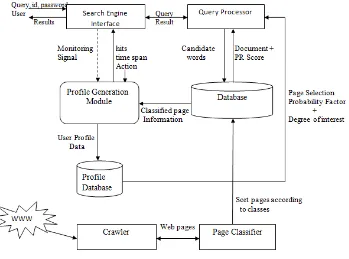
The proposed page ranking mechanism model as shown in the figure1. In the proposed model when the user
process the query from the search engine interface then a signal is send to the profile generation module to
monitoring the activity. In while query is send to the query processor and query processor retrieved the list of
document from the database related to query keywords and performing the ranking on the list and send to search
engine interface which display the result to user.
They are described as follows:
Search Engine Interface
Profile Generation Module
Query Processor
Database
136 |
P a g e
3.1 Search Engine Interface
The search engine interface is a web page which having the text box in which user enters the query and search
engine display the results. It registers the new user and authenticates the exiting user with user id and password.
Search engine interface send the query submitted by user to the query processor to find the appropriate results
related to query and pass signal “monitoring signal” to the user profile generation module. After getting the
sorted results from query processor, presents the result to the user.
3.2 Profile Generation Module
The user profile is created by the special module is called “Profile Generation module”. It creates the profile for
every user which registers on the system. When user enters the query at search engine it gets the signal from
search engine interface and become active. It monitors and save the information such as
Fig 2 Profile Information
It stores the user profile information in the separate profile database. Three different table are used to store user
information namely; Hits_info table, Time_span Table, user interest_class table
1) The Hits_info table store the page as the column and row as the different user and each entry is no of hits
made by user ui on the page pi as shown in table 1.
hits(pi ,ui) = no of hits on Page Pi by user ui
Action (pi ,ui) = action performed on page pi by user ui
ts(ui,pi) = time-span on page pi by user ui
137 |
P a g e
Table 1 Hits_info Table
2) The Time_span table store the pages as the column and row as the different user and each entry of table
contain time span on page pi by user ui as shown in table 2
Table 2 Time_Span Table
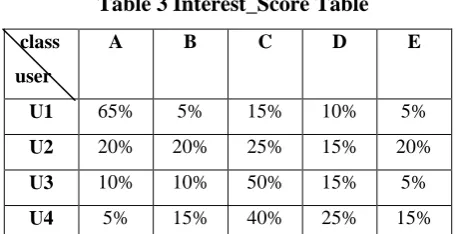
3) The interest score table store the class of page as column and row as different user and each entry is contain
the degree of user interest in the particular classes as shown in the table 3
Table 3 Interest_Score Table
class user
A B C D E
U1 65% 5% 15% 10% 5%
U2 20% 20% 25% 15% 20%
U3 10% 10% 50% 15% 5%
U4 5% 15% 40% 25% 15%
Example :- if user U1 is search about the India and it found in page P1 and P2. P1 in class A and P2 in class D
the P1 have 65% interest_score and P2 have 10% interest_score.
Interest Score is calculation of degree of interest of user in different classes. The interest score is calculated with
corresponding the classes of web page which define in database. User interest is can divided in short term and
long term interest. Due Short term interest change in degree of interest is minor and long term having major role
and it easily calculated. Calculation of interest score is shown in eq. 1
Interest score Is(ui,ci) = --- 1
Class C1 C2 Ck
Page
user
P1 P2 P3 ---- Pn P1 P2 P3 --- Pm P1 P2 P3 --- Pq
U1 10 15 6 - - 7 41 20 - - 2 14 25 - -
U2 3 7 11 - - 13 5 14 - - 41 17 2 - -
U3 4 22 2 - - 26 25 1 - - 47 5 4 - -
- - - -
Un - - - -
Class C1 C2 Ck
Page
user
P1 P2 P3 ---- Pn P1 P2 P3 --- Pm P1 P2 P3 --- Pq
U1 30 25 8 - - 11 16 18 - - 32 21 23 - -
U2 20 12 28 - - 10 25 11 - - 13 27 21 - -
U3 42 22 24 - - 14 35 10 - - 7 35 14 - -
- - - -
Un - - - -
P(ui, ci)
138 |
P a g e
Where :
Interest score (ui,ci) is interest of user ui in class ci
P(ui,pi) is total page browsed by the ui related to the web page class ci Pt is the total page browsed by the user ui
Here we also computed the Page Selection Probability Factor (PSPF). Which based on the user browsing pattern
and PSPF is further used by the query processor in calculating the final page rank. PSPF tells the user browsing
behaviour by which finding page relevance to user is may become more accurate. PSPF is computed by the hits,
time-span, and action factor as we consider personalizing.
PSPF(Pi)=hitswt(Pi)+tswt(Pi)+Actionwt(Pi) ---2
Where:
hitswt(Pi) is the ratio of number of HITs done by user ui on the page pi w.r.t. total no. Of HITs on all the
pages made by user ui
tswt(Pi) is ratio of time-span spent by the user ui on the web page w.r.t. highest time-span spent on any page. Actionwt(Pi) is activity performed by the user on web page like the print, saving, bookmark etc.
1) Hits weight is used in personalization because as many clicks or visits made by user means it more
interested in this web page. Hits weight is count the number of click or visit made by user u on page p. In
eq. 3 calculate the hits weight.
hitswt(Pi)= --- 3
Where:
hits(ui,pi) is number of hits on Page Pi by user ui
hits(ui,*) is total no of hits on all Pages of belongs to all classes by user ui
2) Time-span is a important factor in web personalization if any user spent more time on the web page it
means it more like the page content means more relevance to user. Time-span weight is calculated of page
pi shown in eq. 4
tswt(pi)= --- 4
Where:
ts(ui,pi) is time-span spent on page pi by user ui
Highest time-span spent is the time spent on any page by user ui
3) Action is mainly classify in four type [3] which are print, save, bookmark and send. These four action listed
in the below. We give the highest weight to print after that save, bookmark and last send. Action weight is
calculated by sum of all action weight given in eq. 5
Actionwt = --- 5
Where
Printwt= log{click(ui,pi)+1}*n*4 Savewt=log{click(ui,pi)+1}*n3 Bookmarkwt=log{ click(ui,pi)+1}*n*2
Printwt+Savewt+Bookmarkwt+Sendwt
ts (ui,pi)
hits(ui,pi)
hits(ui,*)
Highest time-span (ui,pi)
139 |
P a g e
Sendwt=log{ click(ui,pi)+1}*n*1
click(ui,pi) is no times page viewed by user u
n is no of time action performed
3.3 Query Processor
Query processor extract the candidate words form the query by apply stop word removal. After that query
processor executes query on the database and fetch the page based on the term relevance.
After that query processor calculate the term relevane_score of all in the list pages. Term _relevance is
calculated using the query candidate words and page keywords by checking the similarity between page and
query and which matching score is called term_relevance. This term relevance score is used in the eq 6 to
calculate final rank of all pages.
Query processor gets the PSPF and degree of interest from the profile database and applies the formula given in
eq-6 on the list of document fetched form the database. Finally shorted list of document is provides to search
engine interface. Formula of modified page rank:
PR(Pi) = Term Relevance_score+ Degree of Interest{interest score} +PSPF --- 6
3.4 Database
Database is collection of summary of list of documents and their URL of page. Database is having the various
attributes related to pages in the table as follows:
URL of pages
Class Ids
Keywords of page
Page Rank
3.5 Page Classifier
Page Classifier gets the keywords and summery of downloaded web page form the crawler and puts in the
repository called database. Page classifier is classifying the pages in the different classes by matching the
keyword of page to class. One page is may be belong to one or more classes.
Example: Page classifier classifying page in class like the:
Entertainment
Sports
Real Estates
Stock Market
Education and etc.
Here a page related to sports class may also belong to entertainment because sports are also entertainment.
Hence some pages are comes under the one or more class.
IV. CONCLUSION
In this paper we have presented a new page rank mechanism which based on the user browsing history and
degree of interest of user and a personalized search engine is build based on this new proposed page rank
140 |
P a g e
previous availabe page rank algoritm but its have some limitation it create some extra burden of dividing page in
classes but its not major. It give the better result to user and user needs of inormation is likely be more satisfy
then our previous page rank algorithm. Comparison in between the different page rank algorithm is given in the
below table 4
Model
Item PR[1] PRLV[2] PSE[3] Proposed
Page Rank Original Modified Modified Modified
User Profile Not created Not created Explicit Explicit
Search Engine Depended (Google) Google Google Own
Ranking Factor Ingoing and
Outgoing links Browsing patterns
Action, Click,
Time
Browsing history
attributes, degree of
interest
Limitation Not include user
browsing behaviour
Link visit is not
major factor some
other like action,
time not consider
Not consider
degree of interest
Extra effort to
divide page in
classes and its some
case not feasible
REFERENCES
[1] S. Brin and L. Page., “The Anatomy of a Large-Scale Hyper textual Web Search Engine”, Proceedings of
7th International World Wide Web Conference, pages 107–117, 1998
[2] Kazunari Sugiyama, Kenji Hatano, Masatoshi Yoshikawa, “Adaptive Web Search Based on User Profile
Constructed without Any Effort from Users”, Proceedings of the 13th international conference on World
Wide Web,2004
[3] Ivan Marecialis and Emanuela De vita, “SEARCHY: An agent to personalize search result”, Third
International Conference on Internet and Web Application and Services, 2008
[4] Hany M. Harb, Ahmed R. Khalifa, Hossam M. Ishkewy, “Personal Search Engine Based on User Interests
and Modified Page Rank”, International Conference on “Computer Engineering & Systems, (ICCES)” 2009 [5] Liu Zhongbao, “Research of a Personalized Search Engine Based on User Interest Mining”, International
Conference on “Intelligent Computing and Integrated Systems (ICISS)”, 2010
[6] Gyanendra Kumar, Neelam Duahn, and Sharma A. K., “Page Ranking Based on Number of Visits of Web
Pages”, International Conference on Computer & Communication Technology (ICCCT)-2011,
978-1-4577-1385-9.
[7] Shilpa Sethi, Ashutosh Dixit, “Design of Personalised Search System Based on User Interest and Query