O R I G I N A L R E S E A R C H
Evaluating a Novel Multifactorial Falls Prevention
Activity Programme for Community-Dwelling
Older People After Stroke: A Mixed-Method
Feasibility Study
This article was published in the following Dove Press journal: Clinical Interventions in Aging
Jun Sheng Gary Koh 1
Anne-Marie Hill 1
Keith D Hill 1,2
Christopher
Etherton-Beer 3
Jacqueline Francis-Coad 1
Elizabeth Bell 1
Liz Bainbridge 1
Lex D de Jong 1
1School of Physiotherapy and Exercise
Science, Faculty of Health Sciences, Curtin University, Bentley, Perth, WA
6102, Australia;2Rehabilitation, Ageing
and Independent Living Research Centre, Monash University, Melbourne, Victoria,
Australia;3WA Centre for Health and
Ageing, Royal Perth Hospital Unit, School of Medicine and Pharmacology and Centre for Medical Research, University of Western Australia, Perth, Western Australia, Australia
Purpose: The overall purpose of this study was to explore participants’and physiotherapists’ experiences regarding the acceptability, implementation, and practicality of a novel group-based multifactorial falls prevention activity programme for community-dwelling older people after
stroke. Specifically, the purpose was to explore if and how participating could impact on the
participants’ health-related quality of life (HRQoL) in terms of their daily lived experience
regarding physical, mental, emotional and social well-being. A secondary purpose was to explore
whether participating in the programme could positively influence participants’ balance,
strength, falls efficacy, mobility and motor impairment of the trunk.
Materials and Methods: This was an exploratory mixed-method Phase I feasibility study.
A convenience sample offive older community-dwelling people after stroke participated in
a novel eight-week multifactorial activity programme which included falls education, a mix of individually tailored and group-based strength and balance exercises, exploring limits of stability and safe landing techniques and a social element. Qualitative data from post-intervention inter-view transcripts with the participants and the physiotherapists who delivered the programme were thematically analysed using both deductive and inductive approaches to explore the
participants’and therapists’experiences with the programme. Quantitative outcomes included
balance, strength, falls efficacy, mobility and motor impairment of the trunk.
Results: The programme was deemed feasible in terms of acceptability, implementation and practicality by the participants as well as the physiotherapists delivering the programme. The
overarching theme regarding HRQoL identified that participating in the programme was
per-ceived to empower the participants living with stroke and positively influenced their daily
physical, mental, emotional and social well-being. Participant outcomes showed a change in the direction of improvements in balance, strength, mobility, motor impairment of the trunk and reduced concerns about falling. Subjectively, participants only reported perceived improvements in balance and strength.
Conclusion:Running a novel multifactorial falls prevention activity programme for older community-dwelling people after stroke was feasible. Participating in the programme helped participants to perceive improved balance, strength and empower them to make meaningful changes, improving their daily lived experiences. A future fully powered study could build on these results to investigate physical improvements, prevention of falls and improvements to domains of HRQoOL.
Keywords:accidental falls, aged, exercise, evaluation studies as topic, stroke, qualitative research, quality of life
Correspondence: Lex D de Jong School of Physiotherapy and Exercise Science, Faculty of Health Sciences, Curtin University, Bentley, Perth, WA 6102, Australia
Email [email protected]
Clinical Interventions in Aging
Dove
press
open access to scientific and medical research
Open Access Full Text Article
Clinical Interventions in Aging downloaded from https://www.dovepress.com/ by 118.70.13.36 on 27-Aug-2020
Introduction
Annually, 15 million people worldwide suffer a stroke1
and approximately 80 million people were living with
stroke in 2016 alone.2 Between 50% and 70% of stroke
survivors experience residual deficits such as muscle
weakness, sensory loss, and abnormalities of vision and
spatial awareness.3These falls-risk increasing impairments
in body functions pose a significant challenge to
maintain-ing balance and can impact on recovermaintain-ing meanmaintain-ingful functional activities such as gait and activities of daily life (ADL). Physical impairments can also negatively
influence mental and psychosocial well-being, resulting
in post-stroke depression,4and an overall reduced
health-related quality of life (HRQoL).5
People after stroke have a high risk of falling, with incidence rates reported to be as high as 45% to 73% in the chronic phase post-stroke.6,7Due to ageing of the population and improvements in post-stroke life expectancy, the societal
impact of falls after stroke is growing3for both people after
stroke and their carers.8Falls may lead to physical harm such
as hip fractures,9 an increased fear of falling10,11 and
a subsequent decline in physical function and autonomy.12
This cascade of problems can hamper reintegration into
society13 and reduce social participation14 and quality of
life (QoL).15
Exercise is a well-established evidence-based approach
to falls prevention in community-dwelling older people16and
to improving balance capacity in people after stroke.17
Multifactorial approaches can also reduce the rate of falls18
in the general older population, but these are underexplored
in patients after stroke.19 Examples of effective exercise
interventions targeting strength and dynamic balance used within falls prevention services include the group-based Falls
Management Exercise (FaME)20,21 programme and the
Otago22 home exercise programme. A recent systematic
review and meta-analysis has further provided evidence
that gamified exercises ('Exergames') can improve balance
and falls risk factors after stroke.23 Although it has been
established that regular participation in physical activities and exercise is integral to reduce the risk of falls,24,25other
key elements such as falls prevention education,26and home
falls hazard evaluations and modifications27may be no less
important. Incorporating safe landing/falling techniques in falls prevention programmes as a means to teach individuals how to fall in such a manner to reduce injury may also help to reduce fear of falling and how seriously and frequently older
people or people after stroke injure themselves from a fall.28
Research into the use of such safe landing/falls technique strategies by older adults is scarce.29,30 People after stroke also value the inclusion of a social element to programmes they participate in.31,32Research into the use of these differ-ent strategies is warranted to verify the effectiveness and
suitability for at-risk populations.28 Apart from the effects
on physical and functional impairments resulting from parti-cipating in stroke-specific multifactorial falls prevention pro-grammes, the effects on mental, emotional and social
domains of well-being in stroke survivors remain unclear.33
The scant literature available has suggested that
a community-based programme for stroke survivors includ-ing exercise, education and peer support could help partici-pants to reconstruct their lives, for example in terms of
increased physical and social confidence, thereby improving
participation in their social world.34 This has led to the
recommendation to include interventions addressing
domains beyond physical impairments during stroke rehabi-litation to optimise outcomes.14,34
Because people with residual impairments following
a stroke are considered at increased risk of a fall,35more
and broader falls prevention research in this population is
recommended.19,36To this end, we developed a novel falls
prevention activity programme that aimed to increase the
participants’ falls prevention knowledge, improve their
balance and strength, evaluate their home falls hazards, and gain skills in how to land safely in case of a fall, move
on thefloor and get up again. The idea was to deliver the
programme in a way that provided participants the oppor-tunity to train and socially interact with support from
a small group of peers. As a first step in identifying if
this programme could work37,38and to gather information
to inform the design of a definitive study of its
effective-ness, we set out to investigate its feasibility in a small group of community-dwelling older people after stroke. Adhering to guidelines for the design of feasibility
studies,39 the primary aim of this study was to explore
the participants’and physiotherapists’experiences
regard-ing the acceptability, implementation, and practicality of the programme. The secondary aim was to test
limited-efficacy by exploring how participating impacted on the
participants’ health-related quality of life (HRQoL) in
terms of their daily lived experience regarding physical, mental, emotional and social well-being. A secondary pur-pose was to explore whether participating in the
pro-gramme could positively influence participants’ balance,
strength, falls efficacy, mobility and motor impairment of
the trunk.
Clinical Interventions in Aging downloaded from https://www.dovepress.com/ by 118.70.13.36 on 27-Aug-2020
Materials and Methods
Design
This was an exploratory mixed-method Phase I feasibility study with a pre-post design.
Ethical and Organizational Review
The study was approved by Curtin University’s Human
Research Ethics Office (approval number HRE2018-0104).
The trial was registered on March 19, 2018 (NCT03484351; https://clinicaltrials.gov/ct2/show/NCT03484351). Participant recruitment commenced on April 9, 2018. The last
partici-pant’s follow-up assessment was on October 2, 2018.
Participants
A convenience sample of community-dwelling adults over the age of 50 and more than 6 months post-stroke from one urban area in Western Australia were invited to participate
in the study. They were identified by physiotherapists (PTs)
from the researchers’networks. Participants were eligible if
they were living in the community, had good cognition
(Mini Mental State Examination ≥ 25 points) and were
able to walk at least three times weekly outside their home without hands-on supervision (with or without the use of
a walking aid; Functional Ambulation Classification40,41
category≥4). Participants with medical issues preventing
them from participating in moderate to vigorous exercises, receptive aphasia impacting on the ability to follow instruc-tions and who were unable to provide informed consent were excluded from participation. Written informed con-sent was obtained from all participants.
Intervention
The intervention (dubbed the Fall Monty Activity Programme) is a novel therapist-led group-based exercise and multifactorial falls prevention activity programme. For the purpose of this feasibility study, the programme was designed for older people after stroke to help prevent falls and aid in functional recovery by addressing limitations in strength and balance whilst also increasing social interac-tion and offering a platform to share thoughts about aspects contributing to their HRQoL. Twelve programme sessions were offered over an eight-week period. Each session com-prised a recurring mix of established evidence-based
activ-ities and exercises as well as some new approaches.42
Details of the different activities and exercises are presented in Appendix 1. Each session was approximately 90–100 mins in duration, thus with full adherence the intervention
comprised up to 18–20 hrs of exercise and education/
knowledge sharing. The sessions were organised in a room of approximately 6 by 12 m containing basic equip-ment such as foldable tables, chairs and a projector screen. Prior to each session exercise equipment was brought into the room such as crash mats, balance boards, exercise balls, Exergames hardware (laptop and motion tracking sensor), resistance bands and small exercise steps. The venue, which was located in a health and wellness centre of a university, was chosen for ease of public transport, parking and physi-cal access. All programme sessions were delivered by two
female qualified PTs who had three and over 20 years of
experience with the treatment of people after stroke,
respec-tively. They delivered the programme to a group of five
participants. In order to also be able to supervise and guide some of the more challenging exercises on a one-to-one basis, this was considered the maximum group size. Where necessary, exercises and activities were tailored to, and performed at the discretion of, individual participants. A folder was issued to each participant to collect their
educational information- and home exercise leaflets which
were handed out in a staggered way after each session. Participants were asked to perform the selected home
exer-cises for at least 10–20 mins on three weekdays for the
duration of the programme. Participants self-reported details of the frequency and type of fall incidents during the programme period using a diary purposely designed for this study.
Primary Outcomes
A researcher who was experienced in qualitative research (LDdJ) and a physiotherapy student (JSGK) attended each
programme session to take unstructured field notes using
a reflective journal. They noted descriptions of participants’ interactions, made general observations, and potential biases
were noted to enhance trustworthiness, reflexivity and
increase confirmability of the findings.43 They also
con-ducted and noted informal conversations with participants during the classes to understand their experiences. Together they interviewed all participants individually about their experiences with the programme within 1 week after the
final programme session. A semi-structured interview topic
guide consisting of open-ended questions was created. For the participants, the questions were structured around four of
eight recommended areas of focus for feasibility studies,39ie
acceptability, implementation, practicality and the intended effects (“limited efficacy”) of the programme. Additionally, questions were structured around the domains of HRQoL
Clinical Interventions in Aging downloaded from https://www.dovepress.com/ by 118.70.13.36 on 27-Aug-2020
(physical, mental, emotional and social well-being) as it was
felt that there was limited knowledge about how
a multifactorial falls prevention program could impact the daily lived experiences of stroke survivors. A broad frame-work was used to conceptualise how participants would react to participating in the novel programme. The two PTs who delivered the programme were also interviewed individually
(by one researcher, LDdJ) within 1 week of the final
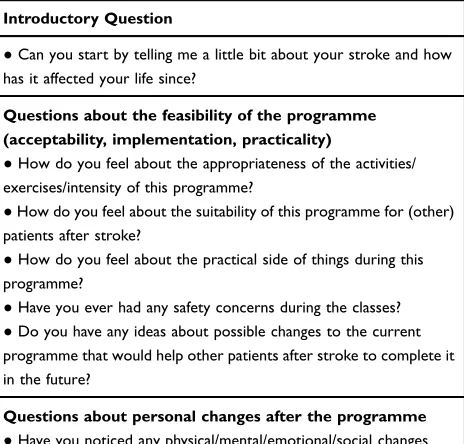
pro-gramme session. Their interviews mainly focussed on the feasibility topics. The interview topics are presented in Table 1. All interviews were recorded, fully transcribed
verbatim and anonymised by an external vendor.43
Transcripts were not returned to participants nor physiothera-pists for comments or corrections.
Secondary Outcomes
All secondary (quantitative) outcomes were administered 1
week prior to the start of, and within 1 week after, thefinal
programme session. Outcomes included validated and
reli-able falls research questionnaires Short Falls-Efficacy
Scale-International (FES-I),44 European Quality of Life
5 Dimensions Health Questionnaire (EQ-5D-5L)45 and
Stroke Impact Scale 3.0 (SIS).46,47Three psychometrically
strong balance and mobility tests administered were the
Berg Balance Test (BBS),48 the 4-Square Step Test
(FSST)49 and the 5-Times Sit-to-Stand Test (FTSTS).50,51
Specifically for this study, the stroke-specific Trunk
Impairment Scale (TIS)52was used to measure the motor
impairment of the trunk through the evaluation of static and dynamic sitting balance as well as coordination of trunk movement. Two experienced physiotherapy lecturers (EB, LB) who were not involved in the programme sessions each performed half of all ten assessments in a random order.
Data Analysis
Primary Outcomes
Thematic analysis was used to analyse the interview
tran-scripts and field notes.53 Data analysis employed both
deductive and inductive approaches.43 Two researchers
(JSGK, LDdJ) read through the anonymised interview
tran-scripts andfield notes independently several times to
famil-iarise themselves with the data. Using Microsoft Word (Microsoft, 2016) the researchers independently organised
preliminary codes identified using a deductive approach
relevant to the participants’ and the PTs’ perspectives
about the acceptability, implementation and practicality of the programme and the impact of participating in the
pro-gramme on the participants’ HRQoL-domains.43,54
Regarding the latter, an inductive approach was used to explore unanticipated codes and to identify deeper
meanings.55 Codes were subsequently developed into
more abstract and comprehensive units of understanding
in the forms of subthemes, and initial candidate themes.55
Cross-examination between the researchers then com-menced to achieve consensus around the subthemes and
candidate themes.55 Together with a third researcher
(AMH), the candidate themes and overall data set were cross-examined until consensus was reached. This aimed to ensure an accurate representation of the data collected.
Agreement on thefinal subthemes and themes was sought
from all authors. Representative verbatim quotations were selected to exemplify the formation of subthemes and
themes56 and labelled to indicate the participants’ gender
(M, F) and age or to indicate the quoted PTs (PT1, PT2). Final themes emerging from the interviews with the parti-cipants about their physical, mental, emotional and social well-being after participating in the programme were orga-nised in a thematic map. This map illustrated the relation-ship between codes and themes, and was reviewed and refined such that they were all clearly reflected.55Finally, a deductive approach was used to relate the overarching theme to the research question. This aimed to ensure that
findings accurately reflected participants’ perspectives
Table 1Participant and Physiotherapist Interview Topics
Introductory Question
●Can you start by telling me a little bit about your stroke and how
has it affected your life since?
Questions about the feasibility of the programme (acceptability, implementation, practicality)
●How do you feel about the appropriateness of the activities/
exercises/intensity of this programme?
●How do you feel about the suitability of this programme for (other)
patients after stroke?
●How do you feel about the practical side of things during this
programme?
●Have you ever had any safety concerns during the classes?
●Do you have any ideas about possible changes to the current
programme that would help other patients after stroke to complete it in the future?
Questions about personal changes after the programme
●Have you noticed any physical/mental/emotional/social changes
since participating in the programme?
●Have you noticed any changes in your independence/activities of
daily living since participating in the programme?
●Do you have any further suggestions?
Clinical Interventions in Aging downloaded from https://www.dovepress.com/ by 118.70.13.36 on 27-Aug-2020
regarding how participating impacted on the participants’ health-related quality of life (HRQoL) in terms of their daily lived experience regarding physical, mental, emotional and social well-being.
Secondary Outcomes
Participant characteristics, including data on falls, slips and trips during the study period, were presented descriptively. Given the feasibility nature of the study, significance testing of the quantitative data collected (questionnaires, functional
tests) was not performed57,58 and data were presented
descriptively. These included median (interquartile ranges) SIS 3.0 domain scores, EQ-5D-5L (UK value set) index values, BBS, FES-I and TIS sum scores, as well as mean (standard deviations) times taken to perform the FTSTS, FSST and distances on the visual analogue scale (item 9 of the SIS).
Assessment of the Feasibility to Progress to a Full Trial
The a priori agreed progression criteria to judge the feasi-bility of a full trial were i)≥70% of the participants complet-ing at least 9 of the 12 group sessions and ii) <10% of serious adverse events deemed due to the intervention.
Results
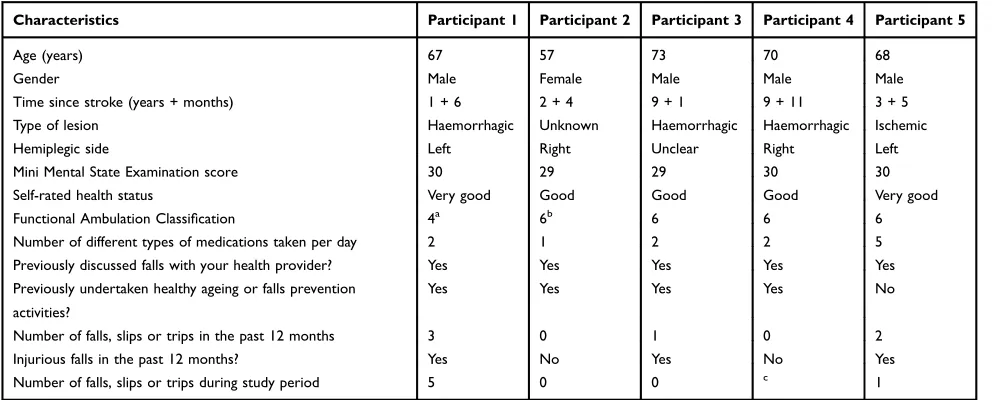
Participant characteristics are presented in Table 2. Four
participants (80%) attended all 12 programme sessions and one attended eight sessions. The two participants with the
lowest BBS scores were the ones reporting one and five
falls during the study period, respectively. None of these falls were injurious and most happened while the partici-pants were dressing or moving in the dark. One participant fell during one of the exercises during one of the pro-gramme sessions but was also unharmed. No serious adverse events were reported.
An overview of the themes, subthemes and additional exemplary quotes emerging from the interviews with the
five participants and the two PTs who delivered the
pro-gramme about the acceptability, implementation and
prac-ticality of the programme are provided inSupplementary
Data File 1 that can be found here: https://doi.org/10. 25917/5e79caa8ead95
Acceptability of the Programme
The theme of acceptability captured the participants’ and
PTs’views about the novel programme in terms of
appro-priateness, satisfaction and safety. Overall, the participants
strongly concurred that they enjoyed, and were satisfied with,
the program for reasons of the fun, the camaraderie that developed and the friendly atmosphere during the sessions:
[. . .] everything I did I found it an adventure and it was fun. [. . .] A hell of a camaraderie develops amongst the team of people that you had out here, and I must say that that actually is like playing in a sports team. M (68)
The PTs enjoyed being able to help the participants
achieve their goals and watch them improve their confi
-dence and some of their functional capabilities:
Table 2Characteristics of the Five Participating People After Stroke
Characteristics Participant 1 Participant 2 Participant 3 Participant 4 Participant 5
Age (years) 67 57 73 70 68
Gender Male Female Male Male Male
Time since stroke (years + months) 1 + 6 2 + 4 9 + 1 9 + 11 3 + 5
Type of lesion Haemorrhagic Unknown Haemorrhagic Haemorrhagic Ischemic
Hemiplegic side Left Right Unclear Right Left
Mini Mental State Examination score 30 29 29 30 30
Self-rated health status Very good Good Good Good Very good
Functional Ambulation Classification 4a 6b 6 6 6
Number of different types of medications taken per day 2 1 2 2 5
Previously discussed falls with your health provider? Yes Yes Yes Yes Yes
Previously undertaken healthy ageing or falls prevention
activities?
Yes Yes Yes Yes No
Number of falls, slips or trips in the past 12 months 3 0 1 0 2
Injurious falls in the past 12 months? Yes No Yes No Yes
Number of falls, slips or trips during study period 5 0 0 c 1
Notes:a
4 = independent ambulator.b
6 = ambulator, but dependent for supervision.c
Data missing.
Clinical Interventions in Aging downloaded from https://www.dovepress.com/ by 118.70.13.36 on 27-Aug-2020
I really enjoyed watching their confidence improve and their functional capabilities improve as well over the 12 sessions, I really enjoyed it. Also [. . .] having that amount of time to spend with a client as well is really nice. So you get to know them and what they, what their goals are and being able to help them kind of navigate towards achiev-ing some of those goals which I really enjoy doachiev-ing. [. . .] So it touched on a lot of different areas to do with falls prevention. I think the participants got a lot out of it as well. I thought it was great. PT2
The participants felt that most of the different programme activities and exercises were appropriate for them and suitable for people after stroke:
To me that [education] set the scene. It was like theory in practice, yeah. No, I think that was brilliant, I loved that. M (73)
[The T’ai-Chi movements] were very easy, good
move-ments and I must say I found thatflow of movement was
actually very nice. M (68)
I think those [Exer]games are very good because what happens is that it gets me to do the stuff extensively and I think it actually creates more of a connection between my vision and my muscles which I think is very important. M (68)
[The falling techniques were] good fun [. . .] because
I found it really interesting because that’s the way I used
to be. I used to throw myself around, like fall over and muck around and that was good because it was more me. [. . .] Very normal to fall over and fall over and make a fool of yourself and get up. M (70)
One PT specifically noticed how the participants enjoyed
the T’ai-Chi exercises and also acknowledged the
appro-priateness of teaching the participants how to get on and off thefloor:
I think it’s very appropriate and I think that’s one of the
big things after having a stroke, is confidence. Getting on
and off thefloor and confidence surrounding falls and fear
of falling and all that kind of thing. So I think it’s very
appropriate to target that towards stroke patients. PT2
Both participants and PTs reported some recommendations
for improvement. These broadly related to thefine-tuning
of the organisation, arranging a follow-up programme, but
most notably to specific exercises:
When we combine the cognitive games with the exercise
at the same time, then it’s going to be difficult. I think I’d
need to go back and have it simplified. [. . .] I’d say in the
early stages [the cognitive Exergames are] definitely not
[appropriate] Because [the exercise alone is] hard enough. M (73)
I think that they really enjoyed the T’ai-Chi though in the
last few sessions, that might be interesting to incorporate that a little bit earlier on. PT2
With each session it becomes more clear that the falls technique training is not suitable for everybody. For exam-ple, [M (73)] has back complaints and he wears a corset which impedes him in his movement. [F (57)] is really afraid of falling and does not want to fall on the mat even from a very low height. In her case maybe a very slow progression could work. Field note, session 9.
None of the participants or PTs expressed any concerns for safety during the different activities and exercises.
Implementation of the Programme
The theme of implementation mainly captured positive opinions about how the new programme was delivered to the current group of people after stroke. It was mainly the PTs that offered their views for this theme. They felt positive about having been able to offer proper education, individual guidance and to tailor activities and exercises to individual participants despite it being offered in a group situation and despite some initial doubts about safety:
I do have to admit that in the beginning I was a bit nervous about even practicing any kind of falls techniques, thinking I was going to end up with an [injured participant]. PT1
Participants and PTs also reflected on resources that could
be implemented if the programme was offered again in the future:
You have a very small number, onlyfive people and you
had two physios which you probably wouldn’t get in
a more practical situation, you wouldn’t have that much
staff available or prepared to release that staff, with an activity like that you might have one physio, one person with a screen and that would be about it, or an assistant or something. M (67)
The more external equipment you bring in makes it diffi
-cult to adapt for them to do at home. So yes, [...] part of
what we were doing was therapy while we’re here, but
part of it was to do it at home. So you need to be able to be doing things in here that you can do at home rather than
a lot of fancy different other things. So it’s thatfine line of
what you’re wanting to achieve. PT1
Clinical Interventions in Aging downloaded from https://www.dovepress.com/ by 118.70.13.36 on 27-Aug-2020
I think the environment, perhaps, wasn’t quite appropriate
for practising [falling techniques] in that we didn’t have
nice crash mats that we could use. PT2
Both PTs and participants felt the venue and group space used during this study were suitable.
Practicality of the Programme
The theme of practicality captured some of the
partici-pant’s and PTs’ opinions about whether the programme
could be carried out as delivered in the current form.
Specific comments from two participants suggested that
especially the Exergames were challenging to perform. Overall, the participants and PTs felt that the group size was appropriate and all participants were well able to follow the programme:
Nobody came in and said: “that was too easy”. Nobody
said:“I don’t want to do as much”. Sometimes you had to
tell them to stop. I don’t think anybody was held back at
all. PT1
In
fl
uence on the Participants
’
Daily Lived
Experience
The overarching theme identified was that participants
felt empowered by participating in the programme. An overview of the themes, subthemes and additional
exemp-lary quotes emerging from the interviews with the five
participants about their physical, mental, emotional and social well-being after participating in the programme is
provided inSupplementary Data File 2(https://doi.org/10.
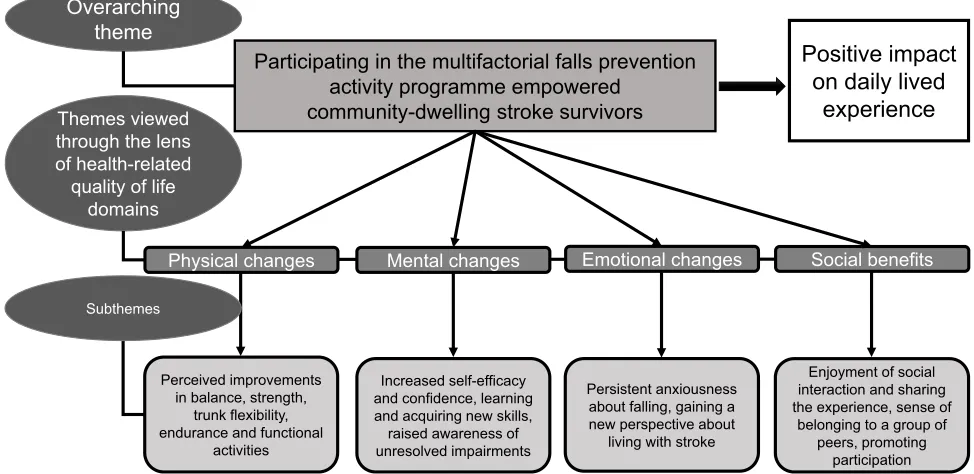
25917/5e79caa8ead95). The final conceptual framework relating to the HRQoL domains of physical, mental,
emo-tional and social well-being (Figure 1) assisted to explain
how participating in the programme changed the
partici-pants’daily lived experience.
Physical Changes
The participants’perceptions about physical changes were
mixed. Two participants did not notice any physical improvements or improvements in their balance. Other participants perceived increases in strength, better balance, increased endurance or more normal gait after completing the program:
No [I haven’t noticed any physical changes in my body
since starting the program]. M (73)
Standing up from a low seated position, that improved immensely. That improved 100% if not more. M (68)
I can turn around a bit quicker and can maintain my balance in different environments in different parts of the
house. [. . .] I don’t think [participating in the programme]
had any effect on the limitations of the stroke, but it has allowed me to get my balance better, I personally think that. M (67)
Themes viewed through the lens of health-related quality of life
domains
Participating in the multifactorial falls prevention activity programme empowered
community-dwelling stroke survivors
Positive impact
on daily lived
experience
Overarching theme
Physical changes Mental changes Emotional changes Social benefits
Perceived improvements in balance, strength,
trunk flexibility, endurance and functional
activities
Enjoyment of social interaction and sharing the experience, sense of
belonging to a group of peers, promoting
participation Persistent anxiousness
about falling, gaining a new perspective about
living with stroke Subthemes
Increased self-efficacy and confidence, learning and acquiring new skills, raised awareness of unresolved impairments
Figure 1Thefinal conceptual framework relating to the health-related quality of life (HRQoL) domains.
Clinical Interventions in Aging downloaded from https://www.dovepress.com/ by 118.70.13.36 on 27-Aug-2020
Two participants perceived that participating in the pro-gramme increased their independence in some functional activities of daily life:
I always try to be as independent as possible to remove as much burden of stress on my wife, [. . .] The two things I do is I make my bed and clean my shoes myself. [. . .] It
must have been since the program that I’ve started to do
that. M (68)
Observations from the researchers supported these
perceptions:
Participants were initially more willing to accept help from the research team when packing up at the end of classes but were observed to refuse similar help towards the end. Field note, session 10.
Mental Changes
Participants reported a range of mental changes, which
suggested positive changes in self-efficacy and confidence:
I pushed my limitations a little bit more so than in the past. M (67)
[. . .] the more you do [the exercise], the more confident
you get, and that confidence gives you an amazing feeling
inside. M (68)
Additionally, some individual comments suggested that participants learned new skills or were made aware they had unresolved impairments in muscle functions. The lat-ter empowered them to work towards their recovery
beyond the confines of participation in the programme:
I’m trying to ask [the PTs] whether there was any of them
could help me in the future because [. . .] I’ve recovered to
almost look like I never had a stroke, but in fact, really,
deep down I know I’ve got some issues with some of the
muscles, muscle ability and that sort of thing. That’s what
had me. M (70)
I would continue doing all the stuff at home, you don’t
have to be in a class to do all of that but I continue doing
that at home and I will be continuing. I haven’t stopped
the program, I haven’t stopped doing what these activities
suggest, I’ve still kept up to yesterday, so I’ll continue
with it, yeah. M (67)
Emotional Changes
Despite several positive mental changes, several partici-pants remained anxious about falling:
I’m up in the sky here somewhere and if I lose my
balance, I’m dead . . . [. . .] I can’t get that out of my
brain. M (73)
On a more positive note, participating in the programme led some participants to gain a new perspective about living with stroke:
I also gained from the point of view that you’re all the
time comparing how am I going compared to some others.
Ifigured out some people are worse than me, and I thought
I was suffering pretty poorly from the stroke. M (67)
Social Bene
fi
ts
Participants strongly concurred having enjoyed and valued the social element and interaction of the programme. One
of the reported benefits was that participating in the
pro-gramme instilled a sense of belonging to a group of peers,
which offered an opportunity to share common
experiences:
[. . .] chatting to the other guys and them telling me their stories was very, very nice to hear because then I relate,
and I say oh you know something, that’s what I had, and
then the way a particular person got around that and how they would do it, that was very interesting. All those little tricks and tips is very, very important that everybody interacts and tells their story. That was very nice. M (68)
This participant also reflected on his interactions with
healthcare professionals and carers during his own rehabilitation:
The thing that was missing, if I think about it now [. . .] was the social interaction. M (70).
Another participant felt the experience promoted his daily social interactions.
I think yes [participating in all these little gatherings that we have at the end of every session spurred me on to do more social activities outside of the program] because it shows that social activities are still very much a part of your life and [. . .] I try [. . .] going out to have coffee
because Ifind that just interaction with that and something
to look forward to doing. It stimulates your life and makes
it worth living, so these little sessions show that there’s
still interaction between the people and everybody’s got
problems. It’s not only your problems, so it’s very good to
have those sessions. M (68)
Clinical Interventions in Aging downloaded from https://www.dovepress.com/ by 118.70.13.36 on 27-Aug-2020
Secondary Outcomes
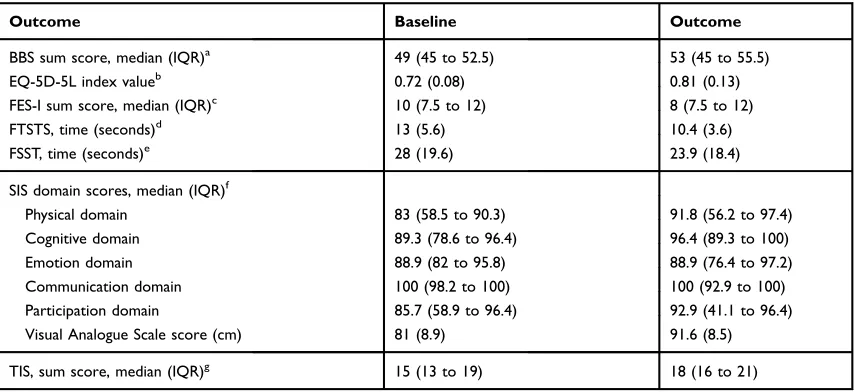
Participants’ quantitative data at baseline and after
parti-cipating in the programme are presented in Table 3.
Overall, participants improved their balance, mobility, motor impairment of the trunk, strength and expressed less concerns over falling. The SIS domains of emotion and communication remained unchanged.
Discussion
The Fall Monty Activity Programme is a novel falls pre-vention activity programme designed to aid older people after stroke in functional recovery and reducing falls. In order to determine whether this programme could work, we set out to explore its feasibility in a small sample of community-dwelling older people in the chronic phase after stroke and with the two physiotherapists delivering the programme. The results of this study suggest that running the programme was feasible. In addition to the programme being feasible to run we noted that participants experienced positive changes in mental, emotional and social well-being and perceived improvements in their physical outcomes such as balance and strength. As such
it may be appropriate to investigate the programme’s effi
-cacy and effectiveness in a randomised trial.
In the past decade, several multifactorial falls preven-tion programmes for older community-dwelling older peo-ple have been developed and evaluated. Only a limited number of studies have focussed on people after
stroke.19,36 Unfortunately, most older people do not use
falls prevention resources even when they are aware of
them,59 for example because falls prevention is not
per-ceived as being personally relevant to them.60 Therefore,
this programme was intentionally framed as offering the participants a platform to learn how to prevent falls and giving them an opportunity to practice activities (rather than just offering exercises) that generally matter to people
after stroke.61 In addition, a limited size group-based
approach was chosen to offer the participants a safe envir-onment to socialise and share thoughts and experiences with peers, and practice the different activities and exer-cises with one-to-one guidance if needed.
The quantitative results of this study suggest that
par-ticipating in the programme may have positively infl
u-enced some of the participants’ stroke-related
impairments in body functions such as strength, balance and mobility. Participants made several comments sup-porting these results, especially relating to increased leg strength. These results contrasted the effects of another
Table 3Participants’Quantitative (Physical) Outcomes at Baseline and After Participating in the 8-Week Activity Programme
Outcome Baseline Outcome
BBS sum score, median (IQR)a 49 (45 to 52.5) 53 (45 to 55.5)
EQ-5D-5L index valueb 0.72 (0.08) 0.81 (0.13)
FES-I sum score, median (IQR)c 10 (7.5 to 12) 8 (7.5 to 12)
FTSTS, time (seconds)d 13 (5.6) 10.4 (3.6)
FSST, time (seconds)e 28 (19.6) 23.9 (18.4)
SIS domain scores, median (IQR)f
Physical domain 83 (58.5 to 90.3) 91.8 (56.2 to 97.4)
Cognitive domain 89.3 (78.6 to 96.4) 96.4 (89.3 to 100)
Emotion domain 88.9 (82 to 95.8) 88.9 (76.4 to 97.2)
Communication domain 100 (98.2 to 100) 100 (92.9 to 100)
Participation domain 85.7 (58.9 to 96.4) 92.9 (41.1 to 96.4)
Visual Analogue Scale score (cm) 81 (8.9) 91.6 (8.5)
TIS, sum score, median (IQR)g 15 (13 to 19) 18 (16 to 21)
Notes:a
Scores range from 0 to 56 where a higher score indicates better static and dynamic balance.b
The index value ranges between 0 and 1 where a score closer to 1 indicates a better health state.cScores range from 7 to 28 where a higher score indicates more concern over falling.dA shorter time indicates better functional mobility and strength.e
A shorter time indicates better balance.f
The domain scores range from 0 to 100 and are calculated using the equation ((mean item score–1)/4)*100. Higher item scores indicate a lower level of difficulty experienced with the task. The physical domain comprises the original SIS domains of strength, hand function, ADL/IADL and mobility. The latter are aggregated into a composite because they are highly correlated. The majority of domain scores were not normally distributed. To facilitate comparisons the medians (interquartile ranges) were calculated for all domains.g
Scores range from 0 to 23 where a higher score indicates better static and dynamic sitting balance and coordination of trunk movement. All data are means (standard deviation) unless stated otherwise.
Abbreviations:BBS, Berg Balance Scale; EQ-5D-5L, European Quality of Life 5 Dimensions Health Questionnaire; FES, Falls Efficacy Scale-International; FTSTS, Five Times Sit-to-Stand Test; FFST, Four Square Step Test; SIS, Stroke Impact Scale 3.0; TIS, Trunk Impairment Scale.
Clinical Interventions in Aging downloaded from https://www.dovepress.com/ by 118.70.13.36 on 27-Aug-2020
multifactorial falls prevention program delivered to com-munity-dwelling stroke survivors, which reported minimal
effect in improving physical function nor falls-related effi
-cacy as compared to usual physiotherapy care.62In light of
our small sample of participants and the results of a recent
systematic review,36which found low to very low-quality
evidence that exercises as part of a multi-component
inter-vention reduce the rate of falls aſter stroke, our
quantita-tive results should be interpreted with caution.
Acceptability, Implementation and
Practicality of the Programme
The qualitative findings of this study suggest that the
participants and the PTs delivering the programme deemed the overall programme activities and exercises feasible for people after stroke. Observations from the researchers and some comments from participants suggested that espe-cially the cognitive Exergames and the safe landing and falls technique activities were quite challenging for some, but nevertheless appropriate, enjoyable and safe. The fea-sibility and safety aspects of the Exergames have been
reviewed and confirmed previously63,64 and our results
accord with those findings. Similar research evaluating
safe landing and falls technique activities in older adults and patients after stroke is lacking and thus warranted. Discussions within the research team after the study led to the conclusion that individual tailoring of, and close
supervision during, these specific activities are necessary if
these activities are to remain part of the programme.
Changes in the Participants
’
Daily Lived
Experience
The qualitative findings of this study show that
partici-pants perceived participating in the programme as an
empowering experience. These findings suggest that
a multifactorial falls prevention program, integrating activ-ities that include a social element and promote social
participation, can positively influence stroke survivors’
daily lived experiences. This supports previous research which found exercise integrating peer-support elements enabled stroke survivors to positively reconstruct their
lives after stroke.65,66Alongside some perceived
improve-ments in balance and strength, improveimprove-ments on the FES-I suggested participants had less concern regarding the pos-sibility of falling after the programme. It may be that the
participant’s increased knowledge and skill about how to
land safely and get up from the floor contributed to an
increase in confidence and self-efficacy. On the other hand,
some participants indicated they were still anxious about falling. It would be worthwhile to investigate whether a longer duration programme could help to positively
influence feelings of anxiety related to falling.
The individualised aspect of the program appeared to assist participants in gaining more awareness regarding their stroke recovery. This improved knowledge raised
participants’ self-efficacy, enabling them to incorporate
strategies in their daily living to manage their deficits.
We postulated that participants felt a renewed sense of
confidence from having more control over their
rehabilita-tion journey. This concurs with research reporting that stroke survivors who can independently manage their
con-ditions had higher self-efficacy and less negative feelings
about living with stroke.4,67 Self-efficacy was also
improved by participants becoming more vigilant about environmental hazards and how these increase the risk of
falls in the context of their physical deficits. Conducting
the falls education and Exergames within a group setting also seemed to facilitate learning within and between
participants, concurring with research on the benefits of
peer support.68Overall, our results are in line with results
from a recent review which concluded that peer support facilitated shared experiences, social comparison,
vicar-ious learning, and mutual gain.68Various comments from
our participants suggested that the interactions between them provided valuable opportunities to share and validate their respective lived experiences as a stroke survivor. For example, some comments suggested that it helped them to view their own disability through the lens of others who were worse off, allowing them to reduce their
self-perceived level of disability.65,66 Similarly, stroke
survi-vors who attended peer-support programs were found to
have improved confidence, personal growth and enhanced
social connections.69 Sharing their experiences facilitated
our participants’empathetic and affirmative social
engage-ment which was suggested to be missing from their usual day-to-day interactions with healthcare professionals and carers. The perception that healthcare practitioners lack the shared experience to fully understand their
pre-dicament was reported previously by stroke survivors.70
Our findings also reinforced how the presence of peer
support facilitated joint problem solving, and may have helped in promoting social acceptance through general-ising experiences to positively impact social
well-being68,69 as well as alleviating the sense of isolation
many people after stroke feel.67 Taken together, these
Clinical Interventions in Aging downloaded from https://www.dovepress.com/ by 118.70.13.36 on 27-Aug-2020
findings suggest that the integration of social elements within the rehabilitative experience for participants may improve physical recovery alongside improving social well-being and participation in societal and domestic
roles.71 These benefits could be highlighted to pique
older people’s interest to engage in falls prevention
activities72and used to promote programme adherence.73
Strengths and Limitations of This
Study
Our study provided invaluable insights into the safety and appropriateness of delivering this novel falls preven-tion activity program for stroke survivors, which contri-butes to our current understanding of the topic and serves as a basis for continued work. The use of separate sources of data (older people after stroke, PTs' delivering the programme and researchers) allowed triangulation of the results to enhance the trustworthiness of our data
analysis. The researcher diaries helped to improve refl
ex-ivity and minimised personal bias in influencing the data
analysis process. The a priori progression criteria to judge the feasibility of progressing this programme to a full trial were met. The research team discussed the practicality of the study design, its impact on, and accept-ability to, both older people after stroke and
profes-sionals. Given the participants’ improvements in
physical and health-related quality of life domains and the PTs' positive experiences with running the pro-gramme, progression of this novel programme to a randomised trial is currently being considered. Future research should also evaluate the entry requirements for this programme and the cost-effectiveness of this approach. In addition to research with older people after stroke, future research could also be carried out using other subgroups of participants with different levels of disability or a higher risk of falling. It may also be worthwhile to involve family members or carers in the programme. As this was a feasibility study using only
five participants, generalisability of the results is limited.
Our participants had a good to very good self-rated health status, were independently ambulant and on aver-age over 5 years post-stroke. This allowed for undertak-ing activities and exercises at a level that might not be feasible for all people after stroke. Finally, thematic analysis of the data may not have reached saturation or sampled all important issues.
Conclusion
The overall results of this feasibility study suggest that running a novel multifactorial falls prevention activity programme for older community-dwelling people after stroke is feasible in terms of acceptability, implementa-tion and practicality of the programme. The qualitative data suggest that community-dwelling stroke survivors felt participating in this group-based, multifactorial falls prevention activity program empowered them to make meaningful changes and positively improved their daily
lived experiences. Raising personal self-efficacy by
inte-grating multiple interventions, including a social element in a falls prevention activity program, may be integral in facilitating independence in the daily lives of stroke survivors. The quantitative data suggest that the pro-gramme may result in some improved strength and bal-ance outcomes. A future fully powered study could build on these results to investigate physical improvements, prevention of falls and improvements to domains of HRQoOL.
Data Sharing Statement
De-identified participant data (quantitative outcomes,
interview transcripts) and details about the content of the 12 sessions of our novel multifactorial falls prevention activity programme are available from the corresponding author on reasonable request up to 5 years following initial
publication.Supplementary Data Files 1 and 2are publicly
available in the Research Data Australia repository,https://
doi.org/10.25917/5e79caa8ead95.
Acknowledgments
The authors would like to thank Trish Starling and Sally Wilson for running all programme sessions, and all parti-cipants for their participation.
Disclosure
MIRA Rehab Limited (London, UK) provided their Exergames software platform free of charge. The sponsor had no involvement in study design, data collection and analysis, decision to publish, or preparation of the
manu-script. The authors report no other conflicts of interest in
this work.
References
1. Mackay J, Mensah GA. The Atlas of Heart Disease and Stroke. Geneva: World Health Organization;2004.
Clinical Interventions in Aging downloaded from https://www.dovepress.com/ by 118.70.13.36 on 27-Aug-2020
2. Johnson CO, Nguyen M, Roth GA, et al. Global, regional, and national burden of stroke, 1990–2016: a systematic analysis for the global burden of disease study 2016. Lancet Neurol. 2019;18 (5):439–458. doi:10.1016/S1474-4422(19)30034-1
3. Weerdesteyn V, De Niet M, Van Duijnhoven HJR, Geurts ACH. Falls in individuals with stroke.J Rehabil Res Dev.2008;45(8):1195–1214. doi:10.1682/JRRD.2007.09.0145
4. Pohjasvaara T, Vataja R, Leppävuori A, Kaste M, Erkinjuntti T. Depression is an independent predictor of poor long-term functional outcome post-stroke.Eur J Neurol.2001;8(4):315–319. doi:10.1046/ j.1468-1331.2001.00182.x
5. Godwin KM, Ostwald SK, Cron SG, Wasserman J. Long-term health related quality of life of survivors of stroke and their spousal carers. J Neuroscience Nurs. 2013;45(3):147–154. doi:10.1097/ JNN.0b013e31828a410b
6. Sackley C, Brittle N, Patel S, et al. The prevalence of joint contrac-tures, pressure sores, painful shoulder, other pain, falls, and depres-sion in the year after a severely disabling stroke. Stroke. 2008;39 (12):3329–3334. doi:10.1161/STROKEAHA.108.518563
7. Mackintosh SFH, Goldie P, Hill K. Falls incidence and factors associated with falling in older, community-dwelling, chronic stroke survivors (>1 year after stroke) and matched controls.Aging Clin Exp Res.2005;17(2):74–81. doi:10.1007/BF03324577
8. Rigby H, Gubitz G, Phillips S. A systematic review of caregiver burden following stroke. Int J Stroke. 2009;4(4):285–292. doi:10.1111/j.1747-4949.2009.00289.x
9. Ramnemark A, Nilsson M, Borsse B, Gustafson Y. Stroke, a major and increasing risk factor for femoral neck fracture. Stroke.
2000;31:1572–1577. doi:10.1161/01.STR.31.7.1572
10. Schmid AA, Arnold SE, Jones VA, Ritter MJ, Sapp SA, Van Puymbroeck M. Fear of falling in people with chronic stroke. Am J Occup Ther.2015;69(3):6903350020. doi:10.5014/ajot.2015.016253 11. Goh HT, Nadarajah M, Hamzah NB, Varadan P, Tan MP. Falls and
fear of falling after stroke: a case-control study. PM R. 2016;8 (12):1173–1180. doi:10.1016/j.pmrj.2016.05.012
12. Skelton D, Beyer N. Exercise and injury prevention in older people. Scand J Med Sci Sports. 2003;13(1):77–85. doi:10.1034/j.1600-0838.2003.00300.x
13. Sen A, Bisquera A, Wang Y, et al. Factors, trends, and long-term outcomes for stroke patients returning to work: the South London stroke register.Int J Stroke.2019;14:1–10.
14. Woodman P, Riazi A, Pereira C, Jones F. Social participation post stroke: a meta-ethnographic review of the experiences and views of community-dwelling stroke survivors. Disabil Rehabil. 2014;36 (24):2031–2043. doi:10.3109/09638288.2014.887796
15. Azadeh H, Fekri A, Amraie H, Roostaei M, Baharlouei H. The correlation between rates of falling, balance, quality of life and fear of falling in patients with chronic stroke. J Rehabil. 2018;19 (1):36–43. doi:10.21859/jrehab.19.1.36
16. Paul SS, Lord SR, Michaleff ZA, et al. Exercise to prevent falls in older adults: an updated systematic review and meta-analysis.Br J Sports Med.2016;51(24):1750–1758. doi:10.1136/bjsports-2016-096547 17. Van Duijnhoven HJR, Heeren A, Peters MAM, et al. Effects of
exercise therapy on balance capacity in chronic stroke: systematic review and meta-analysis. Stroke. 2016;47(10):2603–2610. doi:10. 1161/STROKEAHA.116.013839
18. Hopewell S, Adedire O, Copsey BJ, et al. Multifactorial and multiple component interventions for preventing falls in older people living in the community.Cochrane Database Syst Rev.2018;7.
19. Batchelor F, Hill K, MacKintosh S, Said C. What works in falls preven-tion after stroke?: a systematic review and meta-analysis. Stroke.
2010;41(8):1715–1722. doi:10.1161/STROKEAHA.109.570390 20. Skelton DA, Dinan SM. Exercise for falls management: rationale for
an exercise programme aimed at reducing postural instability. Physiother Theory Pract. 1999;15(2):105–120. doi:10.1080/09593 9899307801
21. Iliffe S, Kendrick D, Morris R, et al. Multicentre cluster randomised trial comparing a community group exercise programme and home-based exercise with usual care for people aged 65 years and over in primary care. Health Technol Assess (Rockv). 2014;18 (49):1–105. doi:10.3310/hta18490
22. Thomas S, Mackintosh S, Does HJ. The“Otago exercise programme” reduce mortality and falls in older adults?: a systematic review and meta-analysis.Age Ageing.2010;39(6):681–687. doi:10.1093/ageing/ afq102
23. Corbetta D, Imeri F, Gatti R. Rehabilitation that incorporates virtual reality is more effective than standard rehabilitation for improving walking speed, balance and mobility after stroke: a systematic review. J Physiother.2015;61(3):117–124. doi:10.1016/j.jphys.2015.05.017 24. World Health Organization. WHO global report on falls prevention in
older age. 2007. Available from: http://www.webcitation.org/ 6rKU08OH9. Accessed June 19, 2017..
25. Australian Commission on Safety and Quality in Health Care, Australian Commission on Safety and Quality in Healthcare. Preventing Falls and Harm from Falls in Older People;2009. 26. Hill A-M, McPhail SM, Waldron N, et al. Fall rates in hospital
rehabilitation units after individualised patient and staff education programmes: a pragmatic, stepped-wedge, cluster-randomised con-trolled trial.Lancet.2015;385(9987):2592–2599. doi:10.1016/S0140-6736(14)61945-0
27. Luck T, Motzek T, Luppa M, et al. Effectiveness of preventive home visits in reducing the risk of falls in old age: a randomized controlled trial.Clin Interv Aging.2013;8:697–702. doi:10.2147/CIA.S43284 28. Moon Y, Sosnoff JJ. Safe landing strategies during a fall: systematic
review and meta-analysis. Arch Phys Med Rehabil. 2017;98 (4):783–794. doi:10.1016/j.apmr.2016.08.460
29. Moon Y, Bishnoi A, Sosnoff JJ, Shin JC, Un R. Preliminary inves-tigation of teaching older adults the tuck-and-roll strategy: can older adults learn to fall with reduced impact severity. J Biomech.
2018;83:291–297. doi:10.1016/j.jbiomech.2018.12.002
30. Groen BE, Smulders E, De Kam D, Duysens J, Weerdesteyn V. Martial arts fall training to prevent hip fractures in the elderly. Osteoporos Int. 2010;21(2):215–221. doi:10.1007/s00198-009-0934-x
31. Harrison M, Ryan T, Gardiner C, Jones A. Psychological and emo-tional needs, assessment, and support post-stroke: a multi-perspective qualitative study. Top Stroke Rehabil. 2017;24(2):119–125. doi:10.1080/10749357.2016.1196908
32. Tse T, Binte Yusoff SZ, Churilov L, et al. Increased work and social engagement is associated with increased stroke specific quality of life in stroke survivors at 3 months and 12 months post-stroke: a longitudinal study of an Australian stroke cohort. Top Stroke Rehabil.2017;9357(April):1–10.
33. Saunders DH, Greig CA, Mead GE. Physical activity and exercise after stroke: review of multiple meaningful benefits.Stroke.2014;45 (12):3742–3747. doi:10.1161/STROKEAHA.114.004311
34. Reed M, Harrington R, Duggan Á, Wood VA. Meeting stroke survi-vors perceived needs: a qualitative study of a community-based exercise and education scheme. Clin Rehabil. 2010;24(1):16–25. doi:10.1177/0269215509347433
35. Ashburn A, Hyndman D, Pickering R, Yardley L, Harris S. Predicting people with stroke at risk of falls.Age Ageing.2008;37(3):270–276. doi:10.1093/ageing/afn066
36. Denissen S, Staring W, Kunkel D, et al. Interventions for preventing falls in people after stroke.Cochrane Database Syst Rev.2019;10. 37. Eldridge SM, Lancaster GA, Campbell MJ, et al. Defining feasibility
and pilot studies in preparation for randomised controlled trials: development of a conceptual framework. PLoS One. 2016;11 (3):1–22. doi:10.1371/journal.pone.0150205
38. Orsmond GI, Cohn ES. The distinctive features of a feasibility study: objectives and guiding questions. OTJR Occup Particip Heal.
2015;35(3):169–177. doi:10.1177/1539449215578649
Clinical Interventions in Aging downloaded from https://www.dovepress.com/ by 118.70.13.36 on 27-Aug-2020
39. Bowen DJ, Kreuter M, Spring B, et al. How we design feasibility studies. Am J Prev Med. 2009;36(5):452–457. doi:10.1016/j. amepre.2009.02.002
40. Kollen B, Kwakkel G, Lindeman E. Time dependency of walking classification in stroke.Phys Ther.2006;86(5):618–625. doi:10.1093/ ptj/86.5.618
41. Mehrholz J, Wagner K, Rutte K, et al. Predictive validity and respon-siveness of the functional ambulation category in hemiparetic patients after stroke. Arch Phys Med Rehabil. 2007;88(10):1314–1319. doi:10.1016/j.apmr.2007.06.764
42. Lord S, Close JC, Ord STRL, Lose JACTC, Lord S, Close JC. New horizons in fall prevention. Age Ageing. 2018;47(April):1–7. doi:10.1093/ageing/afy059
43. Creswell J, Creswell J.Research Design: Qualitative, Quantitative, and Mixed Methods Approaches. 5th ed. Thousand Oaks, California: Sage Publications, Inc.;2018.
44. Kempen GIJM, Yardley L, Van Haastregt JCM, et al. The short FES-I: a shortened version of the falls efficacy scale-international to assess fear of falling.Age Ageing.2008;37(1):45–50. doi:10.1093/ ageing/afm157
45. Herdman M, Gudex C, Lloyd A, et al. Development and prelimin-ary testing of the newfive-level version of EQ-5D (EQ-5D-5L). Qual Life Res. 2011;20(10):1727–1736. doi:10.1007/s11136-011-9903-x
46. Duncan PW, Bode RK, Lai SM, Perera S. Rasch analysis of a new stroke-specific outcome scale: the stroke impact scale. Arch Phys Med Rehabil. 2003;84(7):950–963. doi:10.1016/S0003-9993(03) 00035-2
47. Mulder M, Nijland R. Stroke impact scale.J Physiother.2016;62 (2):117. doi:10.1016/j.jphys.2016.02.002
48. Blum L, Korner-Bitensky N. Usefulness of the berg balance scale in stroke rehabilitation: a systematic review. Phys Ther. 2008;88 (5):559–566. doi:10.2522/ptj.20070205
49. Dite W, Temple VA. A clinical test of stepping and change of direction to identify multiple falling older adults. Arch Phys Med Rehabil.2002;83(11):1566–1571. doi:10.1053/apmr.2002.35469 50. Whitney SL, Wrisley DM, Marchetti GF, Gee MA, Redfern MS,
Furman JM. Clinical measurement of sit-to-stand performance in people with balance disorders: validity of data for thefi ve-times-sit-to-stand test. Phys Ther. 2005;85(10):1034–1045. doi:10.1093/ptj/ 85.10.1034
51. Mong Y, Teo TW, Ng SS. 5-repetition sit-to-stand test in subjects with chronic stroke: reliability and validity.Arch Phys Med Rehabil.
2010;91(3):407–413. doi:10.1016/j.apmr.2009.10.030
52. Verheyden G, Nieuwboer A, Mertin J, et al. The trunk impairment scale: a new tool to measure motor impairment of the trunk after stroke.Clin Rehabil.2004;18(3):326–334.
53. Thomas E, Magilvy JK. Qualitative rigor or research validity in qualitative research. J Spec Pediatr Nurs. 2011;16(2):151–155. doi:10.1111/j.1744-6155.2011.00283.x
54. Clarke P. Understanding the experience of stroke: a mixed-method research agenda. Gerontologist. 2009;49(3):293–302. doi:10.1093/ geront/gnp047
55. Braun V, Clarke V. Successful Qualitative Research: A Practical Guide for Beginners. 1st ed. London: SAGE Publications;2013. 56. Polit D, Beck C. Essentials of Nursing Research. Appraising
Evidence for Nursing Practice. 8th ed. Philadelphia: Wolters Kluwer, Lippincott Williams & Wilkins;2014.
57. Arain M, Campbell MJ, Cooper CL, Lancaster GA. What is a pilot or feasibility study?A Rev Curr Pract Editor Policy BMC Med Res Methodol.2010;10:1–7.
58. Whitehead AL, Sully BGO, Campbell MJ. Pilot and feasibility stu-dies: is there a difference from each other and from a randomised controlled trial? Contemp Clin Trials. 2014;38(1):130–133. doi:10.1016/j.cct.2014.04.001
59. McMahon SK, Park YS, Lewis MPHB, et al. Older adults’ utiliza-tion of community resources targeting fall prevenutiliza-tion and physical activity.Gerontologist.2018;1–11.
60. Dollard J, Barton C, Newbury J, Turnbull D. Older community-dwelling people’s comparative optimism about falling: A population-based telephone survey. Australas J Ageing. 2013;32(1):34–40. doi:10.1111/j.1741-6612.2012.00597.x
61. Segar ML, Guérin E, Phillips E, Fortier M. From a vital sign to vitality: selling exercise so patients want to buy it.Curr Sports Med Rep.2016;15(4):276–281. doi:10.1249/JSR.0000000000000284 62. Batchelor FA, Hill KD, MacKintosh SF, Said CM, Whitehead CH.
Effects of a multifactorial falls prevention program for people with stroke returning home after rehabilitation: a randomized controlled trial.Arch Phys Med Rehabil.2012;93(9):1648–1655. doi:10.1016/j. apmr.2012.03.031
63. Skjæret N, Nawaz A, Morat T, Schoene D, Lægdheim J, Vereijken B. Exercise and rehabilitation delivered through exergames in older adults: an integrative review of technologies, safety and efficacy. Int J Med Inform.2016;85:1–16. doi:10.1016/j.ijmedinf.2015.10.008 64. Adcock M, Thalmann M, Schättin A, Gennaro F, de Bruin ED. A pilot study of an in-home multicomponent exergame training for older adults: feasibility, usability and pre-post evaluation. Front Aging Neurosci. 2019;11(November):1–17. doi:10.3389/fnagi.2019. 00304
65. Kutlubaev MA, Hackett ML, Part II. Predictors of depression after stroke and impact of depression on stroke outcome: an updated systematic review of observational studies. Int J Stroke. 2014;9 (8):1026–1036. doi:10.1111/ijs.12356
66. Cho K, Lee G. Impaired dynamic balance is associated with falling in post-stroke patients. Tohoku J Exp Med. 2013;230(4):233–239. doi:10.1620/tjem.230.233
67. Hackett ML, Pickles K. Part I: frequency of depression after stroke: an updated systematic review and meta-analysis of obser-vational studies.Int J Stroke. 2014;9(8):1017–1025. doi:10.1111/ ijs.12357
68. Clark E, MacCrosain A, Ward NS, Jones F. The key features and role of peer support within group self-management interventions for stroke? A systematic review.Disabil Rehabil.2018;42(3):1–10. 69. Kessler D, Egan M, Kubina LA. Peer support for stroke survivors:
a case study.BMC Health Serv Res.2014;14(1). doi:10.1186/1472-6963-14-256
70. Clark E, Bennett K, Ward N, Jones F. One size does notfit all–Stroke survivor’s views on group self-management interventions. Disabil Rehabil.2018;40(5):569–576. doi:10.1080/09638288.2016.1268653 71. Elloker T, Rhoda AJ. The relationship between social support and
participation in stroke: a systematic review. African J Disabil.
2018;7:1–9. doi:10.4102/ajod.v7i0.357
72. Nyman SR, Victor CR. Older people’s participation in and engage-ment with falls prevention interventions in community settings: an augment to the cochrane systematic review. Age Ageing. 2012;41 (1):16–23. doi:10.1093/ageing/afr103
73. de Jong LD, Coe D, Bailey C, Adams N, Skelton DA. Views and experiences of visually impaired older people and exercise instructors about the falls management exercise programme: a qualitative study. Disabil Rehabil.2019;1–7. doi:10.1080/09638288.2019.1704894
Clinical Interventions in Aging downloaded from https://www.dovepress.com/ by 118.70.13.36 on 27-Aug-2020
Clinical Interventions in Aging
Dove
press
Publish your work in this journal
Clinical Interventions in Aging is an international, peer-reviewed journal focusing on evidence-based reports on the value or lack thereof of treatments intended to prevent or delay the onset of maladaptive correlates of aging in human beings. This journal is indexed on PubMed Central, MedLine, CAS, Scopus and the Elsevier
Bibliographic databases. The manuscript management system is completely online and includes a very quick and fair peer-review system, which is all easy to use. Visit http://www.dovepress.com/ testimonials.php to read real quotes from published authors.
Submit your manuscript here:https://www.dovepress.com/clinical-interventions-in-aging-journal
Clinical Interventions in Aging downloaded from https://www.dovepress.com/ by 118.70.13.36 on 27-Aug-2020