INTERNATIONAL RESEARCH JOURNAL OF PHARMACY
www.irjponline.com
ISSN 2230 – 8407
Research Article
EVALUATING THE ANTI-CANCER POTENTIAL OF
LAUNAEA PROCUMBENS
(ROXB.)
BY COMPARATIVE MOLECULAR DOCKING ANALYSIS AGAINST ABL KINASES
Gaurav J. Mishra
1*, Priyansh D. Gujarati
2and M. N. Reddy
11
Bapalal Vaidya Botanical Research Centre, Department of Biosciences, Veer Narmad South Gujarat University,
Surat 395 007, Gujarat, India
2
Department of Chemistry, Towson University, Jess and Mildred Fisher College of Science and Mathematics, Towson,
MD 21252 U.S.A.
*Corresponding Author Email: [email protected]
Article Received on: 04/01/19 Approved for publication: 02/02/19
DOI: 10.7897/2230-8407.1003105
ABSTRACT
Phytochemicals have been used as drugs since long time and many of the medicinal plants have been characterized for secondary metabolite and their possible use in the chemotherapy including cancer. The most important and commonly targeted compounds in the search of anticancer molecules are tyrosine kinases. The activation of oncogenes in the cancer cells can be regulated by the selective tyrosine kinases inhibitors, and therefore it can be considered as a promising approach for the targeted therapeutic development. The scope of present study is based on the aim to determine possible use of plant Launaea procumbens in the field of therapeutics for cancer studies by performing in-silico docking analysis of isolated flavonoid compound from Launaea procumbens on two most conserved domains SH3 and SH2 of each tyrosine protein kinase ABL 1 and ABL 2 in comparison with approved anti-cancer drugs such as Imatinib, Dasatinib, Daunorubicin, and Doxorubicin. The present investigation elucidated that the flavonoid compound which is isolated and identified from plant, Launaea procumbens, acted as potential anticancer agent for the target proteins. Further, its physicochemical detailing comparison with approved drugs, it was found that the isolated flavonoid constituent has high possibilities to be an anticancer drug, if utilized further with systematic approaches.
Keywords: Launaea procumbens, Molecular Docking, Flavonoid, Tyrosine Protein Kinase ABL
INTRODUCTION
Cancer chemoprevention has become an appealing strategy to combat the dogma associated with increasing cases of cancers worldwide. One of the most important and versatile phytocompounds found in plant in variable proportions is the flavonoid1. Flavonoids constitute one of the most characteristic
classes of compounds in higher plants2. The possible uses of
isoflavonoids on human health are also extensively investigated, especially in the prevention of breast cancer3, and colon cancer4.
Herbal medication in general was applied as a combination therapy with the conventional chemotherapy to hopefully increase the therapeutic benefit and quality of life as well as to decrease the side effects or complications5, 6. The most important
and commonly targeted compounds in the search of anticancer molecules are the tyrosine kinases7.
Tyrosine kinases integrate multiple signalling networks in cells, including growth, survival, invasion and angiogenesis during tumour initiation and progression. Various forms of drug discovery efforts in cancer therapy have therefore focused on the tyrosine kinase inhibition8. Non-receptor protein tyrosine kinases
shows an important role in regulation of gene expression, either by activating the signal transducer and activator of transcription or by inhibition of cell growth via stimulation of nuclear tyrosine kinases, such as Abl, resulting in transcription factor activation9, 10.
The Abelson (Abl) kinase family members include; Abelson kinase 1 (Abl-1) and 2 (Abl-2) encoded by ABL 1 and ABL 2 gene respectively, which are considered as most conserved domains in human genome11. ABL 1 was first discovered as
oncogene in the Abelson murine leukaemia virus and later identified as an oncogene associated with chromosome translocations in human leukaemia12. An example of Oncogenic
activation of the ABL kinases can be observed in the Philadelphia positive (Ph+) human leukaemia containing a fusion gene called BCR-ABL 1 gene. This gene codes for a hybrid protein: a tyrosine kinase signalling protein that is “always on”, causing the cell to divide uncontrollably13. Each of ABL protein contains an
SH3-SH2 domain cassette, which confers auto regulated kinase activity and is common among the non-receptor tyrosine kinases14. Therefore with all due studies and involvement in
cancer regulations, ABL has become a very interesting molecule of choice to analyze for the new potential anticancer agents.
Imatinib, the wonder drug, was identified in the late 1990s by Dr. Brian J Druker, which is a small molecule kinase inhibitor used to treat certain types of cancer. Imatinib is a tyrosine kinase inhibitor that inhibits the Bcr-Abl tyrosine kinase. It inhibits proliferation and induces apoptosis in Bcr-Abl positive cell lines as well as fresh leukemic cells from Ph+ CML15. Dasatinib, at
nanomolar concentrations, inhibits tyrosine protein kinases including Bcr-Abl, SRC family and others. Based on the modelling studies, dasatinib is predicted to bind to multiple conformations of the ABL kinase16. Daunorubicin and
possessing antimitotic and cytotoxic activity through a number of proposed mechanisms of action. Doxorubicin is widely used for the treatment of several solid tumors while daunorubicin is used exclusively for the treatment of leukaemia17.
Hence, in the present study, authors tried to evaluate the flavonoid constituent isolated from plant Launaea procumbens against SH2 and SH3 domains of both ABL-1 and ABL-2 kinases and compared its potential with these selected anticancer drugs viz., Imatinib, Dasatinib, Daunorubicin and Doxorubicin.
MATERIALS AND METHODS Collection of Samples
Fresh plants were collected from Shree Bapalal Vaidhya Botanical Garden, located in the Veer Narmad South Gujarat University Campus, Udhna Magdalla Road, Surat, Gujarat, India. Taxonomic identities of the plant were confirmed by the Taxonomists in Department of Biosciences, Veer Narmad South Gujarat University, Surat, Gujarat, India and the specimen voucher collection were preserved in the herbarium of the Department. The leaves from the plants were separated, washed under the running tap water and dried at 45°C in the oven. The dried leaves were then homogenized to fine powder and stored in the air tight container for future use.
Isolation of flavonoids and characterization
Methanolic extract of the stored powdered plant material was prepared according to the procedure stated by Mishra et al., and was subjected to initial screening of flavonoids through the thin layer chromatography17. After successful formation of clear band
of flavonoid and identification through chemical analysis, the preparative high performance thin layer chromatography was performed and the minute proportion of the flavonoid component was collected. The isolated component of fraction was then analyzed using UV-Vis Spectrophotometer showing single peak2.
The confirmation of single compound believed to be from the family of flavonoids was done by the IR Spectroscopy and then the fraction was sent for GC-MS analysis at Central Salt and Marine Chemical Research Institute (CSMCRI), Bhavnagar, Gujarat, India.
Retrieval of protein and Ligand structures for molecular docking analysis
The PDB structures of SH3 and SH2 domains for each ABL kinase namely ABL1-SH2 Domain (1ab2), ABL1-SH3 Domain (5oaz), ABL2-SH2 Domain (2ecd) and ABL2-SH3 Domain (5np3) was retrieved from Research Collaboratory for Structural Bioinformatics Protein Data Bank. The identified flavonoid (FRC-1) was searched on chemical databases and the PDB structure of compound was downloaded from Pubchem website with id CID546821, while the PDB structures of other four known compounds reported to show anti-cancer property viz., Imatinib (DB00619), Dasatinib (DB01254), Daunorubicin (DB00694), and Doxorubicin (DB00997) were downloaded from Drugbank website.
Analysis of physicochemical properties
The physicochemical descriptions of ligands as well as ADME parameters were analyzed using SwissADME web tool19,
developed and maintained by the Molecular Modeling Group of the Swiss Institute of Bioinformatics (SIB), while the physicochemical properties of proteins were evaluated and compared using the ExPASy’s ProtParam tool.
Preparation of Protein and Ligand Structure
The PDB protein structures and ligand structures were processed with the Protein Preparation Wizard and LigPrep tools in the Schrodinger suite respectively20. All the interacting heavy atoms,
crystallographic water molecules, other unwanted ligand, metal ions are removed and added with hydrogen atoms using Schrodinger suite. Then, the protein was subjected to energy minimization and on the final stage, addition of hydrogen atoms to the target protein molecule before docking was performed21.
Analysis of Target Active Binding Sites
Active binding site pockets of protein targets were identified using CASTp server22. CASTp is used to verify the ligand binding
sites of a protein. It includes annotated functional information of specific residues on the protein structure23.
Molecular Docking Analysis
Docking analysis of target proteins and ligands were done using the online program PatchDock24. The PDB format of both
proteins and ligands was sent to PatchDock server for docking maintaining clustering RMSD at default 4.0 and complex type as default. A conformational analysis of docking was also performed using AutoDock Vina as stated by Rauf et al.25 and
macromolecules were docked separately with the ligand molecules26. Detailed visualization and comparison of the docked
sites of target proteins and ligands was done by PyMol27 and
LigPlot28.
RESULTS AND DISCUSSION
Isolation of Flavonoid Constituent and Characterization
The confirmation of flavonoid component in leaf extracts of
Launaea procumbens, and its further isolation was carried out by following the procedure of Mishra et. al.2, 18 and named the
fraction as FRC-1. The fraction collected, FRC-1, was then subjected for further characterization studies by identifying the specific component present in it by GC-MS analysis. The GC-MS analysis revealed one major peak with two minor peaks. The major peak constitutes of 80.03% area with retention time at 17.985 and the IUPAC name of compound was interpreted as “
1,4-Epoxynaphthalene-1(2H)-methanol,4,5,7-tris(1,1-dimethyl)-3,4 dihydro” from the library search. The compound was searched on various chemical databases for structure identification and found on PubChem Database with ID: CID546821.
Analysis of Physicochemical Properties
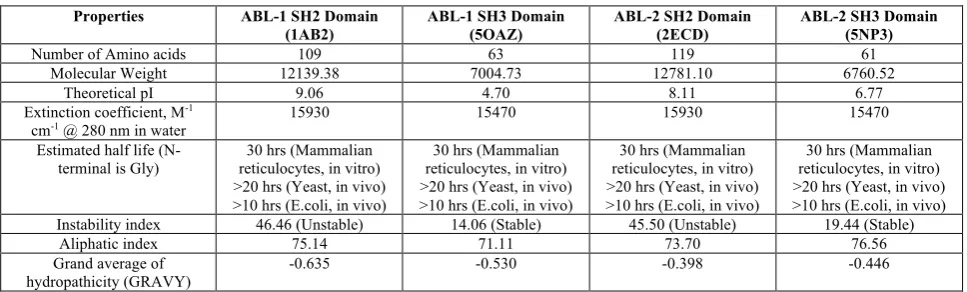
The 3D structure of all the proteins and ligands including FRC-1 is visualized using PyMOL (Fig. 1), while the physicochemical properties of proteins were calculated using the ExPASY’s ProtParam web tool29 (Table 1) and the physicochemical details
and pharmacokinetic properties of FRC-1 and other ligands were analyzed using the SwissADME web tool (Table 2). The analysis of physicochemical properties of FRC-1 (Table 2) shows that it is comparatively a small molecule, which increases its permeation rate. Studies report that increase in molecular weight and rotatable bond count has a negative effect on the permeation rate of drugs and therefore it should be preferably less than 450 g/mol and 10 respectively30. The number of H-bond acceptors and donors in
FRC-1 was also calculated to be 29.46 A°. This shows that it is having a very high permeating property in the cells, as molecules having polar surface area greater than 140 A° tend to be poor at permeating cell membranes and for molecules to penetrate the blood brain barrier, a polar surface area less than 90 A° is usually needed32.
To access the chance for a molecule to become an oral drug with respect to bioavailability, the properties such as druglikeness and medicinal chemistry properties of compounds were also calculated and compared (Table 3). The druglikeness properties of compound provides five different rule based filters; originate from analyses by major pharmaceutical companies aiming to improve the quality of their proprietary chemical collections such as; The Lipinski (Pfizer)33, The Ghose (Amegen)31, Veber
(GSK)30, Egan (Pharmacia)34 and Muegge (Bayer)35. FRC-1 in
the studies clearly passes all the filters with only one Lipinski rule of five violations, where MLOGP value is 4.38 while it should not be more than 4.1533.
Further the bioavailability score of FRC-1 (Table 3) shows it to be a good permeant compound for oral absorption36. Also the
medicinal chemistry properties show that FRC-1 does not pose any objectionable alerts such as PAINS (Pan Assay Interference Compounds) or Brenk, where molecules containing substructures showing potent response in assays irrespective of the protein target yielding false positive biological output37. The synthetic
accessibility is also one of the major factors to be considered where virtual molecules can be synthesized for biological assays depending on the size and complexity such as macrocycles, chiral centres, or spiro functions38. The synthetic accessibility score
range from 1 (very easy) to 10 (very difficult), and this shows that FRC-1 with a score of 4.49 can be moderately easy to synthesize.
Analysis of Target Protein Active Sites
Analysis of protein structures for binding site pockets is an important and often the starting point considered in the protein-ligand docking studies. In the present study, CASTp server is used to identify the possible active binding sites for ligand in the respective proteins. CASTp server predicted 16 active sites of protein 1AB2, 6 active sites of protein 5OAZ, 28 active sites of protein 5NP3 and 18 active sites of protein 2ECD. The area and volume of computed proteins along with total amino acids and residues are shown in Table 4 respectively, while the 3D representation of pockets is shown in Figure 2 with largest pocket in blue color and other pockets in red color.
Molecular Docking Analysis
The goal of ligand-protein docking is to predict the predominant binding model(s) of a ligand with a protein of known 3D structures39. To study the binding mode of FRC-1 in the binding
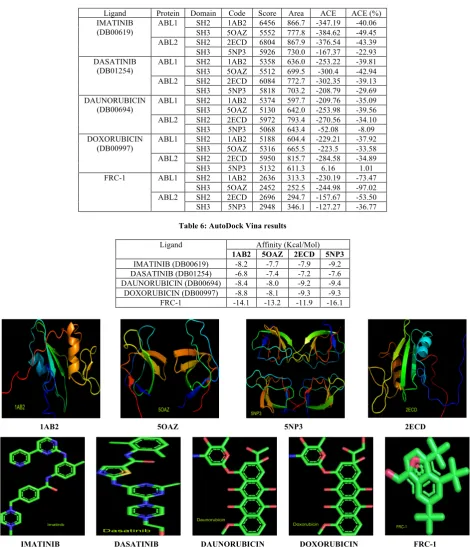
site of ABL Kinases, docking studies were performed and compared with the standard drugs marketed using one online tool and one offline tool. The online docking studies were carried out by PatchDOCK server (Table 5), while the offline analysis was done by Autodock Vina (Table 6). In both the programs, energy values were calculated from the docked confirmations of the protein-inhibitor complexes in order to find out how likely the compound binds to the target proteins based on the negative binding affinity values40. Docking studies yielded crucial
information concerning the orientation of the inhibitors in the binding pocket of the target protein. Comparison of minimum binding energy of FRC-1 and other selected drug molecules with both the kinases indicated that both the ABL Kinases were successfully docked with FRC-1 and showed a good binding affinity.
In the molecular docking paradigm, the ligand with more negative binding energy is considered more successful and more potent than to the one with less or positive binding energy. In the present study, results from PatchDock analysis revealed that the binding affinity of FRC-1 is significant in comparison of other drug molecules. The binding affinity score of FRC-1 with both the ABL kinases is much better than the other drugs (Table 5). The percentage energy of minimization with respect to the area of binding is -97.02% and -73.47% for SH3 and SH2 domain of ABL-1, while it is -53.50% and -36.77% for SH2 and SH3 domain of ABL-2 respectively. Following the PatchDock analysis for molecular docking of compounds, an offline analysis for molecular docking of compounds was also performed to compare and confirm the results using AutoDock Vina. The affinity of ligands was calculated in Vina and showed in the Table 6. The results of Vina also confirm that FRC-1 is the most successful ligand to bind with both the ABL kinases. The binding energy of FRC-1 with SH2 and SH3 domain of ABL-1 is -14.1 Kcal/mol and 13.2 Kcal/mol, while that with SH2 and SH3 domain of ABL-2 is -11.9 Kcal/mol and -16.1 Kcal/mol respectively, which is much better in comparison to the other ligands used in the study (Table 6).
Thus the results of PatchDock and Vina, supports the consideration that FRC-1 is much better compound in the comparison of insilico molecular docking analysis with available drug molecules and also shows very prominent binding affinity with all the four ABL kinase domains (Fig. 3 & 4), which makes the molecule to be considered as much better competitor in the arena of ABL kinase inhibitors for cancer treatment.
Table 1: Physicochemical properties of Proteins by ExPASy’s ProtParam Tool
Properties ABL-1 SH2 Domain (1AB2)
ABL-1 SH3 Domain (5OAZ)
ABL-2 SH2 Domain (2ECD)
ABL-2 SH3 Domain (5NP3)
Number of Amino acids 109 63 119 61
Molecular Weight 12139.38 7004.73 12781.10 6760.52
Theoretical pI 9.06 4.70 8.11 6.77
Extinction coefficient, M-1
cm-1 @ 280 nm in water 15930 15470 15930 15470
Estimated half life
(N-terminal is Gly) reticulocytes, in vitro) 30 hrs (Mammalian >20 hrs (Yeast, in vivo) >10 hrs (E.coli, in vivo)
30 hrs (Mammalian reticulocytes, in vitro) >20 hrs (Yeast, in vivo) >10 hrs (E.coli, in vivo)
30 hrs (Mammalian reticulocytes, in vitro) >20 hrs (Yeast, in vivo) >10 hrs (E.coli, in vivo)
30 hrs (Mammalian reticulocytes, in vitro) >20 hrs (Yeast, in vivo) >10 hrs (E.coli, in vivo)
Instability index 46.46 (Unstable) 14.06 (Stable) 45.50 (Unstable) 19.44 (Stable)
Aliphatic index 75.14 71.11 73.70 76.56
Grand average of
Table 2: Physicochemical and Pharmacokinetic properties of Ligands by SwissADME
Properties Imatinib (DB00619) Dasatinib (DB01254) Daunorubicin (DB00694) Doxorubicin (DB00997) FRC-1 (CID546821) 1. Physicochemical Properties:
Formula C29H31N7O C22H26CIN7O2S C27H29NO10 C27H29NO11 C23H36O2
Molecular weight 493.60 g/mol 488.01 g/mol 527.52 g/mol 543.52 g/mol 344.53 g/mol
No. of heavy atoms 37 33 38 39 25
No. of aromatic heavy atoms 24 17 12 12 6
No. of rotatable bonds 8 8 4 5 4
No. of H-bond acceptors 6 6 11 12 2
No. of H-bond donors 2 3 5 6 1
Molar refractivity 154.50 138.63 131.50 132.66 106.09
TPSA (A°) 86.28 A° 134.75 A° 185.84 A° 206.07 A° 29.46 A°
2. Lipophilicity Properties:
iLOGP 4.04 3.37 2.94 2.58 4.07
XLOGP3 3.52 3.59 1.83 1.27 5.73
WLOGP 3.19 2.36 0.70 -0.32 5.32
MLOGP 2.15 1.35 -1.35 -2.10 4.38
3. Pharmacokinetic Properties:
GI absorption High High Low Low High
BBB permeant No No No No Yes
P-gp substrate Yes No Yes Yes Yes
CYP1A2 inhibitor No No No No No
CYP2C19 inhibitor Yes Yes No No No
CYP2C9 inhibitor Yes Yes No No No
CYP2D6 inhibitor Yes Yes No No Yes
CYP3A4 inhibitor Yes Yes No No No
Log Kp (skin permeation) -6.81 cm/s -6.73 cm/s -8.22 cm/s -8.71 cm/s -4.33 cm/s
Table 3: Druglikeness and Medicinal Chemistry properties of selected ligands
Properties Imatinib (DB00619) Dasatinib (DB01254) Daunorubicin (DB00694) Doxorubicin (DB00997) FRC-1 (CID546821) 1. Druglikeness:
Lipinski Yes;
0 violations; Yes; 0 violations; No; 2 violations; MW>500; NorO>10 No; 3 violations; MW>500; NorO>10; NHorOH>5 Yes; 1 violation; MLOGP>4.15
Ghose No;
2 violations; MW>480; MR>130 No; 2 violations; MW>480; MR>130 No; 2 violations; MW>480; MR>130 No; 2 violations; MW>480; MR>130 Yes
Veber Yes Yes No;
1 violations; TPSA>140 No; 1 violations; TPSA>140 Yes
Egan Yes No;
1 violations; TPSA>131.6 No; 1 violations; TPSA>131.6 No; 1 violations; TPSA>131.6 Yes
Muegge Yes Yes No;
2 violations; TPSA>150; H-acc>10 No; 3 violations; TPSA>150; H-acc>10 No; 1 violation; XLOGP3>5
Bioavailability score 0.55 0.55 0.17 0.17 0.55
2. Medicinal Chemistry:
PAINS 0 alert 0 alert 1 alert;
Quinone_A
1 alert; Quinone_A
0 alert
Brenk 0 alert 0 alert 1 alert;
Hydroquinone
1 alert; Hydroquinone
0 alert
Leadlikeness No;
3 violations; MW>350; Rotors>7; XLOGP3>3.5 No; 3 violations; MW>350; Rotors>7; XLOGP3>3.5 No; 1 violation; MW>350 No; 1 violation; MW>350 No; 1 violation; XLOGP3>3.5
Table 4: CASTp result of the proteins
Protein Area Volume Amino Acids
Residues
1AB2 329.05 313.50 16 GLY3, ASN4, GLU7, HIS9, SER10, TRP11, TYR12, HIS13, GLY14, PRO15, VAL16, ALA20,
ALA21, LEU24, LEU25, SER32, PHE33, LEU34, ARG50, PRO100, ALA101, PRO102, LYS103, ARG104, ILE106, HIS107 & ARG108
5OAZ 163.33 297.66 7 ASP77, ASN78, THR79, GLU101, GLN108, GLY109 & TRP110
2ECD 346.73 468.01 23 SER5, SER6, GLY7, THR8, PRO9, VAL10, ASN11, SER12, GLU14, LYS15, HIS16, SER17, TYR19,
HIS20, ALA108, PRO109, LYS110, CYS111, ASN112, GLY115, PRO116, SER117 & SER118
5NP3 148.76 174.38 12 TYR70, ASP71, SER75, GLY76, ASP77, ASN78, THR79, LYS84, ASN94, GLN95, TRP99 & TRP110
Table 5: PatchDock results
Ligand Protein Domain Code Score Area ACE ACE (%)
IMATINIB (DB00619)
ABL1 SH2 1AB2 6456 866.7 -347.19 -40.06
SH3 5OAZ 5552 777.8 -384.62 -49.45
ABL2 SH2 2ECD 6804 867.9 -376.54 -43.39
SH3 5NP3 5926 730.0 -167.37 -22.93
DASATINIB (DB01254)
ABL1 SH2 1AB2 5358 636.0 -253.22 -39.81
SH3 5OAZ 5512 699.5 -300.4 -42.94
ABL2 SH2 2ECD 6084 772.7 -302.35 -39.13
SH3 5NP3 5818 703.2 -208.79 -29.69
DAUNORUBICIN (DB00694)
ABL1 SH2 1AB2 5374 597.7 -209.76 -35.09
SH3 5OAZ 5130 642.0 -253.98 -39.56
ABL2 SH2 2ECD 5972 793.4 -270.56 -34.10
SH3 5NP3 5068 643.4 -52.08 -8.09
DOXORUBICIN (DB00997)
ABL1 SH2 1AB2 5188 604.4 -229.21 -37.92
SH3 5OAZ 5316 665.5 -223.5 -33.58
ABL2 SH2 2ECD 5950 815.7 -284.58 -34.89
SH3 5NP3 5132 611.3 6.16 1.01
FRC-1 ABL1 SH2 1AB2 2636 313.3 -230.19 -73.47
SH3 5OAZ 2452 252.5 -244.98 -97.02
ABL2 SH2 2ECD 2696 294.7 -157.67 -53.50
SH3 5NP3 2948 346.1 -127.27 -36.77
Table 6: AutoDock Vina results
Ligand Affinity (Kcal/Mol)
1AB2 5OAZ 2ECD 5NP3
IMATINIB (DB00619) -8.2 -7.7 -7.9 -9.2
DASATINIB (DB01254) -6.8 -7.4 -7.2 -7.6
DAUNORUBICIN (DB00694) -8.4 -8.0 -9.2 -9.4
DOXORUBICIN (DB00997) -8.8 -8.1 -9.3 -9.3
FRC-1 -14.1 -13.2 -11.9 -16.1
1AB2 5OAZ 5NP3 2ECD
IMATINIB DASATINIB DAUNORUBICIN DOXORUBICIN FRC-1
1AB2 5OAZ 5NP3 2ECD Figure 2: CASTp result showing major pocket in blue color and other pockets in red color
Figure 3: Binding model of PatchDock results for FRC-1 with SH2 & SH3 domains of ABL-1 & ABL-2
CONCLUSION
In the present in-silico investigation, we elucidated one finding that the flavonoid compound (FRC-1) which is isolated and identified from plant (Launaea procumbens) shows very high binding affinity against the selected domains of ABL kinases. It can therefore be considered as potential anticancer agent for the target proteins, namely, Abelson tyrosine protein kinase 1 and Abelson tyrosine protein kinase 2. Analysis of ligand binding interaction with the target proteins can be useful for new preventive and therapeutic drug for cancer. Based on the molecular drugs docking and binding affinities of the target proteins with FRC-1 and its physicochemical detailing, it was found that the flavonoid, FRC-1, has high possibilities to be an anticancer drug, if utilized further with systematic approaches. The results obtained from this study would be useful in both understanding the inhibitory mode as well as in rapidly and accurately predicting the activities of new inhibitors on the basis of docking scores to narrow down and finalize the lead compounds. The results are also helpful for the design and development of novel drug having better inhibitory activity against various types of cancer.
Finally from this study, we conclude that plant Launaea procumbens contains a very remarkable phytocompound (FRC-1). This compound shows a significant and very high potential in anticancer property in insilico studies and therefore can be one of the possible compound to provide anticancer property to plant for which it is used as traditional herbal medicine in leukemia. This potential drug candidate can therefore be further validated in wet lab studies for its proper function.
ACKNOWLEDGEMENT
The authors highly acknowledge the support and facilities provided by the Department of Biosciences, Veer Narmad South Gujarat University, Surat and Department of Chemistry, Towson University, Maryland, USA for the entire research program.
REFERENCES
1. Batra P, Sharma AK. Anticancer potential of flavonoids: Recent trends and future perspectives. Biotechnology. 2013; 3: p. 439-459.
2. Mishra GJ, Reddy MN, Rana JS. Isolation of flavonoid constituent from Launaea procumbens Roxb by preparative HPTLC method. IOSR Journal of Pharmacy. 2012; 2(4): p. 5-11.
3. Magee PJ, Rowland IR. Phytoestrogens, their mechanism of action: Current evidence for a role in breast and prostate cancer. Brazilian Journal of Nutrition. 2004; 91: p. 513-531. 4. Guo JY, Li X, Browning JD. Dietary soy isoflavones and
estrone protect ovariectomized ERalphaKO ad wild type mice from carcinogen induced colon cancer. The Journal of Nutrition. 2004; 134: p. 179-182.
5. Ferro MA, Leis A, Doll R, Chiu L, Chung M, Barroetavena M. The impact of acculturation on the use of traditional Chinese medicine in newly diagnosed Chinese cancer patients. Supportive Care in Cancer. 2007; 15(8): p. 985-992. 6. Maskarinec G, Shumay DM, Kakai H, Gotay CC. Ethnic differences in complementary and alternative medicine use among cancer patients. Journal of Alternative and Complementary Medicine. 2000; 6(6): p. 531-538.
7. Grandis JR, Sok JC. Signaling through the epidermal growth factor receptor during the development of malignancy. Pharmacology and Therapeutics. 2004; 102: p. 37-46.
8. Emileigh KG, Pameeka SP, Wang J, Pandergast A. Role of ABL family kinases in cancer: From Leukemia to solid tumors. Nature Reviews Cancer. 2013; 13(8): p. 559-571. 9. Yin B. Focal adhesion kinase as a target in the treatment of
hematological malignancies. Leukemia Research. 2011; 35: p. 1416-1418.
10.Elias D, Ditzel HJ. Fyn is an important molecule in cancer pathogenesis and drug resistance. Pharmacological Research. 2015; 100: p. 250-254.
11.Sirvent A, Benistant C, Roche S. Cytoplasmic signalling by the c-Abl tyrosine kinases in normal and cancer cells. Biology of the Cell. 2008; 100: p. 617-631.
12.Ben-Neriah Y, Daley GQ, Mes-Masson AM, Witte ON, Baltimore D. The chronic myelogenous leukemia-specific P210 protein is the product of the bcr/abl hybrid gene. Science. 1986; 233: p. 212-214.
13.Wapner J. The philadelphia chromosome: A genetic mystery, a lethal cancer, and the improbable invention of a life saving treatment: ISBN 9781615191970.
14.Colicelli J. ABL tyrosine kinases: Evolution of function, regulation and specificity. Science Signaling. 2010; 3(139): p. 6.
15.Deininger MW, Druker BJ. Specific targeted therapy of chronic myelogenous leukemia with imatinib. Pharmacological Reviews. 2003; 55(3): p. 401-423. 16.Das J, Chen P, Norris D, Padmanabha R, Lin J, Moquin RV,
et al. 2-aminothiazole as a novel kinase inhibitor template. Structure-activity relationship studies toward the discovery of Dasatinib, BMS-354825 as a potent pan-Src kinase inhibitor. Journal of Medicinal Chemistry. 2006; 49(23): p. 6819-6832. 17.Weiss RB. The anthracyclines: will we ever find a better doxorubicin? Seminars in Oncology. 1992; 19(6): p. 670-686. 18.Mishra GJ, Rana JS, Gadhvi R, Reddy MN. Identification of total phenolics, total flavonoids and antioxidant potential in the leaf extracts of Launaea procumbens Roxb. International Journal of Pharmaceutical Research Scholars. 2014; 3(1): p. 374-381.
19.Daina A, Michielin O, Zoete V. SwissADME: A free web tool to evaluate pharmacokinetics, drug likeness and medicinal chemistry friendliness of small molecules. Scientific Reports. 2017; 7(42717).
20.Schrodinger. Schrodinger Suite 2018-1, Protein preparation wizard: Epik. Schrodinger, LLC, New York, NY. 2016. 21.Sastry GM, Adzhigirey M, Day T, Annabhimoju R, Sherman
W. Protein and ligand preparation: Parameters, protocols and influence on virtual screening enrichments. Journal of Computer-Aided Molecular Design. 2013; 27(3): p. 221-234. 22.Joe D, Zheng O, Jeffery T, Andrew B, Yaron T, Jie L. CASTp: Computed atlas of surface topography of proteins with structural and topographical mapping of functionally annotated residues. Nucleic Acid Research. 2006; 34: p. W116-W118.
23.Prajapati C, Reddy MN. Molecular docking studies of canthin-6-one from Simarouba glauca against EGFR tyrosine kinase. International Journal of Pharmaceutical Sciences and Research. 2017; 8(12): p. 5130-5136.
24.Schneidman DD, Inbar Y, Nussinov R, Wolfson HJ. PatchDock and SymmDock: Servers for rigid and symmetric docking. Nucleic Acid Research. 2005; 33: p. W363-W367. 25.Rauf MA, Zubair S, Azhar A. Ligand docking and binding
site analysis with pymol and autodock/vina. International Journal of Basic and Applied Sciences. 2015; 4(2): p. 168-177.
27.DeLano WL. The PyMOL molecular graphics system. San Carlos; 2009.
28.Laskowski RA, Swindells MB. LigPlot+: multiple ligand-protein interaction diagrams for drug discovery. Journal of Chemical Information and Modelling. 2011; 51: p. 2778-2786.
29.Gasteiger E, Hoogland C, Gattiker A, Duvaud S, Wilkins MR, Appel RD, et al. Protein identification and analysis tools on the ExPASy server. In Walker JM. The Proteomics Protocols Handbook.: Humana Press; 2005. p. 571-607. 30.Veber DF, Johnson SR, Cheng HY, Smith BR, Ward KW,
Kenneth D. Molecular properties that influence the oral bioavailability of drug candidates. Journal of Medicinal Chemistry. 2002; 45(12): p. 2615-2623.
31.Ghose AK, Viswanadhan VN, Wendoloski JJ. A knowledge based approach in designing combinatorial or medicinal chemistry libraries for drug discovery: A qualitative and quantitative characterization of known drug databases. Journal of Combinatorial Chemistry. 1999; 1(1): p. 55-68 32.Pajouhesh H, Lenz GR. Medicinal chemical properties of
successful central nervous system drugs. NeuroRx. 2005; 2(4): p. 541-553.
33.Lipinski CA, Lombardo F, Dominy BW, Feeney PJ. Experimental and computational approaches to estimate solubility and permeability in drug discovery and development settings. Advanced Drug Delivery Reviews. 2001; 46: p. 3-26.
34.Egan WJ, Merz KM, Baldwin JJ. Prediction of drug absorption using multivariate statistics. Journal of Medicinal Chemistry. 2000; 43: p. 3867-3877.
35.Muegge I, Heald SL, Brittelli D. Simple selection criteria for drug-like chemical matter. Journal of Medicinal Chemistry. 2001; 44: p. 1841-1846.
36.Martin YC. A bioavailability score. Journal of Medicinal Chemistry. 2005; 48: p. 3164-3170.
37.Baell JB, Holloway GA. New substructure filters for removal of pan assay interderence compounds (PAINS) from screening libraries and for their exclusion in bioassays. Journal of Medicinal Chemistry. 2010; 53: p. 2719-2740. 38.Ertl P, Schuffenhauer A. Estimation of synthetic accessibility
score of drug-like molecules based on molecular complexity and fragment contributions. Journal of Cheminformatics. 2009; 1: p. 8.
39.Mittal RR, McKinnon RA, Sorich MJ. Comparison data sets fro benchmarking QSAR methodologies in lead optimization. Journal of Chemical Information and Modelling. 2009; 49: p. 1810-1820.
40.Mashiach E, Schneidman DD, Peri A, Shavit Y, Nussinov R, Wolfson HJ. An integrated suite of fast docking algorithms. Proteins. 2010; 78: p. 3197-3204.
Cite this article as:
Gaurav J. Mishra et al. Evaluating the anti-cancer potential of
Launaea procumbens (Roxb.) by comparative molecular docking analysis against ABL kinases. Int. Res. J. Pharm.
2019;10(3):200-207 http://dx.doi.org/10.7897/2230-8407.1003105
Source of support: Nil, Conflict of interest: None Declared