74 |
P a g e
DEVELOPING SEMANTIC WEB MODEL OF
SCHOOL INFORMATION SYSTEM USING
SEMANTIC WEB TECHNOLOGIES
Digant Bhatt
1,
Dr. Hiren Joshi
21
Department of Computer Science, Kadi Sarva Vidhyalaya, Gandhinagar, Gujarat, (India)
2
School of Computer Science, (BAOU) Ahmadabad, Gujarat, (India)
ABSTRACT
Information technology (IT) has a remarkable influence on Education sector. Number of Schools and colleges are increased now a day. Schools are provided highly infrastructure, transportation and learning facilities through latest technology. Every parent have dream to give their children better education. To find the school based on criteria, traditional web pages have limitation to give proper results. This paper proposed semantic web framework to enhance the school information system. Semantic model of school information system provides knowledge based information about the schools. Ontology [1] of user profile including questionnaires related to schools can be useful in searching proper information.
Keywords –Information Technology, Upper Level Ontology,
I. INTRODUCTION
Education sector is a public and private sector which is the largest sector of the economy in most countries. In India, Education sector is under the control of state and central Government. Indian government highly focuses on development of new technology in educational area.
Information related to Schools, colleges, education schemes; programs are also available on the portal. But these information services are not sufficient as it is not converted to knowledge based information.
Citizens are not directly connected with any Education programs and schemes. Information are scattered and citizens can’t get proper results after searching for particular term.
In which, E-learning has offered opportunity to raise educational standards in school. Technology makes the learning procedure more flexible and user friendly [2].
75 |
P a g e
SchoolGood
Infrastructure
Transportation/ Security
Tours / Programs Good
Education
Sport Food & Medical
Services
Co-Curricular Activities
II. SCHOOL INFORMATION SYSTEM
Parents look for good school for their children. Selection of good school is also depends on so many criterion.
Figure. 1- Basic School Requirements
Searching of schools based on user criterion, it is necessary to build the semantic based framework for school information in which User profile ontology and school ontology are created.
III. SEMANTIC FRAMEWORK FOR SCHOOL INFORMATION
Semantic model for School information have covered three modules of User, Suggested school and knowledge bank. In User module, questionnaires related with the School are added for strengthening the user profile. PROTON upper level ontology, school ontology and user ontology are used in designing of semantic model of School information system.
76 |
P a g e
User module has a user account form having details of username, password, address, birth date, phone, email, etc. for creating user profile. The User request is directly controlled by user controller which is accepting the request and takes appropriate actions. UI component of the presentation layer is responsible for collecting data from user and pass it the business layer for further processing. In Business layer, User manager uses Data Access Object (DAO) for manipulating with data stored in the database.For maintaining log of the user activity during visiting the web User log DAO is used.User manager has User Profile Expert for determining user profile. Main function of User profile expert is to use User ontology that contains instances of classes and relations from the User ontology.
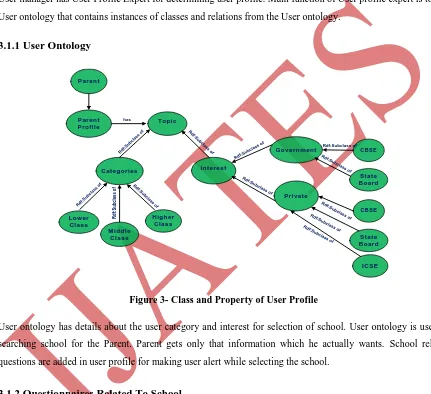
3.1.1 User Ontology
Parent Government Higher Class Middle Class Lower Class Interest Categories Topic Parent Profile Rdf :Sub clas s of
R d f: S u b c la s s o
f Rdf:
Su bcla
ss o f
R df:Su
bcla ss o
f
Rdf :Sub
clas s of has
Rdf:S ubcla
ss of
Rdf:S ubclas
s of
CBSE State Board Private Rdf:Subclass of CBSE State Board ICSE Rd f:S ubclas
s of Rd
f:S ubclas
s of Rd
f:S ubclas
s of Rdf:S
ubclas s of
Figure 3- Class and Property of User Profile
User ontology has details about the user category and interest for selection of school. User ontology is used in searching school for the Parent. Parent gets only that information which he actually wants. School related questions are added in user profile for making user alert while selecting the school.
3.1.2 Questionnaires Related To School
Below Questionnaires can be useful to parent for selection of the school.
Ques
No.
Questions
1) Do you want to make your child study in same school from 1st to 12th standard? 1. Yes
2. No
77 |
P a g e
2) Is there any guardian other than parents for caring child?1. Yes 2. No
3) Specify the area distance you generally prefer for school? 1. Distance below 2 km
2. Distance from 2 km to 3 km 3. Distance from 3 km to 5 km 4. NA
4) Which Transportation facility you like from school? 1. Bus
2. Auto 3. Van 4. Self
5) Which kinds of activities your children most like? 1. Music & Dance
2. Karate 3. Sport
4. Other(specify)
6 Do you prefer any religious based school? 1. Yes
2. No
3. If yes specify religion 7 Is your son suffering from any dieses?
1. Yes 2. No
8 What type of services you have? 1. Transferable (to any other state) 2. Transferable (to any other city ) 3. Non-transferable
Table-1 Questionnaires for Parents
According to user’s answers, system will manage the data and make the user alert when select for the particular school. For example, if no guardian is available other than parent for caring child, system will suggest day school for children.
User ontology expert plays the important role in analyzing the answers and prepare ontology accordingly.
3.2 Suggested School Module
78 |
P a g e
Offers
Parent
Profile Activities
Is matched with
Cultural
rdf:subclass of
c
Transport rd
f: s u b c la s s o f Services c c rdf:subclass of Sport Tour Educational General rdf: sub clas
s o f rd f:su b cla ss of r d f: s u b c la s s o f Hostel Facility c H a s Medical rdf: sub clas
s o f c Food rd f:su b cla ss of c Auto c c Van Bus rdf:subclass of c c Break Fast Lunch rd f:s ub cla ss
of rdf:s ub
c las
s of
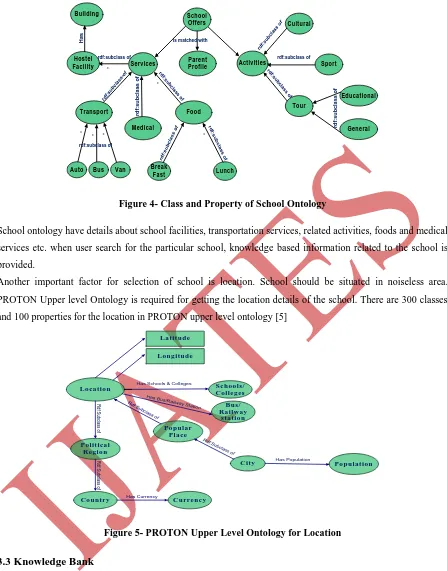
Figure 4- Class and Property of School Ontology
School ontology have details about school facilities, transportation services, related activities, foods and medical services etc. when user search for the particular school, knowledge based information related to the school is provided.
Another important factor for selection of school is location. School should be situated in noiseless area. PROTON Upper level Ontology is required for getting the location details of the school. There are 300 classes and 100 properties for the location in PROTON upper level ontology [5]
Location Political Region Country Currency Popular Place City Population Bus/ Railway station Latitude Longitude Schools/ Colleges Rdf:S ubc
lass of
Rdf:Sub class of Has Schools & Colleges
Has Bu
s/Railway Station
Has Population R df:S ub cla ss o f R df: S ub cla ss o f Has Currency
Figure 5- PROTON Upper Level Ontology for Location
3.3 Knowledge Bank
79 |
P a g e
IV. IMPLEMENTATION AND RESULTS
To implement the Semantic web for school information, it is necessary to set up the development environment. To develop the Semantic web; Java 1.6 Software Development Kit, Eclipse Integrated Development Environment 3.4, Eclipse Integrated Development Environment 3.4 and Eclipse Integrated Development Environment 3.4 are used [7].
4.1
User Profile Form
User profile covers the user details such as user name, address, Educational qualification, Profession and Interest. Whenever user log on to the Semantic School information system, schools are automatically suggested by the system based on the user profile which is stored in User profile ontology.
Figure-6 Semantic User Profile Form [8]
4.2
Searches For The School
User can search the school based on school type, Board, Available services etc. If user selects the board “CBSE” [9], the entire school list related to only CBSE will be populated in to the screen.
80 |
P a g e
Administrator can add the school with necessary details of School name, Principal Name, Fees structure and Transportation Facilities.Figure-8 Semantic Add School Form
4.4
Manage School
Manage school is also handled by Administrator. Added school list is populated automatically. Staff details and additional facilities provided by the school are added by the administrator.
Figure-9 Semantic Manage School Form
V. CONCLUSION
81 |
P a g e
REFERENCES
[1] Rui G. Pereira and Mário M. Freire, (2006); SWedt: A Semantic Web Editor Integrating Ontologies and Semantic Annotations with Resource Description Framework, IEEE
[2] Sangeeta Kakoty, Monohar Lal, Shikhar Kr. Sarma, (2011); E-learning as a Research Area: An Analytical Approach, IJACSA, Vol. 2 No. 9.
[3] Amar Nayak,Jitendra Agarwal, Vindokumar Yadav and Shadab Pasha(2009); Enterprise Architecture for semantic web mining in education, Second International Conference on Computer and Electrical Engineering, IEEE
[4] Software Architecture, www.msdn.mirosoft.com
[5] PROTON, http://en.wikipedia.org/
[6] Zongmin Ma and Huaiqing Wang, “The Semantic Web for Knowledge and Data Management: Technologies and Practices”.
[7] John Hebeler, Matthew Fisher, Ryan Blace and Andrew Perez-Lopez, “Semantic Web Programming” [8] illustration-of-school-building Images, http://walkamileinmyissues.com/
![Figure 2- Semantic Framework for School Information System [4]](https://thumb-us.123doks.com/thumbv2/123dok_us/9167722.1455850/2.595.67.518.149.738/figure-semantic-framework-school-information.webp)