SHORT COMMUNICATION
Interpreting vertical movement behavior
with holistic examination of depth distribution:
a novel method reveals cryptic diel activity
patterns of Chinook salmon in the Salish Sea
M. C. Arostegui
*, T. E. Essington and T. P. Quinn
Abstract
Aquatic organisms exhibit a variety of diel changes in vertical movement that are investigable through the use of biotelemetry. While certain species do not change their movements between day and night, others exhibit diel verti-cal migration (DVM) or a diverse range of diel activity patterns (DAPs). Consequently, day–night differences in depth distribution may be stark and easily detectable, or more subtle and difficult to identify. To augment the discovery and classification of cryptic diel vertical movement behavior, we developed and utilized a novel method that analyzed entire depth distributions while comparing diel period, season, and season/diel period models. This analysis revealed a seasonally variable DAP previously unreported in Chinook salmon (Oncorhynchus tshawytscha). In summer and fall, Chinook salmon in the Salish Sea juxtaposed shallow and confined daytime movements with nighttime bounce diving. This DAP was reversed in winter, when they occupied deeper sections of the water column during the day, resulting in a substantially overlapping, but more even depth distribution than at night. These results demonstrate the analytical utility of accompanying other metrics with holistic examination and visualization of the entire distribution of depth data. Additionally, we highlight the need to use a framework that answers all of the following questions: (1) does the target species exhibit seasonal variation in depth, (2) does it undergo DVM, (3) if it does not undergo DVM, does it follow a DAP, and (4) if it follows a DAP, what is the difference in vertical movement behavior between diel periods?
Keywords: Telemetry, Depth distribution, Diel activity pattern, Chinook salmon
© The Author(s) 2017. This article is distributed under the terms of the Creative Commons Attribution 4.0 International License (http://creativecommons.org/licenses/by/4.0/), which permits unrestricted use, distribution, and reproduction in any medium, provided you give appropriate credit to the original author(s) and the source, provide a link to the Creative Commons license, and indicate if changes were made. The Creative Commons Public Domain Dedication waiver (http://creativecommons.org/ publicdomain/zero/1.0/) applies to the data made available in this article, unless otherwise stated.
Background
Biotelemetry is a powerful tool for investigating the movements of aquatic organisms that would otherwise be inaccessible to researchers. Transmitters and data log-gers can provide data on the horizontal movements of animals, and also their depth distributions and vertical movements, yielding many insights into their behavior. Analysis of vertical movement data may reveal that a spe-cies’ depth distribution is influenced by factors including temperature [1, 2], oxygen [3], the former two in concert [4], light level [5, 6], predation risk [7], prey movements
[8, 9], and foraging efficiency [10, 11]. Consequently, ver-tical distributions often vary with the seasons and diel periods [12, 13]. Thus, telemetry studies yield valuable information on the behavior and ecology of the target species in relation to its biotic and abiotic environment.
While certain organisms show no day–night differ-ences in depth distribution, others exhibit behavior that can be categorized as diel vertical migration (DVM) or a diel activity pattern (DAP). DVM occurs when an organism occupies deeper water during the day and shal-lower water at night, or (less commonly) vice versa [8]. This behavior has been documented in numerous forage species, such as mesopelagic myctophid fish that reside at deeper depths (200–2000 m) during the day to avoid predation and migrate closer to the surface at night
Open Access
*Correspondence: [email protected]
(10–100 m) to forage when predation risk is reduced [14,
15]. Large predators including bluntnose sixgill [16] and bigeye thresher sharks [17] also undergo DVM, often foraging deeper during the day than at night. The diel separation of modal depths that defines DVM, where dis-tributions are not significantly overlapping and are of a similar variance (see Fig. 2 of [16]), does not necessarily occur under a DAP. For example, blue marlin (Makaira nigricans) may repeatedly dive from the surface to waters 100 m deep or more and back during the day, whereas at night they stay almost exclusively at the surface (see Fig. 4 of [18]). In this case, the blue marlin nighttime dis-tribution is a different shape than and entirely overlapped by the daytime distribution due to the stark difference in variance between diel periods. Such diving behavior dif-fers from the disparate modal depths in day and night typical of DVM and therefore must be analyzed differ-ently to be recognized as a DAP. It is important to note that DVM is a single specialized paradigm, whereas DAP represents a wide range of diel movement behaviors. This distinction is relevant because some authors, after finding no evidence of DVM and then not investigating further for any DAPs, may prematurely conclude that a species does not exhibit diel movement behavior.
A recent acoustic telemetry study employed a linear statistical model to assess seasonal and diel depth pat-terns of Chinook salmon (Oncorhynchus tshawytscha) in Puget Sound, WA [13]. They found that Chinook salmon showed seasonal changes in depth distribution but did not exhibit DVM. However, because their model pre-dicted average depths derived from hourly means of the depth detections per fish to explore diel movement pat-terns, they could not fully evaluate changes in variability in depths associated with DAPs.
Here, we illustrate the importance of holistic exami-nation of diel depth distribution data applied to Puget Sound Chinook salmon data described above. We develop and apply a novel analytical method enabling researchers to assess whether the organisms exhibit sea-sonal changes in depth distribution, DVM, and DAPs. Utilizing acoustic telemetry data from Smith et al. [13] and more recently collected data, we demonstrate that subadult Chinook salmon in marine waters exhibit a seasonally variable DAP consisting of shallow, vertically confined movements during the day in summer/fall and at night in winter, and deeper, more variable movements during the night in summer/fall and day in winter. The novelty of this work is highlighted by the rarity of long-term acoustic telemetry studies on the vertical move-ments of immature anadromous salmonids in the marine environment [19, 20]. The method described in this paper provides both analytical flexibility and resolution by using the entire distribution of depth data, making it
applicable to other species with cryptic patterns of verti-cal movement.
Methods
Receiver deployment and fish tagging
Acoustic receivers were deployed in five regions of the Salish Sea in waters of the USA and Canada: the Strait of Juan de Fuca, the San Juan Islands, Whidbey Basin, Admiralty Inlet, and central Puget Sound (Fig. 1; see [13,
21] for more details). Immature (i.e., subadult) Chinook salmon (n = 28; Table 1) were captured and surgically implanted with depth recording acoustic tags (Vemco: Bedford, Nova Scotia, Canada) following the methods of Smith et al. [13] and Arostegui et al. [21]. The tags accu-rately recorded depths up to 110 m from the surface, but deeper detections had questionable precision and were subsequently classified solely as >110 m for analysis.
Data classification
For each Chinook salmon, detections were classified by season, diel period, and depth bin. The seasons were defined as: summer (July–September), fall (October– December), winter (January–March), and spring (April– June). Day and night were defined as the time between sunrise and sunset, and sunset and sunrise, respectively, obtained from the Astronomical Applications Depart-ment of the US Naval Observatory [22] (http://aa.usno. navy.mil/data/docs/RS_OneYear.php, accessed October 2015). Ten-meter depth bins from 0 to 110 m were uti-lized plus one bin summing all detections >110 m, for a total of 12 bins.
Data selection
The four individual Chinook salmon with the most detec-tions in a given season and diel period (i.e., summer day, summer night, fall day, etc.) were chosen to test the method (Table 2). The number of detections is equivalent to the amount of time a fish’s depth was observed over a season within a specific diel period. This metric was uti-lized because fish that accumulate more detections are more likely to provide data that accurately represent the true depth distribution in a given season and diel period. The number of fish informing a specific estimated dis-tribution was kept consistent to maintain the level of individual variability incorporated into each maximum likelihood estimated model.
Model data treatment
where xi is the vector of proportions of time spent at K
depth bins for fish i, αk are the parameters of the
Dir-ichlet distribution, so that the mean proportion in any bin equals αk
K k=1αk.
We have four alternative models to test: The vector αk
is (1) the same for all diel periods and seasons; (2) differ-ent between diel periods but the same for seasons; (3) the
(1a)
L(xi)=
1 B(α)
K
k=1
xαk−1
k,i
(1b)
β(α)=
K
k=1Γ αk
Γ
K
k=1αk
same for diel periods but different between seasons; (4) different between diel periods and seasons.
As we have 12 depth bins, there are 12 different val-ues of αk to be estimated. However, there are two related
issues with parameter estimation of the vector α. The first is that our data consist of proportions in discretized depth bins that have a natural ordering to them (e.g., 1–10 and 10–20 m), so that a priori, we anticipate that the α1 should be more similar to α2 than it is to α3, and
so on. Two, we wish to test different models that sup-pose different vectors α for diel periods and seasons. If the αk are all estimated as free parameters, each distinct
vector consists of 12 additional parameters that have to be estimated, which in model selection penalizes models that presume distributions are different across times or seasons.
To address both of these problems, we fit a parametric function to describe how the estimated mean proportion of observation varies with depth. Specifically, we fit the following functional form:
where f(y) is a gamma probability density function with shape parameter θ and scale parameter kg, y is depth,
and ymin,k and ymax,k are the upper and lower bounds of
the depth bin k. In other words, the estimated probability of being in depth bin k is the integral of a gamma prob-ability density function over the depth range that bin k
represents.
Given the vector pˆ(k), and a multiplier αmult, we can
then obtain the vector α for the Dirichlet probability
(2)
ˆ
p(k)= ymax,k
ymin,k
f(y)dy
density function and thereby calculate the likelihood for each observation:
Thus, the parametric model only required that we esti-mate three parameters, θ, kg, and αmult, rather than 12
distinct parameters in the vector αk.
Occasionally, the pˆ(k) would become too small,
result-ing in near-zero estimated probabilities so that some likelihoods could not be computed. To remedy this prob-lem, we added a final variable, termed pfloor, which was
the smallest value that pˆ(k) could take. This was done by
adding a constant small probability ε to Eq. 2 above and constraining pˆ(k) such that the sum over all k = 1:
We set pfloor to 0.0001. Depth distribution models
Four different models (null, diel period, season, and sea-son/diel period) were fitted to test for their ability to describe the Chinook depth distribution proportions. The null model was fit to data consisting of 32 individual distributions from the four seasons and two diel periods (Table 2). The “diel period” model presumed that depth distributions varied by diel period only. The “season” model presumed that depth distributions varied by sea-sons only, and the “season/diel period” model presumed that depth distributions were different for each season and diel period. Thus, the null model estimated a single vector of parameters, the diel model estimated two vec-tors of parameters (for day and night), the season model estimated four vectors of parameters, and the season/ diel period model estimated eight vectors of parameters (24 parameters total).
Parameter estimation and model comparison
Maximum likelihood estimates of the θ, kg, and αmult
parameters were calculated with the “mle2” function of the “bbmle” package in R [23], using the L-BFGS-B method with bounded parameters [24]. We used a modi-fied version of the “ddirichlet” function (modimodi-fied to cal-culate log-likelihoods) of the “gtools” package in R [25]. All computation was conducted in R (version 3.2.2) [26], the code and data for which is provided [see Additional files 1, 2].
αk = ˆp(k)αmult
(3a) ε=
pfloor−minkymax,k
ymin,k f(y)dy
1−Kpfloor
(3b) ˆ
p(k)= ˆ
p(k)=ymax,k
ymin,k f(y)dy+ε
Kε+
k
ymax,k
ymin,k f(y)dy Table 1 Tagged Chinook salmon information
Serial number, fork length (mm), tagging date, and total number of detections for the 28 subadult Chinook salmon tagged in this study. The 12 fish above the bold were utilized in the quantitative analyses and the 16 below were not
Serial # Fork length (mm) Tagging date # of detections
3134 276 11/1/06 798
4996 330 6/7/07 1246
4997 370 6/7/07 3760
5033 401 11/2/06 3024
5035 296 11/1/06 567
6038 260 11/1/06 151
1040674 266 6/7/07 853 1040676 280 6/7/07 217 1040678 316 6/7/07 533 1055541 275 12/11/08 359 1082468 430 5/13/12 2058 1082477 425 4/12/12 1574
3130 342 6/7/07 81
3131 254 11/1/06 70
3133 369 6/7/07 354
4998 255 6/7/07 24
5034 505 11/1/06 23
1040675 346 6/8/07 354
1040677 330 6/7/07 18
1045449 260 12/12/07 29
1055537 273 12/11/08 64
1082469 400 6/24/12 401
1082470 400 6/24/12 14
1082471 450 5/13/12 10
1082472 400 6/24/12 162
1082473 425 5/13/12 2
1082474 430 4/22/12 35
Results
The 28 Chinook salmon were detected 16,791 times at 65 different acoustic receivers from November 1, 2006, to December 23, 2012 (Table 1; Fig. 1). In a given season/ diel period, individual fish were detected 0–1512 times. Among the 32 distributions from the top four individu-als with the most detections in each of the eight season/ diel periods, the mean number of total detections was 435.63 ± 363.56 (Table 2). The 32 season/diel period distributions came from 12 of the 28 Chinook salmon (Table 2). These 12 fish exhibited no significant differ-ence in fork length (mm) from the 16 fish that did not
contribute to the models (Student’s t test: P = 0.1422), indicating no size-related bias in the likelihood of detection.
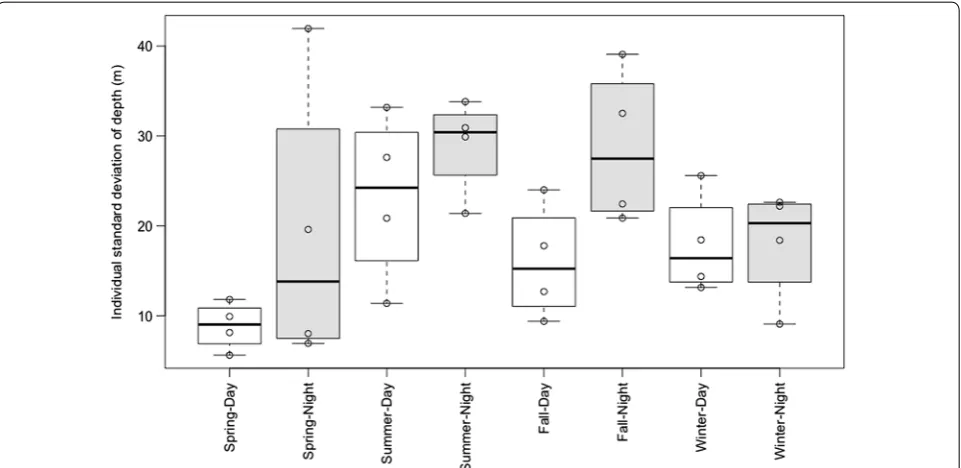
The median of the individual mean depths of the four distributions in each season/diel period was greater at night than during the day in all seasons except winter (Fig. 2). The variation in depth tended to be greater at night than during the day in all four seasons; however, in the winter the interquartile ranges were fully overlapping (Fig. 3).
The season/diel period model had the lowest Akaike information criterion (Table 3). Independently, the diel
Table 2 Detection data
Detections per depth bin by the four individual Chinook salmon with the most detections in each of eight season and diel period combinations. Note that the 32 observed distributions displayed here come from 12 different Chinook salmon
Serial # Season Diel Depth bin (m) Total
0–10 10–20 20–30 30–40 40–50 50–60 60–70 70–80 80–90 90–100 100–110 110+
4996 Summer Day 57 88 85 66 15 1 0 0 0 0 0 0 312
4997 Summer Day 52 78 44 95 173 92 79 51 17 1 3 0 685 1082468 Summer Day 73 135 198 261 111 74 34 29 21 18 16 68 1038 1082477 Summer Day 12 19 63 83 99 68 48 48 27 37 51 222 777 4996 Summer Night 4 24 11 14 7 4 1 4 10 17 23 192 311 4997 Summer Night 44 84 66 57 127 93 49 38 21 1 1 0 581 1082468 Summer Night 101 180 134 129 74 59 40 35 28 11 17 54 862 1082477 Summer Night 11 17 41 38 37 48 47 36 58 67 91 265 756
3134 Fall Day 0 63 80 55 43 19 21 17 2 0 0 16 316
4997 Fall Day 4 1 18 29 58 111 85 95 74 12 1 1 489
5033 Fall Day 13 104 359 124 66 10 2 0 0 0 0 0 678
5035 Fall Day 7 41 33 6 9 8 0 0 0 0 0 0 104
3134 Fall Night 10 145 145 63 52 10 11 37 15 0 2 2 492 4997 Fall Night 1 16 71 106 119 220 206 189 110 29 13 84 1164
6038 Fall Night 22 3 1 1 0 0 0 7 35 10 8 27 114
1040674 Fall Night 1 7 0 5 7 40 0 1 1 0 8 27 97
4997 Winter Day 0 1 0 5 11 61 37 37 37 40 0 14 243
5033 Winter Day 25 146 315 408 404 168 27 16 2 0 1 0 1512
5035 Winter Day 22 6 10 24 14 0 0 0 0 0 0 0 76
1055541 Winter Day 4 6 3 3 1 4 12 10 0 0 0 0 43
4997 Winter Night 1 3 10 4 41 102 87 40 20 10 2 55 375 5033 Winter Night 99 163 193 134 87 38 16 18 5 7 2 0 762 5035 Winter Night 33 164 102 19 12 3 0 0 0 0 0 0 333 1055541 Winter Night 28 38 38 32 42 51 20 6 5 1 3 1 265
4997 Spring Day 94 51 4 0 0 0 0 0 0 0 0 0 149
1040674 Spring Day 56 118 46 1 0 2 2 2 0 1 0 0 228
4996 Spring Day 339 176 55 3 3 0 0 0 0 0 0 0 576
1040678 Spring Day 122 68 13 2 0 0 0 0 0 0 1 0 206
4997 Spring Night 54 14 6 0 0 0 0 0 0 0 0 0 74
1040674 Spring Night 13 71 5 2 0 1 8 4 1 0 0 0 105
1040676 Spring Night 72 13 0 0 0 0 0 1 0 0 0 0 86
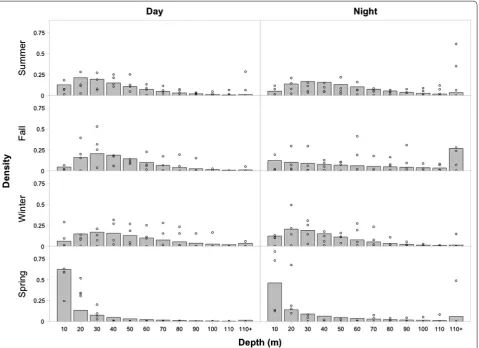
period and season significantly improved fitting to the Chinook depth data (compared to the null model), but season more substantially improved the model than diel period (Fig. 4). However, the interaction of season and diel period significantly improved the model more than either of the factors alone (Table 3). The season/diel period model output exhibited greater 50, 70, and 90% occupancy depths at night than during the day in all sea-sons except winter (Table 4). This represents a deeper and more variable depth distribution at night than day in summer, fall, and spring (Fig. 4).
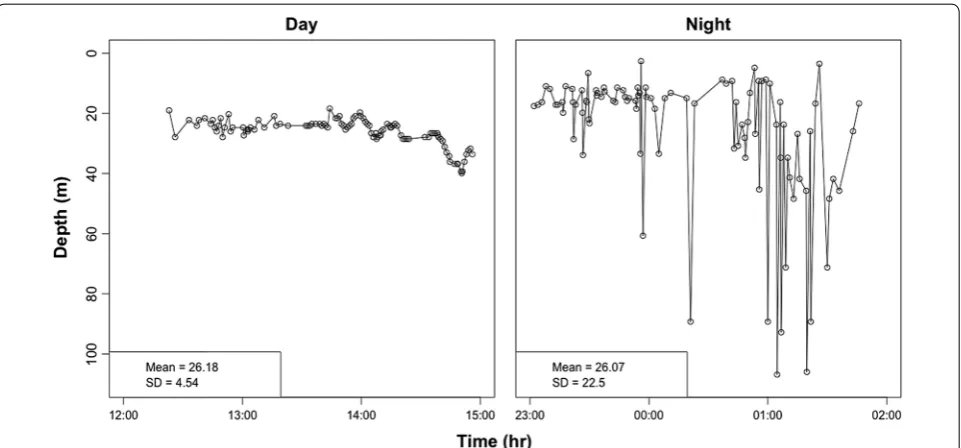
The more even (i.e., variable) depth distributions in one diel period versus the other indicated DAPs (Table 4; Figs. 2, 3, 4). Daytime distributions with a shallow mode were fish confining their movements to a small depth range closer to the surface than the bottom (Figs. 4, 5). In contrast, nighttime distributions with more equal proportions across all depth bins represent bounce div-ing (repeated, brief vertical movements) by Chinook salmon (Figs. 4, 5). While the frequency and amplitude of these dives varied, both the preliminary analyses and the model indicated that this behavior primarily occurred at night (Figs. 3, 4). The juxtaposition of shallow and confined daytime movements with nighttime bounce diving, particularly in summer and fall (Fig. 4), revealed a DAP in the Chinook salmon depth distributions. In the model, this DAP was reversed in winter; during the
daytime, they occupied deeper sections of the water col-umn, resulting in a more even distribution than at night (Fig. 4). The preliminary analysis exhibited a shallower median nighttime than daytime mean depth in the winter (Fig. 2); however, it did not detect a difference in depth variation between day and night (Fig. 3). Regardless, both methods demonstrated a reverse in the DAP during the winter; Chinook salmon shifted their depth distribution higher in the water column at night (Figs. 2, 4).
Discussion
The depth distribution of subadult Chinook salmon var-ied seasonally and revealed diel activity patterns. Con-ventional methods demonstrated that median mean and standard deviation of depth were higher at night in all seasons, except winter, and the Gamma-Dirichlet method linked the underlying cryptic differences in depth distri-butions to DAPs. The contrast of a more variable and deeper depth distribution at night strongly overlapping with a less variable and shallower depth distribution dur-ing the day, and the reverse in winter, shows that Chinook salmon do not exhibit classically defined DVM, confirm-ing the conclusions of Smith et al. [13]. Consistent with our DAP findings, Candy and Quinn [27] found that dur-ing the summer in Johnstone Strait, British Columbia, Canada, Chinook salmon swam deeper and had greater rates of vertical movement during the night than day. The
notable nighttime bounce diving by Chinook salmon in summer and fall may result from them ascending to feed on prey that undergo nighttime DVM toward the surface [28, 29] and then descending to avoid marine mammal predators including harbor seals [30, 31] and southern resident killer whales [32, 33]. However, we did not test any behavioral hypotheses to explain the DAPs, and their ecological purpose requires further examination.
The Chinook salmon DAPs found in this study, con-ducted in interior marine areas, exhibit both simi-larities and differences to vertical movement patterns documented in earlier studies of Chinook salmon and other Pacific salmonids. Walker and Myers [34] observed an immature aged 1.2 (1 freshwater and 2 ocean winters) Chinook salmon rearing in the Bering Sea that similarly exhibited seasonally variable vertical movement behavior. In the summer, this fish was surface-oriented at night and
underwent vertical movements into deeper water dur-ing the day [34]. It then reversed its pattern in the winter by becoming surface-oriented during the day and under-going deeper movement at night [34]. These intra-sea-sonal movement patterns in the Bering Sea are opposite of the DAPs we observed in Puget Sound in the summer and winter. However, both the fish in Walker and Myers’ study [34] and the ones in this work reversed their move-ment pattern between these two seasons, suggesting that this inter-seasonal reversal in vertical movement behavior may be a characteristic trait of Chinook salmon. Steelhead, coho, pink, chum, and sockeye salmon in the North Pacific Ocean in spring and summer were surface-oriented at night and deeper during the day [35, 36], contrasting with the DAPs by subadult Chinook salmon we documented in those seasons. In interior marine waters between Vancou-ver Island and the British Columbia mainland, adult sock-eye salmon homing to the Fraser River in summer were documented swimming in shallower water at night and deeper water during the day [37]. A subsequent study on sockeye salmon in that same area reported different diel patterns in the two study years [38], revealing the need to continue investigating the complexities of movement behavior. Further interspecific comparisons of seasonal and diel vertical movement patterns in the marine envi-ronment would be enabled by the collection of more long-term data on all of the Pacific salmonids [19, 20].
Fig. 3 Individual standard deviation in depth. Box plots of the individual standard deviation in depth for the Chinook salmon distributions (n= 4) in each season/diel period. These calculations are based off of all the raw depth detections for each individual fish in the corresponding season/diel period. Daytime and nighttime boxes are white and gray, respectively. Detections from >110 m were changed to exactly 110 m due to the depth limitation of the acoustic tags, making these calculations conservative
Table 3 Model comparison
Akaike information criterion (AIC), number of parameters, and ΔAIC for each of the four models tested
Model AIC # of parameters ΔAIC
Season/diel period −6709.52 24 0.00
Season −6662.46 12 47.06
Diel period −6521.04 6 188.48
The cryptic day–night differences, consistent with DAPs, of Chinook salmon vertical movements highlight the necessity of analyzing the entire distribution of depth
data. Smith et al. [13] reduced variation in the dataset by calculating model predicted average depths derived from hourly means and detected the strong seasonal variation but not the subtle diel variation in depth distribution for Chinook salmon in Puget Sound, WA. Additionally, the framework employed by Smith et al. [13] addressed sea-sonal variation in depth and DVM, but not DAPs. The 12 Chinook salmon we incorporated into the model were the same fish used in Smith et al. [13], but some of which had generated additional detection data between the end of their study and the beginning of ours. However, the addition of more recent data is not responsible for our supplementary conclusions. Instead, our framework and method inclusive of and capable of differentiating diverse DAPs enabled us to provide more information on Chi-nook salmon vertical movement behavior.
When changes in depth distribution are particularly pronounced, standard metrics may reveal significant dif-ferences across seasons and/or diel periods. For example,
Fig. 4 Modeled depth distributions. Modeled depth distributions by bin under the best fitting model (season/diel period). Numbers on the x-axis refer to the deep end of a depth bin (i.e., 10 represents 0–10 m) except for the last bin, which covers all depths greater than 110 m. Empty black circles mark the actual observed values in each bin from the individual distributions (n= 4) contributing to each subdivision of the model
Table 4 Model predicted depth occupancy
Season/diel period model predicted depths (m) of 50, 70, and 90% occupancy. Depth of percent occupancy is defined as the depth above which the specified cumulative percentage of the distribution occurs. Note that if the predicted depth occurred deeper than 110 m, it was reported here conservatively as “>110” due to the depth limitation of the acoustic tags
50% Spring Summer Fall Winter
Day 5.1 28.0 34.5 37.8
Night 12.2 39.0 56.8 29.0 70%
Day 15.0 41.1 46.8 53.7
Night 31.1 54.8 100.4 42.6 90%
Day 45.5 66.2 69.1 83.6
the calculation of mean depths (seasonally, diurnally, hourly, etc.) is a common analysis in telemetry stud-ies, but it can oversimplify vertical movement behavior, and its visual representation does not provide the actual shape of the depth distributions. While mean depths and other metrics can and have revealed much about vari-ous species [39–45], they should be accompanied by the analysis and display of full depth distributions that will augment discovery and proper classification of cryp-tic vercryp-tical movement behavior. The Gamma-Dirichlet method employed in this paper utilizes a holistic analy-sis and presentation of entire depth distributions, thereby enabling detection of particularly fine differences that may otherwise be lost if investigated solely with a stand-ard metric.
Modeling depth distribution data with the Gamma-Dirichlet combination provides substantial benefits in terms of design flexibility and analytical resolution. First, the Dirichlet can estimate proportions over an infinite number of components [46], meaning that few or many depth bins may be used when fitting the gamma. By calculating the αk of each bin from the αmult and pˆ(k) ,
parameterization in each model subdivision is minimized and kept constant. Second, the depth bins may be of any width and need not all be the same width as each other.
Bin width can be expanded or reduced depending upon the depth recorder’s resolution and accuracy, and the degree of data coverage. Tags that either record data in bins of varying sizes or that have depth-related limita-tions are also accommodated by the distribution combi-nation demonstrated here. In conjunction, these flexible aspects of the Gamma-Dirichlet method not only allow the researcher to analyze depth distributions with as much or as little resolution as is desired (and appropri-ate), but also support the application of this approach to species in different vertical habitats.
For many aquatic species, telemetry studies are ideal for answering questions related to seasonal and diel depth patterns. The primary questions must include: (1) is the depth distribution seasonally variable, (2) does the organ-ism undergo DVM, (3) if it does not undergo DVM, does it follow a DAP, and (4) if it follows a DAP, what is the difference in day–night vertical movement behavior? The framework employed in this paper and the method that assesses the whole depth distribution allow all of these questions to be answered and thoroughly describe the vertical movements of the target species. Future studies should consider using such a framework to describe the seasonal and diel variability in vertical depth distribution and relate it to horizontal movements when appropriate.
Abbreviations
AIC: Akaike information criterion; DVM: diel vertical migration; DAP: diel activ-ity pattern; SD: standard deviation.
Authors’ contributions
MCA developed the Gamma-Dirichlet method, analyzed and interpreted the data, and wrote the manuscript. TEE helped develop the Gamma-Dirichlet method and contributed to manuscript preparation. TPQ obtained funding for the project, coordinated fieldwork and data management, and contributed to manuscript preparation. All authors read and approved the final manuscript.
Acknowledgements
We thank Kurt Fresh, Anna Kagley, Dawn Spilsbury-Pucci, Scott Veirs, and Fred Goetz for receiver deployment and retrieval, fish tagging, and data manage-ment. We also thank the Pacific Ocean Shelf Tracking (POST) Project, the Ocean Tracking Network (OTN), Beam Reach, the U.S. Army Corps of Engineers, and the NOAA Northwest Fisheries Science Center (NWFSC) for receiver deployment, retrieval, and maintenance. We thank Joe Smith for data maintenance, analytical insight, and figure design assistance. We also thank Trevor Branch, Curry Cun-ningham, and Rachel Hovel for useful discussions regarding model design and comparison, Kelly Andrews for reviewing the manuscript prior to submission, and Tim Walsworth, Christine Stawitz, Pamela Moriarty, Laura Koehn, and par-ticularly Michael Vlah for helpful comments on various facets of the work.
Availability of data and materials
The dataset supporting the conclusions of this article is included within the article.
Competing interests
The authors declare that they have no competing interests.
Ethics approval and consent to participate
Permits for the deployment of receivers were obtained from NOAA-Fisheries, the Washington Department of Natural Resources, Washington Department of Fish and Wildlife, and San Juan County. Permits for the capture and handling of fish were obtained from NOAA-Fisheries, the Washington Department of Fish and Wildlife, and the University of Washington’s IACUC.
Funding
Funding for this project was provided by the Washington State Recreation and Conservation Office, NOAA-Fisheries, the Clarence H. Campbell Endowed Lauren Donaldson Scholarship in Ocean and Fishery Sciences, the Achievement Rewards for College Scientists (ARCS) Foundation Seattle Chapter via the Barton family, and the H. Mason Keeler and Richard and Lois Worthington endowments.
Received: 22 September 2016 Accepted: 15 December 2016
References
1. Brill RW, Block BA, Boggs CH, Bigelow KA, Freund EV, Marcinek DJ. Hori-zontal movements and depth distribution of large adult yellowfin tuna (Thunnus albacares) near the Hawaiian Islands, recorded using ultrasonic telemetry: implications for the physiological ecology of pelagic fishes. Mar Biol. 1999;133:395–408.
Additional files
Additional file 1. Gamma-Dirichlet (Arostegui et al.).R Gamma-Dirichlet Method Code: This is the R code we utilized to analyze our binned detection data with the Gamma-Dirichlet method. It utilizes our dataset, provided in additional file 2, to fit and compare the models.
Additional file 2. Binned_Detection_Data (Arostegui et al.).csv. Binned Detection Data: This is the dataset we utilized in the manuscript and ana-lyzed with the Gamma-Dirichlet method. It consists of the four individual Chinook salmon depth distributions from each season/diel period.
2. Gorsky D, Zydlewski J, Basley D. Characterizing seasonal habitat use and diel vertical activity of lake whitefish in Clear Lake, Maine, as determined with acoustic telemetry. Trans Am Fish Soc. 2012;141:761–71.
3. Kraus RT, Secor DH, Wingate RL. Testing the thermal-niche oxygen-squeeze hypothesis for estuarine striped bass. Environ Biol Fish. 2015;98:2083–92.
4. Carlisle AB, Kochevar RE, Arostegui MC, Ganong JE, Castleton M, Schratwieser J, Block BA. Influence of temperature and oxygen on the distribution of blue marlin (Makaira nigricans) in the Central Pacific. Fish Oceanogr. 2017;26:34-48.
5. Nelson DR, McKibben JN, Strong WR Jr, Lowe CG, Sisneros JA, Schroeder DM, Lavenberg RJ. An acoustic tracking of a megamouth shark, Megachasma pelagios: a crepuscular vertical migrator. Environ Biol Fish. 1997;49:389–99.
6. Kamimura H, Mitsunaga Y. Temporal and spatial distributions of Biwa salmon Oncorhynchus masou subsp. by ultrasonic telemetry in Lake Biwa. Japan. Fisheries Sci. 2014;80:951–61.
7. Humston R, Ault JS, Larkin MF, Luo J. Movements and site fidelity of the bonefish Albula vulpes in the northern Florida Keys determined by acous-tic telemetry. Mar Ecol Prog Ser. 2005;291:237–48.
8. Sims DW, Southall EJ, Tarling GA, Metcalfe JD. Habitat-specific normal and reverse diel vertical migration in the plankton-feeding basking shark. J Anim Ecol. 2005;74:755–61.
9. Gleiss AC, Wright S, Liebsch N, Wilson RP, Norman B. Contrasting diel patterns in vertical movement and locomotor activity of whale sharks at Ningaloo Reef. Mar Biol. 2013;160:2981–92.
10. Ishida Y, Yano A, Ban M, Ogura M. Vertical movement of a chum salmon Oncorhynchus keta in the western North Pacific Ocean a determined by a depth-recording archival tag. Fish Sci. 2001;67:1030–5.
11. Sims DW, Wearmouth VJ, Southall EJ, Hill JM, Moore P, Rawlinson K, Hutchinson N, Budd GC, Righton D, Metcalfe JD, Nash JP, Morritt D. Hunt warm, rest cool: bioenergetics strategy underlying diel vertical migration of a benthic shark. J Anim Ecol. 2006;75:176–90.
12. Harrison PM, Gutowsky LFG, Martins EG, Patterson DA, Leake A, Cooke SJ, Power M. Diel vertical migration of adult burbot: a dynamic trade-off among feeding opportunity, predation avoidance, and bioenergetic gain. Can J Fish Aquat Sci. 2013;70:1765–74.
13. Smith JM, Fresh KL, Kagley AN, Quinn TP. Ultrasonic telemetry reveals seasonal variation in depth distribution and diel vertical migrations of sub-adult Chinook and coho salmon in Puget Sound. Mar Ecol Prog Ser. 2015;532:227–42.
14. Morrison JM, Codispoti LA, Smith SL, Wishner K, Flagg C, Gardner WD, Gaurin S, Naqvi SWA, Manghnani V, Prospoerie L, Gundersen JS. The oxygen minimum zone in the Arabian Sea during 1995. Deep-Sea Res II. 1999;46:1903–31.
15. Catul V, Gauns M, Karuppasamy PK. A review on mesopelagic fishes belonging to family Myctophidae. Rev Fish Biol Fish. 2011;21:339–54. 16. Comfort CM, Weng KC. Vertical habitat and behavior of the bluntnose
sixgill shark in Hawaii. Deep-Sea Res II. 2015;115:116–26.
17. Weng KC, Block BA. Diel vertical migration of the bigeye thresher shark (Alopias superciliosus), a species possessing orbital retia mirabilia. Fish Bull. 2004;102:221–9.
18. Goodyear CP, Luo J, Prince ED, Hoolihan JP, Snodgrass D, Orbesen ES, Serafy JE. Vertical habitat use of Atlantic blue marlin Makaira nigricans: interaction with pelagic longline gear. Mar Ecol Prog Ser. 2008;365:233–45. 19. Drenner SM, Clark TD, Whitney CK, Martins EG, Cooke SJ, Hinch SG. A
synthesis of tagging studies examining the behavior and survival of ana-dromous salmonids in marine environments. PLoS ONE. 2012;7:e31311. 20. Walker RV, Sviridov VV, Urawa S, Azumaya T. Spatio-temporal variation
in vertical distributions of Pacific salmon in the ocean. N Pac Anadr Fish Comm Bull. 2007;4:193–201.
21. Arostegui MC, Smith JM, Kagley AN, Spilsbury-Pucci D, Fresh KL, Quinn TP. Spatially clustered movement patterns and segregation of sub-adult Chinook salmon within Puget Sound, Washington and the Salish Sea. Mar Coast Fish. 2016 (in press).
22. Rise/Set/Transit/Twilight Data. Astronomical Applications Department of the US Naval Observatory, Washington, D.C. 2015. http://aa.usno.navy. mil/data/docs/RS_OneYear.php. Accessed Oct 2015.
• We accept pre-submission inquiries
• Our selector tool helps you to find the most relevant journal • We provide round the clock customer support
• Convenient online submission • Thorough peer review
• Inclusion in PubMed and all major indexing services • Maximum visibility for your research
Submit your manuscript at www.biomedcentral.com/submit
Submit your next manuscript to BioMed Central
and we will help you at every step:
24. Byrd RH, Lu P, Nocedal J, Zhu C. A limited memory algorithm for bound constrained optimization. SIAM J Sci Comput. 1995;16:1190–208. 25. Warnes GR, Bolker B, Lumley T. gtools: Various R programming tools. R
package version 3.5.0. 2015. https://cran.rproject.org/web/packages/ gtools/index.html.
26. R Development Core Team. R: a language and environment for statistical computing. R Foundation for Statistical Computing. Vienna, Austria. 2008. 27. Candy JR, Quinn TP. Behavior of adult Chinook salmon (Oncorhynchus
tshawytscha) in British Columbia coastal waters determined from ultra-sonic telemetry. Can J Zool. 1999;77:1161–9.
28. Thorne RE, Thomas GL. Acoustic observations of gas bubble release by Pacific herring (Clupea harengus pallasi). Can J Fish Aquat Sci. 1990;47:1920–8.
29. Dagg MJ, Frost BW, Newton J. Diel vertical migration and feeding in adult female Calanus pacificus, Metridia lucens, and Pseudocalanus newmani during a spring bloom in Dabob Bay, a fjord in Washington USA. J Marine Syst. 1998;15:503–9.
30. Wright BE, Riemer SD, Brown RF, Ougzin AM, Bucklin KA. Assessment of harbor seal predation on adult salmonids in a Pacific Northwest estuary. Ecol Appl. 2007;17:338–51.
31. Bromaghin JF, Lance MM, Elliott EW, Jeffries SJ, Acevedo-Gutiérrez A, Kennish JM. New insights into the diets of harbor seals (Phoca vitulina) in the Salish Sea revealed by analysis of fatty acid signatures. Fish Bull. 2013;111:13–26.
32. Ford JKB, Ellis GM. Selective foraging by fish-eating killer whales Orcinus orca in British Columbia. Mar Ecol Prog Ser. 2006;316:185–99. 33. Hanson MB, Baird RW, Ford JKB, Hempelmann-Halos J, Van Doornik
DM, Candy JR, Emmons CK, Schorr GS, Gisborne B, Ayres KL, Wasser SK, Balcomb KC, Balcomb-Bartok K, Sneva JG, Ford MJ. Species and stock identification of prey consumed by endangered southern resident killer whales in their summer range. Endanger Species Res. 2010;11:69–82. 34. Walker RV, Myers KW. Behavior of Yukon River Chinook salmon in the
Ber-ing Sea as inferred from archival tag data. N Pac Anadr Fish Comm Bull. 2009;5:121–30.
35. Manzer JI. Preliminary observations on the vertical distribution of Pacific salmon (Genus Oncorhynchus) in the Gulf of Alaska. J Fish Res Board Can. 1964;21:891–903.
36. Walker RV, Myers KW, Davis ND, Aydin KY, Friedland KD, Carlson HR, Boehlert GW, Urawa S, Ueno Y, Anma G. Diurnal variation in thermal environment experienced by salmonids in the North Pacific as indicated by data storage tags. Fish Oceanogr. 2000;9:171–86.
37. Quinn TP, Terhart BA, Groot C. Migratory orientation and vertical move-ments of homing adult sockeye salmon, Oncorhynchus nerka, in coastal waters. Anim Behav. 1989;37:587–99.
38. Drenner SM, Hinch SG, Martins EG, Robichaud D, Clark TD, Thompson LA, Patterson DA, Cooke SJ, Thomson RE. Variable thermal experience and diel thermal patterns of homing sockeye salmon in coastal marine waters. Mar Ecol Prog Ser. 2014;496:109–24.
39. Watkins WA, Daher MA, DiMarzio NA. Sperm whale dives tracked by radio tag telemetry. Mar Mamm Sci. 2002;18:55–68.
40. Mitamura H, Mitsunaga Y, Arai N, Yamagishi Y, Khachaphichat M, Viputha-numas T. Horizontal and vertical movement of Mekong giant catfish Pangasianodon gigas measured using acoustic telemetry in Mae Peum Reservoir, Thailand. Fish Sci. 2008;74:787–95.
41. Polovina JJ, Hawn D, Abecassis M. Vertical movement and habitat of opah (Lampris guttatus) in the central North Pacific recorded with pop-up archival tags. Mar Biol. 2008;153:257–67.
42. Dunstan AJ, Ward PD, Marshall NJ. Vertical distribution and migration patterns of Nautilus pompilius. PLoS ONE. 2011;6:e16311.
43. Potter IF, Howell WH. Vertical movement and behavior of the ocean sunfish, Mola mola, in the northwest Atlantic. J Exp Mar Biol Ecol. 2011;396:138–46.
44. Andrews KS, Quinn TP. Combining fishing and acoustic monitoring data to evaluate the distribution and movements of spotted ratfish Hydrolagus colliei. Mar Biol. 2012;159:769–82.
45. Carlson AE, Hoffmayer ER, Tribuzio CA, Sulikowski JA. The use of satellite tags to redefine movement patterns of spiny dogfish (Squalus acanthias) along the U.S. east coast: implications for fisheries management. PLoS ONE. 2014;9:e103384.