ORIGINAL ARTICLE
Rashmi Kumari · Hirokazu Ito · Masahiro Takatani Miho Uchiyama · Tadashi Okamoto
Fundamental studies on wood/cellulose–plastic composites: effects of
composition and cellulose dimension on the properties of cellulose/PP
composite
Abstract Although wood/cellulose–plastic composites (WPC) of low wood/cellulose content have been more ac-cepted worldwide and are promoted as low-maintenance, high-durability building products, composites containing high wood/cellulose content are not yet developed on an industrial scale. In this study, fl ow properties, mechanical properties, and water absorption properties of the com-pounds of cellulose microfi ber/polypropylene (PP) and maleic anhydride-grafted polypropylene (MAPP) were in-vestigated to understand effects of the high cellulose con-tent and the dimensions of the cellulose microfi ber. The molding processes studied included compression, injection, and extrusion. It was found that fl uidity is not only depen-dent on resin content but also on the dimension of the fi ller; fl uidity of the compound declined with increased fi ber length with the same resin content. Dispersion of the composite was monitored by charge-coupled device (CCD) microscope. Increasing the plastic content in the cellulose– plastic formulation improved the strength of mold in addi-tion to the bond development between resin and fi ller, and the tangle of fi bers. The processing mode affected the physicomechanical properties of the cellulosic plastic. Compression-molded samples exhibited the lowest modu-lus of rupture (MOR) and modumodu-lus of elasticity (MOE) and the highest water absorption, while samples that were injec-tion-molded exhibited the highest MOR (70 MPa) and MOE (7 GPa) and low water absorption (2%).
Key words Cellulose–plastic composite · Compression · Extrusion · Injection molding · High wood content
R. Kumari · M. Takatani · M. Uchiyama · T. Okamoto (*)
Department of Applied Bioscience, Graduate School of Agriculture, Kinki University, Nakamachi, Nara 631-8505, Japan
Tel. +81-74-243-7383; Fax +81-74-243-8976 e-mail: [email protected] H. Ito
Material Developing Section, Product Developing Department, Yamaha Livingtec Corporation, Hamamatsu 432-4001, Japan
Introduction
In recent years, interest in composites based on renewable materials has grown tremendously because of social re-quests for low environmental stress, low-maintenance and high-durability products, and ultraviolet (UV) durability.1–3
Construction, transportation, industrial, and consumer ap-plications for wood/cellulose–plastic composites (WPC) are all on the rise. WPC have been primarily produced with a low and medium percentage of wood/cellulose. Products typically contain approximately 50% (by weight) wood/ cellulose, although some composites contain very little wood/cellulose and others as much as 60%.1,4–7
Wood/ cellulose content may range from 70% to 90% and the interfacial adhesion between wood/cellulose particles and polymers can be improved by adding a compatibilizer. One of the major challenges for WPC is to optimize the content of the wood/cellulose in WPC to reduce costs and compete with solid wood and engineered wood composite products.
Cellulose, one of the basic structural components of wood fi bers, has great potential for the preparation of novel composite materials with thermoplastic resins. However, the highly polar nature of the cellulose surface does not lend itself to strong interactions with the nonpolar polymer, such as polypropylene (PP).8,9 Various fi ber surface
patibilizers have been reported, such as silane, alkali, com-bination of alkali and silane, monomer grafting under UV radiation, maleic anhydride-grafted polypropylene, and others.8–11 Among these treatments, coupling agent maleic
anhydride-grafted polypropylene (MAPP) has been found to be the most effi cient in improving the mechanical proper-ties of cellulose composite materials.
However, extruded WPC are a relatively new product for which market growth has been rapid. The engineering design of extrusion operations requires proper knowledge of the fl ow mechanism of these highly fi lled melts. The WPC formulations also require reliable evaluation of fl ow perfor-mance of the composite melts. Rheological characterization affords knowledge about both the fundamental fl ow
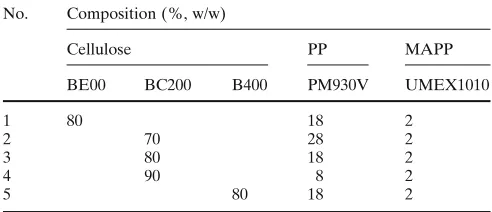
compression molding. Extruded strands were also pellet-ized and the temperatures from cylinder 1 to cylinder 4 were decreased from 230° to 180°C. Pellets were used for extrusion-molding and injection-molding composites. Crushed pellets used for injection samples were also pre-pared with the addition of 2% (w/w) calcium stearate as a lubricant. The compositions of cellulose powder, PP and MAPP are listed in Table 2.
Molding process
Three molding processes commonly used for thermoplastics were used to make test specimens of cellulose/PP/MAPP for studying the effect of molding on the physicomechanical properties of the corresponding cellulosic plastics.
Compression molding
The specimens for mechanical tests were prepared by com-pression molding with an oil hydraulic press HP-1B-P (method A) at 200°C. Other press conditions were set to provide the best opportunity to reach the theoretical density. The theoretical density was calculated on the basis of weight percent and the density of components.
Specimens were cut from the sheets of the cutter mill compound molded by method A (AC) and the hammer mill compound molded by method A (AH). The blends were also compression-molded using a steel mold (mold dimen-sions 1 × 8 × 10 cm) by a Shinto hot press model HCC-BSN-2 (method B) at HCC-BSN-2HCC-BSN-20°C and 11 MPa for 5 min, before being cooled to room temperature. Tefl on fi lms were used to avoid the adhesion of MAPP to the stainless surface of the mold. Twelve standard specimens (dimensions 1 × 2.5 × 10 cm3
) were cut from the sheets of the cutter mill sample molded by method B (BC).
ior of the highly fi lled plastics and practical methods for evaluating the fl ow performance for process development. The technical challenges are to overcome fl ow problems, the low bulk density of the wood/cellulose as well as separa-tion problems of the composite mixture. Therefore, advanc-ing this area of knowledge for this new material class is important for further developments of the science and industry.4,12–14
In this article, a study of the properties of composites made of cellulose microfi bers and random PP is reported. Composites prepared with different fi ber lengths of cellu-lose and with the different content (70%, 80% and 90%) were studied. A study on the mechanical and water absorp-tion of compression-, extrusion-, and injecabsorp-tion-molded com-posites is presented here. Melt fl ow characteristics such as melt index, have been studied with special reference to the effect of blend ratio, cellulose fi ber length, temperature, and diameter of die hole. The effect of the different fi ber length and content of cellulose on the morphology and wa-ter absorption of the composites is discussed. Finally, our ultimate aim is to make clear the possibility of the prepara-tion of composites with very high wood/cellulose content.
Experimental
Materials
The materials used in this study were cellulose, a thermo-plastic polymer, polypropylene (PP), and the coupling agent MAPP, which is polypropylene modifi ed with maleic acid. The thermoplastic polymer was a random PP (PM930V, MFI 30 g/10 min, density 0.9 g/cm3) supplied by SunAllomer (Tokyo, Japan). Three different shapes and sizes of fi brous cellulose (BE00, BC200, B400) were products of Retten-maier and Söhne (Rosenberg, Germany), produced from softwood. The basic properties of all the cellulose powders are listed in Table 1. The coupling agent was MAPP (umex1010) obtained from Sanyo Kasei (Tokyo, Japan).
Blending procedure
The cellulose fi bers, PP, and MAPP were sequentially fed into a conical twin-screw extruder (Model Taitan 80, Cin-cinnati). The temperature profi le of the extruder from cyl-inder 1 through cylcyl-inder 4 was kept between 230° and 180°C and the extruder was operated at a screw speed of 7 rpm. After compounding, the composite was then crushed into a cutter mill (wood grinder) or hammer mill and used for
Table 1. Basic properties of all cellulose powders
Cellulose Color Structure Fiber length Fiber diameter Bulk density
(mm) (mm) (g/l)
BE00 White Short fi ber 120 20 150–180
BC200 White Medium fi ber 300 20 60–80
B400 White Long fi ber 900 20 20–40
Table 2. Composition of cellulose powder, polypropylene (PP), and
maleic anhydride-grafted polypropylene (MAPP) No. Composition (%, w/w)
Cellulose PP MAPP
BE00 BC200 B400 PM930V UMEX1010
1 80 18 2
2 70 28 2
3 80 18 2
4 90 8 2
Extrusion molding
Pellets were extruded as thick long sheets in this process. Pellets were fed into a conical twin-screw extruder (Titan 68, Taiyo Gosei, Kagawa, Japan). The molding conditions were as follows: temperatures on cylinder 1 to cylinder 4 were held between 215° and 170°C and the temperature of exit die from heating zone to cooling zone declined from 175° to 45°C from the heating zone to the cooling zone. The extruder was operated at a screw speed of 5 rpm. The result-ing sheets were cut lengthwise (EL) and widthwise (EW) to make the test specimens.
Injection molding
The injection molder used was a Roboshot a-100C (Fanac). The molding conditions are listed in Table 3. The resulting dumbbell-shaped mold without lubricant (IX) and mold with lubricant (IO) were used appropriately to test me-chanical properties. A regular injection nozzle was used, with a nozzle diameter of 2 mm.
Melt fl ow index
Melt fl ow index (MFI, weight of polymer in grams extruded in 10 min through a capillary), was determined using a Dy-nisco melt fl ow indexer LMI 4000 series in accordance with Japan Industrial Standards (JIS) K 7210. The applied loads and dice diameters were 5 and 10 kg, and 6 and 7 mm, re-spectively. The measurement was carried out at 230°C.
Mechanical test
The small rectangular specimens were tested on a Shinto Model TCM-500 and the load–defl ection curve was deter-mined. The support span depended on the length of the mold and the crosshead speed was 5.0 mm/min. At least 12 specimens were tested for each composite in accordance with JIS A5908. All specimens showed a yielding fracture mode. The modulus of rupture (MOR) and modulus of elasticity (MOE) were calculated from the load–defl ection curve. The MOR was defi ned as the fi rst point on the load– defl ection curve to show a slope of zero. The MOE was determined from the slope in the initial elastic region of the load–defl ection curve.
Water absorption test
The samples based on increasing fi ber length, diameter, and cellulose content of compression molding were tested for water absorption for 0 to 24 h under atmospheric pressure at room temperature. Water absorption in weight gain (Wt), and thickness gain (T h) were calculated by Eqs. 1 and 2, respectively:
Wt = (W1− W0)/W0 (1)
T h = (t1− t0)/t0 (2)
where W1, W0, t1, and t0 are the weight of the composite
containing water, weight of the dried composite, thick-ness of wet composite, and thickthick-ness of dry composite, respectively.
Morphology of composites
Microscope images of cellulose fi ber of fi ber length 120, 300, and 900 µm and the fractured surface after mechanical test-ing were taken ustest-ing CCD Moritex Inf 500 DA at different magnifi cations.
Results and discussion
Possibility of compression, injection, and extrusion molding
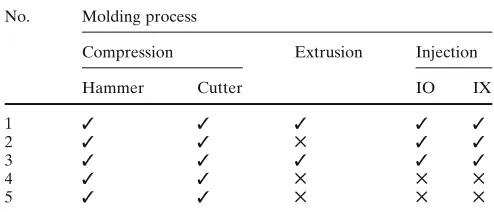
Table 4 illustrates the feasibility of compression, injection, and extrusion molding. It is noted that the feasibility is highly dependent on both the fi ber content and length of fi ber. Unfortunately, feasibility studies on extrusion molding and injection molding of the highly loaded wood/ cellulose plastics are scarce in the open literature. Two ex-trusion-molded composites and three injection-molded composites have been developed.
Melt fl ow rate
Flowability of compound is one of the most important fac-tors to be considered when establishing injection molding and extrusion molding.4,15 Figures 1 and 2 show the experi-mental results obtained for the melt fl ow index of pellets. The melt fl ow rate provides valuable information about the Table 3. Molding conditions of injection mold
No.a Lubricant (%) Injection time (s) Nozzle Peak pressure temperature (°C) (MPa)
1 IX 0 0.29 210 29.6
IO 2 0.30 195 29.4
2 IX 0 0.57 185 22.7
IO 2 0.60 185 23.9
3 IX 0 0.29 210 29.5
IO 2 0.31 195 29.5
fl ow behavior of materials. MFI experiments were done at 230°C. It was found that the MFI value decreased with an increase of cellulose content because the incorporation of rigid material to the polymeric matrixes limited their free mobility and increased the material apparent viscosity. For-mulations with 15% and 10% resin loadings did not fl ow and MFI values were unable to be measured. Caraschi and
Leão16
obtained similar results in which the increase of fi ber amount decreased the MFI value. On the other hand,
300-µm fi ber length cellulose pellets showed lower values than 120-µm cellulose pellets. For each pellet, an increase in dice diameter increased the melt fl ow, especially with 10-kg load. With 5-kg load, the 20% resin content compound could not be measured with 6-mm diameter. However, it could be measured with 7-mm dice. With 10-kg load, compound with 20% resin content could be measured with both dice of 6- and 7-mm diameter. The compound with 30% (w/w) resin content had remarkably low fl uidity relative to a general plastic material. Therefore, it was concluded that desirable conditions for measurement were 5-kg load/7-mm dice and 10-kg load/6-mm dice. A good extrusion-molded and injec-tion-molded composite could be obtained at this tempera-ture (230°C). However, degradation of cellulose fi bers starts at 180°C.17
Composite density Effect of resin content
Method A. Figure 3 presents the variations in the compos-ite density for formulations with different plastic content in compression, injection, and extrusion molding. When the resin content was 20% or less, the densities of hammer mill compounds were higher than those of cutter mill com-pounds, probably because the relative composition of component reinforcements, their aspect ratio, and also the extent of chemical modifi cation infl uences the overall rheo-logical behavior. Fluidity was low when the resin content was low. There was a tendency for the particle sizes of ham-mer mill compounds to be smaller than those of cutter mill compounds. As a result, the aspect ratio became larger for cutter mill fi ber. For this reason, the compound with the same resin content may have shown low fl uidity and caused the density difference of the composites AH and AC. Because the fl uidity was high for 30% resin content, there was little infl uence of the pulverization method on the den-sities of the composites. No remarkable relationship was Table 4. Feasibility of compression, injection, and extrusion molding
of compositions of cellulose fi ber/PP/MAPP
No. Molding process
Compression Extrusion Injection
Hammer Cutter IO IX
1 ✓ ✓ ✓ ✓ ✓
2 ✓ ✓ ✕ ✓ ✓
3 ✓ ✓ ✓ ✓ ✓
4 ✓ ✓ ✕ ✕ ✕
5 ✓ ✓ ✕ ✕ ✕
Ticks indicate that molding is feasible; crosses indicate that molding is not feasible
a Same as in Table 2 0
10 20 30 40 50 60 70 80
6mm 7mm 6mm 7mm
5kg 10kg
Dice diameter (mm) and applied load (kg)
Melt flow rate (g/10min)
70% 80%
Fig. 1. Melt fl ow indexes of pellets containing 300-µm-long cellulose
with different cellulose/plastic compositions. Error bars indicate stan-dard deviations. Filled bars, 70/28/2 cellulose/polypropylene (PP)/ maleic anhydride-grafted polypropylene (MAPP); open bars, 80/18/2 cellulose/PP/MAPP
0 10 20 30 40 50 60
6mm 7mm 6mm 7mm
5kg 10kg
Dice diameter (mm) and applied load (kg)
Melt flow rate (g/10min)
120µm 300µm
Fig. 2. Melt fl ow indexes of pellets with 80%/20% (w/w)
cellulose/plas-tic composition and different fi ber lengths. Error bars indicate standard deviations
0 0.5 1 1.5 2
AC AH BC EL EW IO IX
Composites
Density (g/cm
3)
70% 80% 90%
Fig. 3. Density of composites of different fi ber content of 300-µm
observed between the resin content and product density. Method A composite was prepared under a press condition setup to attain a density close to the theoretical density. Therefore, all press pressures and press times were differ-ent. When the resin content was high, the theoretical den-sity was attained at low pressure and with a short press time. However, high pressure was needed when the resin content was low. In this case, a compound of low fl uidity would be crushed during the molding process. If the fi ber shape changed during the molding process, the resin content may have affected various performances. On the other hand, press molding has merit that can be applied for a wide range of molding conditions. Therefore, a wide range of resin contents was selected to make composites by compression molding.
Method B. The densities of composites also decreased with increased cellulose content. Hence, the void ratio of these composites increased with increasing fi ber content. A pos-sible explanation for the voids is the movement of air from within the cell lumens to the cell wall–PP interface during compaction.18 Again, the fl uidities of the compounds were high when the resin content was high. Because method B molding was carried out under the constant press condi-tions, compounds of high fl uidity were expected to give more compact composites. The melt fl ow characteristic was peculiar for each formulation and could be estimated be-cause the technique used in this experiment exerted little infl uence, except on fl ow characteristics, on the various product performances.
Effect of fi ber length of cellulose
Figure 4 presents the density of composites from compres-sion, injection, and extrusion molding with different fi ber lengths and 80% fi ber content. A hammer mill produces fi ner powder than a cutter mill. Therefore, when the fi ber length was long, the hammer mill compound was more fi nely powdered, ensuring high melt fl uidity, and so the composite density was high. When fi ber length was short, this infl uence was not clear because the fi ber was originally small and fi ne. In addition, packing may have been infl u-enced by fi ber length. When fi bers were long, maximum
packing may have occurred with optimum particle size dis-tribution leading to high density, but such a conclusion can be only tentative with a density difference of this magni-tude. Composite density decreased when the fi ber length was increased.
Injection molding and extrusion molding
In the case of injection-molded composite without process-ing aids, the density decreased with increasprocess-ing plastic content. The density was reduced with lubricant at a fi ber content of 80%; hence, the processing aid developed some voids. Similar observations were made in the case of com-parison of fi ber length.
Mechanical test Compression molding
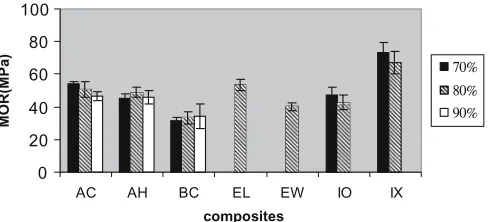
Method A. The effects of PP content on MOE and MOR of the cellulose/PP/MAPP composites are shown in Figs. 5 and 6, respectively. Having the compound crushed by a hammer mill tended to decrease the MOR with the increase of resin content from 20% to 30%. If the extent of phase separation was very severe, the strength of the materials
0 0.2 0.4 0.6 0.8 1 1.2 1.4 1.6
AC AH BC EL EW IO IX
Composites
Density(g/cm
3)
120µm 300µm 900µm
Fig. 4. Density of composites of different fi ber lengths of 80% fi ber
content and 20% plastic content. Error bars indicate standard deviations
0 20 40 60 80 100
AC AH BC EL EW IO IX
composites
MOR(MPa)
70% 80% 90%
Fig. 5. Effects of fi ber content on modulus of rupture (MOR) of
com-posites of 300-µm cellulose. Error bars indicate standard deviations. Filled bars, 70/28/2 cellulose/PP/MAPP; shaded bars, 80/18/2 cellulose/ PP/MAPP; open bars, 90/8/2 cellulose/PP/MAPP
0 2 4 6 8 10
AC AH BC EL EW IO IX
composites
MOE(GPa)
70% 80% 90%
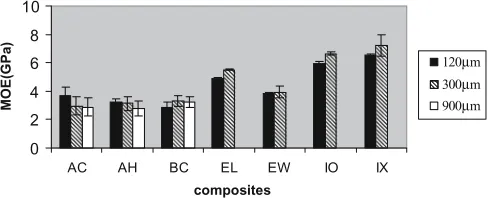
Fig. 6. Effects of fi ber content on modulus of elasticity (MOE) of
decreased.19
The MOR of cutter mill composite simultane-ously increased with an increase in PP content, suggesting that a relatively strong interaction exists between cellulose and PP.19
The cutter mill compound contained fi bers with a high average aspect ratio, and so they oriented easily under conditions of high fl uidity. Because the press pressure of method A was high, it was easy for a cutter mill compound to orient under high fl uidity press conditions with 30% resin content. The bending strength and the elastic modulus were high as expected. Because a compound of 20% resin con-tent had low fl uidity, the resulting composite did not differ much from the composite of hammer mill compound. In addition, the MOE of the composite AC decreased as the fi ber length of cellulose increased.
Method B. There was a tendency for the bending strength and the elastic modulus to decrease with the resin content, although the tendency was not remarkable.
Effect of fi ber length of cellulose
In Figs. 7 and 8, the enhancing effect of the fi ber length of cellulose in the mechanical properties is clearly shown. While 300- and 900-µm fi bers did not have much effect on MOE, the MOE of the composite BC increased as the fi ber length increased. However, the mechanical properties of composites with 900-µm fi ber length showed high variation (large standard deviation; SD). Because the fi bers were long, the resin did not disperse uniformly. There was also a suggestion of a lack of miscibility between cellulose and PP/MAPP.
Effect of method A, method B, injection and extrusion molding
Widthwise extrusion composite (EW) had lower MOR and MOE than those of the lengthwise extrusion composite (EL). The injection molding without lubricant (IX) had higher MOR and MOE than those of the injection molding with lubricant (IO). Composite BC had lower MOR and MOE than those of composite AH and composite AC because of low density. The volume of BC was high with plenty of voids, and as a result, bonding of the resin and fi bers was decreased. However, the injection molding without lubricant of 80% PP gave the highest MOR and MOE.
Water absorption Effect of resin content
Method A. As shown in Figs. 9 and 10, water absorption increased as the resin content decreased. It is considered that water absorption took place initially by permeating voids and by binding with cellulose. Therefore, molded composites with densities signifi cantly different from theo-retical densities may have undergone high water absorp-tion. Water absorption is also considered in the molded composite of near-theoretical density. This is explained in terms of water permeating through the part that has not
0 20 40 60 80
AC AH BC EL EW IO IX
composites
MOR(MPa)
120µm 300µm 900µm
Fig. 7. Effects of fi ber length on MOR of composites of 80% fi ber
content and 20% plastic content. Error bars indicate standard deviations
0 2 4 6 8 10
AC AH BC EL EW IO IX
composites
MOE(GPa)
120µm 300µm 900µm
Fig. 8. Effects of fi ber length on MOE of composites of 80% fi ber
content and 20% plastic content. Error bars indicate standard deviations
0 5 10 15 20 25
AC AH BC E IO IX
composites
Weight gain(%)
70% 80% 90%
Fig. 9. Effects of fi ber content on weight gain of composites of 300-µm
cellulose. Filled bars, 70/28/2 cellulose/PP/MAPP; shaded bars, 80/18/2 cellulose/PP/MAPP; open bars, 90/8/2 cellulose/PP/MAPP. E, Extru-sion molding. Error bars indicate standard deviations
0 5 10 15 20
AC AH BC E IO IX
composites
Thickness gain(%)
70% 80% 90%
Fig. 10. Effects of fi ber content on thickness gain of composites of
been combined with resin, and remains as cellulose-binding water and induces swelling of the composite. In addition to expansion due to the cellulose-binding water, a tangle of fi ber was destroyed with the water that permeated into the composite. Therefore, expansion of the molded com-posite was large for comcom-posites with high water absorption. The thickness swelling increased as the resin content decreased.
Method B. Water absorption increased as the resin content decreased. This composite was porous and contained many void spaces; hence, much water was absorbed. The ratio of water absorption to the theoretical void (measured density/ theoretical density) showed a parallel tendency. Because the composite did not absorb water completely when im-mersed in water for 24 h, it was expected to be similar the method A molded composite in that water had permeated between fi bers, and so on as above. The thickness swelling increased as the decrease of resin content. The factor con-trolling thickness swelling was the same as for method A molded composite. Therefore, a composite with high water absorption shows high expansion, and so on.
Effect of method A, method B, injection and extrusion molding
Method A molded composite had little water absorption and expansion compared with method B molded composite. The difference is explained on the basis of density differ-ence and void ratio. For the composites of 30% resin con-tent, thickness swelling per 1% of water absorption was larger for method A composite than for method B. Because the composite with 30% resin was high in resin, there were few fi bers that were not covered with resin. Therefore, when there are many voids inside the composite, cellulose/ PP/MAPP composite of high density tends to expand more by water absorption. Injection-molded samples showed the least water absorption. The values obtained for water ab-sorption in injection-molded composite with lubricant and without lubricant were similar. Although micrographs did not show a clear difference in this study, more coverage of fi ber by resin is expected for injection-molded composites.
Effect of fi ber length of cellulose
Figure 11 shows the trend in weight gain of increasing fi ber length of cellulose, while Fig. 12 represents the thickness gain of the increasing fi ber length of cellulose. Composite with fi ber length of 120 µm had low swelling per 1% of water absorption. Because fi ber length was short, tangles between fi bers were less developed. Water absorption was near the theoretical ratio of void, but because water absorp-tion for 24 h in water did not reach the saturaabsorp-tion level throughout the composite, it is thought that, like method A molded composite, water permeated into the space between fi bers. It was also observed that water absorption increased with an increase in fi ber length. Therefore, as the entangled
part of fi bers increased, inducing more clearance in the composite, the bonded part of fi bers with resin may have decreased. Method A molded composite had little void. Therefore, it is expected that water permeated and was ab-sorbed by the fi ber that was not bonded with resin. With longer fi bers, it is possible that the amount of fi ber not bonded with resin increased, which led to increased water absorption. The thickness swelling increased as the fi ber length become long; tangles of fi ber may have been de-stroyed with the permeated water, the water bound to cel-lulose may have increased, and the composite expanded. Therefore, longer fi bers with many tangles between fi bers may show high expansion.
Morphology of composites
Effect of resin content on the morphology of the fracture surface
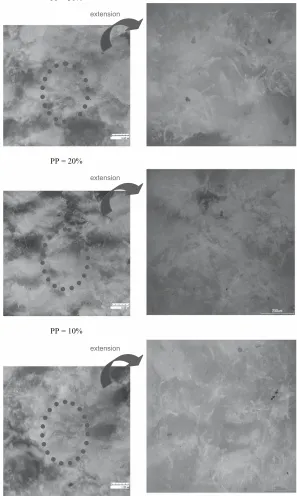
CCD micrographs of fractured surfaces of compression-molded composite containing 30%, 20%, and 10% PP are shown in Fig. 13. As the resin content decreased, more fl uff of fi ber was detected. The occurrence of fl uff is considered to be a starting point of fracture. This observation is more pronounced with composites of low resin content, so it is assumed that strength of the composite is maintained by tangles between fi bers. As the resin content decreased, more fi ber ball-like material was observed on the fracture surface. In composite with 30% PP, the fi ber was dispersed into the matrix and coated with PP. For the composite
0 5 10 15
AC AH BC E IO IX
composites
Weight gain(%)
120μm 300μm 900μm
Fig. 11. Effects of fi ber length on weight gain of composites of 80%
fi ber content and 20% plastic content. Error bars indicate standard deviations
0 2 4 6 8 10 12 14
AC AH BC E IO IX
composites
Thickness gain(%)
120µm 300µm 900µm
Fig. 12. Effects of fi ber length on thickness gain of composites of 80%
containing 10% PP, a fi brous particle of cellulose was partially covered by the PP, with part of the surface still not covered. This proves that a fully developed interfacial interaction was not developed in the 10% PP composite.
Effect of cellulose fi ber length on the morphology of the fracture surface
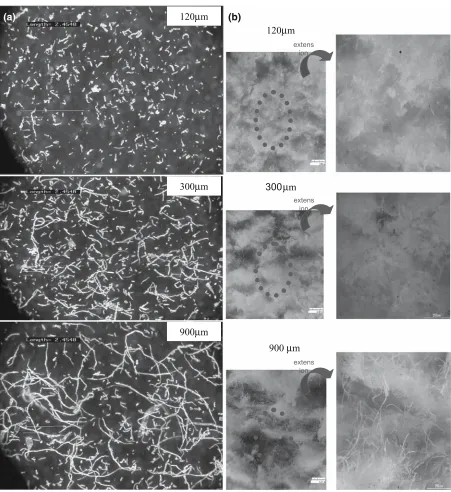
Microscope images of cellulose fi ber and fractured surfaces of compression-molded composite with increasing fi ber length of cellulose are shown in Fig. 14. When long fi bers
were present, they were conspicuous on the fracture face. A stratifi ed pattern was conspicuous on fracture sur-faces when fi bers were long. Fracture of composites took place at weak parts of the composite where fi bers were not been well bonded with resin. Fluff was more conspicuous for composites with long fi bers. On other hand, lamination also occurred when fi bers were long. This phenomenon should have some infl uence on the strength. The cellulose fi bers with fi ber lengths of 120, 300, and 900 µm partially changed into microparticles during melt-extrusion process-ing. In the case of 120-µm fi bers, homogeneity of the blend-ed mixture was observblend-ed, indicating that it should serve as a good polymer matrix.
extension PP = 10%
extension PP = 20%
extension PP = 30%
Fig. 13. Micrographs of fractured surfaces of
Effect of compression, injection, and extrusion molding
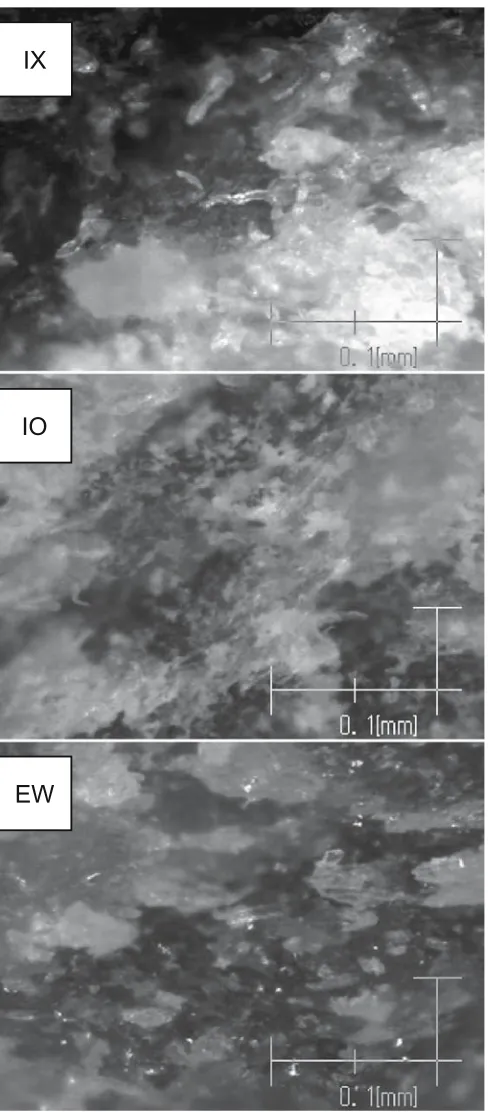
Micrographs of fractured surfaces of extrusion moldings and injection moldings are shown in Fig. 15. The interfacial interactions were limited in the compression-molding com-posites, probably because of a smaller number of ester bonds between highly fi brous cellulose and the MAPP/PP matrix.8,9 The micrographs of extrusion-molded composites
EW no. 1 composition (120 µm fi ber length, 80% cellulose) clearly show gaps and voids in the PP matrices as well as
along the cellulose fi bers, the surfaces of which are smooth and practically intact, and that there exist some aggregates of cellulose fi bers. Much improved distribution of particles of cellulose was found in the injection molding with lubri-cant IO and without lubrilubri-cant IX with 120-µm fi bers and 80% cellulose. The micrographs also reveal a marked im-provement in interfacial adhesion between cellulose parti-cles and the MAPP/PP matrix, which was brought about by increased area of surface contact. In this stage, the fi ber was not uniformly dispersed in the melted PP matrix.
extens ion
300µm
extens ion
120µm
extens ion
900µm 900µm
300µm 120µm
(a) (b)
Fig. 14a,b. Micrographs of a cellulose fi bers of 120 µm (BE00), 300 µm (BC200), and 900 µm length (B400), and b fractured surfaces of
wood based material with high content of cellulose as “green,” eco-friendly composites. Better fl owability of pel-lets was achieved with higher levels of cellulose and PP/ MAPP at 230°C. It is encouraging to see that with suitable selection and content of plastic, the wood/cellulose–plastic composites can achieve stiffness and toughness properties comparable with other wood composites. Extrusion allows better mixing of cellulose, thermoplastic, and additives be-cause of the high shear of extrusion processing, as shown by CCD micrographs. The mechanical and physical proper-ties of composites vary considerably depending on the plas-tic content, shape and size of cellulose fi ber, and molding methods. The mechanical properties of composites are in-fl uenced mainly by the adhesion between the matrix and tangle of fi bers. The results for the mechanical properties also supported the existence of a certain degree of miscibil-ity in the composite plastics. Because of loosely arranged fi bers, composites with 900-µm fi bers and 90% plastic con-tent had the highest water swelling among the composites. The trend of water resistance and mechanical properties was injection molding > extrusion molding > compression molding by method A > compression molding by method B. We conclude that injection- and extrusion-molded com-posites of cellulose in PP with MAPP give the best mechani-cal and physimechani-cal properties.
Acknowledgments This work was supported in part by the Academic
Frontier Project for Private Universities: matching fund subsidy from MEXT, 2004–2008 (R.K.). The authors express their deep gratitude to Taiyo Gosei Co. Ltd. for providing extrusion experiment.
References
1. Stark NM, Matuana LM (2004) Surface chemistry and mechanical property changes of wood-fl our/high-density-polyethylene com-posites after accelerated weathering. J Appl Polym Sci 94:2263– 2273
2. Heydy M (1998) Ecological considerations on the use and produc-tion of biosynthetic and synthetic biodegradable polymers. Polym Degrad Stab 59:3–6
3. Espert A, Camacho W, Karlson S (2003) Thermal and thermo-mechanical properties of biocomposites made from modifi ed recycled cellulose and recycled polypropylene. J Appl Polym Sci 89:2353–2360
4. Li TQ, Wolcott MP (2005) Rheology of wood plastics melt. Part 1. Capillary rheometry of HDPE filled with maple. Polym Eng Sci 45:549–559
5. Li TQ, Ng CN, Li RKY (2001) Impact behavior of sawdust/ recycled–PP composites. J Appl Polym Sci 81:1420–1428
6. Takatani M, Ikemiya A, Nagata Y, Kitayama T, Okamoto (2005) Properties of wood fl our/thermoplastic polymer composites of high wood content. J Adhes Soc Jpn 41:301–305
7. La Mantia FP, Morreale M, Mohd Ishak ZA (2005) Processing and mechanical properties of organic fi ller-polypropylene composites. J Appl Polym Sci 96:1906–1913
8. Qiu W, Zhang F, Endo T, Hirotsu T (2004) Milling-induced esteri-fi cation between cellulose and maleated polypropylene. J Appl Polym Sci 91:1703–1709
9. Qiu W, Endo T, Hirotsu T (2004) Interfacial interactions of a novel mechanochemical composite of cellulose with maleated polypro-pylene. J Appl Polym Sci 94:1326–1335
10. Arbelaiz A, Cantero G, Fernández B, Mondragon I, Gañán P, Kenny JM (2005) Flax fi ber surface modifi cations: effects on fi ber
EW
IO
IX
Fig. 15. Micrographs of fractured surfaces of extrusion molding and
injection molding of composition of 80% fi ber content and 20% plastic content. IX, Injection molding without lubricant; IO, injection molding with lubricant; EW, extrusion mold sample in widthwise direction
Conclusions
physico mechanical and fl ax/polypropylene interface properties. Polym Compos 26:324–332
11. Oraby W, Hopfenberg HB, Stannett V (2003) Radiation grafting of vinyl monomers onto wood pulp cellulose. Part I. J Appl Polym Sci 15:2987–2998
12. Li TQ, Wolcott MP (2004) Rheology of HDPE–wood composites. I. Steady state shear and extensional fl ow. Compos Part A Appl Sci Manufact 35:303–311
13. Li TQ, Wolcott MP (2006) Rheology of wood plastics melt, part 2: effects of lubricating systems in HDPE/maple composites. Polymer Eng Sci 46:464–473
14. Li TQ, Wolcott MP (2006) Rheology of wood plastics melt, part 3: nonlinear nature of the flow. Polym Eng Sci 46:114–121
15. Joseph PV, Oommen Z, Joseph K, Thomas S (2002) Melt rheological behaviour of short sisal fibre reinforced polypropylene composites. J Thermoplast Compos Mater 15:89–114
16. Caraschi JC, Leão AL (2002) Wood fl our as reinforcement of polypropylene. Mater Res 5:405–409
17. Brandrup J, Immergut EH, Grulke EA, Abe A, Bloch DR (1999) Polymer handbook, 4th edn. Wiley, New York, p II/475
18. Geimer RL, Clemons CM, Wood JE (1993) Density range of com-pression-molded polypropylene–wood composites. Wood Fiber Sci 25:163–169