M a s a h i r o T a k a t a n i 9 O s a m u K a t o 9 T a k a s h i K i t a y a m a T a d a s h i O k a m o t o 9 M i t s u h i k o T a n a h a s h i
Effect of adding steam-exploded wood flour to thermoplastic
polymer/wood composite
Received: December 18, 1998 / Accepted: July 9, 1999
A b s t r a c t The effect of steam-exploded wood flour (SE) added to wood flour/plastic composite was examined using SE from beech, Japanese cedar, and red meranti and three kinds of thermoplastic polymer: polymethylmethacrylate, polyvinyl chloride, and polystyrene. Addition of SE in- creased the fracture strength and water resistance of the composite board to an extent dependent on the polymer species and the composition of wood/SE/polymer. How- ever, water resistance decreased with the increasing propor- tion of SE when SE meranti was added. Effects of the wood species of SE on the properties of resulting board were small. An increased moisture content of wood flour or SE (or both) increased the variation of board performance.
K e y w o r d s Wood flour 9 Thermoplastic polymer 9 Wood/ polymer composite (WPC) - Steam explosion
Introduction
In an earlier paper we reported an excellent effect of steam- exploded beech flour as an additive to a wood adhesive based on phenol-formaldehyde resin. ~ Here, the effect of steam-exploded wood flour (SE), from wood species beech, Japanese cedar, and red meranti, as an additive to wood/ plastic composite was investigated.
Wood plastic composite has attracted attention as a method of recycling wood and plastic waste and of prepar- ing water-resistant wood-based material without using formaldehyde-based adhesives. 2-4 Plastic polymers have molecular backbones consisting of hydrophobic carbon-
carbon chains. On the other hand, the principai constituent of wood species is carbohydrates (e.g., cellulose and hemi- cellulose), which are abundant in hydrophilic hydroxyl groups or at least polar oxygen atoms. Therefore, it is not expected, in principle, for a mixture of wood species and plastic polymers to have strong mutual intermolecular bonding interaction. In an attempt to increase the com- patibility of the two components, several compounds have been examined as to their effect as dispersants, modifiers, or coupling agents. 2's Sometimes the components themselves (wood and additives) were modified through derivatization, co-polymerization, or both. 6'7 The guiding principle of these treatments is to increase the compatibility of the two by increasing the hydrophilicity of polymers and decreasing the hydrophilicity (or increasing hydrophobicity)of wood. In the general preparation of plastic/wood composite, wood as fiber or flour is blended with thermoplastic polymers, and the resulting mixture is molded directly from the mixture or after being pelleted.
Steam-exploded wood flour has long known as a raw material for preparing plastic-like molded wood products, although the technology is not widely used nowadays) It may be expected that SE is a good additive to plastic/wood composite because wood components are decomposed into fragments of low molecular weight, and hydrophilicity may be decreased by dehydration through high temperature treatment. In this context, it is of interest to see what hap- pens when S E i s added to wood/plastic composites. The results of our recent study on the effect of adding SE to thermoplastic/wood composite are reported here. Excellent fracture strength and water-resistant properties of the resulting composite board were obtained.
M. Takatani 9 O. Kato 9 T. Kitayama 9 T. Okamoto ([])
Department of Agricultural Chemistry, Faculty of Agriculture, Kin- ki Daigaku University, Nakamachi, Nara 631-8505, Japan
Tel. +81-742-43-1151; Fax +81-742-43-1445 e-mail: [email protected] M. Tanahashi
Department of Utilization of Biological Products, Gifu University, Yanagito, Gifu 501-1112, Japan
Experimental
Materials
[ ] PST only ml wood flour +
steam exploded
Japanese cedar + PST [ ] wood flour + PST
~wood
flour + steam exploded WA wood flour +steam exploded
beech + PST ~ red meranti + PST
6.0
I standard deviation
( Cryptomeria japonica),
and red meranti( Shorea
negrosensis)
wood chips (a mixture of heartwood and sap- wood) after cooking at 215~ (about 2.1MPa) for 8rain. The exploded mixture was used in experiments after drying at 60~ Some of the chemical composition of SE was re- ported in the preceding paper./ Thermoplastic polymers used in this work were commercially available polystyrene (PST; average degree of polymerization, Pn = 2500; Hitachi Chemical Co.), polymethylmethacrylate (PMMA;Pn =
6000;Yoneyama Reagents Industry), and polyvinyl chloride (PVC;Pn
= 1020, Kishida Reagents Chemicals). No plasticizers or additives were added to the polymers. Mixed soft wood material, a flour of 20 mesh pass, was used after drying at 60~Preparation of composites
Wood/plastic composite was prepared with a fixed ratio of (wood + SE)/plastic polymer, 7/3 by weight, and varying the ratio of wood/SE by 10%, from 70/0 (wood only) to 40/ 30. In a typi6al preparative procedure, a mixture of wood and SE was placed in a vat, and plastic polymer dissolved in a suitable solvent (benzene for PST, acetone for PMMA, tetrahydrofurane for PVC) was poured over the wood/SE mixture; the mixture was stirred with a spatula. The solvent was allowed to vaporize in a hood, and the residue was air- dried overnight. The material thus obtained was powdered with a ball mill, and 19.2g of the powder was put into a press frame of 80 x 100mm size and hot pressed at 130~ for 10 min under 90 MPa pressure to prepare a composite board of average 2.0mm thickness. The board was cut into three pieces of 25 • 100mm, which were used as test pieces for analyses of three-point bending and water resistance according to Japanese Industrial Standard methods. 9 The board density of a sample was calculated by measuring the average thickness at three points: center, one-quarter, and edge. Actually, the observed density varied from the estimated value of 1.2 by + 0.08. Water resistance was determined by measuring time-dependent change of the thickness swelling and water absorption of the test pieces after immersing the board into water at room tempera- ture. An average of five samples were tested for each experiments.
Results
Bending test
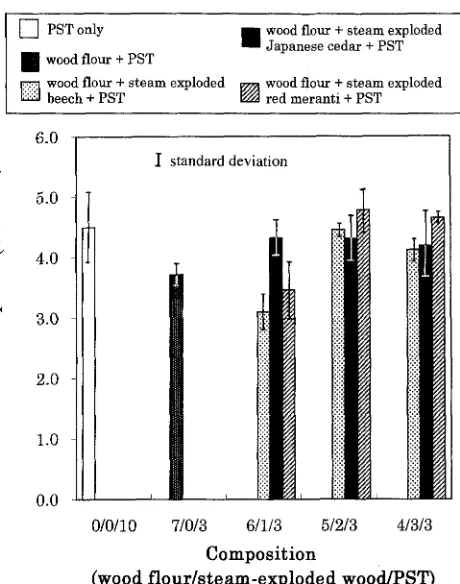
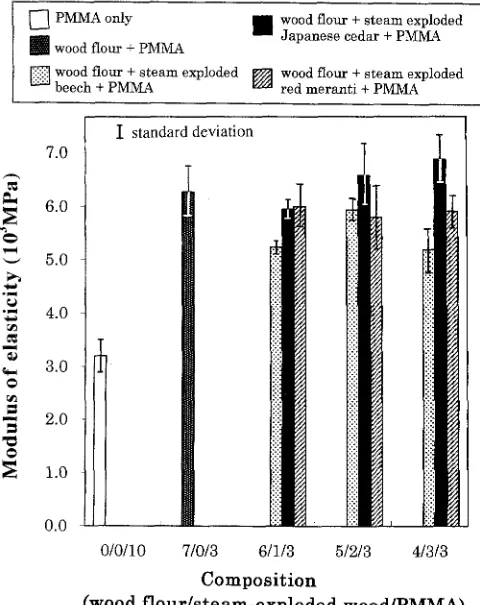
Results of bending tests of the pressed boards are shown in Figs. 1-3 with variation of plastic materials (PST, PVC, PMMA). Each figure shows the dependence of the modulus of rupture on the wood flour/SE ratio and the wood species of the SE. Similar results for the modulus of elasticity of the composite boards are summarized in Figs. 4-6. In each fig- ure the experimental value for molded plastic itself is also shown for comparison.
5.0
4.0
3.0
2.0
1.0
0.0 r I I
0/0/10 7/0/3 6/1/3 5/2/3 4/3/3
Composition
(wood flour/steam-exploded
wood]PST) Fig. 1. Moduli of rupture of wood flour/steam-exploded wood/polysty- rene (PST) composites[._..J PMMA only ~ wood flour +
steam exploded
Japanese cedar + PMMA [ ] wood flour + PMMA
wood flour + steam exploded [ ] wood flour + steam exploded beech + PMMA red meranti + PMMA
7.0
II, 6.0
"" 5.0 0,1
4.0
3.0
,~ 2.0 Q
N
1.0
0.0
I standard deviation 0
0
0/0/10 7/0/3 5/2/3 4/3/3 ::::l
::::|
::::|
~1
6/1/3
Composition
(wood flour/steam-exploded wood/PMMA)
6.0 [ ] PVC only
[ ] wood flour + PVC D wood flour + steam exploded
beech + PVC
wood flour + steam exploded Japanese cedar + PVC
~ w o o d flour + steam exploded red meranti + PVC
5.0
4.0
3.0
2.0 0
o 1.0
0.0
0/0/10
I standard deviation
i i
!i it
7/0/3 6/1/3 5/2/3 4/3/3Composition
(wood flour/steam-exploded wood/PVC)
Fig. 3. Moduli of rupture of wood flour/steam-exploded wood/ poly(vinyl chloride) (PVC) composites
Water resistance
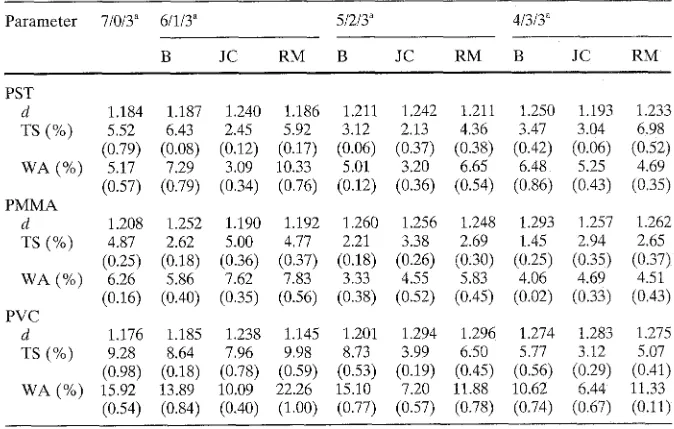
T h e results of thickness swelling and water a b s o r p t i o n tests are s u m m a r i z e d in T a b l e 1.
Discussion
T h e m o d u l u s of r u p t u r e , m o d u l u s of elasticity, and water resistance of the w o o d plastic b o a r d were generally in- c r e a s e d by replacing w o o d flour with SE. although the com- position at which the b e s t p e r f o r m a n c e of the b o a r d was o b t a i n e d differed d e p e n d i n g on the plastic p o l y m e r and. to a lesser extent, the w o o d species of SE. T h e m o d u l u s of r u p t u r e of PST c o m p o s i t e e x h i b i t e d g o o d p e r f o r m a n c e at a w o o d flour/SE ratio of 5/2 for all the S E w o o d speceis (Fig, 1), which is almost as high as the value for the b o a r d m a d e f r o m PST only. T h e m o d u l u s of r u p t u r e of the P M M A c o m p o s i t e e x h i b i t e d g o o d p e r f o r m a n c e at a w o o d flour/SE ratio of 5/2 or 6/1 for all kinds of w o o d species of S E (Fig. 2). T h e n the m o d u l u s of r u p t u r e of P V C c o m p o s i t e e x h i b i t e d g o o d p e r f o r m a n c e at a w o o d flour/SE ratio of 4./3 for S E of b e e c h and J a p a n e s e c e d a r (Fig. 3/. T h e m o d u l u s of elasticity of the PST or P M M A c o m p o s i t e using SE s h o w e d g o o d p e r f o r m a n c e r e g a r d l e s s of the a m o u n t a n d kinds of S E (Figs. 4. 5), which was s u p e r i o r to that of PST or P M M A p o l y m e r b o a r d , respectively. In contrast, the m o d u l u s of elasticity of P V C c o m p o s i t e s h o w e d a m a x i m u m at the r a t i o of 4/3 regardless of the kinds of SE (Fig. 6), which e x c e e d e d that of P V C b o a r d . T h e w a t e r r e s i s t a n c e of ai1 c o m p o s i t e s using SE was b e t t e r than that of composites w i t h o u t SE regardless of the plastic p o l y m e r ( T a b l e 1). Especially g o o d
Table 1. Specific gravity and water resistance of wood flour/steam-exploded wood/polymer composites
Parameter 7/0/3 ~ 6/1/3 a 5/2/3 a 4/3/3"
B JC RM B JC RM B JC RM
PST
d 1.184 1.187 1.240 1.186 1.211 1.242 1.211 1.250 1.193 1.233 TS (%) 5.52 6.43 2.45 5.92 3.12 2.13 4.36 3.47 3.04 6,98
(0.79) (0.08) (0.12) (0.17) (0.06) (0.37) (0.38) (0.42) (0.06) (0,52) WA (%) 5.17 7.29 3.09 10.33 5.01 3.20 6.65 6.48 5.25 4,69
(0.57) (0.79) (0.34) (0.76) (0.12) (0.36) (0.54) (0.86) (0.43) (0,35) PMMA
d 1.208 1.252 1.190 1.192 1.260 1.256 1.248 1.293 1.257 1.262 TS (%) 4,87 2.62 5.00 4,77 2.21 3.38 2.69 1.45 2.94 2.65
(0.25) (0.18) (0.36) (0.37) (0.18) (0.26) (0:30) (0.25) (0.35) (0.37) WA (%) 6.26 5.86 7.62 7.83 3.33 4.55 5.83 4.06 4.69 4.51
(0.16) (0.40) (0.35) (0.56) (0.38) (0.52) (0.45) (0.02) (0.33) (0.43) PVC
d 1.176 1.185 1.238 1.145 1.201 1,294 1.296 1.274 1.283 1,275 TS (%) 9.28 8.64 7.96 9.98 8.73 3.99 6.50 5.77 3.12 5.07
(0.98) (0.18) (0.78) (0.59) (0.53) (0.19) (0.45) (0.56) (0.29) (0.41) WA (%) 15.92 13.89 10.09 22.26 15.10 7.20 11.88 10.62 6.44 11.33
(0.54) (0.84) (0.40) (1.00) (0.77) (0.57) (0.78) (0.74) (0.67) (0.11)
d, specific gravity; WF, woof flour; SE, steam-exploded wood; B, beech; JC, Japanese cedar; RM, red meranti; TS, thickness swelling; WA, water absorption
6.0
'-" 5.0
o,~
4.0
3.0
@
= 2.0
@
1.0
I
i 0/0/10
0/0/I0 7/03 6/1/3 5/2/3 4/4/3 C o m p o s i t i o n
0.0
(wood f l o u r / s t e a m - e x p l o d e d wood/PST)
Fig. 4. Moduli of elasticity of wood flour/steam-exploded wood/poly- styrene composites
[ ] PVC only [ ] wood flour + PVC
wood flour + steam exploded [ ] beech + PVC
wood flour + steam exploded [ ] Japanese cedar + PVC
wood flour + steam exploded N red meranti + PVC
8.0
I
7.0 -
6.0 i
5.0i
*~ 4 . 0 -
3.0
r ~
- ' 2.0 -
1.0 -
0.0
I standard deviation
5/2/3 4/3/3
[ ] PST only J wood flour + steam exploded
I Japanese cedar + PST
[ ] wood flour + PST
~ w o o d flour + steam exploded ~ N wood flour + steam exploded beech + PST vz~a red meranti + PST
I standard deviation
7.0
7/0/3 6/1/3
C o m p o s i t i o n
( w o o d f l o u r / s t e a m - e x p l o d e d wood/PVC)
Fig. 6. Moduli of elasticity of wood flour/steam-exploded wood/ poly(vinyl chloride) composites
[ •
PMMA only I l l wood flour + steam explodedI
Japanese cedar + PMMA
[ ] wood flour + PMMA
wood flour + steam exploded wood flour + steam exploded ~Tffff~
beech + PMMA r e d meranti + PMMA
I standard deviation
7.0
6.0
--~ 5.0
4.0
~. 3.0
-- 2.0
1.0
0.0 i
7/0/3 6/1/3
C o m p o s i t i o n
0/0/10 5/2/3 4/3/3
( w o o d f l o u r / s t e a m - e x p l o d e d wood/PMMA)
Fig. 5. Moduli of elasticity of wood flour/steam-exploded wood/ poly(methyl methacrylate) composites
water resistance (thickness swelling and water absorption) was obtained at wood flour/SE ratios of 5/2, 4/3, and 4/3 for PST, PMMA, or PVC composite, respectively.
The characteristics of wood plastic composites using SE can be summarized as follows. The boards with the best performance were obtained with a wood flour/SE ratio of 5/ 2 for the PST composite, 4/3 for the PVC composite, and 6/ 1 or 5/2 for the P M M A composite. There was some effect of the SE wood species, but the influence was smaller than the effect of the polymer. In most cases, values for the maxi- mum fracture strength and modulus were almost the same as those of the polymers themselves and scarcely exceeded them. It may be concluded at this point that the resulting composite has properties intermediate between wood and plastic polymers, and that the addition of SE makes the composite more plastic-like.
the final density of the board is 1.1-1,4. 8 It is well known that the performance of wood species is, in general, dependent on the density of the material: the higher the density, the better the performance in terms of fractur~e strength and so on. An increase in the density of the material would lead to greater interaction of components in the composite material. Judging from the results, the authors conclude that the effect of SE is based on the increased contact of the components of the composite at higher density.
Conclusions
Addition of steam-exploded wood flour to wood/plastic composites increased the fracture strength and water resis- tance of the resulting composite board to an extent mainly dependent on the polymer species used. The effect of the wood species was less significant.
Acknowledgment Financial support of this work (in part) by the Ministry of Education, Science, Sports and Culture of Japan in the form of a Scientific Research Fund (grant 08660213) is gratefully acknowledged.
formaldehyde based wood adhesives containing steam exploded beech four. Holzforschung 52:651-653
2. Wolcott MP (ed) (1993) Wood fiber/polymer composites. Madison, Forest Products Society, pp 1-134
3. Caufield DF. Rowell RM. Youngquist JA (eds) (1996) Wood fiber,' polymer composites. Forest Products Society, Madison. pp 1- 256
4. Rowell RM. Schultz TP. Narayan R (eds) (1992) Emerging tech- nologies for materials and chemicals from biomass. American Chemical Society, Washington, DC, pp 1-451
5. Conner AH. Christiansen AW. Myers GE. River BH. Vick CB. Spelter HN (eds) (199B Wood adhesives 1990. Forest Products Research Society. Madison. pp 163-190
6. Rowelt RM. Cleary BA. Rowell JS, Clemons C.Young R A t 1993) Results of chemical modification of lignocellulosic fibers for use in composites. In: Wolcott MP (edl Wood fiber polymer composites. Forest Products Society. Madison. pp 12t-127
7. Narayan R (1992) Compatibilization of lignocellulosics with plastics. In: Rowell RM, Schultz TP. Narayan R (eds) Emerg- ing technologies for materials and chemicals from biomass. American Chemical Society, Washington, DC. pp 57-75 8. Stamm AJ, Harris EE 11953) Chemical processing of wood. New
York, Chemical Publishing Co, pp 360-362
9. Japanese Industrial Standard (1994) Particleboards. JIS A 5908 (in Japanese). Tokyo, Japan
10. Ito H (1996) BS thesis (in Japanese), Faculty of Agriculture. Kinki Daigaku University