Interdisciplinarity in biodiversity project evaluation: a work in progress
Ross CullenA and Piran C.L. WhiteB
AAccounting, Economics and Finance Department, Room 202, Commerce Building,
PO Box 84 Lincoln University, 7647, Christchurch, New Zealand Email: [email protected]
BEnvironment Department, University of York, Heslington, York, YO10 5DD, United
Kingdom
Email: [email protected]
Running head: Interdisciplinarity in biodiversity evaluation
Abstract
Decision-‐makers and managers responsible for biodiversity conservation need to prioritise between competing objectives. Summative ex post evaluations can provide important information on what works and what does not, and can also distinguish between actions that are cost-‐effective and those that are not.
Over the last 25 years, a range of methodological frameworks has been established to assist decision-‐makers with evaluations, but their uptake has been limited. Some researchers suggest a lack of research interest as being one factor contributing to the lack of more rapid progress in the area. In particular they suggest that
interdisciplinary approaches to biodiversity project evaluation are infrequent, despite the insights that such approaches can bring.
We evaluate this assertion by examining the provenance of current research in this area. Specifically, we examine the reference lists of three recent papers concerning the summative evaluation of biodiversity conservation projects, two published in a conservation journal and one in an interdisciplinary journal. We find that, of 63 papers cited across all three focal papers, only two were cited in common by two of the three papers, and no paper was cited in common by all three papers.
research but also in practical application of the techniques, in terms of reducing the likelihood of identifying inadequate, inappropriate or inefficient conservation investments.
There is still considerable opportunity for further collaboration in the areas of biodiversity evaluation between researchers in a range of disciplines, including ecology, economics, statistics, forestry, wildlife management. Biodiversity
conservation evaluation is a growing field, but its potential is unlikely to be fulfilled unless biodiversity researchers seek to develop a more integrated community, and particularly to learn from researchers in other disciplines where evaluation has a longer history.
The need for prioritisation and evaluation in biodiversity conservation
Management of biodiversity is a significant challenge for many nations and globally. The IUCN lists more than 65,000 species on its Red List, of which more than 20,000 are threatened with extinction (IUCN 2012). Approximately US$0.10-‐0.15 billion is spent annually on the conservation of terrestrial biodiversity (McCarthy et al. 2012), but it is estimated that protecting and managing all terrestrial sites of global
biodiversity importance would cost US$76.1 billion annually (McCarthy et al. 2012). Current levels of global conservation expenditure are at least an order of magnitude short of the amount required to halt biodiversity loss. It is therefore essential that we use to best effect the limited resources that are available for biodiversity management.
Decision makers and managers concerned with biodiversity need to consider
carefully where to apply the limited resources available to them given that they have an explicit goal to pursue. The papers in this Special Issue of Wildlife Research focus on aspects of that question. As Cullen (2012) notes, researchers during the last 25 years have devoted large efforts to development of methods, datasets, software, and analysis to help inform decision makers on biodiversity prioritisation. It seems clear that considerable progress has been made by this research effort and decision makers can now choose from a range of prioritisation approaches and tools to ensure their decisions are based upon best available information and are made following coherent, logical steps.
Of course the application of today’s best prioritisation methods are heuristics and there are no guarantees of success or predictable outcomes. Biodiversity managers typically have incomplete information about the species, habitats and ecosystems, and the threats to the biodiversity, and conservation decisions need to be made on this basis (Grantham et al. 2012). The effectiveness of management actions can be influenced by many factors including weather, timing, level and quality of contractor effort, human and other species interventions. In short, there are chronic risk and uncertainty issues in biodiversity management. Managers and decision makers in many cases can benefit from summative evaluations that assess just how effective, and cost effective, biodiversity management actions have been. Without rigorous ex post expenditure evaluation, we have little basis for judging what works and what
does not work, which actions are cost effective and which are not, and which provide benefits that are at least as great as their costs.
evaluation. To answer those two questions we need first to review what is entailed in biodiversity project evaluation.
Biodiversity project prioritisation is an example of formative evaluation – it aims to inform us before, or at various point during implementation how we can better target effort to achieve the designated biodiversity objectives. Summative
evaluation occurs after a project or programme has been implemented and typically aims to inform us how successful a project or programme has been in delivering on its designated objectives. There are a number of aspects of a project or programme that can be evaluated including design, implementation, and delivery. Laboratory experiments often permit control of many variables of interest, but few biodiversity projects are designed or implemented in ways that allow control of many variables, hence alternative evaluation approaches are required. Assessment of a project or programme outcomes might be achieved by way of comparison of outcomes with targets, by comparison with similar projects or programme outcomes, or by comparison with counterfactual, which may include ‘no treatment’. Which
evaluation approach to use in any situation is not always obvious, and completing a useful evaluation can be challenging.
In a recent paper, Possingham (2012) observed the importance of evaluation and the valuable, often unexpected insights it can provide (Sutherland et al. 2004; Walsh et al. 2012). He also declaimed the reluctance of many young ecology researchers to tackle evaluation, but noted there were some signs that some biodiversity
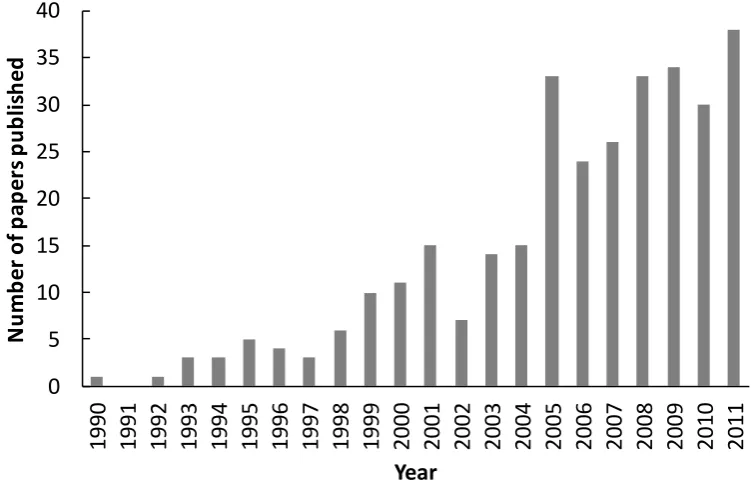
four points warrants some comment. A Web of Science search using the terms ‘biodiversity’, ‘project’ and ‘evaluation’ brings up 304 records since 2000 and 340 since 1990. Clearly there is quite a bit of biodiversity evaluation going on and a little digging reveals that biodiversity evaluation has been conducted since at least 1991 (Tisdell, 1991), although there has been a steady increase in research in the area in recent years (Figure 1).
The role of interdisciplinarity in biodiversity project evaluation
Researchers from many fields, as well as from ecology, can and do complete
evaluations of biodiversity projects and programmes. However, researchers who do not look beyond their own discipline may fail to see how much evaluation is
occurring or the opportunities that provides. Many of the methodological advances in biodiversity evaluation over the last decade have occurred at the interface between the disciplines of ecology and economics. Ecology has a long history of interaction with other disciplines (Lowe et al. 2009), but the urgency for more effective interdisciplinary integration has accelerated over the last decade in recognition of the increasing multifaceted nature of environmental problems. Indeed, this has been reflected in the trend for some mainstream applied ecological and conservation journals to include increasing numbers of papers which
Ehrlich 1999; Baumgaetner et al. 2006) and a new integrative discipline of ecological economics has emerged, served by its own interdisciplinary journal.
In a rapidly-‐expanding research area such as biodiversity project evaluation, which specifically pits ecological outcomes against economic inputs, the benefits to be gained from adopting an interdisciplinary approach should be substantial. However, some of the observations made by Possingham (2012) and other papers in the same volume contend that such interdisciplinary integration in this area is still rather limited. Although conservation biology as a discipline has been one of those areas within ecology which has increasingly looked to the social sciences, it may be that the sub-‐discipline of conservation evaluation is not so outward-‐looking as it could be in this regard.
Analysis of interdisciplinarity in biodiversity evaluation research
An indication of the historical provenance of a piece of published research is provided by its reference list. The reference list defines the starting points for the work and the academic ‘stable’ from which is has emerged. To test the extent of interdisciplinarity in the area of biodiversity project evaluation, we therefore examined the reference lists of three recent papers concerning the summative evaluation of biodiversity conservation projects. Two of these papers (Howe and Milner-‐Gulland 2012a; Walsh et al. 2012) appeared in a conservation journal, Animal Conservation, and were highlighted by Possingham (2012) in the same volume as
We extracted from the reference lists of each of these three papers all citations to other papers that were listed in the Web of Science database. References to
unpublished reports were excluded, as were references of a purely statistical nature, such as to software used or specific analytical routines, which had no direct bearing on the evaluation methods used. Following this selection process, we categorised each cited paper according to its Subject Categories provided in Web of Science. This ensured that the assignment of categories was objective and not subject to
researcher bias.
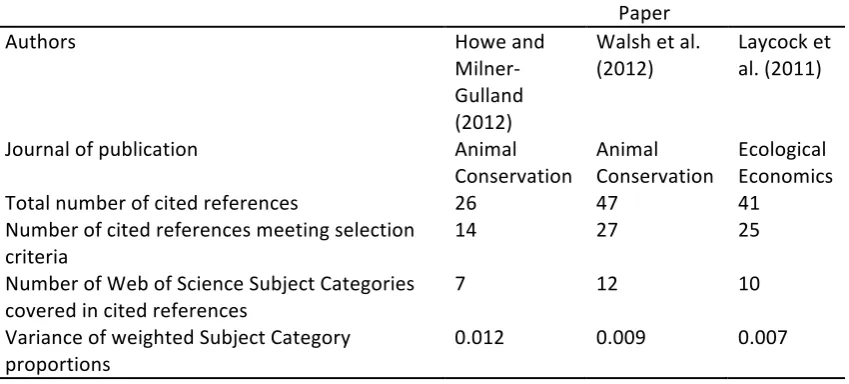
number of cited references within each paper that met our original selection criteria to allow direct comparisons between the three papers (Table 1).
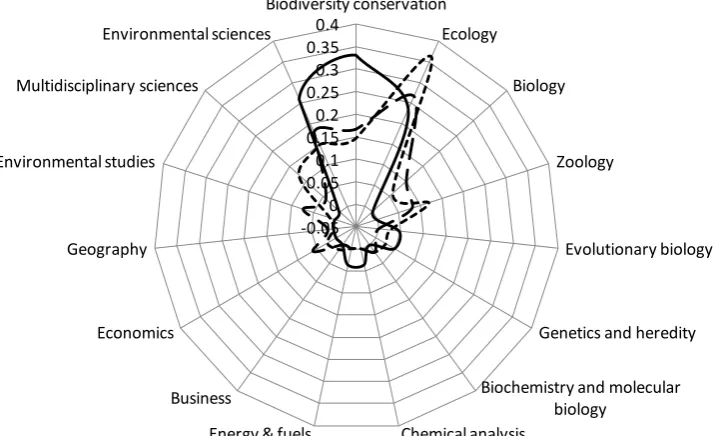
Comparison of the three papers revealed an expected dominance of Subject Categories most closely aligned with ecological science (Figure 2). However, there were different patterns of provenance in the three papers. Howe and Milner-‐Gulland (2012a) was the most restricted in terms of disciplinary provenance and its citations were dominated by other papers in the biodiversity conservation literature. The Laycock et al. (2011) and Walsh et al. (2012) papers displayed very similar overall patterns of disciplinary provenance. Both had a relatively more diverse distribution of disciplinary provenance than Howe and Milner-‐Gulland (2012a) and ecology sources were the most numerous cited references in both papers. The Laycock et al. (2011) and Walsh et al. (2012) papers diverged in disciplinary provenance only for the less commonly-‐cited disciplines, with the Laycock et al. (2011) paper citing more papers from the social sciences, including economics and environmental studies. Perhaps surprisingly, despite the similarities in disciplinary provenance of these two papers, they cited just one paper in common (Murdoch et al. 2007). Laycock et al. (2011) also cited one paper in common with Howe & Milner-‐Gulland (2012), which was Salafsky and Margoluis (1999). No papers were commonly cited by Howe and Milner-‐Gulland (2012a) and Walsh et al. (2012). Thus, of 63 papers cited across all three focal papers, only two were cited in common by two of the three papers, and no paper was cited in common by all three papers.
The status of evaluation as a research theme in biodiversity conservation
In their editorial to support a number of featured papers on biodiversity conservation evaluation in a recent edition of Animal Conservation, Howe and Milner-‐Gulland (2012b) observed that conservation lags behind many other fields in both the quantity and quality of evaluations. A number of contributory reasons for this are discussed by these authors, including the fact that the outcomes are
frequently subtle, difficult to measure and take a long time to come to fruition. The authors also point out that the impact of external factors can complicate the interpretation of evaluations. Although evaluation of conservation projects is increasing, at least among the research community, we agree with these authors that there is some way to go in terms of reliable and commonly-‐accepted
methodology. Based on our analysis, we would also suggest that the development of evaluation as a research field within biodiversity conservation is also being restricted by a relative lack of interdisciplinary knowledge exchange. There is an increasing number of relevant papers in the literature, both within the area of biodiversity conservation and outside. Both quantitative and qualitative approaches are used and they include case studies (Shwiff et al. 2005), survey research (Scofield et al. 2011), statistical analysis (Laycock et al. 2009), and model building (Busch and Cullen 2009; Honey-‐Roses et al. 2011). Notwithstanding these developments, the field of
that the area of evaluation is currently developing along at least three, relatively distinct, pathways rather than as a fully-‐integrated theme.
The multi-‐stranded pattern of development of the area of biodiversity evaluation has a number of implications. From a research perspective, overall progress is likely to be slower than if the different sub-‐areas were working better together. Against a backdrop of continuing declines in biodiversity (Butchart et al. 2010), the lack of a coherent research effort on conservation evaluation may have significant
consequences in terms of failing to highlight inadequate, inappropriate or inefficient conservation investments if it is not addressed urgently.
Progress in understanding of evaluation is one thing, but for conservation evaluation to have an impact in the real world, it needs to be adopted by practitioners and policy-‐makers. This depends on it being seen as an integral and core part of
various other stakeholders from the outset of a research project, from the design of the project and setting of objectives, through contributions to the design and methodology, interpretation of the results and dissemination of the conclusions (Reed, 2008; Phillipson et al. 2012). In the area of conservation evaluation, there is no doubt that some of this is occurring, but it is doing so in a very piecemeal way, and there is evidence to suggest that much more can be done to integrate activities, even between the researchers themselves, let alone between the researchers and policy-‐makers.
Conservation evaluation has developed by borrowing from other disciplines and fields of research. However, as our analysis has showed, interdisciplinarity in conservation evaluation is limited and there is still plenty of opportunity for further collaboration between researchers in a range of disciplines (including ecology, economics, statistics, forestry, wildlife management). Collaboration across disciplines can pool resources, make use of comparative advantages, enable cross fertilisation of ideas, disperse knowledge more widely about what works and what does not work, and contribute to better use of scarce biodiversity management resources (Murdoch et al. 2007). As pointed out by several other researchers in the field (Possingham 2012, Howe & Milner-‐Gulland 2012b), biodiversity conservation evaluation is a growing field with many opportunities for research, but we do not believe that the potential can be fulfilled without a more positive effort at
integration, both within the discipline and with other disciplines.
The future for conservation evaluation
Given the constraints on spending, and the reality that resources for conservation will never be adequate to protect all biodiversity, conservation evaluation needs to be at the heart of natural resource management into the future. What is needed for this transition to occur? Some microeconomics is helpful here, since we need to understand how we can match up demand and supply. We therefore need to understand where the demands for evaluation will be, who will fund its
development, and who will take note of the outcomes. However motivated the researchers are to contribute and apply effort and skill to complete research, unless there is a demand for evaluations and uptake of the information they provide, little will be gained by their completion (Pullin et al. 2004).
produce specific outcomes; (ii) which projects deliver greatest benefits per dollar invested; and (iii) which delivery mechanisms are most appropriate.
These are all laudable objectives, but nevertheless, a word of caution should be expressed here. No-‐one likes to be evaluated, and whilst strategic decision-‐makers should be expected to look favourably upon the benefits that project evaluation can bring, those individuals or organisations responsible for the delivery of individual biodiversity projects may have a different perspective (Innes et al. 2012; Scofield and Cullen 2012). Individuals seeking to carry out evaluations may be met with suspicion by those being evaluated and there is a risk that outcome data based on perceptions may be biased. An evaluation culture is very unlikely to be unanimously popular with the conservation lobby. However, better conservation evaluation is a necessity and education concerning the wider benefits of evaluation should help to ameliorate some of these barriers. Biodiversity researchers have the capacity to supply the necessary methodological frameworks, but the full potential for evaluation can only be realised if biodiversity researchers seek to develop a more integrated community, working collaboratively and in a participatory manner with other researchers and decision-‐makers, and embrace the lessons learnt from those working in other areas with a wealth of evaluation expertise already behind them.
References
Baumgaetner, S., Becker, C., Faber, M. and Manstetten, R. (2006). Relative and absolute scarcity of nature. Assessing the roles of economics and ecology for biodiversity conservation. Ecological Economics 59, 487-‐498.
Bottrill, M. C., Hockings, M. & Possingham, H. P. (2011). In pursuit of knowledge: addressing barriers to effective conservation evaluation. Ecology and Society 16(2), 14.
Busch, J. and Cullen, R. (2009). Effectiveness and cost effectiveness of yellow-‐eyed penguin recovery. Ecological Economics, 68, 762-‐776.
Butchart, S. H. M., Walpole, M., Collen, B. et al. (2010) Global biodiversity: indicators of recent declines. Science 328, 1164-‐1168.
Cook, C. N., Hockings, M. and Carter, R. (2010). Conservation in the dark? The information used to support management decisions. Frontiers in Ecology and the
Environment 8, 181–186.
Costanza, R. and Daly, H. (1992). Natural capital and sustainable development.
Conservation Biology, 6, 37–46.
Daily, G. C. and Ehrlich, P. R. (1999) Managing earth's ecosystems: An interdisciplinary challenge. Ecosystems 2, 277-‐280.
Ferraro, P. J. & Pattanayak, S. K. (2006). Money for nothing? A call for empirical evaluation of biodiversity conservation investments. PLoS Biology 4, 482–488.
Grantham H. S., Wilson K. A., Moilanen A., Rebelo T. and Possingham H. P. (2009) Delaying conservation actions for improved knowledge: how long should we wait?
Ecology Letters 12, 293–301.
Honey-‐Roses, J., Baylis, K. and Ramirez, I. (2011). Do our conservation programs work? A spatially explicit estimator of avoided forest loss. Conservation Biology 25, 1032-‐1043.
Howe, C. and Milner-‐Gulland, E.J. (2012a). Evaluating indices of conservation success: a comparative analysis of outcome-‐ and output-‐based indices. Animal
Conservation 15, 217–226.
Howe, C. and Milner-‐Gulland, E.J. (2012b). The view from the office is not all bad: conservation evaluation as a ‘sexy’ research goal. Animal Conservation 15, 231-‐232.
IUCN (2012) The IUCN Red List.
http://www.iucn.org/about/work/programmes/species/our_work/the_iucn_red_list
/. Accessed October 2012.
Laycock, H., Moran, D., Smart, J., Raffaelli, D. and White, P. (2011). Evaluating the effectiveness and efficiency of biodiversity conservation spending. Ecological
Economics 70, 1789–1796.
Lowe, P., Whitman, G. and Phillipson, J. (2009). Ecology and the social sciences.
Journal of Applied Ecology 46, 297-‐305.
McCarthy, D., Donald, P.F., Scharlemann, J.P.W., Buchana, G.M., Balmford, A., Green, J.M.H., Bennun, L.A., Burgess, N.D., Fishpool, L.D.C., Garnett, S.T., Leonard, D.L., Maloney, R.F., Morling, P., Schaefer, H.M., Symes, A., Weidenfeld, D.A. and Butchart, S.H.M. (2012) Financial costs of meeting global biodiversity conservation targets: current spending and unmet needs. Science 338, 946-‐949.
Millennium Ecosystem Assessment (2005). Ecosystems and Human Well-‐being: Policy Responses: Findings of the Responses Working Group of the Millennium Ecosystem
Assessment. Island Press, Washington, D.C.
Phillipson, J., Lowe, P., Proctor, A. and Ruto, E. (2012) Stakeholder engagement and knowledge exchange in environmental research. Journal of Environmental
Management 95, 56-‐65.
Possingham, H. P. (2012) How can we sell evaluating, analyzing and synthesizing to young scientists?. Animal Conservation 15, 229-‐230.
Pullin, A. S., Knight, T. M., Stone, D. A. and Charman, K. (2004). Do conservation managers use scientific evidence to support their decision-‐making? Biological
Conservation 119, 245–252.
Reed, M. S. (2008) Stakeholder participation for environmental management: A literature review. Biological Conservation 141, 2417-‐2431.
Salafsky, N. and Margoluis, R. (1999) Threat reduction assessment: A practical and cost-‐effective approach to evaluating conservation and development projects. Conservation Biology 13, 830-‐841.
Scofield, P., Cullen, R. and Wang. M. (2011). Are predator proof fences the answer to New Zealand’s terrestrial faunal biodiversity crisis? New Zealand Journal of Ecology 35, 312-‐317.
Scofield, P., and Cullen, R. (2012). Fenced sanctuaries need critical evaluation: a reply to Innes et al. (2012). New Zealand Journal of Ecology 36, 239-‐242.
Shwiff, S.A., R.T. Sterner, J.W. Turman, and Foster, B.D. (2005). Ex post economic analysis of reproduction-‐monitoring and predator-‐removal variables associated with protection of the endangered California least tern. Ecological Economics 53, 277-‐287.
Tisdell, C.A. (1991). Economics of Environmental Conservation. Edward Elgar, Cheltenham, UK.
Walsh, J. C., Wilson, K. A., Benshemesh, J. & Possingham, H. P. (2012). Unexpected outcomes of invasive predator control: the importance of evaluating conservation management actions. Animal Conservation 15, 319-‐328.
White, P. C. L., Cinderby, S., Raffaelli, D., de Bruin, A., Holt, A. and Huby, M. (2009) Enhancing the effectiveness of policy-‐relevant integrative research in rural areas.
Area 41, 414-‐424.
Table 1. Summary statistics of analysis of cited references from the three focal papers
Paper
Authors Howe and
Milner-‐ Gulland (2012)
Walsh et al.
(2012) Laycock et al. (2011)
Journal of publication Animal
Conservation
Animal Conservation
Ecological Economics
Total number of cited references 26 47 41
Number of cited references meeting selection
criteria 14 27 25
Number of Web of Science Subject Categories
covered in cited references 7 12 10
Variance of weighted Subject Category
proportions 0.012 0.009 0.007
Figures.
Figure 1. Trend in papers published on biodiversity project evaluation since 1990, as listed in Web of Science.
0 5 10 15 20 25 30 35 40
1990 1991 1992 1993 1994 1995 1996 1997 1998 1999 2000 2001 2002 2003 2004 2005 2006 2007 2008 2009 2010 2011
Nu
m
be
r o
f p
ap
er
s p
ub
lis
he
d
Figure 2. Radar chart showing the relative prevalence of different Subject Categories among the cited references from each of the three focal papers. Howe & Milner 2012, solid line; Laycock et al 2011, dashed line; Walsh et al 2012, dotted line.
-‐0.050 0.050.1 0.150.2 0.250.3 0.350.4
Biodiversity conservation Ecology
Biology
Zoology
Evolutionary biology
Genetics and heredity
Biochemistry and molecular biology
Chemical analysis Energy & fuels
Business Economics Geography Environmental studies
Multidisciplinary sciences
Environmental sciences
Howe & Milner 2012
Laycock et al. 2011