*Corresponding author, [email protected]
ENHANCEMENT OF PHYSIOLOGICAL EFFICIENCY OF BORO RICE USING
EXOGENOUS GIBBERELLIC ACID
RANJAN DAS*, B. HALOI AND K. PATHAK
Department of Crop Physiology, Assam Agricultural University, Jorhat-785013, Assam Received on 14th Dec., 2010, Revised and accepted on 24th Oct., 2011
SUMMARY
An experiment was conducted to study the effect of plant growth regulators using gibberellic acid (GA3) on the physiological efficiency of Boro rice. The physiological parameters and their relation with growth and yield attributes were analysed in the experiment. The experiment consisted of four treatments viz., T1: application of 10 ppm GA3 at early tillering stage, T2: application of 10 ppm GA3 at panicle initiation, T3: application 10 ppm GA3 at early tillering + at panicle initiation and T4: control. It was revealed that GA3 applied on boro rice at different stages of growth had improved significantly the physiological traits namely biomass allocation, chlorophyll contents, reducing, non reducing and total sugars, stomatal characters with significant effect on growth parameters leading to enhancement in grain yield. GA3 applied at early tillering + panicle initiation stage was found to be superior over other treatments. Gibberellic acid treatment significantly increased the NR activity and made 17.68% higher photosynthetic contribution after flowering thereby enhanced 12.5% higher grain yield over control.
Key words: Boro rice, gibberelic acid, nitrate reductase activity, panicle initiation, sink capacity, total sugars
INTRODUCTION
Rice (Oryza sativa L.) being the staple food of more than 60% of the global population deserves top most priority in agriculture. In Assam as well as North East Hill region as a whole, rice serves as the main cereal food for the people. Among the different classes of rice in Assam, winter rice locally known as Sali is the most important one, which occupies about 70% of the total annual rice area. Though Sali rice in terms of production and consumption is the main rice crop of Northeastern region of India, the crop experiences flash floods during tillering to active panicle initiation stage and crop area of some pockets gets damaged extensively. Moreover, period is insufficient for staggering plantation which results in poor stock of both grain and straw in the lean
germination to tillering, minimal resource capacity of the small and marginal farmers, comparatively inadequacy of production technology for this crop, and vulnerability of this crop to pests and diseases.
Application of suitable growth regulators at optimum concentration may regulate vegetative growth and can be used to have a proper balance between source and sink for increasing the yield of crops. Role of growth regulators in the transport and regulation of metabolites from source to sink in rice has been well documented (Biswas and Choudhury 1981). The exogenous application of various chemicals which are either promotory or inhibitory, might stimulate the metabolic processes (Gogoi and Baruah 2000). The most significant physiological effect of exogenous gibberellic acid (GA3) on plants is to break dwarfism and stimulate the elongation of genetically dwarf genotypes, as these dwarf lines generally have a low level of endogenous GA3 in their tissues (Suge 1990). Ponnuswamy et al. (1998) found an increasing proportion in seed set and yield by applying GA3 which significantly increased panicle exsertion, seed set and yield of CMS line IR58025A by a maximum of 80%, 20% and 77%, respectively at 150 g ha-1 dosage.
The present investigation was therefore planned to investigate the influence of some plant growth regulators on crop efficiency and productivity of Boro rice in improving yield potential. Generally low temperature affects the growth of rice from seedling to reproductive stage. Low temperature prevails during vegetative phase and chilling temperature during flowering leads to spikelet sterility. The other aspect is that low temperature during the seedling growth and vegetative stage affect this category of rice in proper establishment of seedling and prolong the duration of crop (Baruah and Medhi 1994). As GA3 has some direct influence in physiological processes, the foliar application of GA3 on Boro rice was executed to overcome the above-mentioned problems.
MATERIALS AND METHODS
The investigation was carried out at the Instructional Cum Research (ICR) farm, Assam Agricultural University, Jorhat, India during winter season in a
randomized block design with four replications. There were four treatments including control viz., T1: application of 10 ppm GA3 at tiller initiation stage (TI), T2: application of 10 ppm GA3 at panicle initiation, T3: application 10 ppm GA3 at tiller initiation stage + at panicle initiation and T4: Control were followed in plots with dimension 3 m x 2 metre. For experiment thirty-five days old seedlings of cultivar Kanaklata were transplanted in the puddled plots in the month of December. Two to three seedlings were planted per hill keeping plant-to-plant distance 15 cm and row-to-row 20 cm. The field was fertilized as per recommended dose for boro rice in Assam.
Growth parameters: The relative growth rate (RGR) and net assimilation rate (NAR) were computed following Radford (1967) while leaf area index (LAI) was computed following Gardner et al. (1985).
Anatomical studies
Leaf stomata: Fully expanded top leaf samples at flowering stage were collected in polythene bag. Clear nail polish was applied to both leaf surfaces and allowed to dry for approximately five minutes: Double sided cellophane tape was used to peel dried impression from the leaves. Five cm long section of the impression at the tip, center and base positions of each leaf surface were mounted on microscope slide and cover slip was placed.
Stomata of each surface were counted in 1.85 mm2
microscopic field (100 x magnifications, Cohen et al. 1988)
Stomata size:Stomatal size was estimated by measuring exterior guard cell length and breadth of five stomata per sample field using 100 x magnifications (Cohen et al. 1988).
Stomatal index (SI): The stomatal index was calculated as follows:
No. of stomata
(No. of guard cell + epidermal cell)
SI= x 100
Percent tiller mortality: The number of tillers was counted from among ten plant samples at maximum tillering stage and at flowering stage and tiller mortality was expressed in percentage by the following formula.
weight (g) at flowering stage and PH = panicle weight (g) at harvest stage.
Yield and yield contributing parameters: The yield and yield contributing parameters viz. number of panicles per square meter number of spikelets per panicle, number of grains per panicle and, thousand grain weight were recorded at harvest. The high density grain was recorded as follows:
No. of tillers at flowering stage
No. of tillers at maximum tillering stage
Tiller mortality %= 100-tiller survival % x 100
Biochemical parameters: Nitrate reductase activity (E.C. 1.6.6.1) by following the method of Klepper et. al , 1971 and the leaf chlorophyll was extracted by non-maceration method using dimethyl sulphoxide (DMSO) (Hiscox and Israelstam, 1979) and light absorption at 663 nm and 645 nm was read in a spectrophotometer (Model GS570155 EC, India Ltd. The chlorophyll content was determined by the formula as suggested by Arnon (1949) and expressed as mg g-1 leaf fresh weight.
Sample extraction for estimation of sugar was accomplished according to method reported by
McCready et al. (1950). The reducing sugar was
determined following Nelson’s arsenomolybdate method (Nelson 1944). Five milliliter of extract was hydrolyzed by boiling with half volume of 0.5 N HCl in water bath for 30 min and neutralized at slightly acidic side with NaOH (0.5N). The neutralized extract was made to 10 ml. This solution was used for determining the total sugar. An aliquot of this was analyzed for sugar following the same procedure as described for reducing sugar and expressed in mg g-1 dry weight. The reducing sugar was subtracted from the total sugar to obtain the non-reducing sugar content. Total soluble sugar (TSS) content was computed by adding reducing and non-reducing sugar content (Allen et al. 1988) and expressed in mg g-1 dry weight.
Photosynthesis related parameter: The post flowering photosynthetic contribution to grain yield was calculated by adopting the formula suggested by Yoshida (1973).
Translocation (%) = SF-SH/PH-PF x 100
Where, SF = shoot weight (g) at flowering stage, SH = shoot weight (g) at harvest stage, PF = panicle
Number of grains settled down at 1.20 specific gravity solution
Total spikelets
% HD grains = x 100
Data were analyzed statistically following Panse and Sukhatme (1967) and computerized through MSTAT C software programming.
RESULTS AND DISCUSSION
Effect of GA3 on morpho-physiological parameters: All the treatments significantly influenced the morpho-physiological parameters over control. The highest height and tiller number observed in GA3 applied at TI + PI stages of growth (Table 1). The percentage increased in plant height over the control was 37.5 % and 18.7 % in pre and post flowering, respectively. This result was accordance with the findings of Yanni (1991). According to him foliar spray of GA3 increased the productive tiller number. This might be due to increase of cell division of meristematic region following GA3 treatment and helped rapid elongation of hypocotyls length of seedling. Sauter and Kende (1992) also studied gibberellins induced growth and regulation of cell division cycle in deep water rice and gibberellins induced growth regulation of cell division cycle in deep water rice recording that GA3 first promote cell elongation in the intercalary meristem and that cell division was stimulated as a result of cell growth. In the present investigation increase in shoot length, leaf area index, leaf numbers and tiller number were observed (Table 1). The finding is in conformity with Hamayun et al. (2010), reporting GA3 application significantly promoted plant height and plant fresh and dry biomass.
two increased number of productive tillers in rice (Yanni 1991).
The reduction in number of days to panicle initiation, days to flowering and days to maturity recorded in GA3 treated plant over the control was observed (Table 1). However there was no significant difference among the treatments due to early emergence of tillering as It was interesting to note that tiller mortality was
lower in GA3 treated plants as compared to control. Among the treatments lowest percentage of tiller mortality (Table 1) was recorded in GA3 treated in TI+ PI stages of growth. This might be due to the growth promoting effect of gibberelic acid. Similar results were also reported by Gogoi and Baruah (2000) in Boro rice. Foliar spray of 10 and 30 ppm GA3 at transplanting and
Table 1. Effect of gibberellic acid on growth, physiological and on phenological attributes during pre and post flowering stages of growth
Treatments Plant height Tiller RGR g-1 NAR g LAI Days Days to Days to
(cm) mortality (%) g-1 d-1 dm-2 d-1 toPI flowering maturity
Pre Post Pre Post Pre Post Pre Post Pre Post
Control Pre Post Pre Post 0.110 0.012 0.044 0.029 5.60 4.17 97.21 123.70 156.21 TI 56.3 101.2 21.0 18.0 0.127 0.014 0.050 0.034 6.15 4.98 90.00 113.20 145.70 PI 68.7 116.3 17.0 12.5 0.125 0.014 0.057 0.035 6.23 4.99 88.20 112.57 146.30 TI+PI 76.4 117.6 17.5 11.6 0.134 0.015 0.059 0.035 6.42 5.07 87.10 110.54 140.30 CD (5%) 78.3 120.2 17.0 9.90 0.008 NS 0.007 0.008 0.95 0.10 5.07 6.12 7.23
TI=Tiller initiation stage, PI= Panicle initiation stage and, TI +PI =Tiller initiation stage + Panicle initiation stage. Pre = pre flowering stage, post = post flowering stage
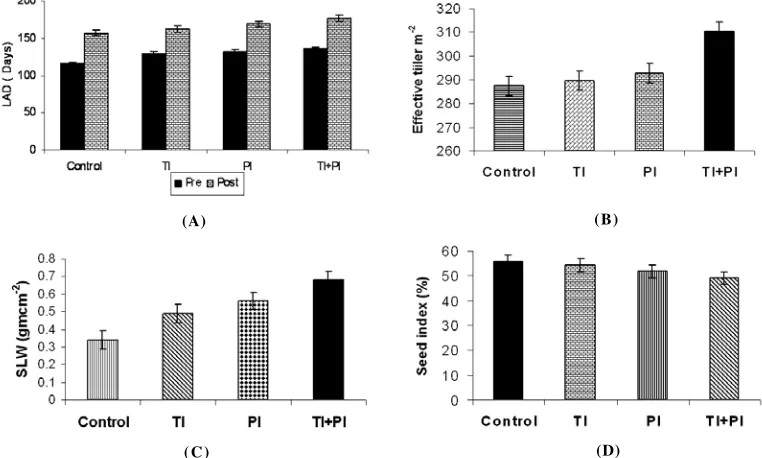
Fig. 1. Effect of gibberellic acid (10 ppm) application on leaf area duration (A), effective tillers (B), specific leaf weight, (C) and on Seed index (D) at tillering (TI), panicle initiation (PI) and TI and PI stages
(A) (B)
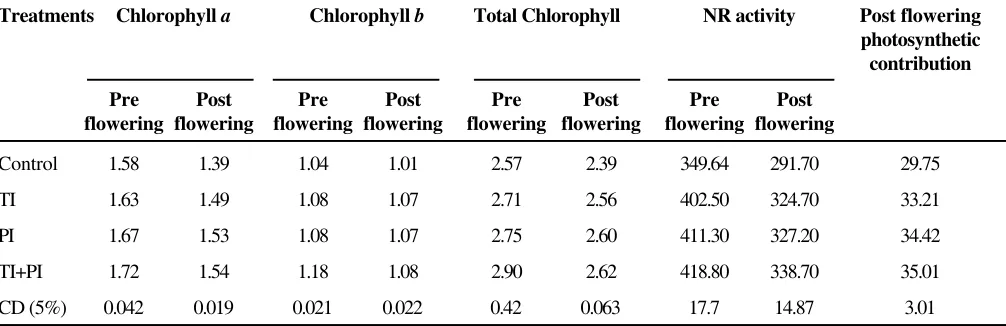
The higher percentage of chl a, chl b, total chlorophyll were observed in GA3 treated plants in both pre and post flowering stages of growth over control (Table 3). Among the treatments higher amount of chl a, chl b and total chlorophyll recorded in GA3 applied at TI + PI stage of growth. The percent increase in total chlorophyll as compared to control was 12.8% and 9.6 % in both pre and post flowering respectively. Marked increase in chlorophyll content was noticed in response to GA3 application in rice (Prakash and Parthapasenan 1990).
Biochemical parameters: There was significant difference in NR activity, the highest NR activity being recorded in GA3 applied at TI + PI stage of growth. The increment was 19.8% and 16.1% in pre and post flowering respectively (Table 3). This had reflected the compared to control. This might helped in the early
establishment of seedlings and tillering in field and thus escaped the severe cold during the growing season.
Effect of GA3 on growth parameters: GA3 increased various growth parameters viz. RGR, NAR, LAI and LAD over the control (Table 1). The maximum RGR, NAR, LAI and LAD (Fig. 1A) recorded in GA3 applied in early and PI stage. The percent increase were 21.8%, 34.1%, 14.1% and 17.2% respectively in pre flowering and 25.0%, 22.7%, 12.7% and 12.7% over control. Pain and Basu (1985) reported that shoot dry matter increased significantly when the rice plant treated with GA3. Kwai and Takeoka (1988) reported that application of GA3 at panicle initiation stage in rice-hastened heading and as a result growth duration shortened.
Table 2. Leaf thickness and stomatal characters as influenced by application of gibberellic acid at 50 % flowering stages of growth
Treatments Epidermal cell size Stomatal characters
Length Breadth Area Stomatal index Stomatal length Stomatal width Stomatal area
(μm) (μm) (μm2) (%) (μm) (μm) (μm2)
Control 74.67 28.32 2114.65 28.60 14.67 6.15 90.22 TI 97.8 30.17 2950.63 30.40 17.01 7.12 131.51 PI 99.54 32.34 3219.12 31.61 18.47 7.00 136.68 TI+PI 106.2 34.12 3623.54 35.8 19.46 7.53 144.59 CD (5%) 3.07 2.97 25.62 0.78 0.82 0.24 3.21
Table 3. Effect of Gibberellic acid on chlorophyll content (mg g-1 fr. wt., NR activity (μmol g-1 fr. wt.) and post flowering photosynthetic contribution (%)
Treatments Chlorophyll a Chlorophyll b Total Chlorophyll NR activity Post flowering
photosynthetic contribution
Pre Post Pre Post Pre Post Pre Post
flowering flowering flowering flowering flowering flowering flowering flowering
synthesis of leaf soluble protein through application of GA3 more particularly at the stage of TI + PI (Table 4). Similar results were obtained by Singh and Ram (2003) in a specific study of responses of GA3 and other growth regulators in rice cultivars.
Higher amount of total soluble sugars (reducing + non reducing) was recorded in GA3 applied at TI + PI stage of growth. The percent increase was 21.7% in reducing sugar and 16.2% in non-reducing sugars (Table 4). Patil and Mahapatra (1992) reported that foliar application of GA3 increased the soluble carbohydrate content per unit dry weight at the time of anthesis following the application of GA3 in rice. Sugars are necessary for some metabolic process as substrate at low temperature (low temperature experienced by Boro rice during development (Baruah and Medhi 1994). The role of sugar is quite significant to reduce the harmful effect of cold by enhancing water retaining capacity and cell dehydration (Trunova 1982). Increase in total soluble sugar may provide respiratory substrate and thus energy may be available to maintain the optimum growth.
Gibberellic acid probably overcomes the detrimental effect of cold by increasing the sugar accumulation during growth.
Photosynthetic related parameters: Data presented in Table 3 revealed that there were significant differences among the treatments in terms of post flowering photosynthetic contribution (PFPC). The higher value of PFPC recorded in all GA3 treated plant over control. The higher percentage (17.6%) of PFPC recorded in GA3 applied at TI + PI stage of growth. This might be related
to the enhancement of NAR by application of GA3
indicating photosynthetic efficiency leading to better post flowering photosynthetic contribution. According to Dong and Arteca 1981 root applications of gibberellic acid (GA3) on photosynthesis in tomato plants showed a 40– 50% increase within 5 hr after treatment with a 1.4 μm gibberellic acid (GA3).
Leaf epidermal cell size: There was a significant difference among the treatments in terms of epidermal cell size. The highest epidermal cell size was observed Table 4. Effect of gibberellic acid on reducing, non reducing and total sugar and leaf Soluble protein content at
50% flowering stage
Treatments Reducing sugar Non reducing sugar Total sugar Soluble protein
(mg g-1 fr. wt.) (mg g-1 fr. wt.) (mg g-1 fr. wt.) (g 100-1 g dry wt.)
Control 21.75 42.58 64.23 4.50
TI 24.52 48.34 72.86 4.72
PI 25.32 47.80 73.12 4.82
TI+PI 27.12 49.46 76.58 6.02
CD (5%) 1.47 1.14 1.77 0.22
Table 5. Influence of gibberellic acid on grain yield and yield attributes of boro rice
Treatments Tiller number m-2 Number of grains/ 1000 Grain weight High density grain Yield (t ha-1)
panicle (g) (%)
Control 337.10 106.41 20.48 49.23 5.00
TI 402.20 120.42 20.81 53.42 5.40
PI 410.70 121.40 20.85 53.92 5.52
TI+PI 421.60 129.32 21.43 56.42 5.64
in GA3 applied at TI + PI stage of growth. The increment was 42.2% in length and 20.5% in breadth over the control (Table 2). Matsukura et al. 1998 opined that Gibberellic acid enhanced the growth of the second leaf sheath and increased the extensibility of cell walls in the elongation zone of the leaf sheath. It also increased the total amount of osmotic solutes including sugars in the leaf sheath, but did not increase the osmotic concentration of the cell sap, due to an accompanying increase in cell volume by water absorption. In the later stage of GA3 induced growth, starch granules completely disappeared from leaf sheath cells, whereas dense granules remained in control plants. These findings indicate that GA3 enhances cell elongation by increasing wall extensibility, osmotic concentration being kept unchanged by starch degradation.
Stomatal parameters: The stomatal index and stomatal size increased in the all the treatments over control. Among the treatments higher percentage of stomatal index and stomatal size were observed in GA3 applied at TI + PI stage of growth (Table 5).
Gibberellic acid is known to promote hypocotyl growth and stomatal development in Arabidopsis seedlings that are grown in the light (Cowling and Harberd 1999). Indeed, a variety of endogenous and external stimuli affects the levels of bioactive GA3 and hence affects GA3 signaling (Fleet and Sun 2005, Swain and Singh 2005). The physiological role of GA3 on stomatal regulation is not yet well known.
Grain yield and yield attributing parameters: It was noticed that gibberellic acid enhanced the yield attributing parameters. The highest number of grains per panicle, no. of panicles per meter sq. and thousand grain weights were observed under GA3 applied at TI + PI stage of growth. There was significant difference in yield over the control, the percent increase over the control being 12.5% (Table 5). These enhancements could be attributed to the significant increment of SLW (Fig. 1C) and deceleration of SLA under the influence of GA3. Thus, cold tolerant rice group viz. Boro rice, growth modification can be substituted for by plant growth regulators like GA3 if applied at critical phenological stage.
Similar trends of results were observed in terms of high density grain under GA3 applied at TI + PI stage of growth. In an experiment conducted by Patil and Mahapatra (1992) with four rice cultivars recorded poor development of spikelets resulted in a high percentage of degeneration and sterility and consequently poor grain yield with however improvement in grain yield by
application of GA3 and Kinetin. Mukharjee and
Prabhakor (1980) observed the influence of GA3 on the yield response of rice applied at heading stage and observed that seed yield increased with increased concentration. Dunand et al. (1992) also reported that foliar application of gibberellic acid increased the panicle length and yield of semi dwarf rice.
Another notable observations in the present investigation was that application of GA3 reduced the tiller mortality thereby inducing the proliferation of effective tillers (Fig. 1B). Similarly, seed index (Fig. 1D)
was remarkably influenced by application of GA3
indicating improvement in sink activity as reflected by high density grain (Table 5).
Panicle poor exsertion from flag leaf sheath is a problem in cytoplasmic male sterile lines. Foliar application of gibberellic acid is an essential technique in promoting panicle exsertion for obtaining high cross-pollinated seed set in hybrid rice seed production (Duan and Ma 1992), which was proven and a successful approach to increase in seed yield in China. In hybrid rice seed production, GA3 was also used to increase the duration of floret opening, the rate of stigma exsertion, lengthen the duration of stigma receptivity and adjust the plant height of both parents, and increase the growth rate of secondary and tertiary tillers so that they bear panicles (Virmani and Sharma 1993).
rice cultivar Konaklata enhancing the grain yield over the control. Moreover, GA3 applied at early tillering + panicle initiation stage was found to be superior to the other treatments. GA3 application was very effective in increasing seed set rate and seed yield through elongation of plant height, promoting panicle and spikelet exsertion, enhancing stigma exsertion and longevity and receptivity.
REFERENCES
Allen, L.H., Vu, J., Valtte, R.R., Boote, K.J. and Jones, P.H. (1988). Non-structural carbohydrates and nitrogen of soybean grown under carbon dioxide enrichment. Crop Sci.28: 84-94.
Arnon, D.I. (1949). Copper enzymes in isolated chloroplasts. Polyphenoloxidase in Beta vulgaris. Plant Physiol. 24:
1–15.
Baruah, K.K. and Medhi, A. (1994). Effect of seedling hardening treatments on cold acclimation in rice (Oryza sativa L.). Indian J. Plant Physiol. 37: 190-192.
Biswas, A.K. and Choudhuri, M.A. (1981). Influence of plant senescence as modified by hormones and nutrients on yield of rice. Indian J. Agric. Sci.25: 77-90.
Cohen, C.J., Chicote, D.O. and Frakes, R.V. (1988). Leaf anatomy and stomatal characteristics of four tall Fescue selections differing in forage yield. Crop Sci.22:
704-708.
Cowling, R.J. and Harberd, N.P. (1999). Gibberellins control Arabidopsis hypocotyls growth via regulation of cellular elongation, J. Exp. Bot. 50: 1351–1357.
Dong, C.N. and Arteca, R.N. (1981). Changes in photosynthetic rates and growth following root treatments of tomato plants with phytohormones
Photosynthesis Res. 3: 45-52.
Duan, X.M. and Ma, H.S. (1992). Effects of gibberellic acid application on seed yield and quality of hybrid rice.
Seed Science and Tech.29: 209-214.
Dunand, R.T., Dilly, R.R. and Meche, G.A. (1992). Foliar application of gibberellic acid and yield enhancement in semi dwarf rice (Oryza sativa L).
Annu-res-rep-La-State-Univ.-Baton-Rouge-La, Crowley, La, The Station. 84: 292-294.
Fleet, C.M. and Sun, T.P. (2005). A Acate balance: the role of gibberellin in plant morphogenesis, Curr. Opin. Plant Biol. 8: 77–85.
Gardener, F.P., Pearce, R.B. and Mitchel, R.L. (1985). Physiology of Crop Plants. The Iowa State University Press. Ames.
Gogoi, N. and Baruah (2000). Effect of cold hardening and GA3 on growth and yield of ‘Boro’ rice. Indian J. Plant Physiol. 5: 15-18.
Hamayun, M., Khan, S.A., Khan, A.L., Rehman, G. and Kim, Y.H. (2010). Gibberellins production and plant growth promotion by pure cultures of Cladosporium sp.
MH-6 isolated from Cucumber (Cucumis sativus L.).
Mycologia 102: 989-995.
Hiscox, J.D. and Israelstam, G.F. (1979). a method for the extraction of chlorophyll from leaf tissue without maceration. Canadian J. Bot. 57: 1332-1334
Jensen WA. (1962). Botanical histochemistry, principles and practice. San Francisco: WH Freeman and Company.
Kawai, T. and Ikeoka, Y. (1988). The effect of gibberellin on spikelet organogenesis in rice with different nitrogen top dressings. Report Tolai Branch Crop Sci. Soc. Jpn. 105: 51-52.
Klepper, L.A., Elesher, D. and Hageman, R.H. (1971). Potential for nitrate reduction in wheat (Triticum astivum L). J. Plant Nut.3: 843-852
Matsukura, C., Itoh, S., Nemoto, K., Tanimoto, E. and Yamaguchi, J. (1998). Promotion of leaf sheath growth by gibberellic acid in a dwarf mutant of rice. Planta. 205:
McCready, R.M., Guggolz, J., Silviera, V. and Owens, H.S.
(1950). Determination of starch and amylose in
vegetables. Anal. Chem. 22: 1156.
Mukherjee, R.K. and Prabhakar, B.S. (1980). Effect of gibberellin on rice yield response to nitrogen applied at heading and quality of seeds. Plant Soil. 55:
153-156.
Nelson, N. (1944). A photometric adaptation of the somogyi method of determination of glucose. J. Biol. Chem.243:
Pain, S.K. and Basu, K.K. (1985). Growth and metabolism of rice seedlings: the effects of gibberellic acid. Indian J. Agric. Res. 19: 59-68.
Panse, V.G. and Sukhatme, P.T. (1967). Statistical methods for agricultural workers. (2nd Ed.) Indian Council of Agricultural Research, New Delhi.
Patil, R. and Mahapatra, P.K. (1992). Regulation of spikelet development in rice by hormones. J. Expt. Bot.43:
257-262.
Ponnuswamy, A.S., Rangaswamy, M., Rangaswamy, P. and Thiyagarajan, K. (1998). Adapting hybrid rice seed production technology. International Rice Research Notes. pp. 23-26.
Prakash, L. and Parthapasenan, G. (1990). Interactive effect of NaCl salinity and gibberellic acid on shoot growth, content of abscisic acid and gibberellin like substances and yield of rice (Oryza sativa L.). Plant Sci. 100:173–
181.
Radford, R.J. (1967). Growth analysis formulae- their use and abuse. Crop Sci.7: 171-175.
Sauter, M. and Kende, H. (1992). Gibberellin-induced growth and regulation of the cell division cycle in deepwater rice. Planta. 188: 362-368.
Singh, S. and Ram, T. (2003). Biochemical response of rice genotypes to exogenous gibberellic acid. IRRN 28:
68-71.
Suge, H. (1990). Survey of gibberellin in rice lines having dwarfing genes and in auto tetraploid lines. Jpn. J. Breed. 40: 21-31.
Swain, S.M. and Singh, D.P. (2005). Tall tales from sly dwarves: novel functions of gibberellins in plant development, Trends Plant Sci. 10: 123–129.
Trunova, T.I. (1982). Mechanism of winter wheat hardening at low temperature, K.A. Timiryazev Inst. Of Pt. Phy.
USSR Academy of Sc. Moscow, USSR. pp. 41-54.
Virmani, S.S. and Sharma, H.L. (1993). Manual for hybrid rice seed production. Manila, Philippines, IRRI.
Yanni, Y.G. (1991). Protection of rice against rosette long day disorder by inoculation with Aulosira fertilissima vs treatment with GA. World J. Microbiol. Biotech. 7:
436-438.