ARTICLE
Increase in Incidence of Medically Treated Thyroid
Disease in Children With Down Syndrome After
Rerelease of American Academy of Pediatrics Health
Supervision Guidelines
Kecia N. Carroll, MD, MPHa, Patrick G. Arbogast, PhDb,c, Judith A. Dudley, BSc, William O. Cooper, MD, MPHa
aDivision of General Pediatrics, Child and Adolescent Health Research Unit, Department of Pediatrics, and Departments ofbBiostatistics andcPreventive Medicine, Vanderbilt University Medical Center, Nashville, Tennessee
The authors have indicated they have no financial relationships relevant to this article to disclose.
What’s Known on This Subject
Although reports vary, prevalence rates of any thyroid dysfunction in children with DS have been estimated at up to⬃15%.
What This Study Adds
This study estimates the population-based incidence of medically treated thyroid dis-ease in children with DS and determines whether rates incrdis-eased after the rereldis-ease of AAP health supervision guidelines in 2001.
ABSTRACT
OBJECTIVE.The purpose of this work was to estimate the incidence of medically treated thyroid disease in children with Down syndrome enrolled in Tennessee Medicaid (TennCare) during 1995–2005 and to determine whether rates increased after rere-lease of American Academy of Pediatrics guidelines in 2001.
PATIENTS AND METHODS.We conducted a population-based retrospective cohort study in which we identified children with Down syndrome by using TennCare files and birth certificates. We included 1- to 18-year-olds who were continuously enrolled in TennCare and did not fill a prescription for thyroid medication during a 90-day prestudy period. The rate of medically treated thyroid disease (prescription filled for thyroid medication) was the main outcome. We used Poisson regression to estimate rates of medically treated thyroid disease according to study year, age, gender, race, region of residence, and payer type.
RESULTS.During the 11-year study period, 1257 children with Down syndrome (28% black, 72% white) met inclusion criteria. Overall, 10.8% filled a new prescription for thyroid medication. Rates of medically treated thyroid disease per 1000 child-years were 13.25 (1995–1997), 13.34 (1998 –1999), 13.62 (2000 –2001), 22.37 (2002– 2003), and 22.51 (2004 –2005). After adjusting for child age and race, there was an increased rate of medically treated thyroid disease in 2002–2003 and 2004 –2005 compared with 1995–1997. In a comparison cohort of children without Down syndrome, there was a smaller increase in the rate of medically treated thyroid disease when comparing 2002–2003 and 2004 –2005 with 1995–1997.
CONCLUSIONS.Over the 11-year period, 10.8% of children with Down syndrome filled a new prescription for a thyroid medication. A 73% increase in the incidence of medically treated thyroid disease occurred after rerelease of American Academy of Pediatrics guidelines, which may have influenced screening.Pediatrics2008;122:e493–e498
D
OWN SYNDROME (DS)is the most common known genetic cause of moderate-to-severe intellectual disability, and⬃10 000 children with DS are born in the United States each year.1 A number of medical conditions are associated with DS, including thyroid dysfunction. Although reports vary, prevalence rates of any thyroid dysfunc-tion in children with DS have been estimated up to⬃15%.2–4Hypothyroidism has a subtle presentation and can be particularly challenging to detect in patients with intellectual disabilities and communication and language impair-ments. Furthermore, symptoms of hypothyroidism overlap with features of DS, including impaired intellectual development in young children, decreased linear growth, dry skin, dentition abnormalities, and decreased physical activity.5–8Although routine screening for thyroid disease is recommended for children with DS, it is not known how recommendations may influence physician practice.
The American Academy of Pediatrics (AAP) recommends annual screening for thyroid disease for individuals with DS who areⱖ1 year of age.2Several cross-sectional and longitudinal studies have contributed to our understanding
www.pediatrics.org/cgi/doi/10.1542/ peds.2007-3252
doi:10.1542/peds.2007-3252
Key Words
Down syndrome, thyroid disorders, guidelines
Abbreviations DS—Down syndrome
AAP—American Academy of Pediatrics ICD—International Classification of Diseases TANF—Temporary Aid to Needy Families SSI—Social Security Insurance IRR—incidence rate ratio CI— confidence interval
Accepted for publication Apr 7, 2008
Address correspondence to Kecia N. Carroll, MD, MPH, AA 0220 Medical Center North, Nashville, TN 37232. E-mail: kecia.carroll@ vanderbilt.edu
of the association of DS and thyroid disease.3,4,9–12 How-ever, there are no large population-based estimates of the incidence of medically treated thyroid disease in children with DS. It is also not known whether the rerelease of AAP guidelines, recommending routine thy-roid screening in children with DS, would be associated with increased identification of new cases of disease. The objectives of the study were to investigate whether an increase in medically treated thyroid disease occurred after rerelease of AAP guidelines in 2001 and to estimate the population-based incidence of medically treated thy-roid disease in children with DS enrolled in a state public health insurance plan from 1995 to 2005.
PATIENTS AND METHODS
We conducted a population-based retrospective cohort study from 1995 to 2005 including children with DS enrolled in TennCare, Tennessee’s managed care pro-gram for persons with disabilities (Social Security In-surance), financial need (Temporary Aid to Needy Families), and children without health insurance (un-insured). The study population was limited to children who were continuously enrolled in TennCare 90 days before study entry and with no prescription for thyroid medication during those 90 days. Continuous enroll-ment was defined as no gap of ⬎30 consecutive days during the 90-day prestudy entry period. The study was approved by the institutional review board of Vanderbilt University, the Tennessee Department of Health, and the TennCare Bureau.
Using previously described methods, we identified eligible children and obtained all of the study data from linked Tennessee Medicaid administrative data files and Tennessee State vital records.13,14We identified children with DS between ages 1 and 18 years fromInternational Classification of Diseases (ICD) diagnoses (69.77%), birth certificate data (8.27%), or both (21.96%). Inpatient and outpatient claims of visits at ⱕ12 years old with ICD-9 codes (758.0) or ICD-8 (759.3 used 1977–1978) were used. Children with a single inpatient ICD-9 or ICD-8 diagnosis of DS or 2 outpatient ICD-9 or ICD-8 diagnoses met our study definition of DS.
Our main outcome variable was the rate of medically treated thyroid disease, defined as a new prescription filled for thyroid medication. To be eligible for the study, individuals could not have filled a prescription for thy-roid medication during the 90 days before study entry. Therefore, a new prescription was considered to repre-sent the onset of medically treated thyroid disease. Thy-roid replacement medications included liotrix, levothy-roxine sodium, thyroglobulin, thyroid, and liothyronine sodium. Prescriptions for antithyroid medications (pro-pylthiouracil and methimazole) were also captured and included in our definition. We followed children until they filled a prescription for thyroid medication, had
⬎30 days of consecutive nonenrollment, had out-of-state enrollment, died, or the study ended.
We assessed the rate of medically treated thyroid disease before and after the February 2001 release of the AAP guidelines for health maintenance for individuals with DS. We combined adjacent years to give 5
catego-ries: 1995–1997, 1998 –1999, 2000 –2001, 2002–2003, and 2004 –2005. Because of an odd number of years, the first category combined 3 years, and the other categories included 2 years. We were also particularly interested in whether there were differences in medically treated thy-roid disease by participant race. Because participant race was a variable of interest, children with unknown race (8.7%) were excluded. We conducted sensitivity analy-ses before the exclusion of children with unknown race. Results of bivariate analyses of race and new thyroid medication prescriptions were similar whether the un-known group was separate or combined with either the white or black group or excluded. In addition, children of other racial or ethnic groups were excluded, because they were too few to study (5.6% combined for Latino, Asian, and other). Other predictor variables examined included participant age, participant gender, region of residence in Tennessee (urban, suburban, or rural), and TennCare enrollment category. TennCare enrollment categories included Temporary Aid to Needy Families (TANF), Social Security Insurance (SSI), or otherwise uninsured. For overlapping enrollment segments with different enrollment categories, if there was any TANF, the category was classified as TANF. If there were over-lapping SSI and uninsured categories, enrollment was classified as SSI. For overlapping enrollment segments with different regions, if there were any rural regions, the enrollment was classified as rural. If there were suburban and urban regions, region was classified as suburban. Using TennCare claims (1 inpatient and/or 2 outpatient physician claims), we captured the date of the first ICD-9 diagnosis of specific chronic diagnoses, in-cluding congenital cardiac disease (745, 746, and 747.0 – 747.4), gastrointestinal conditions (751.0 –751.5), or leukemia (204 –208). ICD-8 codes were used for 1977– 1978.
As a parallel comparison group, we assembled a co-hort of children without DS enrolled in TennCare in 1995–2005. Children in the non-DS cohort did not have DS indicated on the birth certificate or an ICD-9 diag-nosis of DS. As with the primary DS cohort, children in the non-DS comparison group were continuously en-rolled during the 90 days before study entry and did not fill a prescription for thyroid medication during this pre-study period.
model factors that could potentially confound the rela-tionship between the year of study and the rate of med-ically treated thyroid disease. On the basis of an inci-dence of DS of 1 in 1000 in the population, we estimated that we would identify⬃1300 children with DS.1
RESULTS
A total of 1257 black and white children with DS were included in the study cohort. Overall, 28% of the chil-dren were black, and 55% were boys (Table 1). At study entry, 75% of the children were in the SSI insurance payer category, 22% were in TANF, and 3% were oth-erwise uninsured. Thirty-four percent of the children lived in urban regions of the state, 27% in suburban, and 39% in rural. As expected, a substantial portion of the children with DS experienced comorbidities, including congenital heart disease (40%) and gastrointestinal dis-orders (6%).
Over the 11-year study period, 10.8% of children in the cohort filled a new prescription for a thyroid medi-cation. The majority of medications filled were for thy-roid hormone replacement (95.6%). By study years, rates of medically treated thyroid disease per 1000 child-years were 13.25 (1995–1997), 13.34 (1998 –1999), 13.62 (2000 –2001), 22.37 (2002–2003), and 22.51 (2004 –2005; Table 2). Black subjects had a lower rate of medically treated thyroid disease than white subjects. Rates of medically treated thyroid disease differed by
TABLE 1 Demographics and Baseline Characteristics of Children With DS Enrolled in TennCare: 1995–2005
Characteristics No. (N⫽1257)
%
Age at study entry, y
1 to⬍3 690 54.9
3 to⬍6 140 11.1
6 to⬍12 252 20.1
12–18 175 13.9
Race
White 905 72.0
Black 352 28.0
Gender
Male 691 55.0
Female 566 45.0
Payer category
Uninsured 32 2.6
Disability 943 75.0
TANF 282 22.4
Region of residence
Urban 426 33.9
Suburban 340 27.0
Rural 491 39.1
Comorbid conditions
Cardiac 506 40.3
Gastrointestinal 71 5.7
Leukemia 6 0.5
TABLE 2 Rates and Univariate Analyses of Predictors of Medically Treated Thyroid Disease in Children With DS Enrolled in TennCare: 1995–2003
Characteristics No. of Thyroid Prescriptions
Child-Years Rate per 1000 Child-Years
Rate Ratio (95% CI)
P
Age at study entry, y
1 to⬍3 39 1043.17 37.39 1
3 to⬍6 16 1430.31 11.19 0.30 (0.17–0.54) ⬍.001
6 to⬍12 28 2620.62 10.68 0.29 (0.18–0.46) ⬍.001
12–18 41 2300.50 17.82 0.48 (0.31–0.74) .001
Race
White 102 5262.28 19.38 1
Black 22 2132.32 10.32 0.53 (0.34–0.84) .007
Gender
Male 64 4116.11 15.55 1
Female 60 3278.48 18.30 0.85 (0.60–1.21) .36
Payer category
Uninsured 3 197.72 15.17 1
SSI 109 6371.28 17.11 1.13 (0.36–3.55) .84
TANF 12 825.59 14.54 0.96 (0.27–3.39) .95
Region of residence
Urban 36 2559.21 14.06 1
Suburban 34 1912.74 17.78 1.26 (0.79–2.02) .33
Rural 54 2922.64 18.48 1.31 (0.86–2.00) .21
Comorbid conditions
None 59 4225.68 13.96 1
Any 65 3168.91 20.51 1.47 (1.03–2.09) .03
Study year
1995–1997 25 1887.33 13.25 1
1998–1999 18 1348.98 13.34 1.01 (0.55–1.85) .98
2000–2001 19 1394.97 13.62 1.03 (0.57–1.87) .93
2002–2003 31 1385.98 22.37 1.69 (1.00–2.86) .05
child’s age. The highest incidence of medically treated thyroid disease occurred in children aged 1 to⬍3 years, and the lowest incidence occurred in the late childhood age group of 6 to⬍12 years. Children with a preexisting medical condition were more likely to have medically treated thyroid disease than children without a medical condition.
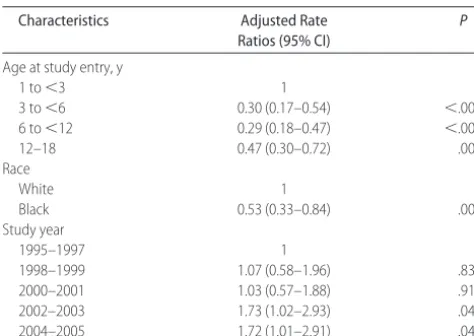
In the Poisson regression model adjusting for child age and race, there was an increased rate of medically treated thyroid disease in 2002–2003 and 2004 –2005 compared with 1995–1997 (Table 3). Older children were less likely to receive a new prescription for thyroid medication compared with toddlers, including children aged 3 to⬍6 years, 6 to⬍12 years, and 12 to 18 years. Also, there was a lower rate of medically treated thyroid disease in black subjects compared with white subjects. Over the 11-year study period, 0.2% of children in the cohort without DS filled a new prescription for a thyroid medication. The majority of medications filled were for thyroid hormone replacement (93.2%). Rates of medically treated thyroid disease per 1000 child-years were 0.19 (1995–1997), 0.19 (1998 –1999), 0.19 (2000 – 2001), 0.24 (2002–2003), and 0.23 (2004 –2005). Figure 1 demonstrates the rate of medically treated thyroid disease over the study period in children with and with-out DS. In the Poisson regression analyses, after adjust-ing for child age and race, the rates of medically treated thyroid disease were increased in 2002–2003 (adjusted incidence rate ratio [IRR]: 1.26 [95% CI: 1.03–1.53]) and 2004 –2005 (adjusted IRR: 1.22 [95% CI: 0.99 – 1.49]) compared with 1995–1997. The rate of medically treated thyroid disease was lower in black subjects (0.16 per 1000 child-years) compared with whites (0.24 per 1000 child-years; adjusted IRR: 0.68 [95% CI: 0.59 – 0.79]).
DISCUSSION
Although racial disparities in the life expectancy of in-dividuals with DS exist, overall the median life expect-ancy has increased dramatically in recent decades.16,17 Despite improvements in quality of life, people with DS
remain a vulnerable population. Screening for thyroid disease has been recommended for a number of reasons, including the high prevalence in the population, the adverse medical effects associated with the disorder, and the availability of safe testing and an effective treatment. Over the 11-year study period, the population-based incidence of medically treated thyroid disease in this cohort of⬎1000 children with DS was 10.8%. Although several studies have investigated the prevalence and in-cidence of thyroid dysfunction in children and adults with DS, to our knowledge, this is the first population-based estimate of the incidence of medically treated thy-roid disease in children with DS.4,9–11,18–24
The primary objective of this investigation was to determine whether an increase in medically treated thy-roid disease occurred after rerelease in February 2001 of AAP guidelines recommending annual screening for thyroid disease starting at age 1 year. Compared with 1995–1997, rates of medically treated thyroid disease increased 73% in 2002–2003 and 72% in 2004 –2005.
We determined rates of medically treated thyroid dis-ease in a comparison cohort of children without DS, in whom an increase in the identification of new cases of medically treated thyroid disease would not be expected after rerelease of DS-specific guidelines. In a Scottish cohort, which included⬎100 000 children aged 1 to 22 years, the prevalence of receiving ⱖ2 prescriptions for thyroid medication was 0.135% over the 3-year study period.25In the TennCare cohort of children without DS, the incidence of medically treated thyroid disease over the 11-year study period was 0.21%. In contrast to the 73% increase in the cohort of children with DS, there was a 26% increase in the rate of medically treated thyroid disease in 2002–2003 compared with 1995– 1997.
There were also differences in medically treated thy-roid disease by race and age. Black children with DS were less likely to have medically treated thyroid disease than white children. It is important to note that the decreased rate in black subjects compared with white subjects was also seen in the parallel cohort of children
0 5 10 15 20 25 30
1995_1997 1998_1999 2000_2001 2002_2003 2004_2005
Year of study Rate of medically treated thyroid disease per 1000 child-years
DS cohort
Non-DS cohort
Confidential - Not for Circulation
FIGURE 1
Rates of medically treated thyroid disease in children with and without DS enrolled in TennCare: 1995–2005.
TABLE 3 Predictors of Medically Treated Thyroid Disease in Children With DS Enrolled in TennCare: 1995–2005 Characteristics Adjusted Rate
Ratios (95% CI)
P
Age at study entry, y
1 to⬍3 1
3 to⬍6 0.30 (0.17–0.54) ⬍.001
6 to⬍12 0.29 (0.18–0.47) ⬍.001
12–18 0.47 (0.30–0.72) .001
Race
White 1
Black 0.53 (0.33–0.84) .007
Study year
1995–1997 1
1998–1999 1.07 (0.58–1.96) .83
2000–2001 1.03 (0.57–1.88) .91
2002–2003 1.73 (1.02–2.93) .04
without DS. Previous studies have also reported lower rates of hypothyroidism in black adolescents and adults compared with whites.26,27Therefore, we do not know whether racial differences in rates of medically treated thyroid disease in children with DS are because of dif-ferences in disease incidence caused by biological factors or in differences in screening rates, which could reflect racial differences in health-seeking behavior, access to medical care, or quality of medical care.26–32Lastly, there were differences in the risk of medically treated thyroid disease by age group. In children with DS, all of the children in older age groups were less likely to have medically treated thyroid disease than the 1- to⬍3-year age group. This could be the result of a number of factors, including the highest incidence occurring in this age group or the higher likelihood of undergoing screen-ing because of multiple contacts with the health care system. In addition, physicians may be more likely to prescribe medication for young children with abnormal thyroid function studies, because children less than age 3 years are particularly vulnerable to the adverse effects of untreated hypothyroidism on intellectual development. Previous investigations have explored physician knowledge of and use of clinical guidelines/practice pa-rameters.33–38 From the current literature, the evidence that clinical practice guidelines change physician behav-ior is limited; however, practices such as uptake of new immunizations have been more successfully imple-mented after recommendations.39Although obtaining a test requiring phlebotomy in children with intellectual disabilities may present challenges, it is possible that the potential perceived benefit and the straightforwardness of ordering testing for thyroid dysfunction may have helped facilitate increased screening.
It is also important to consider other potential factors that could have contributed to the increase in the rate of medically treated thyroid disease, such as systemwide policy changes or awareness campaigns that occurred during the study period. However, across the 11-year study period, there were no major changes in the struc-ture of TennCare, no statewide awareness efforts regard-ing thyroid disease in children with DS, and no changes in how the primary outcome, prescription filled for thy-roid medication, was captured. Furthermore, changes in the sensitivity of thyroid function testing were not tem-porally related to rerelease of the guidelines. Although there was an increase in the rate of medically treated thyroid disease in the non-DS cohort (26%), the in-crease was lower than in the DS cohort (73%).
There are several limitations to consider. The out-come of medically treated thyroid disease depends on screening for thyroid disease, which is likely subject to variation in physician practice. We were not able to capture screening for thyroid disease or the results of laboratory tests in this study. In addition, practice pat-terns may vary among physicians in the treatment of abnormal thyroid function. For example, the treatment of compensated thyroid disease, a condition that may be transient, is a topic of debate.3,10However, this study was designed to determine the rate of medically treated
thy-roid disease in this population, not the appropriateness of treatment.
Although we assessed the level of medically treated thyroid disease after the rerelease of the policy guideline statement, we were not able to directly evaluate the impact of a particular guideline on screening for thyroid disease. In addition, because of the retrospective nature of this cohort study, it is possible that study findings were influenced by other unmeasured factors. However, this study does provide a population-based estimation of the incidence of medically treated thyroid disease and investigates the temporal relationship of the change in incidence and the rerelease of guidelines.
The findings may also have limited generalizability. The TennCare population in Tennessee represents indi-viduals with disabilities who are low income or unable to otherwise obtain medical insurance. Therefore, we did not capture participants with only private insurance, the uninsured, or individuals who did not seek medical care. The practice patterns of physicians who serve patients in TennCare or disproportionately provide care for children with DS may not reflect those of providers who primar-ily work with other patient populations. Therefore, the rate of medically treated thyroid disease in the TennCare cohort may not reflect the rate of children who were privately insured or who did not have any type of in-surance. However, because TennCare provides insur-ance for children with disabilities, the study likely in-cludes the majority of children with DS in the state.
CONCLUSIONS
A 73% increase in the rate of medically treated thyroid disease in children with DS enrolled in TennCare was seen after rerelease of AAP guidelines. The population-based incidence of medically treated thyroid disease in the cohort was 10.8%, over the 11-year period 1995– 2005. The temporal relationship suggests that the rere-lease of the AAP guidelines may have increased physi-cian awareness, resulting in increased rates of screening for and identification of thyroid dysfunction.
ACKNOWLEDGMENTS
This study was supported by grants from the Agency for Healthcare Research and Quality, the Ambulatory Pedi-atric Association, and the National Institutes of Health (K12 RR17697).
We are indebted to the Tennessee Bureau of TennCare of the Department of Finance and Adminis-tration and the Tennessee Department of Health, Office of Policy, Planning and Assessment, for providing the data.
REFERENCES
1. Roizen NJ, Patterson D. Down’s syndrome. Lancet. 2003; 361(9365);1281–1289
2. American Academy of Pediatrics, Committee on Genetics. Health supervision for children with Down syndrome. Pediat-rics.2001;107(2):442– 449
syndrome in the first two decades.Arch Dis Child.2005;90(6): 574 –578
4. Pueschel SM, Jackson IM, Giesswein P, Dean MK, Pezzullo JC. Thyroid function in Down syndrome. Res Dev Disabil.1991; 12(3):287–296
5. Hardy O, Worley G, Lee MM, et al. Hypothyroidism in Down syndrome: screening guidelines and testing methodology.Am J Med Genet A.2004;124(4):436 – 437
6. Morreale de EG, Obregon MJ, Escobar del RF. Role of thyroid hormone during early brain development. Eur J Endocrinol.
2004;151(suppl 3):U25–U37
7. Bettendorf M. Thyroid disorders in children from birth to ad-olescence. Eur J Nucl Med Mol Imaging. 2002;29(suppl 2): S439 –S446
8. Demers LM. Thyroid disease: pathophysiology and diagnosis.
Clin Lab Med.2004;24(1):19 –28
9. Selikowitz M. A five-year longitudinal study of thyroid func-tion in children with Down syndrome.Dev Med Child Neurol.
1993;35(5):396 – 401
10. Tuysuz B, Beker DB. Thyroid dysfunction in children with Down’s syndrome.Acta Paediatr.2001;90(12):1389 –1393 11. Karlsson B, Gustafsson J, Hedov G, Ivarsson SA, Annere´n G.
Thyroid dysfunction in Down’s syndrome: relation to age and thyroid autoimmunity.Arch Dis Child.1998;79(3):242–245 12. Cutler AT, ezra-Obeiter R, Brink SJ. Thyroid function in young
children with Down syndrome.Am J Dis Child.1986;140(5): 479 – 483
13. Ray WA, Griffin MR. Use of Medicaid data for pharmacoepi-demiology.Am J Epidemiol.1989;129(4):837– 849
14. Cooper WO, Hernandez-Diaz S, Arbogast PG, et al. Major congenital malformations after first-trimester exposure to ACE inhibitors.N Engl J Med.2006;354(23):2443–2451
15. McCullagh P, Nelder JA. Generalized Linear Models. 2nd ed. London, United Kingdom: Chapman & Hall; 1989
16. Yang Q, Rasmussen SA, Friedman JM. Mortality associated with Down’s syndrome in the USA from 1983 to 1997: a population-based study.Lancet.2002;359(9311):1019 –1025 17. Centers for Disease Control and Prevention (CDC). Racial
dis-parities in median age at death of persons with Down syndrome: United States, 1968 –1997.MMWR Morb Mortal Wkly Rep.2001 8;50(22):463– 465
18. Pueschel SM, Pezzullo JC. Thyroid dysfunction in Down syn-drome.Am J Dis Child.1985;139(6):636 – 639
19. Fort P, Lifshitz F, Bellisario R, et al. Abnormalities of thyroid function in infants with Down syndrome.J Pediatr.1984;104 (4):545–549
20. Rooney S, Walsh E. Prevalence of abnormal thyroid function tests in a Down’s syndrome population. Ir J Med Sci. 1997; 166(2):80 – 82
21. Prasher V, Gomez G. Natural history of thyroid function in adults with Down syndrome: 10-year follow-up study.J Intel-lect Disabil Res.2007;51(pt 4):312–317
22. Mani C. Hypothyroidism in Down’s syndrome.Br J Psychiatry.
1988;153:102–104
23. Friedman DL, Kastner T, Pond WS, O’Brien DR. Thyroid dys-function in individuals with Down syndrome.Arch Intern Med.
1989;149(9):1990 –1993
24. Rubello D, Pozzan GB, Casara D, et al. Natural course of subclinical hypothyroidism in Down’s syndrome: prospective
study results and therapeutic considerations.J Endocrinol Invest.
1995;18(1):35– 40
25. Hunter I, Greene SA, MacDonald TM, Morris AD. Prevalence and aetiology of hypothyroidism in the young.Arch Dis Child.
2000;83(3):207–2010
26. Aoki Y, Belin RM, Clickner R, Jeffries R, Phillips L, Mahaffey KR. Serum TSH and total T(4) in the United States population and their association with participant characteristics: National Health and Nutrition Examination Survey (NHANES 1999 –2002).Thyroid.2007;17 (12):1211–1223
27. Hollowell JG, Staehling NW, Flanders WD, et al. Serum TSH, T(4), and thyroid antibodies in the United States population (1988 to 1994): National Health and Nutrition Examination Survey (NHANES III). J Clin Endocrinol Metab. 2002;87(2): 489 –99
28. Smedley B, Stith A, Nelson A.Unequal Treatment: Confronting Racial and Ethnic Disparities in Health Care. Washington, DC: National Academies Press; 2003
29. Flores G, Tomany-Korman SC. Racial and ethnic disparities in medical and dental health, access to care, and use of services in US children.Pediatrics.2008;121(2). Available at: www.pediatrics.org/ cgi/content/full/121/2/e286
30. Ngui EM, Flores G. Satisfaction with care and ease of using health care services among parents of children with special health care needs: the roles of race/ethnicity, insurance, lan-guage, and adequacy of family-centered care.Pediatrics.2006; 117(4):1184 –1196
31. Hambidge SJ, Emsermann CB, Federico S, Steiner JF. Dispar-ities in pediatric preventive care in the United States, 1993–2002.Arch Pediatr Adolesc Med.2007;161(1):30 –36 32. Ferris TG, Kuhlthau K, Ausiello J, Perrin J, Kahn R. Are
minority children the last to benefit from a new technology? Technology diffusion and inhaled corticosteriods for asthma.
Med Care.2006;44(1):81– 86
33. Christakis DA, Rivara FP. Pediatricians’ awareness of and atti-tudes about four clinical practice guidelines. Pediatrics.1998; 101(5):825– 830
34. Maisels MJ, Kring E. Early discharge from the newborn nurs-ery-effect on scheduling of follow-up visits by pediatricians.
Pediatrics.1997;100(1):72–74
35. Sand N, Silverstein M, Glascoe FP, Gupta VB, Tonniges TP, O’Connor KG. Pediatricians’ reported practices regarding de-velopmental screening: do guidelines work? Do they help?
Pediatrics.2005;116(1):174 –179
36. Vernacchio L, Vezina RM, Mitchell AA. Knowledge and prac-tices relating to the 2004 acute otitis media clinical practice guideline: a survey of practicing physicians.Pediatr Infect Dis J.
2006;25(5):385–389
37. Broder KR, MacNeil A, Malone S, et al. Who’s calling the shots? Pediatricians’ adherence to the 2001–2003 pneumococ-cal conjugate vaccine-shortage recommendations. Pediatrics.
2005;115(6):1479 –1487
38. Byrd RS, Hoekelman RA, Auinger P. Adherence to AAP guide-lines for well-child care under managed care. American Acad-emy of Pediatrics.Pediatrics.1999;104(3 pt 1):536 –540 39. Davis MM, Ndiaye SM, Freed GL, Clark SJ. One-year uptake of
DOI: 10.1542/peds.2007-3252 originally published online July 7, 2008;
2008;122;e493
Pediatrics
Kecia N. Carroll, Patrick G. Arbogast, Judith A. Dudley and William O. Cooper
Supervision Guidelines
Down Syndrome After Rerelease of American Academy of Pediatrics Health
Increase in Incidence of Medically Treated Thyroid Disease in Children With
Services
Updated Information &
http://pediatrics.aappublications.org/content/122/2/e493
including high resolution figures, can be found at:
References
http://pediatrics.aappublications.org/content/122/2/e493#BIBL
This article cites 36 articles, 12 of which you can access for free at:
Subspecialty Collections
ub
http://www.aappublications.org/cgi/collection/metabolic_disorders_s
Metabolic Disorders
http://www.aappublications.org/cgi/collection/endocrinology_sub
Endocrinology
following collection(s):
This article, along with others on similar topics, appears in the
Permissions & Licensing
http://www.aappublications.org/site/misc/Permissions.xhtml
in its entirety can be found online at:
Information about reproducing this article in parts (figures, tables) or
Reprints
http://www.aappublications.org/site/misc/reprints.xhtml
DOI: 10.1542/peds.2007-3252 originally published online July 7, 2008;
2008;122;e493
Pediatrics
Kecia N. Carroll, Patrick G. Arbogast, Judith A. Dudley and William O. Cooper
Supervision Guidelines
Down Syndrome After Rerelease of American Academy of Pediatrics Health
Increase in Incidence of Medically Treated Thyroid Disease in Children With
http://pediatrics.aappublications.org/content/122/2/e493
located on the World Wide Web at:
The online version of this article, along with updated information and services, is
by the American Academy of Pediatrics. All rights reserved. Print ISSN: 1073-0397.