Volume 40 Issue 4
Article 2
2013
A Quantity-Driven Solution to Aggregation Grouping Under the U.S.
A Quantity-Driven Solution to Aggregation Grouping Under the U.S.
Sentencing Guidelines Manual
Sentencing Guidelines Manual
Kevin Bennardo
[email protected]
Follow this and additional works at:
https://ir.law.fsu.edu/lr
Part of the
Law Commons
Recommended Citation
Recommended Citation
Kevin Bennardo, A Quantity-Driven Solution to Aggregation Grouping Under the U.S. Sentencing Guidelines
Manual, 40 Fla. St. U. L. Rev. (2013) .
https://ir.law.fsu.edu/lr/vol40/iss4/2
F
LORIDA
S
TATE
U
NIVERSITY
L
AW
R
EVIEW
A
Q
UANTITY
-D
RIVEN
S
OLUTION TO
A
GGREGATION
G
ROUPING
U
NDER THE
U.S.
S
ENTENCING
G
UIDELINES
M
ANUAL
Kevin Bennardo
V
OLUME
40
S
UMMER
2013
N
UMBER
4
A QUANTITY-DRIVEN SOLUTION TO AGGREGATE
GROUPING UNDER THE U.S. SENTENCING
GUIDELINES MANUAL
KEVIN BENNARDO
∗ABSTRACT
The United States Sentencing Guidelines Manual mandates the grouping of many mul-tiple-count convictions on an aggregate basis. In these instances the Guidelines aggregate a specific quality of the offenses—often the amount of drugs or money—and determine the punishment based on the aggregated quantity.
This Article first reviews the purposes of grouping under the Guidelines and concludes that grouping under the Guidelines’ non-aggregate grouping provisions should precede grouping on an aggregate basis in order to minimize the influence of prosecutorial charging decisions. Second, the Article analyzes the text, commentary, and purpose of the aggregate grouping guideline and concludes that aggregate grouping is only appropriate when the offense level determination is based primarily on quantity or some other aggregable quality of the offense. Next, the Article formulates a mathematical ratio by which to test whether the offense level for an individual offense guideline is determined primarily on an aggregable or non-aggregable quality of the offense. The ratio is then applied to every offense guideline in the Guidelines Manual as well as to the distribution of each controlled substance and listed chemical. This data is reproduced in a series of appendices. The Article highlights anoma-lies in the data and identifies the specific offense guidelines that are either improperly sub-jected to or excluded from aggregate grouping under the current scheme. Lastly, in an ap-pendix, the Article sets forth the text of a proposed revised aggregate grouping guideline.
I. INTRODUCTION ... 792
II. GROUPING OVERVIEW ... 793
III. THE UNIQUE NATURE OF AGGREGATE GROUPING ... 795
IV. PROPER APPLICATION OF THE AGGREGATE GROUPING GUIDELINE... 800
A. Order of Operations ... 800
B. Types of Offense Guidelines Subject to Aggregate Grouping ... 803
1. Quantity-Driven Offense Guidelines ... 803
2. Ongoing or Continuous Offense Behavior ... 806
V. APPLICATION TO INDIVIDUAL OFFENSE GUIDELINES ... 809
A. Anomalies Currently Subject to Aggregate Grouping... 810
1. Section 2A3.5 – Failure to Register as a Sex Offender ... 810
2. Section 2K2.1 – Unlawful receipt, possession, or transportation of firearms or ammunition; prohibited transactions involving firearms or ammunition ... 811
3. Section 2L1.1 – Smuggling, transporting, or harboring an unlawful alien ... 812
4. Section 2L2.1 – Trafficking in a document relating to naturalization, citizenship, or legal resident status, or a United States passport; false statement in respect to the citizenship or immigration status of another; fraudulent marriage to assist alien evading immigration law ... 812
∗ Teaching Fellow and Assistant Professor of Professional Practice, Louisiana State University Paul M. Hebert Law Center; J.D., The Ohio State University Moritz College of Law. Many thanks for the helpful input of the participants of the Southeastern Law Schol-ars Conference and of the sentencing roundtable at the ABA Criminal Justice Section & AALS Section on Criminal Justice’s Joint Legal Educators Colloquium.
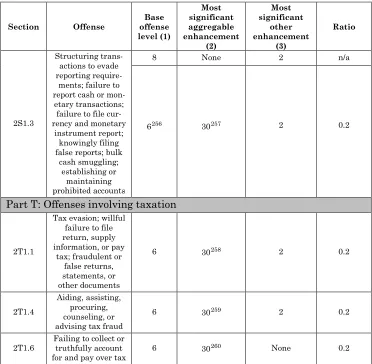
5. Section 2S1.1 – Laundering of monetary instruments; engaging in monetary transactions in property derived from unlawful activity, and Section 2S1.3 – Structuring transactions to evade reporting requirements; failure to report cash or monetary transactions; failure to file currency and monetary instrument report; knowingly filing false reports; bulk cash smuggling; establishing or
maintaining prohibited accounts ... 813
6. Offense guidelines calculated through the Drug Quantity Table of subsection 2D1.1(c) ... 814
7. Offense guidelines calculated through the Chemical Quantity Table of subsection 2D1.11(e) ... 816
B. Anomalies Currently Excluded from Aggregate Grouping ... 816
1. Section 2B2.3 – Trespass... 817
2. Section 2B3.3 – Blackmail and similar forms of extortion ... 817
C. Offense Guidelines with Aggregable Qualities Currently Subject to Aggregate Grouping on a Case-by-Case Basis ... 818
1. Case-by-Case Offense Guidelines with Self-Contained Aggregable Qualities ... 819
2. Case-by-Case Offense Guidelines with Offense Levels Calculated by Reference to Other Offense Guidelines... 820
VI. CONCLUSION ... 821
VII. APPENDIX A: RATIO CALCULATIONS FOR SPECIFIC OFFENSE GUIDELINES ... 823
VIII. APPENDIX B: RATIO CALCULATIONS FOR CONTROLLED SUBSTANCES LISTED ON THE DRUG QUANTITY TABLE ... 850
IX. APPENDIX C: RATIO CALCULATIONS FOR LISTED CHEMICALS ... 851
X. APPENDIX D: PROPOSED REVISED AGGREGATE GROUPING GUIDELINE ... 852
I. INTRODUCTION
For some multiple-count convictions, the United States
Sentenc-ing Guidelines Manual (“Guidelines”) provides for the groupSentenc-ing of the
offense conduct on an aggregate basis. In these instances, the
Guide-lines aggregate a specific quality of the offense—often the amount of
drugs or money—without regard to separate counts of conviction. The
effect of aggregate grouping is that the number of times the offense
was committed has little impact on the offense level calculation
rela-tive to the aggregable quality of the offense.
It follows that, for offense guidelines subject to aggregate
group-ing, the base offense level should be low relative to the potential
en-hancement for the aggregable quality of the offense. And the opposite
should hold true as well—for offense guidelines excluded from
aggre-gate grouping, the aggregable quality of the offense should not
domi-nate the offense level calculation. While many offense guidelines fit
this mold, others do not and lead to anomalous application or
non-application of the aggregate grouping guideline.
mecha-nisms set forth in the Guidelines. Part IV argues that aggregate
grouping should only occur after the application of non-aggregate
grouping mechanisms and should apply only where some aggregable
quality of the offense dominates the offense level calculation. A
mathematical ratio is constructed in order to measure whether an
aggregable quality of the offense dominates the offense level
calcula-tion. The ratio is then applied to every offense guideline in the
Guide-lines Manual as well as to the distribution of each type of controlled
substance and listed chemical. These results are reported in
Appen-dices A, B, and C. In Part V, the Article highlights anomalies in the
data and identifies the specific offense guidelines that are either
im-properly subjected to or excluded from aggregate grouping under the
current system. Appendix D incorporates all of the suggested
revi-sions from the Article into a proposed revised aggregate
grouping guideline.
II. GROUPING OVERVIEW
The importance of aggregate grouping, and grouping in general,
on Guidelines calculations is difficult to overstate. Its importance is
perhaps only eclipsed by its problematic nature. The Introduction to
the Guidelines candidly admits that the Commission “has found it
particularly difficult to develop guidelines for sentencing defendants
convicted of multiple violations of law, each of which makes up a
sep-arate count in an indictment.”
1One of the Guidelines’ chief
archi-tects, then-Judge Stephen Breyer, has described the treatment of
multiple counts as an “intractable sentencing problem” that “is so
complex that only a rough approach to a solution is possible.”
2Alt-hough the grouping process has been previously well summarized in
numerous sources,
3the grouping guidelines remain some of the most
difficult to apply.
4It is therefore worth briefly setting them out again
1. U.S.SENTENCING GUIDELINES MANUAL § 1A1.4(e) (2012) [hereinafter U.S.S.G.].
2. Stephen Breyer, The Federal Sentencing Guidelines and the Key Compromises upon Which They Rest, 17 HOFSTRA L.REV. 1, 25 (1988); see alsoid. at 25-26 (arguing that
the widely held perceptions that more severe punishment is warranted for each additional unit of harm inflicted, but that the corresponding increase should not be strictly propor-tional, “make it difficult to write rules that properly treat ‘multiple counts’ ”). The Guide-lines’ solution has garnered at least some accolades from members of the judiciary. See
United States v. Mizrachi, 48 F.3d 651, 654 (2d Cir. 1995) (recounting the “problem” of the either completely concurrent or completely consecutive sentences that were routinely im-posed before the promulgation of the Guidelines and hailing the consistent treatment of defendants convicted of multiple counts as “[o]ne of the major innovations of the Guide-lines”).
3. See, e.g., United States v. Gordon, 291 F.3d 181, 192-93 (2d Cir. 2002); Mizrachi, 48 F.3d at 654-55; Breyer, supra note 2, at 27; James P. McLoughlin, Jr., Deconstructing United States Sentencing Guidelines Section 3A1.4: Sentencing Failure in Cases of Finan-cial Support for Foreign Terrorist Organizations, 28 LAW &INEQ. 51, 90-91 (2010).
4. 2011 U.S.SENTENCING COMM’N ANN.REP. 28 (noting that queries related to the
grouping of multiple counts of conviction are some of the most frequently asked questions
before engaging in a discussion of specific grouping mechanisms,
be-cause “[t]o fully comprehend the comments and criticisms regarding
the Guidelines, at least a rudimentary understanding of how they
work is required.”
5When a defendant is convicted of multiple counts, her convictions
may be combined into one or more groups of multiple counts or left
separate as essentially “groups” of single counts. Counts that are
sub-ject to grouping may be grouped on an aggregate or non-aggregate
basis. Counts of conviction may be grouped on a non-aggregate basis
if: (1) the “counts involve the same victim and the same act or
trans-action;” (2) the “counts involve the same victim” and multiple “acts or
transactions connected by a common criminal objective or
constitut-ing part of a common scheme or plan;” or (3) one count “embodies
conduct that is treated as a specific offense characteristic” or
adjust-ment to “the guideline applicable to another of the counts.”
6If counts
are grouped in this manner, then the offense level for the most
seri-ous offense in the group becomes the offense level for the group.
7When counts of conviction are grouped on an aggregate basis, “the
offense level applicable to a Group is the offense level corresponding
to the aggregated quantity” after factoring in any applicable
adjust-ments.
8The aggregate grouping guideline lists thirty-five offense
guidelines that “are to be grouped” on an aggregate basis, fifty-two
offense guidelines that are excluded from aggregate grouping, and
renders the balance—the remaining sixty-seven offense guidelines—
to a case-by-case determination of whether grouping on an aggregate
basis is appropriate.
9Any count of conviction that cannot be grouped on these bases
es-sentially becomes its own group. Once the total offense level of each
group is tallied, the total offense level of all the groups together must
be calculated.
10First, the group with the highest offense level (“the
on the Commission’s HelpLine); OFFICE OF THE GEN.COUNSEL,U.S.SENTENCING COMM’N,
FEDERAL SENTENCING:GROUPING OF MONEY LAUNDERING AND FRAUD COUNTS OF C ONVIC-TION (2000) [hereinafter FEDERAL SENTENCING] (describing the circuit fracture on whether
and by what mechanism to group money laundering and fraud counts). 5. Breyer, supra note 2, at 6.
6. U.S.S.G. § 3D1.2(a)-(c) (2012). 7. Id. § 3D1.3(a).
8. Id. § 3D1.3(b). When counts of different offenses “of the same general type” are aggregately grouped, the offense guideline that produces the highest offense level is ap-plied. Id.
9. Id. § 3D1.2(d). Although offense guidelines that are subject to mandatory grouping under subsection 3D1.2(d) have been referred to as “aggregatable offenses,” U.S.S ENTENC-ING COMM’N,STAFF DISCUSSION PAPER:RELEVANT CONDUCT 5 (1996) [hereinafter STAFF
DISCUSSION PAPER], this Article will use the less bulky term “aggregable offenses.” See, e.g., Julie R. O’Sullivan, In Defense of the U.S. Sentencing Guidelines’ Modified Real-Offense System, 91 NW.U.L.REV. 1342, 1359 (1997).
10. Although not the approved vernacular, the groups of counts are essentially them-selves grouped to create an ultimate group of groups.
most serious group”) is counted as one “unit.”
11Each additional group
is counted as one unit, half a unit, or zero units depending on how
greatly the group’s offense level deviates from the offense level of the
most serious group.
12The units are then converted into offense levels
and added to the offense level of the most serious group.
13That sum
is the total offense level for all of the groups.
14The Guidelines favor
imposing concurrent sentences of the “total punishment” on each
count of conviction to the extent permitted by law.
15III. THE UNIQUE NATURE OF AGGREGATE GROUPING
The aggregate grouping guideline is distinct from the Guidelines’
other three grouping mechanisms in both purpose
16and effect.
17Be-cause of its distinct qualities, the inclusion of the aggregate grouping
guideline in section 3D1.2 (“Groups of Closely Related Counts”)
alongside the other grouping mechanisms is misleading at best and
disingenuous at worst. The aggregate grouping guideline should be
removed from section 3D1.2 and placed into its own guideline.
18On a high level of generality, grouping “provide[s] incremental
punishment for significant additional criminal conduct.”
19The
Guide-11. U.S.S.G. § 3D1.4 (2012).
12. Id. § 3D1.4(a)-(c). A group that is zero to four offense levels less serious than the most serious group adds one unit. A group that is five to eight levels less serious than the most serious group adds half of a unit. A group that is nine or more levels less serious than the most serious group adds zero units.
13. Id. § 3D1.4. Units do not convert into offense levels on a one-to-one basis. Instead, the Guidelines assign “more, but declining, additional amounts of punishment” for each additional group. See Breyer, supra note 2, at 27-28. For example, a total of six or more units adds five offense levels (although the commentary notes that a departure may be warranted where significantly more than five units are involved).
14. U.S.S.G. § 3D1.4 (2012).
15. Seeid. § 5G1.2-1.3. A more thorough description of the intricacies of the Guide-lines’ treatment of concurrent and consecutive sentencing of multiple counts is not neces-sary for purposes of this Article’s discussion. For a more detailed discussion, see 21 AM.
JUR.2DCriminal Law § 793 (2012).
16. Defining the “purpose” behind certain guidelines is often an exercise in interpreta-tion. Unlike other rule-making federal agencies, the Sentencing Commission need not pro-vide explanations for its rules nor may its rules be legally challenged as “ ‘arbitrary’ or ‘capricious.’ ” KATE STITH &JOSÉ A.CABRANES,FEAR OF JUDGING:SENTENCING G UIDE-LINES IN THE FEDERAL COURTS 57 (1998). But see 28 U.S.C. § 994(p) (2006) (requiring that newly proposed amendments to the Guidelines be submitted to Congress with a statement of reasons). To the extent possible, this Article draws the “purpose” of a guideline from the limited guidance set out in the Guidelines commentary and other Commission publications. 17. See United States v. Gordon, 291 F.3d 181, 193 (2d Cir. 2002) (noting the “unique mechanism” created by subsection 3D1.3(b), which recognizes “the distinct structure of the punishment for § 3D1.2(d) offenses”).
18. Seeinfra Appendix D (outlining a proposed revised stand-alone version of the aggregate grouping guideline). Likewise, the commentary to Part D of Chapter Three should be revised to reflect the distinct nature of aggregate grouping.
19. U.S.S.G. ch. 3, pt. D, introductory cmt. (2012). The Guidelines generally do not employ a scale of increasing punishment that is proportional to increases in the aggregable quality of an offense, but rather assign a “ ‘diminishing marginal significance’ ” to
lines commentary states that a purpose of grouping is “to limit the
significance of the formal charging decision and to prevent multiple
punishment for substantially identical offense conduct.”
20Otherwise
stated, “[t]he guidelines have been written in order to minimize the
possibility that an arbitrary casting of a single transaction into
sev-eral counts will produce a longer sentence.”
21However, this purpose
is borne out only through grouping under subsections 3D1.2(a)-(c) by
collapsing the offense level of the entire group into the highest
of-fense level of any ofof-fense in the group.
22Under these three
subsec-tions, less serious offenses within the group do not add to the offense
level when offenses are grouped. But such is not the case with
aggre-gate grouping. With aggreaggre-gate grouping, a certain quality of each
of-fense is aggregated together to
increase
the offense level of the group.
Aggregate grouping does nothing to limit the significance of charging
decisions or to prevent multiple punishments for essentially the same
conduct. Instead of collapsing the counts into each other, aggregate
grouping does the opposite—it
adds
some aggregable quality of the
counts together and calculates the offense level based on that
aggregated quantity.
Consistent with the purpose of minimizing the impact of the
charging decision, grouping counts under subsections 3D1.2(a)-(c) can
never result in a greater total offense level than if the counts had
remained ungrouped.
23But aggregate grouping can—and often
does—result in a higher total offense level than if the counts had not
been grouped at all.
24Because of its potential to increase the offense
tional harm. Aaron J. Rappaport, Rationalizing the Commission: The Philosophical Prem-ises of the U.S. Sentencing Guidelines, 52 EMORY L.J. 557, 609-10 (2003); see also Breyer,
supra note 2, at 27 (“Since the Commission’s punishments for most drug and money crimes are determined by tables that increase punishment at a rate less than proportional to the amounts of drugs or money, collapsing the counts and using the tables [through aggregate grouping] produces a result . . . [through which] the punishment increases, but at a less than proportional rate.”).
20. U.S.S.G. ch. 3, pt. D, introductory cmt. (2012); see also FIREARMS POLICY TEAM,
U.S.SENTENCING COMM’N,SENTENCING FOR THE POSSESSION OR USE OF FIREARMS DURING A CRIME:REPORT OF THE FIREARMS POLICY TEAM 18 n.43 (2000) (“Rules for grouping
relat-ed counts were creatrelat-ed to prevent charge stacking from resulting in ‘double counting’ or otherwise exaggerating the punishment.”); FIREARMS POLICY TEAM, U.S. SENTENCING
COMM’N,SENTENCING FOR THE POSSESSION OR USE OF FIREARMS DURING A CRIME:E XECU-TIVE SUMMARY 3-4 (1999) (grouping rules “help to prevent prosecutorial charging decisions
from controlling the final sentence, and to reduce disparity created by charging varia-tions”); FEDERAL SENTENCING,supra note 4, at 2 (grouping “is meant to protect defendants against arbitrary additions resulting from the government’s formal charging decision”).
21. U.S.S.G. § 1A1.4(e) (2012). 22. Id. § 3D1.3(a).
23. In this way, grouping of counts “reduces the impact of ancillary and minor related offenses on the sentence.” McLoughlin, supra note 3, at 91.
24. See, e.g., United States v. Napoli, 179 F.3d 1, 12 (2d Cir. 1999) (noting that aggre-gate grouping would “actually increase” the sentence in some cases); United States v. Miz-rachi, 48 F.3d 651, 655 (2d Cir. 1995) (“Contrary to normal expectations, the defendant objected to the recommended grouping and the prosecution favored it.”); see also FEDERAL
level, aggregate grouping is grouping of a totally different character
than grouping under subsections 3D1.2(a)-(c).
25Inclusion of an offense guideline in the “must group” list of
subsec-tion 3D1.2(d) carries another important consequence: it exposes the
defendant to incremental punishment based on relevant conduct,
in-cluding non-convicted conduct, that was “part of the same course of
conduct or common scheme or plan as the offense of conviction.”
26The
concept of relevant conduct is of monumental importance to the
of-fense level determination.
27The relevant conduct guideline provides
for aggregation through the backdoor of all conduct that shares a
common scheme as the offense of conviction, regardless of whether
the defendant was charged with the conduct, charged but had the
charges dropped as part of a plea bargain, or charged and then
ac-quitted of the conduct.
28Thus, through the consideration of relevant
SENTENCING, supra note 4, at1-2 (explaining that grouping under subsection (d) could
“actually increase” a defendant’s sentence).
25. Consider a defendant convicted of three counts of counterfeiting $50,000 that were not part of a common scheme. The base offense level for counterfeiting bearer obligations of the United States is nine. U.S.S.G. § 2B5.1(a) (2012). Six offense levels are added based on the $50,000 value of the counterfeit items. Id. § 2B5.1(b).
If the three counts of conviction were not grouped, each would have an offense level of fifteen. In converting the three groups into a single offense level, a total of three units, which converts into three offense levels, would be added to the most serious group. See id. § 3D1.4. Thus, the total offense level would be eighteen.
If the three counts were grouped on a non-aggregate basis, the total offense level for the group would be the offense level of the most serious count. The relevant conduct guideline would not apply because the three acts of counterfeiting were not part of a common scheme. See id. § 1B1.3. Thus, the total offense level would be fifteen.
Under the aggregate grouping guideline, the three counts of conviction would be aggre-gated into essentially one act of counterfeiting $150,000. Id. § 3D1.2(d). Counterfeiting at that quantity adds ten offense levels to the base offense level of nine. Id. § 2B1.1(b)(1)(F). Thus, under the aggregate grouping guideline, the total offense level would be nineteen. Although this example is artificial because under a proper application of the Guidelines the three counts could only be grouped on an aggregate basis, it illustrates the point that the grouping mechanism employed impacts the resulting offense level calculation.
26. Id. § 1B1.3(a)(2).
27. An article co-authored by the Sentencing Commission’s first chairman and its general counsel hailed the concept of relevant conduct as the “cornerstone” of the Guide-lines. William W. Wilkins, Jr. & John R. Steer, Relevant Conduct: The Cornerstone of the Federal Sentencing Guidelines, 41 S.C.L.REV. 495 (1990). Relevant conduct has also been described, although less admiringly, as “the most extraordinary conceptual invention of the Commission.” STITH &CABRANES,supra note 16, at 96.
28. Commentators have criticized the inclusion of such non-convicted conduct in the relevant conduct guideline and the disparate impact of including such conduct in the de-termination of offense guidelines that are subject to aggregate grouping while excluding consideration of such conduct for offense guidelines that do not appear on the “must group” list of subsection 3D1.2(d). See David Yellen, Illusion, Illogic, and Injustice: Real-Offense Sentencing and the Federal Sentencing Guidelines, 78 MINN.L.REV. 403, 433-54 (1993).
But see generally O’Sullivan, supra note 9 (defending the Guidelines’ contemplation of non-convicted conduct); STAFF DISCUSSION PAPER,supra note 9.
As with any real-offense consideration, the inclusion of relevant conduct in the sentenc-ing calculation removes power from the prosecutor by minimizsentenc-ing the impact of the charg-ing decision. STITH &CABRANES,supra note 16, at 132; Wilkins & Steer, supra note 27, at
499-500, 509. However, relevant conduct also grants prosecutors the power to indict a
conduct, an offense guideline’s inclusion in subsection 3D1.2(d)’s
“must group” list can greatly impact the offense level calculation even
if counts are not grouped under subsection (d).
29Unfortunately, by placing the aggregate grouping guideline
along-side the other grouping mechanisms in section 3D1.2, the Sentencing
Commission failed to signal the unique importance of the inclusion of
an offense guideline on the “must group” list of subsection 3D1.2(d).
30Indeed, the placement of the aggregate grouping guideline in a
guide-line entitled “Groups of Closely Related Counts” is puzzling.
31Group-ing under subsections 3D1.2(a)-(c) occurs when the counts are closely
related: counts must involve the same victim and at least acts
con-nected by a common criminal objective or part of a common scheme,
or one of the counts must embody conduct that is subsumed as a
spe-cific offense characteristic or adjustment of another count.
32But
ag-gregate grouping requires no such close relationship.
33Under
subsec-tion 3D1.2(d), theft from one victim must be grouped and aggregated
fendant on the charges that are easiest to prove beyond a reasonable doubt and then, upon conviction, to expose the defendant to additional punishment for uncharged conduct that perhaps was not provable beyond a reasonable doubt. STITH &CABRANES,supra note 16, at
140. Moreover, through fact bargaining to determine which version of the “facts” is pre-sented to the court, the exercise of prosecutorial power has been, to some extent, driven from the light of day and away from meaningful checks. Id. at 138-39; see also Tony Garop-polo, Fact Bargaining: What the Sentencing Commission Hath Wrought, 10 Crim. Prac. Man. (BNA) 405, 405 (Oct. 9, 1996) (labeling fact bargaining as “a serious corruption of the federal criminal process”).
29. Had the relevant conduct guideline applied to the illustration, supra note 25, be-cause the three acts of counterfeiting were part of a common scheme, the dollar amount of each of the counts of conviction would have been aggregated through the relevant conduct guideline. Thus, the counterfeiting amount for each of the three counts would be $150,000, and each count would carry an offense level of nineteen. If the three counts were not grouped, the total offense level would be twenty-two. U.S.S.G. § 3D1.4 (2012) (adding three levels for three units to a base offense level of nineteen). If the counts were grouped on a non-aggregate basis, the total offense level would be nineteen. Id. § 3D1.3(a) (applying the offense level of the most serious offense). If the counts were grouped on an aggregate basis, the total offense level would remain nineteen because, in order to avoid impermissible dou-ble counting, the operation of the relevant conduct guideline does not affect the relevant quantity for the aggregate grouping calculation here.
30. Based on its significance to the operation of the relevant conduct guideline, Pro-fessor Yellen has suggested that “the Guidelines divide federal criminal offenses into two categories, those that fall under Section 3D1.2(d) and those that do not.” Yellen, supra note 28, at 438.
31. See U.S.S.G. § 3D1.2 (2012). 32. Id. § 3D1.2(a)-(c).
33. When different Guidelines provisions apply, offenses should be grouped under subsection 3D1.2(d) if the offenses “are of the same general type and otherwise meet the criteria for grouping under” subsection 3D1.2(d). Id. § 3D1.2 cmt. n.6. Some distance inter-venes between offenses of “the same general type” and those that are truly “closely relat-ed.” Attempts by courts to apply the closely related principle to analysis under subsection 3D1.2(d) have been strained and result in non-grouping because, quite simply, subsection 3D1.2(d) does not require a close relation for grouping. See, e.g., United States v. Harper, 972 F.2d 321, 322 (11th Cir. 1992) (per curiam).
with defrauding a separate victim on a different occasion.
34No close
relationship is present between the two offenses—the strongest
commonality is that the offense guideline for both offenses is
deter-mined primarily on the basis of the dollar amount of the loss. Thus,
because the offense level of both theft and fraud is primarily
meas-ured in dollars, the Commission saw fit to group the offenses and add
the dollars together. The Guidelines promulgate a fiction by listing
aggregate grouping as grouping of “closely related counts.”
The only common theme running through many offense guidelines
subject to aggregate grouping is that the harm is primarily measured
in quantity.
35The Introduction to the Guidelines recognizes the
dis-tinct nature of aggregate grouping by summarizing it separately from
the other grouping mechanisms.
36Likewise, the introductory
com-34. Both theft and fraud are covered by the offense guideline of section 2B1.1. That offense guideline appears on the “must group” list of the aggregate grouping guideline. U.S.S.G. § 3D1.2(d) (2012).
35. Quantity is the most common specific offense characteristic found in the Guide-lines. STITH &CABRANES,supra note 16, at 68; see also Rappaport, supra note 19, at 608 (stating that quantity is the “key determinant” in offense seriousness under Chapter 2 of the Guidelines). The use of quantity as a dominant offense characteristic has been heavily criticized. See STITH &CABRANES,supra note 16, at 69-70 (arguing that although
quantifi-cation is facially attractive because it distinguishes defendants “on the basis of apparently objective and precisely measured criteria,” the Guidelines’ heavy reliance on quantification “give[s] relatively short shrift to more subjective, less-easily-measured aggravating factors relating to both harm and culpability”); Albert W. Alschuler, The Failure of Sentencing Guidelines: A Plea for Less Aggregation, 58 U.CHI.L.REV. 901, 915 (1991) (“Sentencing
commissions can quantify harms more easily than they can quantify circumstances. Com-missions count the stolen dollars, weigh the drugs, and forget about more important things.”); Stephen J. Schulhofer, Assessing the Federal Sentencing Process: The Problem is Uniformity, Not Disparity, 29 AM.CRIM.L.REV. 833, 854 (1992) (“In effect, quantity-driven sentences mandate inequality by requiring that different cases be treated alike.”); Yellen,
supra note 28, at 452-53 (opining that the quantity for many offenses—including larceny, fraud, and narcotics offenses—“is often beyond the defendant’s control or expectations” and arguing that quantity-driven offense guidelines give law enforcement the ability to manip-ulate sentences through suggesting higher quantities in undercover operations). See gener-ally Eric L. Sevigny, Excessive Uniformity in Federal Drug Sentencing, 25 J.QUANT.C RIM-INOLOGY 155, 155 (2009) (finding that quantity-driven sentencing results “in excessively
uniform sentences for offenders with highly dissimilar roles in the offense”). The Commis-sion itself has found that the drug quantity attributable to a defendant is a poor proxy of the defendant’s role in the drug distribution organization. See U.S.SENTENCING COMM’N,
REPORT TO CONGRESS:MANDATORY MINIMUM PENALTIES IN THE FEDERAL CRIMINAL J US-TICE SYSTEM 165-68 (2011); see also STEPHEN J.SCHULHOFER,ROBERT B.MCKAY PROF. OF
LAW,N.Y.U.SCH. OF LAW,STATEMENT BEFORE THE U.S.SENTENCING COMMISSION 12-14
(2010) (explaining how the concepts of relevant conduct and co-conspirator liability drive up the drug quantities attributable to less culpable defendants so that drug quantity does not actually distinguish between major and minor actors in drug distribution organiza-tions). Despite these criticisms and findings, the quantification of harms remains deeply entrenched in the Guidelines. Given that reality, this Article lets alone the question of whether mass quantification is wise and seeks to resolve whether and when the aggrega-tion of such quantifiable harms through grouping is appropriate.
36. U.S.S.G. § 1A1.4(e) (2012) (distinguishing “when the conduct involves fungible items (e.g., separate drug transactions or thefts of money), the amounts are added and the guidelines apply to the total amount” from “when nonfungible harms are involved, the
mentary to Part D of Chapter Three of the Guidelines seemingly
rec-ognizes this difference and summarizes aggregate grouping
separate-ly from those grouping mechanisms set forth in subsections
3D1.2(a)-(c).
37The commentary directs grouping under the latter rules “[w]hen
offenses are closely interrelated,” as distinct from grouping under the
aggregate grouping guideline, which is appropriate when the Chapter
Two offense guidelines are based primarily on quantity or deal with
ongoing conduct.
38In doing so, the commentary specifically separates
aggregate grouping from grouping of offenses that are “closely
inter-related.”
39Such distinction is appropriate given the uniqueness of the
aggregate grouping guideline. Therefore, the aggregate grouping
guideline should not appear in section 3D1.2 (“Groups of Closely
Re-lated Counts”), but rather in a separate section with a more
appro-priate title, such as “Groups of Quantity-Driven Counts.”
40Severing
the aggregate grouping guideline from the other three grouping
mechanisms would appropriately reflect its distinct nature and
pur-pose and increase the grouping guidelines’ transparency.
IV. PROPER APPLICATION OF THE AGGREGATE GROUPING GUIDELINE
A. Order of Operations
Although section 3D1.2 provides that offense guidelines “shall” be
combined whenever possible into a single group,
41it does not directly
advise users on the proper order of applying its grouping
subsec-tions.
42Thus, grouping is mandatory, but the
order
of the grouping is
not mandated by the Guidelines.
43As explained above, non-aggregate
grouping under subsections 3D1.2(a)-(c) leads to a very different
method for combining counts than does aggregate grouping under
subsection 3D1.2(d). Thus, the order of grouping operations has very
real implications on the calculation of a defendant’s total offense
lev-el. Grouping first under subsections (a)-(c) will always produce a total
offense level that is lower than or, at most, equal to an offense level
offense level for the most serious count is increased (according to a diminishing scale) to reflect the existence of other counts of conviction”).
37. See id. ch. 3, pt. D, introductory cmt. 38. Id.
39. Id.; see also United States v. Gordon, 291 F.3d 181, 193 (2d Cir. 2002) (noting that the introductory commentary emphasizes the uniqueness of subsection 3D1.2(d)).
40. Seeinfra Appendix D. 41. U.S.S.G. § 3D1.2 (2012).
42. Some individual offense guidelines provide special instructions for grouping (or for not grouping) offenses. See, e.g., id. § 2A1.4(b)(1); id. § 2J1.3(d)(1) (instructing that certain multiple counts should not be grouped together); id. § 2M6.1(d)(1); id. § 2N1.1(d)(1).
43. SeeGordon, 291 F.3d at 196-98 (Newman, J., concurring) (discussing the lack of guidance in the Guidelines on whether to group counts first under subsection 3D1.2(c) or (d)).
produced by grouping first under subsection (d). Thus, grouping first
under subsections (a)-(c) is understandably attractive to defendants.
The Guidelines’ Application Instructions obliquely direct users to
“[a]pply Part D of Chapter Three to group the various counts and
ad-just the offense level accordingly.”
44The step-by-step grouping
check-list provided by the Commission directs users to first group all
ap-propriate counts under subsection (d) before grouping any counts
un-der subsections (a)-(c).
45However, several examples in the Guidelines
commentary suggest grouping counts under subsections (a) and (b)
rather than under subsection (d)
46or grouping counts under
subsec-tion (a) before doing so under subsecsubsec-tion (d).
47Another example in
the commentary grants Guidelines users the option to group under
either subsection (b)
or
subsection (d) because the resulting offense
level would be the same under either approach for that example.
48Elsewhere, the commentary to specific offense guidelines or
adjust-ments directs grouping under subsection (c).
49While acknowledging
that grouping under multiple subsections may be necessary,
50the
Guidelines commentary fails to clearly direct users as to the
pre-ferred order of grouping operations and whether such ordering is
mandatory or at the discretion of the sentencing court.
In light of the purposes of the various grouping guidelines,
group-ing should first occur under subsections (a)-(c) whenever those
sub-sections are applicable. Grouping under subsub-sections (a)-(c) minimizes
the effects of the formal charging decision.
51Because aggregate
grouping has no such mitigating effects, it should yield to
non-aggregate grouping.
44. U.S.S.G. § 1B1.1(a)(4) (2012).
45. Checklist for Multiple Count Grouping (§3D1.2), U.S. SENTENCING COMM’N,
http://www.ussc.gov/Education_and_Training/Guidelines_Educational_Materials/checklis.h tm (last visited June 30, 2013). After grouping under subsection (d), the checklist goes on to direct users to group “all counts involving an attempt, conspiracy, or solicitation and a substantive count that was the sole object” of the same under subsections (a) and (b), then to group all appropriate counts under subsection (c), and finally to return to subsections (a) and (b) to group “counts in which the victim is the same and substantially the same harm results.” Id.
46. See U.S.S.G. § 3D1.2 cmt. n.3, ex. 5 (2012) (grouping three counts of bringing ille-gal aliens into the United States under subsection (a)); id. § 3D1.2 cmt. n.4, ex. 2 (grouping two counts of mail fraud and one group of wire fraud under subsection (b)).
47. Seeid. § 3D1.2 cmt. n.6, ex. 8 (grouping two counts of check forgery and one count of uttering the first of the forged checks under subsection (a)).
48. Id. § 3D1.2 cmt. n.4, ex. 4 (noting that after the operation of the relevant conduct guideline, grouping under either subsection (b) or subsection (d) would produce the same drug quantity for two counts of distributing a controlled substance).
49. Seeid. § 2K2.6 cmt. n.3 (using body armor in connection with another count of conviction); id. § 2S1.1 cmt. n.6 (laundering the proceeds of another count of conviction); id.
§ 3C1.1 cmt. n.8 (obstructing justice with respect to another count of conviction). 50. Id. § 3D1.2 cmt. n.7.
51. See supra Part III.
For subsections (a)-(b), counts that involve the same victim and
either a single act or different acts constituting part of a common
scheme are collapsed into the most serious offense guideline no
mat-ter how many different counts arose from the act or scheme. The
same should hold true even if some quality of the offense conduct
could be aggregated.
Expanding an example from the Guidelines commentary that
il-lustrates grouping under subsection (a), a defendant could be
con-victed of forging and uttering the same $7500 check.
52Aggregating
the harm of both offenses by doubling the $7500 check into an
aggre-gated $15,000 loss amount would unfairly penalize defendants based
on whether the prosecutor bothered to charge both forging and
utter-ing the check or just one of the two offenses. In this case, a
defend-ant’s two-count conviction reflects the prosecutorial charging decision
more than her actual bad acts. Thus, it is sensible to collapse the two
counts of conviction into one group under subsection (a) and apply
the most serious offense level rather than counting the face value of
the check twice under subsection (d).
53Moreover, by embedding the aggregation principle into the
rele-vant conduct guideline, subsections (a) and (b) adequately take
ag-gregated quantities into consideration without the need to group first
under subsection (d). Distribution of controlled substances in the
course of a common scheme provides a good example. If a defendant
is twice convicted of distributing two grams of methamphetamine,
the guideline for each will be calculated using the backdoor
aggrega-tion embedded in the relevant conduct provision of secaggrega-tion 1B1.3.
That section directs the inclusion of all acts or omissions “that were
part of the same course of conduct or common scheme or plan as the
offense of conviction” for offense guidelines that are on subsection
3D1.2(d)’s “must group” list.
54Thus, the offense guideline for each
methamphetamine distribution offense would be calculated using
four grams as the drug quantity. Proper punishment results from
grouping under subsection (b) and taking relevant conduct into
ac-count, thereby setting the drug quantity at four grams and collapsing
the second count into the first under subsection 3D1.3(a). Thus,
ag-gregate grouping should follow grouping under subsections (a) and (b).
Subsection 3D1.2(c) is designed to “prevent[] ‘double counting’ of
offense behavior” by grouping together closely related counts where
one count “is also a specific offense characteristic in or other
adjust-52. U.S.S.G. § 3D1.2 cmt. n.3, ex. 1 (2012).
53. Seeid. § 3D1.2 cmt. n.6, ex. 8 (advising to group uttering and forgery counts first under subsection (a) “so that the monetary amount of that check counts only once when the rule in § 3D1.3(b) is applied”).
54. Id. § 1B1.3(a)(2). The relevant conduct guideline requires the inclusion of non-convicted conduct as well. See supra note 28 and accompanying text.
ment to another count.”
55Grouping such counts first under
subsec-tion (d) would only multiply the double counting that subsecsubsec-tion (c)
was designed to prevent and could lead to triple counting or worse by
using one count as an upward adjustment for another count
and
add-ing the aggregable quality of the two counts together. Thus, groupadd-ing
under subsection (c) should precede grouping under subsection (d).
B. Types of Offense Guidelines Subject to Aggregate Grouping
The text of subsection 3D1.2(d) states that aggregate grouping is
appropriate
[w]hen the offense level is determined largely on the basis of the
total amount of harm or loss, the quantity of a substance involved,
or some other measure of aggregate harm, or if the offense
behav-ior is ongoing or continuous in nature and the offense guideline is
written to cover such behavior.
56Thus, the guideline authorizes aggregate grouping on two distinct
bases: (1) offense guidelines based on quantity, and (2) offense
behav-ior that is ongoing. While the first is appropriate in some cases, the
latter is unsupportable.
1. Quantity-Driven Offense Guidelines
Because the effect of aggregate grouping is to focus the offense
level determination on the aggregable quality of the offense
guide-line, aggregate grouping is appropriate only for offenses in which
so-ciety’s main interest in punishing is based on the aggregable quality
of the offense rather than on how many times the offense was
com-mitted or some other non-aggregable quality. To strike the
appropri-ate balance, it is first necessary to address a discrepancy between the
text of subsection 3D1.2(d) and the guideline commentary. The
guide-line text states that counts involve substantially the same harm and
therefore should be grouped “[w]hen the offense level is determined
largely
on the basis of the total amount of harm or loss, the quantity
of a substance involved, or some other measure of aggregate harm.”
57The commentary, in two separate places, states that section 3D1.2(d)
applies to offenses “where the guidelines are based
primarily
on quantity.”
5855. U.S.S.G. § 3D1.2 cmt. n.5 (2012). 56. Id. § 3D1.2(d).
57. Id. (emphasis added).
58. Id. § 3D1.2 cmt. n.6 (emphasis added); see alsoid. ch. 3, pt. D, introductory cmt. (explaining that aggregate grouping is appropriate “[i]f the offense guidelines in Chapter Two base the offense level primarily on the amount of money or quantity of substance in-volved” (emphasis added)).
As a clarification of the guideline’s text, the commentary’s
“pri-marily” language sets forth the proper standard for aggregate
group-ing determinations. This type of commentary “interpret[s] the
guide-line or explain[s] how it is to be applied.”
59The United States
Su-preme Court has explained that such explanatory commentary is
“authoritative unless it violates the Constitution or a federal statute,
or is inconsistent with, or a plainly erroneous reading of, that
guide-line.”
60Inconsistency between a guideline’s text and its commentary
exists where “following one will result in violating the dictates of the
other.”
61Deference to the guideline text is proper where such forced
violation exists. But explanatory commentary, which is written by
the same body as a guideline’s text, and often at the same time, is not
akin to administrative regulations that fill holes in Congressional
statutes and necessarily yield to the clear meaning of the statutes.
62Rather, federal courts are required to consider the Guidelines’
com-mentary at sentencing,
63and failure to abide by explanatory
com-mentary may lead to an incorrect application of the Guidelines.
64The “primarily” language of the commentary merely serves to
clar-ify the term “largely” in the text of subsection 3D1.2(d). Here,
follow-ing the language of the commentary does not lead to any violation of
the language of the text. Thus, the commentary need not yield to the
guideline text because the two are not “inconsistent.” Rather, the
commentary “assist[s] in the interpretation and application” of
sub-section 3D1.2(d) and “represent[s] the most accurate indication[] of
how the Commission deems that the guidelines should be applied.”
65Consistent with that treatment of the commentary, numerous courts
have applied the “primarily” language of the commentary despite its
absence in the text of the guideline.
6659. Id. § 1B1.7.
60. Stinson v. United States, 508 U.S. 36, 38 (1993). 61. Id. at 43.
62. Id. at 44.
63. See 18 U.S.C. § 3553(b) (2006). 64. U.S.S.G. § 1B1.7 (2012). 65. Stinson, 508 U.S. at 45.
66. See United States v. Young, 413 F.3d 727, 733-34 (8th Cir. 2005) (noting section 3D1.2(d) “requires grouping where the offense level is determined primarily on the basis of the total amount of the loss”); United States v. Napoli, 179 F.3d 1, 9-11 (2d Cir. 1999) (find-ing that aggregate group(find-ing was not appropriate because the offense guideline for money laundering was not based primarily on the amount of money laundered); United States v. Rudolph, 137 F.3d 173, 179 (3d Cir. 1998) (noting section 3D1.2(d) applies to “offenses where guidelines are based primarily on quantity or contemplate continuing conduct”); United States v. David, 940 F.2d 722, 741 (1st Cir. 1991) (finding that aggregate grouping was proper because the drug offenses all had offense levels that were “determined primari-ly by the aggregate quantity of drugs involved in [the defendant’s] course of conduct”); see also United States v. Gordon, 291 F.3d 181, 192 (2d Cir. 2002) (noting commentary’s di-rective to group on an aggregate basis where the offense level is based primarily on meas-urable quantity); United States v. Kalust, 249 F.3d 106, 114 n.3 (2d Cir. 2001) (Winter, J., concurring) (noting that the Napoli court emphasized the “primarily” language in the
The policy behind aggregate grouping supports the “primarily”
language as well. Grouping on an aggregate basis is only appropriate
where the offense level is driven by the aggregable quality of the
of-fense rather than the base ofof-fense level or some other non-aggregable
quality of the offense. In setting the base offense level, the
Sentenc-ing Commission deems that the bare commission of an offense at the
lowest possible level of measurable harm is worth a certain number
of offense levels. It is only where the possible upward adjustment for
the aggregable quality of the offense eclipses that base offense level
that aggregate grouping makes sense. Otherwise, aggregate grouping
is not appropriate simply because something other than the
aggrega-ble quality of the offense is the primary determining factor of the
offense level.
Thus, in the words of the commentary, aggregate grouping is
proper where the offense level determination of an offense guideline
is based
primarily
on quantity or some other aggregable quality of
the offense.
67As an extension, offense guidelines that are determined
by reference to underlying offense guidelines should be amenable to
aggregate grouping when the underlying offense guideline is
calcu-lated primarily on the basis of an aggregable quality.
68Offense
guide-lines with offense level determinations driven by a non-aggregable
quality of the offense should not be grouped on an aggregate basis.
The term “primarily” is easily reducible to mathematical
quantifi-cation. The simplest way to ensure that the aggregable quality of an
offense is the primary driver of the offense level is to compare the
maximum potential upward enhancement available for the
aggrega-ble quality of the offense to the base offense level and other potential
enhancements based on non-aggregable qualities of the offense. If the
aggregable quality of the offense predominates, then the ratio will be
less than one and aggregate grouping is appropriate.
69If the base
of-fense level (or some other non-aggregable quality) predominates,
then the ratio will be greater than one and aggregate grouping is not
commentary over the “largely” language of the text of subsection 3D1.2(d)). But see United States v. Kneeland, 148 F.3d 6, 15 (1st Cir. 1998) (“focus[ing] on the term ‘largely’ ” in the text of subsection 3D1.2(d)).
67. U.S.S.G. ch. 3, pt. D, introductory cmt. (2012).
68. For example, the offense level for aiding and abetting is determined solely by ref-erence to the offense level for the underlying offense. Id. § 2X2.1. Thus, when the offense guideline for the underlying offense is primarily based on an aggregable quality, the aiding and abetting offense guideline is as well.
69. For example, the base offense level for insider trading is eight, and the maximum potential upward enhancement based on the amount of money gained in the offense is thir-ty. Id. § 2B1.4. Thus, the ratio is 8:30, or 0.27. Aggregate grouping is appropriate because the offense level calculation is primarily driven by the amount of money gained in the of-fense, not by the bare commission of the offense. Although a guideline’s commentary will occasionally state that the amount of the loss is the principal factor in calculating the of-fense level, see, e.g., id. § 2B1.1 cmt. background; id. § 2B5.3 cmt. background, such explicit self-analysis does not consistently appear throughout the Guidelines commentary.
appropriate.
70The ratio looks only to the Chapter Two offense
guide-lines to determine the basis of the offense level calculation—not to
Chapter Three adjustments or to possible grounds for departure.
71The ratio provides an easily measurable way to determine whether
aggregate grouping is appropriate for a given offense guideline.
72Although rare, a small number of offense guidelines contain
mul-tiple aggregable qualities.
73When aggregate grouping under
subsec-tion 3D1.2(d) is appropriate, multiple counts of convicsubsec-tion should be
aggregated across all possible aggregable qualities. Once the
gate grouping hurdle has been cleared, it makes little sense to
aggre-gate some qualities but not others. Failure to aggreaggre-gate some
quali-ties of multiple counts of conviction would lead to an incomplete
pic-ture of the total offense conduct by collapsing, rather than adding
together, some aggregable qualities of the offense conduct. Thus, in
order to align outcomes with expectations and impose incremental
punishment for incremental harms, offense level calculations
aggre-gately grouped under subsection 3D1.2(d) should aggregate all
ag-gregable qualities of the offenses.
2. Ongoing or Continuous Offense Behavior
As a separate basis from offense levels that are determined
pri-marily upon some type of aggregable harm, subsection 3D1.2(d)
mandates grouping “if the offense behavior is ongoing or continuous
70. For example, the commentary to the robbery offense guideline explains that, con-sistent with pre-Guidelines practice, the monetary amount of the loss is less important than the other harms attendant to robbery. Id. § 2B3.1 cmt. background. The base offense level for robbery is relatively high (twenty) compared to the maximum potential upward enhancement based on the dollar amount of the loss (seven). Id. § 2B3.1. Thus, the ratio is 20:7, or 2.86. Aggregate grouping is not appropriate because the offense level calculation is primarily driven by the bare commission of the offense, not by the dollar amount of the robbery.
71. Although the Guidelines commentary contemplates upward departures for offens-es involving “substantially” greater than the maximum defined aggregable quality for many offenses (for example, for passport trafficking offenses involving substantially more than 100 passports, see id. § 2L2.1 cmt. n.5), such departures do not factor into the ratio because, first, the Guidelines do not offer quantifiable guidance on how to calculate the extent of such a departure and, second, departures are by their very nature outliers from the mainline application of the specific offense guidelines.
72. The Second Circuit has applied a similar percentage-based method to determine whether a specific offense guideline is based primarily on quantity. See United States v. Napoli, 179 F.3d 1, 11 (2d Cir. 1999) (finding that the money laundering offense guideline, as it was then written, was not based primarily on quantity because the maximum poten-tial upward adjustment based on the amount of money laundered was only approximately sixty percent of the base offense level); see also United States v. Kneeland, 148 F.3d 6, 15-16 (1st Cir. 1998) (comparing base offense level to possible enhancement based on specific offense characteristics). But see United States v. O’Kane, 155 F.3d 969, 974 (8th Cir. 1998) (comparing base offense level for money laundering to the enhancement for amount of money laundered in that case).
73. See U.S.S.G. § 2B1.1(b) (2012) (using dollar amount of loss and number of vic-tims); id. § 2G2.2(b) (using retail value of the material and number of images).
in nature and the offense guideline is written to cover such
behav-ior.”
74However, subsection 3D1.3(b), which directs the aggregate
grouping of offenses grouped under subsection 3D1.2(d), calls for the
calculation of the offense level based on the “aggregated quantity.”
75Thus, to the extent that subsection 3D1.2(d) groups counts based on
ongoing offense behavior that does not contain an aggregable quality,
it is unclear how—or why—subsection 3D1.3(b) operates to
deter-mine the total offense level on the basis of the “aggregated quantity.”
Where ongoing behavior lacks an aggregable quality, it is simply
im-possible to group on an aggregate basis.
76Furthermore, to the extent that offense behavior is ongoing in
na-ture, it is unclear what subsection 3D1.2(d) contemplates by “written
to cover
such
behavior.”
77Either “such” refers to “offense behavior” in
the sense that the offense guideline must be written to cover the
de-fendant’s offense behavior, or “such” refers to the ongoing nature of
the offense behavior, in the sense that the offense guideline is written
to cover continuous behavior.
78Neither option is satisfying. The
for-mer will always be true: in the absence of erroneous application of
the Guidelines, the offense guideline applied to the defendant’s
con-duct will
always
be written to cover the defendant’s offense
behav-ior—otherwise the offense guideline would not apply. Thus, this
in-terpretation is a circular non-limitation.
74. Id. § 3D1.2(d). 75. Id. § 3D1.3(b).
76. The original version of subsection 3D1.2(d) in the 1987 Guidelines Manual di-rected that “[t]his rule also applies where the guidelines deal with offenses that are contin-uing” and listed the examples of sections 2L1.3 (engaging in a pattern of unlawful employ-ment of aliens) and 2Q1.3(b)(1)(A) (mishandling of environemploy-mental pollutants resulting in an ongoing, continuous, or repetitive discharge, release, or emission of a pollutant into the environment). Id.§3D1.2(d) (1987). While the text of the rule was easier to follow, neither of the example Guidelines contained a true aggregable quality, and thus, aggregation un-der section 3D1.3(b) would have been problematic. Although it still contains the same “on-going” offense characteristic, section 2Q1.3 does not appear on the current “must group” list. Section 2L1.3 was deleted with the removal of petty offenses from the Guidelines. See id. app. C amend. 194 (2003); see alsoid. § 1B1.9 (2012).
In United States v. Mizrachi, the Second Circuit ostensibly grouped arson and fraud counts under subsection 3D1.2(d) because the offense behavior was ongoing and the arson guideline was written to cover such behavior in that it contemplated arson committed in connection with a scheme to defraud. 48 F.3d 651, 655 (2d Cir. 1995). However, in calculat-ing the offense level, the court did not actually aggregate anythcalculat-ing—it simply calculated the offense level for the most serious offense, arson, and collapsed the other counts into that offense level. Id. at 655-56. To avoid the thorny problem of aggregating ongoing behav-ior, the court essentially co-opted the grouping mechanism of subsection 3D1.3(a) and ap-plied it to the grouping of ongoing offense behavior.
77. U.S.S.G. § 3D1.2 (2012) (emphasis added).
78. At least one court has stated it both ways in the same case. See United States v. McIntosh, 216 F.3d 1251, 1253 (11th Cir. 2000) (per curiam) (stating that “[t]o prevail, [the defendant] would have to prove both that his offense behavior was ongoing or continuous in nature and that the offense guideline is written to cover his offense conduct” but later stat-ing that, for subsection 3D1.2(d) to apply, the offense guideline must be written to cover the defendant’s offense behavior “as an ongoing offense”).
The latter option is puzzling.
79If the offense guideline is written to
cover ongoing behavior, then the ongoing nature of the offense is “a
specific offense characteristic in, or other adjustment to, the
guide-line applicable to another of the counts,” and grouping would be
ap-propriate under subsection 3D1.2(c).
80In such a circumstance, the
ongoing nature of the behavior has already been accounted for in the
guideline, and no aggregation would be necessary to achieve
incre-mental punishment. For example, under the guideline for offenses
that pertain to material involving the sexual exploitation of a minor,
an upward adjustment of five offense levels is appropriate “[i]f the
defendant engaged in a pattern of activity involving the sexual abuse
or exploitation of a minor.”
81Thus, the Commission has already
deemed that the ongoing nature of the defendant’s activity is worth
five offense levels. But to aggregate multiple counts based on the
on-going nature of the offense behavior would effectively double count
that ongoing nature—first as an offense adjustment and then as an
aggregation of the an offense characteristic.
82Subsection 3D1.2(c)
was written purposefully to avoid such double counting because, if at
all, multiple counts should either elevate the offense level of a group
through an adjustment or through aggregation, but not through both.
83Aggregate grouping of ongoing offenses that utilize different
of-fense guidelines is simply impossible when those guidelines do not
contain compatible aspects subject to ready aggregation. For
exam-ple, controlled substance and monetary offenses simply do not easily
aggregate, even if they are part of an ongoing scheme such as
dis-tributing drugs and evading tax on the proceeds. Multiple controlled
substance offenses may be readily aggregated with each other based
on drug quantity. Multiple monetary offenses may be readily
aggre-gated with each other based on dollar amount. But, without
indulg-ing in the fiction that everythindulg-ing can be monetized (or converted into
a drug quantity), drug quantities and dollar amounts do not
aggre-gate. Nor do smuggled illegal aliens and smuggled firearms, even if
both are smuggled together as part of ongoing offense conduct.
84Ag-79. To read one judge’s dissatisfaction with the latter interpretation, see United States v. Rudolph, 137 F.3d 173, 181-83 (3d Cir. 1998) (Becker, C.J., concurring) (suggest-ing that “the group(suggest-ing guidelines would benefit from a redraft that would elevate sub-stance and common sense over form”).
80. U.S.S.G. § 3D1.2(c) (2012). 81. Id. § 2G2.2(b)(5).
82. Section 2G2.2 contains two potentially aggregable offense qualities—pecuniary gain and the number of images. Id. § 2G2.2(b)(3)(A), (7).
83. Id. § 3D1.2 cmt. n.5.
84. Seeid. § 2K2.1(b)(1); id. § 2L1.1(b)(2).
gregation is only possible where the aggregable qualities of the
of-fenses are of the same type.
85Because attempted aggregation of ongoing offense behavior under
subsection 3D1.3(b) is troublesome, if not impossible, the continuous
nature of offense behavior should not bring it within the compass of
subsection 3D1.2(d).
86Rather, subsection 3D1.2(d) should be reserved
only for offense guidelines for which the offense level calculation is
based primarily on some aggregable quality of the offense.
87V. APPLICATION TO INDIVIDUAL OFFENSE GUIDELINES
The Sentencing Commission has made the determination for each
offense that its bare commission is worth a certain number of offense
levels and specific offense characteristics are worth a certain number
of additional levels. This Article does not undertake to second-guess
those determinations. Rather, it accepts the levels set by the
Com-mission and analyzes whether the current levels demonstrate that
the offense guideline should be grouped on an aggregate basis.
Ap-pendix A sets forth the ratio between the most significant
non-aggregable quality of each offense guideline (usually the base offense
level) and the offense guideline’s most significant aggregable
en-hancement.
88For offense guidelines with a variety of base offense
levels, a separate ratio is set forth for each base offense level.
89Many
offense guidelines possess no aggregable qualities, and thus receive
no ratio. Appendices B and C calculate the same ratio for each
indi-vidual controlled substance and listed chemical.
90The following
sec-85. Indeed, for multiple counts involving different offense guidelines, the commentary advises that grouping under subsection 3D1.2(d) is only appropriate “if the offenses are of the same general type.” Id. § 3D1.2 cmt. n.6.
86. Moreover, the grouping guidelines already appropriately account for the grouping of most ongoing behavior. Where the ongoing offense behavior injures the same victim or societal interest, multiple counts are grouped under subsection 3D1.2(b). Where multiple counts of ongoing behavior are treated as offense adjustments of each other, those counts are grouped under subsection 3D1.2(c). Where the ongoing behavior involves offense guide-lines that are primarily determined based on quantity, multiple counts are grouped under the first clause of subsection 3D1.2(d). The only remaining ungrouped ongoing behavior will be that which involves different victims, is not primarily based on quantity, and is not treated as an offense adjustment of another count. In the unlikely event that the remaining offense guidelines contain aggregable offense qualities, aggregation would likely distort the resulting offense level by placing too great or too small an emphasis on the aggregable quality of at least one of the offense guidelines. Thus, should such ungrouped ongoing of-fense behavior exist and merit grouping, the grouping should not be done on an aggregate basis through subsection 3D1.3(b).
87. See supra Part IV.B.1. 88. See infra Appendix A.
89. Not all base offense levels are subject to the same enhancements within the same offense guideline. See, e.g., U.S.S.G. § 2J1.6 (2012) (splitting the offense guideline for fail-ure to appear by a defendant between two base offense levels; certain specific offense acteristics can only decrease one of the base offense levels while other specific offense char-acteristics can only increase the other base offense level).
90. See infra Appendices B, C.